Abstract
Objective: To describe the epidemiological aspects of childhood tuberculosis (TB) in a Brazilian reference hospital.
Methods: This was a retrospective study (1999-2008) of 473 subjects (0-14 year olds) with conirmed TB, or with clinical improvement by the fourth month of treatment under the unit’s care, including the review of medical records, monitoring reports and notiications by the TB unit.
Results: Among 473 TB cases included in the study, positive tuberculin skin test was observed in 52%, history of contact with a patient with pulmonary tuberculosis in 66%, mostly intra-household, and with the father/stepfather most commonly involved; and disseminated TB in 22%. The result of HIV testing was obtained in 265 (56%) cases, being positive in 45 (17%). The diagnosis of TB was conirmed in 31% of cases, most frequently in children older than 5 years, with negative tuberculin skin test, and in disseminated forms. Of the 65 cultures positive for TB performed in the study, drug sensitivity testing to anti-TB drugs was done in 30 (46%) clinical samples, among which 10 (33%) were resistant to one or more anti-TB drugs, and 2 (0.8%) were multi-drug-resistant. Among patients with conirmed pulmonary TB, 31% did not meet the criteria for starting anti-TB treatment according to the scores of the Ministry of Health (≤ 25 points).
Conclusion: The high proportion of drug-resistant TB and co-infection with HIV identiied in this study highlight the necessity to carry out additional studies in order to evaluate the impact of TB control activities on childhood TB.
J Pediatr (Rio J). 2012;88(4):335-40: Tuberculosis-diagnosis, epidemiology, tuberculosis-child.
O
riginala
rticleCopyright © by Sociedade Brasileira de Pediatria
335
Introduction
Tuberculosis (TB) is an important cause of child morbimortality in the world. According to the World
Health Organization, the estimated percentage of TB in children under 15 years ranges from 3 to 25% in different
nations.1 Corbett et al.2 estimated that, in 2000, there were 23,520 cases of TB in children from 0 to 14 years in Brazil, representing 20% of total cases, while Sant’Anna
et al.3 estimated 15% for the same period. In local studies performed in Brazil, it was observed that TB affected 5%
of children in this age group at a unit in Ribeirão Preto,4 6.7% in the municipality of Rio de Janeiro,5 9% at a unit
in Salvador6 and 13.3% in Vale do Paraíba.7
The diagnosis of childhood TB usually based on clinical
criteria remains as a challenge. Until the present moment, the new diagnostic approaches (molecular testing or liquid
culture) that have been used in TB assessments in adults
have not been incorporated into the clinical practice, due
to the large variability of accuracy and low positivity in
Epidemiological aspects of tuberculosis
in children and adolescents in Rio de Janeiro
Thaise Pereira Matos,1 Afrânio Lineu Kritski,2 Antônio Rufino Netto3
1. Master’s candidate. Universidade Federal do Rio de Janeiro (UFRJ), Rio de Janeiro, RJ, Brazil. 2. Full professor. Faculdade de Medicina, UFRJ, Rio de Janeiro, RJ, Brazil.
3. Full professor. Faculdade de Medicina de Ribeirão Preto, Universidade de São Paulo, Ribeirão Preto, SP, Brazil.
No conflicts of interest declared concerning the publication of this article.
Suggested citation: Matos TP, Kritski AL, Ruffino Netto A. Epidemiological aspects of tuberculosis in children and adolescents in Rio de Janeiro. J Pediatr (Rio J). 2012;88(4):335-40.
Manuscript submitted Aug 12 2011, accepted for publication Apr 10 2012.
children.8 In 2002, the Brazilian Ministry of Health (MH) included in the Manual of Recommendations for Tuberculosis
Control, a scoring system, which was updated in 2010,8 aiming to assist the diagnosis of pulmonary TB in children
with negative bacilloscopy in services of low complexity,
especially on an outpatient basis.3 Variables considered relevant received individual points which, added, classiied the suspect patients as follows: very likely diagnosis of TB (≥ 40 points), allowing thus, the start of the anti-TB treatment; likely diagnosis (30 to 35 points), cases in which
the treatment could be initiated according to clinical criteria;
unlikely diagnosis (< 25 points), cases in which the suspect
child should continue under clinical investigation.8 This clinical score was assessed in some studies with sensibility
ranging from 89 to 99%, and speciicity ranging from 70 to 87%.6,9,10
In this age group, infection with human immunodeiciency virus (HIV) is a complicating factor for the diagnosis of
TB. Children carrying the virus are more susceptible to exposure to Mycobacterium tuberculosis at the household
level, to the development of severer clinical forms, to the non-reactivity of the tuberculin test, to low weight,
besides the possibility of association with other pulmonary
comorbidities, such as bronchiectasis or pneumonias.11,12
Regarding the TB co-infection with HIV in childhood, Oliveira et al.5 found association in 4.1% of cases.
Epidemiological studies on TB in children and
adolescents are limited, which hampers the identiication and the monitoring of more adequate interventions for
epidemic control. The aim of this study was to describe the epidemiological characteristics of children with TB
treated at a reference pediatric Hospital in Rio de Janeiro,
which is the state with higher incidence of TB at the national level.
Methods
This study, which was approved by the Research Ethics Committee of the Health and Civil Defense Department of the City Hall of Rio de Janeiro, consists of an epidemiological, descriptive study, with data collection from January 1999 to December 2008. Data sources include medical records, clinical monitoring reports of TB from the Pediatric Pulmonary Service and TB notiication records from the hospital. In this period, 530 cases of TB were monitored, and 473 were included in the study.
The excluded patients were the following: (a) patients
without conirmed diagnosis or without clinic improvement
until the fourth month of anti-TB treatment (n = 33); (b)
patients with change of diagnosis (n = 15); (c) patients
from whom it was not possible to retrieve the information from the records (n = 8); (d) patients who restarted the
treatment after abandonment, whose initial diagnosis of
TB was outside the period of the study (n = 1).
In a specific form, the following variables were collected: age, sex, city of residence, weight, situation of the vaccine against tuberculosis (BCG), history of contact with a patient with bacilliferous pulmonary TB, results of tuberculin skin test, tests performed, anti-HIV serology, clinical presentation, onset of symptoms, seek for treatment at health services, start of treatment, hospitalization,
complications and outcome. Analyses were performed in the
Statistical Package for the Social Sciences version 13.0 for
Windows.We used the percentile and the chi-square test with signiicance level of ≤ 0.05 for comparison between
variables.
The clinical diagnosis of TB was made by the medical staff
based on clinical evaluation of the suspected patient, along with epidemiological data, interpretation of the tuberculin test and radiological indings. This study considered the cases in which there was no conirmation of etiology, but
the patient showed clinical improvement (weight gain and
remission of symptoms) and/or radiological improvement
(complete resolution of the initial injury) until the fourth
month of speciic anti-TB treatment.
TB was considered conirmed when clinical samples presented resistant acid-fast bacilli, growth of M. tuberculosis in culture, and/or histopathological report with typical granulomatous process. Cases of miliary TB, tuberculous
meningitis and TB affecting two or more sites simultaneously (excluding association of pulmonary and pleural TB) were considered disseminated TB. The tuberculin test was
considered positive if ≥ 10 mm in BCG vaccinated children until 2 years old and if ≥ 5 mm in all other subjects.
The MH score was applied retrospectively in accordance
with the 2010 Manual of Recommendations for Tuberculosis
Control,8 in all patients with identiication of pulmonary focus, isolated or not.
The study was conducted at the Hospital Municipal Jesus, at an exclusively pediatric unit, which is a reference in the municipality of Rio de Janeiro. The hospital has nursing-led inpatient units, intensive and semi-intensive care units, surgical center, pathology service, laboratory, and ambulatory care. It has an average capacity of 120 beds for inpatient care and performs over 90,000 consultations
per year. The hospital receives the demand of patients from
the host and neighboring municipalities, patients transferred
from other health services or referred for hospitalization
by expert opinion. It has several pediatric subspecialties, among which: pediatrics pneumology, infectious diseases (with an excellence service for HIV infection), pediatric
orthopedics and pediatric surgery.
Results
The total of 473 subjects included corresponds to 16%
of TB cases in patients from 0 to 14 years old reported in
Figure 1 - Distribution of the patients in the study period of all patients included, 68% lived in the host municipality.
Figure 1 shows the distribution of cases during the study period. There was a progressive decrease in the occurrence of TB cases in the period between 2001 and 2004.
According to age criteria, TB occurred: with < 1 year in 13% (63 cases); from 1 to 4 years in 40% (191 cases); from 5 to 9 years in 31% (145 cases); and from 10 to 14 years in 16% (74 cases). Males included 55% of cases and weight below the 10th percentile occurred in 45% of cases.
Vaccination with BCG was found in 99% of cases, and the positive tuberculin test in 52% of cases. The history
of contact with a patient with bacilliferous pulmonary TB
was present in 66%, most of them intra-household, being the father/stepfather the most implicated family member.
The diagnosis of disseminated TB (miliary TB, tuberculous
meningitis or TB affecting two or more sites simultaneously)
was identiied in 22% (104 cases) in similar proportions
in the different age groups. Pulmonary involvement was
present in 66% of cases, followed by the clinical ganglionic and bone forms, respectively, in order of frequency.
Out of the 65 positive cultures for TB obtained in the study, the antibiogram was performed in 46%, among
which one third presented resistance to one or more anti-TB drugs. The simultaneous resistance to rifampicin and isoniazid (multidrug resistant tuberculosis) occurred
in 0.8% of cases. In the tests performed, the following positivity was observed: 24% bronchoalveolar lavage cultures, 28% bacilloscopy tests, 35% gastric lavage cultures, 63% endobronchial lesions among the lexible bronchoscopies performed and 83% histopathologic
abnormalities consistent with TB.
The co-infection with HIV was identiied in 17% of cases. The result of the anti-HIV test was obtained in 56%
of cases.
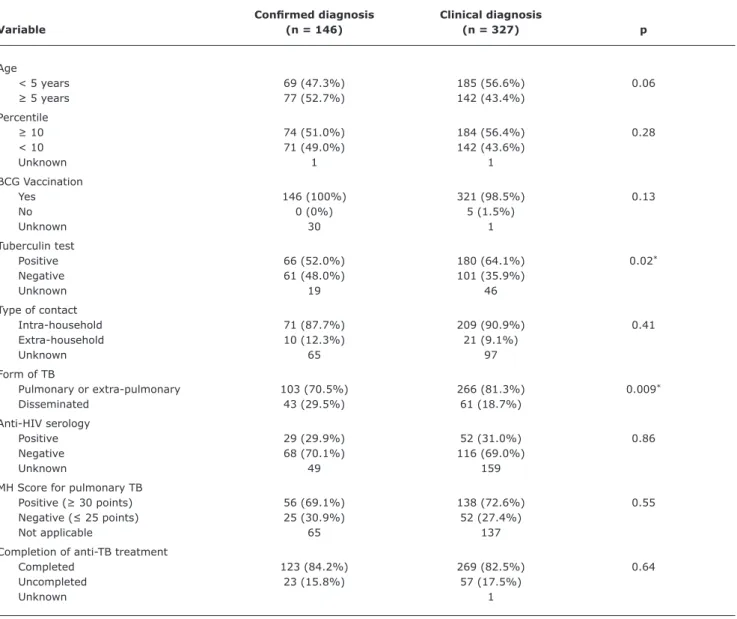
In Table 1, epidemiological aspects, laboratory aspects
and the result of the anti-TB treatment are compared between
patients with conirmed diagnosis and those with clinical diagnosis. Conirmed TB was more frequent in children aged over 5 years and signiicantly higher (p ≤ 0.05) in carriers of negative tuberculin skin test (p = 0.02) and of
disseminated forms (p = 0.009). The diagnosis of TB was
conirmed in 31% of cases, and out of the patients with conirmed TB and pulmonary involvement, 31% did not
meet the inclusion criteria to start of treatment according
to the MH scores (≤ 25 points).
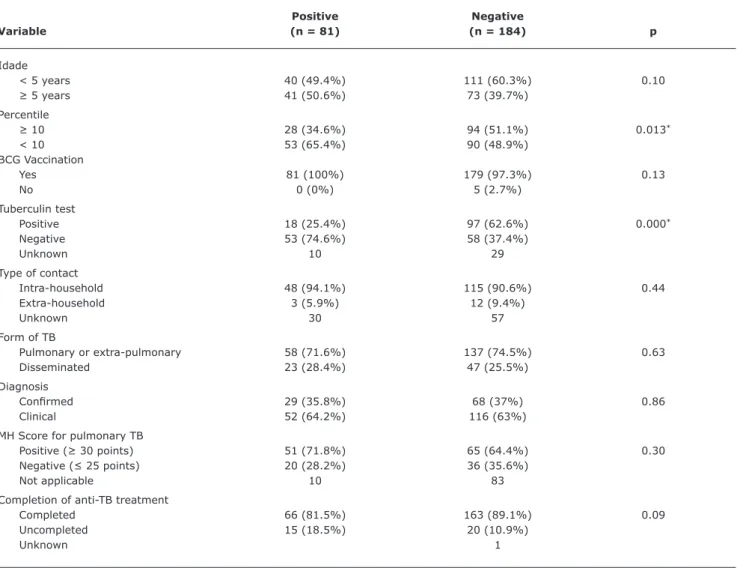
Table 2 compares the epidemiological aspects, laboratory
aspects and the treatment outcomes between patients
infected with HIV and those not infected. Patients known to be infected with HIV presented lower rates of completion of the anti-TB treatment, as well as signiicantly lower weight (< 10th percentile, p = 0.013), besides lower tuberculin
test positivity (p = 0.000).
Hospitalization occurred in 70% of the cases, 63% of them lasting over 15 days. Complications during anti-TB treatment were identiied in 12% of cases, and one third occurred in patients who were HIV seropositive.
Regarding the result of the anti-TB treatment, it was observed completion in 83%, death in 2.5% (mostly HIV positive) and abandonment in 12% (more frequent around
the 2nd month of treatment).
Discussion
The number of TB cases followed by this unit suffered a progressive decrease in the period between 2001 and
2004, remaining stable thereafter. One of the factors
associated with this scenario was the publication by
the MH, in 2001, of the punctuation score for childhood TB with negative bacilloscopy, oficially included in the guidelines for the national management of TB in 2002,
Conirmed diagnosis Clinical diagnosis
Variable (n = 146) (n = 327) p
Age
< 5 years 69 (47.3%) 185 (56.6%) 0.06
≥ 5 years 77 (52.7%) 142 (43.4%)
Percentile
≥ 10 74 (51.0%) 184 (56.4%) 0.28
< 10 71 (49.0%) 142 (43.6%)
Unknown 1 1
BCG Vaccination
Yes 146 (100%) 321 (98.5%) 0.13
No 0 (0%) 5 (1.5%)
Unknown 30 1
Tuberculin test
Positive 66 (52.0%) 180 (64.1%) 0.02*
Negative 61 (48.0%) 101 (35.9%)
Unknown 19 46
Type of contact
Intra-household 71 (87.7%) 209 (90.9%) 0.41
Extra-household 10 (12.3%) 21 (9.1%)
Unknown 65 97
Form of TB
Pulmonary or extra-pulmonary 103 (70.5%) 266 (81.3%) 0.009*
Disseminated 43 (29.5%) 61 (18.7%)
Anti-HIV serology
Positive 29 (29.9%) 52 (31.0%) 0.86
Negative 68 (70.1%) 116 (69.0%)
Unknown 49 159
MH Score for pulmonary TB
Positive (≥ 30 points) 56 (69.1%) 138 (72.6%) 0.55
Negative (≤ 25 points) 25 (30.9%) 52 (27.4%)
Not applicable 65 137
Completion of anti-TB treatment
Completed 123 (84.2%) 269 (82.5%) 0.64
Uncompleted 23 (15.8%) 57 (17.5%)
Unknown 1
Table 1 - Distribution according to the diagnostic criterion used
BCG = vaccine against tuberculosis; HIV = human immunodeficiency virus; MH = Brazilian Ministry of Health; TB = tuberculosis. * p ≤ 0.05.
There was a slight male predominance, similar to that
described in literature.6,13,14 Epidemiological history of
contact with a bacilliferous patient was observed in 66% of cases, conirming the relevance of contacts control in
preventing the spread of this disease.
Vaccination coverage was high; however, higher morbidity was still identiied in patients younger than 5 years. Patients under 5 presented higher frequency of disseminated forms and non-completion of treatment, mainly due to treatment abandonment. Oliveira et al.15 reported an apparent vulnerability to the abandonment of anti-TB
treatment in children younger than 1 year old, associated
with a previous history of noncompliance with treatment
and absent and/or drug user father.
Co-infection with HIV, in this study, was high (17%),
probably due to the existence of a reference pediatric service
for monitoring HIV infection in the unit. Most seropositive patients presented weight below the 10th percentile, lower
positivity in the tuberculin test and tendency towards
non-completion of the speciic treatment for TB, a scenario that
was consistent with the literature.11,12
Etiological conirmation occurred mostly in children older than 5 years old, with negative tuberculin test and in the form of disseminated TB. In children over 5 years the spontaneous obtaining of lung material is easier, favoring
Positive Negative
Variable (n = 81) (n = 184) p
Idade
< 5 years 40 (49.4%) 111 (60.3%) 0.10
≥ 5 years 41 (50.6%) 73 (39.7%)
Percentile
≥ 10 28 (34.6%) 94 (51.1%) 0.013*
< 10 53 (65.4%) 90 (48.9%)
BCG Vaccination
Yes 81 (100%) 179 (97.3%) 0.13
No 0 (0%) 5 (2.7%)
Tuberculin test
Positive 18 (25.4%) 97 (62.6%) 0.000*
Negative 53 (74.6%) 58 (37.4%)
Unknown 10 29
Type of contact
Intra-household 48 (94.1%) 115 (90.6%) 0.44
Extra-household 3 (5.9%) 12 (9.4%)
Unknown 30 57
Form of TB
Pulmonary or extra-pulmonary 58 (71.6%) 137 (74.5%) 0.63
Disseminated 23 (28.4%) 47 (25.5%)
Diagnosis
Conirmed 29 (35.8%) 68 (37%) 0.86
Clinical 52 (64.2%) 116 (63%)
MH Score for pulmonary TB
Positive (≥ 30 points) 51 (71.8%) 65 (64.4%) 0.30
Negative (≤ 25 points) 20 (28.2%) 36 (35.6%)
Not applicable 10 83
Completion of anti-TB treatment
Completed 66 (81.5%) 163 (89.1%) 0.09
Uncompleted 15 (18.5%) 20 (10.9%)
Unknown 1
Table 2 - Assessment of patients with known HIV serological status (265 cases)
BCG = vaccine against tuberculosis; HIV = human immunodeficiency virus; MH = Brazilian Health Ministry; TB = tuberculosis. * p ≤ 0.05.
The resistance to one or more drugs observed in 33%
of patients who had an antibiogram performed is worrying.
According to Kritski,16 multi-resistant TB is associated with high level of mortality, especially in children and individuals infected with HIV. It is necessary to perform investigations
on anti-TB drugs resistance in children and adolescents to
conirm these results observed in this reference hospital
unit.
It was observed that 31% of conirmed cases of
pulmonary TB did not meet the inclusion criteria for treatment
according to the MH score, with the use of the same cutoff point of other studies (≤ 25 points).6,9,10 This scenario points out to the importance of assessing the need to continue this clinical research in units of greater complexity in patients
with suspected pulmonary TB who obtain ≤ 25 points, once the idea of the score is to assist, on an outpatient basis, the diagnosis of children with negative bacilloscopy
tests.3,8 According to Coelho Filho et al.,6 if all patients with score > 25 points start anti-TB treatment, at least 30% of
them will be carriers of other diseases than TB. New studies
are needed in order to conirm the indings.
Although the study was performed in a tertiary unit, which, therefore, receives more complex cases that require further clinical investigation, the hospitalization rate observed (70%) is worrying. In the cases of diagnosis established in hospitals, a hospitalization longer than 15
days was observed in more than half the cases. This scenario contributes to the rising costs of TB for the Brazilian public
Uniied Health System. It is essential that the early diagnosis
of TB and the correct outpatient follow-up be performed to change this situation.
Correspondence: Thaise Pereira Matos
Rua Cabo Roberto Mothé, 81, Ilha do Governador CEP 21941-430 - Rio de Janeiro, RJ - Brazil E-mail: [email protected]
References
1. World Health Organization (WHO). Guidance for national tuberculosis programmes on the management of tuberculosis in children. Geneva: WHO; 2006. 50 p.
2. Corbett EL, Watt CJ, Walker N, Maher D, Williams BG, Raviglione MC, et al. The growing burden of tuberculosis: global trends and interactions with the HIV epidemic. Arch Intern Med. 2003;163:1009-21.
3. Sant’Anna CC, Mourgues LV, Ferrero F, Balanzat AM. Diagnóstico e terapêutica da tuberculose infantil - uma visão atualizada de um antigo problema. J Pediatr (Rio J). 2002;78 Supl 2:S205-14 4. Watanabe A, Rufino-Netto A. O peril epidemiológico dos casos
de tuberculose notiicados em hospital terciário. Bol Pneumol Sanit. 2001;9:19-34.
5. Oliveira HM, Rufino-Netto A, Vasconcellos GS, Dias SM. Epidemiological analysis of pediatric tuberculosis in the city of Rio de Janeiro. Cad Saude Publica. 1996;12:507-13.
6. Coelho Filho JC, Caribé MA, Caldas SC, Martins Netto E. Is tuberculosis dificult to diagnose in childhood and adolescence? J Bras Pneumol. 2011;37:288-93.
7. Nascimento LF. Childhood tuberculosis incidence in Southeast Brazil, 1996. Cad Saude Publica. 2004;20:1749-52.
8. Brasil. Ministério da Saúde. Secretaria de Vigilância em Saúde. Programa Nacional de Controle da Tuberculose. Manual de recomendações para o Controle da Tuberculose no Brasil. Brasília: Ministério da Saúde; 2010.
9. Sant’Anna CC, Orfaliais CT, March M de F. A retrospective evaluation of a score system adopted by the Ministry of Health, Brazil in the diagnosis of pulmonary tuberculosis in childhood: a case control study. Rev Inst Med Trop Sao Paulo. 2003;45:103-5.
10. Maciel EL, Dietze R, Silva RE, Hadad DJ, Struchiner CJ. Evaluation of a scoring system recommended by the Brazilian Ministry of Health for the diagnosis of childhood tuberculosis. Cad Saude Publica. 2008;24:402-8.
11. World Health Organization (WHO). TB/HIV: A clinical manual. Geneva: WHO; 2004. 220 p.
12. Marais BJ, Graham SM, Cotton MF, Beyers N. Diagnostic and management challenges for childhood tuberculosis in the era of HIV. J Infect Dis. 2007;196 Suppl 1:S76-85.
13. Dias MH. Epidemiology of tuberculosis in children under 15 years of age in the municipality of São Paulo, Brazil, 1984. Rev Saude Publica. 1991;25:426-34.
14. Maciel EL, Marinato CA, Bandeira CF, Tonini MS, Dietze R, Ramos MC. O peril epidemiológico da tuberculose em crianças e adolescentes menores de 15 anos na Grande Vitória, Brasil, no período de 1990 a 2001. Cad Saúde Colet (Rio J). 2006;14:81-94.
15. Oliveira VL, da Cunha AJ, Alves R. Tuberculosis treatment default among Brazilian children. Int J Tuberc Lung Dis.
2006;10:864-9.
16. Kritski AL. Multidrug-resistant tuberculosis emergence: a renewed challenge. J Bras Pneumol. 2010;36:157-8.
from retrospective studies are questionable; however, it was possible to demonstrate the quality of the information
on the medical records over the years.
TB in children and adolescents has been neglected
historically. However, this situation has been reversed in
recent years with the increasing publications and research
development on the subject. Diagnosis is still a sensitive issue in the management of this age group. Thus, prospective studies should be conducted in this population, in order to
enhance the development and improvement of new clinical
scores, coupled with an assessment of the impact of such
scores or further diagnostic methods. The co-infection with
HIV is a confounding factor, and also a subject in need of
further studies to assess the real impact of TB in this group in different epidemiological settings.
Acknowledgements