TUBERCULOSIS CONTROL ACTIONS: ANALYSIS BASED ON THE ACCESS
AND PRIMARY HEALTH CARE QUALITY IMPROVEMENT PROGRAM
Francisco de Sales Clementino¹, Emanuella de Castro Marcolino², Luciano Bezerra Gomes³, Joria Viana Guerreiro4,Francisco Arnoldo Nunes de Miranda5
1 Ph.D. in Nursing. Professor, Universidade Federal de Campina Grande, Undergraduate Nursing Program. Campina Grande, Paraíba,
Brazil. E-mail: [email protected]
2 M.Sc in Public Health. Nursing, Government of Rio Grande do Norte. Natal, Rio Grande do Norte, Brazil. E-mail: emanuella.
3 Doctoral student in Medicine, Universidade Federal do Rio de Janeiro. Professor, Undergraduate Medical Program, Universidade Federal da Paraíba (UFPB). João Pessoa, Paraíba, Brazil. E-mail: [email protected]
4 Ph.D. in Public Health. Professor, Undergraduate Medical Program, UFPB. João Pessoa, Paraíba, Brazil. E-mail: joria2005@yahoo.
com.br
5 Ph.D. in Nursing. Professor, Undergraduate and Pós-Graduação em Enfermagem, Universidade Federal do Rio Grande do Norte. Natal,
Rio Grande do Norte, Brazil. E-mail: [email protected]
ABSTRACT: The study’s aim was to analyze primary health care delivered to people with tuberculosis on a national level, based on the information collected by an external assessment implemented by the Programa de Melhoria do Acesso e da Qualidade da Atenção Básica. This cross-sectional study with a quantitative approach used data from the 2nd cycle external assessment of the Programa de Melhoria do Acesso e da Qualidade da Atenção Básica conducted in 2014. The Statistical Package for Social Sciences was used to establish frequencies and check for
associations using the Chi-square test. The percentage of Family Health Strategy units recording the annual number of conirmed tuberculosis
cases and respiratory symptoms was high for the entire country (81.1%). In contrast, the recording of follow-up of tuberculosis cases was performed by only 48.3% of the facilities, while only 48% of the health basic unites units implemented directly observed treatment. The
indings reveal barriers in the structure of health basic unites units regarding the operationalization and sustainability of care provided to
individuals with tuberculosis, including directly observed treatment. DESCRIPTORS: Tuberculosis. Health evaluation. Primary health.
AÇÕES DE CONTROLE DA TUBERCULOSE: ANÁLISE A PARTIR DO
PROGRAMA DE MELHORIA DO ACESSO E DA QUALIDADE DA ATENÇÃO
BÁSICA
RESUMO: O estudo objetivou analisar as ações de saúde à pessoa com tuberculose na atenção básica à saúde, em nível nacional, a partir da avaliação externa do Programa de Melhoria do Acesso e da Qualidade da Atenção Básica. Trata-se de um estudo transversal de abordagem quantitativa, com base nos dados da avaliação externa do 2º ciclo do Programa de Melhoria do Acesso e da Qualidade da Atenção Básica realizado em 2014. Utilizou-se o software Statistical Package for Social Sciences para realização de frequências e tentativas de associações por
meio do teste estatístico qui-quadrado. Constatou-se que o percentual de registro da estimativa anual do número de casos conirmados de
tuberculose e sintomáticos respiratórios na Estratégias Saúde da Família atingiu 81,1%, em todo Brasil; em contrapartida, o percentual de registros de acompanhamento dos casos de tuberculose alcançou, somente, 48,3% e tratamento diretamente observado 48% das unidades básicas de saúde. Os achados indicaram a presença de barreiras na estruturação das unidades básicas de saúde quanto à operacionalização e sustentabilidade da assistência ao portador de tuberculose, incluindo a estratégia do tratamento diretamente observado.
DESCRITORES: Tuberculose. Avaliação em saúde. Atenção primária à saúde.
ACCIONES DE CONTROL DE LA TUBERCULOSIS: ANÁLISIS A PARTIR
DEL PROGRAMA DE MEJORÍA DEL ACCESO Y DE LA CALIDAD DE LA
ATENCIÓN BÁSICA
RESUMEN: El estudio tuvo como objetivo analizar las acciones de salud a la persona con tuberculosis en la Atención Básica, a nivel nacional, desde la Evaluación Externa del Programa de Melhoria do Acesso e da Qualidade da Atenção Básica. Se trata de un estudio transversal con abordaje cuantitativo, basados en los datos de la evaluación externa del 2º ciclo del Programa de Melhoria do Acesso e da Qualidade da Atenção Básica realizado en el año de 2014. Se utilizó el programa software Statistical Package for Social Sciences para la realización de frecuencias y tentativas de asociaciones por medio del teste estadístico Qui-Cuadrado. Se encontró que el porcentual de registro de la
estimativa anual del número de casos conirmados de tuberculosis y sintomáticos respiratorios en las ESF atingió 81,1%, en todo Brasil;
en contrapartida el porcentual de registros de acompañamiento de los casos de Tuberculosis alcanzó, solamente, 48,3% y el Tratamiento Directamente Observado en el 48% de las unidades básicas de salud. Los datos indicaron la presencia de barreras en la estructuración de las unidades básicas de salud cuanto a la operacionalización y sustentabilidad de la asistencia al portador de tuberculosis, incluyendo la estrategia Tratamiento Directamente Observado.
DESCRIPTORES: Tuberculosis. Evaluación en salud. Atención primaria a la salud.
INTRODUCTION
Tuberculosis (TB) still remains a challenge in the Brazilian public health. Even though the inci-dence of the disease has decreased approximately 20.3% since 2003, 71,230 new cases were identiied in 2013, of these 11,500 of which were involved in retreatment, with an incidence of 37.2/100,000 in-habitants. TB is the most lethal contagious infectious disease worldwide. It affects all age groups and is aggravated by poor social and economic conditions.1-2
Given this epidemiological situation, the World Health Organization (WHO) recommends a Post-2015 Proposition, the purpose of which is to elimi-nate the worldwide TB epidemic, with goals to be achieved by 2025 and 2035. The goals for 2025 include decreasing the mortality rate by 75% as recorded in 2015 and decreasing its incidence by 50% worldwide. For 2035, the goals include decreasing mortality rate recorded in 2015 by 95% and decreasing its incidence by 90% (to less than 10/100,000 inhabitants).1
Considered a priority for the Brazilian gov-ernment, the disease has been listed in the main national pacts since 2003: Pacto pela Saúde [Health Pact]; Programa Mais Saúde [More Health Program];
Programação das Ações de Vigilância em Saúde [Health Surveillance Actions Programing]; Pacto da Atenção Básica [Primary Healthcare Pact]; and more recently, it lists in the Agenda Estratégica da Secretaria de Vigilância em Saúde [Strategic Agenda of the Health Surveillance Department].3
The strategies considered a priority by the Pro-grama Nacioanl de Controle da Tuberculose (National Tuberculosis Control Program-PNCT) include: improved case-detection rates in the various socio-economic and clinical epidemiological contexts by strengthening primary healthcare (PHC) services,4
without overlooking the importance of the Estratégia Saúde da Família (Family Health Strategy- ESF) in
implementing surveillance, prevention and disease control actions.4
Despite the numerous advancements obtained in the PHC expansion process, researchers5-7 indicate
that promoting access for individuals with TB did not facilitate diagnosis in health basic units (HBUs) because of organizational, economic and geographic dificulties faced by the cities in integrating TB control actions.
The decentralization of health actions is a complex issue involving a political-managerial dimension, the qualiication of professionals, inter-sectorial actions, inancing of actions, ordination of the information system, and organization of the referral/counter-referral low for exams supporting diagnosis and specialties, which requires the context of a health care network.8
With the implementation of the Programa de melhoria do acesso da qualidade da atenção básica (Access and PHC Quality Improvement Program-PMAQ-AB) since 2013, the Ministry of Health intends to strengthen PHC actions mainly to expand access to and quality of PHC services, to ensure government actions are effective and to reorganize the healthcare model.9
Considering the national nature of the PMAQ-AB, this study is relevant because it assesses aspects of a national dimension regarding healthcare deliv-ered to individuals with TB within the PHC context. The study’s aim was to analyze care provided nation-ally to individuals with TB at the PHC level based on an external assessment performed by the PMAQ-AB.
METHOD
This cross-sectional study, with quantitative approach, is based on data collected by the 2nd cycle
2014, which addressed aspects concerning physi-cal structure and ambivalence, work process, and patient satisfaction.
All the HBUs that adhered to the 1st stage of
the program (contractual arrangements for ESF and managers with the PMAQ-AB) participated in the external assessment. In the 2nd cycle of the
PMAQ-AB, 100% of these units in Brazil were able to adhere to the Program, hence, 24,055 HBUs in the entire country participated in the external assessment.
The instruments developed and revised by the public higher education institutions linked to the Ministry of Health, named Modules I, II, III, IV, V and VI, were used to collect data.
The thematic axes concerning care delivered to individuals with Tuberculosis (Module II) and identiication of healthcare units and transporta-tion (Module I) were addressed in this study. The instruments were applied between January and June 2014 by supervisors and ield evaluators distributed throughout the entire country.
The logistics used for the application of instru-ments were as follows: irst, city managers of the health sector were contacted by telephone to arrange a visit for the ield team. Next, letters were sent to communicate the time, place, and names of the supervisor and quality evaluator who would apply the instruments, in addition to a list of supporting documents to be presented during the interview with the health worker.
Variables concerning care delivered to indi-viduals with TB were: estimated annual number of TB cases and respiratory symptoms; whether the irst sputum sample used to diagnose TB was col-lected in the irst consultation; recording of the num-ber of patients with TB in the last year; recording of follow-up of cases; TB reporting forms available at the unit; directly observed treatment (DOT); active search for patients who missed their DOT; surveil-lance of household contact with new TB cases. All
the answers were categorized either as yes, no, or I do not know or did not answer. In regard to the variables concerning identiication of HBUs, the type of health unit and availability of a vehicle in good condition were used. Based on the conception of the HBUs, units are responsible for providing programed or unprogramed PHC and integral care in primary specialties to the population, possibly also providing dental care and other types of care provided by professionals with a college degree.9
The Statistical Package for the Social Sciences (SPSS), version 21, was used to obtain absolute and relative frequencies of variables and associations using Chi-square. The study was approved by Eth-ics Committee at the Universidade Federal do Rio Grande do Sul (report No. 21904).
RESULTS
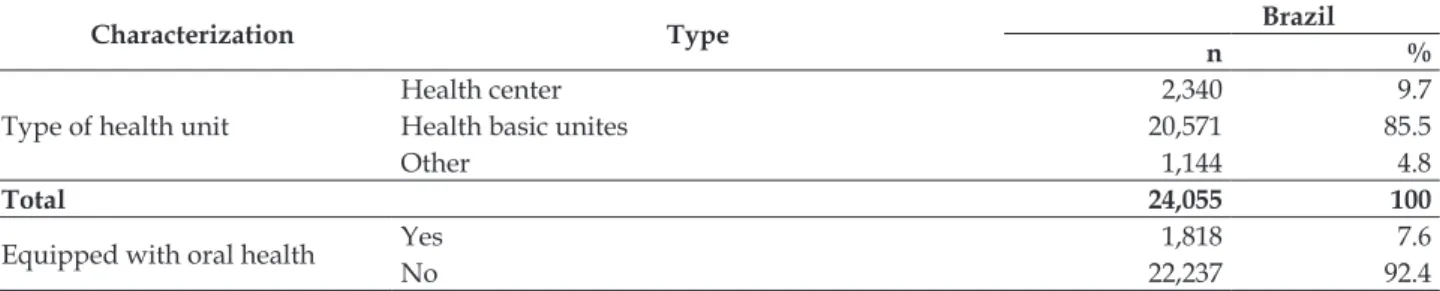
HBUs predominated among the health facili-ties participating in the PMAQ-AB’s 2nd cycle. This
program focuses on the irst level of healthcare through other types of health facilities, adapted to the PHC modality, such as: policlinics, mixed health-care units, and health centers, can also participate. Of these units, 92.4% were equipped for oral health, that is, with PHC teams organized differ-ently from those within ESF, though they followed minimum parameters adhering to the PMAQ-AB. Additionally, minimum number of professionals and minimum workload for the workers composing these teams are considered,9 however, only 65.9% of
the health units had ESF with oral health, consider-ing the aforementioned minimum parameters in the PHC team (Table 1).
With regard to the information system used in the health units, the (Sistema de Informações da Atenção Básica - PHC Information System SIAB) still predominates and the e-SUS was implemented in only 8.1% of the health facilities (Table 1).
Table 1- Characterization of the health facilities participating in the Programa de Melhoria do Acesso e da Qualdade da Atenção Básica
Characterization Type Brazil
n %
Type of health unit
Health center 2,340 9.7
Health basic unites 20,571 85.5
Other 1,144 4.8
Total 24,055 100
Equipped with oral health Yes 1,818 7.6
Total 24,055 100
Oral health Family health strategy teams w/ oral health 15,854 65.9
Family health strategy teams w/o oral health 8,201 34.1
Total 24,055 100
Information system
Primary healthcare information system 20,354 84.6
e-SUS 1,940 8.1
Others 1,215 5.1
Did not know/did not answer 546 2.3
Total 24,055 100
Care provided by the HBUs to individuals with TB per region is presented in Table 2. The per-centage of PHC units recording the annual number of conirmed TB cases and respiratory symptoms was high for the entire country (81.1%).
The irst sputum sample was collected in the irst consultation to establish a TB diagnosis by 51.5% of the HBUs in the northeast and by 62.9% of HBUs, at the most, in the south. The number of patients with TB in the most recent year, with docu-mentary evidence, was presented by 51% of all the HBUs in Brazil; 43.6% of the teams did not present patients with TB in the territory under their cover-age. The percentages followed the same pattern per region (Table 2).
With regard to follow-up of TB cases under the responsibility of HBUs, 49% of these units did not know or did not answer this question. The north presented the highest percentage of follow-up of TB cases (54.1%), while the south presented the lowest percentage (46.4%).
TB reporting forms were found in 89.4% of the HBUs under study; the percentages followed the same pattern per region. The northeast presented the highest percentage of reporting forms (92.8%) (Table 2).
DOT has been performed in 48% of the
Brazil-ian HBUs, a percentage similar to that of units that did not know or did not answer this item (43.6%). The northeast presented the highest number of HBUs that did not know or did not answer con-cerning DOT (45.1%), while the north presented the lowest number of units that did not know or did not answer this item (35.6%). The active search for individuals missing DOT across the country fol-lowed the same percentage pattern, with 44.8% of the HBUs reported actively searching for patients, while 49% reported a lack of knowledge or did not answer the question. With regard to this item, the percentage of HBUs that did not know or did not answer whether the unit actively searched for patients is higher in all regions than the percentage of HBUs that do search for patients missing treat-ment (Table 2).
A larger percentage of HBUs did not know or did not answer the question regarding investiga-tion of household contact with new TB cases, when compared to those units that investigate household contact with TB cases; the mid-west region stands out with 50.5% of the HBUs being unable to report whether they perform this action, compared to 47.7% of HBUs that do investigate household con-tact with new TB cases in the territory under their coverage (Table 3).
Table 2 – Care delivered to people with tuberculosis in the PHC units participating in the primary health care quality improvement program 2nd cycle per region, Brazil, 2014
Primary Healthcare Units that...
Brazil North Southeast South
Yes %
No %
DNK*
% Yes
% No
%
DNK*
% Yes
% No
%
DNK*
% Yes
% No
%
DNK*
% Yes
% No
%
DNK*
% Yes
% No
%
DNK*
% Present an annual estimate
of number of TB cases and respiratory symptoms
81.1 18.9 - 79.6 20.4 - 76.0 24.0 - 79.5 20.5 - 83.8 16.2 - 81.8 18.2
-Collect the 1st sputum sample
to diagnose TB in the 1st
con-sultation
57.0 43.0 - 51.5 48.5 - 44.5 55.5 - 64.7 35.3 - 60.9 39.1 - 62.9 37.1
-Present recording of the number of individuals with TB in the last year
Primary Healthcare Units that...
Brazil North Southeast South
Yes %
No %
DNK*
% Yes
% No
%
DNK*
% Yes
% No
%
DNK*
% Yes
% No
%
DNK*
% Yes
% No
%
DNK*
% Yes
% No
%
DNK*
% Present a record of follow-up
of cases 48.3 2.7 49.0 48.8 2.0 49.2 54.1 1.7 44.2 47.4 2.1 50.5 47.2 3.3 49.5 46.4 3.9 49.8 Have TB reporting forms in
the unit 89.4 10.6 - 92.8 7.2 - 87.6 12.4 - 87.4 12.6 - 87.6 12.4 - 86.9 13.1 -Perform DOT 48.0 8.4 43.6 46.9 8.0 45.1 53.2 11.3 35.6 49.2 7.2 43.6 47.9 8.0 44.1 46.6 9.7 43.8 Actively search for patients
missing DOT 44.8 6.3 49.0 43.8 7.0 49.2 48.9 7.1 44.0 45.3 4.3 50.4 44.5 6.0 49.5 44.4 5.9 49.8 Watch for household contact
with new TB cases 48.8 2.2 49.0 49.0 1.8 49.2 53.8 2.0 44.2 47.7 1.8 50.5 48.3 2.2 49.5 46.6 3.6 49.8 *Did not know or did not answer;†There were no individuals with tuberculosis in the territory.
Table 3 – Association between care actions delivered to individuals with tuberculosis and availability of transportation in PHC units participating in primary health care quality improvement program 2nd
cycle, Brazil, 2014
Care actions
Availability in health units of transportation in good condition Yes No p-value Prevalence ratio
n % n %
Investigation of household contact with new TB cases
Yes 7,212 96 291 97 5.50 0.390 (0.173 -
0.882)
No 291 4 6 3
Total 7,503 100 297 100
DOT implementation
Yes 7,116 84 285 84 0.030
-No 1,277 16 51 16
Total 8,393 100 336 100
Active search for patients missing DOT
Yes 6,623 87 261 87 0.134 0.936 (.656 –
1.335)
No 976 13 36 13
Total 7,599 100 297 100
Association was found between the variables “Availability of transportation in good condition” and “DOT implementation” (p<0.05). Association was also found between “Availability of transpor-tation in good condition” and the variables “Inves-tigation of household contact with TB new cases” and “Actively searching for patients missing DOT” (p>0.05). Note that more than 70% of the HBUs did not know or did not answer the item regarding the availability of transportation in good condition (Table 3).
DISCUSSION
This study enabled identifying the challenges routinely faced by the NTCP when addressing people with TB in the ive Brazilian regions, con-sidering actions to control the disease as regulated by the Ministry of Health. With regard to the collec-tion of irst sputum sample in the irst consultacollec-tion performed by the HBUs to diagnose TB, the results show a mean coverage below 60% in the ive Bra-zilian regions, while the PNCT recommends this procedure be performed for all symptomatic cases.
One study conducted in Porto Alegre10 found
a similar percentage regarding sputum smears in PHC. Such a fact was considered a concern because, in addition to its low cost, a sputum smear is the main diagnostic method recommended by the WHO to diagnose pulmonary TB. A late diagnosis is considered the main variable that accounts for the high prevalence of the disease, thus, the capacity of the healthcare network has to be reconsidered in order to it be able to deliver better coordinated care to minimize access barriers and favor timely diagnosis of TB in PHC services.4
One study developed in three Brazilian capi-tals also reports the low frequency with which spu-tum smear is performed in HBUs.11 Likewise, one
study conducted in São José do Rio Preto, a priority city for TB control, highlighted that Emergency Ser-vice Units were the entrance door for TB diagnosis (49.4%), while hospitals were the facilities that most frequently diagnosed the disease (39.5%), followed by HBUs (30.9%).12
Other studies10,13-14 conirm that TB control
as Emergency units and hospitals, in which a large number of cases are diagnosed and therapeutic regimes are established, which is contrary to what is recommended by the Ministry of Health, which has reinforced the decentralization of care since the implementation of the NTCP.10
The NTCP established two primary strategies in 2013 to cope with TB: expand diagnosis with new technology and strengthen TB actions at the PHC level. Nonetheless, TB diagnosis is usually delayed in Brazil, which is seen when other indica-tors are considered, such as cure rate, treatment abandonment, mortality, comorbidities, and time elapsed from the appearance of symptoms to the establishment of diagnosis, among others.15 These
incompatibilities relate to follow-up that is focused on medication therapy, disregarding socioeconomic and cultural complexities, which inluence one’s perceptions, from the onset of the disease up to treat-ment adherence. From the perspective of integral-ity, this reveals weakness in a care delivery model developed from the perspective of integrality.16
One study conducted in 2012 reveals that TB treatment abandonment is related to the social environment to which a patient belongs.17
Addition-ally, treatment abandonment also results from poor follow-up.18
Therefore, to fully provide access, diagnosis and TB treatment to patients, it is necessary to transfer essential care actions to PHC services, properly structuring HBUs in clinical-scientiic, structural and organizational terms so that they are able to properly deal with patients and provide integral care.13
Regarding the number of individuals with TB in the last year, the results reveal a concerning epidemiological situation among the HBUs under study, considering that 43.6% of these did not keep a record of patients with TB in their area of coverage.
Therefore, management should invest in professional training, seeking to improve and reorganize the work process with changes in the practice from the perspective of the Politica nacional de Educação Permanente em Saúde (National Policy of Permanent Health Education-EPS) involving four pillars: education, management, care delivery and social control, adopting as its methodology the prob-lematization of the work process in the healthcare networks of the Brazilian Public Health System.19
Additionally, it is relevant to clarify knowledge concerning the topic, as the results available con-tribute to decision-making and to the development of policies to control TB.20
In addition to complete reporting forms con-cerning cases in which TB is diagnosed, completing the Treatment Control Book, an instrument used to record data concerning the follow-up of TB patients (result of exams, criterion for discharge), is also recommended. Information must be sent monthly to the irst informatized level of the Sistema de
In-formação de agravos de notiicação (Notiiable Diseases Information System-SINAN).4
Brazil has not yet achieved the goals estab-lished by the WHO, namely 70% of cases detected, 85% cure through DOT, and at most 5% treatment abandonment.13 Thus, the bottlenecks of the TB
sur-veillance system need to be identiied to determine at which point patients are not being identiied, and consequently not reported, treated or monitored.
Underreporting of cases, mainly due to poor performance of active searches for those who are missing DOT, ineficient recording and information low, relect a lack of equal access to healthcare ser-vices. Studies conducted in various regions of Brazil highlight potential explanations for these problems, such as: training processes are discontinued, lack of permanent education policies, and high turnover of healthcare workers due to the rotation or discontinu-ity of ruling political parties.20-22
Additionally, attention should be paid to the training of healthcare workers able to meet the re-quirements of the Brazilian Public Health System and its principles.23 Professionals and policies that
transcend the fragmented and reductionist nature of actions are essential for the effective control of TB.24
The study reveals that supervised treatment has been implemented in 48% of the HBUs under study, similar to the percentage of health units that did not know or did not answer this item (43.6%). Note that ESF units are not following the NTCP guidelines in regard to the coverage of patients undergoing DOT, which indicates the need to im-prove actions in order to enhance the quality of TB treatment as recommended by the WHO.
Since 1993, the WHO has recommended DOT as the main strategy to control the disease,25
decreas-ing the transmission of TB bacilli by implementdecreas-ing early diagnosis and appropriate treatment.26-28 DOT
is based on four premises: detection of cases through sputum smear for those with respiratory symptoms; treatment through regular supply of medications; recording information regarding the treatment; and government commitment through health policies focusing on TB control.29
is administered, without changing the therapeutic regimen. That is, a trained worker is responsible for observing the taking of medication by the patient from the beginning of the treatment up to complete cure.25-27
In addition to observing the treatment, the workers conform with the logic that an individual with TB is, above all, a human being with demands that need to be perceived and resolved as much as possible. This holistic care is directly relected in treatment adherence and, consequently, in po-tential cure.30
Because treatment abandonment is crucial when TB treatment fails to materialize, the various and complex aspects associated with this fact need to be highlighted. Such aspects are related both to the patient and to the operationalization of the treat-ment and the treattreat-ment itself. Hence, the relation-ship developed between professional and patient is a tool that can enhance care practices, self-care and responsibility shared with the individual with TB.31
The professional practices of the PHC teams concerning the active search for individuals with TB and DOT implementation, as well as the organiza-tional support of HBUs, are essential to combating TB. This is conirmed by the signiicant association between variables (p<0.05). There is low coverage of active searches and investigation of household contact with new TB cases due to operational and logistic reasons, among which is lack of transporta-tion for the teams.
This situation implies weaknesses in the DOT operationalization process, suggesting that there is a need for local PHC policies concerning the moni-toring of household contact with order to interrupt TB transmission in a timely manner. Additionally, healthcare professionals, as well as health policies, need to overcome the fragmented and reductionist nature of actions, enabling the delivery of integral care to effectively control the disease.31
CONCLUSION
This study’s objective was to analyze the care provided to individuals with TB using information collected in the external assessment performed by the PMAQ-AB. The indings indicate barriers in the structuring of HBUs, such as problems of an organizational, geographic and economic nature.
The way PHC is organized is a determining factor in ensuring access to early diagnosis and follow-up of patients and families in the area under coverage, considering the fragilities presented in terms of the operationalization and sustainability
of the DOT strategy, such as: a low percentage of HBUs performing DOT; the merely incipient active search for those missing DOT; and the insuficient surveillance of household contact with TB cases, in addition to a high percentage of units lacking knowledge concerning these priority strategies.
The elements concerning PHC delivered to individuals with TB lead us to relect upon means that are objectively necessary to decentralize ac-tions, moving them to the PHC level, considering evident barriers that prevent the implementation of the NTCP through Brazilian family health teams.
Strengthening the DOT strategy requires an inter-sector commitment, starting with the govern-ment ensuring the resources needed to implegovern-ment TB control and to provide and guarantee that pa-tients and families have access to quality healthcare services.
The PMAQ-AB’s external assessment enabled a systematic analysis of the Brazilian PHC context and revealed the weaknesses of the NTCP concern-ing the practice of family health teams. Thus, it provided an opportunity to re-think how to decen-tralize care delivered to individuals with TB at the irst level of care.
Therefore, there is a need to reorient actions, change inter-sector and inter-government ap-proaches, and enhance PHC through organizational models that encourage healthcare workers to pro-duce the essence of PHC, namely: establishment of bonds; health surveillance and care delivery over time; and, more importantly, assume TB control as a priority action in the areas under the units’ coverage.
REFERENCES
1. World Health Organization (WHO). Global Tuberculosis report 2013. Geneva (CH): WHO Library; 2013.
2. Sá LD, Rodrigues DC, Barreto AJ, Oliveira AA, Pinheiro PG, Nogueira JA. A organização da estratégia saúde da família e aspectos relacionados ao atraso do diagnóstico da tuberculose. Cogitare Enferm [Internet] 2011 [cited 2015 Jul 15]; 16(3):437-42. Available from: http://ojs.c3sl.ufpr.br/ojs/index.php/cogitare/ article/view/21245/16227
3. Ministério da Saúde (BR). Boletim epidemiológico. Coordenação-Geral do Programa Nacional de Controle da Tuberculose. Departamento de Vigilância de Doenças Transmissíveis – DEVIT. Secretaria de Vigilância em Saúde. Tuberculose no Brasil: realidade e perspectivas. Brasília (DF): MS; 2012.
diagnóstico de tuberculose em município do Nordeste
do Brasil: desaio da atenção básica. Rev Eletr Enf
[Internet]. 2014 [cited 2016 Feb 12]; 16(3):520-6. Available from: http://dx.doi.org/10.5216/ree. v16i3.23491
5. Clementino FS, Miranda FAN. Tuberculose: acolhimento e informação na perspectiva da visita domiciliária. Rev Enferm UERJ [Internet]. 2015 [cited 2016 Feb 12]; 23(3):350-4 Available from: http://www.e-publicacoes.uerj.br/index.php/ enfermagemuerj/article/view/4289/13773
6. Villa TCS, Ponce MAZ, Wysock AD, Andrade RLP, Arakawa T, Scatolin BE, et al. Diagnóstico oportuno da tuberculose nos serviços de saúde de diversas regiões do Brasil. Rev Latino-Am Enfermagem [Internet] 2013 [cited 2016 Feb 10]; 21(Spec):[08 telas]. Available from: http://www.scielo.br/pdf/rlae/v21nspe/pt_24.pdf 7. Bertolozzi MR, Takahashi RF, Hino P, Litvoc M,
Fran-ça FOS. O controle da tuberculose: um desaio para a
saúde pública. Rev Med (São Paulo) [Internet]. 2014 [cited 2015 Jul 11]; 93(2):83-9. Available from: http:// www.revistas.usp.br/revistadc/article/view/97330 8. Mota RRA, David HMSL. Programa Nacional de
Melhoria do Acesso e da Qualidade da Atenção Básica: questões a problematizar. Rev Enferm UERJ [Internet]. 2015 [cited 2015 Jun 10]; 23(1):122-7. Available from: http://www.facenf.uerj.br/v23n1/v23n1a20.pdf 9. Ministério da Saúde (BR). Secretaria de Atenção a
Saúde. Departamento de Atenção Básica. Manual do Avaliador da Qualidade. Brasília (BR): MS; 2013.
10. Almeida CPB, Skupien EC, Silva DR. Health care
seeking behavior and patient delay in tuberculosis diagnosis. Cad Saúde Pública [Internet]. 2015 [cited 2015 jul 10]; 31(2):321-30. Available from: http:// www.scielosp.org/pdf/csp/v31n2/0102-311X-csp-31-02-00321.pdf
11. Campos CEA, Fonseca ACF, Pessini ML. Análise dos percursos assistenciais de pacientes com tuberculose por equipes de saúde em três capitais brasileiras.
Que lições os proissionais podem tirar? Cad Saúde
Colet [Internet]. 2012 [cited 2015 Jul 23]; 20(2):188-94. Available from: http://www.iesc.ufrj.br/cadernos/ images/csc/2012_2/artigos/csc_v20n2_188-194.pdf 12. Ponce MAS, Wysocki AD, Scatolin BE, Andrade
RLP, Arakawa T, Netto AR et al. Diagnóstico da tuberculose: desempenho do primeiro serviço de saúde procurado em São José do Rio Preto, São Paulo, Brasil. Cad Saúde Pública [Internet]. 2013 [cited 2015 Jul 02]; 29(5):945-54. Available from:
http://www.scielo.br/scielo.php?pid=S0102-311X2013000500012&script=sci_arttext
13. Souza MSPL, Aquino R, Pereira SM, Costa MCN, Barreto ML, Natividade M et al. Fatores associados ao acesso geográfico aos serviços de saúde por pessoas com tuberculose em três capitais do Nordeste brasileiro. Cad Saúde Pública [Internet]. 2015 [cited 2015 Jul 13]; 31(1):111-20. Available from: http://
www.scielosp.org/pdf/csp/v31n1/0102-311X-csp-31-01-00111.pdf
14. Amaral AS, Tamaki EM, Sales CM, Renovato RD. Avaliação da descentralização do programa de controle da tuberculose do nível secundário para o nível primário do sistema de saúde de Dourados-MS. Saúde Soc [Internet]. 2010 [cited 2015 Jun 23]; 19(4):794-802. Available from: http://www.scielo. br/pdf/sausoc/v19n4/07.pdf
15. Souza KMJ, Sá LD, Silva LMC, Palha PF. Atuação da Enfermagem na transferência da política do tratamento diretamente observado da tuberculose. Rev Esc Enferm USP [Internet]. 2014 [cited 2015 May 01]; 48(5):874-82. Available from: http:// www.scielo.br/pdf/reeusp/v48n5/pt_0080-6234-reeusp-48-05-874.pdf
16. Sá LD, Scatena LM, Rodrigues RAP, Nogueira JA, Silva AO, Villa TCS. Gateway to the diagnosis of tuberculosis among elders in Brazilian municipalities. Rev Bras Enferm [Internet]. 2015 [cited 2016 Feb 11]; 68(3):408-14. Available from: http://www.scielo.br/ pdf/reben/v68n3/0034-7167-reben-68-03-0467.pdf 17. Souza ABF, Cruz ZV. Abandono do tratamento
da tuberculose no município de Itapetinga-BA: um estudo da influência dos fatores ambientais. Encic Biosfera. [Internet]. 2012 [cited 2016 Feb 08]; 8(14):1471-86. Available from: http://www.conhecer. org.br/enciclop/2012a/saude/abandono.pdf 18. Santos TMMG, Nogueira LT, Santos, Santos LNM,
Costa CM. O acesso ao diagnóstico e ao tratamento de tuberculose em uma capital do nordeste brasileiro. Rev Enferm UERJ. 2012; 20(3):300-5.
19. Oliveira RCC, Adário KDO, Sá LD, Videres ARN, Souza SAF, Pinheiro PGOD. Speeches of managers about the policy of the directly observed treatment for tuberculosis. Texto Contexto Enferm [Internet]. 2016; [cited 2016 Sep 27] 25(2):e3210015 Available from: http://www.scielo.br/pdf/tce/v25n2/pt_0104-0707-tce-25-02-3210015.pdf
20. Lima LM, Harterb J, Tomberg JO, Vieira DA, Antunes ML, Cardozo-Gonzalese RI. Avaliação do acompa-nhamento e desfecho de casos de tuberculose em município do sul do Brasil. Rev Gaúcha Enferm [In-ternet]. 2016; [cited 2016 Sep 27] 37(1):e51467 Available from: http://www.scielo.br/pdf/rgenf/v37n1/0102-6933-rgenf-37-1-1983-144720160151467.pdf
21. Cardoso GCP, Cruz MM, Abreu DMF, Decotelli PV, Chrispim PPM, Borenstein JS et al. A conformidade das ações do tratamento diretamente observado
para tuberculose na perspectiva dos proissionais de
duas unidades de saúde da cidade do Rio de Janeiro. Cad Saúde Colet [Internet]. 2012 [cited 2015 Jun 22]; 20(2):203-10. Available from: http://www.cadernos. iesc.ufrj.br/cadernos/images/csc/2012_2/artigos/ csc_v20n2_203-210.pdf
tuberculose para a Estratégia Saúde da Família em Jardim Catarina – São Gonçalo (RJ), 2010. Cad Saúde Colet [Internet]. 2012 [cited 2015 Jul 05]; 20(2):177-87. Available from: http://www.cadernos.iesc. ufrj.br/cadernos/images/csc/2012_2/artigos/ csc_v20n2_177-187.pdf
23. Grecco R, Oliveira CBB; Silva LMC; Souza KMJ; Santos GP; Palha PF. Tratamento diretamente observado da tuberculose: processos de aprendizagem em uma instituição de ensino superior. Rev Enferm UERJ [Internet]. 2014 [cited 2016 Feb 10]; 22(1):77-82. Available from: http://www.facenf.uerj.br/v22n1/ v22n1a12.pdf
24. Silva DM. Tratamento da tuberculose na Atenção Básica: avaliação de estrutura e processo dos serviços de saúde [dissertação]. João Pessoa (PB): Universidade Federal da Paraíba, Programa de Pós-graduação em Enfermagem; 2013.
25. World Health Organization (WHO). Global Tuberculosis Control: epidemiology, strategy,
inancing: WHO report 2011. Geneva: WHO; 2011.
26. Ministério da Saúde (BR). Secretaria de Vigilância em Saúde. Programa Nacional de Controle da Tubercu-lose. Manual de Recomendações para o Controle da Tuberculose no Brasil. Brasília (DF): MS; 2011. 27. Ministério da Saúde (BR). Secretaria de Vigilância em
Saúde. Departamento de Vigilância Epidemiológica.
Programa Nacional de Controle da Tuberculose. Brasília (DF): MS; 2011.
28. Siqueira HR, Vargas TC, Costa W, Faria AC, Lopes AJ, Capone D. O tratamento atual da tuberculose (para adolescentes e adultos) comentado. Rev HUPE [Internet]. 2010 [cited 2015 Jul 13]; 9. Available from: http://www.e-publicacoes.uerj.br/index.php/ revistahupe/article/view/9178
29. Sá LD, Oliveira AAV, Gomes ALC, Nogueira JA,Villa TCS, Collet S. Caring for tuberculosis patients in the Family Health Strategy: the nurses’ perceptions. Rev Esc Enferm USP [Internet]. 2012 [cited 2015 Jun 20]; 46(2):356-63. Available from:
http://www.scielo.br/scielo.php?pid=s0080-62342012000200013&script=sci_arttext&tlng=en
30. Hino P, Takahashi RF, Bertolozzi MR, Villa TCS, Egry EY. Conhecimento da equipe de saúde da família acerca das necessidades de saúde das pessoas com tuberculose. Rev Latino-Am Enferm [Internet]. 2012 [cited 2016 Feb 15]; 20(1):44-51 Available from: http:// www.scielo.br/pdf/rlae/v20n1/pt_07.pdf
31. Silva PF, Moura GS, Caldas AJM. Fatores associados ao abandono do tratamento da tuberculose pulmonar no Maranhão, Brasil, no período de 2001 a 2010. Cad Saúde Pública [Internet]. 2014 [cited 2015 Jul 15]; 30(8):1745-54.
Available from: http://www.scielo.br/scielo.php?pi
-d=S0102-311X2014000801745&script=sci_arttext
Correspondence:Francisco de Sales Clementino
Universidade Federal de Campina Grande - Enfermagem Rua Juvêncio Arruda, 795
58400510 – Bodocongó, Campina Grande, PB, Brasil E-mail: [email protected]