RESUmEn
Objeivo: Analizar el costo directo de
de-lantales de tejido reuilizables y de dese
-chables en hospital universitario público. Método: Estudio transversal de abordaje cuanitaivo, con énfasis en el costo direc
-to de los delantales de tejido reuilizables y desechables, realizado en hospital uni
-versitario del norte de Paraná. La poblaci
-ón de estudio estuvo compuesta de datos secundarios recogidos en informes de los servicios de costo, lavandería, división de material y provisiones de la insitución, referentes al año de 2012. Resultados: Se
ideniicó un menor costo medio de uiliza
-ción del delantal desechable cuando com
-parado con el costo del delantal de tejido reuilizable. El costo directo de uilización del delantal de tejido fue de R$3,06, sien
-do las etapas de confección y lava-do las principales responsables de la elevación del costo, y el delantal desechable costó R$0,94. Conclusión: Los resultados presen
-tados consituyen herramientas para que los gestores hospitalarios puedan desinar adecuadamente los recursos y gesionar los costos en insituciones hospitalarias.
dESCRiPtoRES Costos de hospital Enfermería Gesión en salud RESUmo
Objeivo: Analisar o custo direto de aventais de tecido reuilizáveis e de descartáveis em hospital universitário público. Método:
Es-tudo transversal de abordagem quanitaiva, com enfoque no custo direto de aventais de tecido reuilizáveis e de descartáveis, reali
-zado em hospital universitário do norte do Paraná. A população de estudo foi composta por dados secundários coletados em rela
-tórios dos serviços de custo, lavanderia, di
-visão de material e suprimentos da insitui
-ção, referentes ao ano de 2012. Resultados:
Ideniicou-se um menor custo médio de ui
-lização do avental descartável quando com
-parado ao do avental de tecido reuilizável. O custo direto de uilização do avental de te
-cido foi de R$ 3,06, sendo as etapas de con
-fecção e lavagem as principais responsáveis pela elevação do custo, e o avental descartá
-vel custou R$ 0,94. Conclusão: Os resultados
apresentados consituem ferramentas para que os gestores hospitalares possam alocar adequadamente os recursos e gerenciar cus
-tos em insituições hospitalares.
dESCRitoRES Custos hospitalares Enfermagem Gestão em saúde AbStRACt
Objecive: To analyze the direct cost of reusable and disposable aprons in a pu
-blic teaching hospital. Method:
Cross-secional study of quanitaive approach, focusing on the direct cost of reusable and disposable aprons at a teaching hospital in northern Paraná. The study populaion consisted of secondary data collected in reports of the cost of services, laundry, materials and supplies division of the ins
-ituion for the year 2012. Results: We
ideniied a lower average cost of using disposable apron when compared to the reusable apron. The direct cost of reusa
-ble apron was R$ 3.06, and the steps of preparaion and washing were mainly res
-ponsible for the high cost, and disposable apron cost was R$ 0.94. Conclusion: The
results presented are important for hospi
-tal managers properly allocate resources and manage costs in hospitals
dESCRiPtoRS Hospital costs
Nursing
Health management
Costs of reusable and disposable
aprons in a public teaching hospital
O
riginal
a
rticle
Paloma de Souza Cavalcante Pissinati1, maria do Carmo Lourenço Haddad2, mariana Ângela
Rossaneis3, Roseli broggi Gil4, Renata Aparecida belei5
CUSTOS DE AVENTAIS DE TECIDO REUTILIZÁVEIS E DE DESCARTÁVEIS EM HOSPITAL UNIVERSITÁRIO PÚBLICO
COSTOS DE DELANTALES DE TEJIDO REUTILIZABLES Y DE DESECHABLES EN HOSPITAL UNIVERSITARIO PÚBLICO
1 Masters’ student in Nursing, Nursing Graduate Program, State University of Londrina, Londrina, PR, Brazil. 2 PhD, Nursing Department, State University of
intRodUCtion
In recent years, technological advances in health care, paricularly in nursing, contributed to the increased work
-load and increased suscepibility of workers to occupa
-ional hazards such as chemical, physical, ergonomic, bio
-logical and accidents, which consitute factors concerning managers of hospital services(1). Therefore, in order to
minimize occupaional hazards, hospitals provide Person
-al Protecive Equipment (PPE) for workers(2), which aims to protect the individual from threats to their health and safety in the workplace(3).
The provision of PPE became mandatory in insituions
by Regulatory Standard No.6, which was updated by Ordi
-nance of the Secretary of the Labour Inspecion Board and the Department of Safety and Health at Work in 2010(4). Ac -cording to this regulatory standard, the employer is respon
-sible to provide appropriate equipment to each acivity and the worker must meet the guidelines for the correct use.
In the hospital seing, due to the developed of assis
-tenial aciviies, the most representaive PPE are masks and goggles, being used to protect the face, gloves, upper limb, and aprons that are designed to protect the torso of the worker(4). Among the PPE, apron is highlighted due to the increase of its use as a protecive barrier during
contact with paients colonized by muli-resistant micro
-organisms (MR).
Microbial resistance has increased considerably in recent years and has become a public health problem worldwide. Addiionally, the increased morbidity and mortality of paients and the rising costs of care reinforce the concern of hospital managers with the spread of these microorganisms(5). Therefore, the use of long sleeved aprons during direct contact of professionals with infected or colonized paients by MR is mandatory and essenial. This pracice aims to reduce contaminaion of the health worker during the care(3).
The literature suggests two main types of aprons for the protecion of health professionals: the reusable apron, which is subjected to washing in laundry ater use, and disposable apron, made from material called nonwoven, also classiied as ready to use. Choosing for one of these equipment should consider aspects related to asepsis, eicacy as a protecive barrier, cost/beneit relaionship and environmental sustainability(6). The hospital managers should be sensiive to diferences in their manufacture, acquisiion, storage and disposal process. Criterions’ ob
-servaion will subsidize the best choice with the lowest cost to the insituion, and greater security to the profes
-sionals who use them.
Regarding reusable aprons, in most hospitals, they
are manufactured in the own insituion, with the acqui
-siion of raw materials, availability of human resources and equipment to manufacture them(7). The process of
reuilizaion of this kind of apron is held by the laundry service that is responsible for collecing the contaminated clothes in the care units, soring, weighing, washing, re
-pairing and distribuing clean clothes(7).
Thus, ater use, reusable aprons are collected and subjected to the washing process in order to promote disinfecion of fabric and decreasing the risk of nosoco
-mial infecion(8). In case of idenifying the impairment of protecive funcion or the wear of the ibers, the reus
-able aprons are submited to the disinfecion process to reduce the microbial load, and when they do not present biological, chemical or radioacive risks to health or to the environment, are disposed as ordinary waste(9).
Disposable aprons, on the other hand, are made of ma
-terials called nonwovens, which ofer protecion against the penetraion of luids. This type of apron has single use and are discarded as hazardous waste ater use(10). It is noteworthy that the expression hazardous waste refers to components with possible presence of biological agents, according to their concentraion, can transmit infecions. In public teaching hospitals, disposable aprons are ac
-quired through bidding process(9).
In recent years, the increased consumpion of aprons contributed to a signiicant increase in costs related to them. Hospitals, concerned to restructure its inancial management policy toward the scarcity of resources, seeking to combine costs on these products to the quality of care and safety for professionals who use it(11).
In public insituions, the process of cost management becomes even more complex given the need to combine a commitment to providing quality services to paients with limited resources(12). Teaching hospitals, must maintain an adequate system of management of material resources that allow them to monitor rising prices, in addiion to preserve the quality of acquired products and promote safety for users. Thus, the increase in reusable and dis
-posable aprons consumpion associated to the concern of hospital managers to reduce costs, ensure quality of care and safety for professionals jusify the relevance of this study as an opportunity to analyze the direct costs spent with use of these products.
The present study will contribute to daily pracice of hospitals to promote relecion on the management of reusable and disposable apron costs. The scarcity of re
-search on the topic, especially in the ield of nursing, re
-inforces the scieniic contribuion to the ield of manage
-ment of health services.
Given the above, this research analyzes the direct cost of reusable and disposable aprons in a public teaching hospital.
mEtHod
This is a cross-secional study with quanitaive ap
disposable aprons in a public teaching hospital, located in the northern state of Paraná.
The insituion studied provides 100% of its service ca
-pacity to the Uniied Health System (SUS). Currently, the hospital has 316 beds, performs high-complexity care, outpaient clinic and hospitalizaion for all medical spe
-cialies.
This is a research of parial economic analysis, which can be used for comparing technologies, since it is cen
-tered only on the consequences or costs that they pro -duce(13). This technique of parial economic analysis
proved adequate to the purpose of the research, since it
atempt to carry out a full assessment of costs, efecive
-ness and consequences, however we proposed to analyze only the direct cost of reusable and disposable aprons.
The study populaion consisted of secondary data. The source of data used were reports of the cost of services, laundry, and division of material and supplies of the insi
-tuion for the year 2012.
To measure these variables, we used the system of direct cosing, related to the producion, ie quaniiable. With regard to the hospital area, basically composed by labor force, materials and equipment directly involved in the care process(14).
The indirect cost of reusable and disposable aprons was not included in this study, since it comprises a por
-ion of the total cost that cannot be atributed directly to the materials in analysis. Since they are obtained by ap
-porionment criteria and involve expenditure from other products, services and units of the insituion(15), factors that could interfere with the analysis of the results.
Data collecion was based on informaion from the cost reports of the insituion. Thus, for reusable aprons, we calculated the cost of raw materials, cost of labor force to manufacture, the cost of a kilogram of washing and dis
-posal process, while for disposable aprons were consid
-ered the unit cost of the acquisiion and disposal, or even as hazardous waste.
Data were compiled and tabulated in Microsot Oice Excel and Word, version 2010, presented through graphs and tables.
This research is part of the project enitled Man
-agement of material resources in public and teaching hospitals insituions approved by the State Univer
-sity of Londrina Research Ethics Commitee, as CAAE 03997212.8.0000.5231.
RESULtS
In the insituion studied, manufacturing reusable aprons is held in the sewing service of the hospital, ac
-cording to the semiannual schedule of aciviies. It involves
the work of six workers to an average producion of 600 aprons/year.
The direct cost of manufacturing reusable apron was obtained by summing the costs of labor and raw mate
-rials, and the calculaion of the unit cost of direct labor was performed based on average wages of sewing service workers, corresponding to R$ 899.22, considering social charges, provisions for vacaion and 13th salary. These
workers meet the workload of 40 hours, approximate
-ly 160 hours/month. Therefore, the unit cost of hours worked is equivalent to R$5.62.
It is noteworthy that for the producion of 600 aprons is necessary six workers of the sewing sector, for a period of 32 hours. Thus, the insituion spends on average R$ 1,079.04 of labor for making this number of aprons, which corresponds to a unit cost of labor force of approximately R$ 1.79/apron.
With respect to the raw material, it is necessary 4.6 meters of denim fabric, which cost for the insituion R$ 9.68/meter, being spent R$ 44.52/apron. Were used to two units handle, with a unit price of R$ 0.81 and cost R$ 1.62/apron. Sill, were needed 100 meters of line, which costs R$ 0.08 to every 10 meters, with a total value of R$ 0.80/apron. Thus, the average cost of raw material for each reusable apron produced corresponds to R$ 46.94/apron. In Table 1, we present the direct cost of manufacturing one unit of reusable apron, approxi
-mately R$ 48.73.
Table 1 - Calculating the unit cost of manufacturing one unit of reusable apron at a public teaching hospital - Paraná, 2014
Cost Type Cost in R$
Direct cost
Cost of labor force 1.79
Raw material cost 46.94
Unit cost of manufacturing 48.73
Source: Annual Report of the Division of Hospital Cost (SCH), 2012.
In the studied hospital, reusable apron is classiied as contaminated clothing and submited to a speciic wash cycle. The average costs R$ 5.43 per kilogram of washed cloth. Considering that the approximate weight of this equipment is 0.514 kg, we obtain the unit cost of launder
-ing equivalent to R$ 2.79/apron.
Each reusable apron is subjected to a washing process, approximately 180 imes/year. Thus, the average cost of wash from the irst use unil its disposal is R$ 502.20.
wash cycles and the unit cost of disposal of R$ 0.11, gen
-eraing a unitary inal cost of R$ 551.04/apron.
Then, we calculated the cost of each use of the reus
-able apron, performed by dividing the inal cost of the unit, R$ 551.04 by the average number of imes the equip
-ment is used, 180 imes, which generates a using cost of R$ 3.06/apron.
Regarding disposable aprons, we calculated as a di
-rect cost expenditure on purchasing this equipment, add
-ed the amount of disposal. Thus, disposable aprons, man
-ufactured of a material called nonwoven were acquired through a bidding process, in electronic trading mode, and showed unit cost of approximately R$ 0.84/apron. When purchased, these aprons are ready to use, single use, and, ater the end of each procedure, not being subjected to the washing process are disposed of as hazardous waste.
The average cost for the disposal of a kilogram of haz
-ardous waste is R$ 2.45. Considering that each disposable apron has approximate weight of 0.042 kg, they spent on average R$ 0.10/apron. Thus, the inal cost of a disposable apron was obtained by the sum of the unit purchase price of this equipment, which corresponds to R$ 0.84/apron, and the cost of the disposal process, R$ 0.10/apron result
-ing in a total cost of usage of R$ 0.94/apron.
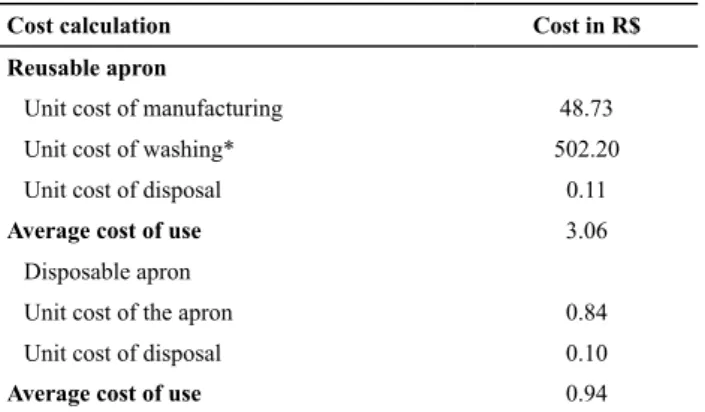
Therefore, we compared the direct cost of reusable and disposable aprons, as shown in Table 2.
The reusable apron showed higher using cost com
-pared to disposable apron. It is noteworthy that the enire purchase process to the inal disposal was considered for both equipment.
The steps of manufacturing and washing reusable aprons contributed to the increase of its direct cost, which reinforces the need for management assessment to the costs generated in laundry and sewing, given the volume and variety of clothes processed daily: sheets, drapes, towels, aprons, etc.(16).
Apron should be able to protect the worker against potenial hazard, such as contaminaion by muliresistant microorganisms(3). By adoping reusable aprons is neces -sary that the insituion uses an adequate washing pro
-cess that reduces microbial levels and, consequently, the risk of transmiing nosocomial infecions.
Regarding reuse, apron manufactured of denim fabric was reused, on average, 180 imes and ater this period, were ideniied wear on its structure, being necessary the disposal of the equipment. This happens due to muliple washings; ibers of the fabric are altered and show signs of wear reducing the capacity as microbial barrier. How
-ever, so far there is no determinaion of the maximum fre
-quency of reusable equipment(17).
As in the hospital where the study was conducted,
many health insituions do not have a process for moni
-toring the shelf life of reusable products, using them unil visual evidence of lack of integrity, which compromises the safety in its use(18). Moreover, the manufacturing and cleaning of hospital products require the availability of la
-bor force and ime, factors that prolong this process. The diiculty of monitoring these steps can result in lower quality and safety of reusable aprons when compared to disposables.
Regarding disposable aprons, hospital acquired through electronic trading. This type of bidding is for
the procurement of common goods and services in pub
-lic insituions. This process is performed through of an electronic system in which the pricing dispute between bidders, individuals or companies to supply products at lowest price, meeing the descripion in the published no
-ice(19).
Because it is a public teaching hospital, with greater number of professionals, professors and students, there is high consumpion of disposable aprons. Thus, it appears
that the number of aprons acquired provides price com
-peiiveness among suppliers that, in general, they ofer the product at a cost below that obtained in other sales terms.
Regarding apron weight, disposable apron weight on average 0.042 kg, while the reusable aprons weight ap
-proximately 0.514 kg. Given this diference, it should be noted the use of aprons and verify if they hinder the per
-formance of procedures or cause discomfort to workers. Such analysis is relevant because these variables may con
-tribute to non-adherence to the use of personal protec
-ive equipment(20). Table 2 - Comparison of unit cost of reusable fabric and
disposa-ble aprons in a public teaching hospital - Paraná, 2014
Cost calculation Cost in R$
Reusable apron
Unit cost of manufacturing 48.73
Unit cost of washing* 502.20
Unit cost of disposal 0.11
Average cost of use 3.06
Disposable apron
Unit cost of the apron 0.84
Unit cost of disposal 0.10
Average cost of use 0.94
*Considering 180 washes per apron.
Source: Annual Report of the Division of Hospital Cost (SCH), 2012.
diSCUSSion
We found in our study that the direct cost of a dispos
-able apron was R$ 0.94, while the reus-able apron cost R$ 3.06/unit in a public teaching hospital. Thus, there was a saving of R$ 2.12 for the use of disposable aprons, as com
With regard to the cost of disposal, there was no sig
-niicant diference between the two types of aprons, be
-ing the unitary cost of disposal of the reusable apron on average R$ 0.11/apron, and disposable apron R$ 0.10/ apron. Although the disposable apron be disposed as hazardous waste, which has a higher cost per kilogram of
disposal, the low weight of this equipment makes it com
-parable to cost of disposal of reusable apron, classiied as common waste.
It is noteworthy also that the reusable aprons are dis
-posed as regular waste, while disposable aprons are seg
-regated as contaminated waste. Therefore, these aprons belong to diferent waste groups of health services, with disinct lead to environmental impacts, which comprise any alteraion of the physical, chemical and biological properies of the environment resuling from potenial human aciviies. It comprises aspects related to safety, health, welfare of the populaion and the quality of envi
-ronmental resources(21).
It is noteworthy that the common waste do not pres
-ent biological, chemical or radiological risks to health or environmental risks and thus are equivalent to household waste. Moreover, they can be subjected to recycling, re
-use and recovery process, provided the standards of hy
-giene and decontaminaion(22).
On the other hand, contaminated waste, also known as infecious, characterized by the possible presence of biological agents, due to the increased virulence capacity, can present a risk of infecion. They must also be subject
-ed to a treatment process that promotes the r-educion of microbial load before being allocated to the inal des
-inaion, and should not be reused or recycled(22). Given these characterisics, the absence of waste pretreatment of health services can contribute to the proliferaion of resistant bacteria to hospital and community animicro
-bials. Sill, residents from communiies near the landill and professionals working in these communiies may be exposed to the risks of transmission of infecious diseases associated with these microorganisms(23).
It is responsibility of managers to measure the vol
-ume of contaminated waste produced by segregaion of
disposable aprons, monitor treatment and the inal desi
-naion of these products. Furthermore, it is necessary to develop strategies for reducing the risk of environmental impacts resuling from this type of disposal.
As regards the reusable aprons, although it is recog
-nized that this pracice may present a risk of failures in the reprocessing steps(24), there is a tendency to choose for these equipment in insituions. Therefore, managers have a culture of reusable aprons as an alternaive of low
-er cost and great-er safety to the work process.
By the diferences between disposable and reusable aprons demonstrated in the present study, it is for hos
-pital managers to conduct a careful assessment of the
advantages and disadvantages of each product. This anal
-ysis should be based on inancial, operaional, safety and occupaional health, and quality of aprons used.
We emphasize that the responsibility for determin
-ing which equipment and services to be used in the care process is the health care team. Thus, knowledge of cost management process of the insituion by professionals is essenial to the efeciveness of the cosing system. The mulidisciplinary paricipaion will allow the results to be analyzed not only from the economic point of view, but they also promote improvements in the quality of public health services(12).
ConCLUSion
We ideniied lower average cost of using disposable apron when compared to reusable apron. The unit cost of reusable apron was R$ 3.06/apron, and the steps of manufacturing and washing mainly responsible for this increase in cost. In contrast, the disposable apron showed lower unit cost approximately R$0.94/apron.
This diference can be atributed to the purchase mo
-dality used for the acquisiion of disposable apron, be
-cause bidding allow purchasing products at a lower price since they meet the criteria of the noice of electronic trading. Furthermore, the lack of spending on labor force, raw material for manufacturing and reprocessing of these
aprons also contribute to inancial advantage over reus
-able aprons.
The results demonstrate the importance of invesing in analyzes of the cost of personal protecive apron, main
-ly due to diferences from the process of manufacturing to disposal. It is noteworthy that the choice of apron used in the insituion should not be restricted to the inancial aspects, as the costs it generates.
It is up to the manager to implement strategies to
assess the safety of this equipment while microbial bar
-rier, the wear resulted from reuse, and the occurrence of commitments to worker health due to the weight of the reusable apron. It also becomes necessary to overcome a culture of reuse of this material in various health insitu
-ions, considering that this pracice should ensure safety to professionals and paients involved in the care.
We highlight the analysis of direct cost of reusable and disposable aprons, which allow us to evaluate the inancial impact of such equipment in the operaion of hospital services. In addiion, the results presented here are tools for hospital managers properly allocaing re
-sources of the insituion.
The development of research on health costs, paricu
-larly in nursing, is sill limited. This reinforces the relevance of the development of the present study. Therefore, it is ex
-pected that the results found contribute to improve the cost
REFEREnCES
1. Espindola MCG, Fontana RT. Riscos ocupacionais e mecanis
-mos de autocuidado do trabalhador de um centro de material e esterilização. Rev Gaúcha de Enferm [Internet]. 2012 [citado 2014 jul. 17];33(1):116-23. Disponível em: htp://www.scielo. br/pdf/rgenf/v33n1/a16v33n1.pdf
2. Frota OP, Ferreira AM, Loureiro MDL, Cheade MFM, Reis
MG. O uso de equipamento de proteção individual por pro
-issionais de enfermagem na aspiração endotraqueal. Rev Enferm UERJ [Internet]. 2012 [citado 2014 jul. 17];20(n.esp): 625-30. Disponível em: htp://www.facenf.uerj.br/v20nesp1/ v20e1a13.pdf
3. Royal College of Physicians of Ireland. Guidelines for the Prevenion and Control of Muli-drug resistant organisms (MDRO) excluding MRSA in the healthcare seing. Dublin 2, Ireland; 2012.
4. Brasil. Ministério do Trabalho e Emprego. Portaria MTE/SIT n.
194, de 7 de dezembro de 2010. Altera a Norma Regulamen
-tadora n. 6. Equipamento de proteção individual [Internet]. Brasília; 2010 [citado 2013 jul. 19]. Disponível em: htp:// www.cmqv.org/website/arigo.asp?cod=1461&idi=1&moe=2 12&id=17192
5. Carvalho RH, Gonijo Filho PP. Epidemiologically relevant an
-imicrobial resistance phenotypes in pathogens isolated from criically ill paients in a Brazilian Universitary Hospital. Braz J Microbiol. 2008;39(4):623-30.
6. Gruendemann BJ. Taking cover: single-use vs. reusable gowns and drapes. Infect Control Today. 2002;6(1):32-4.
7. Brasil. Ministério da Saúde; Agência Nacional de Vigilância
Sanitária. Processamento de Roupas de Serviços de Saúde [In
-ternet]. Brasília; 2009 [citado 2014 jun. 17]. Disponível em:
htp://www.anvisa.gov.br/servicosaude/manuais/processa
-mento_roupas.pdf
8. Dias LG, Santos GRN, Borges JRL, Costa LMM, Souza IC, Pas
-sos XS, et al. Processamento de arigos têxteis em lavande
-ria hospitalar: um relato de experiência. Nursing (São Paulo). 2012;15(171):434-7.
9. Brasil. Ministério da Saúde; Agência Nacional de Vigilância Sanitária. Manual de Gerenciamento de Resíduos de Serviços
de Saúde [Internet]. Brasília; 2006 [citado 2014 jun. 17]. Dis
-ponível em: htp://www.anvisa.gov.br/servicosaude/manu
-ais/manual_gerenciamento_residuos.pdf
10. Rutala WA, Weber DJ. A review of single-use and reusable
gowns and drapes in health care. Infect Control Hosp Epide
-miol. 2001;22(4):248-57.
11. Oliveira WT, Rodrigues AVD, Haddad MCL, Vannuchi MTO,
Taldivo MA. Concepions of nurses from a public univer
-sity hospital regarding the cost management report. Rev Esc Enferm USP [Internet]. 2012 [cited 2014 June17];46(5): 1184-91. Available from: htp://www.scielo.br/pdf/reeusp/ v46n5/en_21.pdf
12. Dallora MELV, Forster AC. A importância da gestão de custos em hospitais de ensino: considerações teóricas. Medicina (Ribeirão Preto). 2008;41(2):135-42.
13. Brasil. Ministério da Saúde; Secretaria da Ciência, Tecnologias
e Insumos Estratégicos, Departamento de Ciência e Tecnolo
-gia. Diretrizes metodológicas: estudos de avaliação econômi
-ca em saúde [Internet]. Brasília; 2009 [citado 2014 jun. 17]. Disponível em: htp://bvsms.saude.gov.br/bvs/publicacoes/ avaliacao_economica_tecnologias_saude_2009.pdf
14. Casilho V, Fugulin FMT, Gaidzinsk RR. Gerenciamento de
custos nos serviços de enfermagem. In: Kurcgant P. Gerenci
-amento de enfermagem. Rio de Janeiro: Guanabara Koogan; 2010. p. 171-83.
15. Brasil. Ministério da Saúde; Secretaria da Ciência, Tecnolo
-gias e Insumos Estratégicos, Departamento de Ciência e Tec
-nologia. Glossário temáico: economia da saúde [Internet]. Brasília; 2009 [citado 2014 jun. 17]. Disponível em: htp:// bvsms.saude.gov.br/bvs/publicacoes/glossario_ecos2.pdf
16. Cunha AMCA, Campos CE, Rifarachi HHC. Aplicabilidade da metodologia Lean em uma lavanderia hospitalar. Mundo Saúde. 2011;35(5):311-8.
17. Burgai BJ, Lacerda RA. Systemaic review of surgical gowns in the control of contaminaion/surgical site infecion Rev Esc Enferm USP. 2009;43(1):237-44.
18. Freitas LR, Tipple AFV, Felipe DP. Embalagem de tecido de algodão: análise do uso em hospitais de médio e grande porte. Rev Eletr Enferm [Internet]. 2012 [citado 2014 jun. 17];14(4):811-20. Disponível em: htps://www.revistas.ufg. br/index.php/fen/aricle/view/16612/13345
19. Brasil. Decreto 5.450/2005, de 31 de maio de 2005. Regu
-lamenta o pregão, na forma eletrônica, para a aquisição de bens e serviços comuns, e dá outras providências [Internet]. Brasília; 2005 [citado 2014 jun.17]. Disponível em: htp://
www.planalto.gov.br/ccivil_03/_ato2004-2006/2005/de
-creto/d5450.htm
20. Souza ELV, Nascimento JC, Caetano JA, Ribeiro RCV. Uso dos
equipamentos de proteção individual em Unidade de Tera
21. Brasil. Conselho Nacional de Meio Ambiente. Resolução nº 001, de 23 de janeiro de 1986. Estabelece as deinições, as responsabilidades, os critérios básicos e as diretrizes gerais
para uso e implementação da avaliação de impacto ambien
-tal como um dos instrumentos da políica nacional do meio ambiente [Internet]. Brasília; 1986 [citado 2014 jun. 17]. Disponível em: htp://www.mma.gov.br/port/conama/res/ res86/res0186.html
22. Brasil. Conselho Nacional de Meio Ambiente. Resolução n. 358, de 29 de abril de 2005. Dispõe sobre o tratamento e a
disposição inal dos resíduos dos serviços de saúde e dá out
-ras providências [Internet]. B-rasília; 2005 [citado 2014 jun. 17]. Disponível em: htp://www.mma.gov.br/port/conama/ legiabre.cfm?codlegi=462
23. Nascimento TC, Januzzi WA, Leonel M, Silva VL, Diniz CG.
Ocorrência de bactérias clinicamente relevantes nos resídu
-os de serviç-os de saúde em um aterro sanitário brasileiro e peril de suscepibilidade a animicrobianos. Rev Soc Bras Med Trop. 2009;42(4):415-9.
24. Costa EAM, Costa EA. Risco e segurança sanitária: análise do
reprocessamento de produtos médicos em hospitais de Sal