ISSN 0100-879X
BIOMEDICAL SCIENCES
AND
CLINICAL INVESTIGATION
www.bjournal.com.br
www.bjournal.com.br
Volume 43 (4) 268-380 April 2011
Braz J Med Biol Res, April 2011, Volume 44(4) 374-380
doi:
A Brazilian family with hereditary inclusion body myopathy associated
with Paget disease of bone and frontotemporal dementia
R.D. Fanganiello, V.E. Kimonis, C.C. Côrte, R. Nitrini and M.R. Passos-Bueno
10.1590/S0100-879X2011007500028
Faculdade de Medicina de Ribeirão Preto Campus
Ribeirão Preto
Institutional Sponsors
The Brazilian Journal of Medical and Biological Research is partially financed by
analiticaweb.com.br S C I E N T I F I C
A Brazilian family with hereditary inclusion body
myopathy associated with Paget disease of
bone and frontotemporal dementia
R.D. Fanganiello
1, V.E. Kimonis
2, C.C.
Côrte
3, R. Nitrini
4and M.R. Passos-Bueno
11Centro de Estudos do Genoma Humano, Departamento de Genética e Biologia Evolutiva, Instituto de Biociências, Universidade de São Paulo, São Paulo, SP, Brasil 2Division of Genetics and Metabolism, Department of Pediatrics, University of California, Irvine, CA, USA 3CLINORT, Fortaleza, CE, Brasil 4Departamento de Neurologia, Hospital das Clínicas, Universidade de São Paulo, São Paulo, SP, Brasil
Abstract
Inclusion body myopathy associated with Paget disease and frontotemporal dementia (IBMPFD) is a progressive and usually misdiagnosed autosomal dominant disorder. It is clinically characterized by a triad of features: proximal and distal myopathy, early onset Paget disease of bone (PDB), and frontotemporal dementia (FTD). It is caused by missense mutations in the valosin-containing protein (VCP) gene. We describe here the clinical and molecular findings of the first Brazilian family identified with IBMPFD. Progressive myopathy affecting the limb girdles was detected by clinical examination followed by muscle biopsy and creatine kinase measurement. PDB was suggested after anatomopathological bone examination and FTD was diagnosed by clinical, neuropsychological and language evaluations. Brain magnetic resonance revealed severe atrophy of the anterior temporal lobes, including the hippocampi. A R93C mutation in VCP was detected by direct sequencing screening in subject W (age 62) and in his mother. Four more individuals diagnosed with “dementia” were reported in this family. We also present a comprehensive genotype-phenotype correlation analysis of mutations in VCP in 182 patients from 29 families described in the literature and show that while IBM is a conspicuously penetrant symptom, PDB has a lower penetrance when associated with mutations in the AAAD1 domain and FTD has a lower penetrance when associated with mutations in the Junction (L1-D1) do-main. Furthermore, the R93C mutation is likely to be associated with the penetrance of all the clinical symptoms of the triad.
Key words: Frontotemporal dementia; VCP gene mutations; Myopathy; Paget disease of bone
Introduction
Correspondence: M.R. Passos-Bueno, Centro de Estudos do Genoma Humano, Departamento de Genética e Biologia Evolutiva, IB, USP, Rua do Matão, 277, Sala 200, 05508-090 São Paulo, SP, Brasil. Fax: +55-11-3091-7966. E-mail: [email protected]
Received September 21, 2010. Accepted February 21, 2011. Available online March 11, 2011. Published April 11, 2011. Hereditary inclusion body myopathy associated with
Paget disease of bone (PDB) and frontotemporal dementia (FTD; IBMPFD, MIM 167320) is a rare, highly penetrant, progressive and ultimately lethal multisystemic disorder. It is characterized by a triad of clinical features: 1) proximal and distal muscle weakness due to myopathy; 2) early age of onset of PDB, and 3) FTD (1,2). Inclusion body myopathy is the most common clinical feature of IBMPFD, occurring in about 90% of the patients. The myopathy is of the adult-onset type and is characterized by progressive distal and proximal muscle weakness initially involving the shoulder and hip girdle muscles. It is accompanied by
dif-ficulty to raise the arms, inability to properly ambulate or
to climb stairs, hand weakness and reduction or absence
of tendon reflexes, thus resembling limb girdle muscular
dystrophy (2,3). In IBMPFD the highest levels of creatine kinase (CK) are typically present at the early stages of the disease. Respiratory and cardiac failure may ultimately lead to death (4).
PDB in IBMPFD has a classical distribution, being pres-ent in the spine, pelvis, scapulae, and cranial bones. Other symptoms associated with PDB are long and cranial bone deformations, pathological fractures and spine and hip pain. Elevated levels of alkaline phosphatase, urine pydridinoline and deoxypydridinoline are also common (1,4).
Brazilian family with IBMPFD 375
concerning social and personal behavior, apathy, abulia, disinhibition, and absence of insight are common (5). Many patients report visual and auditory hallucinations. Drastic alterations in the personality such as impairment of social conduct, aphasia and emotional blunting have also been reported (4).
Other inconspicuous clinical features are
cardiomyo-pathy, hepatic fibrosis, sensorimotor axonal neurocardiomyo-pathy,
and cataracts (6-8).
IBMPFD is inherited as an autosomal-dominant trait. It is caused by missense mutations in the valosin-containing protein gene (VCP, CDC48, or p97), mapped to chromosome 9p21-p12, a member of the type II AAA-ATPase (ATPases Associated with a variety of Activities) family (9). VCP plays fundamental roles in multiple events within the cell such as membrane fusion, nuclear envelope reconstruction, endoplasmic reticulum-associated degradation, post-mitotic Golgi cisternae reassembly, and ubiquitin-proteasome deg-radation. Until now 14 mutations in the VCP gene have been described in more than 150 patients with IBMPFD, and most of them are clustered in the N-terminal domain. To date no correlation between the genotype and phenotype has been observed.
We report the clinical and molecular findings of the first Brazilian family identified with IBMPFD and review all
the previous mutations in VCP reported in the literature, including the mutation reported here to determine if the penetrance of FTD, PDB and myopathy varies according to the location of the mutation.
Subjects and Methods
The study was approved by the Ethics Committee of the Instituto de Biosciências, Universidade de São Paulo, Brazil, and written informed consent was obtained from all participants. We obtained clinical evaluation, review of
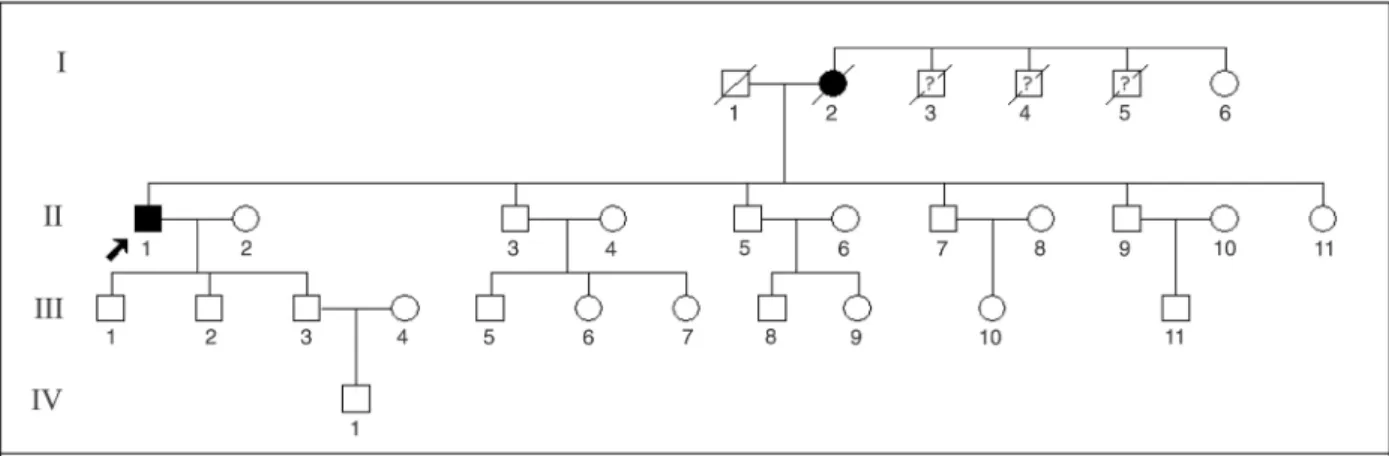
records, analysis of CK, muscle biopsy, and molecular tests for 1 individual (W) and a pedigree diagram for the family (Figure 1). Concerning his deceased mother (N), autopsy was not performed, but a molecular test was obtained since we had isolated her DNA before her death.
Genomic DNA was isolated from venous blood and mutation screening was performed by direct sequencing of PCR products of the coding exons of the VCP gene by the Children’s Hospital Boston Division of Genetics service,
Harvard Medical School, USA. The results were confirmed
at the Human Genome Research Center, University of São Paulo, Brazil.
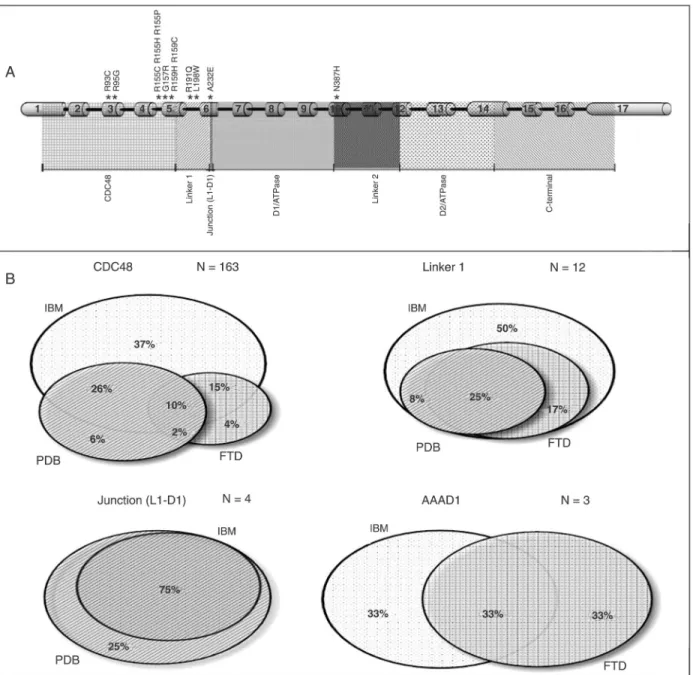
A comprehensive literature review of the reports contain-ing both clinical and molecular details of the patients was performed. Cases containing isolated IBM, PDB, FTD, or combinations of these symptoms were considered. Euler-Venn diagrams comparing the ratio of each symptom in relation to total sample number for mutations occurring in different VCP protein domains (CDC48, Linker 1, Junction (L1-D1), and AAAD1) were prepared.
Results
Clinical and molecular data
Subject W belongs to a multigenerational family that includes 3 deceased individuals with dementia. The patient’s mother, N, died at the age of 81 years, with a 20-year his-tory of progressive dementia. We were unable to evaluate these individuals or to have access to detailed clinical data about them.
Subject W is a 62-year-old university-graduate man with a 7-year history of muscle weakness. Clinical examination revealed muscle weakness of the shoulders and arms, evident proximal weakness, mild lumbar hyperlordosis, and pain in the lower neck. He still walks unaided but has
difficulty to get up from bed or a chair. Tendon reflexes
are present in both upper and lower limbs. Prominent calves were present.
A muscle biopsy of the left quadriceps
muscle showed irregular fiber size with the presence of slight to moderate atrophic fibers. About 5% of the fibers had nuclear central -ization. CK measurements at the age of 56 years ranged from 284 to 572 U/L (normal <100 U/L).
Pathological bone examination of four bone fragments from the L3 vertebral body performed when the subject was 56 years old presented mosaic irregularity of the ce-ment lines in two of them, with intratrabecular
spaces filled with vascular connective tissue,
suggestive of PDB.
Mild behavioral disturbances and cogni-tive decline had started with progressive reduction of initiative and spontaneity, execu-tive dysfunction, topographic disorientation, and forgetfulness when he was 56 years old. A neuropsychological evaluation performed three years later revealed impairment of at-tention and concentration, lack of initiative
and mild difficulty on a multiple-choice face
recognition test. When he was 60 years old his score in the Mini-Mental State Examina-tion (MMSE) was 29, a normal score for his educational level (10,11). Cerebral magnetic resonance done at the age of 60 showed severe atrophy of the anterior temporal lobes, including the hippocampi, with mild diffuse enlargement of the cerebral sulci (Figure 2A-D). Eighteen months later, executive
dysfunction had increased and difficulties in
recognizing friends and well-known people were evident, together with loss of interest in hobbies. His MMSE score was still 29, but mild anomia, moderate verbal and non-verbal
semantic impairments, and moderate to severe prosopag-nosia were detected.
Mutation analysis of the propositus revealed a heterozy-gous nucleotide transition in exon 3 (c.277C
→
T) of the VCP gene resulting in an arginine substitution with cysteine in codon 93 (p.R93C). This substitution is located in thedouble ψ barrel of the N-terminal domain, which could
potentially affect the VCP ubiquitin binding domain. This
mutation was also identified in the mother (subject N) of
the propositus. We were not able to test any other member of the family.
Genotype-phenotype correlations
In order to perform this analysis we considered clini-cal and molecular details of 182 patients from 29 different families described in 13 articles (Table 1). One hundred
and sixty-three (89.6%) of these patients, belonging to 24 families, have mutations in the CDC48 domain of VCP, and 90.8% of these mutations are clustered on exon 5. Twelve patients from 3 different families were reported with mutations in the Linker 1 domain, whereas 4 and 3 patients were reported with a mutation on Junction (L1-D1) and on the AAAD1 domain, respectively, each belonging to one family.
The manifestation ratio of each symptom of the triad may vary depending on the protein domain affected by the mutation, as pictured in the Euler-Venn diagrams (Figure 3). The genotype-phenotype analysis depending on the protein domain containing the mutation shows that IBM is the only clinical symptom conspicuously penetrant, with the lowest penetrance associated with mutations in the AAAD1 domain (66%) and the highest (100%) associated with mutations in
Brazilian family with IBMPFD 377
the Linker 1 domain. PDB showed no penetrance associated with mutations in the AAAD1 domain, full penetrance when associated with Junction (L1-D1) domain and penetrance of 36 and 33% when associated with mutations in the CDC48 and in the Linker 1 domains, respectively. Last, FTD was absent in patients with mutations in the Junction (L1-D1) domain and penetrance varied from 31 to 66% when as-sociated with mutations in the other domains.
Discussion
Patient W presents mild progressive myopathy affect-ing mainly the limb girdles, and PDB with the onset of the symptoms approximately at the age of 55 years. Mild behavioral disturbances and cognitive impairment started to develop at the age of 56 years. This caused progres-sive FTD with features of both the behavioral variant of FTD and of semantic dementia and severe atrophy of the anterior temporal lobes, one of the characteristic features of semantic dementia (12) previously described in cases
of IBMPFD (13).
Therefore, the clinical presentation of this patient
ful-fills the clinical criteria for this condition, which includes
the presence of at least 2 of the symptoms of the triad and a suspicious family history. It is noteworthy that the clinical diagnosis of this patient took several years to be established. Indeed, due to its wide phenotypic variability, IBMPFD is frequently misdiagnosed. Amongst the com-mon misdiagnoses are limb-girdle muscular dystrophy, amyotrophic lateral sclerosis, Alzheimer’s disease, or other types of frontotemporal lobar degenerations and muscular dystrophies.
It should be noted that topographical disorientation as observed in this case is an uncommon complaint in FTD. However, since prosopagnosia and landmark agnosia are frequently associated by both being related to the ventral cortical visual processing stream, it is probable that the topographical disorientation manifested by this patient was caused by landmark agnosia.
The best approach to confirm the clinical diagnosis of
Table 1. Clinical and molecular findings of IBMPFD patients harboring mutations in the valosin-containing protein (VCP) gene.
Mutation Exon Protein domain
No. of families
No. of affected patients evaluated
IBM PDB FTD IBM + FTD
IBM + PDB
PDB + FTD
IBM + PDB + FTD
Ref.
R93C 3 CDC48 1 6 - - 2 1 - 1 2 6
1 1 - - - 1 - - - 13
1 1 - - - 1 8
1 1 - - - 1 Present
article
R95G 3 CDC48 1 6 4 - - 1 1 - - 9
R155C 5 CDC48 2 30 18 - 1 3 4 - 4 9
1 2 - - - 1 1 - - 14
1 1 - - - 1 - - - 15
1 9 3 - 1 5 - - - 6
R155H 5 CDC48 7 78 27 10 3 9 25 - 4 9
1 7 5 - - - 1 - 1 16
1 1 - - - 1 8
R155P 5 CDC48 1 9 3 - - - 5 - 1 9
G157R 5 CDC48 1 4 - - - - 2 2 - 17
R159H 5 CDC48 1 4 - - - - 4 - - 7
R159C 5 CDC48 1 1 - - - 1 - - - 18
1 2 - - - 1 - - 1 19
R191Q 5 Linker 1 1 4 2 - - 2 - - - 19
1 4 2 - - - 2 9
L198W 6 Linker 1 1 4 2 - - - 1 - 1 20
A232E 6 Junction (L1-D1)
1 4 - 1 - - 3 - - 9
N387H 10 AAAD1 1 3 1 - 1 1 - - - 20
IBMPFD is molecular testing for VCP. Indeed, the screen-ing for mutations in the VCP gene in patient W led to the
identification of the p.R93C mutation, which was also
present in his mother. This mutation has been described before in other patients with IBMPFD and compromises an evolutionarily highly conserved arginine residue in the
VCP N-terminal domain. Therefore, its pathogenicity is unquestionable.
It is important to point out that the full-blown phenotype of IBMPFD involves a triad of clinical features, but each of its individual components may have a variable penetrance: generally, inclusion body myopathy is present in 80-90%
Brazilian family with IBMPFD 379
References
1. Guinto JB, Ritson GP, Taylor JP, Forman MS. Valosin-containing protein and the pathogenesis of frontotemporal dementia associated with inclusion body myopathy. Acta Neuropathol 2007; 114: 55-61.
2. Kovach MJ, Waggoner B, Leal SM, Gelber D, Khardori R, Levenstien MA, et al. Clinical delineation and localization to chromosome 9p13.3-p12 of a unique dominant disorder in four families: hereditary inclusion body myopathy, Paget disease of bone, and frontotemporal dementia. Mol Genet Metab 2001; 74: 458-475.
3. Clark G, White E, White D, Carson J. Bibliography of diag-nostic uses of ultrasound in medicine and biology from 1 January 1971. No. 15. Ultrasound Med Biol 1978; 4: 363-391.
4. Kimonis VE, Fulchiero E, Vesa J, Watts G. VCP disease associated with myopathy, Paget disease of bone and fron-totemporal dementia: review of a unique disorder. Biochim Biophys Acta 2008; 1782: 744-748.
5. Miller BL, Ikonte C, Ponton M, Levy M, Boone K, Darby A, et al. A study of the Lund-Manchester research criteria for frontotemporal dementia: clinical and single-photon emis-sion CT correlations. Neurology 1997; 48: 937-942. 6. Guyant-Marechal L, Laquerriere A, Duyckaerts C,
Duman-chin C, Bou J, Dugny F, et al. Valosin-containing protein gene mutations: clinical and neuropathologic features.
Neurology 2006; 67: 644-651.
7. Haubenberger D, Bittner RE, Rauch-Shorny S, Zimprich F, Mannhalter C, Wagner L, et al. Inclusion body myopathy and Paget disease is linked to a novel mutation in the VCP gene.
Neurology 2005; 65: 1304-1305.
8. Hubbers CU, Clemen CS, Kesper K, Boddrich A, Hofmann
A, Kamarainen O, et al. Pathological consequences of VCP mutations on human striated muscle. Brain 2007; 130: 381-393.
9. Watts GD, Wymer J, Kovach MJ, Mehta SG, Mumm S, Darvish D, et al. Inclusion body myopathy associated with Paget disease of bone and frontotemporal dementia is caused by mutant valosin-containing protein. Nat Genet
2004; 36: 377-381.
10. Brucki SM, Nitrini R, Caramelli P, Bertolucci PH, Okamoto IH. [Suggestions for utilization of the Mini-Mental State Ex-amination in Brazil]. Arq Neuropsiquiatr 2003; 61: 777-781. 11. Folstein MF, Folstein SE, McHugh PR. “Mini-Mental State”.
A practical method for grading the cognitive state of patients for the clinician. J Psychiatr Res 1975; 12: 189-198. 12. Pereira JM, Williams GB, Acosta-Cabronero J, Pengas G,
Spillantini MG, Xuereb JH, et al. Atrophy patterns in histo-logic vs clinical groupings of frontotemporal lobar degenera-tion. Neurology 2009; 72: 1653-1660.
13. Krause S, Gohringer T, Walter MC, Schoser BG, Reilich P, Linn J, et al. Brain imaging and neuropsychology in late-onset dementia due to a novel mutation (R93C) of valosin-containing protein. Clin Neuropathol 2007; 26: 232-240. 14. Gidaro T, Modoni A, Sabatelli M, Tasca G, Broccolini A,
Mira-bella M. An Italian family with inclusion-body myopathy and frontotemporal dementia due to mutation in the VCP gene.
Muscle Nerve 2008; 37: 111-114.
15. Schroder R, Watts GD, Mehta SG, Evert BO, Broich P, Fliessbach K, et al. Mutant valosin-containing protein causes a novel type of frontotemporal dementia. Ann Neurol 2005; 57: 457-461.
16. Viassolo V, Previtali SC, Schiatti E, Magnani G, Minetti C,
of the affected individuals, PDB is estimated to be present in 43-51% of IBMPFD cases and FTD is usually the latest clinical feature to manifest, at about 51-54 years of age, present in 30% of cases (9). In contrast, there are no data showing if the penetrance of each symptom of the triad varies according to the location of the mutation. Although in the present study it was not possible to apply statistical analysis due to the small number of patients, we observed that the penetrance of IBM, FTD and PDB differed among the 4 groups: while IBM had a conspicuous penetrance independently of the mutated protein domain, FTD had lower penetrance when associated with mutations in the Junction (L1-D1) domain and PDB had lower penetrance when associated with mutations in the AAAD1 domain.
Since all the mutations may influence VCP binding to adap
-tor proteins and in agreement with the findings that VCP
mutants R155H and A232E appropriately form a hexamer, it is possible that, depending on the protein domain and on the tissue, mutations may enhance association with a
specific set of adaptors, favoring penetrance of some clinical
manifestations in spite of others. Description of additional new cases will be important to validate these preliminary observations.
In addition, comparing the clinical features of the patient described here to those of the other patients harboring the R93C mutation in the VCP gene described in the literature
(6,13) we find a complete penetrance of the triad, sug -gesting that this mutation might be associated with a high penetrance of the full major clinical features. Nevertheless, a larger number of patients with this same mutation and with a detailed clinical evaluation is needed in order to corroborate this hypothesis.
Acknowledgments
Zara F, et al. Inclusion body myopathy, Paget’s disease of the bone and frontotemporal dementia: recurrence of the VCP R155H mutation in an Italian family and implications for genetic counselling. Clin Genet 2008; 74: 54-60. 17. Djamshidian A, Schaefer J, Haubenberger D, Stogmann E,
Zimprich F, Auff E, et al. A novel mutation in the VCP gene (G157R) in a German family with inclusion-body myopathy with Paget disease of bone and frontotemporal dementia.
Muscle Nerve 2009; 39: 389-391.
18. Bersano A, Del Bo R, Lamperti C, Ghezzi S, Fagiolari G, Fortunato F, et al. Inclusion body myopathy and frontotem-poral dementia caused by a novel VCP mutation. Neurobiol
Aging 2009; 30: 752-758.
19. Spina S, Van Laar AD, Murrell JR, de Courten-Myers G, Hamilton RL, Farlow MR, et al. Frontotemporal dementia associated with a valosin-containing protein mutation: Re-port of three families. FASEB J 2008; 22 (Meeting Abstract Supplement): 58.4.