RESEARCH
J. res.: fundam. care. online 2014. dez. 6(supl.):10-21
10
Conhecimento e prática de profissionais sobre conservação de vacinas Knowledge and professional practice on conservation of vaccines Conocimiento y práctica profesional en la conservación de las vacunas
Malena Gonçalves Almeida1, Telma Maria Evangelista Araújo2, Benevina Maria Vilar Teixeira Nunes3,
Maria Eliete Batista Moura4, Maria do Carmo de Carvalho e Martins5
Objective: To assess knowledge and practices for the conservation of biological products for professional rooms vaccine in Piauí. Method: Study developed in 23 rooms vaccine in 14 counties. Data were collected through interviews, observation and document analysis. Univariate analyzes were performed. Results: In the 23 rooms vaccines visits, 86.2 % were technical professionals/nursing assistant, 93.1 % received training in vaccination, 62.1 % were under five years of work in vaccine. The majority (69 %) had knowledge "Regular" and practice "Inadequate" (65.5 %). Knowledge "Inappropriate" was observed in those with longer formed (17.4 years) and a longer duration of vaccine units (7 years). However the practice classified as "Regular" was observed among those who had more time working in vaccine (8.3 years). Conclusion: It is important to invest in the training of these professionals, since the knowledge and practice were not considered satisfactory . Descriptors: Vaccines, Immunization, Nursing.
Objetivo: Avaliar conhecimentos e práticas adotadas para conservação de imunobiológicos por profissionais de salas de vacina no Piauí. Método: Estudo desenvolvido nas 23 salas de vacina de 14 municípios. Os dados foram coletados por meio de entrevistas, observação e análise documental. Foram realizadas análises univariadas. Resultados: Nas 23 salas de vacinas visitadas, 86,2% dos profissionais eram técnico/auxiliar de enfermagem,93,1% receberam treinamento em vacinação, 62,1% tinham até cinco anos de trabalho em sala de vacina. A maioria (69%) apresentou conhecimento “Regular” e prática “Inadequada” (65,5%). O conhecimento “Inadequado” foi observado naqueles com maior tempo de formado (17,4 anos) e um maior tempo de sala de vacina (7 anos). Em contrapartida a prática classificada como “Regular” foi observada entre os que tinham maior tempo de trabalho em sala de vacina (8,3 anos). Conclusão: É importância investir na capacitação desses profissionais, uma vez que o conhecimento e a prática não foram considerados satisfatórios. Descritores: Vacinas, Imunização, Enfermagem.
.
Objetivo: Evaluar los conocimientos y prácticas para la conservación de productos biológicos para la vacuna habitaciones profesional en Piauí. Método: Estudio desarrollado en la vacuna de 23 habitaciones en 14 condados. Los datos fueron recolectados a través de entrevistas, observación y análisis de documentos. Se realizaron análisis univariados. Resultados: En las 23 habitaciones vacunas visitas, el 86,2 % eran técnicos profesionales asistente / de enfermería, 93,1 % recibió capacitación en vacunación, 62.1 % tenían menos de cinco años de trabajo en la vacuna. La mayoría (69 %) tenía conocimiento "Regular" y la práctica " inadecuada " (65,5 %). Conocimiento " inapropiado" se observó en aquellos con más formada (17,4 años) y una mayor duración de las unidades de vacunas (7 años). Sin embargo, la práctica de clasificar como " regular " se observó entre los que tenían más tiempo trabajando en la vacuna (8,3 años). Conclusión: Es importante invertir en la formación de estos profesionales, ya que el conocimiento y la práctica no se consideraron satisfactorios. Descriptores: Vacunas, Inmunización, Enfermería.
1Fisioterapeuta. Mestre em Saúde da Família pelo Centro Universitário UNINOVAFAPI. Teresina – Piauí - Brasil.
E-mail: [email protected]. 2Doutora em Enfermagem pela Escola de Enfermagem Anna Nery da
Universidade Federal do Piauí. Professora do Departamento de Enfermagem da UFPI. Teresina – Piauí - Brasil. E-mail: [email protected]. 3Enfermeira. Doutora em enfermagem pela UFRJ. Professora do Programa de
Pós-Graduação e Mestrado em Enfermagem da UFPI. Teresina – Piauí – Brasil. E-mail: [email protected].
4Enfermeira. Doutora em Enfermagem pela UFRJ. Professora da Graduação e do Programa de Pós-Graduação e
Mestrado em Enfermagem da UFPI. Coordenadora do Programa de Mestrado Profissional em Saúde da Família do Centro Universitário UNINOVAFAPI. Teresina – Piauí – Brasil.E-mail: [email protected].
5Nutricionista. Doutora em Ciências Biológicas pela UFPE. Professora da Graduação e do Programa de Mestrado
Profissional em Saúde da Família do Centro Universitário UNINOVAFAPI. Professora da UFPI. Teresina-PI. Brasil. E-mail: [email protected].
ABSTRACT
RESUMEN RESUMO
J. res.: fundam. care. online 2015. 2014. dez. 6(supl.):10-21
11
v
accination occupies undoubtedly a prominent place among the instruments used by public health policies in an attempt to decrease the morbidity and mortality from vaccine-preventable diseases. Besides its effectiveness in saving lives, vaccines have a higher cost-effectiveness in preventing disease when compared to other interventions in health care.¹Vaccination strategies in Brazil, have achieved high levels of efficiency and served as a model for other countries. Currently the actions of immunization are implanted throughout the national territory, offering minimum basic scheme for the population at different stages of life (child, adolescent, adult, elderly and pregnant women), protecting it against epidemiologically relevant diseases.²
However, immunobiologicals require adequate cooling, among other precautions to keep their immunizing capacity, which is extremely important to maintenance of Cold Chain to ensure the quality of the vaccines offered.³ Therefore, it is recommended that the vaccine rooms maintain maximum ambient temperature of 22 º C, refrigerator with a minimum capacity of 280 liters internal temperature between +2 ° C and +8 ° C and analog or digital thermometers, with extender cable or not.4 Also with respect to refrigerators, it is
important highlight that its exposure to sunlight influences the maintenance of internal temperature may cause risk to the immunogenicity of vaccines, since they are sensitive to light.5
Studies3,5 have reported the lack of knowledge of the professionals about
temperature intervals suitable for vaccine storage, the absence of thermometers or daily monitoring of temperatures, and also warned of inadequate organization of refrigerators and not exclusivity of them to store vaccines. Study6 conducted in Campinas observed the
nonconformity of the equipment available in the Basic Health Units, where 21% had bad state of conservation and 7.6% had no ideal state of operation.
Therefore, for the vaccines achieve the desired efficiency they need to be handled safely, before and during his administration in the population. That is as important as the act of providing the vaccine, to administer the immunobiological and reach the entire target population, maintenance of product quality is fundamental.7
From this perspective, it is relevant the specific technical preparation of professionals responsible for preparing rooms vaccine, since it is their responsibility to maintain the quality of immunobiologicals at the local level, since its receipt to the administration.3,8 The safety, knowledge and proper practice are essential in performing all
procedures related to this activity, which is possible through the implementation of training processes, adapting them to the new reality of the National Immunization Program (NIP), as well implantation of continuous and systematic monitoring processes7,8. Thus, it is of
J. res.: fundam. care. online 2015. 2014. dez. 6(supl.):10-21
12
METHOD
fundamental importance to the success of immunization programs, monitoring and evaluation of activities developed by those responsible for this action.9,10
The Immunization Program is essentially exercised by nursing professionals, being responsible for the management and delivery of immunobiologicals to the described the population, which leads to the need for supervision and monitoring of the work process by nurses.11,12 Research conducted in the state of São Paulo¹³ also indicates the importance of
systematic surveillance, not only contemplating organizational and educational aspects, but to improve the humanization of care in vaccine.
According to the State Coordination of Immunization in the state of Piaui is still frequent the observation of inappropriate practices, which may bring harm to users and discredit the vaccine. It is noteworthy that the flaws in the implementation of existing recommendations for the preservation of vaccines in the local instance have been frequent, despite several trainings aimed at its employees, promoted by the Secretary of Health of Piauí and municipalities.14 However, there are no data on the evaluation of acquired
knowledge and practice performed in the rooms of vaccine from the trainings conducted. Based on these, this study aimed to assess the knowledge and practice adopted for the conservation of immunobiologicals by professional of vaccine room from municipalities which comprise a health region of Piauí.
The study was conducted in the rooms of the vaccine Basic Health Units of the 14 municipalities that compose the Vale do Sambito territory, in Piauí. The region has 59 rooms vaccine, including 23 fixed rooms in urban and rural areas and 36 virtual. However, they were included in the study only rooms fixed vaccine. For purposes of this study, are defined as fixed rooms, those that besides registered by municipalities, have physical structure, equipment and employees specifically crowded and has the same operating system in at least two daily shifts, Monday to Friday.
Were excluded from the study only the virtual rooms that match those that even registered, have no physical structure, equipment and employees specifically blended in the same, but use spaces of service of the Family Health Strategy (FHS), which are performed vaccination activities on fixed dates, previously scheduled with the population of a given area.
The study population was composed of nursing professionals working in the rooms vaccine included in research. Considering that each room has at least one professional, 29 were investigated, because only six of them had more than one.
Data were collected in the period September-October 2012 the very author of the study and the nurses from the State Coordination of the NIP, after previously having been instructed.
J. res.: fundam. care. online 2015. 2014. dez. 6(supl.):10-21
13
RESULTS AND DISCUSSION
The procedures were performed by three different techniques: interviews by the application form, with some semi-open and closed questions. The instrument was adapted from a standard form adopted for supervision by the NIP. Next was applied the technique of observation to the refrigerators, coolers and the thermometers of vaccine rooms as well as the handling of the same, recorded in a standardized script, also adapted from NIP. The third and final stage consisted of document analysis, all existing forms being observed in vaccine rooms for the conservation of the same.
Descriptive analyzes were performed through the distribution of the categories of the study variables. Were considered independent variables, time since graduation and working time in vaccine room and, as dependent variables, the classification of the knowledge and practice.
To sort the knowledge of professionals the study in relation the conservation of vaccines, were analyzed responses to a set of questions of the form, which have assessed the knowledge and later scores were assigned. Taking as a reference performed in Teresina study in this subject area9, each response considered entirely correct, that is, in agreement
with the NIP15 worth one point. Thus, knowledge was categorized into three class intervals,
as the percentage of correct answers of: ADEQUATE (90-100%); REGULAR (70-89%) and INADEQUATE (less than 70%).
To classify the practice, were observed conduct related to the conservation of vaccines and whether were in accordance with the guidelines of NIP. Therefore, each item of the observation form correctly performed, got a point. Thus, the practice was also categorized into three class intervals, as the percentage of correctness of conduct: ADEQUATE (90-100%); REGULAR (70 to 89%) and INADEQUATE (less than 70%).
Data were entered and analyzed using the Statistical Package for the Social Sciences application (SPSS) version 18.0. Univariate and bivariate analyzes were performed. The Kruskal-Wallis test was used to observe the variables with three categories and the Mann Whitney test for those who had two categories. Statistical significance was set at p ≤ 0.05, with a confidence interval of 95%.
The study was approved by the Ethics Committee in Research of the Federal University of Piauí (CAAE: 07381812.2.0000.5214). All ethical precepts contained in Resolution 196/96 of the National Health Council were respected16. To the participants was
requested signing the Term of Free and Informed Consent after the due explanations about the aims of the study, its risks and benefits, discomforts, and all guaranteed anonymity, confidentiality and privacy, as well as the previously required to permission of the Municipal Health, municipalities where the research was conducted.
It was found that in 23 rooms visited all professionals who performed the vaccination had technical training or nursing assistant. In only four of the rooms counted with the presence of nurses (Table 1).
J. res.: fundam. care. online 2015. 2014. dez. 6(supl.):10-21
14
With regard to the time of formation, it was found that 65.5% of professionals had six or more years after graduation and 34.5% were under five years. As for time worked in vaccine, 62.1% have up to five years and 37.9% worked for six years or more, and 27 of them are exclusive of room and two did not.In respect to receiving training in vaccine room, 27 responded positively and only two reported never having participated in training. Among those who had participated in specific technical training in vaccination, 86.2% reported having made just a year ago and 6.9% for more than two years.
Table 1. Description of the study population. Teresina / PI 2012 (n = 29).
Legend: : Medium, ± standard deviation: 95% CI, Confidence intervals of 95%.
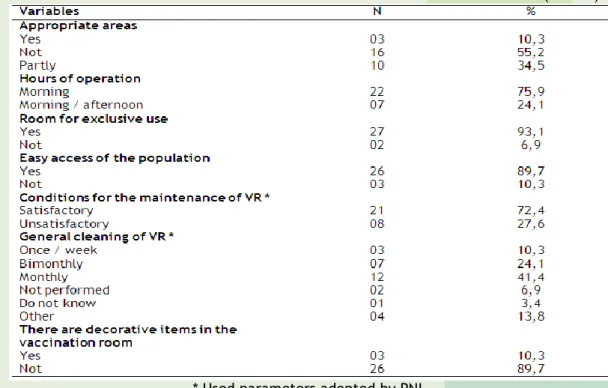
It was observed that most vaccine rooms (75.9%) only worked the morning shift and only seven worked full time. It was also found that 27 rooms were exclusively used for vaccination (Table 2). However, two were used for other purposes besides vaccination.
Concerning access to the rooms by the population, it was found that almost all had good location within the health facility (89.7%). The conditions for the maintenance, in 21 (72.4%) of them satisfactory situation was observed, in 41.4% the general cleaning was done only once a month and only 24.1% were every two weeks. In 89.7% of the rooms there were no decorative objects (Table 2).
Table 2. General Characteristics of rooms vaccine. Teresina / PI 2012 (n = 29)
J. res.: fundam. care. online 2015. 2014. dez. 6(supl.):10-21
15
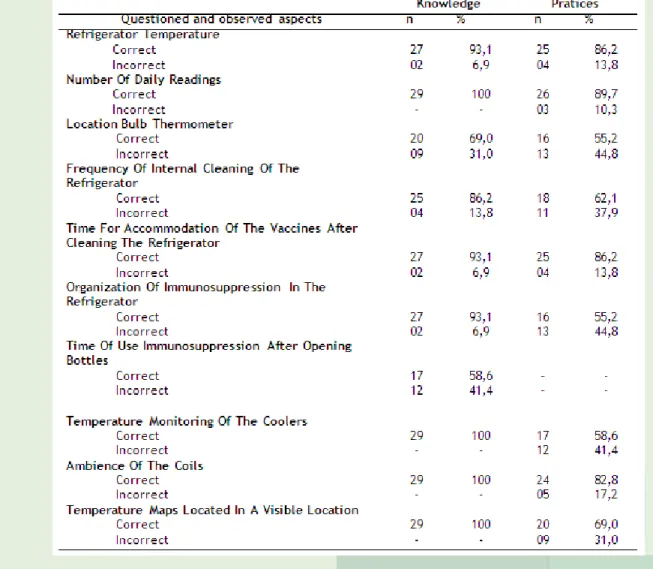
According to Table 3, it was found that 93.1% of the investigated professional showed correct knowledge from the refrigerator temperature and 86.2% maintained it at with the proper temperature. All (100%) knew how many readings should be done daily, but only 89.7% did. The location of the bulb of the thermometer was known for 69% of them, however slightly more than half placed in the proper location.Regarding the organization of the immunobiological in the refrigerator,93.1% provided the correct information and only 55.2% had the correct practice. More than half the population knew about the time of use of the vaccines after opening of the bottles, but it was not possible to assess the practice.
As for monitoring the temperature of coolers, setting the ice coils and convenient location for the temperature maps, 100% of the professionals surveyed had adequate knowledge. However, the right practices were observed in 58.6%, 82.8% and 69%, respectively.
Table 3. Knowledge and practices of the study population related to the conservation of the vaccine. Teresina / PI - 2012.
It was observed that most professionals (69%) showed knowledge classified as "Regular". High percentage (24.1%) had inadequate knowledge. The practice of expressive most investigated was classified as inadequate (Table 4).
J. res.: fundam. care. online 2015. 2014. dez. 6(supl.):10-21
16
Table 4. Classification of knowledge and practice of conservation vaccine of the sample (n = 29).In Table 5, it was found that those professionals who had knowledge "inappropriate" had higher mean time since graduation (17.4 years) and longest period of vaccination room (7 years).
When crossing the dependent variable "Practice" of the professional and independent variables time after graduation and working time in vaccine, it was observed that those with Practice "inadequate" had higher mean time since graduation (12.3 years). In contrast, those who had more time working in vaccine room (8.3 years) were classified as those who presented regular practice.
Table 5. Analysis of variance between the variables of time since graduation and working time in vaccine room with the classification of knowledge and practice. Teresina / PI, 2012.
* The p value was obtained using the Kruskal-Wallis test. Statistical significance was set at p ≤ 0.05. The Vaccination is an important measure to reduce the mortality rate from preventable diseases, ranging between interventions with the best cost-effective.4,17
In the vaccine rooms object of this research, maintaining the quality of immunobiological is a exclusive activity of the nursing staff, which requires, on the part of these professionals, specific knowledge and training so that the service offered is quality.14,18
In this study, there was a predominance of nurse technicians and assistants. Most of these professionals had five years of experience in vaccine rooms and in less than a year had received specific training in vaccine, which diverged of study14 where most
professionals had more than five years of experience and had no attended training in the last year. It is noteworthy that human resources the vaccination room needs to be constantly engaged in continuing education processes that include policies, procedures and other technical aspects related into the rooms of vaccine, since the knowledge related to immunization is very dynamic.
Another point worth mentioning concerns the lack of supervision to the work of the nursing staff of the vaccine rooms by nurses. In only four of them it was found a technical lead. The processes of permanent education are fundamental, but it is undeniable the importance of supervision to guarantee the quality of services provided.
J. res.: fundam. care. online 2015. 2014. dez. 6(supl.):10-21
17
Regarding the physical structure of the rooms of the study, it was observed that most of them were easily accessible to the population, but few had the physical area as recommended by PNI. The rooms vaccine should be easy to access and visualization, so that the user do not need carry over into other dependencies of UBS, and shall have a minimum area of 9 m² space needed to accommodate the furniture, equipment, staff and users.With regard to the general cleaning of the rooms of vaccines, most of them follow the recommendation of doing it at least once a month. In most of them there were no decorative objects, which differed from another study14 where 91.3% of the rooms had
children's drawings and informational signs posted on the walls. As important, the existence of basic equipment, qualified personnel, sufficient quantity immunobiologicals, is the proper physical structure to attend the safest and most comfortable way possible to the population.17
The literature states that the vaccine rooms should be exclusively used for vaccination, the realization of other procedures in this sector is not allowed. It was observed that only two study participants responded using the site for other purposes, besides vaccination, as the administration of injectable medications and the use of the room to meet the nutritionist. Similar findings were found in another study in the city of São Luís, where most of them were exclusively for the storage of biopharmaceuticals. The refrigerators must also be used exclusively for the storage and preservation of immunobiologicals and for that is recommended to use coils of ice in the freezer and bottles with water dyed in the basin of refrigerators.21,22 This procedure is important because it
contributes to the slow temperature rise in case of power failure or malfunction of equipment.19
The internal organization in the refrigerator is crucial for the proper conservation of immunobiologicals and consequently the guarantee of the effectiveness of vaccination. When questioned about the organization of immunobiologicals in the refrigerator, most surveyed answered correctly. However, when inspecting the refrigerator, it was found that mostly they were not correctly arranged. These data differ from those found in a study²³ in the city of São Paulo, where about 70% of the refrigerators had immunobiological stored properly.
Cleaning and defrosting refrigerators are also important aspects in vaccine storage. According to the rules the PNI19, the cleaning of refrigerators should be performed every
two weeks or when ice thickness reaching 1.0 cm. In this study, more than half of respondents perform professional cleaning refrigerators within fifteen days. These results were similar to those found in other studies.3,15
The not ambiance of the coils can contribute to the exposure of immunobiological to temperature variations and consequent inactivation of immunogenic components.19 It was
found that most respondents reported performing ambiance of the coils, which diverged from the UBS study³ of a city in the Midwest region of Minas Gerais.
It is noteworthy that the temperature of the refrigerator was monitored at least twice daily, being observed the records of maximum and minimum. However, the same control was not applied to coolers. The vaccines are temperature sensitive products. Exposure to heat or freezing of vaccines can reduce their validity time or effectiveness.
J. res.: fundam. care. online 2015. 2014. dez. 6(supl.):10-21
18
CONCLUSION
Therefore, it is extremely important to monitor the temperature of both the refrigerator as the cold box.
As in other studies3,5 , many professionals surveyed demonstrated not know the ideal
time to use of most vaccines after opening their bottles. This time is crucial for the effectiveness of action of immunobiological. Probably, this result is due to the fact that recent changes adopted by manufacturers of some vaccines. Therefore, because of rapid inclusion of new vaccines and new recommendations, it becomes essential to implement and update the professionals responsible for this demand in health.19
The successful conservation and storage of immunobiological depends on the work of professionals responsible for vaccination. Are not sufficient safety and efficacy in the production of immunobiological, if health professionals do not operationalize them in accordance with specific recommendations.5,20 Therefore, it is essential that professionals
who work in vaccine rooms has adequate technical and scientific knowledge, so that they can perform the job safely and act in the best way. In the present study, it was observed that the knowledge of professionals rooms vaccine was mostly considered regular. However, the practice has been considered inappropriate. Considering that many of them had participated in recent training processes, it can be inferred that supervision needs to be more present.
When we analyzed the relationship of knowledge with time since graduation and with time working professionals in vaccine, those who had knowledge considered "inappropriate" had more time of formed and more time in vaccine room. This finding can be attributed to the difficulty that some may present to accept changes.
It was also observed that those professionals who had more time of graduated had an "inappropriate" practice within the vaccine room. But those who worked a longer time presented a practice considered "regular." Probably, this is due to the fact that those with longer time of formed are those with greater age and, mostly, are the most resistant to change. The longer time in vaccine room can promote greater experience in dealing with them.
A limitation in this study was the failure to observe the practice regarding the use of vaccines after opening the bottle. It was not possible to observe such a situation, since the residence time in each vaccine room was only one day. Considering the size of the study population, it was also not possible to perform statistical tests to identify possible association between knowledge and practice with training in vaccine, since only two were not screened.
The control of vaccine-preventable diseases cannot be credited only to the high and wide vaccine coverage. The handling, storage / packaging and transport of immunobiological under appropriate conditions are essential factors to the success of the
J. res.: fundam. care. online 2015. 2014. dez. 6(supl.):10-21
19
REFERENCES
NIP, which requires, among other requirements, the involvement of nursing staff trained specifically for this purpose.
The results of this study have highlighted that the rooms vaccine are operationalized by technicians and nursing assistants, which amounted to 86.2%, mostly without the supervision of nurses. In just four rooms showed the presence of a nurse on condition of supervisor / responsible technician. It was also found that 65.5% had six or more years of graduates, 93.1% had received specific training on vaccination and 86.2% of the trainings had been held for less than two years.
It was found that 89.7% of the investigated rooms are easy to access, yet only 10.3% of them have adequate size, 6.9% are not exclusive and a significant percentage (75.9%) have functioning only in the morning shift, which contradicts the recommendations of the PNI. Restrict the functioning of a vaccine room to a single shift is an attitude that leads to the widening of missed vaccination opportunities.
Regarding knowledge and practices in vaccine, a dissonance between them was found. Despite the knowledge presented by 86.2% to 100% of the study population were sufficient reasons for the various aspects related to the conservation of vaccines, it does not endorsed the practices so that they are performed correctly, since only 55.2% to 89.7% were held in accordance with the recommendations of the PNI. Thus, 24.1% were classified as inadequate knowledge, this is, with the corresponding percentage of less than 70%, while accuracy for the practice was attributed to inadequate 65.5% of the investigated.
No statistically significant association was found between knowledge and practice conservation of vaccine, with the service time and the time of formation.
It is noteworthy that the role of the professional nurse is critical at all stages of the conservation process of vaccines. From this perspective, it is called attention to the importance of their presence, through continual supervision to rooms of vaccine in order to demonstrate that as nursing team leader, holds the responsibility for the safety and quality of immunobiologicals.
1. Luhm RK. Cobertura vacinal e fatores associados à situação vacinal em Curitiba. Tese [doutorado] - Universidade Federal de São Paulo, São Paulo, 2008.
2. Brasil, Ministério da Saúde. [site da Internet]. 2010 [acessado 2012 out 10]. Disponível
em: http:// portal.saude.gov.br/portal/aplicacoes/noticias/
default.cfm?pg=dspDetalheNoticia&id_area=124&CO. Acesso em: 12 mai 2011.
3. Oliveira VC, Guimarães EAA, Guimarães IA, Januário LH, Pinto IC. Prática da enfermagem na conservação de vacinas. Acta paul.enferm, São Paulo, v.22, n.6, p.814-18, 2009.
4. Brasil, Ministério da Saúde. Secretaria de Vigilância em Saúde. Manual de Rede de Frio. 4 ed. Brasília: Ministério da Saúde, 2007.
J. res.: fundam. care. online 2015. 2014. dez. 6(supl.):10-21
20
5. Queiroz AS, Moura ERF, Nogueira PSF, Oliveira NC, Pereira MMQ. Atuação da equipe de enfermagem na sala de vacinação e suas condições de funcionamento. Rev.Rene. Fortaleza, v.10, n.4, p.126-35, out/dez, 2009.6. Ribeiro DO, Castro F, Ferreira GC, Santos JC, Coutinho RMC. Qualidade da conservação e armazenamento dos imunobiológicos da rede básica do Distrito Sul de Campinas. J Health SciInst.; v.28, n.1, p.21-8, 2010.
7. Vanini M, Casarin ST, Thumé E. Armazenagem e conservação dos imunobiológicos em unidades de saúde. XVI Congresso de Iniciação Científica: pesquisa e responsabilidade social, 2007. Disponível em: http://www.ufpel.edu.br/cic/2007/cd/pdf/CS/CS_00141.pdf. Acesso em 16 jul 2012.
8. Araújo TME. Vacinação Infantil: conhecimentos, atitudes e práticas da população da Área Norte/Centro de Teresina/PI. 2005. 95 f. Tese (Doutorado em Enfermagem) – Universidade Federal do Rio de Janeiro, Escola de Enfermagem Anna Nery, Rio de Janeiro, 2005.
9. Waldman EA, Freitas FRM, Sato HK, Aranda CMSS, Arantes BAF, Pacheco MA. Eventos adversos pós-vacina contra difteria, coqueluche e tétano e fatores associados à sua gravidade. Rev. Saúde Pública, São Paulo, v.41, n.6, p. 1032-41, 2007.
10. Vasconcelos KKE, Rocha A, Ayres JÁ. Avaliação normativa das salas de vacinas na rede pública de saúde do município de Marília, Estado de São Paulo, Brasil, 2008-2009. Epidemiol. Serv. Saúde, Brasília, v.21, n.1, p.167-76, jan-mar, 2012.
11. Luna GLM, Vieira LJES, Souza PF, Lira SVG, Moreira DP, Pereira AS. Aspectos relacionados à administração e conservação de vacinas em centros de saúde no Nordeste do Brasil.Ciênc. saúde coletiva. Rio de Janeiro, v.16, n.2, p.513-21, fev., 2011.
12. Mitchell AD, Bossert TJ, Yip W, Mollahaliloglu S. Health worker densities and immunization coverage in Turkey: a panel data analysis. Human Resources for Health, 2008. Disponível em: http:// www.human-resources-health.com/content/6/1/29. Acesso em 12 jul 2012.
13. Escobar EMA, Adami NP, Silva CV. Avaliação da qualidade da rede de frio do Programa de Imunização de Vinhedo-SP. Acta Paul Enf, São Paulo, v.15, n.3, p. 7-14, 2002.
14. Brasil, Ministério da Saúde. Sistema nacional de vigilância em saúde relatório de situação. Coordenação Estadual de Imunização do Piauí. Brasília: Ministério da Saúde, 2011. 15. Brasil, Ministério da Saúde. Secretaria de Vigilância em Saúde. Coordenação-Geral do Programa Nacional de Imunizações. Manual de rede de frio / Ministério da Saúde, Secretaria de Vigilância em Saúde, Departamento de Vigilância Epidemiológica, Coordenação-Geral do Programa Nacional de Imunizações; elaboração Cristina Maria Vieira da Rocha et al .4ª ed. Brasília: Ministério da Saúde, 2011.
16. Brasil, Ministério da Saúde. Comissão Nacional de Ética e Pesquisa. Conselho Nacional de Saúde. Manual Operacional para Comitês de Ética em Pesquisa. Séri
Técnicos, série A, Normas e Manuais Técnicos, n. 133. Brasília; 2002. 83-91p.
17. Brasil, Ministério da Saúde. Secretaria de Vigilância em Saúde. Coordenação-Geral do Programa Nacional de Imunizações. Manual de rede de frio / Ministério da Saúde, Secretaria de Vigilância em Saúde, Departamento de Vigilância Epidemiológica, Coordenação-Geral do Programa Nacional de Imunizações; elaboração Cristina Maria Vieira da Rocha et al .4ª ed. Brasília: Ministério da Saúde, 2011.
J. res.: fundam. care. online 2015. 2014. dez. 6(supl.):10-21
21
18. Molina PO, Arbiza PA, Vicente RA, Rábago MLG, Pardo JRJ, Rojas VD. Cadena del frio para la conservación de lãs vacunas em lós centros de atención primaria de una area de Madrid: mantenimiento y nível de conocimientos. Rev. Esp. Salud publica. Madrid, v.76, n.4, p. 333-46, 2002.19. BRASIL, Ministério da Saúde. Fundação Nacional de Saúde. Manual de Rede de Frio. 3ª ed. Brasília: Funasa, 2001.
20. Sousa VEC, Lira MRS, Gomes RIB. Avaliação do Funcionamento de Salas de Vacina na Rede Básica de Saúde de São Luis. Florence em revista. São Luis/MA: v. 1, n.1, mai, 2011. 21. Almeida MM. Conservação e manipulação de imunobiológicos. In: Farhat CK, Carvalho ES, Weckx LY, Carvalho LHF, Succi RCM, editores. Imunizações: fundamentos e prática. 4a ed. São Paulo: Atheneu; 2000. P. 125-35.
22. Aranda CMS. Avaliação do conhecimento e práticas adotados na conservação dos imunobiológicos utilizados na rede pública do município de São Paulo. [Dissertação], São Paulo: Secretaria da Saúde, Coordenadoria de Controle de Doenças, 2005.
23. Wecky LY, Carvalho LHFR, Farhat CK, Succi RCM. Imunizações _ fundamentos e práticas. 5ª ed. Rio de Janeiro: Atheneu, 2008.
Received on: 01/08/2014 Required for review: No Approved on: 01/12/2014 Published on: 20/12/2014
Contact of the corresponding author: Malena Gonçalves Almeida
Teresina - PI – Brasil Email:[email protected]