PROPOLIS EXTRACT IN POSTHARVEST
CONSERVATION BANANA‘PRATA’
1FLÁVIA REGINA PASSOS2 , FABRÍCIA QUEIROZ MENDES3 , MARIANA CRIVELARI DA CUNHA4,
MARIANA TEIXEIRA PIGOZZI5, ANDRÉ MUNDSTOCK XAVIER DE CARVALHO6
ABSTRACT – In the present work were evaluated the effects of propolis coatings of various botanical sources on quality traits of bananas cv. Prata (Musa sapientum L.) stored at room temperature. ´Prata´ bananas were selected and submitted to five postharvest treatments: four coatings applied by immersion in propolis extracts at a concentration of 2.5% (w/v) and a control (without coating). Propolis extracts were applied as 1) a wild type aqueous propolis extract, 2) a wild type hydroalcoholic propolis extract, 3) a rosemary green type hydroalcoholic propolis extract and 4) a red type hydroalcoholic propolis extract. The bananas were evaluated at three-day intervals along 12 days for fresh weight losses, flesh firmness, soluble solids (SS), titratable acidity (TA), the ratio SS/TA and pH. Sensory analyses were performed after three and six days of storage by 55 not trained panelists designed for acceptability. At the end of the twelve-day storage period, bananas coated either with the rosemary green hydroalcoholic extract or with the aqueous extract presented lower fresh weight losses in comparison to the bananas of the control treatment. No differences were determined in relation to flesh firmness and along the storage period TA values decreased and pH values increased in bananas of all treatments. SS contents increased towards the end of the storage period that, consequently, contributed to increases in the SS/TA ratio. The most significant increase in SS/TA ratio was determined in bananas coated with the red type hydroalcoholic extract. Taste panelists did not detect significant differences amongst coated and not coated cv. Prata bananas up to six days of storage.
Index terms: Musa sp., hydroalcoholic extract, taste panel, fruit acceptability, storage.
EXTRATO DE PRÓPOLIS NA CONSERVAÇÃO
PÓS-COLHEITA DE BANANA ‘PRATA’
RESUMO - Este trabalho foi realizado com o objetivo de avaliar os efeitos do revestimento com extrato de própolis de diferentes fontes botânicas sobre as características físico-químicas de banana ‘Prata’ (Musa sapientum L.), armazenada à temperatura ambiente. Bananas ‘Prata’ foram selecionadas e submetidas à cinco tratamentos pós-colheita, sendo quatro formas de revestimento por imersão em extrato de própolis de diferentes fontes botânicas com concentração de 2,5% (m/v) (“extrato aquoso de própolis do tipo silvestre”, “extrato hidroalcoólico de própolis do tipo silvestre”, “extrato hidroalcoólico de própolis do tipo verde alecrim e “extrato hidroalcoólico de própolis do tipo vermelho ”) e um controle (sem revestimento). As variáveis avaliadas foram perda de massa, firmeza da polpa, sólidos solúveis (SS), acidez titulável (AT), relação entre sólidos solúveis e acidez titulável (SS/AT) e potencial hidrogeniônico (pH), realizadas em intervalos de 3 dias por 12 dias de armazenamento. Realizou-se a análise sensorial das bananas aos 3 e 6 dias de armazenamento, avaliadas por 55 provadores não treinados através do teste de aceitação. Ao final de 12 dias de armazenamento, os revestimentos de extrato de própolis “verde” e “aquoso” reduziram a perda de massa em banana ‘Prata’, quando comparados ao tratamento pós-colheita “controle”. Neste mesmo período, não foi observado diferenças entre os tratamentos pós-colheita na firmeza da polpa dos frutos. Verificou-se a ocorrência de menores valores de AT e maiores valores de pH em todos os tratamentos pós-colheita no decorrer do amadurecimento dos frutos. O teor de SS aumentou ao final do período de armazenamento, que consequentemente, contribuiu para elevar a relação de SS/AT nos tratamentos pós-colheita, sendo mais significativo no tratamento pós-colheita “vermelho”. Sensorialmente, as bananas ‘Prata’ não apresentaram diferenças significativas entre os tratamentos pós-colheita com e sem revestimento de extrato de própolis, apresentando características sensoriais similares até o 6º dia de armazenamento.
Termos para indexação: Musa sp., própolis, revestimento, vida-útil, aceitação.
1(Trabalho 167-15). Recebido em: 29-06-2015. Aceito para publicação em: 18-09-2015.
2M.Sc. em Produção Vegetal na UFV Campus de Rio Paranaíba. E-mail: [email protected] 3D.Sc. em Bioquímica Agrícola, Profa. da UFV Campus de Rio Paranaíba. E-mail: [email protected] 4Mestranda em Ciência dos Alimentos, UFLA, E-mail: [email protected]
5Discente em Ciências de Alimentos, UFV Campus de Rio Paranaíba. E-mail: [email protected] 6D.Sc. em Solos e Nutrição de Plantas, Prof. da UFV Campus de Rio Paranaíba. E-mail: [email protected]
ISSN 0100-2945 http://dx.doi.org/10.1590/0100-29452016931
INTRODUCTION
Bananas are the second most important fruit in Brazil. Only oranges overcome banana production. In the year 2014, according to IBGE (2015), Brazilian total production was of 7.1 million ton, which place the country in fifth place in the world’s biggest producers list. In Brazil prevails the cultivar Prata. An evidence of its good acceptability by the consumer (DONATO et al., 2009).
Bananas are climacteric fruit and ripen quickly reducing postharvest shelf life (CHITARRA; CHITARRA, 2005). Banana ripening is characterized by a series of physiological and biochemical changes, including the conversion of starch to sucrose, enzymatic depolimerization of structural carbohydrates, polyphenol degradation and chlorophyll breakdown (MOHAPATRA et al., 2011; KADER, 2002). These changes influence the quality of the bananas, such as flesh firmness, astringency, flavor, aroma and commercial value (MAQBOOL et al., 2010).
Current postharvest procedures too often do not suffice to guarantee good quality bananas (BOTREL et al., 2002). With that in mind, the implementation of practices to maintain banana quality and to prolong shelf life is essential. Midst available techniques, the use of refrigeration, controlled atmosphere (CA) or modified atmosphere (MA), applying MA entails the lowest costs (DAIUTO et al., 2012). MA might be achieved by means of plastic films, like low density polyethylene (LDPE), polyvinyl chloride (PVC), or coatings based on carnauba wax, polysaccharides, proteins, lipids, resins amongst other substances (CHITARRA; CHITARRA, 2005). Included under promising coatings to promote MA, propolis has been highlighted in recent literature (ALI et al., 2015; ALI et al., 2014; ZAHID et al., 2013; DAIUTO et al., 2012; PASTOR et al., 2011).
Propolis is a resinous substance produced by Africanized honeybees (Apis mellifera L.) gathering plant exudates, which are then enzymatically changed by the bees (SFORCIN, 2007). The composition of propolis reflects the flora the bees have visited (BURDOCK, 1998) and its color may vary from a yellow-green and brownish-red tone to black (MARCUCCI, 1995). In Brazil, some types of propolis have been characterized and classified according to its color (PARK et al., 2002).
Propolis from the species Baccharis
dracunculifolia, known as green propolis, results from exudates of that species common to the Brazilian Cerrado region, mainly in the states of São
Paulo and Minas Gerais (PARK et al., 2004). Most of the components determined in B. dracunculifolia
are also present in green propolis such as flavonoids derived from coumaric acid and predominantly the bioactive component Artepillin C (3,5-diprenyl-4-hydroxycinnamic acid) (HATA et al., 2012; PARK et al., 2004).
Wild type propolis is produced by bees that collect exudates from different species in areas where a distinct or predominant flora is not prevailing (BURDOCK, 1998). That type of propolis has a characteristic brown color and a strong aroma.
Red propolis is produced by bees from a resin of a native species of the Northeast of Brazil,
Dalbergia ecastophyllum L. that imparts the red color to propolis (LÓPEZ et al., 2014; DAUGSCH et al., 2008). That species is considered as an important source of bioactive compounds, mainly the isoflavones: daidzein, formononetin and biochanin A (LÓPEZ et al., 2014; OLDONI et al., 2011; DAUGSCH et al., 2008).
Independently of the origin, the majority of propolis extracts on the market are available in the hydroalcoholic form and, eventually, as an aqueous formulation. Aqueous formulations maintain the taste and the characteristic smell of propolis and are free of alcohol (SFORCIN, 2007). The concoction of aqueous propolis extracts has a lower cost as compared to hydroalcoholic extracts and it is believable that both, aqueous and hydroalcoholic extracts, present similar concentrations of phenolic compounds resulting in a product of appropriate functional characteristics (MELLO et al., 2010).
Propolis extracts, in addition to a broad spectrum of antimicrobial activity, contain hydrophobic composites that assist in ameliorating attributes as biodegradable films on fruits (ALI et al., 2015; ALI et al., 2014; ZAHID et al., 2013; DAIUTO et al., 2012). Immersion of produce in propolis extracts leads to the buildup of films that might enhance permeability barriers to gases (ALI et al., 2015; ALI et al., 2014; CARVALHO et al., 2013). That performance, nonetheless, diverges concerning the species to be treated and its climacteric path or in response to the postharvest handling procedures such as temperature and relative humidity and, moreover, to the type of the applied propolis extract.
MATERIAL AND METHODS
The experiments and evaluations were conducted at the Laboratório de Análises Químicas de Alimentos of the Instituto de Ciencias Agrarias of the Universidade Federal de Viçosa, Campus Rio Paranaíba (UFV/CRP).
Musa sapientum L. bananas were selected for uniformity, peel color and ripeness stage and, then, at random divided into five groups of fruit to which the following postharvest treatments were applied:
Control (without coating);
Coating with wild type aqueous propolis extract at 2.5% (w/v);
Coating with wild type hydralcoholic propolis extract at 2.5% (w/v);
Coating with rosemary green hydroalcoholic propolis extract at 2.5% (w/v);
Coating with a combination of red type and rosemary green hydroalcoholic propolis extracts at 2.5% (w/v).
The extracts were obtained from propolis produced by Africanized honeybees (Apis mellifera
L.), harvesting exudates from an assortment of botanical species (wild type propolis), from
Baccharis dracunculifolia (rosemary green type propolis) and from Dalbergia ecastophyllum L. (red type propolis). Propolis was gained in a partnership with Indústria e Apiário Centro Oeste Ltda / Natucentro located in Bambuí, Minas Gerais. The hydroalcoholic propolis extracts (wild type, rosemary green and red types) at a concentration of 11% (w/v) were diluted in alcohol of cereals at 70% to obtain a final 2.5% concentration. To prepare the aqueous wild type propolis extract at a concentration of 2.5%, the extract at 11% (w/v) was diluted in distilled water.
The coatings were applied via immersion of the fruit into the various extract types for 5 seconds. After immersion, the fruit were laid horizontally for about 5 minutes on a nylon net to drain the excess of treatment solution. Afterwards the bananas were placed on lab benches in a completely randomized design and maintained at 23 ± 1 °C and 76 ± 6% UR. The experiment with six replicates per treatment was conducted during November and December, 2013.
Bananas cv. Prata were obtained from the central distribution Market (CEASA Minas Gerais) located in the city of Contagem. The experiment was installed two days after harvest of the bananas. Bananas were ranked for peel color at an index of four (more yellow than green) according to the grading scale of von Loesecke (PBMH; PIF, 2006). Bananas were evaluated at the day of treatment
application and after 3, 6, 9 or 12 days of storage for fresh weight losses and for flesh firmness, soluble solids (SS), titratable acidity (TA), SS/TA ratio and pH according to methodology described in Instituto Adolfo Lutz (2004).
For fresh weight losses, the bananas from each treatment were weighed at the beginning of the experiment and after 3, 6, 9 or 12 days of storage. Fresh weight losses were analyzed in completely randomized design in a factorial of subdivided parcels (5 X 4), where postharvest treatments (control treatment, aqueous extract, wild type, rosemary green and red type alcoholic extracts) were the main parcel and the storage periods were established as sub parcels. Bananas were weighed on a semi analytical scale, model BL-320H (Splabor), with an accuracy of 0.001 g and results expressed as percentage of the initial weight.
Bananas flesh firmness, SS, TA, SS/TA ratio and pH were determined in a completely randomized design in a factorial of subdivided parcels (5 x 4 + 1) where the postharvest treatments were designated as the main parcel and storage periods as sub parcels with the additional analysis at day zero.
Flesh firmness was determined on whole and peeled bananas by a digital penetrometer (Instrutherm, model PTR-300) equipped with 5mm diameter probe. Measurements were taken at two opposite sites at the central area of the bananas and results are expressed in Newton (N). SS contents were determined by a hand refractometer (Instrutherm, model RT – 280) with automatic temperature compensation to 20 ºC. Results are expressed in oBrix. TA was determined by titration of a tissue sample with a 0.1 mol.L-1 NaOH solution using phenolphthalein (1% w/v) as indicator. Results are expressed as g malic acid.100g-1 tissue. pH values were obtained as direct readings on a digital potentiometer (Tecopon, model mPA-210) previously calibrated pH 4.0 and 7.0 buffered solutions. Results are expressed as absolute value read on the display. The present research was approved concerning ethical and methodological issues by the Comitê de Ética em Pesquisa com Seres Humanos of the Universidade Federal de Viçosa under the certificate of ethical appraisal number nº 32222114.8.0000.5153.
16h00. Each participant received a 20 gram-sample in a white disposable plastic cup codified with three digit numbers from every treatment in completely randomized order (REIS; MINIM, 2010). Each sample was supplemented with a cup of potable water at room temperature to take in between sample tasting.
The samples were judged based on a structured hedonic scale of 9 grade points varying from ´liked extremely´ to which a grade point of 9 was attributed up to ´disliked extremely´ with a grade point of 1, according to the methodology described in Dutcosky (2013).
Data were tested for variance homogeneity (test of Hartley) and normality of residues (test of Jarque-Bera). The results of quality traits were analyzed as a completely randomized design with six replicates and submitted to analysis of variance (Anova), employing the F test to determine significant differences at a 5% probability.
The influence of factors (postharvest treatments and storage periods) and their interactions were submitted to factorial analyses in subdivided parcels. Averages of postharvest treatments (main objective of the present work) were compared using the Student-Newman-Keuls test (SNK) at 5% probability. That test was chosen over the Tukey test for the reason that it is a more powerful test and because of a better control over type I errors (PERECIN; BARBOSA, 1988). The averages of the postharvest treatments along the evaluation periods were as well submitted to regression analyses and equations adjusted to models of maximum two dependent factors. Equations are significant at 5% (F test) and lack of adjustment was not significant.
Sensorial analyses were run in casualized blocks design with 55 replicates. Panelists’ notations were transformed to numerical values for Anova analysis at 5% probability (F test) to determine significant differences.
RESULTS AND DISCUSSION
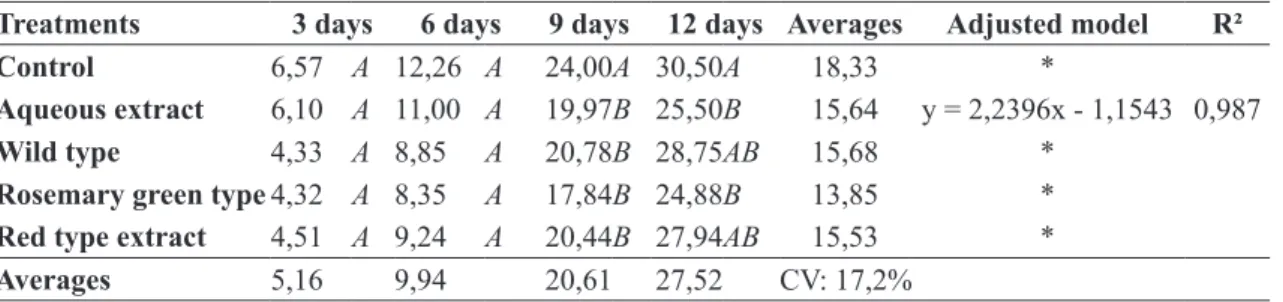
Postharvest treatments affected significantly fresh weight losses of the bananas and as storage time progressed an interaction between factors was determined (Table 1). In every postharvest treatment, increments in fresh weight losses were determined in response to storage time. Kader (2002) concluded that 10% fresh weight losses are an acceptable value and since all bananas maintained turgidity up to the sixth day of storage with an average value of 9.94%, no significant differences were detected amongst postharvest treatments. After nine days of
storage, fresh weight losses of the control treatment was significantly higher in comparison to the other treatments. ´Prata´ bananas coated with wild type propolis and with rosemary green hydroalcoholic propolis extracts presented after 12 days of storage significantly lower fresh weight losses in comparison to the control treatment and, therefore, these treatments are more efficient to maintain fresh weight.
The lower percentages of weight losses in bananas coated with propolis extracts might result from a vapor barrier effected by those extracts. An outcome of delays in respiratory rates by propolis coatings yielding lower oxygen (O2) concentrations and higher carbon dioxide (CO2) concentrations in internal tissues.
Membranes fail in selective permeability capability alongside with fruit ripening processes giving way to electrolyte leakage (PALMER, 1971). That phenomenon results in fresh weight losses directly proportional to metabolic activity such as respiration and transpiration, which is caused by a vapor pressure deficit between the fruit and environment (CHITARRA; CHITARRA, 2005).
Maqbool et al. (2010) concluded that chitosan incorporated into Arabic gum coatings reduced fresh weight losses in ´Berangan´ bananas stored for 28 days at 13 ºC – 80% UR plus 5 more days at 25 ºC – 60% UR. The authors also stated that weight losses ranged from 15% to 30%.
Temperature and relative humidity affect postharvest quality of the bananas. These factors explain the higher fresh weight losses in the present study in comparison to the observations of Maqbool et al. (2010). Variations in these elements result in high weight losses of fruit setting off the formation of a water film on fruit surfaces that have a propensity to vaporize to a lower humidity environment and, above and beyond, easing spore germination to further invade tissues (CHITARRA; CHITARRA, 2005; LEE et al., 1996).
observed in all treatments.
Firmness decreases in banana pulp tissues are, normally, triggered by enzyme activity upon starch contents and on cell walls (CHITARRA; CHITARRA, 2005), such as amylases, phosphorilases and glycosidases ((BASSINELO et al., 2002) and pectinmethylesterase (PME) and polygalacturonase (PG) (ALI et al., 2004). According to Mohapatra et al. (2011) beyond starch hydrolysis and cell wall pectin depolimerization, losses in firmness in fruit might as well be associated to increases in tissue water contents in response to osmotic exchanges in which the peel loses turgidity.
Soluble solids (SS) contents of the bananas did show significant differences with regards to postharvest treatments and storage periods and, as well did present interaction between factors. Nonetheless, it was not possible to fit a regression equation for storage period (Table 3). SS differed significantly amongst treatments only after 12 days of storage. Bananas treated with the aqueous extract and the hydroalcoholic wild type and rosemary green extracts had the lowest amounts of soluble solids, but the SS did not differ amongst themselves and from the SS contents of the control treatment. Bananas treated with red type propolis extract had the highest SS contents, which also did not differ from SS contents of control bananas.
On the first day of evaluation, the bananas had the lowest SS contents. That content augmented up to the third day of storage and from the sixth day on the contents decreased again. On the last day of evaluation (12 days), SS contents again increased compared to the initial values. That behavior of SS indicates that starch is hydrolyzed to sugars via primary metabolism to deliver respiratory substrate for biological activities of the fruit with a consequent increase in sweetness.
Chitarra and Chitarra (2005) observed that starch contents of bananas remains high, in the range of 20 to 25%, during ripening and that contents decreases rapidly after the climacteric peak leading to the accumulation of sucrose, glucose, fructose and small amounts of maltose. According to Botrel et al. (2002), the maximum value for SS determined in several different banana cultivars is 27 °Brix and that amount decreases when the banana is ripe that is attributable to the consumption of reserve substances. However, soluble solids might increase at the end of fruit ripening or beginning of senescence, a tendency observed in the present work. That increase might be related to fresh weight losses because of dehydration resulting in concentration of sugars (CHITARRA; CHITARRA, 2005).
The results determined for that variable in the present work are in accordance with results observed by Nascimento Junior et al. (2008) and Botrel et al. (2002). The values reported by these authors varied in between 19 and 25 ºBrix in ´Prata´ bananas stored for 12 days at room temperature.
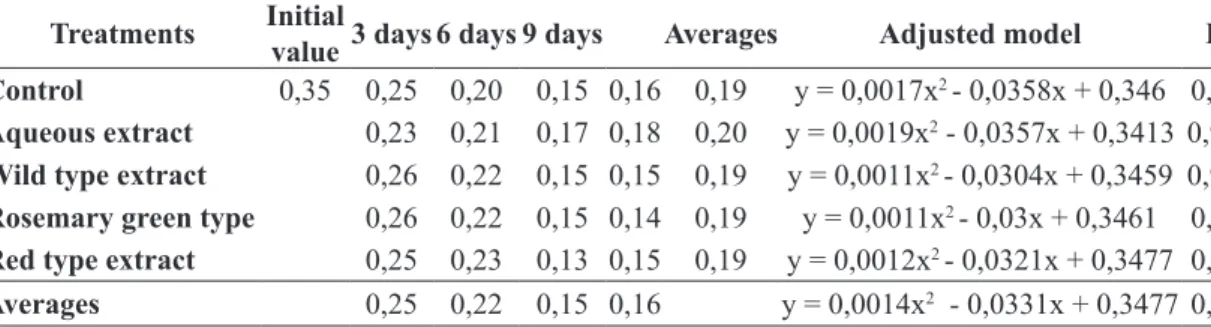
Titratable acidity (TA) varied significantly in response to days of storage, though without significant differences with regards to postharvest treatments and interactions between factors (Table 4). Maximum TA of `Prata´ bananas was 0.35 g malic acid. 100 g-1 of pulp tissue at the beginning of storage and at the end of the storage period malic acid concentration had decreased to 0.14 g malic acid. 100 g-1. These results do also agree with observations made by Botrel et al. (2002). Acidity increases, with predominance of malic acid, reach a maximum value at the moment when banana peel has completely turned yellow and, then, to reduce afterwards
Reductions in the contents of TA was also observed by Maqbool et al. (2010) on ´Berangan´ bananas coated with chitosan incorporated to Arabic gum and stored at 13 ºC and 80% UR plus five more days at 25 ºC – 60% UR.
Malic acid contents diminished with banana ripening processes as result of its use as respiratory substrate and conversion to simple sugars (CHITARRA; CHITARRA, 2005) consequently backing increases of SS after 12 days of storage. That observation coincides, as expected, with higher pH values determined during ripening of the bananas from the beginning up to the end of storage.
The SS/TA ratio varied significantly between postharvest treatments and storage periods with an interaction between factors. Postharvest treatments varied significantly from the ninth day of storage and onwards. Bananas from the postharvest treatment hydroalcoholic red propolis extract had the highest SS/TA, differed significantly from the other postharvest treatments from the ninth day of storage. After 12 days of storage, the treatments control and aqueous propolis extract had the lowest ratios. That observation is explained by the higher SS contents determined from the bananas treated with the red type hydroalcoholic propolis extract and does indicate as well that bananas treated with that type of extract ripen earlier so that the variable SS/ TA might be considered a maturity index (AGUSTÍ, 2000) (Table 5).
2005). SS/TA ratios varied from 63.87 to 174.94. These values are close to the variations observed by Ribeiro et al. (2012). The authors determined values up to full ripeness stage varying from 92.4 to 164.43 in bananas harvested from both conventional production and organic production systems.
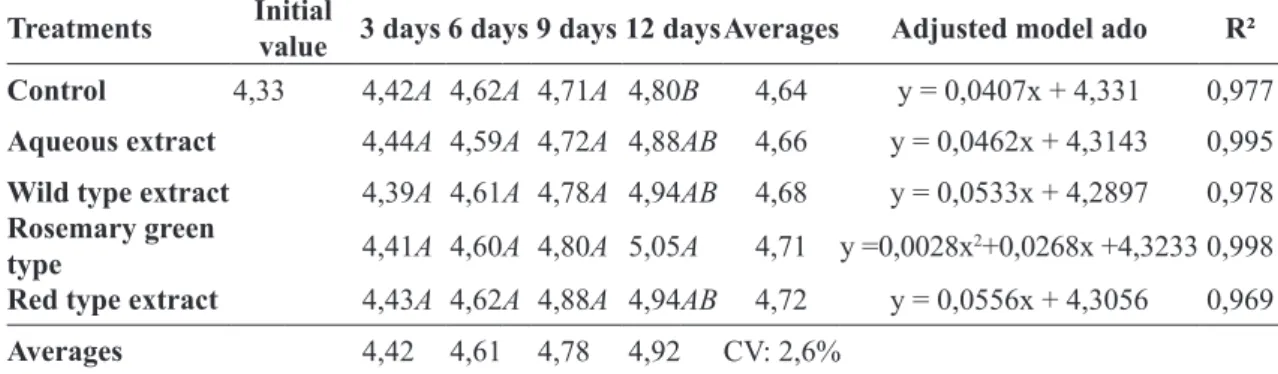
pH values of ´Prata´ bananas differed significantly for both postharvest treatments effects and for storage period and interactions between factors. The pH was only significantly different amongst postharvest treatments on the 12th day of storage. Bananas treated with rosemary green propolis extract presented a higher pH only to the pH of the bananas from the control treatment. The pH values of all the other treatments were similar and did not differ as well from the pH values of the bananas treatments rosemary green type extract and control (Table 6|).
Concerning storage periods, a significant increase in pH was determined in all treatments. According to Wang et al. (2014) and Carvalho et al. (2011), pH values decrease in bananas after harvest, though, towards the end of ripening and beginning of senescence increases in pH are typical and that tendency was observed in the present work.
Chitarra and Chitarra (2005) concluded that a lower pH value at the beginning of storage is correlated to increases in acidity from organic acids released from the vacuoles and from cell wall and from chlorophyll breakdown. At the end of the storage period pH values increased associated to the depletion of organic acids as respiratory substrate and conversion of acids to sugars, in view of higher energy demand originating from boosted metabolism
at that stadium of fruit development (CHITARRA; CHITARRA, 2005; KADER, 2002).
Results of pH determined in the present work with ´Prata´ bananas were higher than the values determined by Silva et al. (2006) and similar to observations of Botrel et al. (2002) for the same cultivar. Values ranged from 4.7 and 4.82 and from 4.2 to 5.3, respectively.
Sensorial analyses of the bananas were structured at the third and sixth day of storage at which bananas presented fresh weight losses below 10%, the maximum acceptable limit for fresh consumption (KADER, 2002). The taste panels did not evidence significant differences that could be related to the postharvest treatments (Table 7).
The different coatings applied did not affect ´Prata´ bananas and the appraisals were, in general, associated to the hedonic terms ´liked moderately´ and ´liked slightly´ on the third and sixth day of evaluation, respectively. The ranks attributed by panelists to sensorial characteristics of the bananas from the third day of storage were higher compared to rankings to the bananas from the sixth day. These observed rankings are quite satisfactory considering that a value higher than 7 on that hedonic scale indicates good consumer acceptability (DUTCOSKY, 2013). The reduction in the ranks determined on the sixth day of storage for the ´Prata´ bananas might be related to fresh weight losses that could affect considerably quality traits and the commercialization of these bananas.
TABLE 1 - Percentage of fresh weight losses of ‘Prata’ bananas with and without coating with propolis extracts and stored at room temperature.
Treatments 3 days 6 days 9 days 12 days Averages Adjusted model R²
Control 6,57 A 12,26 A 24,00A 30,50A 18,33 *
Aqueous extract 6,10 A 11,00 A 19,97B 25,50B 15,64 y = 2,2396x - 1,1543 0,987
Wild type 4,33 A 8,85 A 20,78B 28,75AB 15,68 *
Rosemary green type4,32 A 8,35 A 17,84B 24,88B 13,85 *
Red type extract 4,51 A 9,24 A 20,44B 27,94AB 15,53 *
TABLE 2 – Flesh firmness (N) of ‘Prata’ bananas with and without coatings wit propolis extracts and stores
at room temperature.
TreatmentsInitial
value 6 days 9 days 12 days Averages Adjusted model R² Control 4,16 3,22A 2,47B 2,06A 1,42A 2,29 y = –0,2208x + 3,9903 0,980
Aqueous
extract 4,03A 2,27B 2,10A 1,99A 2,60 y = 1,9848 + (2,2968 / (1+e
(x-4,5378))) 0,987
Wild type 3,91A 2,50B 1,67A 2,22A 2,58 y = 1,9353 + (2,2535 / (1+e(x-4,8827))) 0,964
Rosemary
green type 3,81A 4,16A 1,79A 1,30A 2,77 y = 11479 + (2,9866 / (1+e
(x-8,0457))) 0,964
Red type
extract 3,11A 3,86A 1,70A 1,37A 2,51 *
Averages 3,62 3,05 1,86 1,66 CV: 28,4%
Averages followed by the same letter in columns do not differ significantly at p< 0.05 by the SNK test. * It was not possible adjust regression models with two dependent factors..
TABLE 3 – Soluble solids (ºBrix) of ‘Prata’ bananas with and without coatings wit propolis extracts and stores at room temperature.
Treatments Initial
value 3 days 6 days 9 days 12 days Averages R
2
Control 22 23,83A 21,92A 20,25A 23,50AB 22,38 *
Aqueous
extract 23,67A 22,58A 20,42A 22,08B 22,19 * Wild type 24,00A 22,58A 19,50A 20,92B 21,75 *
Rosemary
green type 24,17A 22,75A 19,42A 21,25B 21,90 * Red type
extract 23,83A 21,83A 21,75A 25,25A 23,17 * Averages 23,90 22,33 20,27 22,60 CV: 8,3%
Averages followed by the same letter in columns do not differ significantly at p< 0.05 by the SNK test. * It was not possible adjust regression models with two dependent factors.
TABLE 4 – Titratable acidity (g malic acid 100 g-1 tissue) of ‘Prata’ bananas with and without coatings wit propolis extracts and stores at room temperature.
Treatments Initial
value 3 days 6 days 9 days Averages Adjusted model R² Control 0,35 0,25 0,20 0,15 0,16 0,19 y = 0,0017x2 - 0,0358x + 0,346 0,990
Aqueous extract 0,23 0,21 0,17 0,18 0,20 y = 0,0019x2 - 0,0357x + 0,3413 0,965
Wild type extract 0,26 0,22 0,15 0,15 0,19 y = 0,0011x2 - 0,0304x + 0,3459 0,982
Rosemary green type 0,26 0,22 0,15 0,14 0,19 y = 0,0011x2 - 0,03x + 0,3461 0,975
Red type extract 0,25 0,23 0,13 0,15 0,19 y = 0,0012x2 - 0,0321x + 0,3477 0,943
TABLE 5 – Soluble solids and titratable acidity ratio(SS/AT) of ‘Prata’ bananas with and without coatings wit propolis extracts and stores at room temperature.
Treatments Initial
value 3 days 6 days 9 days 12 days Averages Adjusted model R² Control 63,87 96,69A 109,66A136,03B 134,53B 119,23 y=6,0216x+72,028 0,915
Aqueous extract 101,98A 107,77A122,88B 123,58B 114,05 y=–0,5198x2 +10,915x+ 66,596 0,961
Wild type
extract 94,93A 102,88A130,62B 142,91AB 117,83 y=6,4584x+ 68,291 0,970 Rosemary green
type 95,56A 102,10A132,96B 151,61AB 120,56 y =7,0959x+66,646 0,974
Red type extract 95,08A 96,68A173,07A 174,94A 134,94 y=180,4-(103,51 / (1+e(x-7,1399)))0,947
Averages 96,85 103,82 139,11 145,51 CV: 20,1%
Averages followed by the same letter in columns do not differ significantly at p< 0.05 by the SNK test.
TABLE 6 - Hydrogenionic potential (pH) of ‘Prata’ bananas with and without coatings with propolis extracts and stores at room temperature.
Treatments Initial
value 3 days 6 days 9 days 12 daysAverages Adjusted model ado R² Control 4,33 4,42A 4,62A 4,71A 4,80B 4,64 y = 0,0407x + 4,331 0,977
Aqueous extract 4,44A 4,59A 4,72A 4,88AB 4,66 y = 0,0462x + 4,3143 0,995
Wild type extract 4,39A 4,61A 4,78A 4,94AB 4,68 y = 0,0533x + 4,2897 0,978 Rosemary green
type 4,41A 4,60A 4,80A 5,05A 4,71 y =0,0028x
2+0,0268x +4,3233 0,998
Red type extract 4,43A 4,62A 4,88A 4,94AB 4,72 y = 0,0556x + 4,3056 0,969
Averages 4,42 4,61 4,78 4,92 CV: 2,6%
Averages followed by the same letter in columns do not differ significantly at p< 0.05 by the SNK test.
TABLE 7 – Rankings (average ± standard deviation) attributed by panelists to sensorial characteristics of cv. ‘Prata’ bananas with or without coatings propolis extracts and stored at room temperature.
Treatments 3 days*1 6 days*1
Control 7,18 ± 1,36 6,98 ± 1,35
Aqueous extract 7,46 ± 1,29 6,67 ± 1,43
Wild type extract 7,29 ± 1,28 6,33 ± 1,81 Rosemary green type 7,07 ± 1,39 6,71 ± 1,71
Red type 7,05 ± 1,48 6,73 ± 1,56
9
F. R. PASSOS et al.
CONCLUSIONS
Coating ´Prata´ bananas with the rosemary green type propolis hydroalcoholic extract and the aqueous wild type propolis extract were efficient in fresh weight reductions and might be used to pro-long shelf life of these fruit. Even so, coatings do not positively influence quality traits that are asso-ciated to ripening processes of ´Prata´ bananas at the end of the storage period and performance is similar to not coated fruit.
Bananas coated with propolis extracts from different botanical sources were accepted equiva-lently to not coated fruit by taste panelists demons-trating that coating of the fruit does not alter senso-rial attributes up to six days of storage.
ACkNOWLEDgMENTS
To Capes in acknowledgement for the scholarship and to Natucentro for the supply of the propolis extracts to run the experiments.
REfERENCES
AGUSTÍ, M. Crecimiento y maduración del fruto. In:
AZCÓN-BIETO, J.; TALÓN, M. fundamentos de
fisiologia vegetal. Barcelona: Edicions Universitat de Barcelona, 2000. cap.6, p.419–433.
ALI, A.; CHOW, W.L.; ZAHID, N.; ONG, M.K. Efficacy of propolis and cinnamon oil coating in controlling post-harvest anthracnose and quality of chilli (Capsicum annuum L.) during cold storage.
food and Bioprocess Technology, New York, v.7, n.9, p.2742-2748, 2014.
ALI, A.; WEI, Y.Z.; MUSTAFA, M.A. Exploiting propolis as an antimicrobial edible coating to control post-harvest anthracnose of bell pepper. Packaging Technology and Science, Singapore, v.28, n.2,
p.173-179, 2015.
ALI, Z.M.; CHIN, L.; LAZAN, H. A comparative study on wall degrading enzymes, pectin modifications and softening during ripening of selected tropical fruits. Plant Science, Limerick, v.167, n.2, p.317–327, 2004.
BASSINELLO, P.Z.; CORDENUNSI, B.R.; LAJOLO, F.M. Amylolytic activity in fruits: comparison of different substrates and methods using banana as model. Journal of Agricultural and food Chemistry, Washington, v.50, n.21,
p.5781-5786, 2002.
B O T R E L , N . ; F R E I R E J U N I O R , M . ; VASCONCELOS, R.M.; BARBOSA, H.T.G. Inibição do amadurecimento da banana-‘prata-anã’ com a aplicação do 1-metilciclopropeno. Revista Brasileira de fruticultura, Jaboticabal, v.24, n.1, p.53–56, 2002.
BURDOCK, G.A. Review of the biological properties and toxicity of bee propolis (propolis).
food and Chemical Toxicology, Oxford, v.36, n.4, p.347-363, 1998.
CANO, M.P.; ANCOS, B.; MATALLANA, M.C.; CÁMARA, M.; REGLERO, G.; TABERA, J. Differences among Spanish and Latin-American banana cultivars: morphological, chemical and sensory characteristics. food Chemistry, London, v.59, n.3,
p.411-419, 1997.
CARVALHO, A.V.; SECCADIO, L.L.; MOURÃO JÚNIOR, M.; NASCIMENTO, W.M. O. Qualidade pós-colheita de cultivares de bananeira do grupo ‘maçã’, na região de Belém – PA. Revista Brasileira de fruticultura, Jaboticabal, v.33, n.4, p.1095–1102,
2011.
CARVALHO, J.X.; SUÁREZ, R.O.; MENDES, F.Q.; FERNANDES, R.V.B.; CUNHA, M.C.; CARVALHO, A.M.X. Extensão da vida de prateleira
de ovos pela cobertura com própolis. Semina:
Ciências Agrárias, Londrina, v.34, n.5, p.2287–
2296, 2013.
CHITARRA, M.I.F.; CHITARRA, A.B. Pós-colheita
de frutas e hortaliças: fisiologia e manuseio. 2.ed.
Lavras: UFLA, 2005. 785p.
DAIUTO, E.R.; MINARELLI, P.H.; VIEITES, R.L.; ORSI, R.O. Própolis e cera vegetal na conservação de abacate ‘Hass’. Semina: Ciências Agrárias, Londrina, v.33, n.4, p.1463–1474, 2012.
DAUGSCH, A.; MORAES, C.S.; FORT, P.; PARK, Y.K. Brazilian red propolis - chemical composition and botanical origin. Evidence-Based Complementary and Alternative Medicine,
DONATO, S.L.R.; ARANTES, A.M.; SILVA, S.O.; CORDEIRO, Z.J.M. Comportamento fitotécnico da bananeira ‘Prata-Anã’ e de seus híbridos. Pesquisa Agropecuária Brasileira, Brasília, v.44, n.12, p.1608–1615, 2009.
DUTCOSKY, S.D. Análise sensorial de alimentos. 4.ed. Curitiba: Champagnat, 2013. 531p.
HATA, T.; TAZAWA, S.; OHTA, S.; RHYU, M.; MISAKA, T.; ICHIHARA, K. Artepillin C, a major ingredient of Brazilian propolis, induces a pungent taste by activating TRPA1 channels. Plos One, San Francisco, v.7, n.11, p.1–9, 2012.
I B G E . I N S T I T U T O B R A S I L E I R O D E
GEOGRARIA E ESTATÍSTICA. Levantamento
sistemático da produção agrícola. Rio de Janeiro:
IBGE, v.29, n.1, p.1–83, 2015.
INSTITUTO ADOLFO LUTZ. Métodos
físico-químicos para análise de alimentos. 4.ed. Brasília:
Ministério da Saúde, 2004. 1018p.
KADER, A.A. Postharvest technology of
horticultural crops. 3rd ed. Berkeley: University of California, 2002. 535p.
LEE, L.; ARUL, J.; LENCKI, R.; CASTAIGNE, F. A review on modified atmosphere packaging and preservation of fresh fruits and vegetables. Physiological basis and practical aspects. Packaging Technology andScience, London, v.9, n.6, p.315– 331, 1996.
LÓPEZ, B.G.C.; SCHMIDT, E.M.; EBERLIN, M.N.; SAWAYA, A.C.H.F. Phytochemical markers of different types of red propolis. food Chemistry, London, v.146, n.1, p.174–180, 2014.
MAQBOOL, M.; ALI, A.; RAMACHANDRAN, S.; SMITH, D.R.; ALDERSON, P.G. Control of postharvest anthracnose of banana using a new edible composite coating. Crop Protection, Amsterdam, v.29, n.10, p.1136–1141, 2010.
MARCUCCI, M.C. Propolis: chemical composition, biological properties and therapeutic activity.
Apidologie, Paris, v.26, n.2, p.83–99, 1995.
MELLO, B.C.B.; PETRUS, J.C.C.; HUBINGER, M.D. Desempenho do processo de concentração de extratos de própolis por nanofiltração. Ciência e Tecnologia de Alimentos, Campinas, v.30, n.1,
p.166–172, 2010.
MOHAPATRA, D.; MISHRA, S.; SINGH, C.B.; JAYAS, D.S. Post-harvest processing of banana: opportunities and challenges. food and Bioprocess Technology, New York, v.4, n.3, p.327–339, 2011.
NASCIMENTO JUNIOR, B.B.; OZORIO, L.P.; REZENDE, C.M.; SOARES, A.G.; FONSECA, M.J.O. Diferenças entre bananas de cultivares Prata e Nanicão ao longo do amadurecimento: características físico-químicas e compostos voláteis. Ciência e Tecnologia de Alimentos, Campinas, v.28, n.3,
p.649–658, 2008.
OLDONI, T.L.C.; CABRAL, I.C.R.; D’ARCEA, M.A.B.R.; ROSALEN, P.L.; IKEGAKIC, M.; NASCIMENTO, A.M.; ALENCAR, S.M. Isolation and analysis of bioactive isoflavonoids and chalcone from a new type of Brazilian propolis. Separation
and Purification Technology, Hong Kong, v.77,
n.2, p.208–213, 2011.
PALMER, J.K. The banana. In: HULME, A.C. (Ed.).
The biochemistry of fruits and their products. London: Academic Press, 1971. v.2, p.65–105.
PARK, Y.K.; ALENCAR, S.M.; AGUIAR, C.L. Botanical origin and chemical composition of Brazilian propolis. Journal of Agricultural and food Chemistry, Washington, v.50, n.9, p.2502–
2506, 2002.
PARK, Y.K.; PAREDES-GUZMAN, J.F.; AGUIAR, C.L.; ALENCAR, S.M.; FUJIWARA, F.Y. Chemical constituents in Baccharis dracunculifoliaas the main botanical origin of southeastern Brazilian propolis.
Journal of Agricultural and food Chemistry, Washington, v.52, n.5, p.1100–1103, 2004.
PASTOR, C.; SÁNCHEZ-GONZÁLES, L.; MARCILLA, A.; CHIRALT, A.; CHÁFER, M . ; G O N ZÁ LEZ- M A RTÍ N EZ, C . Q u ality a n d s a f e t y o f t a b l e g r a p e s c o a t e d w i t h hydroxypropylmethylcellulose edible coatings containing propolis extract. Postharvest Biology and Technology, Amsterdam, v.60, n.1, p.64–70,
PBMH e PIF – PROGRAMA BRASILEIRO PARA A MODERNIZAÇÃO DA HORTICULTURA E
PRODUÇÃO INTEGRADA DE FRUTAS. Normas de
classificação de banana. São Paulo: CEAGESP, Centro de Qualidade em Horticultura, 2006. (Documentos, 29).
PERESIN, D.; BARBOSA, J.C. Uma avaliação de seis procedimentos para comparações múltiplas.
Revista Matemática e Estatística, São Paulo, v.6, n.1, p.95–103, 1988.
REIS, R.C.; MINIM, V.P.R. Teste de aceitação. In: MINIM, V.P.R. Análise sensorial: estudos com
consumidores. 2.ed. Viçosa: Ed. UFV, 2010. cap.3, p. 66–82.
RIBEIRO, L.R.; OLIVEIRA, L.M.; SILVA, S.O.; BORGES, A.L. Caracterização física e química de bananas produzidas em sistemas de cultivo
convencional e orgânico. Revista Brasileira de
fruticultura, Jaboticabal, v.34, n.3, p.774–782,
2012.
SFORCIN, J.M. Propolis and the immune system: a review. Journal of Ethnopharmacology, Limerick, v.113, n.1, p.1–14, 2007.
SILVA, C.S.; LIMA, L.C.; SANTOS, H.S.; CAMILI, E.E.; VIEIRA, C.R.Y.I.; MARTIN, C.S.; VIEITES, R.L. Amadurecimento da banana-prata climatizada
em diferentes dias após a colheita. Ciência e
Agrotecnologia, Lavras, v.30, n.1, p.103–111, 2006.
WANG, S.; LIN, T.; MAN, G.; LI.; ZHAO, L.; WU, J.; LIAO, X. Effects of anti-browning combinations of ascorbic acid, citric acid, nitrogen and carbon dioxide on the quality of banana Smoothies. food and Bioprocess Technology, New York, v.7, n.1, p.161–173, 2014.
ZAHID, N.; ALI, A.; SIDDIQUI, Y.; MAQBOOL, M. Efficacy of ethanolic extract of propolis in maintaining postharvest quality of dragon fruit during
storage. Postharvest Biology and Technology,