Pesq. agropec. bras., Brasília, v.34, n.4, p.575-583, abr. 1999
PERFORMANCE OF FOOD-TYPE SOYBEAN GENOTYPES 575
PERFORMANCE OF FOOD-TYPE SOYBEAN GENOTYPES
AND THEIR POSSIBILITY FOR ADAPTATION TO BRAZILIAN LATITUDES1
EDSON PEREZ GUERRA2, DEONISIO DESTRO3, LILIAN AZEVEDO MIRANDA4 and RICARDO MONTALVÁN5
ABSTRACT - This work was conducted at the Universidade Estadual de Londrina (UEL), in Londrina, State of Paraná, Brazil, with the goal to study food-type soybean (Glycine max (L.) Merrill) genotypes performance for use in cultivation or crosses. A total of 104 genotypes were analyzed: 88 were food-type with large seeds, eight were food-food-type with small seeds, and eight-grain food-types adapted cultivars. The experimental plan was in randomized complete block design with four replications, and 12 traits of agronomic importance were considered. Genetic diversity was observed in the food-type germplasm. There were some genotypes with high yield adapted to a normal period of sowing. Soybean genetic improvement programs for direct human consumption in Brazil, either by means of Asiatic pure lines or by means of the incorporation of genes for late flowering in short-day conditions in this lines is highly viable.
Index terms: agronomic characters, genetic breeding, germplasm, Glycine max.
COMPORTAMENTO DE GENÓTIPOS DE SOJA TIPO ALIMENTO E POSSIBILIDADES DE ADAPTAÇÃO ÀS LATITUDES BRASILEIRAS
RESUMO - O presente trabalho foi desenvolvido na Universidade Estadual de Londrina (UEL), em Londrina, PR, com o objetivo de estudar o comportamento de genótipos de soja (Glycine max (L.) Merrill) tipo alimento, para posterior uso como cultivares ou em cruzamentos. Foram avaliados 104 genótipos, sendo 88 do tipo alimento, de sementes grandes, oito do tipo alimento, de sementes pequenas, e oito adaptados, tipo grão. O delineamento foi o de blocos completos ao acaso, com quatro repetições, considerando 12 caracteres de importância agronômica. Foi observada uma grande diversidade genética no germoplasma tipo alimento, havendo genótipos com alta produtividade e adaptados para época normal de semeadura. Programas de melhoramento genético da soja para consumo humano direto, no Brasil, são viáveis, seja pelo uso direto de linhagens asiáticas, seja por meio da incorporação de genes para florescimento tardio, em dias curtos, nestas linhagens.
Termos para indexação: caracteres agronômicos, melhoramento genético, germoplasma, Glycine max.
1 Accepted for publication on February 17, 1998.
Part of a thesis presented by the first author to Universidade Estadual de Londrina (UEL).
2 Eng. Agr., M.Sc., Prof. Assistente, Dep. de Agronomia,
PUC-PR, Caixa Postal 16210, CEP 81611-970 Curitiba, PR. E-mail: [email protected]
3 Eng. Agr., Dr., Prof. Adjunto, Dep. de Agronomia, UEL.
E-mail: [email protected]
4 Bióloga, Doutoranda em Ciência de Alimentos, UEL.
5 Eng. Agr., D.Sc., Prof. Adjunto, Dep. de Agronomia, UNIOESTE,
Caixa Postal 91, CEP 85960-000 Mal. Cândido Rondon, PR. Bolsista do CNPq.
of China, where its use is registered as one of the first food crops for humans (Silveira et al., 1989). After being introduced and improved in the United States, soybean was brought to Brazil where it has reached international recognition for high grain production since 1973 (Vello, 1992). Almost all grain type of soy-bean production is destined to foreign and domestic industries for oil and meal production. The soybean meal is almost entirely used for animal food and the oil is for human consumption.
There are several advantages, however, in the use of soybean for food: a) it is easily available for do-mestic consumption and can be cultivated anywhere in the country; b) it has the highest protein content among all the crop species grown in Brazil, and it also has a higher caloric power along with some other INTRODUCTION
Pesq. agropec. bras., Brasília, v.34, n.4, p.575-583, abr. 1999
E.P. GUERRA et al. 576
nutritional qualities; c) its protein supply cost is lower than that of the other conventional sources; d) it has a variety of cooking applications and can be part of most of traditional Brazilian cookery; and e) soybean has been used for millenniums in the Far East, and its human consumption increases in geometric progression in industrialized countries (Carrão-Panizzi, 1988).
Soybean directly used as food must have some especial characteristics, such as: a) a better quality and higher protein content; b) lower oil content and lower linolenic and linoleic unsaturated fatty acids and absence of lipoxigenases 1, 2 and 3; c) sweet taste resembling nuts; d) light color seeds (cotyle-dons, tegument and hilum with similar colors, prefer-entially tan), appropriate size to the kind of food; and e) fast cooking (Destro, 1991; Vello, 1992). Soy-bean for industry uses generally does not have all these characteristics, which makes it difficult to use as food supply. Eastern cultivars for human con-sumption have adaptation problems due to Brazilian photoperiodical conditions, resulting in lower pro-ductivity. Genotypes developed in Asia (with a lati-tude of approximately 40º) have early flowering when cultivated under short-day conditions. In Brazil, ear-lier flowering is associated with determinate stem growth habit, which reduces the number of intern-odes, plant height, and yield (Santos, 1988).
Carrão-Panizzi & Meira (1989) made the charac-terization and analysis of 83 genotypes on food-type soybean germplasm collection from Embrapa-CNPSo and suggested nine quantitative traits of agronomic importance and nine qualitative traits for genotype identification and classification.
However, information about performance on food-type soybean germplasm with breeding objectives are scarce in the literature.
The objective of this work was to study the per-formance of soybean genotypes appropriate to hu-man consumption, in field conditions, for selection of the best genotypes for use as high yielding culti-vars or in crosses.
MATERIAL AND METHODS
This experiment has utilized 104 soybean genotypes, 88 of which are food-type soybean genotypes with large seeds
of either vegetable or "Edamame" kind, eight are food-type soybean genotypes with small seeds of either natto or sprout kind, and eight soybean cultivars adapted to Brazilian culti-vation conditions, which were used as control samples. "Davis Marrom" has brown seeds and is an isogenic line selected from Davis cultivar, which presents yellow seeds. As these genotypes differ apparently only in seed color, "Davis Marrom" was considered adapted to Brazilian culti-vation conditions.
The experiment was conducted in Londrina in 1991, on a soil classified as terra roxa estruturada eutrófica (Hapludult). The experimental plan was a randomized complete block design with four replications. Each plot included one 3.0-m row, with 12 plants each, with an av-erage distance of 0.25 m between plants and of 0.90 m between plots. Insecticides were applied during the ex-periment to control the stink bug population.
The following qualitative traits were registered: FC: flower color (W: white and P: purple); PC: pubescence color (Gy: gray and Br: brown); CSC: color of seed coat (Y: yellow, Bl: black, Gn: green, and Br: brown); HC: hilum color (L: light, Bl: black, LB: light brown and DB: dark brown).
The quantitative traits assessed were as follows: NDF: number of days to the beginning of flowering was the period between sowing and the first flower anthesis (R1
stage of the scale of Fehr & Caviness (1977)); PHF: plant height (cm) at the beginning of flowering was measured as the distance between soil and the inflorescence inser-tion most distant from main stem, analyzed on R1 stage;
NDM: number of days to maturity is the period between sowing and the day in which approximately 95% of the pods were mature (R8 stage of the scale of Fehr & Caviness
(1977)); PHM: plant height (cm) at maturity was mea-sured as the distance between the soil and the inflores-cence insertion most distant from main stem, analyzed on R8 stage; AW: agronomic worth was visually analyzed at
Pesq. agropec. bras., Brasília, v.34, n.4, p.575-583, abr. 1999
PERFORMANCE OF FOOD-TYPE SOYBEAN GENOTYPES 577
plants was used for analysis; RP: reproductive period was the number of days between the beginning of flowering and maturity (RP = NDM-NDF); %RP: reproductive period percentage was the ratio, in percentage, of the number of days between flowering and maturity and the number of days for maturity (%RP = (RP/NDM) x 100); RG: repro-ductive growth after flowering was plant growth (cm) be-tween the beginning of flowering and maturity (RG = PHM-PHF); %RG: reproductive growth percentage was the ra-tio, in percentage, of the plant growth after flowering, and its height after maturity (%RG = (RG/PHM) x 100).
Besides the univariated variance analysis, the average comparisons based on Scott & Knott (1974) criteria were also done for the quantitative characteristics. Pacova (1992) suggested that such method is used to detect differences among average groups of treatments for balanced designs, especially those in which a great number of genotypes is compared. The method essentially consists of the rami-fied or hierarchical spelling process, in which n treatment averages are divided in two large groups. Each group is further subdivided in two other groups and so on, in a continuous process of subdivision, so that each sub-group has a pattern of mutual similarity to the data set. The subdivision process ends when there is no significant dif-ference between two groups. The analysis provides a mum intra-cluster homogeneity and, consequently, a maxi-mum inter-cluster heterogeneity. The method allows the separation of treatments in classes, which are represented by one letter for each analyzed variable. Because IPY is one of the main characteristics in parental selection for crosses, treatments with higher IPY (letter A) were chosen.
RESULTS AND DISCUSSION
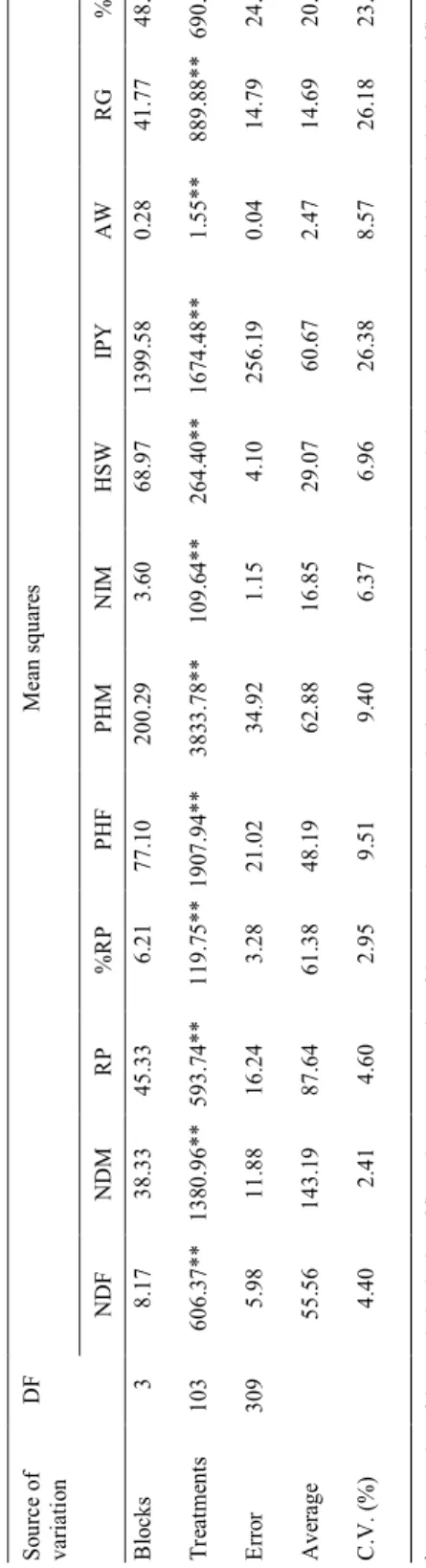
The analysis of variance of the 12 traits of agro-nomic importance indicated significant differences (P<0.01) among genotypes for all analyzed charac-ters (Table 1). The coefficient of variation (C.V.) of the characters were small, with exception of IPY (26.4 %), RG (26.2 %) and %RG (26.6%). Destro (1991), in a study of food-type soybean genotypes reported similar C.V. values for IPY and for number of seeds per plant.
The means of the evaluated characters and the Scott & Knott significance test are presented in Table 2. Diversity among genotypes was evident for all traits, with emphasis for NDF (from 31.2 to 84.6 days), for NDM (from 96.3 to 174.3 days), and for
PHM (from 19.7 to 157.9 cm). 1
Pe
sq
. a
gr
op
ec
. b
ra
s.,
B
ra
síl
ia
, v
.3
4, n
.4
, p
.5
75
-5
83
, a
br.
1
99
9 E
.P
. G
U
E
R
R
A
e
t a
l.
57
8
TABLE 2. Qualitative characters and mean analysis by the Scott & Knott clustering test of quantitative characters of 104 soybean genotypes (N), conducted at UEL, Londrina, PR, Brazil. Sowing on November 25, 19911.
Continue...
Cultivar2 Quantitative characters3 Qualitative characters
_________________________________________________________________________________________________________________________________________________ ______________________________________
NDF NDM RP %RP PHF PHM NIM HSW IPY AW RG %RG FC PC CSC HC
BR-27 73.6c 166.0b 92.4d 55.6f 83.8c 103.3e 21.5d 22.5e 68.6b 3.56b 19.5e 19.0g W Br Y Bl
EMBRAPA-4 50.7h 137.3h 86.7e 63.1c 41.9h 54.4i 15.3g 20.9f 75.2b 2.36e 12.5f 22.9f P Gy Y LB
IAC-12 56.1g 140.5h 84.4e 60.1d 49.9g 63.9i 18.1f 14.1g 81.1a 2.86d 13.9f 21.8f W Br Y LB
IAC-100 58.9f 133.0i 74.1g 55.7f 39.1h 58.9i 17.4f 11.8h 61.8b 2.58e 19.8e 33.4e W Br Y L
Doko Preta 84.6a 162.6c 78.0f 48.0h 97.9a 100.9e 22.2d 16.0g 47.0c 3.18c 3.0h 2.9i W Br Bl Bl
Davis Marrom 53.1g 141.3g 88.2d 62.3d 38.3h 46.3j 15.0g 19.1f 91.0a 2.46e 8.0g 17.3g W Gy Br DB
Paraná Marrom 49.0i 119.7k 70.7g 59.0e 38.2h 47.9j 14.2g 16.5g 60.4b 2.12f 9.7g 20.3f W Gy Br DB
IAC-4 Marrom 70.4d 157.8d 87.4d 55.3f 64.6e 74.6h 20.3e 14.7g 66.4b 2.84d 10.0g 13.3h W Gy Br DB
Delsta 55.4g 146.4f 91.0d 62.2d 38.4h 48.6j 15.9f 31.0c 74.5b 2.33f 10.2g 21.0f P Gy Y LB
Faz. Progresso 77.1b 167.1b 90.0d 53.8g 75.3d 82.5g 23.7d 30.2d 99.5a 3.51b 7.2g 8.7h P Gy Y LB
F80-3309 51.2h 150.2f 99.0b 65.9b 38.3h 45.9j 13.3h 24.1e 49.5c 2.39e 7.6g 16.7g P Br Y DB
F80-6717 64.2e 168.3b 104.1b 61.9d 63.0e 72.6h 16.2f 32.1c 77.7b 3.17c 9.7g 13.3h P Br Bl Bl
F80-6933 45.4j 136.4h 91.0d 66.7a 34.2i 38.3k 11.3h 36.2b 66.5b 2.07f 4.1h 10.7h P Br Bl Bl
F81-9136 50.8h 158.3d 107.5a 67.9a 37.0h 49.8j 14.4g 34.1c 70.4b 2.29f 12.8f 25.6f P Br Y Bl
F82-5628 53.9g 154.9e 101.0b 65.2b 42.7h 58.2i 16.0f 34.5c 55.4c 2.70d 15.5f 26.3f P Br Bl Bl
F82-5630 50.8h 157.7d 106.9a 67.8a 34.6i 46.9j 13.7h 35.8b 40.7c 2.12f 12.3g 26.4f P Br Bl Bl
F82-5721 52.5h 153.5e 101.0b 65.7b 41.4h 49.3j 13.9g 34.3c 83.8a 2.48e 7.9g 16.0g P Br Bl Bl
F82-5722A 47.8i 157.3d 109.5a 69.4a 46.0g 59.8i 16.4f 38.9b 88.5a 2.83d 13.8f 23.1f P Br Gn Bl
F82-5722P 57.6f 157.0d 99.4b 63.3c 46.7g 60.1i 16.0f 42.0a 90.9a 2.91d 13.3f 22.0f P Br Bl Bl
F82-5767 52.1h 154.1e 102.0b 66.2b 40.0h 42.3k 11.9h 42.8a 71.2b 2.29f 2.3h 5.3i P Br Bl Bl
F82-5769 52.0h 152.1e 100.1b 65.8b 40.7h 51.2j 14.7g 36.9b 92.4a 2.52e 10.5g 20.4f W Br Bl Bl
F82-5782 58.1f 149.5f 91.4d 61.2d 49.4g 64.1i 17.1f 38.3b 112.3a 2.70d 14.7f 23.0f P Br Bl Bl
F82-5783 48.8i 152.8e 104.0b 68.1a 26.6i 35.2l 12.5h 36.5b 67.2b 1.98g 8.5g 22.1f P Br Bl Bl
F82-5803 53.5g 152.3e 98.8b 64.9b 39.3h 48.3j 14.0g 33.2c 91.0a 2.56e 9.0g 18.5g W Br Y Bl
F82-5812 50.3h 153.2e 102.9b 67.2a 34.2i 40.9k 12.5h 35.4b 67.3b 2.19f 6.7g 15.8g W Br Gn DB
F82-5813 50.1h 145.3g 95.1c 65.5b 33.3i 41.7k 14.2g 29.4d 90.0a 2.40e 8.3g 20.0f W Br Y DB
F83-8202 62.2e 165.0b 102.8b 62.3d 59.4f 88.9f 20.9e 30.1d 79.6b 3.23c 29.6d 33.2e P Br Bl Bl
F83-7843 54.1g 151.1e 97.0b 64.2c 41.8h 50.4j 15.4g 31.3c 84.5a 2.53e 8.6g 16.9g P Gy Y LB
F83-7864 54.4g 157.5d 103.1b 65.4b 42.4h 50.0j 15.0g 33.0c 58.3c 2.25f 7.5g 15.1g W Br Y Bl
F83-7931 44.4j 136.5h 92.1d 67.5a 28.8i 34.8m 11.7h 24.7e 30.5d 1.74g 6.0h 17.1g P Br Y Bl
F83-7959 55.1g 158.2d 103.0b 65.1b 36.2h 42.5k 14.6g 31.4c 39.8c 2.03g 6.3h 14.8g P Br Y Bl
F83-7977 53.1g 151.9e 98.8b 65.0b 42.0h 49.7j 14.6g 35.2b 67.9b 2.41e 7.7g 15.4g W Gy Y LB
F83-7999 52.1h 151.2e 99.1b 65.5b 38.3h 45.3j 14.1g 34.1c 64.0b 2.33f 7.0g 15.5g P Br Y Bl
F83-8000 53.4g 161.5c 108.2a 66.9a 36.8h 43.6k 14.0g 33.5c 53.8c 2.21f 6.9g 15.6g P Br Y Bl
F83-8012 70.3d 166.7b 96.4c 57.8e 78.6c 96.6e 23.6d 37.0b 103.5a 3.71a 18.0f 18.5g P Br Bl Bl
Pe
sq
. a
gr
op
ec
. b
ra
s.,
B
ra
síl
ia
, v
.3
4, n
.4
, p
.5
75
-5
83
, a
br.
1
99
9
P
E
R
F
O
R
M
A
N
C
E
O
F
F
O
O
D
-T
Y
P
E
S
O
Y
B
E
A
N
G
E
N
O
T
Y
P
E
S
57
9
TABLE 2. Continuation.
Continue...
Cultivar2 Quantitative characters3 Qualitative characters
_________________________________________________________________________________________________________________________________________________ ______________________________________
NDF NDM RP %RP PHF PHM NIM HSW IPY AW RG %RG FC PC CSC HC
F83-8058P 49.4i 148.3f 99.8b 67.2a 34.0i 39.4k 13.2h 36.5b 76.0b 2.32f 5.4h 14.2h P Br Bl Bl
F83-8117 78.4b 172.8a 94.4c 54.6g 83.7c 89.2f 19.1e 42.3a 69.8b 3.40b 5.4h 6.1i P Br Bl Bl
F83-8119 59.2f 162.6c 103.4b 63.6c 44.7h 61.5i 16.9f 39.0b 79.0b 2.78d 16.8f 27.3f P Br Bl Bl
F83-8175 78.6b 174.3a 95.8c 54.9f 84.9c 93.9f 20.4e 36.8b 46.8c 2.91d 9.1g 9.5h P Br Bl Bl
F83-8185 78.4b 170.3a 92.2d 54.1g 80.8c 84.0g 17.1f 42.8a 85.5a 3.32b 3.2h 3.9i P Br Bl Bl
F83-8192 79.5b 170.7a 91.3d 53.4g 87.0c 92.8f 19.3e 43.0a 86.7a 3.57b 5.8h 6.3i P Br Bl Bl
F83-8203P 47.2i 145.3g 97.8b 67.4a 32.1i 39.6k 12.7h 31.5c 56.6c 2.02g 7.5g 18.6g P Br Bl Bl
F83-8207AB 53.0g 149.3f 96.5c 64.6b 39.5h 47.4j 14.2g 35.9b 72.7b 2.42e 7.9g 16.8g W Gy Y LB
F83-8211 50.2h 155.1e 104.8b 67.6a 36.8h 44.6j 13.4h 31.5c 72.5b 2.29f 7.8g 17.5g P Br Bl Bl
F83-8240 54.8g 154.5e 99.6b 64.5c 49.0g 61.9i 15.3g 32.3c 70.9b 2.52e 12.9f 20.8f P Br Bl Bl
F85-11346 57.0f 169.5a 112.5a 66.4b 51.8g 65.2h 16.5f 37.2b 63.3b 3.03c 13.3f 20.4f W Br Y Bl
Kanrich 31.8l 105.3l 73.5g 69.7a 20.2j 46.1j 15.5g 31.7c 29.4d 1.77g 25.9d 56.1c P G Y LB
Kanro 34.1l 96.9m 62.7h 64.6c 18.5j 19.7m 8.4j 27.7d 17.8d 1.23h 1.2h 5.9i P Br Y L
L81-4590 31.2l 96.3m 65.0h 67.5a 17.4j 45.0j 15.5g 19.9f 42.4c 1.97g 27.6d 61.4b W Br Y Bl
Late Giant 45.0j 146.7f 101.7b 67.8a 24.9j 31.6l 11.0i 39.3b 53.1c 1.95g 6.8g 21.5f P Br Bl Bl
Mendota 32.3l 96.5m 64.2h 66.5b 14.6j 26.1m 11.4h 22.5e 24.7d 1.36h 11.4g 43.0d P Gy Y L
Nanda 53.0g 140.0h 86.5e 61.8d 38.2h 52.0i 14.8g 23.1e 36.1d 2.17f 13.8f 25.7f P Gy Y DB
PI-133.226 72.6c 150.8e 78.2f 51.8g 100.0a 116.0d 22.2d 19.8f 55.2c 2.97d 16.1f 13.9h W Gy Y DB
PI-157.440 47.6i 120.7k 72.0g 59.6d 37.6h 40.3k 12.1h 21.6f 57.9c 1.94g 2.7h 6.5i W Gy Y DB
PI-423.909 59.8f 153.8e 94.1c 61.2d 52.2g 109.2d 26.8c 31.8c 60.8b 3.52b 57.0b 52.2c P Br Y DB
Soja Feira 86-13 47.8i 138.0h 90.2d 65.3b 30.8i 85.4g 20.5e 37.8b 70.5b 2.44e 54.7b 64.0b P Gy Y DB
Soja Feira 86-14 72.5c 155.5d 83.0e 53.4g 80.8c 86.4g 22.3d 28.1d 61.7b 3.11c 5.7h 6.5i P Gy Y DB
Aliança Preta 69.8d 161.0c 93.0d 57.8e 79.6c 98.7e 21.3d 32.7c 37.9d 3.17c 19.2e 19.4g P Br Bl Bl
Araçatuba 73.7c 153.3e 79.6f 51.9g 81.6c 137.1b 28.8b 23.9e 62.7b 3.62a 55.5b 40.5d P Br Y DB
Biloxi 252n 73.5c 150.0f 76.5f 51.0h 73.6d 126.1c 30.4b 21.4f 47.5c 3.22c 52.5b 41.5d P Br Br DB
Cherokee 69.3d 151.9e 82.6e 54.3g 57.7f 82.1g 22.6d 29.1d 49.0c 2.90d 24.4d 29.7e P Gy Gn DB
FC 31-665 44.6j 117.3k 72.7g 62.0d 29.0i 35.0l 13.1h 31.9c 58.4c 1.88g 5.9h 17.0g P Gy Y DB
Hampton 48.9i 143.7g 94.7c 65.9b 37.5h 39.2k 13.9g 31.0c 60.0b 2.03g 1.7h 4.3i P Gy Y DB
Hogyoku 53.4g 153.7e 100.3b 65.2b 39.6h 47.1j 16.2f 25.5e 36.5d 2.08f 7.5g 15.8g W Gy Y DB
Ivai 53.6g 141.6g 88.0d 62.1d 47.3g 60.8i 17.0f 24.4e 74.6b 2.54e 13.5f 22.1f P Gy Y LB
Japão-1 38.2k 105.7l 67.5h 63.8c 21.3j 24.3m 10.1i 33.5c 24.4d 1.37h 3.0h 12.2h W Br Gn Bl
Japão-2 43.9j 124.0j 80.1f 64.5c 31.0i 38.2k 12.1h 36.1b 47.1c 1.77g 7.2g 17.5g P Br Gn Bl
KS#3xAkiyoshif-F7-2 52.2h 124.3j 72.1g 58.0e 38.6h 43.5k 13.6h 27.7d 42.2c 1.83g 4.8h 11.1h P Br Y DB
KS473 x SJ2-F7 57.0f 135.4h 78.4f 57.8e 48.3g 59.4i 16.6f 24.1e 45.4c 2.33f 11.1g 18.5g P Br Y DB
Kurakake 38.0k 106.0l 68.0h 64.1c 23.3j 24.9m 10.7i 32.4c 23.1d 1.38h 1.5h 6.3i W Br Gn Bl
Majós 51.9h 145.0g 93.0d 64.2c 40.1h 45.3j 15.3g 35.8b 97.3a 2.46e 5.2h 11.5h W Gy Y LB
Pe
sq
. a
gr
op
ec
. b
ra
s.,
B
ra
síl
ia
, v
.3
4, n
.4
, p
.5
75
-5
83
, a
br.
1
99
9 E
.P
. G
U
E
R
R
A
e
t a
l.
58
0
TABLE 2. Continuation.
Cultivar2 Quantitative characters3 Qualitative characters
_________________________________________________________________________________________________________________________________________________ ______________________________________
NDF NDM RP %RP PHF PHM NIM HSW IPY AW RG %RG FC PC CSC HC
Miyashipoken 45.2j 121.7j 76.6f 62.9c 32.7i 38.8k 12.3h 32.5c 43.3c 1.83g 6.2h 15.8g P Br Gn Bl
Nimame 34.4l 109.1l 74.7g 68.4a 28.5i 32.5l 10.3i 34.5c 28.5d 1.47h 4.0h 11.6h P Br Y LB
PI-80.441 34.4l 105.4l 70.9g 67.1a 19.3j 20.0m 8.9j 29.6d 13.4d 1.07h 0.8h 3.7i W Gy Y LB
PI-91.725-3 57.8f 138.9h 81.0f 58.2e 48.4g 59.2i 16.8f 26.4e 32.0d 2.38e 10.8g 18.4g P Br Y DB
PI-165.672 49.6i 118.9k 69.4g 58.3e 45.6g 66.8h 16.0f 33.1c 55.2c 2.51e 21.2e 31.5e P Br Gn Bl
PI-165.676 53.8g 144.5g 90.6d 62.7d 39.6h 59.2i 16.7f 33.0c 44.7c 2.37e 19.6e 33.0e P Br Br DB
PI-229.320 46.9i 118.9k 71.9g 60.5d 33.1i 36.6l 11.8h 26.8e 50.1c 1.76g 3.5h 9.5h P Br Y DB
PI-230.977 47.0i 131.1i 84.1e 64.1c 26.8i 30.1l 12.3h 40.1a 68.0b 1.96g 3.2h 10.6h P Br Bl Bl
PI-230.977/S 53.3g 145.8g 92.5d 63.5c 43.1h 68.2h 17.7f 36.5b 45.0c 2.52e 25.1d 36.6d P Br Y Bl
PI-243.514 42.9j 120.3k 77.3f 64.3c 24.9j 28.2m 11.8h 31.2c 56.3c 1.62g 3.3h 11.3h W Br Y DB
PL-1 70.6d 150.3e 79.7f 53.0g 75.4d 87.6g 21.4d 29.3d 68.5b 3.05c 12.2g 14.0h P Br Y DB
Pluto 44.8j 117.7k 73.0g 62.0d 35.5h 40.9k 12.8h 23.4e 37.8d 1.80g 5.5h 13.3h W Br Bl Bl
Stwart 63.0e 152.7e 89.7d 58.7e 71.2d 93.9f 22.2d 19.7f 85.7a 3.49b 22.7e 24.1f W Gy Y DB
Tadacha 41.7j 112.0l 70.3g 62.6d 25.0j 27.6m 10.4i 26.6e 18.6d 1.39h 2.6h 9.6h W Br Br DB
Tamba 56.5f 153.2e 96.7b 63.1c 50.9g 75.1h 20.2e 27.3d 51.5c 2.58e 24.2d 31.9e P Br Bl Bl
Tarheel Black 47.4i 130.9i 83.5e 63.8c 37.7h 41.8k 13.1h 36.7b 57.4c 2.06f 4.0h 9.6h P Br Bl Bl
TMV 72.5c 153.1e 80.6f 52.6g 85.4c 91.8f 21.8d 25.6e 100.3a 3.41b 6.4h 6.9i P Br Y DB
TK#5 x Unknown-F7 49.6i 128.7i 79.1f 61.4d 42.4h 64.8h 16.6f 34.2c 42.4c 2.46e 22.5e 34.6e P Br Gn Bl
TN#4xPI-230970 F7-1 61.0f 153.7e 92.6d 60.3d 68.3e 81.8g 18.0f 23.9e 46.2c 2.60e 13.5f 16.4g P Br Y DB
TN#4xPI-230970 F7-4 54.4g 139.9h 85.6e 61.1d 45.3g 55.7i 15.4g 28.1d 35.4d 2.00g 10.4g 18.7g P Br Y DB
Yamagataken 44.1j 123.6j 79.5f 64.3c 29.7i 33.8l 12.0h 31.9c 61.3b 1.85g 4.1h 12.2h P Gy Gn Bl
Wolverine 44.0j 116.8k 72.8g 62.3d 26.5i 31.5l 11.9h 23.8e 52.8c 1.72g 5.0h 15.7g P Br Y Bl
64.64 x KS473 52.2h 138.8h 86.6e 62.4d 49.9g 59.6i 15.6g 23.6e 56.3c 2.22f 9.7g 16.1g P Br Y DB
Easycook 40.3j 126.6i 86.4e 68.2a 23.0j 90.6f 22.1d 18.4f 69.3b 2.23f 67.6a 74.5a P Gy Y DB
Easycook Marrom 4 73.5c 148.0f 74.5g 50.3h 90.6b 147.1a 29.4b 15.7g 65.0b 2.99d 56.5b 38.1d P Br Bl Bl
Easycook Marrom 4-a 69.2d 148.8f 79.6f 53.5g 85.0c 149.7a 28.2c 17.9g 71.0b 3.22c 64.7a 43.2d P Br Bl Bl
Easycook Preta 75.4b 150.9e 75.5g 50.0h 105.2a 157.9a 29.9b 15.4g 69.8b 3.28b 52.7b 32.9e P Br Bl Bl
Aliança Preta/sel. 82.2a 162.0c 79.9f 49.3h 102.2a 152.7a 33.3a 12.0h 68.7b 3.84a 50.4b 33.0e P Br Bl Bl
IAC Santa Maria-702 82.3a 161.6c 79.3f 49.0h 100.4a 142.0b 32.8a 10.8h 61.8b 3.78a 41.5c 29.3e P Br Bl Bl
Imperial 68.5d 141.2g 72.8g 51.5h 55.3f 72.0h 22.1d 8.96i 57.0c 2.43e 16.7f 23.1f P Br Br DB
PI-80.459 65.9e 142.6g 76.7f 53.8g 51.2g 72.2h 22.1d 7.97i 53.3c 2.51e 20.9e 29.2e P Br Br DB
1NDF: number of days to the beginning of flowering; NDM: number of days to maturity; RP: reproductive period; %RP: reproductive period percentage; PHF: plant height at the beginning of flowering; PHM: plant height at maturity; NIM: number of internodes during maturity; HSW: one hundred seed weight; IPY: individual plant yield; AW: agronomic worth; RG: reproductive growth; %RG: reproductive growth percentage; FC: flower color; PC: pubescence color; CSC: color of seed coat; HC: hilum color; W: white; P: purple; Gy: gray; Y: yellow; Bl: black; Gn: green; L: light; Br: brown; LB: light brown; DB; dark brown.
2 The first eight soybean genotypes are adapted to Brazilian cultivation conditions; and the last ones are food-type soybean genotypes with small seeds; and the others are food soybean genotypes with large seeds.
Pesq. agropec. bras., Brasília, v.34, n.4, p.575-583, abr. 1999
PERFORMANCE OF FOOD-TYPE SOYBEAN GENOTYPES 581
HSW mean of the 104 genotypes was 29.1 g. The maximum HSW was 42.8 g/100 seeds for geno-types F82-5767 and F83-8185, which were not dif-ferent from F82-5722P, F83-8117, F83-8192, and PI-230.977. The minimum HSW was 7.9 g/100 seeds for PI-80.459, which did not differ from Im-perial.
IPY general mean was 60.7 g/plant. The maxi-mum IPY was 112.3 g for F82-5782, and was not significantly different from 17 other genotypes. Only two of these were recommended cultivars, industry type, IAC-100 and Davis Marrom, suggesting that there must be food-type soybean genotypes with good adaptability and the possibility of identifying productive genotypes without going through crosses with adapted ones. Food-type soybean adaptation to Brazilian latitude is generally made through cross-ing with adapted material for gene exchange.
The general mean for AWs was 2.5. The maxi-mum AW was 3.8 for Aliança Preta/sel., which did not differ significantly from IAC-Santa Maria-702, F83-8012, and Araçatuba. The best AWs were for genotypes with average and high IPY, whereas the lowest AW was for genotypes having the lowest IPY and PHM. Those results indicate the presence of positive and significative correlation between AW with IPY and PHM.
The general mean of NDF was 55.5 days. The maximum NDFs was 84.6 days for Doko Preta, for Aliança Preta/sel., and IAC-Santa Maria-702. These three genotypes were later flowering, and had an average RP of 79 days and an average PHF of 100 cm. The minimum NDF rate was 31.2 days for L81-4590. Similar NDFs occurred in for five other genotypes with earlier flowering and maturity with the lower PHF and PHM rates. Great genetic variability for NDF occurred food-type soybean germplasm, in which genes for later flowering in short-day conditions may be present. Under normal cultivation conditions (sowing on Novem-ber 25) the genotypes which showed higher NDF did not necessarily show better performance on IPY and vice-versa. Destro (1991) detected an average of 34.4 days for NDF in 41 vegetable soybean geno-types with sowing in February. The maximum rate was 41.4 days, indicating they could not be adapted to cultivation either under low latitudes or sown in
some other period besides the normal one (February), possibly because they do not have genes for juvenile period. Although variation was lower, the later genotypes had better yield when sown in February.
Toledo et al. (1993) in a genetic analysis of growth in soybean genotypes with determinate grow habit, in three different photoperiod, found that ad-aptation selection must be performed in each sow-ing period, either directly selectsow-ing plants or the NDF.
NDM general mean was 143.1 days. The maxi-mum NDM was 174.3 days for F83-8175, which was the latest one but was not significantly differ-ent from F83-8185 and F85-11346.
RP general mean was 87.6 days. The maximum RP was 112.5 days for F85-11346, which was not significantly different from F81-9136, F82-5722A, and F83-8000. %RP general mean was 61.4%. The maximum %RP was 69.7% for Kanrich and other 16 genotypes.
PHF general mean was 48.2 cm. The maximum PHF was 105.2 cm for Easycook Preta and for Aliança Preta/sel., IAC-Santa Maria-702, PI-133.226, and Doko Preta, which also had the highest NDF rates and showed positive correlation between NDF and PHF.
PHM general mean was 62.9 cm. The maximum PHM was 157.9 cm for Easycook Preta, Aliança
Preta/sel., Easycook Marrom 4-A, and Easycook
Marrom 4, which showed the RG highest rates. NIM general mean was 16.8 internodes. The maximum NIM was 33.3 internodes for Aliança Preta/sel., being not different from IAC-Santa Maria-702. The highest NIM rates were directly related to the greater rates of PHM and AW.
Pesq. agropec. bras., Brasília, v.34, n.4, p.575-583, abr. 1999
E.P. GUERRA et al. 582
RG and IPY. Other genotypes with similar perfor-mance included Easycook Marrom 4, Easycook Marrom 4-A, Easycook Preta, Aliança Preta/sel., and IAC-Santa Maria-702 . Yellow coating Easycook genotype had the highest %RP, RG, and %RG, which means Easycook had earlier flowering with low NDF and the lowest PHF. When the growth was indeter-minate it had a better growth after flowering and a higher IPY.
Food-type soybean genotypes exhibit genetic variability among cultivars, which allows the appli-cation of breeding programs to obtain adapted culti-vars. Genotypes with early flowering under short-day conditions, with short height during flowering, but with a high reproductive period and high reproductive growth, and with undetermined growth habit, may reach a good size and a higher yield.
Field observation has emphasized a higher sus-ceptibility to bedbug in food-type soybean genotypes with a sweet taste. A strategy which could be used to minimize this problem would be selecting later flowering genotypes in short-day conditions, or the incorporation of this characteristic into Asiatic geno-types. This would allow either earlier or later food-type soybean sowing to avoid bedbug infestation. These attacks would be avoided because of the grain-type soybean being sown in November and, when the bedbug population is greater in this culture (R3 to R7 stages of the scale of Fehr & Caviness (1977)) the food-type soybean will be at other levels, because of the early or late sowing. In the case of late sowing (February) when plants are at levels R3 and R7 (April to June) the temperature will be relatively lower. Consequently, bedbug infestation will be also lower. If the available genetic variability for food-type soybean is used, there is a possibility to control sowing time of cultivars in which bedbug attack is avoided.
CONCLUSIONS
1. There are some food-type soybean cultivars that are competitive, in terms of yield, with adapted industrial cultivars.
2. Breeding programs oriented to soybean cul-tivars suitable for direct human consumption are
fea-sible through the direct use of Asiatic lines selected to be grown in latitudes which allow a cycle and plant high suitable.
3. Food-type soybean with early flowering in short-day conditions can be easily adapted to Bra-zilian latitudes if genes for later flowering in short-day conditions are incorporated into them.
ACKNOWLEDGMENTS
To Conselho Nacional de Desenvolvimento Científico e Tecnológico (CNPq) and Coordenação de Aperfeiçoamento de Pessoal de Nível Superior (CAPES) for grants and financial support.
REFERENCES
CARRÃO-PANIZZI, M.C. Valor nutritivo da soja e potencial de utilização na dieta brasileira. Londrina: Embrapa-CNPSo, 1988. 13p.
CARRÃO-PANIZZI, M.C.; MEIRA,M.C. Desenvolvi-mento de cultivares de soja adaptadas para o con-sumo humano in natura e para a indústria de ali-mentos. In:EMBRAPA. Centro Nacional de Pesquisa de Soja (Londrina, PR). Resultados de Pesquisa da Soja 1989. Londrina, 1989. p.209-219.
DESTRO, D. Capacidade de combinação de genótipos de soja [Glycine max (L.) Merrill] apropriados para o consumo humano. Piracicaba: ESALQ, 1991, 157p. Tese de Doutorado.
FEHR, W.R.; CAVINESS, C.E. Stages of soybean de-velopment. Iowa: Iowa State Univ., 1977. 12p. (Spe-cial Report, 80).
HIROMOTO, D.M. Parentais exóticos como fonte de genes para precocidade e produtividade da soja [Glycine max (L.) Merrill]. Piracicaba: ESALQ, 1990. 110p. Tese de Mestrado.
PACOVA, B.E.V. Análise genética de progênies
segregantes de soja para o consumo humano.
Piracicaba: ESALQ, 1992. 217p. Tese de Doutorado.
SANTOS, A.L.C. Variabilidade entre genótipos de soja [Glycine max (L.) Merrill] nas fases imatura e madura de desenvolvimento. Piracicaba: ESALQ,
Pesq. agropec. bras., Brasília, v.34, n.4, p.575-583, abr. 1999
PERFORMANCE OF FOOD-TYPE SOYBEAN GENOTYPES 583
SCOTT, A.J.; KNOTT, M.A. A cluster analysis method for grouping means in the analysis of variance.
Biometrics, v.30, p.507-512, 1974.
SILVEIRA, I.L.; FLÁVIO, E.F.; OLIVEIRA, S.A.M. Soja:
o alimento e a nutrição. Viçosa: UFV, 1989. 58p. (Boletim, 273).
TOLEDO, J.F.F.; OLIVEIRA, M.F.; TSUTIDA, A.C.; KIIHL, R.A.S. Genetic analysis of growth of
deter-minate soybean genotypes under three photoperiods.
Revista Brasileira de Genética, v.16,
p.713-748, 1993.
VELLO, N.A. Ampliação da base genética do germo-plasma e melhoramento da soja na ESALQ-USP. In: SIMPÓSIO SOBRE A CULTURA E PRO-DUTIVIDADE DA SOJA. Piracicaba.