LONG-TERM CHARACTERIZATION OF AIR LIME MORTARS
WITH CERAMIC WASTE
Gina Matias1*, Isabel Torres2 and Paulina Faria3
1: ITeCons - Institute for Research and Technological Development in Construction Sciences Rua Pedro Hispano
3030-289 Coimbra, Portugal
e-mail: [email protected], web: http://www.itecons.uc.pt/
2: Department of Civil Engineering, Faculty of Sciences and Technology of the University of Coimbra
Rua Luís Reis Santos - Pólo II 3030-788 Coimbra, Portugal
e-mail: [email protected], web: http://www.uc.pt/fctuc/dec
3: UNIC, Department of Civil Engineering, Faculty of Sciences and Technology of NOVA University of Lisbon
Quinta da Torre, 2829-516 Caparica, Portugal
e-mail: [email protected], web: http://www.dec.fct.unl.pt/
Keywords: Rehabilitation mortars, Ceramic residues, Air lime, Long-term behaviour
Abstract Due to their exposure to environmental conditions, outer coatings composed by render and painting system are usually the first construction elements to deteriorate and require intervention. A correct conservation and rehabilitation of these materials is fundamental once they provide protection to other façade materials.
It is known that old mortar renders were essentially air lime based mortars. To maintain the integrity of the whole wall-render elements, the image of the building and to avoid accelerated degradation, conservation and rehabilitation must be implemented with compatible mortars. As that, lime based mortars would be preferable. It was also common, in ancient renders, the incorporation of ceramic residues, which is, nowadays, an abundant material, especially in Central Region of Portugal. The reuse of these materials has great relevance once their landfilling causes serious environmental issues.
In an attempt to combine the environmental and technical advantages of the use of ceramic waste in mortars’ production for rehabilitation purposes, a research has been developed at the University of Coimbra, in cooperation with Nova University of Lisbon, on the long term behaviour of air lime mortars with ceramic residues.
1. INTRODUCTION
Several studies about old buildings and archaeological sites indicate that the use of some additions in lime mortars with the purpose of improving their behaviour was very common. Heat treated clays, such as brick fragments and other ceramic products (from now on designated by brick waste), have been often detected in old mortars. Those findings remain to the Babylon Empire (3000 B.C.) [1], but its extensive use gains special relevance during the Roman Empire [2]. Commonly designated as opus testaceum and cocciopesto, mortars with brick dust intended to provide hydraulic characteristics to air lime mortars, sometimes also with waterproofing purposes and increased durability to the action of water [3]. Mortars with brick waste were more common as masonry mortars, of structural elements such as arches and foundations and also for baths, cisterns and other elements with hydraulic requirements [1]. This technique was spread throughout all Europe and other continents, and it is still found in more recent buildings, up to the 19th century [4]. Its use has fallen into decline with the arise of hydraulic binders. However, air lime mortars with ceramic waste were quite long-lasting and reliable and they are still easy to find in historical buildings, which is a very good indicator of their durability. As dust, the silica and alumina present in the ceramic waste combined with calcium oxides from the lime and water form calcium silicates and aluminates. Pozzolanic reactions develop providing to the resultant product the ability to harden in the presence of water [5]. However, pozzolanic reactivity is conditioned by several aspects, such as the heating treatment of the ceramics (duration, cycle and temperature), the amount of silica and alumina in the amorphous phase, specific surface of the ceramic particles and the type of clays used [6]. As fragments, the ceramic waste might provide mortars a more cohesive structure, as pozzolanic reactions may occur in the interface between the aggregate and the binder [7].
The use of ceramic waste in mortars as dust, substituting part of the binder, or as coarser fragments, substituting part of the aggregate, may reveal a very advantageous solution. On one hand, produced mortars are likely to present improved characteristics, as observed in the past. On the other hand, this practice potentiates the reduction of the exploitation of natural resources and reduces the considerably large amounts of ceramic waste usually disposed into landfills [8]. In this study, air-lime mortars were prepared with wastes from ceramic industries (non-conform products) of the Central Region of Portugal, producing bricks, roof tiles and pottery. Wastes were milled with a particle size distribution similar to common river sand, were further characterized [9] and were introduced in mortars as a partial substitute of the aggregate. Volumetric proportions of 1:2 and 1:3 (air lime:aggregate) were analysed at 60 and 365 days to understand the evolution, during the curing period, of physical and mechanical properties of the mortars.
2. EXPERIMENTAL CAMPAIGN
2.1.Materials
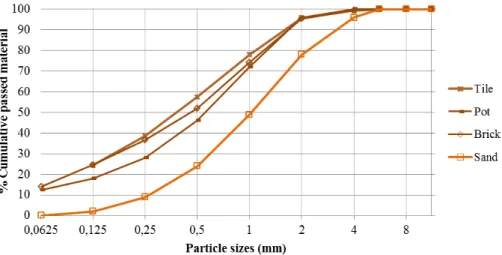
Mortars were prepared with hydrated powder air lime as binder, a common river sand and ceramic wastes as aggregates. The air lime used has a Ca(OH)2 minimum content of 93% and was designated as CL90 according to the EN 459-1 [10] specification. This product was provided by Lusical company from Lhoist Group. The common siliceous river sand used was characterized in what concerns to its particle size distribution, fineness modulus [10], density, water absorption [12], loose bulk density and percentage of voids [13]. Ceramic wastes were collected in bricks, roof tiles and ceramic pottery plants and were grinded in a laboratory Retsch jaw mill, with a 10mm cribble; the same properties as for river sand were determined. The particle size distributions of all the aggregates are presented in Figure 1 and Table 1 specifies densities and water absorption.
Figure 1. Particle size distribution of the river sand and the ceramic residues
Parameter Bricks Roof Tiles Pottery River sand Air lime
FM Fineness modulus [-] 2.41 2.06 2.17 3.42 -
a Apparent particle density
[g/cm3]
2.67 2.69 2.64 2.56 -
rd
Particle density on an
oven-dried basis 1.95 2.06 2.15 2.55 -
ssd
Particle density on a saturated
and surface-dried basis 2.22 2.29 2.34 2.55 -
ρbi Loose bulk density 1.10 1.17 0.98 1.54 0.36
WA24 Water absorption after immersion for 24 hours
[%] 13.9 11.3 8.59 0.04 -
Percentage of voids 43.6 43.1 54.0 39.7 -
which does not happen to the river sand. This fact might induce significant differences in mortars where the aggregate was partially replaced, as it changes its porous structure.
In terms of fineness modulus, studied aggregates are classified as medium sized grains. Densities obtained are from the same order of magnitude, except for loose bulk density; in this case, the wastes present densities that are lower than the river sand and both are much higher than air lime. Significant differences are found in water absorption results: whereas sand presents an almost inexistent water absorption after 24 hours of immersion, wastes present values between 8% and 14%. This aspect may directly affect mortars behaviour.
2.2.Mortar characterization
Several mortar compositions were prepared with 1:2 and 1:3 volumetric proportions and 2 or 3 designate the proportion of mortars. River sand was replaced by 20% and 40% of each type of waste. Mortars with 20% of sand’s substitution were designated with an L (Low) and mortars with 40% of sands substitution were designated with an H (High). Mortars with brick waste were attributed B suffix, mortars with roof tile, T, and mortars with pottery were designated with a P. Besides indicated mixtures, reference mortars without wastes were also prepared to allow the evaluation of the influence in mortars behaviour of each type of waste, has well as the replacement percentages. Those mortars were designated with an R.
All mortars were prepared with a water amount that provided a good workability. It was considered a range of consistency, determined according to EN 1015-3 [14], from 135 to 165mm. In Table 2 the values obtained for this parameter are presented, as well as the water/binder ratio. This table also includes volumetric and weight proportions applied.
Mortar CL90 Residues Sand Volumetric proportions
Weight
proportions Consistency
Water/binder ratio
B T P
3R 1 - - - 3 1:3 1:12.2 147.6 2.21
3LB 1 0.6 - - 2.4 1:0.6:2.4 1:1.8:10.2 150.8 2.21 3HB 1 1.2 - - 1.8 1:1.2:1.8 1:3.6:7.7 152.9 2.56 3LT 1 - 0.6 - 2.4 1:0.6:2.4 1:1.9:10.2 151.3 2.62 3HT 1 - 1.2 - 1.8 1:1.2:1.8 1:3.9:7.7 153.2 2.35 3LP 1 - - 0.6 2.4 1:0.6:2.4 1:1.9:10.2 151.4 2.35 3HP 1 - - 1.2 1.8 1:1.2:1.8 1:3.9:7.7 151.0 2.63
2R 1 - - - 2 1:2 1:8.5 164.8 1.66
2LB - 0.4 - - 1.6 1:0.4:1.6 1:1.2:6.8 152.4 1.66 2HB - 0.8 - - 1.2 1:0.8:1.2 1:2.4:5.1 164.3 1.87 2LT - - 0.4 - 1.6 1:0.4:1.6 1:1.3:6.8 163.1 1.66 2HT - - 0.8 - 1.2 1:0.8:1.2 1:2.6:5.1 148.2 1.66 2LP - - - 0.4 1.6 1:0.4:1.6 1:1.1:6.8 149.2 1.66 2HP - - - 0.8 1.2 1:0.8:1.2 1:2.2:5.1 156.1 1.51
Table 2. Volumetric and weight proportions, consistency and water/binder ratio
flexural and compressive strength, water absorption due to capillary action and porosity and 100mm diameter and approximate 17mm high cylinders were used to determine water vapour permeability. All specimens were kept at 20ºC and 95% relative humidity (HR) in the first 5 days of curing, remained 2 more days at 20ºC and 65% HR and were then demoulded. They remained in these conditions until tested (60 and 365 days of curing).
2.2.1. Mechanical strength
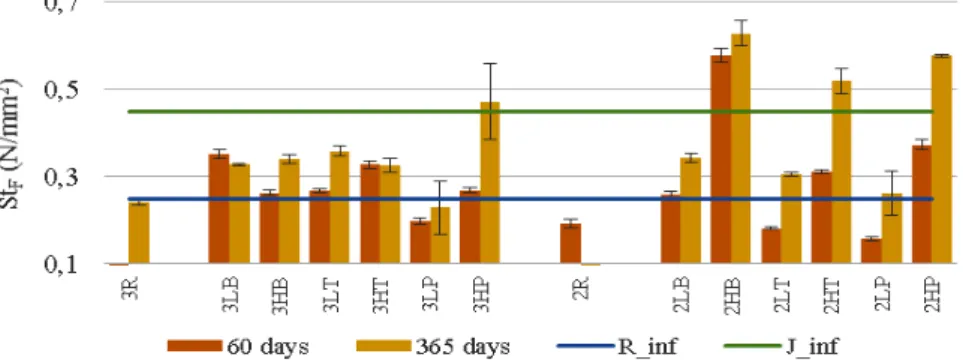
Flexural and compressive strength tests were performed according to EN 1015-11 [15] specifications. Three prismatic specimens were used for each mortar and curing period. Compressive strength was determined with one of the halves resultant from flexural strength test and the other half was used to determine water absorption due to capillary action. Flexural strength results, StF, are indicated in Figure 2, and compressive strengths, StC, in Figure 3. Standard deviation obtained for each sample is also graphically presented.
Figure 2. Flexural strength results at 60 and 365 days
Figure 3. Compressive strength results at 60 and 365 days
higher percentage of wastes might be related to some kind of pozzolanic reactivity. However, these results may be influenced by the shape of the waste particles, probably more angular than the river sand and, consequently, more cohesive and also by the higher amount of fine particles of the wastes that fill in the voids and generate more compact mortars.
When indicative requirements for old buildings replacement mortars, applied as renders, plasters or repointing [16] are analysed, recommended values for flexural strength must be above 0.2 N/mm2 for rendering and plastering mortars and 0.4 N/mm2 for repointing mortars. These limits are represented in Figure 2 as R_inf and J_inf, respectively. After 365 days, almost all mortars with wastes present values above the inferior limit for plastering and rendering mortars. The compositions with 1:2 proportion and higher amounts of wastes also appear to be suitable for repointing purposes. In what concerns to compressive strength, all mortars with wastes present values above the inferior limits for rendering and plastering (R_inf, of 0.4 N/mm2), most of them after 60 days of curing . As repointing mortars (J_inf of 0.6 N/mm2), almost all mortars with wastes present values above the limit at 365 days, especially mortars with higher percentage of wastes.
2.2.2. Water absorption due to capillary action
Water absorption due to capillary action was determined according to EN 15801 [17] recommendations, more appropriate for porous slow curing mortars as air lime ones. One of
the specimens’ halves resultant from flexural strength tests was used. Weightings were carried
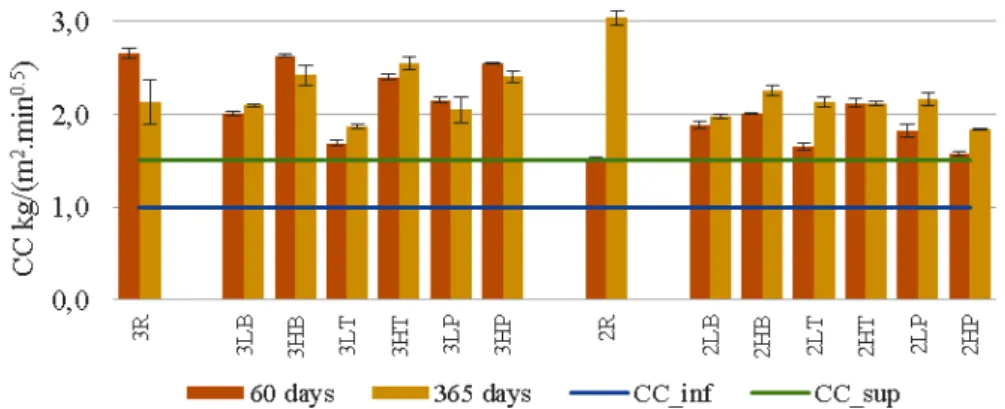
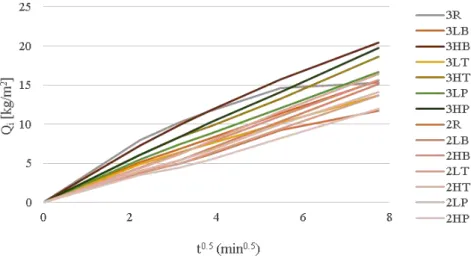
out at 5, 10, 15, 30, 60, 90, 120, 180 min and each 24 h after first contact of the specimens with water, until constant mass was reached. Water absorption coefficient was determined and it is represented in Figure 4, as well as their standard deviation. Figure 5 shows, as an example, first
hour’s absorption curve, at 60 days of curing.
Figure 4. Capillary coefficient results at 60 and 365 days
Figure 5. Water absorbed in the first hour at 60 days
When indicative recommended values are considered [16], values for capillary coefficient must be between a range of 1.0 kg/(m2.min1/2) to 1.5 kg/(m2.min1/2), graphically represented as CC_inf and CC_sup. All obtained values are above this range. However, mortars with lower percentage of residues are close to the superior limit, especially mortars with 1:2 proportions and, compared with the reference mortars, the behaviour introduced by the wastes is sometimes even positive.
2.2.3. Open porosity
Open porosity of mortars, ρO, was estimated considering the procedure described in EN 1936 [18]. For each sample the remaining intact end of specimens used for the compressive strength tests were used. The specimens were immersed in water until saturation was reached and the relation between total open pores and specimens volume was estimated. Results are presented in Figure 6, as well as their standard deviation.
Figure 6. Open porosity results at 60 and 365 days
mortars with higher percentage of wastes present the highest values. This behaviour was also registered for capillary coefficient of mortars, which may be explained with the existence of higher amounts of pores with smaller dimensions which increase water absorption by capillary action.
2.2.4. Water vapour permeability
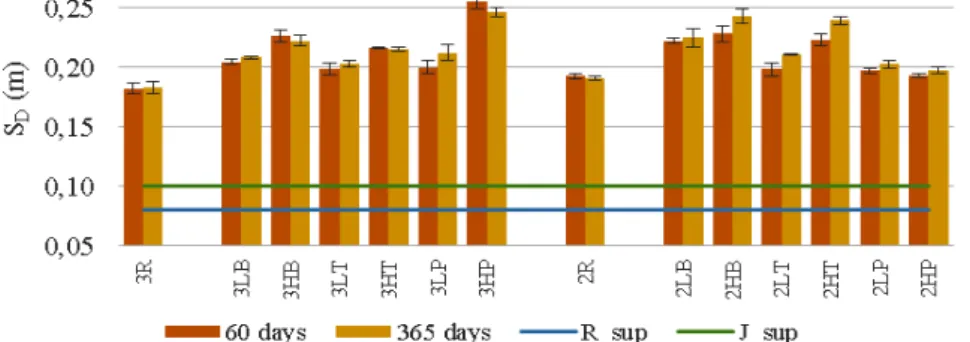
Water vapour permeability was determined according to the procedure described in ISO 12572 [19]. The wet cup method was followed and three cylindrical specimens were used for each mortar composition. Parameters such as water vapour permeability, water vapour resistance factor and water vapour diffusion-equivalent air layer thickness, SD, were determined. As all of these characteristics are proportional to each other, only results of the equivalent air layer thickness are presented (Figure 7).
Figure 7. Water vapour diffusion-equivalent air layer thickness results at 60 and 365 days
Mortars with 1:2 and 1:3 proportions globally present values from the same order of magnitude. It can be observed that mortars that contain wastes obtained higher equivalent air layer thicknesses, corresponding to higher water vapour transmission resistances. Also, this resistance is directly proportional to the percentage of the wastes in the mortars: higher amounts of wastes lead to higher equivalent air layer thicknesses. This aspect may be directly related to the amount of fine particles of the wastes which provide a less porous structure to mortars. Generally, all mortars present a slight increase of the water vapour resistance among the curing period, which was considered negligible.
According to the recommended values from bibliography [16], mortars should present values under 0.08m for rendering and plastering (R_inf) and 0.1m for repointing purposes (J_Sup). None of the mortars satisfy this requirement but, comparing with the reference mortars, the increase due to the ceramic waste is not very important. However, lower values were obtained for mortars with lower percentage of wastes and, in this way, they are more suitable as substitution mortars.
3. CONCLUSIONS
that the inclusion of ceramic wastes improved mortars behaviour, maybe due to some kind of pozzolanic reaction and to specific characteristics of ceramic wastes, as their mineralogical composition, sizes and shape.
In what concerns to physical behaviour, the presence of ceramic wastes in air lime mortars worsens slightly the mortars behaviour. However, obtained results are quite regular and close to the limits defined by bibliographic references. The increase observed in terms of capillary coefficient and water vapour diffusion-equivalent air layer thickness with the inclusion of residues might be related to changes induced in the porous structures, as the presence of smaller particles from ceramics leads to the filling of pores. Also, substituting siliceous sand, with almost no water absorption, with ceramic fragments that present high water absorption leads to a higher water retaining.
When analysing long time behaviour of the studied mortars, it was verified that, in general, mortars with wastes present an improved mechanical performance after 1 year of curing and in physical terms no significant changes were observed. In global terms, it was considered that the obtained results were quite satisfying, encouraging the continuity of this study, with a deeper characterization of the present compositions and with the analysis of other proportions and resources from ceramic industry disposal.
ACKNOWLEDGMENTS
The authors would like to thank the FCT – Fundação para a Ciência e Tecnologia for its support
through the project ‘‘PTDC/ECMCOM/3080/2012 – Development and optimization of a higroadjustable system for drying out buildings after a flood’’. This work has also been framed under the Initiative Energy for Sustainability of the University of Coimbra and supported by the Energy and Mobility for Sustainable Regions – EMSURE – Project (CENTRO-07-0224-FEDER-002004).
REFERENCES
[1] A. Moropoulou, A. Bakolas, S. Anagnostopoulou, “Composite materials in ancient
structures”Cement and Concrete Composites, vol. 27, pp. 295-300, 2005.
[2] G. Baronio, L. Binda, N. Lombardini, “The role of brick pebbles and dust in conglomerates based on hydrated lime and crushed bricks”Construction and Building
Materials, vol. 11, pp. 33-40, 1997.
[3] G. Matias, P. Faria, I. Torres, “Lime mortars with heat treated clays and ceramic waste:
A review” Construction and Building Materials, vol. 73, pp. 125–136, 2014.
[4] A. Moropoulou, A. Bakolas, K. Bisbikou, “Thermal analysis as a method of characterizing ancient ceramic technologies”Thermochimica Acta, vol. 2570, pp. 743-753, 1995.
[6] M. Budak, S. Akkurt, H. Böke, “Evaluation of heat treated clay for potential use in intervention mortars”Applied Clay Science, vol. 49, pp. 414-419, 2010.
[7] H. Böke, S. Akkurt, B. İpekoğlu, E. Uğurlu, “Characteristics of brick used as aggregate in historic brick-lime mortars and plasters” Cement and Concrete Research, vol. 36, pp. 1115-1122, 2006.
[8] E-PRTR, The European Pollutant Release and Transfer Register. European Environment Agency (EEA), Copenhagen, Denmark, 2013.
[9] G. Matias, P. Faria, I. Torres, “Lime mortars with ceramic wastes: Characterization of components and their influence on the mechanical behaviour” Construction and Building Materials, vol. 73, pp. 523-534, 2014.
[10] CEN (2010): EN 459-1:2010 - Building lime - Part 1: Definitions, specifications and conformity criteria, CEN, Brussels, Belgium.
[11] CEN (2012): EN 933-1:2012 - Tests for geometrical properties of aggregates. Part 1: Determination of particle size distribution - Sieving method, CEN, Brussels, Belgium.
[12] CEN (2013): EN 1097-6:2013 - Tests for mechanical and physical properties of aggregates. Part 6: Determination of particle density and water absorption, CEN, Brussels, Belgium.
[13] CEN (1998): EN 1097-3:1998 - Tests for mechanical and physical properties of aggregates - Part 3: Determination of loose bulk density and voids, CEN, Brussels, Belgium.
[14] CEN (1999): EN 1015-3:1999 - Methods of test for mortar for masonry - Part 3: Determination of consistence of fresh mortar (by flow table), CEN, Brussels, Belgium.
[15] CEN (2006): EN 1015-11:2006 - Methods of test for mortar for masonary - Part 11: Determination of flexural and compressive strength of hardened mortar , CEN, Brussels, Belgium.
[16] M. Veiga, A. Fragata, A. Velosa, A. Magalhães, G. Margalha, “Lime-based mortars: viability for use as substitution renders in historical buildings” International Journal of Architectural Heritage, vol. 4, pp. 177–195, 2010.
[17] CEN (2009): EN 15801:2009 - Conservation of cultural property. Test methods. Determination of water absorption by capillarity, CEN, Brussels, Belgium.
[18] CEN (2006): EN 1936:2006 - Natural stone test methods - Determination of real density and apparent density, and of total and open porosity, CEN, Brussels, Belgium.