Instituto Superior de Ciências do Trabalho e da Empresa
MANAGING MOTIVATION IN ORGANIZATIONS
-
WHY EMPLOYEE RELATIONSHIP MANAGEMENT MATTERS
Carmen Wargborn
Dissertation submitted as partial requirement for the conferral of
Master of International Management
Supervisor:
Prof. Alexandra Fernandes, ISCTE Business School, Department of
Management Sciences
I
Abstract
Work motivation is a hot topic within the science of organizational behavior. Low degrees of motivation amongst employees in work organizations contribute in various ways to high costs. Salary is a powerful motivator, but few managers today know that employees may hold back 30 to 80 percent1, 2 of their energy at work because organizations fail to understand what motivates people on an individual level. The large majority of motivation theories developed to date are of the type one size fits all; they do not take individual human differences into account. Employee Relationship Management (ERM) is a strategic tool and a Human Resource Management process which focuses on the continuous perfection of the relationships between organizations and employees through increased communication and knowledge of individual and shared interests. This study suggests that well managed relationships in organizations lead to higher levels of motivation. Twelve managers who participated in this study of the concept of ERM all claimed to be in favor of it as a tool to manage and raise motivational levels in their different companies.
It was discovered that companies experience various employee motivation-related problems and that managers actively seek remedies to better manage and understand low motivation levels of their staff. The conclusion of this study suggests that ERM can be part of a global future solution in the 21st century when it comes to management of motivation in organizations.
Keywords: Work Motivation, Employee Relationship Management (ERM), Human
Resource Management, Organizational Behavior
1
Landale, A. (2006), Lead Through Your Relationships, The British Journal of Administrative Management, June/July, p. 19
2
II
Resumo
Actualmente, a motivação no trabalho é um tema importante no campo de estudo do comportamento organizacional. Investigações demonstraram que reduzidos níveis de motivação contribuem de diversas formas para o aumento de custos nas organizações. Pese embora os salários sejam umas das mais poderosas ferramentas de motivação, são poucos os gestores de hoje que sabem que os seus trabalhadores podem reduzir entre 30 a 80 por cento da sua energia no trabalho porque as organizações não conseguem compreender quais os factores que motivam as pessoas a um nível individual. A maioria das teorias de motivação desenvolvidas até hoje baseia-se numa abordagem genérica, em que um modelo global pode ser aplicado a todos os trabalhadores, não tomando em consideração as diferenças intrínsecas a cada ser humano. O Employee Relationship Management (ERM) é uma ferramenta estratégica e um processo de Gestão de Recursos Humanos que se foca no contínuo aperfeiçoamento das relações entre as organizações e os trabalhadores através do aumento da comunicação entre as partes e através do aumento do conhecimento existente sobre cada indivíduo e sobre os interesses partilhados entre este e a organização. Esta tese de mestrado sugere que a melhoria na gestão das relações entre organização e trabalhadores conduz a maiores níveis de motivação.
Os doze gestores que participaram neste estudo de conceito de ERM, consideram o ERM como uma ferramenta pertinente para incrementar os níveis de motivação nas suas empresas.
No decorrer deste estudo foi descoberto que as empresas tinham diversos problemas de motivação e que os gestores procuravam identificar as causas e soluções para solucionarem este problema. A conclusão deste estudo sugere que o ERM poderá fazer parte de uma futura solução adaptada as necessidades do século XXI no que respeita à gestão da motivação nas organizações.
Palavras-chave: Motivação, Employee Relationship Management (ERM), Gestão de
Recursos Humanos, Comportamento Organizacional
JEL Classifications: M12 (Personnel Management) M54 (Labor Management)
III
Acknowledgements
Choosing a Master Thesis topic is never easy, clearly and successfully proving one’s point may be even harder. This is especially true when dealing with such a popular and diverse topic as the study of motivation in work organizations. The amount of scientific and academic work that has already been carried out within this field is simply enormous, and results and recommendations related to the subject vary greatly depending on the research conducted.
Without the help and guidance I received, this thesis would not have been accomplished as it is today. I would like to express my deepest gratitude to my supervisor and mentor Professor Alexandra Fernandes at the department of Management Sciences at the ISCTE school of Management, Lisbon, Portugal, for her constant support and input in this work. In times when even I had difficulty in finding my own motivation to formulate clear conclusions of my work, she never lost hers.
Secondly I would like to thank all the staff and colleagues who crossed my path at the Master of International Management program at the ISCTE school of Management, Lisbon, Portugal. I learned a lot from all of you, for which I am entirely grateful.
Last but not least, a very special thank you to all the Managers of various companies in Portugal and Scandinavia, who endured, sometimes quite demanding, brainstorming sessions with me and provided me with their invaluable and honest feedback on the subject of work motivation and employee relationship management. Without your ideas and input, no conclusion of this thesis could ever have been made.
Lisbon, March 7th, 2008 Carmen Wargborn
IV
Preface
Are there any general theories Managers can apply across organizations and across cultures to manage and increase motivation in work organizations?
Why is it so hard to motivate oneself to perform certain tasks at work?
Isn’t there a general way to entrust on people elevated levels of inner motivation to perform certain tasks for which they lack motivation to perform?
Maybe money is the most powerful motivator in the workplace after all?
In the workplace, the place where many people find it the most difficult to motivate themselves to perform the tasks in their work-descriptions, are there any theories or methods which could be applied to increase the motivation-levels of the people?
If no such theories exist, or fail to be applicable on a general level (i.e. across different industries, different cultures etc.), could they be developed?
As we shall see, the subject of motivation has proved to be very popular in scientific research over the past 100 years, mainly in the field of psychology. Understanding and influencing employee motivation has also long been one of managements’ most difficult and important duties. Success in this endeavor is becoming more and more challenging in the light of organizational trends such as downsizing, outsourcing, a less loyal workforce and an increasingly competitive labor market.
This thesis looks at the following issues:
• What is motivation, and what creates motivated, contributing people? • How do Managers enable and maintain high employee motivation in work
organizations?
• How do Managers’ reward and recognition systems contribute to, or deflate, employee motivation in work organizations?
• What is ERM – Employee Relationship Management, and why is it important for the future of any modern, motivated organization?
1 Table of Contents
1. Executive Summary... 2
2. Motivation and its Theories – Historic Overview... 4
2.1. How Society defines Motivation ... 4
2.2. The Meaning of Motivation in Work Organizations ... 6
2.3. Motivation Theories shaped in the 20th Century... 11
2.4. Popular Motivation Theories ... 13
2.4.1 Content Theories ... 13
2.4.2 Process Theories... 24
2.4.3 Behavioral Theories... 34
2.4.4 New Approaches ... 36
3. HRM and the Task of Managing Employee Motivation... 47
3.1. The Role of HRM in the Work Organization ... 48
3.2. Responsibility for Managing Employee Motivation... 50
3.3. Measuring Motivation in the Workplace ... 51
3.4. Rewards that Motivate ... 53
3.5. Money as the Most Powerful Motivator in the Workplace... 55
3.6. Work Motivation in Different Cultures ... 58
3.7. The Search for a Global Motivation Theory... 60
4. ERM – Employee Relationship Management ... 62
4.1. Workplace Relationships and Organizational Commitment... 65
4.2. Effects and Implementation of ERM in Work Organizations... 69
5. Interviews with European Managers about Motivation and ERM ... 75
5.1. Methodology of Research ... 75
5.2. Codification Procedures... 78
5.2.1 Personal definitions of Motivation ... 79
5.2.2 Lack of Motivation – Perceived Signs ... 81
5.2.3 Responsibility for Employee Motivation ... 83
5.2.4 Money as the Most Powerful Motivator in Work Organizations ... 84
5.2.5 New Ideas in the Field of Work Motivation... 85
5.2.6 Costs of Losing Unmotivated Employees ... 86
5.2.7 Managers Perception of Employee Relationship Management... 87
5.2.8 Implementation and Perceived costs of ERM ... 87
5.3. Analysis of the Research Results... 90
5.3.1 Many Personal Definitions of Motivation Exist... 90
5.3.2 Work Organizations Experience Motivational Problems ... 90
5.3.3 Management is Partly Responsible for Employee Motivation ... 91
5.3.4 Money is Not the Most Powerful Motivator in All Work Organizations... 92
5.3.5 New Theories within the Field of Work Motivation are Scarce... 93
5.3.6 It is Expensive for Firms to lose Unmotivated Employees ... 94
5.3.7 Managers are Positive to Implementing ERM ... 95
6. Conclusion & Recommendations ... 97
6.1. Limitations of this Research ... 101
6.2. Suggestions of further Research on ERM... 102
7. Bibliography... 103
7.1. Books ... 103
7.2. Articles and Journals... 106
7.3. Academic Publications / Theses ... 110
7.4. Web-based Research... 111
8. Annexes... 112
8.1. Interview Questions for Managers... 112
2
1. Executive
Summary
Every Manager in every organization wishes for employees who perform their tasks with excellence. Motivation at the workplace is one of the key variables determining employee performance and employee satisfaction. Employee performance directly influences the quality of organizations, and still, managers of every corner of the world often complain about their staff not being motivated enough.
At the same time, research has showed that employees may hold back 30 to 80 percent of their energy at work because organizations fail to understand what motivates people on an individual level (Spitzer, 1996; Landale, 2006).
We live in a society that is so dominated by organizations that we always need to learn more about the determinants of organizational effectiveness. We must not forget that a complex independent society must have effective organizations, is it to provide high quality of life for its members. Effective organizations are not to be left up to coincidence or luck. Their existence (and success) almost always depends on the human factor. They depend on the Management of them, and the mindsets of the people inside them.
Those individual behaviors that are crucial in determining the effectiveness of organizations are, almost without exception, voluntary, motivated behavior. Because of this, it is highly important that we understand how organizations influence the motivation levels of their individual members. If we are ever to have effective organizations we must first understand how to encourage effective individual performance.
This Master thesis was written for modern-day managers in any organization, who are interested in how motivation works in the workplace. The goal of this thesis is to provide any interested Manager with easy to understand, straightforward research on how thought about motivation in work organizations have formed since the early 20th century. The thesis consists of an explanatory first part about what motivation means and how researchers have treated the issue in the past. After this the issue of motivation in work organizations is treated.
3 The second part of the thesis presents the results of interviews with 12 Managers working in national and international companies in Portugal and Scandinavia, and their thoughts about motivation in the workplace and Employee Relationship Management (ERM). The final part of this thesis suggests, based on the results of the research and opinions of the interviewed Managers, that Employee Relationship Management is a universal and functional process and a strategy when it comes to manage motivation in the work organization, now and in the future. Evidence of ERM was found in the organizations of the managers interviewed, but often going by different names.
This thesis holds that the Equity Theory (Adams, 1963) was in many ways the first theory to explain the importance and management of human relationships as the underlying generator of human motivation. The Equity Theory should not be overlooked as perhaps the starting point of the development of the concept Employee Relationship Management. It will be argued in this thesis that productive and well-managed relationships between individuals in the workplace are intrinsic to manage motivation. Employee Relationship Management is a possible and functional process and a strategic tool to manage and increase motivation in work organizations, which offers full flexibility while at the same time possessing the powers of being applicable across different cultures and in different industries. Summarizing the conclusion of this thesis in a single, powerful phrase, and in the words of Organizational Behavioral theorist Frederick Schuster (1998):
- Do you want your employees to be more motivated, more productive?
Pay more attention to them!
4
2. Motivation and its Theories – Historic Overview
2.1. How Society defines Motivation
Behavioral psychologists including Beck (2004) agree that one of the most important tasks for a motivation theorist is to be able to define motivation. This is complicated by the fact that theorists approach motivation differently and disagree in their definitions because they may have fundamentally different views of what motivation is really all about (Beck, 2004). What motivation is to one person is clearly not the same as it is to another. Psychologists have used the term “motivation” in a variety of ways. Because of this, they have also not always agreed on exactly which types of behavior should be classified as motivated behavior. Nowadays, there seems to be some agreement that, at the very least, the distinguishing characteristic of motivated behavior is that it is goal-directed (Lawler, 1994).
It can be concluded that the word motivation is in fact so commonly used in most languages in everyday speech, that many people develop their own personal meaning of what motivation really means. Not even the Concise Oxford Dictionary defines “Motivation” in a clear way, just simply referring the word to other words such as “motive” and “enthusiasm”.
Though hard to define, most psychologists agree that motivation is forces acting either on or within a person to initiate behavior. The word is derived from the Latin term motivus (“a moving cause”), which suggests the activating properties of the processes involved in psychological motivation.3
Other popular definitions of what motivation really encompass are commonly more elaborate, like the collection of simply-generated web searches presented below:
“Motivation refers to the initiation, direction, intensity and persistence of behavior. Motivation is a temporal and dynamic state that should not be confused with personality or emotion. Motivation is having the desire and willingness to do something. A motivated person can be reaching for a long-term goal such as becoming a professional writer or a
3
5 more short-term goal like learning how to spell a particular word.” (http://en.wikipedia.org/wiki/Motivation_theories)
“Motivation is the wants, needs and beliefs that drive a character.” (johnaugust.com/site/glossary)
“Motivation is the push of the mental forces to accomplish an action. Unsatisfied needs motivate. On the biological level basic human needs of food, shelter and survival are powerful motivators. On the psychological level people need to be understood, affirmed, validated and appreciated. On the business level motivation occurs when people perceive a clear business reason for pursuing a transfer of knowledge or practices.” (home.earthlink.net/~ddstuhlman/defin1.htm)
As we can see from these different definitions of motivation, there is only a diffuse relationship between the stated comparisons. Subsequently the first task for any person who wants to do research the subject of motivation, is to choose one definition which best serves the purpose of the research at hand.
Even before carrying out the qualitative research for this thesis (interviews), it could be concluded that the general opinion in society of what motivation really means seems to differ widely, or, many different interpretations of what motivation is, exist. For this thesis, a choice was made to adopt the definition of motivation by Jones (1955).
Jones held that: “Motivation is concerned with how behavior gets started, is energized, is sustained, is directed, is stopped, and what kind of subjective reaction is present in the organism while all this is going on”.
Throughout the last 30 years, conclusions of research on motivation in the academic field show the resurgence of the emphasis on needs as underlying explanation of motivation. Especially a resurgence of interest in Maslow’s hierarchical needs theory as a basis to understand what motivation is and how it is generated, is noted (Latham & Pinder, 2005).
6
2.2. The Meaning of Motivation in Work Organizations
Before we can start a discussion of motivation in the work organization, we must pay attention to the context surrounding it, namely the management of firms.
Although the process of management is as old as history, scientific management as we know it today is basically a twentieth century phenomenon. In fact the field of management has been so devoid of real fundamental work, that it took until 1978 for Herbert A. Simon to win the Nobel Price in economics, being the first management theoretician to do to so. His contribution itself gives a clue to the difficulty, bordering on impossibility, of real fundamental, academic work in this field. Management is in essence concerned with people. In order to arrive at perfect decisions, managers must have all the information necessary relevant to the various factors and all the time in the world to analyze the same. This is hardly ever possible in the real world. Both the information available and the time at the manager’s disposal are limited, but he or she must make a decision. And the decision is, therefore, not the perfect one, but a “satisfying” one - in effect, a satisfactory compromise under the real conditions prevailing in the management arena.
Motivation and its applications and implications in the work organization is considered by many managers as one of the management issues which is still one of the hardest to truly define and tackle. On the positive side, at least it could not be concluded in this study that the very word itself would mean different things depending on the language spoken (i.e. English “motivation”, Swedish “motivation”, Norwegian “motivasion”, Finish “Motivaatio”, or Portuguese “motivação”).4
Pinder (1998) reasoned that work motivation (here thus more specific to this thesis) is a set of energetic forces that originate within as well as beyond an individual’s being, to initiate work-related behavior and to determine its form, direction, intensity and duration. Thus, we can conclude that motivation is a psychological process resulting from the interaction between the individual and the environment (here: the work place).
As we shall see, the research on motivation in work organizations has, in fact, touched all the issues raised by the definition by Jones presented earlier, and suggests that they must all be considered if we are to understand motivation in work organizations. In this thesis
4
7 Jones’ definition of what motivation means in the work organization shall be applied, since it also will produce the most comprehensive and valid definition and the most valid coverage of the literature on motivation in organizations (Lawler, 1994).
Studying motivation in work organizations is challenging because of the enormity and complexity of the subject. Part of the complexity is that work organizations come in many different sizes, shapes and forms. They vary in the kinds of products or services they produce, the kinds of customers they serve, and the kinds of financial structures they have. And this is mostly only the beginning of a very list of elements that made them differ from each other.
However, organizations do have some common elements, and by understanding these elements we can go quite a long way towards understanding how organizations can influence motivation. What are these common elements? As is often observed, organizations are made up of two or more people, are goal oriented, and are designed to exist over some length of time. These factors lead to the following characteristics that work organizations normally have in common, adopted by Lawler (1994):
1. Money plays an important role. Money plays a role because to attract and retain people, work organizations have to pay them. Furthermore, to survive work organizations have to be financially viable. Thus, in all work organizations the obtaining, allocating, and spending of money is a crucial issue. Since it is important to many people, money obviously can influence motivation. This leads us to believe that any discussion of motivation in work organizations must consider how the way the organization handles its money influences the motivation of its employees.
2. Some type of hierarchy exists. The structures of most work organizations are characterized by superior/subordinate relationships. The reason for this is simple: as organizations grow they develop coordination problems, and someone or something is needed to see that the activities of the employees represent a coordinated effort towards whatever the goals of the organization are. Organizations try to solve this problem by making some people responsible for coordinating the work of others and by creating information and control systems to monitor the work of employees. We often call this the Management. Admittedly, at times it is hard to believe that the
8 extensive hierarchies that are developed (some organizations have as many as 20 levels) actually contribute to coordination. There is no doubt that in our society the superior/subordinate relationship – the hierarchy itself – is crucial in terms of motivation. The essence of supervision is in influencing the behavior of those being supervised, for example by influencing motivation. The hierarchical structure of organizations also means that some people have more status and power than others. Because of this, the possibility of promotion within the structure is often important to people and thus exerts a significant influence on motivation.
3. People are given assigned tasks to perform. Taken together, all the tasks a person performs are called his job. Large organizations have literally thousands of different jobs. The reason for this division of labor is simple: no one person can perform all the functions that are necessary to do such a thing as for example manufacture and sell a car. People are given responsibility for different parts of the manufacturing and sales process. Recent research has shown that how tasks are grouped to form jobs has a crucial influence on motivation. This connection should not be surprising. The person who works on an assembly line and does the same task over and over again every 15 seconds is obviously in a different environment from that of the person who does a less repetitious task, just as a salesman is in a different position from that of a corporation president. Probably as many approaches to motivating employees have been tried as there are kinds of work organizations. Some organizations successfully motivate their employees by giving them interesting jobs, others use the principles of democratic management, while yet others use pay-incentive plans. This variety of approaches is not surprising, since – due to basic differences – some organizations are better equipped to motivate people in certain ways than are other organizations. For example, the type of product or service produced influences the way in which the organization can design jobs; thus the product or service itself influences how much the organization can use job design to motivate behavior. Just as organizations differ in what they can do to influence motivation, people differ in what motivates them to work. Some people work primarily because of the companionship it offers, others work for money. Some work hard because there is a pay-incentive plan. Although in some ways these differences make it more difficult to understand motivation, they are comprehensible. Motivational differences among employees stem from many different
9 factors, including how people were raised, their culture, and how they are treated at work. In some ways motivation would be even more difficult to understand if someone from the ghetto, without a high school education, could walk into the executive office of a large corporation and respond to organizational policies in the same manner as the college-educated son of the corporation’s president. Because this possibility is very unlikely, we will continue to focus on the ways individuals differ in their motivation. Summarizing all of this leads us to believe that adequate understanding of motivation in the workplace requires that we are able to predict how specific individuals will react to specific organizational practices. We need to be able to predict how specific employees will react to pay-incentive plans, to democratic leadership, to routine jobs, and so on. This can be done with some accuracy if we understand how organizational practices affect people’s goals and their views of how these goals can be obtained. Now that we have defined the characteristics which work organizations should have in common, and under which the individual is challenged to carry out his professional services or labor, we must also not forget that job behavior is influenced by many other factors, not only by motivation. One of the most important of these is ability. No matter how motivated a person is to perform well, good performance is not possible if the person lacks the necessary ability. Many theorists, including Lawler (1994), have suggested that the following equation expresses the relationship of ability and motivation to performance:
Performance = f (Ability x Motivation)
For the ease of use of this equation, both ability and motivation are thought of as ranging from 0 to 1. Because the equation calls for a multiplicative combination of ability and motivation, if either is low, then performance must be low. In other words, high motivation can make up for low ability only to a limited extent, which also applies to high ability and low motivation.
Much evidence supports the fact that ability and motivation do combine multiplicatively to determine performance (Lawler, 1971). It is clear that people are limited in their response capabilities and this limitation does influence performance. Some people simply don’t have the ability to be professional tennis players or opera singers. Therefore, no matter how motivated some people are, they will never be successful in these occupations.
10 One very important further point needs to be made about the (Ability x Motivation) formulation. The most commonly used definition of the term “ability” includes all of the training, experience, talent and aptitude that are necessary to perform well in a given situation. In other words, ability refers to how well the person can perform at the present time. The concept of ability is differentiated from the concept of aptitude, which refers to whether an individual can be brought through training and experience to a specified level of ability. Therefore, aptitude refers to how much the person’s response capabilities can be developed. In line with this distinction between ability and aptitude, the equation presented earlier is best broken down like this (Lawler, 1994):
Performance = f (Ability x Motivation),
where
Ability = f [Aptitude x (Training + Experience)].
An important conclusion at this point is therefore that not all performance problems that occur in work organizations are caused by low motivation. Often, especially in higher-level jobs, performance problems are caused by low ability.
Thus, in trying to diagnose the performance problems of individuals in organizations, it is crucial to try to find out how much of the problem is due to poor ability and how much is due to poor motivation. Poor performance caused by low motivation clearly requires different kinds of corrective actions, from situations of poor performance cause by low ability. Problems that are caused by low motivation can for example be solved by change in job design, the manner of leadership, or the type of reward system. Problems that are caused by low ability levels may be more difficult to solve. First, it is necessary to determine whether the problem can be overcome by training. Often the problem is not that the person lacks the aptitude or talent to perform well, but he or she lacks the training and experience needed to perform well. If this deficiency is the case, then training can solve the problem. But if aptitude is low, then there is no way to improve performance.
11
2.3. Motivation
Theories shaped in the 20
thCentury
Because so many different motivation theories exist, the following 2 sub-chapters attempt to summarize conclusions made about motivation by some of the most important thinkers of the 20th century. These ideas have all served to form and shape the way we understand the concept of motivation today.
At this stage it is important to distinguish between theories of motivation and theories that concern themselves with specifying the nature of human needs or drives. Acceptable theories of human needs or drives have to deal only with why outcomes such as pay, promotion, and job security are sought while other outcomes are avoided. This kind of theory should not be confused with a theory of motivation that tries to fully explain and predict behavior. To explain and predict behavior, a theory must state not only why some outcomes are sought while others are avoided, but also the factors that influence how they are sought. Many psychologists and managers do, however, confuse the two. They assume that because they have theories that make statements about the attractiveness of objects or outcomes, they somehow have theories of motivation that can explain and predict all kinds of behavior. This is a misleading assumption. Because of the nature of their theories, they are limited to saying why something is a goal and to predicting what kind of objects or outcomes will the sought. But they cannot predict how a person will behave in order to obtain or avoid a particular outcome (Lawler, 1994).
The work on motivation in the field of psychology has been dominated by two different views of the nature of man. One represents man as being motivated by inherited, conflicting, unconscious drives that cause him to behave in instinctual and at times self-destructive ways. The second view represents man as rational and aware of his goals and as behaving in those ways that he feels will help him achieve his goals. The first view had its origin in the writings of Freud and the neo-Freudians and has continued to develop during the last fifty years. The second view can be traced to the work of Plato and Aristotle and more recently to the work of Descartes, Hobbes, and Spinoza. A number of learning theories in psychology stem from the views of these philosophers (Lawler, 1994). The distinction between man as a rational, goal-oriented being and man as a being governed by unconscious drives is a very important one. If we accept a view of man as a rational being, then the very design of organizations needs to be different from what it would be if we accept the instinctual model of man. The instinctual model calls for an
12 organization dominated by controls by which the organization tries to monitor and direct the behavior of people. The rational model suggests that motivation can be influenced by the use of goals and that self-control is possible.
These models also suggest very different ways of approaching the study of motivation. One argues for trying to understand how people’s goals develop and how people learn to obtain their goals. The other suggests trying to understand instincts and the analysis of an individuals fantasies, thoughts, and actions in order to understand what unconscious motives may be in operation.
At this point in the history of research on human motivation there is no doubt that the work of Freud and his successors has proved its value. People sometimes behave in irrational ways, and sometimes human behavior is influenced by goals that are not conscious. On the other hand, it also seems clear that the vast majority of human behavior is in fact goal directed and is at least rational in the eyes of the acting individual. The conclusion must be that none of these theories is necessarily wrong, or less applicable than the other, as supported by Lawler (1994).
Apparently, most people in Western societies today seem aware of their goals and try to achieve them in what they think is the best way. Objectively, their way may not be the best, but at least in their own eyes it appears to be the best. Research also shows that people have strong reactions to the results of their behavior. They have different feelings when they achieve their goals and when they don’t. People’s reactions are both predictable and important in understanding human behavior. Thus, onwards in this thesis we are going to assume that:
1. People have many conscious, often complex and competing goals. 2. Most behavior is consciously goal directed.
3. People have affective reactions to the outcomes they obtain as a result of their own behavior.
Let’s now look back at some important ideas and their creators from the 20th century which have all come to form the way we understand motivation today.
13
2.4. Popular Motivation Theories
2.4.1 Content Theories
Freud’s Instinct Theory of Motivation
Sigmund Freud (1856-1939), was an Austrian neurologist and psychiatrist who founded
the psychoanalytic school of psychology. Freud is best known for his theories of the unconscious mind, especially involving the mechanism of repression; his redefinition of sexual desire as mobile and directed towards a wide variety of objects; and his therapeutic techniques, especially his theory of transference in the therapeutic relationship and the presumed value of dreams as sources of insight into unconscious desires.5
Freud, together with other prominent researchers of his time, such as James and McDougall, proposed the instinct theory as an explanation to what drives human motivation. Instead of viewing behavior as something rational, instinct theory argued that much behavior resulted from instinct alone (Steers et al., 2004).
It has been said that Freud was no lover of people, and that he was far from being optimistic when it came to what motivates people in either life or in the workplace.
Freud’s theories on motivation assume that people are lazy; they hate work to the extent that they avoid it; they have no ambition, take no initiative and avoid taking any responsibility; all they want is security, and to get people to do any work, they must be rewarded, coerced, intimidated and punished (Schuster, 1998). This is the so-called “stick and carrot” philosophy, or “theory X” of management. If this theory was valid, managers would have to constantly police their staff, which they cannot trust and who will refuse to cooperate. In such an oppressive and frustrating atmosphere, both for the manager and the managed, there is no possibility of any achievement or any creative work. But fortunately, as we know, this is not the case in real life today.
Douglas McGregor’s Theory X and Theory Y
In sharp contrast to Freud’s ideas, Douglas McGregor (1906-1964) believed that people want to learn and that work is their natural activity to the extent that they develop self-discipline and self-development. They see their reward not so much in cash payments as in the freedom to do difficult and challenging work by themselves. The manager’s job is to
5
14 “dovetail” the human wish for self-development into the organizations need for maximum productive efficiency. The basic objectives of both are therefore met and with imagination and sincerity, an enormous potential can be tapped (Schuster, 1998).
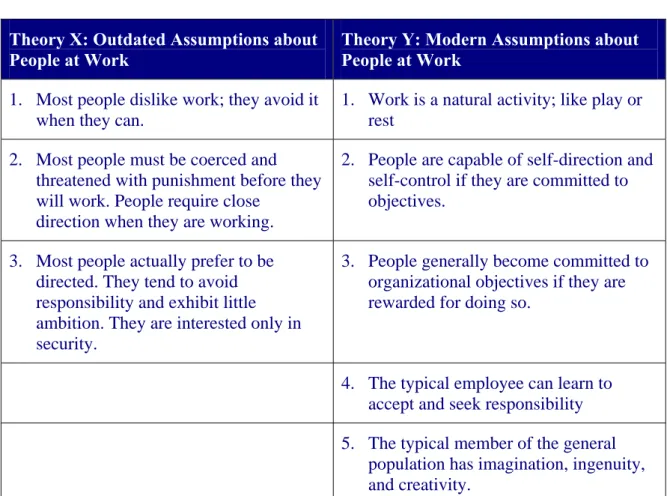
McGregor’s book The Human Side of Enterprise (1960) has had a profound influence on management practices; some even argue it became the new philosophical base for the modern view of people at work in the 20th century.6 In the book McGregor identified an approach of comparing environments within which employees are motivated via authoritative, direction and control or integration and self-control, which he called theory X and theory Y, respectively. Theory Y is the practical application Maslow’s Humanistic School of Psychology, or Third Force psychology, applied to scientific management. Theory X is labeling the assumptions about people at work stated by Freud as outdated (McGregor, 1960).
Table 1: McGregor’s Theory X and Theory Y
Theory X: Outdated Assumptions about People at Work
Theory Y: Modern Assumptions about People at Work
1. Most people dislike work; they avoid it when they can.
1. Work is a natural activity; like play or rest
2. Most people must be coerced and threatened with punishment before they will work. People require close
direction when they are working.
2. People are capable of self-direction and self-control if they are committed to objectives.
3. Most people actually prefer to be directed. They tend to avoid responsibility and exhibit little ambition. They are interested only in security.
3. People generally become committed to organizational objectives if they are rewarded for doing so.
4. The typical employee can learn to accept and seek responsibility 5. The typical member of the general
population has imagination, ingenuity, and creativity.
Source: Adapted from McGregor, D. (1960), The Human Side of Enterprise, Ch. 4
6
Jacobs, D. (2004) Book Review Essay: Douglas McGregor – The Human Side of Enterprise in Peril, Academy of Management Review, April 2004, pp. 293-96
15 To obtain the best results in the work place, the employees must be carefully selected to form a homogeneous group. A good leader of such a group may conveniently “absent” from group meetings so that the group can discuss matters freely and help select and “groom” a new leader. The leader does no longer hanker after power, (s)he lets people develop freely, and may even (it is hoped) enjoy watching the development and actualization of people, as if, by themselves. This should lead to that everyone, and most of all the organization, gains as a result. McGregor’s ideas have, however, been subjected to some criticism by other behavioral scientists for being too soft and slack (Schuster, 1998).
Abraham Maslow and the Hierarchy of Human Needs
Abraham Maslow (1908-1970) was an American psychologist. He is mostly noted today
for his proposal of a Hierarchy of Human Needs and is considered the father of humanistic psychology. The hierarchy of needs theory identifies five levels of needs, which are best seen as a hierarchy with the most basic needs emerging first and the most sophisticated needs emerging last. People move up the hierarchy one level at a time. Gratified needs lose their strength and the next level of needs is activated. As basic, or lower-level, needs are satisfied, higher-level needs become operative. A satisfied need is not a motivator. The most powerful employee need is the one that has not been satisfied (Maslow, 1943).
Maslow first presented the five-tier hierarchy in 1942 to a psychoanalytic society and published it definitely in the 1943 paper A Theory of Human Motivation,7 and in 1954 in the book Motivation and Personality. The paper was later extended to include his observations of humans’ innate curiosity.
7
16
breathing, food, water, sex, sleep, homeostasis, excretion security of body, of employment, of resources, of morality, of the family, of health, of property
friendship, family, sexual intimacy self-esteem,
confidence, achievement, respect of others, respect by others
morality, creativity, spontaneity, problem solving, lack of prejudice, acceptance of facts Self - actualization Esteem Love / Belonging Safety Physiological
Level I - Physiological needs are the most basic human needs. They include food, water,
and comfort. The organization helps to satisfy employees’ physiological needs by a paycheck.
Level II - Safety needs are the desires for security and stability, to feel safe from harm.
The organization helps to satisfy employees’ safety needs by benefits, such as providing a work environment in which the employee feels comfortable.
Level III - Social needs are the desires for affiliation. They include friendship and
belonging. The organization helps to satisfy employees’ social needs through sports teams, parties, and celebrations. The supervisor can help fulfill social needs by showing direct care and concern for employees.
Level IV - Esteem needs are the desires for self-respect and respect or recognition from
others. The organization helps to satisfy employees’ esteem needs by matching the skills and abilities of the employee to the job. The manager can help fulfill esteem needs by showing workers that their work is appreciated.
Level V - Self-actualization needs are the desires for self-fulfillment and the realization
of the individual’s full potential. The organization can help fulfill self-actualization needs by assigning tasks that challenge employees' minds while drawing on their aptitude and
Figure 1:
Maslow's Hierarchy of Needs, represented as a pyramid with more primitive needs at the bottom.
17 training, or by allowing the employee by making career advancements inside the company.
The higher needs in this hierarchy only come into focus when the lower needs in the pyramid are satisfied. Once an individual has moved upwards to the next level, needs in the lower level will no longer be prioritized. However, if a lower set of needs is no longer being met, the individual will temporarily re-prioritize those needs by focusing attention on the unfulfilled needs. The individual never regresses from a higher level to a lower one, however. An example of this fact may be a businessman at the esteem level who is diagnosed with cancer. He will spend a great deal of time concentrating on his health (physiological needs) but would still value his work performance (esteem needs) and is likely to return to work and thoughts about his future career at times when he feels better (Maslow, 1954).
The first four layers of the pyramid are what Maslow called “deficiency needs” or “D-needs”: the individual does not feel anything special if they are met, but she feels anxious if they are not met. Though the deficiency needs may be seen as “basic”, and can be met and neutralized (i.e. they stop being motivators in one’s life), self-actualization and transcendence are “being” or “growth needs” (also termed “B-needs”), i.e. they are enduring motivations or drivers of behavior. Maslow believed that humans have the need to increase their intelligence and thereby chase knowledge. Cognitive needs is the expression of the natural human need to learn, explore, discover and create to get a better understanding of the world around them. Based on Maslow’s beliefs, it is stated in the hierarchy that humans need beautiful imagery or something new and aesthetically pleasing to continue up towards self-actualization. Maslow (1954) referred that humans need to refresh themselves in the presence and beauty of nature while carefully absorbing and observing their surroundings to extract the beauty that the world has to offer.
Self-actualization, a concept which Maslow attributed to Kurt Goldstein - a mentor of his - is the instinctual need of humans to make the most of their abilities and to strive to be the best they can.
18 Maslow (1954) wrote the following of self-actualizing people:
• They embrace the facts and realities of the world (including themselves) rather than denying or avoiding them.
• They are spontaneous in their ideas and actions. • They are creative.
• They are interested in solving problems; this often includes the problems of others. Solving these problems is often a key focus in their lives.
• They feel closeness to other people, and generally appreciate life.
• They have a system of morality that is fully internalized and independent of external authority.
• They have discernment and are able to view all things in an objective manner. In short, self-actualization is reaching one’s fullest potential. According to Maslow (1954), the tendencies of self-actualizing people are as follows:
1. Awareness
• Efficient perception of reality; • Freshness of appreciation; • Peak experiences;
• Ethical awareness. 2. Honesty
• Philosophical sense of humour; • Social interest;
• Deep interpersonal relationships; • Democratic character structure. 3. Freedom
• Need for solitude;
• Autonomous, independent; • Creativity, originality; • Spontaneous.
19 4. Trust
• Problem centered;
• Acceptance of self, others, nature;
• Resistance to enculturation - identity with humanity.
It is interesting to reflect when studying Maslow’s list of characteristics for self-actualizing people, that the world would probably be a good place if all our leaders had reached the highest tier in his pyramid and displayed these tendencies.
Maslow later divided the top of the triangle (the actualization need) to fit in self-transcendence which is also sometimes referred to as spiritual needs. Spiritual Needs are a little different from other needs, accessible from many levels of the hierarchy.8
Maslow believed that we should study and cultivate peak experiences as a way of providing a route to achieve personal growth, integration, and fulfillment. Peak experiences are unifying, and ego-transcending, bringing a sense of purpose to the individual and a sense of integration. Individuals most likely to have peak experiences are self-actualizing, mature, healthy, and self-fulfilled. All individuals are capable of peak experiences. Those who do not have them somehow suppress or deny them.
Alderfer’s ERG Theory
Clayton Paul Alderfer (1940 – ) is an American psychologist who further expanded
Maslow's hierarchy of needs by categorizing it into his ERG Theory (Existence, Relatedness and Growth). The ERG theory first appeared in 1969 in a Psychological Review article entitled “An Empirical Test of a New Theory of Human Need”. Alderfer categorized the lower order needs (Physiological and Safety) into the Existence category. He fit Maslow's interpersonal love and esteem needs into the Relatedness category. The third, Growth category, contained the self actualization and self esteem needs.
Alderfer (1980) also proposed a regression theory to go along with the ERG theory. This regression theory is sometimes labeled the frustration-regression hypothesis. He said that when needs in a higher category are not met then individuals redouble the efforts invested in a lower category need. For example if self actualization or self esteem (the growth
8
20 category) is not met then individuals will invest more effort in the relatedness category in the hopes of achieving the higher need.
Existence needs are the desires for material and physical well being. These needs are satisfied with food, water, air, shelter, working conditions, a pay-check, and fringe benefits. Relatedness needs are the desires to establish and maintain interpersonal relationships. These needs are satisfied with relationships with family, friends, supervisors, subordinates, and co-workers. Growth needs are the desires to be creative, to make useful and productive contributions and to have opportunities for personal development (Alderfer, 1980).
McClelland’s Learned Needs Model
David C. McClelland (1917 – 1998) was an American personality psychologist, social
psychologist, and an advocate of quantitative history. McClelland describes motivating for performance through the Learned Needs Model - a content theory that focuses fully on the needs that motivate people. McClelland’s model states that all people are subject to three important needs or motives - achievement, affiliation, and power - which we acquire through interaction with our surrounding environments. Individuals can be differentiated into distinct personality types depending on which need of these three that predominate one’s personality (McClelland, 1965).
McClelland content theory of motivation is based on Henry Murray’s (1938) theory of personality, which set out a comprehensive model of human needs and motivational processes.
In McClelland’s book The Achieving Society (1961) he asserts that human motivation comprises the three dominant human needs: the need for achievement (N-Ach), the need for power (N-Pow) and the need for affiliation (N-Aff). The subjective importance of each need varies from individual to individual and depends also on an individual’s cultural background. McClelland also claimed that this motivational theory and its implications is an important factor in the social change and evolution of societies. His legacy includes the scoring system which he co-developed for the Thematic Apperception Test (TAT) that was developed by Murray and Morgan in 1935. The TAT is used for personality assessment and in achievement motivation research, and described in the book The
21 Achievement Motive by McClelland, Atkinson, Clark, and Lowell (1953). Many organizations today still use the TAT test when screening candidates in selection and recruitment processes.
People with different needs are motivated differently. While all people have all three motives, they have them to different degrees. In practice, the majority of people have one motive to significantly higher degree, though a few have all three high at close levels.
• High need for achievement - Highly achievement-motivated people should be given
challenging projects with reachable but challenging goals. They should be provided frequent feedback. While money is not an important motivator, it is an effective form of feedback if it is linked to clear measures of success.
• High need for affiliation - Employees with a high affiliation need perform best in a cooperative environment, where they can belong to something larger than themselves.
• High need for power - Management should provide people with a strong need to
influence with the opportunity to manage others.
McClelland's theory allows for the shaping of a person’s needs; training programs can be used to modify one’s need profile. Studies have indicated that motives cannot be decreased, but may be increased over significant time (Kinicki and Kreitner, 2006).
McClelland (1965) focuses much of his research on achievers, people who perform tasks because of a compelling need for personal achievement. McClelland describes the self-motivated achiever as a person with a tendency to think about ways to accomplish something difficult and significant when he or she is not being required to think about anything in particular - that is, when he or she is free to relax and let his or her mind become idle. The self-motivated achiever tends to set goals, avoids the extremes of difficulty in selecting goals, and prefers tasks that provide feedback. Achievers strive to reach goals and measure success in terms of what his efforts have accomplished. He learns to set challenging but achievable goals for himself and for his jobs and, when he achieves them, to set new goals. Goals that are too high and goals that are too low don’t work. Goals that are too high to achieve only lead to frustration, and goals that are too low lead to complacency.
22 Managers can identify achievers and provide ways for them to satisfy their drive to do excellent work. Achievement characteristics, such as personal responsibility, individual participation in the selection of productivity targets, and moderate goals, can be built into the job. Achievers should be provided with immediate, concrete feedback on the results they are attaining. Effective managerial tasks include some general guidance, occasional follow-up, and detailed appraisals.
McClelland’s last paper in 1998 was a study demonstrating that rigorous competency-based selection could predict performance in top executives in a multinational organization: his study found that it is possible to predict job performance (against business goals) two years in advance with 75-85% accuracy - a validity coefficient estimated to be 0.81, and unmatched by any other tool. Since the technique is both labor-intensive and requires skilled assessors to execute at that level, it is a technique not often used at entry-level to supervisory levels of organizations, though it is still claimed to be effective.9
Herzberg’s Motivation-Hygiene Theory
Frederick Irving Herzberg (1923 - 2000) was a noted psychologist who became one of
the most influential names in business management. He is most known for introducing
Job Enrichment and the Motivation-Hygiene theory. His 1968 publication “One More
Time, How Do You Motivate Employees?” had sold over one million reprints by 1987 and was the most requested article from the Harvard Business Review.1011
Maybe this suggests not only the excellency of the article, but also demonstrates how very important the subject of motivation in the workplace continues to be for managers and others.
The Two-Factor Theory (also known as Herzberg's Motivation-Hygiene Theory) holds that job satisfaction and job dissatisfaction act independently of each other. The theory states that there are certain factors in the workplace that cause job satisfaction, while a separate set of factors cause dissatisfaction (Herzberg, Mausner and Snyderman, 1959).
9
McClelland, D. C. (1998), Identifying competencies with behavioral-event interviews, Psychological Science, Vol. 9, No. 5
10
Herzberg, F.I. (1987), One more time: How do you motivate employees?, Harvard Business Review, Vol. 65, Issue 5, Sep/Oct., pp. 109-120
11
23 The theory was based on interviews with 203 American accountants & engineers in Pittsburgh, chosen because of their professions’ growing importance in the business world at the time. The subjects were asked to relate times when they felt exceptionally good or bad about their present job or any previous job, and to provide reasons and a description of the sequence of events giving rise to that positive or negative feeling.
The Two Factor Theory distinguishes between (Hackman and Oldham, 1976):
• Motivators; (e.g. challenging work, recognition, responsibility) which give
positive satisfaction, arising from intrinsic conditions of the job itself, such as recognition, achievement, or personal growth, and
• Hygiene factors; (e.g. status, job security, salary and fringe benefits) which do not
give positive satisfaction, although dissatisfaction results from their absence. These are extrinsic to the work itself, and include aspects such as company policies, supervisory practices, or wages/salary.
Essentially, hygiene factors are needed to ensure that an employee is not dissatisfied. Motivation factors are needed in order to motivate an employee to higher performance. Herzberg also further classified our actions and how and why we chose them, for example, if you perform a work related action because you have to then that is classified as a
movement, but if you perform a work related action because you want to then that is
classified as motivation (Herzberg, 1987).
Herzberg uses the term motivators for job satisfiers since they involve job content and the satisfaction that results from them. Motivators are considered job turn-ons. They are necessary for substantial improvements in work performance and move the employee beyond satisfaction to superior performance. Motivators correspond to Maslow’s higher-level needs of esteem and self-actualization.
Motivators encourage an employee to strive to do his or her best. Job enrichment can be used to meet higher-level needs. Job enrichment in organizational development, human resources management, and organizational behavior, is the process of giving the employee a wider and higher level scope of responsibility with increased decision making authority.
24 Job enrichment is different from of job enlargement, which would not involve greater authority, only an increased number of duties. Modern day practice of job enrichment stems from the early work of Frederick Herzberg in the 1950’s and 1960’s on job satisfaction.
Dissatisfaction at work occurs when the following hygiene factors, extrinsic or job contextual, are not present on the job: pay, status, job security, working conditions, company policy, peer relations, and supervision. Herzberg uses the term hygiene for these factors because they are preventive in nature. They will not produce motivation, but they can prevent motivation from occurring. Hygiene factors can be considered job stay-ons because they encourage an employee to stay on a job. Once these factors are provided, they do not necessarily promote motivation; but their absence can create employee dissatisfaction. Hygiene factors correspond to Maslow's physiological, safety, and social needs in that they are extrinsic, or peripheral, to the job. They are present in the work environment of job context.
While the Motivation-Hygiene theory is still well regarded, satisfaction and dissatisfaction are generally no longer considered to exist on separate scales (Hackman and Oldham, 1976). Furthermore, it has been noted that the theory does not allow for individual differences, such as a particular personality traits, which would affect individuals’ unique responses to motivating or hygiene factors (Hackman and Oldham, 1976).
2.4.2 Process Theories
Vroom’s Expectancy Theory of Motivation and Motivational Hedonism
Victor Vroom (1932 - ) is a Professor at Yale School of Management who developed the
so called Expectancy Theory of Motivation.
Expectancy theory in general holds that people are motivated to behave in ways that produce desired combinations of expected outcomes. Perception plays a central role in expectancy theory because it emphasizes cognitive ability to anticipate likely consequences of behavior. The principle of hedonism is embedded in expectancy theory. Hedonistic people strive to maximize their pleasure and minimize their pain; they also try to choose the outcome that they believe will bring them the greatest pleasure. This is also refereed to as the hedonic axiom (Beck, 2005). Hedonistic theory holds that at any given moment, there is an ordering of events along a continuum ranging from very aversive,
25 through neutral, thorough very desirable. This is called the hedonic continuum. The details of the hedonic continuum may vary from one individual to another or for the same individual at different times. However, at any given time the continuum is assumed to be fixed for a given person (Beck, 2005). Generally, expectancy theory can be used to predict behavior in any situation in which a choice between two or more alternatives must be made. Understanding the cognitive processes which employees make between desired and less desired outcomes can help managers develop organizational policies that enhance employee motivation.
Beck (2005) suggested the following list, which illustrates some motivational concepts that fit under the umbrellas of desire and aversion (psychological hedonism):
DESIRE AVERSION Need for achievement Fear of failure Positive incentives Negative incentives Rewards Punishers
Cognitive consistency Cognitive dissonance
Love Fear
Hope for power Fear of power
Relaxation Stress
Vroom’s expectancy model suggests that people choose among alternative behaviors because they anticipate that particular behaviors will lead to one or more desired outcome(s) and that other behaviors will lead to undesirable outcomes. Expectancy is the belief that effort will lead to first-order outcomes, any work-related behavior that is the direct result of the effort an employee expends on a job.
Vroom created a mathematical model of expectancy theory in his 1964 book Work and Motivation, which is still regarded as a landmark in the field of motivational studies. In this book he summarizes the theory as follows (Kinicki and Kreitner, 2006: 182):
“The strength of a tendency to act in a certain way depends of the strength of expectancy that the act will be followed by a given consequence (or outcome) and on the value or attractiveness of that consequence (or outcome) to the actor.”
26 Motivation according to Vroom boils down to the decision of how much effort to exert in a specific task situation. Three key concepts are central in Vroom’s theory; expectancy, instrumentality and valence.
Expectancy according to Vroom’s terminology, represents an individual’s belief that a
particular degree if effort will be followed by a particular level of performance. It is an effort Æ performance expectation. Expectancies are subjective probabilities in the individuals mind and range from 0 (effort has no anticipated impact on performance) to 1 (effort has total anticipated impact on performance).
Instrumentality is a performance Æ outcome perception. It represents an individual’s
belief that a particular outcome is dependent on first accomplishing a specific level of performance. Performance is instrumental when it leads to something else. For example writing a thesis is instrumental to obtaining a Master’s degree in management.
Instrumentalities range from -1.0 to 1.0. An instrumentality of 1.0 indicates obtaining a particular outcome is totally dependent on prior task performance. An instrumentality of zero indicates that there is no relationship between performance and receiving a specific outcome. An instrumentality of -1.0 would mean that high performance would reduce the chances of obtaining the desired outcome.
Valence according to Vroom refers to the positive or negative value people place on
outcomes. Valence mirrors our personal preferences. For example most employees have a positive valence for receiving additional money or recognition at work. Contrastingly, stress and being fired would likely be negatively valent for most people.
Vroom states that an outcome’s valence depends on an individual’s needs and can be measured for research purposes with scales ranging from a negative to a positive value. For example, an employee’s valence towards getting recognition in the workplace could be assessed on a scale ranging from -2 (very undesirable) to 0 (neutral) to +2 (very desirable) (Kinicki and Kreitner, 2006).
Many researchers have tested Vroom’s expectancy theory since it saw the light of day in the 1960’s. In support of this theory, a meta-analysis of 77 studies indicated that expectancy theory significantly predicted performance, effort, intentions, preferences and choice (van Eerde and Thierry, 1996). Nonetheless the theory has also been criticized for a variety of reasons, such as that it is difficult to test it, and for the fact that the measurements used to assess expectancy, instrumentality and valence have a questionable
27 validity (Mitchell, 1982). However, the expectancy theory can have important practical implications for managers and for the work organization as a whole (see table 2, below).
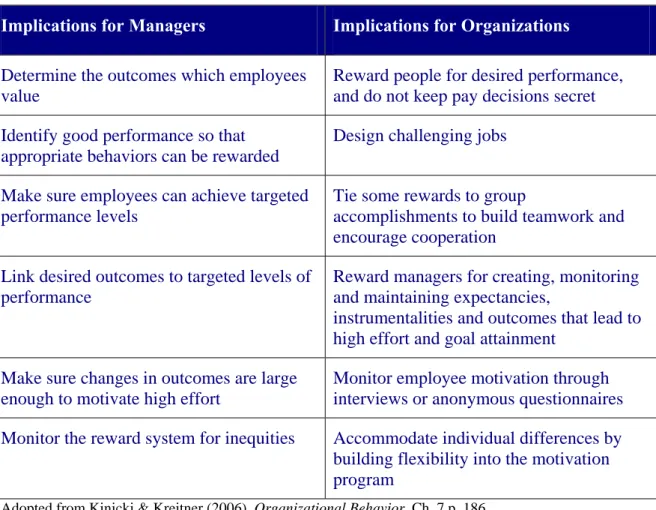
Managers could enhance effort Æ performance expectancies by helping employees to accomplish their performance goal. This could be done with increased support and coaching. It is equally important for managers to influence employees’ instrumentalities and monitor valences for various rewards. This could give raise to the question whether organizations should use monetary rewards as the primary method to reinforce performance or not.12
Table 2: Managerial and Organizational Implications of Vroom’s Expectancy Theory
Implications for Managers Implications for Organizations
Determine the outcomes which employees value
Reward people for desired performance, and do not keep pay decisions secret Identify good performance so that
appropriate behaviors can be rewarded
Design challenging jobs
Make sure employees can achieve targeted performance levels
Tie some rewards to group
accomplishments to build teamwork and encourage cooperation
Link desired outcomes to targeted levels of performance
Reward managers for creating, monitoring and maintaining expectancies,
instrumentalities and outcomes that lead to high effort and goal attainment
Make sure changes in outcomes are large enough to motivate high effort
Monitor employee motivation through interviews or anonymous questionnaires Monitor the reward system for inequities Accommodate individual differences by
building flexibility into the motivation program
Adopted from Kinicki & Kreitner (2006), Organizational Behavior, Ch. 7 p. 186
12
28 The Equity Theory
John Stacy Adams (1925 – ), who was a behavioral psychologist, is known for being the
first to apply the Equity Theory, or Adams’ Equity Theory, to the workplace in 1963. This theory attempts to explain relational satisfaction in terms of perceptions of fair/unfair distributions of resources within interpersonal relationships, notably in organizations (Kinicki and Kreitner, 2006).
Adams (1965) asserted that employees seek to maintain equity between the inputs that they bring to a job and the outcomes that they receive from it against the perceived inputs and outcomes of others. While the equity theory was originally concerned with differences in pay, it may also be applied to other forms of tangible and intangible rewards in the workplace. That is, if for a given individual any input that she brings to the job is not balanced with some perceived-to-be fair output, the individual will not be motivated. The discrepancy may be between the person’s internal standard for what is an equitable return for a certain amount of effort, or it may be in comparison with some external reference (Beck, 2005). Supervisors must manage the perception of fairness in the mind of each employee. If employees think that they are not being treated fairly, it is difficult or even impossible to motivate them, and job-performance will suffer.
Equity theory proposes that individuals who perceive themselves as either under-rewarded or over-rewarded will experience distress, and that this distress leads to efforts to restore equity within the relationship between themselves and, in this case, their employer. The theory focuses on determining whether the distribution of resources is fair to both relational partners. Equity is measured by comparing the ratios of contributions and benefits of each person within the relationship. Partners do not have to receive equal benefits (such as receiving the same amount of holidays, benefits, or financial security) or make equal contributions (such as investing the same amount of effort, time, and financial resources), as long as the ratio between these benefits and contributions is similar. Much like other prevalent theories of motivation, for example Maslow’s hierarchy of needs, the equity theory acknowledges that subtle and variable individual factors affect each person’s assessment and perception of their relationship with their relational partners (Kinicki and Kreitner, 2006).
29 A person will consider that he is treated fairly if he perceives the ratio of his inputs to his outcomes to be equivalent to those around him.
Thus, all else being equal, it would be acceptable for a more senior colleague to receive higher compensation, since the value of his experience (an input) is higher.
This can be illustrated by the following equation (Adams, 1965):
Individual’s outcomes Relational partner’s outcomes Individual’s own inputs
=
Relational partner’s inputs
Inputs are defined as each participant’s contributions to the relational exchange and are viewed as entitling her to rewards or costs. The inputs that a participant contributes to a relationship can be either assets – entitling her to rewards – or liabilities - entitling her to costs. The entitlement to rewards or costs ascribed to each input varies depending on the relational setting. In industrial settings, assets such as capital and manual labor are seen as ”relevant inputs” – inputs that legitimately entitle the contributor to rewards. In social settings, assets such as physical beauty and kindness are generally seen as assets entitling the possessor to social rewards. Individual traits such as bad manners and cruelty are seen as liabilities entitling the possessor to costs (Beck, 2005).
Inputs typically include any of the following components; they are in random order and depend on the situation at hand (Walster and Walster, 1978):
• Time • Effort • Loyalty • Hard Work • Commitment • Ability • Adaptablility • Flexibility • Tolerance • Determination