Cycloaddition reactions of nitrosoalkenes, azoalkenes and nitrile
oxides mediated by hydrotalcite
Américo Lemos* and João P. Lourenço*
CIQA, Departamento de Química e Farmácia, Faculdade de Ciências e Tecnologia, Universidade do Algarve, Campus de Gambelas, 8005-139, Faro, Portugal
E-mail: [email protected], [email protected]
Dedicated to Professor António M. d’A Rocha Gonsalves on the occasion of his 70th anniversary
Abstract
Mg:Al 3:1 hydrotalcite (Ht), used in catalytic quantities, promotes the generation of nitrosoalkenes, azoalkenes and nitrile oxides. These can be intercepted in situ by heterocycles and olefins in [4+2] and [3+2] cycloaddition reactions, producing dihydro-1,2-oxazines, tetrahydropyridazines and isoxazolines. The regeneration and reuse of Ht without loss of activity and the absence of organic solvent are the main advantages of this methodology.
Keywords: Nitrosoalkene, azoalkene, nitrile oxide, hydrotalcite, cycloaddition
Introduction
The development of solid basic materials that can efficiently catalyse chemical reactions such as alkylations, isomerisations, condensations, cycloadditions, etc. in relatively benign conditions has gained a strong incentive in recent years due to economic demands and environmental concerns. Among those materials, the oxides obtained by thermal treatments of hydrotalcites (Hts) have shown promising properties.1
Hydrotalcite is an anionic clay belonging to the class of double layer hydroxides (DLHs) with the general formula Mx2+My3+(OH)2(x+y)Ay/n-n where M2+ and M3+ are a divalent and a
trivalent metal ions, respectively, and A−n is an intercalated anion. The most common metals are
Mg and Al and in this case the structure is described as brucite-like (Mg(OH)2) sheets where
various Mg2+ are isomorphously substituted by trivalent Al3+. The positive charges of the structure are compensated by intercalated anions.
associated with the Lewis basicity of the pairs O2- M2+. A controlled rehydration promotes a structural rearrangement, resulting in a Meixnerit-like compound, and changing the nature of the basic sites. The basic properties are now influenced by the presence of intercalated hydroxide anions.
The acid-base properties of these materials can be tuned, both in terms of the nature and strength of the basic sites, by choosing appropriate conditions for the synthesis and by post-synthesis treatments. Therefore, mixed oxides obtained from DLHs can be prepared with different acid-base properties that make them versatile catalysts for reactions that require different base catalysis.
Diels–Alder and 1,3-dipolar cycloaddition reactions are powerful methods for the construction of six- and five-membered rings in organic chemistry.3 Amongst these, cycloaddition reactions of nitrosoalkenes,4 azoalkenes5 and nitrile oxides6 are important tools for the synthesis of heterocyclic compounds containing nitrogen, such 1,2-oxazines,pyridazines and isoxazolines.
Scheme 1
The usual method for the generation of nitrosoalkenes and azoalkenes 2 is the base induced dehydrohalogenation of halogenated-oximes and hydrazones 1. Similarly, nitrile oxides 5 are usually obtained by dehydrochlorination of hydroximidoyl chlorides 4 (Scheme 1). Since nitrosoalkenes, azoalkenes and nitrile oxides are usually unstable and very reactive species, they
must be generated in very low concentrations and trapped in situ by a dienophile or dipolarophile, usually present in a great excess, in order to minimize dimerizations and other side reactions. The low concentration of nitrosoalkenes, azoalkenes and nitrile oxides is commonly attained using a substantial volume of organic solvent and an inorganic base, the low solubility of which ensures a slow rate of dehydrohalogenation, or by a very slow addition of an organic base usually via syringe pump.
Recently we disclosed our preliminary results on the catalytic application of Mg:Al 3:1 hydrotalcite as mediating agent for [4+2] cycloaddition reactions of nitroso- and azo-alkenes by dehydrohalogenation of α-bromo oximes and hydrazones.7 Our efforts and attempts to broaden
the scope into other halogenated oximes, hydrazones and hydroximidoyl chlorides as well as the generation of other 1,3-dipoles, are the subject of this work.
Results and Discussion
Reaction conditionsInitially, different ratios of Ht and oxime 1a in common organic solvents with diverse polarities and volumes were explored in reactions with ethyl vinyl ether and furan, but with negative results (Table 1, entries 1-4). Under these conditions the starting materials were recovered unchanged. The presence of water soon appeared to be obligatory, presumably in order to rehydrate the Ht, since in all the reactions conducted in its absence no product could be detected or isolated.
The best results were obtained when the oxime or hydrazone was dissolved in the dienophile and 0.05 mL (or two drops) of water were added and, finally, the Ht introduced in a 10% mass ratio to the oxime or hydrazone (entries 11, 12).
Larger amounts of water and/or solvent gave rise to lower yields and very complicated mixtures of reaction products (entries 5, 6, 8, 9). Also, in control reactions performed in the absence of Ht (entry 13), or when Ht was replaced by sodium carbonate – maintaining the same reaction conditions (entry 14) – no reaction products were detected. We were also pleased to find that the Ht filtered from the reaction media, washed with water and acetone, dried and calcined (500 ºC under a flux of dry air), could be used again without loss of activity (entries 15,16).
Scope and limitations of the Ht mediated generation of reactive species
Nitroso- and azo-alkenes. Having found reaction conditions for the Ht mediated cycloaddition
reactions of α-bromooximes and α-bromohydrazones, we subsequently tried to evaluate the generality or scope of this methodology, by the application of this protocol to other α-halogenated oximes and hydrazones as well to other dienophiles or heterocycles.
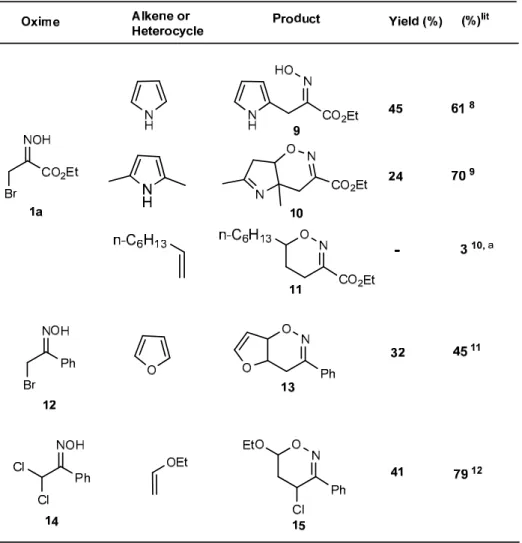
Table 2. Nitrosoalkene generation and cycloaddition reactions
The results outlined on Tables 2 and 3, show that the catalytic use of calcined Mg/Al 3:1 hydrotalcite constitutes an effective method for the generation of nitroso- and azo-alkenes from a variety of α-bromo- and α-dichloro-oximes and –hydrazones permitting their subsequent in situ interception by electron-rich alkenes and heterocycles affording adducts and cycloadducts in reasonable to good yields (the open chain oxime 9 and hydrazone 18 are postulated as resulting from the rearomatization of the primarily formed cycloadducts9).
Table 3. Azoalkene generation and cycloaddition reactions
The scope of this methodology appears to be limited to electron-deficient oximes and hydrazones that are soluble in the dienophile, and/or to electron-rich dienophiles that are able to solubilize the oxime or hydrazone, since no products could be detected when very low or no
solubility was observed, the starting materials being mainly recovered. The lack of solubility presumably prevents the easy access of the oxime and hydrazone to the Ht basic sites and consequently hinders the generation of the nitroso- or azo-alkene.
Nitrile oxide. Hydroxyimidoyl chlorides are commonly used as precursors of nitrile oxides.
These are important transient species in the synthesis of 5-membered rings containing nitrogen and oxygen via 1,3-dipolar cycloadditions.3,6
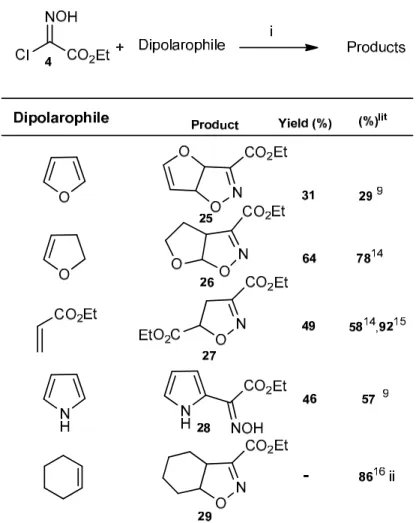
Table 4. Nitrile oxide generation and reactions
Cycloaddition of carboethoxyformonitrile oxide (CEFNO) with dipolarophiles is probably the most straightforward strategy towards isoxazolines carrying a carboxyl substituent. Thus, as a continuation of our studies on the catalytic application of Hts, we became interested in the
investigation, by an extension of the above methodology, of Ht mediated generation of CEFNO from ethyl chlorooximidoacetate 4.
From the results of Table 4 it is possible to conclude that Ht used in catalytic quantities and without solvent is effective at the generation of CEFNO allowing its subsequent interception by a dipolarophile. The yields are comparable to those obtained by other methodologies, showing that this strategy is limited to dipolarophiles capable of solubilization of ethyl chlorooximidoacetate and the transient CEFN, as inferred from the reaction with cyclohexene. In the reactions under study, the furoxan usually formed by dimerization of nitrile oxide was only present to a small extent and no other regioisomers could be detected.
TosMIC deprotonation attempts. The methylene group of p-toluenesulfonylmethyl isocyanide
(TosMIC) is highly activated by the two electron-withdrawing substituents. Likewise, deprotonation can be easily performed with various bases such K2CO3, NaOH and n-BuLi,
amongst others.17 In this context, we were excited by the possibility of extending the above methodology to the deprotonation of TosMIC, but in all experiments, it was almost quantitatively recovered from the reaction media, suggesting that under the reaction conditions examined, the deprotonation did not occur, or if this did indeed happen, then the dipole so formed quickly reverted to the initial isocyanide and consequently interception by the dienophile/Michael acceptor could not take place.
Conclusions
In summary, we have disclosed a simple and effective method for the generation of electron-deficient nitrosoalkenes, azoalkenes and nitrile oxides via dehydrohalogenation of oximes and hydrazones, by the catalytic use of calcined Mg/Al 3:1 hydrotalcite and their subsequent interception by electron-rich alkenes and heterocycles, allowing the isolation of 5,6-dihydro-4H-1,2-oxazines, 1,4,5,6-tetrahydropyridazines and isoxazolines, the solubilisation of the 4π or the 2π reaction partner being a key factor in the process.
When compared with other commonly used strategies, this methodology has the advantages of requiring neither organic solvent nor inorganic base in large excess. The efficiency in [4+2] reactions is somewhat lower than in commonly used methods but comparable in [3+2] reactions and completely ineffective at the deprotonation of TosMIC. The absence of organic solvent as well the regeneration and reuse of Ht without loss of activity, may be valuable contributions to environmentally friendly, greener and economically valuable processes.
Experimental Section
General. 1H NMR spectra and 13C NMR spectra (100.6 or 75.5 MHz) were recorded on a Bruker
internal standard (chemical shifts (δ) in ppm, J in Hz). Multiplicities are recorded as broad peaks (br), broad singlets (bs), singlets (s), doublets (d), triplets (t), quartets (q) and multiplets (m). J values are in Hz and δ in ppm. Infrared spectra were recorded on a Brucker FT-IR Tensor 27 spectrophotometer. Samples were measured, if not otherwise stated, as thin films when oils or as KBr disks when solids, and the main bands are given in cm-1. Melting points were measured on an EZ-Melt, Automated Melting Pont Apparatus from Stanford Research Systems and are uncorrected. Powder XRD patterns were recorded on a Panalytical X’Pert diffractometer using CuKα radiation filtered by Ni and a X’Celerator detector. Nitrogen adsorption was measured at – 196 ºC using an ASAP 2010 Micromeritics apparatus. Prior to the measurements the samples were pre-treated under vacuum at 350 ºC for 3 h.
Synthesis of hydrotalcite with Mg/Al ratio of 3:1. Was performed following closely the
method described in the literaturel.2 A solution (100 ml) containing 0.1 mol of Na2CO3 and 0.3
mol of NaOH was mixed (at a rate of 1 mL/min) with 100 mL of a solution containing 0.111 mol of Mg(NO3)2 and 0.037 mol of Al(NO3)3 with stirring at room temperature. The gel was left for
18 h at 80 ºC. The hydrotalcite was recovered by centrifugation, washed until pH 7 and dried at 80 ºC overnight. Before the catalytic tests, the hydrotalcite was activated at 450 ºC under a flux of dry nitrogen for 6 h.
XRD pattern of as-prepared hydrotalcite. Presented the characteristic peaks of clay minerals
having layered structures and showed that well-crystallized hydrotalcite was formed.2 The specific surface area of the calcined hydrotalcite was measured by N2 adsorption at –196 ºC. The
results obtained are similar to those found in the literature:2 specific surface area (BET) of 253 m2/g, porous volume of 0,78 cm3/g and average pore diameter (4Vp/SBET) of 123 Å.
Figure 1. XRD pattern of as-prepared hydrotalcite.
Oximes 1a18, 1219, 1420, hydrazone 1b13 and ethyl chlorooximidoacetate 4.16 Were
synthesized according to literature procedures. Known isolated products were characterized by comparison of their physical, IR and NMR data with those reported in the literature.
Bromoacetophenone t-butoxycarbonyl hydrazone 20. To a stirred solution of
2-bromoacetophenone (2.70 g; 13.5 mmol) in diethyl ether (50 mL) was added t-butylcarbazate (1.97 g; 14.9 mmmol) and the reaction mixture stirred at room temperature for 6 h. The white solid was then filtered off, washed with diethyl ether and dried, affording analytically pure hydrazone (2.86 g; 67%). m.p.(dec.): 124.6-126.4 ºC; νmax: 3189, 2977, 1701, 1549, 1368, 1275,
1152, 1071; 1H δ (400 MHz) 8.07 (s, 1H), 7.78-7.82 (2H, m), 7.38-7.43 (3H, m), 4.23 (2H, s), 1.58 (9H, s); 13C δ (101 MHz) 152.8, 132.2, 130.4, 130.0, 128.9, 127.8, 126.3, 86.1, 35.3, 28.3, 19.0; HRMS (ESI): m/z [M+Na]+ calcd for C13H17BrN2NaO2 335.0371; found 335.0377.
1,1-Dichloroacetone t-butoxycarbonyl hydrazone 23. To a stirred solution of
1,1-dichloroacetone (1.4 mL; 14.3 mmol) in diethyl ether (60 mL) was added t-butylcarbazate (2.18 g; 16.5 mmol) and the reaction mixture stirred at room temperature for 16 h. The white solid was then filtered off, washed with diethyl ether and dried, affording analytically pure hydrazone (1.91 g; 55%). m.p.(dec.): 130,1-132.3 ºC; νmax: 3197, 2983, 1708, 1537, 1253, 1144,
729; 1H δ (400 MHz) 7.56 (1H, s), 6.40 (1H, s), 2.05 (3H, s), 1.53 (9H, s); 13C δ (75 MHz) 156.8, 143.2, 80.7, 68.3, 28.4, 18.1; HRMS (ESI): m/z [M+Na]+ calcd for C8H14Cl2N2NaO2
263.0330; found 263.0326.
General procedure for cycloadditions
To the mixture of oxime (2 mmol), hydrazone (1 mol) or nitrile oxide (2 mmol) and dienophile or dipolarophile (10 or 20 mmol), was added water (0.05 mL) and Ht (10% in weight). After stirring for 6 to 16 h (TLC monitoring), the Ht was filtered off. Dry-flash chromatography of the filtrate (increasing polarity dichloromethane to dichloromethane/ethyl acetate) afforded the products.
Ethyl (2-hydroxyimino)-3-(2-pyrrolyl)propanoate 9. From oxime 1a and pyrrole; light brown
solid (0.18 g; 45%); m.p.: 119.3-121.8 ºC (from ethanol-hexanes; lit.8 m.p. 118-120 ºC); νmax:
3390, 2988, 1720, 1189, 1026, 724; 1H δ (300 MHz) 10.42 (1H, bs), 8.66 (1H, bs), 6.68-6.71(1H, m), 6.04-6.07 (1H, m), 5.98-6.01 (1H, m), 4.30 (2H, q, J 6.9), 3.93 (2H, s), 1.34 (3H, t, J 6.9.
Ethyl 4a,6-dimethyl-4,4a,7,7a-tetrahydro-pyrrolo[2,3-e]-1,2-oxazine-3-carboxylate 10. From
oxime 1a and 2,5-dimethylpyrrole; oil (0.153 g, 34%); ν : 2980, 1721, 1378, 1280, 1175, 1018;
max
1H δ (300 MHz) 4.32 (2 H, q, J 7.1), 4.13 (1 H, dd, J 6.2, 1.4), 3.08 – 2.91 (1 H, m), 2.90
– 2.69 (2 H, m), 2.65 (1 H, d, J 6.5), 2.01 (3 H, s), 1.34 (3 H, t, J 7.1), 1.24 (3 H, s).
4a,7a-Dihydro-3-phenyl-4H-furo[2,3-e]-1,2-oxazine 13. From oxime 12 and furan; yellow
solid (0.193 g; 48%); m.p.: 72.8-74.2 ºC (from hexanes; lit11 m.p. 71-72 ºC) ν : 3059, 2982, 1612, 1446, 1244, 1059, 694;
max
1H δ (300 MHz) 7.87 – 7.67 (2 H, m), 7.54 – 7.40 (3 H, m), 6.34 (1
H, d, J 10.9), 5.18 – 4.98 (2 H, m), 4.87 – 4.61 (1 H, m), 3.19 (1 H, dd, J 15.4, 3.2), 3.06 (1 H, dd, J 15.2, 2.9).
4-Chloro-6-ethoxy-5,6-dihydro-3-phenyl-4H-1,2-oxazine 15. From oxime 14 and ethyl vinyl
ether; oil (0.196 g; 48%); ν : 2964, 1751, 1673, 1223, 1041; max 1H δ (300 MHz) 7.63 (2 H, dd, J
H, m), 3.56 (1 H, dq, J 9.8, 7.0), 2.68 – 2.32 (2 H, m), 1.15 (3 H, t, J 7.1); 13C δ (75 MHz) 154.5, 133.6, 130.1, 128.6, 126.5, 94.1, 64.4, 39.3, 33.1, 15.1.
Ethyl pyrrole-2-(2-t-butoxycarbonylhydrazono)propanoate 17. From hydrazone 1b and
pyrrole; ligh brown solid (0.121 g, 41%); m.p.:142-143,8 ºC (from dichloromethane-hexanes; lit 141 ºC); ν : 3446, 3415, 1708, 1612; 13
max 1H δ (300 MHz) 8.48 (1 H, bs), 8.29 (1 H, s), 6.70 (1
H, dd, J 4.1, 2.7), 6.10 (1 H, dd, J 5.9, 2.9), 6.04 (1 H, bs), 4.32 (2 H, q, J 7.1), 3.81 (2 H, s), 1.48 (9 H, s), 1.35 (3 H, t, J 7.1); 13C δ (75 MHz) 165.8, 154.5, 145.0, 122.9, 118.5, 108.5, 107.2, 82.7, 62.3, 28.0, 24.8, 14.1.
t-Butyl 6-ethoxy-3-phenyl-1,4,5,6-tetrahydropyridazine-1-carboxylate 21. From hydrazone 20 and ethyl vinyl ether; oil (0.164 g; 54%); νmax: 2967, 1699, 1398, 1336, 1155, 1065; 1H δ (300
MHz) 7.83 (2 H, dd, J = 7.6, 1.8), 7.57 – 7.30 (3 H, m), 5.71 (1 H, bs), 3.64 (2 H, q, J = 7.0), 2.91 – 2.51 (2 H, m), 2.32 – 2.09 (1H, m), 1.80 (1 H, tdd, J = 13.4, 6.4, 2.5), 1.60 (9H, s), 1.17 (3 H t, J = 7.0); 13C δ (101 MHz) 154.4; 137.9, 129.9, 129.2, 128.5, 126.1, 125.6, 123.3, 101.0, 82.6, 63.5, 28.50, 28.41, 23.7, 22.5, 18.5, 15.4; HRMS (ESI): m/z [M+H]+ calcd for C17H25N2O3
305.1865; found 365.1871.
t-Butyl 4-chloro-6-ethoxy-3-methyl-1,4,5,6-tetrahydropyridazine-1-carboxylate 24. From
hydrazone 23 and ethyl vinyl ether; oil (0.116 g, 42%); νmax: 2979, 1702, 1397, 1255, 1148,
1021; 1H δ (300 MHz) 9.52 (1 H, s), 5.64 (1 H, bs), 4.17 (1 H, d, J 6.7), 3.54 (2 H, q, J 7.0), 2.63 (1 H, ddd, J 15.6, 2.6, 0.8), 2.30 – 2.20 (1 H, m), 2.17 (3 H, s), 1.54 (9 H, s), 1.18 (3 H, t, J 7.0);
13C δ (75 MHz) 154.7, 146.5, 94.0, 82.9, 64.3, 62.1, 39.5, 33.2, 18.2, 15.1. HRMS (ESI): m/z
[M+H]+ calcd for C12H22ClN2O3 277.1319; found 277.1312.
Ethyl 3a,6a-dihydrofuro[2,3-d]isoxazole-3-carboxylate 25. From ethyl chlorooximidoacetate 4
and furan; oil (0.114 g, 31%); νmax: 1747, 1625, 1475, 1244, 1056; 1H δ (300 MHz) 6.62 – 6.52
(1 H, m), 6.04 – 5.95 (2 H, m), 5.34 – 5.29 (1 H, m), 4.33 (2H, q, J 7.1), 1.32 (3 H, t, J 7.1); 13C δ (75 MHz) 160.0, 150.4, 149.6, 100.7, 91.7, 87.1, 62.5, 14.3.
Ethyl 3a,4,5,6a-tetrahydrofuro[3,2-d]isoxazole-3-carboxylate 26. From ethyl
chlorooximidoacetate 4 and dihydrofuran; oil (0.237 g, 64%); νmax: 2986, 1722, 1264, 1136,
1089, 1037. 1H δ (300 MHz) 6.28 (1 H, d, J 6.3), 4.41 – 4.23 (2 H, m), 4.14 – 3.89 (1 H, m), 3.89 – 3.74 (1 H, m), 3.53 (1 H, ddd, J 12.0, 9.0, 5.3), 2.32 – 2.14 (1 H, m), 1.34 (3 H, t, J 7.1); 13C δ (75 MHz) 160.0, 152.2, 110.7, 66.6, 50.4, 29.9, 13.9.
Diethyl 4,5-dihydroisoxazole-3,4-dicarboxylate 27. From ethyl chlorooximidoacetate 4 and
ethyl acrylate; oil (0.211 g, 49%); νmax:2988, 1737, 1439, 1258, 1067; 1H δ (400 MHz) 5.20 (1
H, dd, J 11.0, 8.3), 4.35 (2 H, dt, J 14.3, 5.0), 4.11 (2 H, q, J 7.1), 3.50 (2 H, dd, J 9.7, 2.8), 1.36 (3 H, td, J 7.1, 4.5), 1.25 (3 H, t, J 7.1).
Ethyl 2-(hydroxyimino)-2-(1H-pyrrol-2-yl)acetate 28. From ethyl chlorooximidoacetate 4 and
pyrrole; yellowish solid (0.167 g; 48%); m.p.:147.3-149,4 ºC (from dichloromethane-hexanes; lit.9148-150 ºC); νmax: 3432, 3194, 1713, 1126, 1034; 1H δ 11.32 (1H, bs), 11.06 (1H, bs), 7.11 –
7.06 (1 H, m), 6.90 (1 H, dd, J 7.5, 1.4), 6.21-6.18 (1 H, m), 4.36 (2 H, q, J 5.9), 1.36 (3 H, t, J 5.9).
Acknowledgements
The authors thank Prof. Filipa Ribeiro and Dr. Auguste Fernandes for the nitrogen adsorption measurements. Financial support by FCT, for acquisition of XRD equipment, under project REEQ/700/CTM/2005, is also gratefully acknowledged.
References
1. Reviews: (a) Debecker, D. P.; Gaigneaux, E. M.; Busca, G. Chem. Eur. J. 2009, 15, 3920. (b) Centi, G.; Perathoner, S. Micropor. Mesopor. Mat. 2008, 107, 3. (c) Figueras, F.; Kantam, M. L.; Choudary, B. M. Curr. Org. Chem. 2006, 10, 1627. (d) Figueras, F. Top. Catal. 2004, 29, 189.
2. Climent, M. J.; Corma, A.; Iborra, S.; Epping, K.; Velty, A. J. Catal. 2004, 225, 316.
3. (a) Fringuelli, F.; Taticchi, A. The Diels–Alder Reaction: Selected Practical Methods; John Wiley & Sons, Ltd: Chichester, 2002. (b) Kobayashi, S.; Jørgensen, K. A. Cycloaddition
Reactions in Organic Synthesis; Wiley-VCH Verlag GmbH: Weinheim, 2001.
4. Reviews: (a) Lemos, A. Molecules 2009, 14, 4098. (b) Tsoungas, P. G. Heterocycles 2002,
57, 1149. (c) Lyapkalo, I. M.; Ioffe, S. Russ. Chem. Rev. 1998, 67, 467. (d) Gilchrist, T. L.;
Wood, J. E. In Comprehensive Heterocyclic Chemistry II; Boulton, A. J. Ed.; Pergamon Press: Oxford, 1996, Vol. 6, pp. 279-299. (e) Gilchrist, T. L. Chem Soc. Rev. 1983, 12. 53. 5. Reviews: (a) Attanasi, O. A.; De Crescentini, L.; Favi, G.; Filippone, P.; Mantellini, F.;
Perrulli, F. R.; Santeusanio, S. Eur. J. Org. Chem. 2009, 3109. (b) Attanasi, O. A.; De Crescentini, L.; Filippone, P.; Mantelilini, F.; Santeusanio, S. Arkivoc 2002, (xi), 274. (c) Attanasi, O. A.; Filippone, P. Synlett 1997, 1128.
6. (a) Rai, K. M. L. Top. Heterocycl. Chem. 2008, 13, 1. (b) Jäger, V.; Colinas, P. A. in The
Chemistry of Heterocyclic Compounds: Synthetic Applications of 1,3-Dipolar Cycloaddition Chemistry Toward Heterocycles and Natural Products; Padwa, A.; Pearson, W. H. Eds.;
John Wiley & Sons, Inc.: New York, 2002, Vol. 59, pp. 363-472. (c) Gothelf, K. V.; Jørgensen, K. A. Chem. Rev. 1998, 98, 863. (d) Easton, C. J.; Hughes, C. M. M.; Savage, G. P.; Simpson, G. W. In Cycloaddition Reactions of Nitrile Oxides with Alkenes; Katritzky, A. R., Ed.; Adv. Heterocycl. Chem. 1994, 60, 261. (e) Caramella, P.; Grünanger, P. In
1,3-Dipolar Cycloaddition Chemistry; Padwa, A., Ed.; John Wiley & Sons: New York, 1984;
Vol. 1, pp. 291-392.
7. Lemos, A.; Lourenço, J. P. Tetrahedron Lett. 2009, 50, 1311. 8. Gilchrist, T. L.; Lemos, A. Tetrahedron 1992, 48, 7655.
9. Gilchrist, T. L.; Lemos, A. J. Chem. Soc., Perkin Trans. 1 1993, 1391.
10. (a) Gilchrist, T. L.; Roberts, T. G. J. Chem. Soc., Perkin. Trans. 1 1983, 1283. (b) Gilchrist, T. L.; Lingham, D.; Roberts, T. G. J. Chem. Soc.,Chem. Commun. 1979, 1089.
12. Zimmer, R.; Angermann, J.; Hain, U.; Hiller, F.; Reissig, H.-U. Synthesis 1997, 1467. 13. Clarke, S. J.; Gilchrist, T. L.; Lemos, A.; Roberts, T. G. Tetrahedron 1991, 47, 5615. 14. Conti, D.; Rodriquez, M.; Sega, A; Taddei, M. Tetrahedron Lett. 2003, 44, 5327. 15. Yang, S.; Hayden, W.; Griengl, H. Monatsh. Chem. 1994, 125, 469.
16. Kozikowski, A. P; Adamczyk, M. J. Org. Chem. 1983, 48, 366. 17. Reddy, V. V. R. Synlett 2005, 363.
18. Ottenheijm, H. C. J.; Plate, R.; Noordik, J. H.; Herscheid, J. D. M. J. Org. Chem. 1982, 47, 2147.
19. Masaki, M.; Fukui, K.; Ohta, M. J. Org. Chem. 1967, 32, 3564.