Do political budget cycles differ in Latin American
democracies?
Lorena G. Barberia
Fundação Getúlio Vargas [email protected]
George Avelino
Fundação Getúlio Vargas
Abstract
We test for political budget cycles in a panel of eighteen Latin American democracies from 1973 to 2008. Recent studies have argued that the pattern of deficit cycles in a large cross-section of countries is driven by the experience of ‘‘new democracies.” As a large share of the countries that underwent democratization during this period are in Latin America, we seek to verify if these patterns are robust using an updated data set on fiscal expenditures, democratization and elections. Our results suggest that there are important differences when objective judgment and observational criteria of democracy and democratic transitions are employed in comparison to measures that rely on vague and arbitrary operational rules. Furthermore, we show that the deficit cycle in transitional Latin American democracies appears to be driven by lower election-year revenue collection rather than an increase in public expenditures.
Keywords: Political budget cycles; Elections; Latin America.
Prepared for presentation at the 2010 Annual Meeting of the Brazilian Political Science Association (ABCP). Recife, Pernambuco; August 4-7.
1. Introduction
The literature on political business cycles has produced important insights on the extent to which politicians attempt to manipulate government monetary and fiscal policies to influence electoral outcomes. In particular, some of the strongest evidence produced to date suggests that electoral cycles are particularly marked in the case of government expenditures (Drazen 2000; Franzese 2002). Oftentimes, it is also asserted that governments in developing countries and “new democracies” are most susceptible to the manipulation of fiscal and monetary policy to enhance their chances of re-election (Block 2002b; Brender and Drazen 2005b). The experiences of recently re-established Latin American democracies in a period marked by episodes of heightened macroeconomic volatility followed by the adoption of painful stabilization measures provides fertile ground for testing political budget cycle (PBC) theories and recently formulated arguments on the acuteness of these patterns for young fragile democratic regimes in developing countries.
Arguing that empirical tests seeking to verify political budget cycles must be grounded in theoretically rigorous definitions of democracy, transitions and elections, in this paper we employ different measures of these institutional variables to test for political deficit cycles in Latin American democracies. We provide evidence to support the importance of employing objective measures of these institutions to accurately capture the nature and degree of political competition and using these corresponding measures for testing for political budget cycles. We then show that political deficit cycles in Latin American democracies are contingent on whether a country is in the early phase of its democratic transition or in a subsequent phase (assuming that the democratic regime is maintained). Furthermore, we also show that political deficit cycles in transitional Latin American democracies are driven by lower election-year revenue collection. We argue that these findings suggest that democratic regimes in the transition period are more likely to use tax policy, rather than public expenditures, to garner support because governments are seeking to reduce political instability by quelling those economic groups that are most likely to threaten the continuity of democracy.
This paper seeks to answer two main questions. Are elections catalysts for fiscal policy performance in Latin America? Are electoral competitions held during democratic transitions more likely to provoke larger changes in fiscal deficits? The paper is structured in the following way. Section 2 reviews existing theory on the behavior of democracies with respect to government spending, revenue collection and budget deficits, as well as findings that might suggest why competitive elections held in Latin America during transitional democratic periods may prove to be particularly important and distinct. Section 3 describes the time-series-cross-sectional data set employed for hypothesis testing and introduces the measures that will be employed to test for the impact of elections in all Latin American democracies and on whether cycles differ by whether a democratic regime is in transitional or consolidated stage. In this section, we also discuss different measures for democracy and recent democratization and the importance of using these measures to undertake more robust testing of the findings reported in earlier studies on PBCs in recent democracies. Section 4 introduces the model specifications that will be used for hypothesis testing in this paper and the battery of alternative models that are adopted to check the findings for robustness. Section 5 presents and discusses the results of the empirical analysis. The final section concludes the paper with a summary of the key findings.
2. Review of the Literature
A crucial assumption of political business cycle models is that voters choose leaders on the basis of economic variables and accordingly the degree, nature and timing of economic policies exerts influence on citizen decisions at the ballot box.1 The electoral motivations that may guide government policies were discussed by Schumpeter (1939) in his study of business cycles and described by Kalecki (1943), but the theoretical framework to describe the “opportunistic (office-seeking)” motivations of politicians
1
were developed formally by Nordhaus (1975) and Tufte (1978). In these early and subsequent models based on the same assumptions: elected leaders in control of monetary policy were able to successfully manipulate economic activity by surprising myopic voters who were limited in forming their opinions based solely on past incumbent performance and inflation rates. More recent theories have made important advances in two important realms (Drazen 2000). First, models including those developed by Rogoff and Siebert (1988) and Rogoff (1990) have incorporated forward-looking, rational expectations. Second, they have further advanced research on the effects of right and left-wing party orientation on macroeconomic outcomes during and after elections (Alesina 1987).2
Arguing that monetary surprises are an unconvincing driving force for political
business cycles, a group of studies have reinvigorated efforts to develop and test models
that emphasize fiscal policy as the motivating force for opportunistic cycles (Drazen 2000). The basic rationale behind models that emphasize the political budget cycle is that governments will manipulate fiscal policy, in part, in order to obtain electoral success. Based on empirical research, a significant number of recent studies have argued that PBCs are more acute and more marked in the case of less developed countries (Shi and Svensson 2002, 2006; Block 2002a, 2002c; Block et al. 2003; Schuknecht 2000).3
Given the widespread political instability in the region and macroeconomic fluctuations that marked Latin America in recent decades, a significant share of the literature directed at PBCs in developing democracies has focused on Latin America.4 Thus far, the evidence of the “electioneering” of government expenditures and fiscal balances in Latin America, however, has yielded inconclusive findings.
2
For a valuable summary of the findings emerging from partisan cycles, see Franzese (2002). The effects of ideological orientation on the findings reported in this paper will be a task for future research.
3
In contrast, Persson and Tabellini (2003) find that PBCs are also present in developed democracies in a sample that also includes developing countries,.
4
In this section, we have chosen to concentrate our analysis on a discussion emphasizing cross-national empirical research. There have been a number of notable contributions to the study of political budget cycles in specific Latin American countries including Drazen and Eslava (2009).
Ames (1977) finds that government expenditures rose prior to and after the 65 elections that took place in seventeen Latin American countries between 1948 and 1970, although only post-election spending proved to be statistically significant. For the same group of countries, Ames (1987) reports that government expenditures increased by 6.3 percent in the pre-election year and decreased by 7.6 percent in the year after the 82 elections that took place between 1947 and 1982.
In a study of eight South American democracies during the 1980s, Remmer (1993) reports that the quarterly percentage change in the fiscal balance is heterogeneous across countries. She argues that elections in Latin America during the 1980s provided leaders with greater political capital to enact reform given voter’s preferences for reduced income volatility and inflation. Underscoring the importance of the macroeconomic context in the region, she posits that there is evidence of an “anti-political business cycle” in presidential elections in Argentina (1989), Bolivia (1985), Brazil (1989), Ecuador (1984 and 1988), Peru (1990) and Venezuela (1988) for the exchange rate and inflation. However, evidence of disciplined fiscal restraint is not robust across countries. Budget deficits were only reduced in the election of Carlos Andrés Pérez Rodríguez in Venezuela, while the election of Carlos Saul Menem in Argentina was followed by fiscal expansion.
More recent studies on the political determinants of government spending and budget deficits in Latin America have produced stronger evidence of PBCs, but the reported findings have been based on only a sub-set of all Latin American democracies (Amorim Neto and Borsani 2004; Mejía Acosta and Coppedge 2001). Controlling for a multiplicity of political determinants in a study of eight Latin American countries between 1983 and 1998, Mejía Acosta and Coppedge (2001) find that budget deficits worsen during elections, though government expenditures are not found to increase. These last findings are confirmed by Amorim Neto and Borsani (2004), who analyze the influence of presidential and cabinet effects in ten Latin American countries between 1980 and 1998. Based on these findings, the authors argue that fiscal difficulties during elections are driven by the reluctance of governments to increase taxes. In this paper,
using data from the entire sample of eighteen Latin American democracies for the period between 1973 and 2008, we seek to elucidate these earlier suggestive, albeit inconclusive, findings.
As we will further argue in the subsequent sections of this paper, one of the problems that poses the greatest challenge in interpreting the empirical evidence produced to date in studies about PBCs in developing democracies is that all too often insufficient attention has been directed at the selection criteria utilized to define democracy and competitive elections. This point is underscored by Brender and Drazen (2005b), who conclude “In our view, if the political budget cycle reflects the manipulation of fiscal policy to improve an incumbent’s re-election chances, then it only makes sense in countries in which elections are competitive (1274).” Indeed, our review of the studies that have tested for PBCs during elections in developing countries reveals that many include contests held under both democratic and authoritarian regimes (Block 2002b, 2002a; Block et al. 2003; Shi and Svensson 2002, 2006). For example, Block (2002a) finds a marked increase in presidential election-year public expenditures on current consumption goods and away from public investment in 69 developing countries between 1975 and 1990. However, this study includes both multi and single party elections thus confounding interpretation as to exactly how regime type might be influencing the reported results.
The same problem is also found in research specific to Latin America. In both of the cited studies by Ames, elections during periods in which countries were ruled by the military were included. Mejía Acosta and Coppedge (2001) include Mexican presidential elections that include years in which electoral victories were dominated by the Partido Revolucionario Institucional (PRI) and compare these elections with the outcomes from decisions in Argentina, Brazil, Chile, Ecuador, Venezuela and Uruguay after democracy had returned to each of these countries.5To address our concern, in this paper we adopt a
5
The authors also recognize this problem stating, “although Mexico was not clearly democratic until the 2000 presidential election, it offers a useful example of fiscal performance in a hegemonic party system (9).”
research design to test for PBC cycles paying careful attention to how democratic elections are defined.
Political Institutions in Recent Democracies
One of the most often cited arguments made as to why we should expect to find greater political budget cycle effects in developing democracies focuses on the level of development of their political institutions (Persson and Tabellini 2003; Keefer 2005; Keefer and Khemani 2005; Brender and Drazen 2005b; González 2002). These studies argue that the dynamics of political competition are very distinct in recent democracies due to both the experience level of voters and the level of maturity of political institutions. As voters lack experience and information to hold elected officials accountable in democracies that have recently transitioned from authoritarian rule, they are more apt to believe campaign promises and can therefore be more easily manipulated by politicians in the first few elections. In addition, it has been argued that political institutions such as the legislature, the judiciary, central banking authorities, and the media may not be autonomous or institutionalized in the early stages of democracy (Schuknecht 2000).
In the related literature on democratization, Przeworski (1991)argues that pressures to bring about greater representation are driven in great part by Keynesian coalitions that demand greater redistribution. Accordingly, he argues that incoming elected governments during democratic transitions come to power facing a huge backlog of unfulfilled demands, which weakens their ability to effectively manage the economy. Based on the recognized confluence of economic and political crisis that usually precipitate democratic transitions, scholars have argued that newly elected governments find themselves needing to adopt policies that are unsustainable in the medium to long-run given the high stakes involved threatening a reversion to autocracy (Haggard and Kaufman 1989). An important test of these theories is the impact of elections on government spending in the early stages of democratization as the explanations cited to
explain the vulnerability of recently elected governments to these pressures should be even greater in the elections prior to the stabilization of democracy.
Brender and Drazen (2005b) provide an important and noteworthy contribution to the impact of recent democratization on PBCs by robustly testing for them in a cross-section of developed and developing countries from 1960-2001.These authors argue that the pattern of political budget cycle in a large cross-section of countries is driven by “new democracies” and that fiscal manipulation no longer is statistically significant for established democracies once the sample is appropriately separated.6 Adopting an arbitrary definition in which the first four competitive elections are considered to be the “new democratic” period, Brender and Drazen (2005b) find that there is a significant political deficit cycle for new democracies and argue that higher election-year expenditures in the “first few elections” are the lever triggering this effect.7The authors argue that their findings resonate with earlier studies that have found that voters in developed economies are ‘‘fiscal conservatives’’ and often tend to remove deficit-producing incumbents from office (Alesina et al. 1998; Peltzman 1992). In contrast, they argue that voters in new democracies are “less experienced” with electoral economics and verify that the net result is that higher spending and deficits are associated with the first few elections after transition.
In a related vein, Block, Ferree and Singh (2003) test whether there are higher peaks in economic policy performance in the early period of democratization. The authors focus on "founding" competitive elections in sub-Saharan African countries between 1980 and 1995, which they define as the first election in which the position of the head of office was openly contested. The authors argue that these elections may be particularly vulnerable to PBCs as authoritarian incumbents have greater discretion to
6
It should be noted that this is not the only criterion that has been utilized to test for differences between “new” and “established” democracy periods based on a specific time period. Rodrik and Wacziarg (2005) define “New Democracy” as a variable that “takes on a value of 1 in the year(s) and subsequent five years of any major democratization (as defined by Polity IV), unless the process is interrupted by another major regime change, in which case the dummy is coded as 1 until the interruption”; “Established Democracy” is an indicator variable coded one for the sixth and subsequent years of a democracy (51).
7
In contrast to the findings we will report for Latin America in this paper, the authors do not find evidence of a political tax revenue cycle in either type of democracy.
manipulate expenditures prior to elections. Moreover, non-democratic leaders who are reluctantly holding elections may also dig in deep to government coffers to scare off the opposition as the winners will undoubtedly have to undertake painful stabilization measures. Countries that have only recently undergone democratization may have reduced capacities to check and balance the powers exerted by the executive branch. In addition, voters may also be more credulous rendering non-democratic rulers with greater power to manipulate fiscal and monetary policies. Based on 65 presidential elections, they report that multiparty competitive elections (22 of total elections) are associated with higher monetary growth and government consumption as a share of GDP. However, the hypothesis that founding elections have an additional effect on government spending is not validated.
In Latin America, some suggestive evidence that increases in political competition during the transition to democracy fuel political budget cycles is provided by González (2002) in a study of autocratic Mexican presidential elections between 1957 and 1997. Claiming to capture increased levels of “democratization” during elections as measured by lower scores on the Index of Political Coercion and the Autocracy Index, she argues that greater levels of “democracy” exacerbate political budget cycles as the PRI responded to the growing threat of losing power by spending more and more resources in election campaigns to ensure its victory. With the development of Mexico’s political institutions leading to improvements in transparency and accountability, the study concludes by warning that the election effect will increase as the country becomes more accountable and democratic.
Given that the majority of countries in Latin America experienced a founding election marked by the participation of formerly banned political parties and the retreat of the military between the late 1970s and 1990s, Latin America represents an extremely relevant and important region for examining the vulnerability of democratizing countries to PBCs(Huntington 1991). Indeed, transitions to democracy occurred in Argentina, Bolivia, Brazil, Chile, Dominican Republic, Ecuador, El Salvador, Guatemala, Peru and
Uruguay between 1974 and 1990. Subsequently, democracy also returned to Panama and Paraguay in the mid 1990s and Mexico in 2000.
One of the striking features of the recent empirical research aimed at testing whether recent democratization yields is associated with higher fiscal deficits, decreases in tax collection and higher government spending is that the beginning and end of democratic transition is based on a measure that establishes a given number of elections (i.e. the first election, or the first four competitive elections). Alternative definitions for the period of democratic transition based on objective criteria have been developed in political science, but have not yet been used in empirical PBC research. In this paper we seek to test the findings that have emerged from studies that have argued that “new democracies” or democratizing countries are more susceptible to political budget cycles by examining whether results differ when objective judgment and observational criteria for democratic transitions are employed in comparison to measures based on subjective definitions that rely on vague and arbitrary operational rules.
3. Data
Fiscal Data
The dependent variables in this paper are drawn from annual data on central government total expenditure, total revenue and grants, and balance drawn from the International Monetary Fund (IMF)’s Government Finance Statistics (GFS)(International Monetary Fund 2009). We used the data set based on the IMF’s GFS database that was revised by Brender and Drazen (2005b) for the period between 1973 and 2000 and added observations for the period between 2001 and 2008 for those countries in which data were available from the IMF.8All three variables are defined in relative terms as a percentage of GDP, which is based on the figures reported by the IMF in its International
8
The raw GFS data was supplemented by IFS data by the authors. The procedures are described in Brender and Drazen (2005). The data set is available at: http://www.econ.umd.edu/~drazen/. A dummy variable was included in all model estimations to code for the observations added for the period from 2001-2008.
Finance Statistics (IFS). In all eighteen countries the fiscal calendar year follows the
calendar year.
It should be noted that the terms fiscal balance and deficit will be used interchangeably in the paper as most countries ran persistent budget deficits throughout the period. A positive value of the fiscal balance should be interpreted a budget surplus.
Democracy and Election Data
One the main motivations of this paper is to test those studies that have argued new democracies are more susceptible to political budget cycles by testing whether results differ when objective judgment and observational criteria of democracy and democratic transitions are used. To explore these differences, we run all empirical tests employing two different definitions for democracy and democratic transitions.
We control for the number of elections during democracy years employing two different definitions. The first measure is based on Polity IV, analogous to Brender and Drazen (2005b) and Persson and Tabellini (2005), and restricts the sample to those countries who received a score between 0 and 10 on the political regime scale that ranges from -10 (autocracy) to 10 (the highest level of democracy), as first suggested by Londregan and Poole(1990). This is the standard measure used in most empirical research on PBCs. The data are based on country assessments by academics based on available literature(Marshall et al. 2008).However, as the measure involves subjectivity, it is not easily reproducible.
The second measure is based on a dichotomous definition of democracy that, in contrast to Polity IV, seeks to define democracy based on minimalist criteria and which we will refer to as such throughout the paper. The minimalist criterion for democracy dummy variable is drawn from an updated database developed by Cheibub, Gandhi and Vreeland(2009)that extends—both in terms of country and year coverage and in terms of variables—the dataset first published in Álvarez, Cheibub, Limongi and Przeworski (1996). This measure stresses that the coding of democracy should be restricted to the
period in which incumbents lose power through elections and willingly relinquish power to the winner (Przeworski et al. 2000). The strength of this data is that the coding of democracy is clearly linked to its conceptual definition, as it is based on rules that assess whether the offices of the executive and legislature are filled through elections and whether elections are contested.
Under either Polity IV or the Cheibub et al., Colombia, Costa Rica and Venezuela are considered democratic during the entire period. However, in each case, the sample is unbalanced as the other fifteen countries enter the sample in only some years. In some cases, the coding of democracy is in agreement whether Polity IV or the minimalist definition is employed. For example, Argentina is excluded in both samples between 1976 and 1982. In other cases, there are major differences in the year of entry or exit of a particular country.
The most important differences between Polity IV and the minimalist criterion are in the treatment of Mexico and Peru. Based on Polity IV, Mexico is included as a democracy commencing in 1988 with the election of Carlos de Salinas de Gortari. In contrast, this country is only coded by Cheibub, Gandhi and Vreeland as a democracy after the 2000 election in which Vicente Fox assumed power after the Partido Revolucionario Institucional (PRI), which had dominated Mexican presidential elections since 1910, ceded power to the Partido Acción Nacional (PAN). In the case of Peru, the period between the election in 1990 after which Alberto Fujimori staged a coup d’etat in April 1992 until his resignation in 2000is considered autocractic by Cheibub, Gandhi and Vreeland, but it is considered part of an uninterrupted period of democracy that began in 1980 if the Polity IV data set is used. These differences and additional ones for a smaller number of years in the cases of Bolivia, Chile, the Dominican Republic, Ecuador, Guatemala and Nicaragua result in the fact that 46 years are coded differently depending on which measure is utilized.
To replicate the models tested by Brender and Drazen (2005b), the “rule of the year” was used to create a dichotomous dummy variable to code the election year period.
Using this rule, a value of “1” was assigned if an election occurred during the year in question, otherwise the value of “0” was assigned.9Election data is drawn from the information reported in Nohlen (2005) and the Political Database of the Americas (Center for Latin American Studies at Georgetown University 2009). Table 1 presents a summary of the elections that are included and specifies which elections are points of contention depending on whether the Cheibub, Gandhi and Vreeland database or Polity IV are utilized to define democratic regimes.
Table 1.Presidential Elections in Latin America, 1973-2008
Source: Elaborated by the authors.
Using either the Polity IV or minimalist criterion, there are 108 presidential elections in the data set. All eighteen countries had at least one presidential election, but different elections are included or excluded depending on the criterion that is adopted. On average, there are 3.5 presidential elections per country. We limit attention to the years of presidential elections and do not include midterm legislative elections. The focus on presidential elections follows the literature; studies that have included congressional elections have not found that these elections have distinct impacts on electoral cycles (Drazen 2000).
9
An alternative measure based on the “rule of the semester” was also tested. According to this rule, if election was held during the first semester of year ”t”, then the election year is coded as the year before, “t-1”. The results from this alternative method were used as a check on the results reported in this paper and are presented in the appendix.
Argentina 9/1973, 10/1983, 5/1989, 5/1995, 10/1999, 4/2003, 10/2007 Bolivia 6/1980, 7/1985, 5/1989, 6/1993, 6/1997, 6/2002, 12/2005 6/1980 Brazil 1/1985, 11/1989, 10/1994, 10/1998, 10/2002, 10/2006 1/1985 Chile 12/1989,12/1993, 12/1999, 12/2005 12/1989 Colombia* 4/1974, 4/1978, 5/1982, 5/1986, 5/1990, 6/1994, 6/1998, 5/2002, 5/2006 Costa Rica* 2/1974, 2/1978, 2/1982, 2/1986, 2/1990, 2/1994, 2/1998, 2/2002, 2/2006 Dominican Republic 5/1974, 5/1978, 5/1982, 5/1986, 5/1990, 5/1994, 6/1996, 5/2000, 5/2004, 5/2008 5/1974 Ecuador 4/1979, 1/1984, 1/1988, 7/1992, 7/1996, 6/1998, 10/2002, 10/2006 El Salvador 3/1984, 3/1989, 4/1994, 3/1999, 3/2004 Guatemala 3/1974, 3/1978, 11/1985, 11/1990, 11/1995, 11/1999, 11/2003, 9/2007 11/1985 3/1974, 3/1978, 11/1985 Honduras 11/1981, 11/1985, 11/1989, 11/1993, 11/1997, 11/2001, 11/2005 11/1981 Mexico 7/1988, 8/1994, 7/2000, 7/2006 7/1988, 8/1994 Nicaragua 11/1984, 2/1990, 10/1996, 11/2001, 11/2006 11/1984 Panama 12/1989, 5/1994, 5/1999, 5/2004 Paraguay 3/1989, 5/1993, 5/1998, 4/2003, 4/2008 Peru 5/1980, 4/1985, 4/1990, 4/1995, 4/2001, 4/2006 4/1990, 4/1995 Uruguay 11/1984, 11/1989, 11/1994, 10/1999, 10/2004 11/1984 Venezuela* 12/1973, 12/1978, 12/1983, 12/1988, 12/1993, 12/1998, 7/2000, 12/2006 Elections excluded by Polity IV Criterion
Notes: * No democratic transition elections.
Country Presidential Election Dates Elections excluded by
We also created a dummy variable to code those elections in which the incumbent president could be re-elected. Reelection continues to be prohibited in most Latin American countries; only six countries of the entire sample permitted reelection during specific periods between 1973 and 2008 (Payne et al. 2007). Incumbents won in ten elections. The cases are Carlos Saúl Menem in Argentina in 1995, Fernando Henrique Cardoso in 1994 and Luiz Inácio “Lula” da Silva in 2006 for Brazil, Álvaro Uribe in 2006 in Colombia, Joaquín Balaguer in the Dominican Republic in 1974, 1986, 1990 and 1994, Leonel Fernández in the Dominican Republic in 2008, and Hugo Chávez in Venezuela in 2000 and 2006. The dummy variable was coded as equal to “1” if re-election of the president was possible and “0” otherwise. Eighteen re-elections met this criterion.
Similar to the approach utilized to code democracy, we also test if the results suggesting that there are differences in the behavior of PBCs in young democracies are influenced by whether an ad hoc criterion is used. The first measure follows the definition adopted by Brender and Drazen (2005b) in which observations for the first four competitive elections are defined as coming from a ‘‘new democracy.’’ According to this criteria, 60 of the 108 elections represent ‘‘new democracy’’ elections.
In contrast, the second measure for recent democratization is not based on an arbitrary time period, but one guided by theoretical underpinnings. We created a dichotomous dummy variable that codes one for the period of “transitional democracy”. For this measure, the beginning of democratic transition is defined as the year of the inauguration of the first democratic regime following a period of authoritarian rule(O'Donnell and Schmitter 1986). Huntington (1991) defends the alternation in power of opposition parties as a distinct criteria that is important for defining the consolidation of democracy. For Huntington, the onset of stable democracy can be defined as the second consecutive democratic turnover in which there is a change in the political party controlling the presidency. This two-turnover test in his opinion is an unambiguous measure of the resilience of democracy. This definition is also consistent with the
definition of democracy adopted in this study following Álvarez, et al (1996) who argue that this regime is characterized by the opposition rising to power through elections.
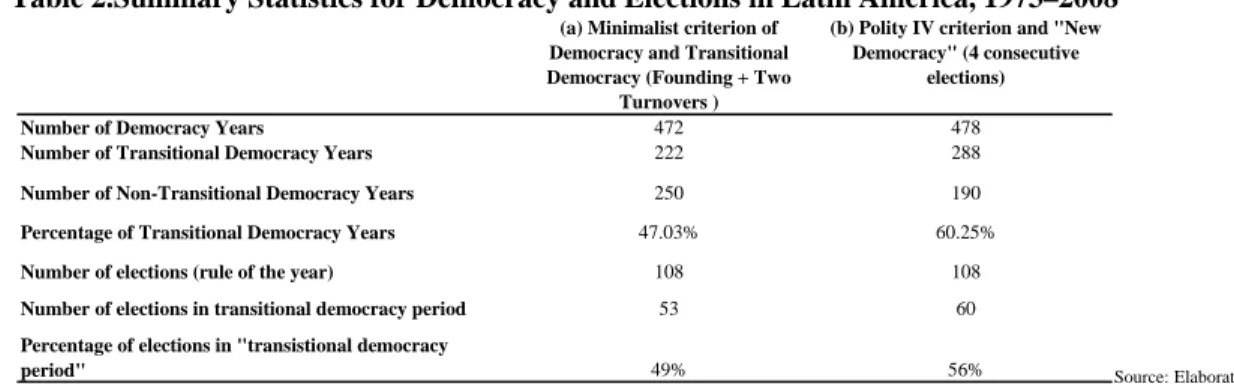
According to the two-turnover test, the transitional democracy period is coded as the years between the year of the founding election and the year of the second consecutive election in which an opposition party wins and assumes office. In the case of Argentina, for example, this implies that the transitional period is between 1983 and 1998 (the year before Fernando de la Rua is elected to the presidency returning the Unión Cívica Radical (UCR) to power). The de la Rua election is defined as the first year of stable democracy. As Table 2 summarizes, 53 elections in the sample meet this criteria.
Table 2.Summary Statistics for Democracy and Elections in Latin America, 1973–2008
Source: Elaborated by the authors.
One of the key challenges in analysis of elections is the extent to which they may be endogenous as oftentimes the end of a particular regime is not pre-determined, but coincides with economic crises (Przeworski and Limongi 1993; Haggard and Kaufman 1997). There are a few reasons why the endogeneity of elections does not seem to be a significant problem for the questions that will be explored in this paper. First, the problem of simultaneity bias is much more severe in PBC studies that employ economic growth, unemployment and inflation as dependent variables as declines in the performance of these variables are precisely what tend to trigger the collapse of particular administrations. Second, unlike parliamentary democracies, elections are typically held on a fixed schedule in presidential democracies such as those found in Latin America. Of course, there are some notable exceptions. Fueled by rampant hyperinflation, Siles Suazo anticipated presidential elections one year earlier than the end of his term in 1985 in
(a) Minimalist criterion of Democracy and Transitional Democracy (Founding + Two
Turnovers )
(b) Polity IV criterion and "New Democracy" (4 consecutive
elections)
Number of Democracy Years 472 478
Number of Transitional Democracy Years 222 288
Number of Non-Transitional Democracy Years 250 190
Percentage of Transitional Democracy Years 47.03% 60.25%
Number of elections (rule of the year) 108 108
Number of elections in transitional democracy period 53 60
Percentage of elections in "transistional democracy
Bolivia. In Argentina, Raúl Alfonsín similarly ceded power earlier than anticipated though only a few months earlier than planned. After only two years in office, President de la Rua resigned from the Argentine presidency in 2001 in light of massive protests and a spiraling economic crisis. The robustness of the results reported in Section 5 without these elections will be tested and reported. Third, control variables in estimations include measures of per capita economic growth to capture the possible endogenous relationship that exists between government spending and elections.
Control Variables
The demographic and economic variables included as control variables are analogous to those used by Brender and Drazen (2005b). Demographic characteristics of the population are likely to influence government spending. Two demographic variables representing the fraction of the population aged 15–64 and 65 and over are employed as controls. A higher percentage of elderly and young people in the population are expected to positively increase budget allocations for social programs and social security leading to increases in fiscal spending and the worsening of budget deficits. Unless otherwise noted, the control variables data are from the World Bank’s World Development
Indicators(2009).
Given the heterogeneity in income and growth rates across the region, it is important to include economic variable controls. The first is the level of economic development, defined as the real gross domestic product per capita and measured in constant 2000 US$ dollars. Per capita income is included in the model to control for Wagner’s Law, which holds that the level of public spending will be positively correlated with levels of economic development. Higher levels of per capita income are expected to be correlated with higher levels of government spending. A control for the output gap or the proportion of growth that is unexpected in a given year is also included. Analogous to Brender and Drazen (2005b), we use the log-difference between real GDP and its (country specific) trend (computed using the Hodrick-Prescott filter).
Trade liberalization increased dramatically in Latin America during the 1990s. Thus, a measure of trade integration is included to control for the degree of an economy’s integration with world markets. Trade is calculated as the sum of imports and exports relative to GDP, where the denominator is calculated by converting domestic local currency to current US$ based on exchange rate conversions. In addition to these variables, a dummy variable was included to control for the additional years that were added to the Brender and Drazen data set to control from the IMF’s GFS database.
4. Estimation Procedure and Model Specification
The baseline model used to test the effect of elections on fiscal variables:
Yi,t = t+ β1Yi,t-1 + β2 Z i, t + β3 ELEC i, t + ci + i,t. (1)
The three measures of fiscal policy that are used are analogous to those used by Brender and Drazen (2005b) and are total government spending as a share of GDP, total revenue collection as a share of GDP and the budget balance as a share of GDP. Z is a vector of control variables as described earlier and represents year dummies. The index
i refers to the N observational units (or panels), and t indexes the T time periods. The
term ci is a dummy variable for each country intended to capture country-specific unobserved effects that impact welfare spending, as well as the democratic character of the regime in a given country. The error term, it, is an error term associated with unit i at time t.
This model follows the literature and tests whether there are differences in spending prior to elections by including a dummy variable, ELEC, for the election year. We check the robustness of political budget cycles to alternative definitions of democracy control by employing the two different definitions described in the previous section of this paper in which a given year was coded as one for the election year if a country received a score indicating that it was a democracy based on the Polity IV criteria and compare these results with those obtained when the election criteria are determined by a
country being classified as democratic per the minimalist criterion defined by Cheibub, Gandhi and Vreeland (2009). We seek to verify if both measures yield a positive coefficient that is statistically significant from zero in the year of the election.
Based on the assumption that past levels of government spending influence the levels of expenditures in future years, a lagged dependent variable is included in each specification. A series of measures were taken to check for consistency and robustness of the results that will be reported in the next section of this paper. First, pooled ordinary least squares regressions (OLS) with panel corrected standard errors (column 1) were estimated.10 Subsequently, country fixed effect estimates (column 2) and year fixed effects on top of country fixed effects (column 3) were undertaken.11 In a second stage, two Generalized Methods of Moments (GMM) procedures were used: the Arellano and Bond (1991) first-differenced GMM estimator (GMM-Diff) and the Blundell and Bond (1998) system GMM estimator (GMM-System) (columns 4-5).12 Therefore, the tables presented below consist of five columns. Two lags of the dependent variable were used in the GMM difference and systems equations. The GMM estimates use the Arellano-Bond (difference) and Blundell-Bond (system) procedures with orthogonal deviations to adjust for an unbalanced panel that were collapsed to minimize the number of instruments following the recommendations of Roodman (2007). Per capita GDP and the log-difference between real GDP and its (country specific) trend (computed using the Hodrick-Prescott filter) were also included as endogenous variables in the GMM estimations. For GMM estimates, standard errors are reported as t-statistics based on
10
The model was estimated with the Stata XTPCSE command.
11
For fixed T, Nickell (1981) demonstrates that the within groups estimate of the coefficient is likely to be biased downward of the order 1/T, where T is the length of the panel. Thus, the magnitude of the bias in the fixed effects estimates can be calculated in the within-group estimator for a dynamic model with fixed individual effects. The exact magnitude depends on which sample and indicator is used as some countries do not report data for the entire period. In a panel of all countries from 1973 to 2008, the length of the sample ranges from 36 years to a minimum length of 19 years for three countries (Honduras, Nicaragua and Paraguay). Hence, the bias from using a fixed effects estimator in these regressions is likely range from 2.77% (1/36) to 5.26% (1/19).
12
The exercise and commands for GMM estimation are based on Roodman (2006) and were carried out using Stata 10.1. GMM estimates were also carried out with control for year fixed effects. The results coincided with GMM results without controls for year fixed effects.
Windmeijer (2005) finite sample correction and corrected for serial correlation and heteroskedasticity.13
In a second stage, in order to test whether elections produce differences if an election takes place during either the “new democracy” or “transitional democracy” period (RECENTDEM), we undertake a second estimation:
Yi,t = t + β1Yi,t-1 + β2 Zi, t + β3 (ELEC)i, t + β4 (RECENTDEM)i,t+ β5 (ELEC*RECENTDEM)i,t+ ci+ i, t..(2)
In the equation, “ELEC” and “RECENTDEM” are dummy variables coding years considered election and transitional democracy years. The variable “ELEC*RECENTDEM” is an interactive variable equal to “1” if the presidential election took place during the transitional democracy period. The marginal impact of the recent democratization period on fiscal performance is captured by . The marginal effect of ˆ4 an election during the democratic transition phase is captured by . ˆ5
In the next section of the paper, we present the results of the test carried out to verify if fiscal spending and deficits increase during elections in recent democracies. We do so by examining if ˆ3ˆ5 (the total marginal effect of an election in a recent
democracy) is statistically significant from zero (Braumoeller 2004; Brambor et al. 2006). In this second stage, we also further test the robustness of political budget cycles to alternative definitions of transitional democracy. Our intention here is to focus on whether objective judgment and observational criteria of democratic transitions produce results that are different from measures that rely on vague and arbitrary operational rules.
13
The results of an error correction model (ECM), which is also appropriate for highly persistent series, with panel corrected standard errors based on the first difference of the dependent variables was also carried out and did not change the findings reported in this paper.
5. Results
In this section, we summarize the findings from tests on political budget cycles in Latin American democracies in the nearly four-decade period between 1973 and 2008.14 Regardless of whether Polity IV or a minimalist criterion is adopted for democracy, the results suggest that there are political deficit cycles in Latin American democracies. In this respect, our tests confirm the findings of research by Brender and Drazen (2005b). However, our results show that arguments that posit that these cycles are driven by recently democratized countries are less robust. For Latin America, our regression results suggest that there are important differences depending on whether objective judgment and observational criteria of democracy and democratic transitions are employed in comparison to measures that rely on vague and arbitrary operational rules. Specifically, we find that evidence of PBCs in recent democracies is dependent on the definition that is adopted for transitional democracy. As we report below, the results produced when models are estimated based on Brender and Drazen (2005b) definitions of democracy and new democracies are not confirmed when we distinguish between elections in which there have been less than two-turnovers of political power and those who have surpassed this mark.
Tables 3 and 4 examine whether there are peaks in government spending, revenue collection and the fiscal deficit in the year of a presidential election in Latin America. As observed earlier, all of the dependent variables are measured as a share of GDP. For presentation purposes only the results for the estimate of the coefficient for the dummy variable for the year of the election is presented. The base group is all other democratic years. Table 3 presents the results of the five specifications in which the year of election was only coded as valid if the country was judged a democracy based on Polity IV. Table 4 presents the results of the same test based on the minimalist definition of democracy.
14
We also carried out the same tests using the original Brender and Drazen (2005) data set for the period between 1973 and 2000. The findings reported in this section were not only confirmed, but generally stronger in terms of statistical significance.
The results in both tables suggest that there are important increases in fiscal deficits (panel C) in Latin America. It bears mention that the fiscal balance can be either a negative or a positive value. A negative coefficient on fiscal balance is thus measuring a worsening of the government’s fiscal balance. Relative to non-election years, both models predict an increase in the budget deficit in an election year in Latin America between six and eight-tenths of one percent of GDP. Independently of the criteria used to define a democratic election in the sample, the findings of a marked political deficit cycle are robust across almost all specifications and the coefficients are consistently the same sign and general value.
The exact levers that are driving the propensity of governments to incur higher fiscal deficits, however, are not confirmed in either tables 3 or 4. We cannot reject the hypothesis that the increase in election year government spending relative to GDP (panel A) is statistically distinct from zero. Both tables provide some suggestive evidence that tax policy, rather than expenditures as commonly assumed, may be the driving force for PBCs in Latin America (panel B). The coefficient measuring the impact of an election on tax revenue collection is negative and statistically significant at ten or less percent after controlling for county and year fixed effects (column 3) in both tables. As appendix 1 and 2 confirm, this pattern is even more robust once the “rule of the semester” is employed to test for PBCs in recent Latin American democracies.
Following the recent literature on PBC in developing democracies, we also tested whether the results on fiscal policy are influenced by whether an incumbent is eligible for reelection (Brender and Drazen 2005a; Drazen and Eslava 2006; Arvate et al. 2009). As we cited earlier, reelection was not allowed in most countries in Latin America and those that do permit incumbents to run for office only began doing so in recent years. When the regressions reported in Tables 3 and 4 are estimated with an additional dummy variable for those elections where incumbents could be re-elected, the marginal effect of these elections is not statistically significant in any specification using either Polity IV or the minimalist definition of democracy.
“New” and Transitional Democracies
Given that a significant share of Latin American countries experienced a transition to democracy in the late 1970s and early 1980s, the results reported in Tables 3 and 4 could be driven by the failure to account for the effects of electoral competition following authoritarian rule, as period in which voters had not had enough experience with elections, as argued by Brender and Drazen (2005b).Tables 5 and 6 present the results after we include appropriate multiplicative interaction terms to test if the marginal effect of fiscal variables in an election year in a recent democracy is statistically significant. Table 5 tests the hypothesis that political budget cycles are more prevalent in elections in ‘‘new democracies.’’ Table 6 reports the results based on a theoretically grounded definition of the period of transitional democracy in which only elections that took place prior to the year in which the two-turnover criteria was satisfied are coded as transitional democracy election years. In both tables, the estimated total marginal effect of an election year on fiscal policy for recent democracies and its standard variation are presented in the last two rows of each panel.
Table 5 confirms the patterns reported by Brender and Drazen (2005b) for new democracies. Recent Latin American democracies increase fiscal deficits by between eight-tenths and one percent in the year of the election. Once objective judgment and observational criteria of democracy and democratic transitions are employed, however, the sign and magnitude of the coefficient of the total effect of an election for a transitional democracy is not robust. In Table 6, the total effect of an election year in a transitional democracy is again predicted to worsen government fiscal balances. However, the coefficient of the combined effect of an election year in a transitional democracy is no longer statistically significant.
The results obtained in Tables 3 and 4 suggested that governments who decrease tax revenue collection in the year of the election drive political budget cycles in Latin America. Table 6 provides limited evidence that this pattern is caused by Latin American governments that seek to reduce political uncertainty and instability by targeting taxpayers during elections in transitional democracies. After controlling for country and
fixed year effects, governments in transitional democracies are predicted to reduce revenue collection efforts by eight-tenths of one percent of GDP in the year of an election (panel b, column 3).
To verify our results, we estimated the same models employing the “rule of the semester.” Under this alternative rule, the evidence of political budget cycles is weaker when subjective (appendix 3) criteria are used and nonexistent when objective (appendix 4) criteria for democracy and transitional democracy are employed. Our results also suggest that governments seek to reduce political uncertainty and instability by signaling fiscal responsibility in the transitional democratic period. Under the “rule of the semester,” presidential administrations are predicted to decrease government spending by eight-tenths of one percent in the year of an election (appendix 4, panel a).
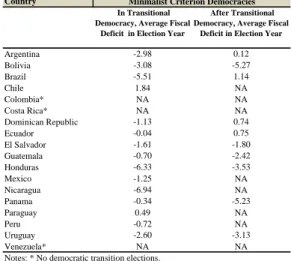
The case of Argentina is illustrative of the trajectory we should expect to see in Latin American countries during the third wave of democratization. Following the return of democracy in 1983 and up until the second turnover in power in which Fernando de la Rua assumed the presidency, the Alfonsín and Menem administrations spent an average of 12.94percent of GDP and collected an average of 10.67 percent of GDP in tax revenue. During the period of transitional democracy, fiscal deficits averaged 2.28percent of GDP. Budget deficits worsened to an average of 2.98 percent during the year of an election. The rise in the deficit was driven by the decrease in tax collection which fell by 6.3% as spending only rose by .003 percent. After there were two turnovers in political power, fiscal balances improved. Indeed, the fiscal deficit averaged 1.20 percent of GDP in the period between 2000 and 2008. In this post-transitional democracy period, fiscal balances did not deteriorate during elections, but instead slightly improved. In 2003, Argentina ran a slight fiscal surplus of 0.12 percent when Néstor Carlos Kirchner was elected as president.
Table 7. Fiscal Deficits during Transitional and Established Democracy Elections, 1973-2008
However, as Table 7 shows, the secular decline in fiscal deficits appears to be only weakly linked to the democratic transition process. There are ten Latin American democracies where data on fiscal deficits during elections in the transitional democracy and post-transition periods can be compared. In five of these ten cases, democratic regimes in the transitional democracy phase incurred higher deficits as compared to the competitions that took place once these same countries had successfully stabilized rule by elected government. Surprisingly, however, we do not find that there are greater levels of opportunistic spending during competitions when there is greater political uncertainty and instability.
6. Conclusion
There is a need for greater understanding of the differences and commonalities that Latin America has with other democracies in either developing or more advanced regions. This paper has sought to undertake a theoretically grounded exploration of political cycles in fiscal policy performance for Latin America during the most profound and widespread period of democratization. It has attempted to address several gaps in past empirical research by considering what happens to performance measures prior to and immediately after elections and when these competitions occur during the transition period prior to the stabilization of democratic institutions.
Country Argentina -2.98 0.12 Bolivia -3.08 -5.27 Brazil -5.51 1.14 Chile 1.84 NA Colombia* NA NA Costa Rica* NA NA Dominican Republic -1.13 0.74 Ecuador -0.04 0.75 El Salvador -1.61 -1.80 Guatemala -0.70 -2.42 Honduras -6.33 -3.53 Mexico -1.25 NA Nicaragua -6.94 NA Panama -0.34 -5.23 Paraguay 0.49 NA Peru -0.72 NA Uruguay -2.60 -3.13 Venezuela* NA NA In Transitional Democracy, Average Fiscal
Deficit in Election Year
Minmalist Criterion Democracies After Transitional Democracy, Average Fiscal
Deficit in Election Year
Based on a battery of specifications, this paper provides compelling evidence confirming that multiparty competitive elections do catalyze fiscal policy in Latin America. The patterns we find, however, have several important distinctions that differ from the trajectories we would expect based on theoretical models, such as Rogoff’s (1990) political budget model, and empirical research on recent democracies. For this reason, we believe that these results underscore that further research on how political budget cycles are affected by the transitional stages of democratic rule is necessary.
Our results underscore that the evidence suggesting that recent Latin American democracies are more likely to engage in opportunistic spending during elections is highly dependent on the criteria used to measure democracy and the evolution of its institutional character. Our findings partially confirm the results presented by Brender and Drazen (Brender and Drazen 2005b, 2007) who argue that recent democracies are more prone to political deficit cycles. In the period following authoritarian rule and prior to the stabilization of the regime, “new” Latin American democracies are more apt to engage in fiscal indiscretion in the year of the election. Our findings, however, show that these findings are not robust once objective criteria for democracy and transitional democracy are employed.
Furthermore, we show that the evidence of PBCs in Latin America is not only highly dependent on the definitions used for democracy and recent democracy, but also on the rule used to code the election year. The use of the semester rule did not change the predicted direction of our results for fiscal behavior in elections, but it did entail a loss of statistical significance for most coefficients. This loss of significance is particularly surprising as most studies on PBCs in emerging democracies devote only limited discussion to how findings are impacted by the adoption of either the rule of the year or rule of the semester. Both semester and year rules are different ways to specify the peculiarity of the electoral year, which is defined as the twelve-month period prior to elections. The rule of the year coding captures the preceding twelve-month period more precisely in samples where more elections are held toward the end of the year.
Conversely, the more elections are held toward the beginning of the year, the better the semester rule captures the “electoral year.”
Of the 108 presidential elections in our data set, 57 were held during the first semester according the minimalist definition of democracy. Thirty of these elections were held either on May or on June, the last two months of the semester, which can be considered a twilight zone for coding. On the other hand, only four elections were held in either July or August, the first two months of the second semester, which could also be considered a twilight coding zone. As elections dates concentrate toward the end of both semesters, one possible explanation for the loss of significance of the coefficient measuring opportunistic fiscal behavior is that the year rule is doing a better job in capturing effects of the twelve-month period before elections.
Our study also sheds new light on the levers that Latin American governments seek to use during elections and reveals a pattern that is contrary to theoretical predictions. While we find that fiscal deficits worsen in the year of election, government spending does not increase. Rather, political budget cycles appear to be linked to reductions in the efforts of governments to collect taxes and demonstrate greater fiscal responsibility. One potential explanation for this pattern may be that governments are eager to appease those interests that are most threatening to their destabilization, namely the upper classes and military elites. If this argument is true, our results further suggest that these fears of a reversion to military rule are not unique to the politically uncertain period of democratic transition.
References
Alesina, Alberto. 1987. "Macroeconomic Policy in a Two-Party System as a Repeated Game." Quarterly Journal of Economics 102:651-78.
Alesina, Alberto, Roberto Perotti, José Tavares, Maurice Obstfeld, and Barry
Eichengreen. 1998. "The Political Economy of Fiscal Adjustments." Brookings
Papers on Economic Activity 1998 (1):197-266.
Alt, James, and K. Alec Chrystal. 1981. "Electoral Cycles, Budget Controls and Public Expenditure." Journal of Public Policy 1 (1):37-59.
Álvarez, Michael, Jose Antonio Cheibub, Fernando Limongi, and Adam Przeworski. 1996. "Classifying Political Regimes." Studies in Comparative International
Development 31:3-36.
Arellano, Manuel, and Stephen Bond. 1991. "Some Tests of Specification for Panel Data: Monte Carlo Evidence and an Application to Employment Equations." Review of
Economic Studies 58 (2):277-97.
Arvate, Paulo Roberto, George Avelino, and José Tavares. 2009. "Fiscal conservatism in a new democracy: "Sophisticated" versus "naïve" voters." Economics Letters 102 (2):125-7.
Block, Steven A. 2002a. "Elections and the Composition of Public Spending in
Developing Countries, Working Paper No. 78." Cambridge: Harvard University, Center for International Development.
———. 2002b. "Political Business Cycles, Democratization, and Economic Reform: The Case of Africa." Journal of Development Economics 67 (1):205-28.
———. 2002c. "Political Business Cycles, Democratization, and Economic Reform:The Case of Africa." Journal of Development Economics 67 (1):205-28.
Block, Steven A., Karen E. Ferree, and Smita Singh. 2003. "Multiparty competition, founding elections and political business cycles in Africa." Journal of African
Economies 12 (3):444-68.
Blundell, Richard, and Stephen Bond. 1998. "Initial conditions and moment restrictions in dynamic panel data models." Journal of Econometrics 87 (1):115-43.
Brambor, Thomas, William Roberts Clark, and Matt Golder. 2006. "Understanding Interaction Models: Improving Empirical Analysis." Political Analysis 14:63-82. Braumoeller, Bear F. 2004. "Hypothesis Testing and Interaction Terms." International
Organization 58:807-20.
Brender, Adi, and Allan Drazen. 2005a. "How Do Budget Deficits and Economic Growth Affect Reelection Prospects? Evidence from a Large Cross-Section of Countries." In NBER Working Paper No. 11862. Cambridge: NBER.
———. 2005b. "Political Budget Cycles in New versus Established Democracies."
Journal of Monetary Economics 52:1271-95.
———. 2007. "Electoral Fiscal Policy in New, Old, and Fragile Democracies."
Comparative Economic Studies 49 (3):446-68.
Center for Latin American Studies at Georgetown University. 2009. "Political Database of the Americas ": Center for Latin American Studies at Georgetown University. Cheibub, José Antonio, Jennifer Gandhi, and James Raymond Vreeland. 2009.
Drazen, Allan. 2000. "The Political Business Cycle after 25 Years." NBER
Macroeconomics Annual 15:75-117.
Drazen, Allan, and Marcela Eslava. 2006. "Pork Barrel Cycles, NBER Working Paper 12190." Cambridge: NBER.
———. 2009. "Electoral manipulation via voter-friendly spending: Theory and evidence." Journal of Development Economics.
Franzese, Robert J. 2002. "Electoral and Partisan Cycles in Economic Policies and Outcomes." Annual Review of Political Science 5:369-421.
González, María de los Angeles. 2002. "Do Changes in Democracy Affect the Political Budget Cycle? Evidence from Mexico." Review of Development Economics 6 (2):204-24.
Haggard, Stephan, and Robert R. Kaufman. 1989. "Economic Adjustment in New Democracies." In Fragile Coalitions: The Politics of Economic Adjustment ed. J. M. Nelson. New Brunswick, N.J.: Transaction Books.
———. 1997. "The Political Economy of Democratic Transitions." Comparative Politics 29 (3):263-83.
Huntington, Samuel P. 1991. The Third Wave: Democratization in the Late Twentieth
Century Norman, Ok: University of Oklahoma Press.
International Monetary Fund. 2009. "Government Finance Statistics." Washington, DC: International Monetary Fund.
Kalecki, Michael. 1943. "Political Aspects of Full Employment." Political Quarterly 7:322-31.
Keefer, Philip. 2005. "Democratization and clientelism: Why are young democracies badly governed?, World Bank Policy Research Working Paper 3594."
Washington D.C.: World Bank.
Keefer, Philip, and Stuti Khemani. 2005. "Democracy, Public Expenditure, and the Poor: Understanding Political Incentives for Providing Public Services." World Bank
Research Observer 20 (1):1-27.
Londregran, John B., and Keith T. Poole. 1990. "Poverty, The Coup Trap, and the Seizure of Executive Power." World Politics 42 (2):151-83.
Marshall, Monty, Keith Jaggers, and Ted Robert Gurr. 2008. "Polity IV, Political Regime Characteristics and Transitions, 1800 - 2008." Available at:
http://www.systemicpeace.org/polity/polity4.htm.
Nickell, Stephen. 1981. "Biases in Dynamic Models with Fixed Effects." Econometrica 49 (6):1417-26.
Nohlen, Dieter, ed. 2005. Elections in the Americas: A Data Handbook. New York, NY: Oxford University Press.
Nordhaus, William D. 1975. "The Political Business Cycle." The Review of Economic
Studies 42 (2):169-90.
O'Donnell, Guillermo, and Phillipe C. Schmitter. 1986. Transitions from Authoritarian
Rule: Tentative Conclusions about Uncertain Democracies. Baltimore, Maryland:
The John Hopkins University Press.
Payne, J. Mark, Daniel Zovatto G., Mercedes Mateo Díaz, Andrés Allamand Zavala, Fernando Carrillo-Flórez, Koldo Echebarría, Flavia Freidenberg, and Edmundo Jarquín. 2007. Democracies in Development: Politics and Reform in Latin
International Institute for Democracy and Electoral Assistance and the David Rockefeller Center for Latin American Studies, Harvard University.
Peltzman, Sam. 1992. "Voters as Fiscal Conservatives." The Quarterly Journal of
Economics 107 (2):327-61.
Persson, Torsten, and Guido Tabellini. 2003. Do Electoral Cycles Differ Across Political
Systems?, University of Bocconi - Innocenzo Gasparini Institute for Economic Research (IGIER) Working Paper No. 232: University of Bocconi - Innocenzo
Gasparini Institute for Economic Research (IGIER)
Przeworski, Adam. 1991. Democracy and the Market: Political and Economic Reforms
in Eastern Europe and Latin America. Cambridge, England; New York, NY:
Cambridge University Press.
Przeworski, Adam, and Fernando Limongi. 1993. "Political Regimes and Economic Growth." The Journal of Economic Perspectives 7 (3):51-69.
Rodrik, Dani, and Romain Wacziarg. 2005. "Do Democratic Transitions Produce Bad Economic Outcomes?" American Economic Review 95 (2):50-5.
Rogoff, Kenneth. 1990. "Equilibrium Political Budget Cycles." American Economic
Review 80:21-36.
Rogoff, Kenneth, and Anne Sibert. 1988. "Elections and Macroeconomic Policy Cycles."
The Review of Economic Studies 55 (1):1-16.
Roodman, David. 2006. "How to Do xtabond2: An Introduction to "Difference" and "System" GMM in Stata, Working Paper 103." Washington D.C.: Center for Global Development.
Schuknecht, Ludger. 2000. "Fiscal Policy Cycles and Public Expenditure in Developing Countries." Public Choice 102 (2).
Schumpeter, Joseph. 1939. Business Cycles: A Theoretical, Historical, and Statistical
Analysis of the Capitalist Process. New York, NY: McGraw-Hill Book Company.
Shi, Min, and Jakob Svensson. 2002. Conditional Political Budget Cycles, CEPR
Discussion Paper #3352.
———. 2006. "Political budget cycles: Do they differ across countries and why?"
Journal of Public Economics 90 (8-9):1367-89.
Tufte, Edward R. 1978. Political Control of the Economy. Princeton, N.J.: Princeton University Press.
Table 3. Political Budget Cycles in Latin America, 1973-2008: The Effect of Elections
Polity IV Democracy
Dependent Variable: (1) (2) (3) (4) (5)
A. Government Spending/GDP Pooled OLS
PCSEa Pooled OLS PCSE with country fixed effects (f.e.) Pooled OLS PCSE with country and year
f.e. GMM One-Step First Diffb GMM One-Step Systemb Election Yeart 0.029 0.132 0.054 0.133 0.098 (0.280) (0.263) (0.272) (0.299) (0.310) Observations 421 421 421 410 421
Avg. Time Series Length 23.39 23.39 23.39 22.17 22.78
R-squared 0.834 0.855 0.871
Number of Instruments 9 17
Arellano-Bond test for AR(2) c
(p value)
0.302 0.253
Hansen test for joint validity of instruments (p value) 0.302 0.172
Diff. Sargan tests for all system instruments (p value) 0.154
B. Government Revenue /GDP
Election Yeart -0.412 -0.447 -0.544* -0.511 -0.399
(0.296) (0.272) (0.280) (0.355) (0.343)
Observations 412 412 412 400 412
Avg. Time Series Length 22.89 22.89 22.89 22.22 22.89
R-squared 0.836 0.862 0.880
Number of Instruments 9 17
Arellano-Bond test for AR(2) c
(p value)
0.679 0.627
Hansen test for joint validity of instruments (p value) 0.732 0.339
Diff. Sargan tests for all system instruments (p value) 0.257
C. Fiscal Balance/GDP.
Election Yeart -0.633** -0.740** -0.704** -0.776* -0.769*
(0.309) (0.296) (0.291) (0.376) (0.422)
Observations 412 412 412 400 412
Avg. Time Series Length 22.89 22.89 22.89 22.22 22.89
R-squared 0.411 0.462 0.548
Number of Instruments 9 17
Arellano-Bond test for AR(2) c
(p value)
0.853 0.805
Hansen test for joint validity of instruments (p value) 0.290 0.424
Diff. Sargan tests for all system instruments (p value) 0.439
Standard errors in parentheses and significance levels are as follows: * significant at 10%; ** significant at 5%; *** significant at 1%.
Notes: The covariates include lags of the dependent variable, the log of per-capita GDP, the ratio of international trade (sum of merchandise exports and imports) to GDP, the fraction of the population over age 65, the fraction of the population between ages 15 and 64, and the log-difference between real GDP and its (country specific) trend, estimated using a Hodrick-Prescott filter. In those cases that are noted, country and year dummy variables were included in regressions but were not reported above for presentation purposes.
a Pooled OLS regressions were estimated with panel corrected standard errors that correct for groupwise heteroskedasticity and contemporaneous correlations
of the errors.
b The two specifications present GMM estimates using the Arellano-Bond (difference) and Blundell-Bond (system) procedures with orthogonal deviations to
adjust for an unbalanced panel and collapsed to minimize the number of instruments following the recommendations of Roodman (2007). Per capita GDP and growth were also included as endogenous variables in the GMM estimations. For GMM estimates standard errors are reported as t-statistics based on Windmeijer (2005) finite sample correction and corrected for serial correlation and heteroskedasticity.
c The Arellano-Bond tests for first-order and second-order serial correlation are on the first-differenced residuals. The p-values are the probability of rejecting