MASTER’S DEGREE
DEVELOPMENT AND INTERNATIONAL COOPERATION
MASTER’S FINAL WORK
DISSERTATION
A
SOUTHERNISATION
OF DEVELOPMENT COOPERATION?
COMPARING CHINESE AND EUROPEAN UNION
DEVELOPMENT FINANCE IN LATIN AMERICA (2007-2017)
LAUREN EMILY GLANVILLE
MASTER’S DEGREE
DEVELOPMENT AND INTERNATIONAL COOPERATION
MASTER’S FINAL WORK
DISSERTATION
A
SOUTHERNISATION
OF DEVELOPMENT COOPERATION?
COMPARING CHINESE AND EUROPEAN UNION
DEVELOPMENT FINANCE IN LATIN AMERICA (2007-2017)
LAUREN EMILY GLANVILLE
SUPERVISION:
PROFESSOR LUÍS MAH
INDEX OF ANNEXES ... i
ACRONYMS ... ii
ABSTRACT ... iii
RESUMO ... iv
I. Introduction ...1
II. Making Sense of the Beyond Aid Debate ...2
2.1 Beyond Aid: A Historical Introduction ...2
2.2 Beyond Aid: SSC, Development Finance, Regulation and Knowledge ...4
III. The (re) Emergence of South- South Development Cooperation ...5
3.1 Introducing SSC ...5
3.2 SSC Narratives and Instruments ...7
3.3 The Changing Development Finance and Sectoral Landscape ...8
IV. Comparing China and the European Union in Latin America: A Southernisation of Development Practices?...11
4.1 China’s Aid to Latin America: Narratives, Instruments and Goals ...13
4.2 EU Aid to Latin America: Narratives, Instruments and Goals ...20
4.3 China and EU in Latin America: Wrapping up ...27
V. Analysis: Comparing EU and Chinese models of Development Cooperation ...27
5.1 Country and Sector Focus ...28
5.2 Political and Economic Conditionalities ...29
5.3 Blending of private and public funds ...31
5.4 Environmental regulation ...32
VI. Conclusion: Some thoughts on the Future of Development cooperation ...33
INDEX OF ANNEXES
ANNEX I
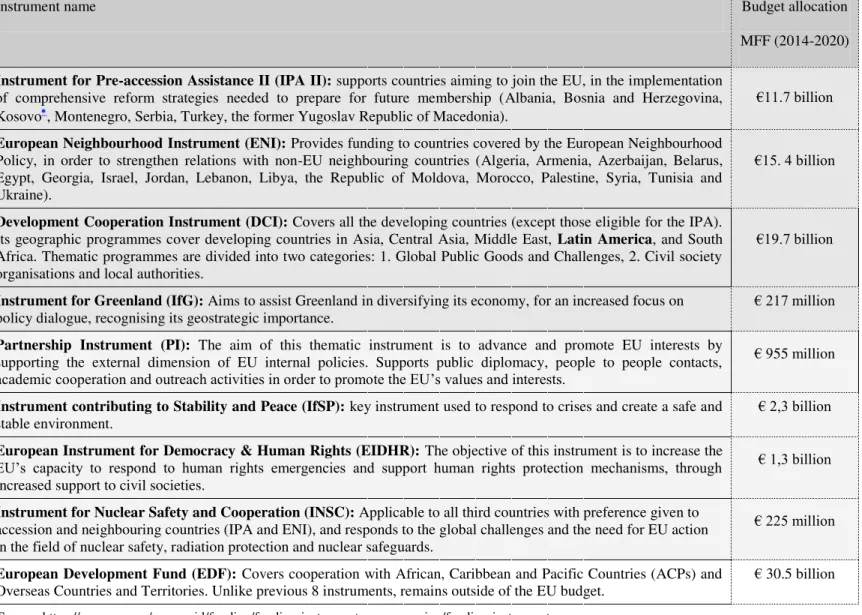
Figure 1: EU Development Finance Geographic and Thematic Instruments (descriptions and allocated budgets)
ANNEX II
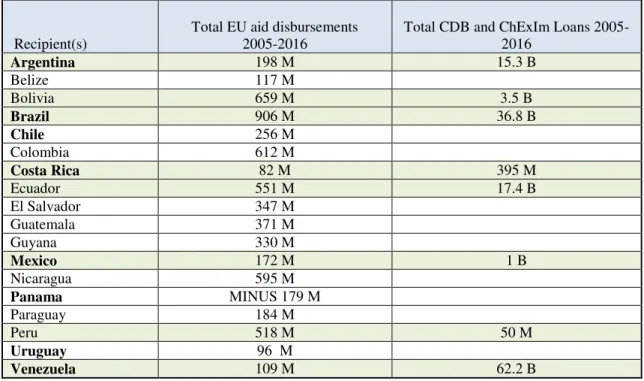
Figure 2: Comparison of EU aid disbursements with Chinese concessional loans to Latin America (2005-2016)
ANNEX III
ACRONYMS
AAA Accra Agenda for ActionACP Africa, Caribbean, Pacific Group of States AfIF Africa Investment Facility
AIF Asian Investment Facility
ALADI Latin American Association for Integration APEC Asia- Pacific Economic Cooperation BOFs Beyond Aid Flows
OOFs Other Official Flows CDB Chinese Development Bank
CELAC Community of Latin American and Caribbean States ChExIm China Export-Import Bank
CIF Caribbean Investment Facility CsP Country Strategy Paper
DAC Development Assistance Committee DCI Development Cooperation Instrument
DG-DEVCO Directorate General for Development and Cooperation EC European Commission
ECOSOC United Nations Economic and Social Council EDF European Development Fund
EEAS European External Action Service
EIDHR European instrument for Democracy and Human Rights ENI European Neighbourhood Instrument
EU European Union GDP Gross Domestic Product HLF High- Levels forums
IFCA Investment Facility for Central Asia IfG Instrument for Greenland
IfSP Instrument for Security and Peace IMF International Monetary Fund
INSC Instrument for Nuclear Safety and Cooperation IPA Instrument for Pre-Accession
LAIF Latin America Investment Facility MDG Millennium Development Goals MFF Multiannual Financial Framework MoU Memorandum of Understanding NAM Non-Aligned Movement
NECD the New European Consensus on Development NIF Neighbourhood Investment Facility
ODA Official Development Assistance
OECD Organisation for Economic Co-operation and Development OOF Other Official Flows
PCD Policy Coherence for Development PI Partnership Instrument
RsP Regional Strategy Paper
SSC South-South Development Cooperation SSDC South-South Cooperation
UN United Nations
ABSTRACT
This paper aims to investigate the notion that development cooperation financing practices are
undergoing a “Southernisation” - that is to say, (re)emerging donors from the South like China, India or Brazil are influencing traditional donor practices and discourse. It aims to do so by means of an exploratory comparative analysis of European Union and Chinese development cooperation financing practices towards Latin America, and how they have evolved over the past decade (2007-2017). The paper finds that for this specific case study, the answer to this question is rather more nuanced than first expected. Firstly, although recent
evolutions in EU’s discourse and practices in terms of development cooperation financing
indicate a move towards the Southern model of development, at the same time China is moving quickly towards the traditional donor model with regards to certain issues including the use of conditionalities and environmental standards, among others. It thus would seem that whereas initial reactions by traditional donors indicated a definite move towards a
“Southernisation” of development financing practices, lessons learnt by China over the past few decades have and are in some regards, reshaping their approach. Secondly, although EU development cooperation has become more focused on value for money, commercial interests and generally adapting to the new developing aid infrastructure, it is not clear whether this move comes as a direct result of the (re)emerging donor practices, or is rather being shaped by the current context taking place within its immediate neighbourhood.
Key words: Development Finance, Southernisation, European Union, South-South
RESUMO
Este artigo tem como objetivo investigar a perceção de que as práticas de financiamento da
cooperação para o desenvolvimento estão a passar por uma “Southernisation” – querendo isto dizer que o (re) aparecimento de doadores do Sul, como a China, India ou Brasil, estão a influenciar o discurso e as práticas dos doadores tradicionais. O objetivo é efetuá-lo através de uma análise comparativa exploratória das práticas de financiamento da cooperação para o desenvolvimento da União Europeia e da China para a América Latina e a sua evolução durante a última década (2007-2017). O artigo conclui que, para este estudo de caso específico, a resposta a esta questão tem mais nuances do que o inicialmente esperado. Em primeiro lugar, apesar das recentes evoluções no discurso e práticas da UE em relação ao financiamento da cooperação para o desenvolvimento, indicando um movimento para o modelo de desenvolvimento do Sul, a China está, paralelamente, a adotar rapidamente o modelo tradicional de doadores no que diz respeito a algumas questões, tais como o uso de condições e padrões ambientais, entre outros. Compreende-se então que, enquanto as reações iniciais dos doadores tradicionais indicaram um movimento definitivo para uma "Southernisation" das práticas de financiamento do desenvolvimento, a estratégia adotada pela China, no que diz respeito às lições aprendidas, tem sido de reformular a sua abordagem. Em segundo lugar, apesar da cooperação para o desenvolvimento da UE se ter tornado mais focada no value for money, em interesses comerciais e, em geral, adaptando-se à nova
estrutura da ajuda para o desenvolvimento, não é claro se este movimento ocorreu como resultado direto das práticas dos doadores (re) emergentes, ou se está a ser moldada pelo contexto atual da região vizinha.
Palavras-chave: Financiamento da Cooperação para o Desenvolvimento, Southernisation,
I.
Introduction
The recent world context has coupled a long-standing economic crisis in Europe
with the fast-paced growth of several developing countries from various continents,
both in economic and political terms. These changing dynamics in the global order have
called into question the foundations of a development cooperation approach whereby
the “enlightened” North assists the “troubled” South. The latter can no longer be seen as
a homogenous unit but rather needs to be viewed as the basis for the emergence of
strong economic and political centres of power with differentiated interests and cultures
– in many cases shaped as reactions to historical relations with the Western powers. The
latter have come to realise that the “emerging” economies and donors are presenting
other developing countries with an alternative development model and approach which
goes Beyond Aid. They see this new approach as undermining the developmental
results they have worked so long and hard to achieve. It can no longer really be
described as “development aid” but rather as a mutually beneficial relationship between
developing countries characterised by a respect for national sovereignty and interests.
The threat to the established North-South development paradigm therefore transcends
the field of Official Development Assistance (ODA), encroaching rapidly on the sphere
of political and economic interests.
This paper hopes to contribute to the Beyond Aid debate by comparing the
development model of a traditional Western donor (the European Union), with that of
one of the major (re)“emerging” donors (China) in Latin America over the period
2007-2017. This timeframe includes the 2008 global financial crisis as well as the period from
following question: Are we witnessing a “Southernisation” of development cooperation
financing practices?
It will be divided into three main chapters: The first two will provide a literature
review of the Beyond Aid debate focusing on South-South Development Cooperation
and development financing practices; Chapter IV will be divided into two main parts.
The first will present Chinese foreign aid both in theory and applied to Latin America;
and the second will outline European Union development cooperation policy in the
same region. The following chapter will summarise the findings and compare the two
development models discussing to what extent it can be argued that we are seeing a
homogenisation of development practices, with a bias towards the “Southern” model.
II.
Making Sense of the
Beyond Aid
Debate
2.1 Beyond Aid: A Historical Introduction
Mawdesly, Savage, Kim (2013) describe recent evolutions in development
cooperation taking as a starting point the late 1990’s, when after a brief hiatus in terms
of aid flows from most Western donors following the dissolution of the USSR, a new
“aid effectiveness agenda” emerged. The latter would concentrate on poverty-reduction
and the promotion of good governance, and this would be achieved in practice through
the achievement of the UN-led Millennium Development Goals (MDGs). Two main
elements would allow for this: greater recipient-country ownership and responsibility
for their own poverty reduction and a global commitment to target-led results.
The aid-effectiveness agenda was linked to a series of High Level forums (HLFs),
which took place in Rome (2003), Paris (2005), Accra (2008), and more recently in
meetings: the Paris Declaration of 2005 “which promoted ownership, harmonization,
alignment, results-based management and mutual accountability” (Ibid), and the Accra
Agenda for Action (AAA) in 2008, which focused on improving predictability of aid
flows, a greater focus on working through recipient country systems, and the untying of
aid and reduction of conditionalities (ibid). Although these initiatives were widely
welcomed and approved of, little progress was made in the areas highlighted by the
international agreements. According to Douglas Alexander (2008), a generation after
the Brandt Commission’s Report (1980) highlighting the need to tackle widespread
poverty, “leading thinkers continue to grapple with many of the same problems faced.”
2.1.1 The Failure of the Aid Effectiveness Agenda: External and Internal Pressures
Some of the most relevant literature relating to the Beyond Aid debate summarizes
the failures of the aid effectiveness paradigm as a result of external and internal
pressures. According to Janus, Klingebiel and Paulo (2015), the external pressures
include the global shifts in poverty that have taken the place over the past few two to
three decades and in particular the growing heterogeneity of the “South”. Additionally,
more and more recipient countries are becoming less dependent on aid with increases in
national income leading to 28 developing countries with a total population of 2 billion,
being crossed off the list of ODA-eligible countries (ibid). Another external pressure
identified is the growing number of explicit goals being pursued with aid. Poverty
reduction is no longer the sole objective and is now complemented by the variety of
national and local level problems, global challenges (such as climate change) and the
need to focus on public goods (such as security) (ibid). Mawdsley, Savage and Kim
(2013) list two further (both internal and external) pressures confronting the Paris
funding and politics by enhancing the notion of “value for money”. Secondly, there has
been a significant increase in the number and type of development partners, coupled
with the growing influence exerted by actors from outside the aid arena (see also Janus,
Klingebiel & Paulo, 2015).
According to Charles Gore (2013), in the past development cooperation and ODA
were understood to be one and the same. There was general consensus around the
definition of ODA as well as a coherent institutional set-up through which the
International Monetary Fund (IMF), the World Bank, the Development Assistance
Committee (DAC) of the Organization for Economic Co-operation and Development
(OECD) oversaw the practices of donors and recipients. However, this architecture is
rapidly evolving to give way to a more complex and diverse system characterized by
multiple actors and differentiated approaches and objectives.
2.2 Beyond Aid: SSC, Development Finance, Regulation and Knowledge
Janus, Klingebiel and Paulo (2015) argue that the emerging form being taken on by
development cooperation is severely fragmented and poorly coordinated, therefore
creating difficulties in terms of the conceptual debate regarding Beyond Aid, which is
still in early phases of development. It has become clear that the existing infrastructure
needs to be reformed in order to respond to the emerging issues and pressures, but how
this should be done is still very much up for debate. They proceed to outline the four
dimensions that they consider make up Beyond Aid.
The first relates to the proliferation of actors engaging in development cooperation
and in particular the “emerging” southern donors that are creating partnerships between
actors are also seeing an increased role in development cooperation. The second
dimension refers to development finance and a move beyond traditional aid financing
through bilateral and multilateral donors to other sources and mechanisms of finance.
Thirdly, regulation and policy coherence for development (PCD) is identified as an
important dimension within the Beyond Aid debate, and finally, the fourth dimension
relates to knowledge sharing and its close link to the transfer of financial resources
(Janus, Klingebiel & Paulo, 2015).
The next section will take a further look at the first and second dimensions
described above: “emerging” donors and SSC, and changes that are taking place in
terms of development financing. The aim of this section will be to lay further theoretical
foundations for the ensuing case study comparing European Union and Chinese
development finance practices.
III.
The (re) Emergence of South- South Development Cooperation
3.1 Introducing SSC
Since the 1990s, a group of “new” or “emerging” donors has been increasing its
participation and importance within the development assistance architecture. This group
of countries comprises “growing nations with strong economies that are increasing their
international footprint through many channels including foreign assistance.” (Walz &
Ramachandran, 2010). They ascribe to the principles of SSC, which simply put, refers
to cooperation between developing countries (Bry, 2017).
Although they are often referred to as “new” donors in the literature on
development cooperation and ODA, it is largely accepted that the majority of these
fact merely “re-emerging”. The Bandung Conference which took place in 1955 resulted
in the creation of the Non- Aligned Movement (NAM), the latter representing “the
official beginning of a collective voice for the South” (Ramachandran & Walz, 2010).
During the following decades, aid programs were implemented in support of the
Bandung objectives, generally in the area of technical assistance and in most cases on a
fairly ad-hoc basis. The 1980’s saw a decline in the number of aid programs due to the
debt and oil crises, which forced countries to turn their attention inwards (ibid).
However, by the end of the decade, development cooperation witnessed the
re-emergence of these donors as “dramatic economic growth in many “third world”
countries proved a model for successful development that was not dependent on the
West” (ibid). The increase in weight of these new players in development cooperation
has been accompanied by a growing focus and need to define them and their practices in
an attempt by traditional donors, to integrate them into the existing and evolving aid
architecture.
According to Walz and Ramachandran (2010), “the notion of emerging donors is
relatively misleading as it lumps very distinct groups of non-DAC donors into one.”
Several different groupings are made in the literature, but the one that seems to appear
most consistently groups emerging donors into three distinct models (ibid), leaving out
the new EU members: 1) The DAC model which bases its aid programs on the DAC and
probably aims to join it at some point; 2) The Arab Model with the Arab donors who
have been heavily involved in aid for some time now and which is very regionally
concentrated and openly influenced by social solidarity and religious ties (Chandy &
Kharas, 2011); and 3) the Southern Model, which includes Brazil, China, Egypt, India,
(although they reject this term) insist on distinguishing their assistance programs from
the DAC donors and the traditional donor-recipient model. According to Chandy and
Kharas (2011), only this last category - the Southern Model - practices South-South
Development Cooperation. Whether this distinction is made varies throughout the
literature. The OECD simply separates into two categories: reporting1 and non-reporting
countries beyond the DAC2.
3.2 SSC Narratives and Instruments
Although “there are as many SSC approaches as there are southern countries
involved in development cooperation” (Chandy & Kharas, 2011), Bry (2017) usefully
groups together the SSC principles and approaches as described in the literature:
Respect for sovereignty, no conditionality and non-Interference in domestic affairs (no
governance conditions attached to projects); mutual benefits (commercial ties viewed as
wholly acceptable in order for both countries to participate in development);
demand-driven ownership; horizontality; effectiveness and adaptability of technical cooperation
and knowledge sharing (mainly in the infrastructure and productive sectors) and a
regional focus.
According to OECD figures (OECD, 2017a), ODA levels from countries “beyond
the DAC” reached 25,2 USD billion from 19 reporting countries and 7.5 billion from 10
non- reporting countries. The total flows from non-DAC providers made up 17,8% of
estimated global development co-operation flows (ibid). This said, estimates in the
literature vary widely and it is hard to definitively evaluate the extent of emerging donor
contribution to development cooperation. On the one hand, reporting practices vary
1 Azerbaijan, Bulgaria, Croatia, Cyprus, Estonia, Israel, Kazakhstan, Kuwait, Latvia, Liechtenstein, Lithuania, Malta, Romania,
Russian Federation, Saudi Arabia, Chinese Taipei, Thailand, Timor Leste, Turkey, United Arab Emirates.
greatly, with some in keeping with the OECD definition while others are under-reported
due to a lack of a standard system for reporting ODA, or of a definition of what
qualifies as development assistance. On the other hand, the OECD-DAC definition of
ODA is restrictive and does not take into account other flows, which South-South
donors might consider to be development cooperation:
“those flows to countries and territories on the DAC list of ODA Recipients and to
multilateral development institutions which are: i) provided by official agencies
including state and local governments, or by their executive agencies; ii) each
transaction of which is: a) administered with the promotion of the economic
development and welfare of the developing countries as its main objective; b)
concessional in character and conveys a grant element of at least 25 per cent
(calculated at a rate of discount of 10 per cent).”
OECD (2017b)
Not all non-DAC donors report their ODA and among those that do, they do not
always hold true to this definition making it very difficult to compare and analyse the
extent, and impact of flows.
3.3 The Changing Development Finance and Sectoral Landscape
Until recently, the development finance landscape was very much dominated by
traditional donors, with developing countries having little option but to depend for the
most part on multilateral development banks and bilateral foreign aid in order to borrow
(Mawdsley, 2012). With the rise of re-emerging donors, new financing opportunities
have become available to developing countries and the importance of official ODA
negotiating power of developing countries vis-à-vis traditional donors (Prizzon,
Greenhill & Mustapha, 2016).
In the 2016 Overseas Development Institute (ODI) synthesis report (ibid), the
importance of Beyond ODA Flows (BOFs) is highlighted. According to the authors, in
2012 total external development finance to all developing countries amounted to $269
billion, 45% ($120 billion) of which came in the form of BOFs. The latter was divided
up mainly amongst Other Official Flows (OOFs) (37%): “defined as official sector
transactions that do not meet official ODA criteria” (OECD, 2017c), bilateral DAC
donors (23%), philanthropic assistance (22%) and (re)emerging donors (13%).
Mawdsley (2012) outlines some of the main types of financing used by re-emerging
donors: Exports credits (whereby either donor or private companies borrow funds on
concessional terms in order to lower investment risk); debt relief (used as development
cooperation and in some cases tied to trade or commercial interests); and technical
cooperation (SSC cooperation is widely thought to be more horizontal, practical and
experience-based experience compared to traditional ODA). However, according to the
author, it is when analysing the use of loans (both concessional and non-concessional)
by emerging donors, that the main conceptual and operational differences between them
and traditional donors on ODA is understood. SSC donors use loans as part of foreign
aid portfolios although they often do not conform to DAC definitions and approaches
and oftentimes they have a high level of commercial intent but are still considered to be
part of development cooperation relationships (ibid). Other characteristics of SSC
development finance relate to: a bias towards infrastructure and production projects,
whereas traditional donors have, since the 1990’s, prioritized social sectors; a
agreement of contracts, project undertaking; and a willingness to fund high-profile
buildings (ibid).
According to Mawdsley (2012), two issues of contention, which cut across all
forms of financing, relate to the tying of aid (mainly referring in this case, to the tying
of aid to specific commodities/services to be procured (Jepma, 1991) and to the use of
conditionalities. The former can take on different forms, often blurring the line between
development and commercial- oriented interests. The DAC has been making great
efforts to untie aid arguing that it undermines developmental and humanitarian
effectiveness. However, according to Mawdsley (2012), a more cynical approach
highlights the fact that tied aid can be seen as undermining fair competition between
firms and creating greater competition within the financial services sector and that it is
“for these reasons the mainstream aid and development community has aimed
conceptually (if less so in practice) at separating aid out from commerce, sequestering it
within a supposedly more virtuous realm” (Ibid). Chandy and Kharas (2011) add that
SSC providers have openly linked aid to commercial objectives and mutual benefits
whilst traditional donors do the same in a less obvious and opaque manner.
With regards to the use of conditionalities, according to Mawdsley (2012),
traditional donors argue that without them aid is more easily subject to elite capture or
other forms of waste or distortion. Emerging donors are seen to be condoning human
rights violations and jeopardizing their efforts in terms of good governance, with some
going as far as to call it “rogue aid” (most notably Naim, 2007). However, according to
an ECOSOC (2008) report, the majority of countries benefiting from southern
assistance are also among the top ten recipients of aid from OECD/DAC donors.
conditionalities, by invoking the Bandung principle of non-interference in sovereign
affairs.
In sum, the main principles of SSCD along with some of the main development
finance practices adopted by (re)emerging donors are the following:respect for
sovereignty; no conditionalities and non-interference in domestic affairs; importance of
mutual benefit approach (essentially the tying of aid to commercial interests); the
importance of loans (both concessional and non-concessional) vis-à-vis grants and other
forms of financing; a bias towards infrastructure and production projects; and speedier
negotiation, agreement of contracts and project undertaking. This selection will guide
the subsequent chapters and serve as a set of indicators in the final analysis and
conclusions.
IV.
Comparing China and the European Union in Latin America: A
Southernisation
of Development Practices?
The following case study aims to provide an initial exploratory analysis of EU
(which subscribes to the DAC model of development) and Chinese (South-South)
development cooperation to Latin America. In doing so, it will explore the
aforementioned idea that SSC, and in particular the more “aggressive” approach
adopted by China, is influencing traditional donor development financing practices, and
that we are witnessing a merging of approaches from the two sides, with a significant
bias towards the Southern model.
Although the EU and China have markedly different approaches to development
cooperation (both in terms of policies and instruments as well as ideologies and
discourses - as will be presented in the subsequent chapters), both have only more
adopting seemingly strategic approaches. Therefore, Latin America provides for an
interesting case study as over the past decade it has witnessed significant changes in the
development cooperation modalities being adopted by both actors: China has only
recently become one of the main finance providers to the region and to some extent, its
involvement in the region can be seen to characterize a more updated and, some might
say, moderate approach by the Chinese government on issues such as the environment,
types of financing instruments, main sectors of interest, and political motivations. On
the other hand, over recent years, the EU has been signalling a move from a traditional
cooperation model, towards a strengthened peer learning model (OECD, 2014) and an
evolution in the terms of its engagement with the region can be seen.
The next chapter will be divided into two main parts: The first will outline China’s
involvement in Latin America and will consider the historical evolution of relations, the
types of development finance instruments being used, and the main areas of contention
as highlighted in the relevant literature. The second part will concentrate on the
structure of EU’s development cooperation and how its approach has changed over the
past period, and on its relations with Latin America both from a historical and current
perspective. Following on from this chapter, this paper will carry out a brief
comparative analysis of both approaches, based both on the set of SSC characteristics
defined earlier on, as well as on more China and EU-specific issues. The overall aim
will be to provide an initial insight into what a future Beyond Aid approach might look
like, and whether it indeed signals a move towards a Southernisation of development
4.1 China’s Aid to Latin America: Narratives, Instruments and Goals
According to Creutzfeld (2017) as a result of its own historical path, China’s
foreign policy is characterized by a few core issues namely, national sovereignty, social
stability and steady consumption. These depend to a large extent on economic growth
with guaranteed access to raw materials, food and energy. Thus, since 1978, the focus
has been on a domestic modernization drive, which resonates in the Five Year Plans
outlining a series of social and economic development initiatives. Further underpinning
China’s foreign policy are the five principles of peaceful coexistence as proclaimed by
Mao Zedong at the birth of the nation in 1949: mutual respect for territorial integrity
and sovereignty; non-aggression; non-interference in others’ internal affairs, equality
and mutual benefit; peaceful coexistence.
China’s record as (net) “donor” dates back to the rise of communism in China in
the late 1940’s, and has experienced several different phases according to its domestic
context. A more recent stage began in 1990’s when China’s economy started to grow
rapidly, and aid levels rose again significantly after a period of concentrating it
attentions on domestic issues. However this time, “in line with the new market
economy, foreign aid was to be carried out on a business-like basis” (Stallings, 2017).
As a result, Chinese aid is not strictly separated from other financial flows such as
commercial loans and Foreign Direct Investment (FDI). Instead aid is seen “as one part
and package of funds that promotes the development of recipient countries” (ibid).
There is an allocation of “foreign aid” but it is seen as comprising one component
within a larger concept of development cooperation (Mawdsley, 2015). China therefore
tends not to make a strict distinction between development loans and investment. In
favourable contracts, while recipient countries gain a new source of financing with little
or no policy conditionalities attached to it – a situation that China describes as “win
-win” (Stallings, 2017).
Compared to the EU, China provides low levels of “foreign aid” according to the
OECD-DAC definition (refer to chapter III), which includes grants, interest-free loans
and concessional loans. The OECD estimates that in 2015, China’s total ODA
(according to OECD definition) amounted to 3.4 billion (OECD, 2017d), a low figure
compared to the EU Institutions disbursement of 13.7 billion in ODA for the same year
(OECD, 2017c). This said, the levels of financing going to other forms of assistance are
significant and as Brautigam (2011) observes, the challenge posed by China on Western
donors “has little to do with the Chinese tools that parallel those labelled ‘official
development assistance’ by the West and far more to do with the many other
instruments used by the Chinese states to promote its (…) engagement”.
The majority of Chinese funding takes the form of soft loans (both commercial and
concessional – with no grant element) and state-to-state investments in infrastructure
and natural resources. Two policy banks provide the lion’s share of Chinese assistance:
China EXIM Bank and the Chinese Development Bank (CDB). The CDB mainly
supports Chinese macroeconomic policies as set out in the Five-Year-Plans, which
focus on 8 main areas of development: electric power, road construction, railway,
petroleum and petrochemical, coal, postal and telecommunications, agriculture and
related industries, and public infrastructure (Gallagher & Irwin, 2016). The China
EXIM Bank on the other hand, is dedicated to supporting China’s foreign trade,
2017), and it does this through the use of export credits, loans to overseas construction
and investment projects and concessional loans (Gallagher & Irwin, 2016).
Most of the literature until recently concentrated on China-Latin America trade
relations which intensified as from the early 2000s and which were easily observable
due to comprehensive databases (Gallagher, Irwin & Koleski, 2012). On the other hand,
China’s investment and lending to Latin America, has only significantly grown in
importance over the past decade and China does not publish official reports and
accounts on these figures. However, despite the lack of information regarding China’s
assistance, the tentative figures indicate that its involvement in the region has rapidly
outpaced that of the EU as well as that from other major sources of finance.
4.1.2 Chinese Narratives and Goals towards Latin America
Within the context of China’s foreign policy described above, Latin America has
come to play a role in terms of natural resource diversification for China, as well as in
advancing its “One-China” policy – nearly half of the countries that recognize Taiwan
are in Latin America (Stallings, 2017). Since 2001, the intensifying of relations started
off mainly as high-level leadership forums and state visits and later further intensified
namely as a result of the 10th Five Year Plan in 2008, which encouraged Chinese
companies to expand their activities into three regions, including Latin America
(Creutzfeld, 2017). Three policy papers were written in 2008, 2014 and 2016, outlining
the terms of their bilateral approach to the region, always emphasizing the “win-win”
nature of the relationship. Furthermore, over the years several attempts have been made
at furthering multilateral cooperation, with the most notable being the creation of the
Development Bank (since January 2009), and has observer status in ALADI, CEPAL,
The Latin American Parliament, the Pacific Alliance and OAS (Creutzfeld, 2017).
Despite these efforts Chinese officials and businessmen have expressed their frustration
at the diversity they have been confronted with among the countries and sub-regions,
which have created obstacles to the interactions with the region as a whole.
4.1.3 Chinese Development Finance to Latin America
As previously mentioned, Chinese financing to Latin America is mainly in the form
of large concessional and commercial loans. According to estimates put together by the
China-Latin America Finance Database, in the year 2005, total Chinese public-sector
lending amounted to $30 million and by 2010 it had already risen to $35.6 billion,
overtaking the amount in loans provided by the World Bank, the International
Development Bank and the US Exim Bank combined. Last year, after a few slower
years (2011-2014), it rose again to $24.6 billion. According to Gallagher and Irwin
(2016) since 2005, Chinese lending to the region has amounted to a total of $141.3
billion, about 80 per cent of which have come from CDB and 10 per cent from the
EXIM bank. The same authors, in their empirically-based research on China’s financing
to Latin America, note that Chinese loans are large and concentrated among a few
countries, namely Venezuela ($62.2B3), Brazil ($36.8B), Ecuador ($17.4B) and
Argentina ($15.3B), which since 2005 have received 91% of total loan commitments.
Other Latin American countries having received Chinese loans since 2005, although in
significantly smaller proportions are: Bolivia ($3.5B), Mexico ($1B), Costa Rica
($395M) and Peru ($50M).
The concentration of loans in countries such as Venezuela, Argentina and Ecuador
that have had or still have restricted access to international capital markets has attracted
attention from the international community claiming that China is undercutting Western
efforts in terms of good governance. Additionally, the high risk taken by the Chinese
government in lending to such governments has been questioned. David Dollar (2017)
further investigates these claims and concludes that China is indifferent to governance
levels and is merely filling a void that has been left by Western donors and IFIs.
Whether this is a smart move by China’s government is unclear still – although the
worsening situation in Venezuela will probably lead China to create stronger safeguards
for its investments in the future.
That being said, an important financing instrument is being used by China in order
to reduce its risk: oil-backed loans or loans-for-oil. The latter involve an agreement
whereby an oil exporting country receives a loan from the Chinese government, and in
return a state-oil company pledges to export a certain amount of oil every day for the
duration of the loan. The oil is then bought by Chinese companies at market prices, the
proceeds of which go straight into an account owned by the policy bank that granted the
loan. The bank then repays itself directly from the account (Gallagher, Irwin & Koleski,
2012). In short, loans for oil “in addition to securing oil supplies, help (…) Chinese
companies expand abroad, and build(…) relationships with South American
governments…lower(ing) risk and increas(ing) profits” (Gallagher, Irwin & Koleski,
2012).
In addition to the focus on a few countries, as mentioned previously, Chinese loans
target different sectors than do IFI and western loans – focusing on EMITH sectors:
energy, mining, infrastructure, transportation and housing (ibid), whilst the latter focus
more on social sectors in order to achieve the Millennium Development Goals (MDGs).
Of the $141.3 billion loan disbursements, the China-Latin America Finance Database
(Gallagher & Myers, 2016) estimates that over 70% went to infrastructure projects, 17%
to energy sector projects, and 12% to mining and other sectors. According to Gallagher,
Irwin and Koleski (2012), whether this sectorial focus signals a different development
model, whereby China seeks to directly impact economic growth and create jobs in
recipient countries, or it is merely seeking access to key natural resources and markets,
is unclear.
The infrastructure and extractive sectors inherently carry high risks in terms of the
environment and the displacement of people (Dollar, 2017). China has a rather tarnished
reputation in this respect, although it argues that instead of subscribing to international
standards, it follows the domestic regulations, in keeping with the notion of
non-interference other country’s domestic affairs. However, as Dollar (2017) argues,
countries with bad governance are often those with the weakest regulation and/or
application of environmental safeguards. However, the same author argues that China
has made important strides in this respect and that in fact although “multilateral banks
have developed gold-plated standards, (…) they apply to only a fraction of investment”
seeing as infrastructure and extractive sector investments account for a minimal amount
of total spending to developing countries. In fact, this is not only due to multilateral
stringent environmental standards impose on recipient country institutions, encouraging
the latter to turn to China for financing in these sectors.
Another characteristic to be discussed in this section relates to the lack of policy
conditionalities imposed by China on recipient or partner countries. This is in keeping
with the Five Principles of peaceful coexistence, which underpin its foreign policy
approach. The idea here is that countries negotiate on equal terms and recipient
countries are not submitted to governance and economic conditions in order to receive
development financing. Although China does not impose policy conditionalities, it
imposes conditions relating to the purchase of Chinese goods or equipment with a part
of the loan, and in some cases the entire loan. This is in keeping with the idea of a “win
-win” partnership and allows Chinese banks to lower the chances of default risk (Dollar,
2017). Finally, concerns have been expressed with concerns to the growing dependence
of the region’s economies on China as a result of what some refer to as the “biggest
commodity lottery” (Wise, 2017). Total China-Latin America and Caribbean trade
increased 22-fold during the period 2000-2013 and FDI increased exponentially
especially to Brazil and Argentina with the most investment being made in resource
extraction (ibid). Although this has had positive impacts especially when one looks at
the capacity of these economies to rebound from the 2008-09 global financial crisis, on
the other hand a large dependency has been created. Carol Wise (2017) argues however,
that although these economies have been negatively affected by China’s slowdown, this
dependence relationship is not specific to these relations, but is rather a case of path
dependence, and thus the slowing down of the Chinese economy is once again
4.2 EU Aid to Latin America: Narratives, Instruments and Goals
According to Mah (2013), the EU’s history as a development aid donor can be
separated into three distinct historical phases. The first spanned from the 50’s to the mid
80’s during which time development policy was guided by the Lomé Convention and
was applicable merely to the African, Caribbean and Pacific (ACP) countries. The
signing of the Maastricht Treaty in 1992, which expanded development policy beyond
the ACP countries to include all developing countries, marked the ensuing phase from
the 1980’s to the late 1990’s. This period was strongly influenced by the Washington
Consensus whereby economic conditions were prioritized over political ones in the
disbursement of aid. The most recent phase can be said to have begun in the early
2000’s with the Cotonou Agreement replacing and updating the Lomé Convention. The
former has aimed to increase the role of recipient countries by making aid needs and
performance-based. Additionally, the 2005 European Consensus on Development,
which sets out common strategic norms for development cooperation, and the 2007
Code of Conduct on Complementarity and Division of Labour, were pivotal in
increasing the complementarity and coordination within EU development cooperation
efforts. Since 2009, the Lisbon Treaty has aimed to further reshape EU development
policy by integrating it into the EU’s external action and by means of important internal
organizational changes.
Currently two main institutions are in charge of EU’s development policy: the new
Directorate General for Development and Cooperation (DG DEVCO) and the European
External Action Service (EEAS). Additionally, the 2011 EU Agenda for Change to
some extent replaced the 2005 European Consensus for Change as the basis for future
EU Council, Commission and Parliament endorsed the New European Consensus for
Development (NECD). The Agenda for Change for its part signalled a change of the
development paradigm from a poverty-focused approach to an economic growth model
(CONCORD, 2013), a change that was then reflected in the EU’s latest seven-year
development cooperation plans.
The EU’s political priorities are presented in financial terms within the Multiannual
Financial Frameworks (MFF), which span a minimum period of 5 years. The latest
MFF runs from 2014 to 2020 and allocates a total of around €95 billion to external
relations (EC, 2017a). This budget is distributed amongst a series of instruments put in
place by the EU to carry out its development policy: Instrument for Pre-accession
Assistance II (IPA II), European Neighbourhood Instrument (ENI), Development
Cooperation Instrument (DCI), Instrument for Greenland (IfG), Partnership Instrument
(PI), Instrument contributing to Stability and Peace (IfSP), European Instrument for
Democracy & Human Rights (EIDHR), and the Instrument for Nuclear Safety and
Cooperation (INSC) (see Figure 1 for descriptions and budget allocations for each of the
instruments). The first 4 instruments listed above are geographic and the following 4 are
thematically focused. Together, these instruments are covered by the EU budget. Aside
from these instruments, € 30.5 billion was allocated to the 11th European Development
Fund (EDF) that is not covered by the EU budget which covers cooperation in among
others, Caribbean countries.
In order for budgets allocated to each instrument to be disbursed to countries and/
or regions, Country Strategy Papers (CSPs) and Regional Strategy Papers (RSPs) are
defined between the EEAS and recipient(s) which then act as the basis for multiannual
Herrera, Lebret & Echeverria, 2014). Development cooperation can be provided using
two main implementation methods: budget support and project modality. The former is
encouraged as a means of strengthening recipient country ownership, financing national
development strategies and supporting more efficient and transparent public finance
management. This modality is often linked to economic and political conditionalities
with countries needing to achieve a series of results in order to continue benefiting from
on-going support (ibid). Projects and programmes on the other hand, support recipient
governments in the implementation of sector policy and improved service delivery
(ibid). Although not strictly a programme implementation method, the EU Blending
Facilities (which will be discussed further in the following section) are also now used in
order to leverage additional resources for development financing.
4.2.1 The Agenda for Change: What’s New?
CONCORD (2013), the Confederation of EU Development NGO´s Platforms, in its
working paper outlines the main trends of the 2011 Agenda for Change and how these
were reflected in the 2014-2020 MFF. Some of these include: a greater move towards a
“value for money” approach and concentration on fewer countries and fewer sectors;
discussions about the definition of ODA with some Member States wanting to expand
aid to include other costs, as well as concessional loans and other official flows (OOFs);
promotion of economic development with increasing focus on private sector
development; promotion of governance and stricter aid conditionalities; a reduction of
direct support to social sectors; using GDP to determine the countries that should be
benefitting from aid; the interests of donors becoming more visible; and the blending of
public and private loans and grants. Some of these emerging trends are directly
present in the latest MFF (2014-2020). The next section will take a look at those having
a direct impact on the EU’s development cooperation approach to Latin America.
4.2.2 EU Narratives and Goals for Aid to Latin America
According to Roy (2009), despite the longstanding links existing between the two
regions, relations between the EU and Latin America did not really take off until the
1980’s. This was mainly due to the initial objectives of the European Community,
which concentrated on developing a European common commercial policy. The
countries within the community, aside from Belgium, had no links to the former
colonies in the region and therefore little interest was taken in the region. Changes
began to take place with the joining of the UK, which still had close colonial ties with
the West Indies, and were further reinforced when in 1986, Portugal and Spain became
members of the European Economic Community (EEC), bringing attention back to
Latin America. According to the same author, the ensuing decade between the 1980s
and 1990s marked a golden era for EU relations with the region mainly due to European
interest in bringing peace and stability to conflict zones, as well as its interest in
exporting the European integration model to the region. Nowadays, the EU is an
important partner both economically and politically to Latin America. It is the leading
donor, one of the main foreign investors and an important trading partner for the region
(OECD, 2014). Relations have intensified and been shaped to a large extent by political
dialogue taking place at regular high-level summits and target not only bilateral
relations but also work through a series of regional and sub-regional partnerships,
reflecting the EU’s recognition of the region’s heterogeneity. Currently the EU boasts a
wide range of agreements with individual countries as well as country groupings.
bioregional Rio Summit which has taken place every two years since 1999, and CELAC
which is a regional mechanism for political dialogue and cooperation that for the first
time groups together all 33 countries (EC, 2013).
4.2.3 EU Instruments for Latin America: from ODA to blended finance?
According to the OECD Statistics Database (OECD, 2017c), during the period
1993 to 2015, the EU disbursed approximately $5.2 billion in bilateral ODA to Latin
America. The region’s development cooperation has been governed by DCI since 2007,
with funds organised into regional, bilateral and thematic programmes.
As outlined earlier, the EU defines policy priorities and the budgets foreseen for the
achievement of results in its MFFs. The latest 2014-2020 MFF, established in
accordance with DCI Regulation and based on the EU-CELAC Strategic Partnership
and Action Plan, committed an overall allocation for the Regional Programme for Latin
America, of €925 million (EEAS & EC, 2014) as well as a total of approximately 1.2
billion under bilateral agreements with individual countries (EC, 2017b).
As mentioned in the previous section, the Agenda for change represents a shift in
paradigm, which has reflected itself in some of the instruments and implementation
methods established by the 2014-2020 MFF, directly affecting the EU-Latin America
development cooperation relationship. Among these are the DCI, the Partnership
Instrument and the EU Blending Facilities:
The Development Cooperation Instrument now functions according to the notion
of differentiation, with the aim being to concentrate more aid in the countries most
in need. This criteria has resulted in the “graduation” of upper-middle income
bilateral geographic component of the DCI, but remain eligible under the DCI’s
thematic and regional programmes. They will now receive bilateral cooperation
under the partnership Instrument. This shift in focus resulted in the discontinuation,
since 2014, of bilateral aid to Argentina, Brazil, Chile, Costa Rica, Mexico, Panama,
Uruguay and Venezuela. Countries that continue to be eligible for bilateral aid
include 13 OCTs and 6 Latin American countries. Colombia, Ecuador and Peru will
have bilateral cooperation discontinued at the end of this year (EC, 2017b).
Relations between the EU and MICs will adopt a cooperation and mutual-interests
approach and these countries will be eligible for project funding under the PI.
The Partnership Instrument represents the main innovative instrument in the
external aid package (EC, 2013), and has the overall objective of furthering EU
interests through the external dimension of its internal policies. “It will also address
specific aspects of the EU’s economic diplomacy with a view to improving access to
third country markets by boosting trade, investment and business opportunities for
European companies” (EC, 2017c). The instrument will aim to further public
diplomacy relations with those countries, which are having a greater role in the
world economy and those, which due to recent GDP growth rates, are no longer
eligible to receive bilateral cooperation (differentiation principle described above).
In practice, this instrument creates forums for dialogues between the EU and a
recipient country or region on a variety of issues within various sectors, both in
order to promote the EU’s values and to create more reciprocal and mutually
beneficial partnerships with these countries. Countries having “graduated” from
bilateral cooperation will rely to a large extent on this instrument to capture EU
The EU Blending facilities combine EU grants or loans with public and private
equity, the objective being to reduce risk with the grant element and as a result
attract more financing for large-scale investments in EU partner countries. EU
blending operations are implemented through regionally or thematically focused
financial instruments and are organised into Blending Frameworks according to the
financing instrument that is providing the funding. For the Latin America, the DCI
Blending Framework includes the The Latin American Investment Facility
(LAIF) which between 2009 and 2016 has been allocated a budget of €323 million,
resulting in a combined investment cost of over €8 billion (Hultquist, 2015). This
mechanism supports the new vision, present in the Agenda for Change and the
NECD, of an EU external cooperation focused on supporting inclusive growth and
job creation, as well as the idea of collaborating further with the private sector in
order to achieve greater development results. The benefits that the European
Commission claims are associated with this innovative financing mechanism
includes, leveraging of ever-shrinking aid budgets, support to policy reforms,
increasing financing in a sustainable and affordable way, socio-economic
development promoted through investment in public service and infrastructure; and
lower risk of investing in new markets and sectors (EC, 2017d).
These changes that have taken place in the EU’s development cooperation signal
an evolving approach. The latter is based on the new world context on two fronts:
European countries have been grappling with the economic crisis and the resulting
pressure to show development results achieved back home, as well as the security issues
(migration, climate change etc.) that have developed in their own neighbourhood. On
recipient countries representing both a challenge and an opportunity for the European
Union in its development policy (EC, 2017e).
4.3 China and EU in Latin America: Wrapping up
European Union development cooperation in Latin America represents a
significantly different model to the Chinese one, which fits in with the SSC
characteristics listed earlier on. It is based on a longer track record in the region, which
has resulted in a more stable, comprehensive and adapted strategy taking into account
the region’s heterogeneity and its main priorities in the field of development
cooperation. Nevertheless, the most recent communication and policy papers have
introduced a noticeably new policy direction as a response to the current world context.
The next section will consider the Chinese and European Union development
cooperation models side-by-side and - to the extent that is possible with two such
different approaches - will discuss what the two sides can learn from each other and
pave the way towards a new Beyond Aid paradigm.
V.
Analysis: Comparing EU and Chinese models of Development
Cooperation
The following analysis will discuss the two development models described thus far,
dividing into four main themes which provide for interesting points of comparison in
terms of development cooperation finance practices: Country and sector focus, political
and economic conditionalities, blending of private and public funds; and environmental
regulation. These four categories incorporate analyses of the SSC characteristics
argument that we are seeing a “Southernisation” of financing practices, can be verified
in the case of China and the European Union in Latin America.
5.1 Country and Sector Focus
Figure 2 shows EU aid disbursements and Chinese loan disbursements (from the
CDB and Chinese ExIm Bank) to Latin American countries for the period 2005-2016.
Chinese aid disbursements are not published according to DAC principles but as
mentioned previously the estimates show that the amounts are very low compared to
overall EU ones, and for this reason loans by the two state-owned policy banks have
been used as a point of comparison. The data shows that countries in which EU and
Chinese development financing intersect are Brazil, Argentina, Bolivia, Costa Rica,
Ecuador, Mexico, Peru and Venezuela. Of these countries, five have “graduated” from
bilateral cooperation with the EU and therefore receive aid only through geographic and
thematic instruments. The NECD strongly emphasizes the fact that funds should be
diverted from Middle Income Countries (MICs) to those that need it the most. A new
path is to be taken whereby more developed economies are seen not as recipients but as
partners in the successful implementation of the 2030 Agenda and the SDGs. The
sectors outlined as priorities are youth, gender equality, mobility and migration,
sustainable energy and climate change, investment and trade, good governance,
democracy and the rule of law and human rights. As seen in the section on Chinese
development cooperation, loans are mainly directed towards EMITH sectors in order to
secure natural resources, and their geographic concentration reflects this preference. It
would seem that the EU is slowly pulling funding from Latin America, recognizing that
many of the economies no longer need its support, and China has been quickly filling
development cooperation results for the continent but negative effects may arise from
the fact that the EU is reducing funds to the social sectors in MICs, in which China is
not that interested in intervening. The focus is shifting towards a partnership based on
trade and commercial activities. “Graduated” countries continue to be eligible for
funding via blending facilities (LAIF), but the targeted sectors will mainly be large
infrastructure projects. This said, the NECD (EC, 2017e) does point out that special
attention will be paid to the more specific challenges faced by the MICs, many of which
“still have high numbers of people living in poverty within their borders and often have
very high levels of inequality and social exclusion”.
5.2 Political and Economic Conditionalities
The EU uses several types of political and economic conditionalities in its aid
disbursements in order to promote democracy, good governance and sustainable
development. These conditions can take the forms of negative measures like sanctions
or positive ones whereby recipients agree to carry out reforms within their public
administrations. The latter approach depends on the achievement of agreed results in
order for the receipt of further funds. The EU use of conditionalities for aid
disbursements reflects its vision that “good governance, democracy and the rule of law
are vital for sustainable development” (EC, 2017e). In addition to this, the recent
context of economic crisis has put increasing pressure on the EU and other donor
countries to be able to show that money spent on aid is having the desired results, and
that they are not supporting autocratic and/or corrupt governments. The underlying aim
has been to give less, and achieve more.
China on the other hand, abides by the principle of non-interference in domestic
lack of a results-based approach. In fact, as mentioned previously, it has concentrated
some of its biggest loans specifically in countries during periods where they had
restricted access to international lending (such as Argentina, Ecuador, Venezuela),
filling the void left by Western finance institutions. All this said, China does impose an
important political conditionality: countries must adhere to the “one China principle” in
order to be eligible for aid and loan disbursements. Additionally, Chinese aid is openly
“tied” with loans often being attached to conditions relating to the use of Chinese labour
and resources, and with the use of oil-backed loans in order to lower the risk associated
with its investments (Gallagher, Irwin & Koleski, 2012). The notion that development
cooperation is undergoing a “Southernisation” would presume that due to Chinese
financing, EU institutions have been losing their leverage over countries, which have
been reluctant to apply political and economic conditionalities. As a result, we should in
fact be seeing a move towards a relaxing of conditions imposed. In the case of
conditionalities, this does not seem to be the case – in fact as shown in the Agenda for
Change and the NECD, the European Union has been signalling a move toward stricter
governance conditions. The need to lower the risk of investments, in the form of grants
and loans, made to recipient countries has become more important as a result of the
increasing need to achieve “value for money” and results. China would seem to be
moving in a similar direction as growth has been slowing down and domestic tensions
have been rising. In addition to this, recent dealings with countries like Venezuela have
sounded the warning bells as the messy political and economic situation has caused the
country to fall back on its oil shipments as payment for Chinese loans. In the case of
conditionalities, it would seem that there is not a “Southernisation” and that in fact it is
this will be done through EU-like conditionalities is unclear; China might merely
achieve these results through further tying of aid.
5.3 Blending of private and public funds
As outlined earlier on, Chinese aid financing is in many cases difficult to separate
from commercial flows due to the set up of the banking system and in particular the role
of its policy banks. This allows China to leverage public funds for investment in
large-scale infrastructure projects with high visibility. According to Mawdsley (2016), the
blending of grants, concessional loans and technical assistance, with market based loans
and export credits in support of projects, has been rather criticized. However, she also
notes that the “pendulum may in fact be swinging in their direction, including among
the DAC and other ‘traditional’ donors”. This does seem to be the case for the EU,
though funding channeled through the Blending facilities remains limited for the period
2014-2020, EU communication and policy papers strongly emphasize a move towards a
more aggressive approach in blending. Both the Agenda for Change and the NECD
highlight the importance of “blending grants and loans, as a way to leverage additional
private finance …(as)… another important means to implement the 2030 agenda.” (EC,
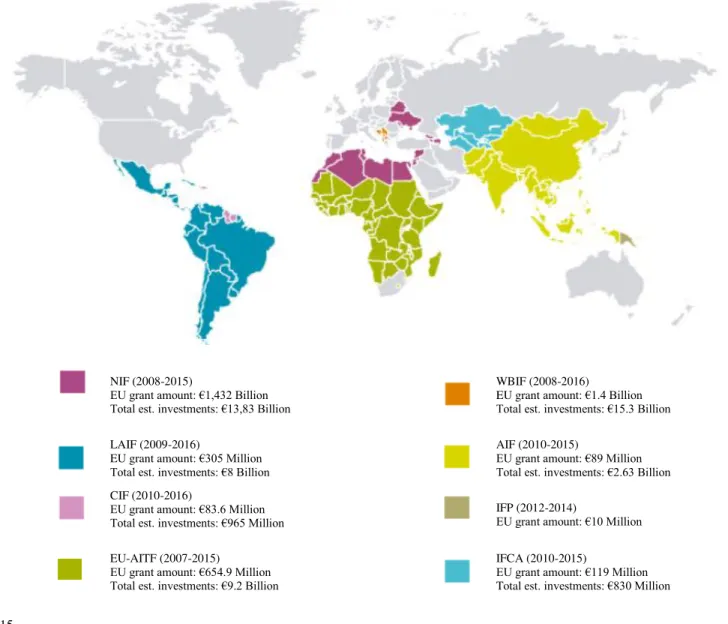
2017e). This said, figure 3 shows EU grant allocations per investment facility for
roughly the period from 2007-2016. When analyzing the figures by region, it is clear
that the EU’s surrounding neighborhood (including Northern African, Middle Eastern
and Western Balkan countries) is prioritized with an allocation of €2.83 Billion. In
second place comes (Sub-Saharan) Africa with €654 million, Latin America and
Caribbean region comes next with €388.6 million, and finally Asia received an
allocation of €218 million over the period 2008-2016. The recent European Investment