Abstract – Land reform in Brazil experienced in the early 1960s an initial historical moment of intense political debate without concrete steps to materialize it. But a second and recent moment, from the mid-1990s onwards produced a relevant record in terms of poor families settled and a huge area expropriated under that policy. However, a spectacular process of agricultural expansion and intense technological incorporation was simultaneously observed thus positing an intriguing ques-tion - how property rights and a required ‘instituques-tional framework’ directly affected by land expro-priation and land invasions by the landless groups did not block that process of agricultural growth? This concrete case exposes the analytical flaws of mainstream literature, which requires institutional preconditions to explain development and/or implementation of national policies. This apparent antinomy constitutes the analytical brackground of this article.
Keywords: Brazilian rural history, economic history, institutional functionalism, land redistribution, rural Brazil.
Ascensão e queda da reforma agrária no Brasil: uma peça em três atos
Resumo – A reforma agrária no Brasil experimentou um momento histórico inicial, sob o qual hou-ve intenso debate político nos primeiros anos da década de 1960. Contudo, não foi materializada na ocasião. Mas durante um segundo e recente momento, a partir de meados da década de 1990, tem-se produzido resultados relevantes em termos do número de famílias rurais pobres assentadas e do total da área desapropriada. Entretanto, um espetacular processo de expansão agrícola e intensa incorporação tecnológica têm sido observados simultaneamente, introduzindo, dessa forma, uma questão intrigante: como os direitos de propriedade e um necessário “arcabouço institucional” di-retamente afetado por desapropriações de terras e invasões de propriedades pelos grupos sem-terra não bloquearam esse processo de crescimento agrícola? O caso brasileiro expõe as falhas da litera-tura mainstream, que exige pré-condições institucionais para explicar o desenvolvimento e/ou a im-plantação de políticas nacionais. Essa aparente antinomia constitui o fundo analítico deste trabalho. Palavras-chave: história rural brasileira, história econômica, funcionalismo institucional, redistribui-ção de terras, Brasil rural.
The rise and fall of
land reform in Brazil
A tale in three acts
1,2
1 Original recebido em 22/8/2016 e aprovado em 29/8/2016.
2 Many thanks are due to Peter Ho (Delft University of Technology, Holland, and Minzu University in China), who read the draft of this
article and generously offered relevant comments. Usual disclaimers do apply.
3 Doutor em Sociologia, pesquisador da Embrapa. E-mail: [email protected]
Introduction
Brazil is nowadays on the verge of becom-ing the most powerful food producer in the world, leaving behind the longstanding dominance enjoyed by the United States. Its total area with pastures aside, agricultural area covered approxi-mately 83,8 million of hectares in the recent cycle of 2014/2015, according to official statistics registered in the “Municipal Agricultural Research” (PAM), a survey regularly conducted by the National Service of Statistics (IBGE).4 Moreover, agricul-tural total factor productivity (TFP) in Brazil is the highest among the most relevant food-exporting countries (FUGLIE et al., 2012), which is a reli-able indicator of technological intensification and deep integration with global markets. Agriculture now produces about 300 types of commodities and most of them serve the large internal market but are also exported for 180 countries. Also in accordance with PAM and other official sources, sugarcane, a source of energy and biofuels, catapulted its production from 91 million metric tonnes in 1975 to 672 million tonnes in 2015 while occupying an estimate 12% of total private land currently in use. Modern agriculture is the most dynamic sector of the country´s economy and, in fact, in the last thirty years it has been repeatedly responsible for the annual positive surplus of the national commercial balance. If it was not for its GNP contribution, Brazilian economy (and its social fabric, as a matter of fact) would be today much poorer and radically distinct, because the financial contribution of the industrial and services sectors have been dismal for most of that period, with a persistent accumulation of deficits.5
Taken these broad empirical facts into consideration, one might expect a near perfect organization of the agricultural sector in the country, with solid institutions, stable property rights, symmetric information and low transac-tion costs, thus embodying all conventransac-tional
premises emphasized in literature. Quite the opposite, however, has been observed in recent times: precisely when Brazil emerged as a giant in global food markets, a simultaneous policy of land reform also emerged and made the country a sort of curious international case, especially be-cause of the figures involved. Almost 90 million hectares (nearly one and a half the size of France) were amassed by the Federal Government and reallocated to almost one million poor landless families.6 Since this is a policy that involves not only land acquisition or mobilization of costless public lands, but also expropriation of private lands, this policy has alarmed landowners under the magnitude of the process of land redistribu-tion. Even more remarkable, the scope achieved by the national program resulted, in particular, from land invasions organized by landless groups, thus threateaning property rights on several oc-casions and in different parts of the country.
These are some of the reasons why it is a background perhaps ideal to refute the general hypothesis about the necessary relation of robust and a priori institutional settings as a pressuposi-tion to promote development or policies in vari-ous fields. An alternative interpretation proposed in recent years by Ho (2013, 2014) seems to nicely fit the concrete circumstances that moulded land reform in Brazil during the period covering the last fifty years. A summary shows an initial moment (early 1960s to the 1970s) when that policy was built as an institution only materialized in its form, but never put into practice, maybe because of its low credibility and negligible political support. In a second phase, however, after a vibrant process of democratization that followed the military regime, land reform re-emerged after 1996 as an institu-tion with strong social credibility but was put in practice only because of its operational function after unpredicted factors (the political action by landless groups, for example). Some of these fac-4 Available at IBGE (2015).
5 See the historical account offered by Barros (2014).
6 These figures are from “Statistics about land reform”, organized by the State agency in charge of land reform, the National Institute for
Colonization and Land Reform (Incra). The official numbers, as in September 2015, are 968,887 families settled in 9,256 rural settlements spread throughout the country (INCRA, 2015).
tors are clearly contradictory to a neo-liberal array of premises but, even so, a remarkable process of agricultural development expanded at the same time. Hence the question that confront those pre-conditions established in mainstream literature: would not be unviable a vigorous expansionary period of agricultural growth in the country, if the most basic fundamental value of capitalist development – inviolable property rights – was under threat by a substantial policy of land reform materialized in the country at the same time by left-leaned governments? How could one explain the spectacular rise of capitalist agriculture pari
passu with the strong but explosive political
pro-cesses commanded by landless organizations and state land expropriations at the same time? This is the general motivation of this article: to depict the most relevant aspects of land reform in Brazil, thus highlighting these (apparently) contradic-tory facets. It will be eventually demonstrated that conventional analytical tenets emphasized in conventional literature might not always constitute the best framework to explain specific models of development and social transformation – these are concrete cases that, in fact, contradict general and theoretical premises usually accepted. As a result, a novel interpretation must be found.
Land reform has inspired a permanent de-bate in Brazil either as a government policy or as an imperative to enhance social development de-fended by various political actors (LERRER, 2003; MARTINS, 2000; MEDEIROS, 1996; NAVARRO, 1998).7 Since the end of the 19th century one finds in literature vigorous demands by social advocates to reform one of the most skewed land structures in the world. However, it is perhaps correct to point out that land reform, in fact, was made highly visible in the political history of the country only in two well-defined periods. First, it emerged in the public agenda in the late 1950s-early 1960s but its political rationale was abruptly captured soon afterwards by the military coup of 1964 (MARTINS, 1981). The second moment
gradually materialized in the 1990s, after the Constitution of 1988, when strong political pres-sures and a growing social demand developed. As a result of the post-Constitution capacity of rural organizations and social movements to exert pressure, by the mid-1990s an ambitious process of land expropriation was in due course. If measured by the implementation of actual ini-tiatives, therefore, this second historical moment covers approximately two decades, from 1996 onwards. Since 2009-2010, however, this policy has been somewhat stalled and land redistribu-tion has gradually been shrinking. From a peak of 136,358 landless families settled in 2006, on average the Federal Government found a plot of land for 26,838 families during the period 2011-2014 (figures from Incra. See footnote 4). In recent years the main goal of the Federal Government has been only to improve “the qual-ity of (existing) rural settlements”, implicitly sug-gesting that conventional measures associated to land reform do not apply anymore.
This article summarizes the trajectory of land reform in Brazil and its most decisive facts, moments and achievements. Section two briefly sketches the origins of land concentration and the main aspects of that first historical moment when land reform surfaced as a heated political issue. It also highlights the military cycle that followed it, when land reform was replaced by projects of colonization and land legalization in several then sparsely populated and remote regions of the country. The section also discusses how land reform was legally structured as a form after the Land Statute was enacted in December 1964, indicating its main formal stipulations and the definition of the expropriation program, as well as how that form was influenced by actors’ endogenous interactions – in other words, how land reform became “an institution”, meaning a set of rules that autonomously derives its shape after interactions of groups of actors with varying interests (HO, 2013). After a synthetic account 7 In this article the expressions “land reform” and “land redistribution” will be used interchangeably. This is not conceptually precise,
but its clarification is perhaps unnecessary for the sake of the main arguments presented in the text. For a short comment on the main difference, check the dictionary entry in Navarro (2013).
on how land reform principles evolved and were adjusted over time, section three discusses recent years, especially after 1995, and the main achieve-ments of the land reform program implemented since that year – that is, the functioning of that policy. Finally, before a short conclusion, section four succintly comments upon the most pressing challenges facing this policy nowadays when it is suggested that it probably has reached its histori-cal end for various reasons, including a diminish-ing social demand (NAVARRO, 2014, 2015).
First act: building an institutional
format – the 1950s and the
years of the military cycle
Brazilian land structure, well known as one of the most unequal land distributions, has a historical justification, starting with the Portuguese colonization, before independence in 1822. It relates to a dual movement favouring aristocratic groups, on the one hand, and a per-sistent effort to deny access to land by members of the white poor. Later in the 19th century, after the rise of coffee as a major global commodity and the end of slavery (1888), those measures were an attempt to avoid former slaves having access to land in order to keep a permanent, large and cheap pool of rural labour for the rural oligarchies. As a result, the main facet of agrarian history was the constitution and persis-tence of under utilized large estates throughout rural Brasil, usually termed as “unproductive latifundia”. In synthesis, this was the historical background that established land concentration and the existing pattern at least until the period following the Second World War. Then Brazil ex-perienced a cycle of democratization that started with elections in 1945 but came to a blunt end with the military coup of 1964.
The first historical moment when struggles for access to land came into centre stage gradually developed from the mid-1950s onwards in pace with the process of political openness that was typical of that period - until the military takeover in 1964 (MEDEIROS, 1989). On that occasion land reform was seen as a fundamental policy that would liquidate the domination of agrarian elites, contribute to improve patterns of income distribution in rural areas and, in particular, it would boost industrialization after the formation of an enlarged internal market. Land reform at that time reflected an international concern and a policy seen crucial to ease social tensions and political demands inspired by the Cuban Revolution and also a reform proposed by the then influential UN Economic Commission for Latin America and the Caribbean (ECLA). Both perspectives had an implicit idea of building a national drive to stimulate capitalist development (DORNER, 1972). It entered the political agenda after the formation of peasant leagues and a series of actions they promoted in some of the tradi-tional sugar cane estates in Brazilian Northeast8. At the same time, for the first time, guided by the then semi-legal Communist Party, rural trade unions were formed in rural areas known for their commercial activities9. Stimulated by these social forces, a mounting pressure on govern-ment to implegovern-ment rural labour rights and land reform gradually became real in several regions. These pressures were even more radicalized dur-ing the brief mandate of the reformist mandate of João Goulart (1961-64), who was eventually deposed by the military coup in April, 1964. In his term, for example, the number of pro-poor rural trade unions spiralled and political spaces for protest and political pressures were more open than ever10. Only to illustrate, in 1963 there occurred the biggest strike by rural workers ever recorded, when the majority of workers in some Northeastern sugar cane producing areas 8 See the pioneering study by Hewitt (1969). An exhaustive study is to be found in Bastos (1984).
9 A robust and illuminating study on the theme is Houtzager (2004). The political strategy of the Communist Party in relation to
wage-earners rural workers and the formation of their trade unions is discussed in Santos (2008).
stopped working to demand the implementation of labour rights (MARTINS, 1981).
In the period 1955-1964, however, there were two particular barriers to overcome, if any attempt to implement land reform was to be suc-cessful. First, the entrenched political conserva-tism of that period, when right-wing parties and political forces were too powerful in Congress and had large majorities, blocking any discus-sions, let alone proposals to change the legal precepts on land reform and labour rights in ru-ral areas. Specifically in the case of land reform, however, the second and main impediment was the Constitution itself. Article 176 stipulated that any land expropriation should compensate the former landowner in cash before eviction. Moreover, the amount paid should reflect fair market prices. Under these requirements, land reform was made impossible and no feasible attempts were made to change the Constitution and, even less, to expropriate land under the impracticalities of those stipulations.
Although many political pressures there occurred in the period, land reform was merely a subject of public debate in this first historical moment and initiatives aimed at land expropria-tion did not materialize. It should be menexpropria-tioned, meanwhile, that agrarian tensions were a major factor affecting the context that eventually led to the military coup in 1964. After this institutional rupture, five successive military presidents, in face of their conservative nature, never seriously attempted to implement land reform and only occasional expropriations were made, usually in circumstances of strong (but local) social ten-sions. According to official statistics, in the period 1964-85 (that is, during the military regime), only 77 thousand families were settled, a figure that in Brazilian terms is negligible (GARCIA, 1988). As a rule, the military governments preferred instead to design a policy of colonization in rural backlands, justifiable under the political im-peratives of forming new human settlements in remote regions of national frontiers. During that
period, in addition to settlement of new areas (colonization), the military also implemented a land titling and registry program. But at least until the end of the military period, in March 1986, no substantial attempts were made to bring land reform back to the political agenda.
The most striking characteristic of land reform and related social struggles is a dual facet that is hardly understood by external observers unaware of the intrincacies typical of Brazilian politics. On the one hand, the country developed after the 1960s a detailed and extensive agrarian legislation that, in principle, would enable any government to implement ambitious programs of land reform, if a political will was in place. In short the form of land reform did materialize. On the other hand, however, the country’s political history has demonstrated a vigorous and as yet invincible alliance between large landowners, politicians and conservative sectors capable of preventing the enforcement of this law in due time and a significant process of land reform never be-came a reality. Brazilian history is a paradigmatic example that demonstrates the political power of elites to block State and Law enforcement when those policies are against their interests11.
The basic legal framework that still sustains land reform in Brasil is the “Land Statute” signed in November, 1964, just after the military coup (LAW, 5604). Its main focus was to devise ways of dealing with “unproductive latifundia”, apart from creating conditions to force agricultural modernization and increasing access to land to the rural poor. Since the primary barrier to over-come was the then existing Constitution (signed in 1946) and its stringent financial requirements to expropriate land, the first military govern-ment signed a constitutional amendgovern-ment (also in November 1964) which scrapped the need of previous and “fair” payment to land expropria-tion to be paid in cash. It stipulated that from that date onwards land expropriation would be paid with public bonds that would be fully redeemed twenty years later after being issued (their val-11 It reminds us a famous Argentinean writer who wrote that “The Law is like a knife; it does not hurt who holds it”. Cf. Hernández (1968).
ues periodically updated in accordance with indexes of inflation). Crucially, this amendment established the unification of existing legal possi-bilities and, after it, only the Federal Government would be entitled to decree expropriations for the purpose of land reform. As a result, no sub-stantive factor could prevent the implementation of this policy since it now depended only on political decisions by Federal authorities. The constitutional amendment even imposed that landowners would be barred from disputing in Court decisions to expropriate their land and would be able only to demand compensation for the investments and buildings made in their properties - but not the expropriation itself.
The Land Statute also established, for the first time, a mechanism to formalize a typology of establishments in rural areas. All landowners, regardless the size of their farms, were invited to declare details about their properties. After this information was collected, private farms were classified in four different types, ranging from (1) the small “minifundia”, to (2) the second type, the (typically medium-sized) rural enterprises and, on the other extreme, the two types of large estates (“latifundia”), one (3) so defined because of the proportion of non utilized land (more than 50% of the potentially productive areas existing in the farm) and the other (4) type because of the sheer absolute size of the rural establishment concerned.
All those categories were defined accord-ing to empirical indicators listed in the approved Statute. These criteria were basically centered on the concept of so-called “rural module”, a fixed unit of minimum land size in any specific region of the country that, in principle, would be enough to secure the livelihood of an “average family” involved in agricultural activities. Depending on the region, proximity to markets, quality of soils, rainfall regimes, and so on, the module was determined for a given region and, after that definition all rural establishments were classified under those four categories - landholdings smaller than the module fixed for their region would fall under the group of minifundia and should be
exempted from expropriation. Later on legislation was modified and currently no farm that is smaller than fifteen times the fixed module rural for its region can be legally expropriated. With this new databank the Federal Government gradually had a clearer idea about land use, types of rural properties, their main characteristics and an ap-proximate photograph about land structure in the country. The rationale was that land reform could be implemented without many tensions, because decisions to expropriate would be based on ob-jective facts and all farmers would know the rules of the game in advance. In particular, the biggest land estates would be expropriated without any legal chance of avoiding it, but those of significant size (but not so immense) could risk expropriation only if they did not cultivate a substantial part of their agricultural land. Medium-size rural enter-prises and small farms, on the other hand, were strictly protected under the new Law and could not be expropriated at all.
It is also relevant to mention that the Land Statute of 1964 established a progressive scale of “land taxation” (ITR in its Portuguese abbreviation) which, on paper, would penalize large landowners, forcing them either to sell their estates or radically rearrange their agricul-tural activities, in order to cultivate most of their land. The biggest landholdings, for example, if not productively cultivating most of their lands would face up to an annual 20% taxation (as a proportion of the market value of the property). If imposed, in few years it would be economi-cally meaningless to keep such a property. This taxation, however, has proven to be hard to enforce. The ITR was levied and collected by the Federal Government and revenues returned to municipalities. The total amount collected has been fairly insignificant and did not produce any impact whatsoever as a strategic objective to stimulate land utilization. The basic error with this taxation is its direct incidence on “non-used land” and the lax and insuperable disinterest of governments at all levels to collect it. In relation to the first aspect, for example, there is a growing contradiction facing an economic activity that in many areas is becoming strongly technologically
organized and more productive and, as a result, is capable of producing more in less arable land. It means that ITR in Brazil is reaching a cu-rious state where it is a burden on those farmers who seek higher productivity because in doing so a larger part of their farms is eventually not used anymore (notwithstanding the higher out-put in the farm) but they may be charged with a higher taxation – see Oliveira (2007). The main evidence of this contradiction is that the area cultivated with crops in Brazil did not increase substantially over the last twenty years whereas the national production of grains, for example, did experience a remarkable rise. In the period 1990-2005 the area under cultivation observed an annual growth of 1.2% while the total agri-cultural output increased 6.5% per year (author’s calculation). When the Brazilian agriculture is experiencing an impressive growth in produc-tion and is gradually becoming highly modern-ized, this taxation still relies on a moral argument based in historical legacies - that is, land taxation is supposed to force the use of land because of so many “unproductive latifundia”.
There is an enormous evasion of informa-tion by land proprietors. As a result, the relainforma-tion of the total area of all officially recognized and registered landholdings with the total surface of the country was only 39% by the mid-1990s (ATLAS…, 1996), a figure that did not change in recent years. For example, the state of Amazonas, in the Northern region, which is the biggest in the country, has only 4% of its area under legal and regular registry (O PORQUÊ…, 2013). In relation to the total amount collected under ITR vis-à-vis other government revenues, the highest proportion obtained in recent years was 0.27% in 1996, also according to official estimates. Since then that proportion has been continuously reduced, reaching only 0.074% in 2014 (REYDON; OLIVEIRA, 2015).
The main goal of most legal changes adopted was to make land productive and, as a consequence, rural farms to fulfill their “social functions”. The Statute and subsequent legisla-tion, though representing an unprecedented
rupture with past agrarian history, was still ex-tremely generous with large landowners because those criteria used to classify land estates were too tolerant. Only immensely large holdings with most of their areas unproductive were, in theory, under the threat of the Law.
Even so, the Land Statute, malgré its in-novations and potential capacity to transform land use and rural structures, stayed for most of the military cycle as a dead letter and was enforced only as a last recourse by the Federal Government. For most of the period, all military presidents preferred to ignore it (and its resulting political disputes) thus recurring to policies of colonization in new agriculture frontiers of the Center-West where poor families were offered plots of land in a region still largely unoccupied. As a consequence, in the period 1964 to 1985, land reform was not implemented and figures about new settlements were rather modest. Not only colonization was one of the major rural policies of the military period, thus freezing land reform but efforts to privatize former public lands in the agricultural frontier were also implemented in those years. It is estimated that approximately 30 million hectares were transferred to private hands through the mechanism of “fiscal incen-tives” adopted by the military governments. Under the promise of productive investments (especially cattle-ranching) in the agricultural frontiers of the Center-West and the backlands of Northeastern regions or in the Amazon state of Para, it was the main policy of land occupa-tion in those years. Especially in the 1980s, this forced transference of land rights was, in fact, the main origin of land conflicts in these areas of the country, because it eventually opposed local and scattered social groups of indigenous population and dispersed small farmers against to the newly arrived interests of powerful economic groups that claimed vast expanses of land.
under the Land Statue) was then made opera-tional, thus igniting its function. Since the original institutions persisted over time, in the context of the 1990s, they became credible and gradually that institutional structure was cause but also ef-fect of that original policy, after actors’ interactions thickened with the passing of the years. So that the “outcome is [was] a complex, multi-layered, contradictory and, at times, downright unintended institutional constellation, that in its bare existence could never have resulted from conscious human design” (HO, 2013, p. 1088, author’s emphasis). A combination of intense politization after de-mocratization, social pressures by landless groups and also an economic crisis affecting commercial agriculture (low prices) meant that land reform could surface and made a significant impact – in short, a passage from form to function and its concrete implementation throughout the country. That is the reason why this specific case of land redistribution in Brazil appears to be best ex-plained under the analytical lens proposed by Ho (2013, 2014), where “if certain institutions have emerged, and more importantly, persist as a result of spontaneous, endogenous development, they are likely to fulfill a certain fuction, and apparently are perceived as credible” (HO, 2013, p. 1095).
However, even after these changes intended to enlarge the scope of this policy, quantitative results did not improve much in relation to the for-mer military period. Official statistics, for example, indicate that in the first civilian government (1985-1990) only 83 thousand families were settled and in the period 1991-1994 only 57 thousand landless families were offered plots of land in different parts of the country (MEDEIROS, 1996). As a result, land structure in Brazil in the 1990s was still reflecting the legacies of the past and showing an immense concentration in the hands of a few owners. While income concentration in the country is high
vis-à-vis international standards (Gini index for income is
currently around 0.6), land concentration is almost unbelievable and the current index is 0.843 accord-ing to official estimates. Given the continental size of Brazil, when calculated for subnational regions,
Second act: from form to function.
The rise of land redistribution from
the mid-1990s to 2009-2010
For most of the 1980s political conditions surrounding the subject strongly changed after the end of the military cycle and the resulting process of political democratization. Land reform returned to the arena of politics again sometime in the second part of that decade, especially during the Congress legislature leading to the signing of the new Constitution, in October 1988. One of the most disputed topics when congressmen were preparing the new carta was precisely the legal requirements to re-define properties available for land expropriation. These debates galvanized so-cial forces, soso-cial movements and several public figures, most in favour of land reform but the new Constitution actually did not improve legal possi-bilities to boost it12. Therefore, when in the 1990s social movements and organizations representing the rural poor became increasingly vocal and capable of mobilizing social support, they faced legal stipulations very similar to past requirements. However, some limited advances were ap-proved by Congress and made part of the new Constitution – articles 184 and 186, for example, established the principle of the “social function of [rural] properties” originally proposed by the Land Statute. Other important decrees were signed in 1993 (Decree 8629, in February, and Law 76, in July) which defined expedite procedures concern-ing expropriation. After these new stipulations the legitimate spaces for legal contestation by affected landowners became stricter. These new laws imposed shorter periods of time to decide on several aspects of a given property that was expropriated for the purpose of land reform. But in that decade, under a democratic spring that was so exuberant, politics flourished and a dense range of interactions linking different social actors gradually forced discussions about land reform. The institutional framework supporting a potential launch of land reform (a form formerly established 12 The standard discussion of that juncture is to be found in Silva (1988).
this index suffers some variations, as Hoffmann and Ney (2010) demonstrate. They are lower as an average in southern states (0.712) and in the centre of the country (0.757), but is higher in the Centre-West (0.810) and North (0.851). In the Northeast, it reaches 0.811. The whole picture is one of dramatic asymmetries: while 31.6% of all rural properties are in the group of 0-10 hectares and the sum of their areas corresponds to only 1.8% of total area owned by all farmers, in the other extreme one finds the opposite, that is, all properties with 2,000 hectares or more comprise only 0.8% of all landholdings but the sum of these properties corresponds to 31.6% of the total area owned by all landowners (HOFFMANN; NEY, 2010).
A new and promising juncture came into be-ing durbe-ing the two mandates of the former president Fernando Henrique Cardoso (1995-2002), when opposition parties and rural organizations defend-ing land reform were stronger and, in particular, a difficult economic context strongly affected agri-cultural activities that eventually made many large landowners to offer their estates for the national program of land reform13. Especially in the years 1996-2002 this program observed an extraordinary rise and approximately 400,000 thousand families were settled in those years. For the first time in Brazilian history land reform received a substantial investment by the central government and made headlines for most of those years.
In the second part of that decade, the Landless Movement (known by its Portuguese abbreviation, MST), in association with the national confederation of rural trade unions representing smaller and poor farmers (Contag) came to the forefront and was able to promote countless land invasions and a growing series of actions intended to divulge struggles for land reform thus exerting pressure on the federal
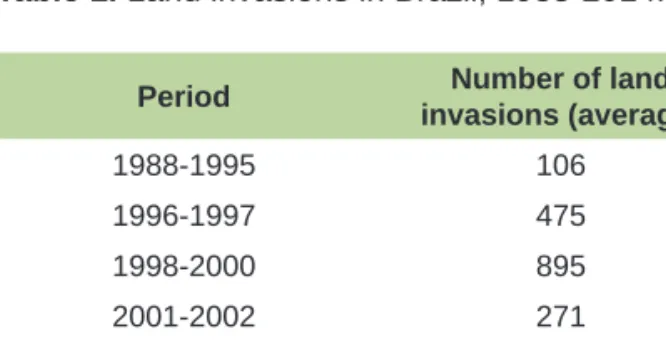
gov-ernment. The record of the MST, particularly in those years, is impressive and well documented in literature14. It is beyond the scope of this ar-ticle, however, to scrutinized the historical role of these organizations and their initiatives in order to stimulate social mobilization in rural areas around land reform and the agrarian question. Their political impact in recent times has dimin-ished, an inevitable outcome in face of so many transformations experienced by the country, for it would be only a matter of time that the country would observe trends like intense urbanization and the relative reduction of agriculture’s con-tribution to GNP or even the loss of the political clout enjoyed in the past by the agrarian elites. Table 1 shows the national evolution of land invasions and demonstrates a clear tendency to diminish their impact in recent years.
It was in this period that for the first time a clear strategy to promote land reform did occur, mobilizing several State ministries (including the Armed Forces) and a detailed plan to break po-litical resistances. The most spectacular result in that period, apart from a huge rise in the number of families settled and the total area expropriated for the national program was the liquidation, in
13 In fact, that period is more nuanced and complex than this mere indication. For example, some large landowners were also attracted
by the policies of privatization carried out by the Cardoso government. Landowners affected by an economic crisis in those years saw an opportunity to sell their properties and enter in the process of privatization in order to reap huge gains. Political factors also palyed a role for the killing of landless workers in Corumbiara (1995) and in Eldorado dos Carajás in the following year, both events in states of the Northern region, caused en enormous impact in public opinion. These tragic events also ignited a growing sympathy for the Landless Movement (MST), which took advantage and promoted even more land invasions. For additional details, see Navarro (2002, 2010).
14 Check among others Branford and Rocha (2002), Navarro (2002, 2010), and Wright and Wendy (2003). For an apologetic reading, see
Harnecker (2002).
Table 1. Land invasions in Brazil, 1988-2014.
Period Number of land invasions (average) 1988-1995 106 1996-1997 475 1998-2000 895 2001-2002 271 2004-2009 517 2010-2014 231
Source: Núcleo de Estudos, Pesquisas e Projetos de Reforma Agrária (2015).
15 This picture, in practice, is not as straightforward as it might suggest. As an example, in many states land records are in a mess and
many presumable proprietors dispute the same land. In addition to this, according to official estimates, only 51% of the total rural area in Brazil is formally registered (REYDON, 2014). Most probably this fact means that a vast area is being illegally utilized, especially for extensive cattle ranching, scattered in the remote regions of the country.
most rural areas, of the capacity by local large landowners to use all means (licit or not) to avoid expropriation and interrupt the continuity of gov-ernment procedures. Nowadays, in most parts of Brazil every large landowner knows that his/her land must be cultivated or the risk of land occupa-tion becomes higher. If it happens, there are good chances that swift legal actions sanctioned by local authorities in order to evict invaders will not be enforced and eventually that property could be lost to expropriation. This is an extraordinary political achievement that results from that junc-ture in the late 1990s, combining government’s strategy and pressures by rural organizations, in particular the MST, to keep land reform rooted in the political agenda – see Navarro (2010).
In the subsequent administration of President Luiz Inacio Lula da Silva, elected in 2002 and re-elected for a second mandate four years later, the national program was maintained with a single but crucial difference, that is, more financial resources were invested. The logistics of it, however, was almost the same. In his first mandate, for example, it was possible to settle 381 thousand landless families in an area of approxi-mately 32 million of hectares (an area equivalent the combined size of Belgium, Denmark, Portugal and Switzerland). The Federal Government invested almost US$ 2 billion to promote land reform in the first four years. Eventually, over 21 years, taken the Cardoso mandates through Lula da Silva’s eight years and taken also in consider-ation the two mandates of the current president, Dilma Rousseff (also elected under the umbrella of the Workers Party), an impressive 87,8 mil-lion hectares were redistributed so far and an estimated 1,26 million rural poor families were allocated a plot of land under the program (ap-proximately 280 thousand still not settled but formally benefited as in November, 2015).
Land expropriation in practice
The national program gradually developed an automatic operational framework and became
functional under a favourable context. Land for
expropriation is targeted through various modern techniques, from aerial images taken by satellites to the formal databases organized through state-ments by landowners forced to do so because of the land rural tax they are supposed to pay. If a specific property appears to fall under the existing criteria and might be expropriated, a visit is made to check its actual conditions and, after that, there are formal steps until the final act represented by a decree signed by the President of Brazil. In fact, there is a standard and normative set of procedures applicable to all cases, regardless the region. Thereafter a financial evaluation is carried out because land is paid with public bonds to be redeemed in twenty years, but all existing invest-ments in the farm are compensated in cash and the former landowner may also decide to contest these decisions. If there is not any further legal dispute then the government agency in charge of land reform (Incra) is issued an authorization to enter the area and start additional measures to establish the new rural settlement. These steps taken together, a new settlement may be formed in about a year or so, if no judicial contestation exists. The main difficulties, in fact, are not to be found in the operational process to expropri-ate a rural property, but in judicial manoeuvres which owners are able to use in order to delay expropriation. In recent times, however, public bonds issued in exchange for an expropriated farm have been accepted in financial markets and many large landowners have opted to avoid any legal litigation. When these disputes occur they are decided by Justice, according to a vast list of decrees, laws and legal norms15.
Beneficiaries, on their turn, are expected to be selected under formal rules and be able to register their interest in the public branches of
the executive agency in charge of land reform. In practice, however, in many cases the selection of new settlers is made under a tacit agreement with rural organizations representing the poor families, like the MST or the rural trade unions. Often this cooperation creates distortion and undue prefer-ences, because those organizations select mainly loyal members and do not pay much attention to more reasonable objective criteria when forming a list of candidates for new settlements. On paper, the new settlers must pay for the land and also for the credits they receive after taking over their piece of land in the new settlement. In practice things may be far different. For example, land will be paid only when the settlement is officially “emancipated” and the settler receives a formal land title of the property and is able to dispose of it as he or she wishes. But social movements and rural organizations representing the rural poor, however, have criticized this final step of making settlers private proprietors. They allege that the settlers will face many difficulties and would be severely affected if emancipated (for example, many would not resist the land markets and would sell their plots in the settlement) and thus oppose any attempt by the Federal Government to offer land titles for settlers. The cases where it happened are rare and it means that land has not been paid so far in the vast majority of settle-ments. As in the end of 2015, there were 9,256 rural settlements established under the program of land redistribution throughout the country, though with a concentration in recent years in the northern states of Maranhão and Pará – a quarter of all rural settlements are to be found in these two states (see footnote 4).
After occupying their corresponding plot of land in the new settlement, all families are entitled to different forms of credit for different purposes in order to secure post development support. For example, an initial credit is offered to build their houses while at the same time so-called “basic food baskets” are offered to all families at least during the first year. A more sub-stantial form of credit called “Pronaf A” (under the “National Program to Support Family-based Agriculture”, which is specific for rural settlers in
the land reform program) is also available and covers expenses to cultivate the area (seeds, fertilizers) in the two initial years, not to mention other forms of credit for specific purposes which some settlements sometimes are entitled to because of specific circumstances. The settlers pay these loans they incur but it is common a substantial discount when the time of payment is reached. Although there are national rules for all these forms of credit offered to settlers, it has been observed that part of the debts may be reduced or even cancelled in face of political pressures or the patronage of a given political actor, according to specific circumstances.
Impacts of new settlements
A controversial aspect of land reform in Brazil concerns its impacts in broad sense. Several studies were carried out in recent years and, in general, there are some positive findings about the national program, in particular arguments based on social justice and improved quality of life. Starting with the pioneering study by Zimmermann (1989), dozens of studies were carried out over the 1990s, but virtually all of them focussed on the case of one specific rural settlement here and there, with no relation to the general policy and/or analyti-cal links with national processes. Few efforts at-tempted to reflect on the novelty represented by the whole group of settlements scattered in the country (MEDEIROS; LEITE, 1999, 2004; NEVES, 1997; SPAROVEK, 2003). As an illustration of this topic, perhaps the study by Leite et al. (2004) is ideal to provide a more complete idea about the contribution of new settlements in Brazilian rural areas and their findings are here summarized. The study selected six regions where there is a concentration of new settlements formed by the national program and interviewed 1,568 settlers in 92 settlements during a period of almost two years of fieldwork.
It was found, for example, that in almost 90% of the cases, the initiative to demand the land expropriation came from the landless fami-lies themselves, after invading a private land or exerting other pressures. State action in this field
has been rather slow and if rural organizations do not promote actions, it is rare that State agencies will offer land in advance for an interested group of landless families, despite updated informa-tion available and more reliable administrative procedures. However impressive the number of landholdings expropriated in the last ten years, the fact is that land structure did not change in any significant aspect throughout Brazil. After analyzing data, authors concluded that new rural settlements selected did not alter patterns of land ownership and the Gini indexes in most regions studied remained the same. Usually this fact also implies that in the regions of new settlements the local power and influence of large landowners is still the same as ever and a process of political democratization did not transform local realities. The survey also indicated that approximately 80% of the population settled lived formerly in the same region and 94% worked in rural activities.
This fact highlights the crucial importance of land reform, offering a reasonable productive occupation to a large population of poor unem-ployed rural families formerly living under a very unstable social and economic situation. After being settled, these families usually use their plot of land to produce a long list of crops (and ani-mals) and eventually approximately 70% of their income is produced in the land they cultivate. This ambitious research also demonstrated that conditions of life improved substantially, in all aspects. Not only housing and better diet for all, but rural settlements, in particular, create stable conditions for the members of a given kinship, including relatives who were not formally settled but who are invited to live with the family that was offered the land. New settlements stimulate the local commerce when they sell their prod-ucts. Farmers seek credit to implement new initiatives and become active “economic actors”, especially when they establish organizations (like co-operatives) and are able to make visible their presence in the local economy. After some time,
they are adapted in the local society and are also involved in politics and other social dimensions of those municipalities where the settlements were established. If the town is small, a medium-sized settlement (80-150 families) formed might make a substantial impact in the local economy because many settlers will be entitled to receive government grants and pensions, they search for new credits and eventually there is a new eco-nomic dynamics in the municipality.
All findings taken into consideration, the cited study by Leite et al. clearly demonstrates the social and economic relevance of new settle-ments formed under the national program of land reform for most rural areas of Brazil (2004). The most revealing finding is exactly the sensation by the vast majority of those settled that their lot improved substantially and they find themselves in a much better condition of life.
Third act: the fall of land
reform in recent years through
the loss of credibility
Particularly after the years 2009-2010, despite the consolidation of an institutional framework to implement land reform, this policy is becoming uncertain and is facing growing dilemmas and difficulties. The first aspect to highlight is the dramatic reduction of social demand in most regions, especially because an unstoppable drive towards urbanization16. The structural spatial change of the population is impressive: according to official demographic statistics, while in 1960 the total rural population was an estimate 55% of the total population, the most recent demographic census demonstrated that the rural population directly involved in ag-riculture activities is nowadays around only 10% of the total Brazilian population. Not to mention the economic dominance of industrial and ser-vices sectors, agriculture does not produce jobs 16 “Demand” here in its political expression, that is, when potential beneficiaries are able to organize themselves and make public their
interests. It does not refer to what social scientists would call “potential demand”. The latter is obviously higher but is also diminishing with the passing of time, for the same reasons pointed out in the text.
in the same proportions as in the past because of mechanization and an increasing technologi-cal rationale prevailing in agricultural activities. The actual number of possible beneficiaries for the national program of land redistribution is highly disputable because of the different statistical sources, which, in this case, are often unreliable. It is also controversial because social demand is not always publicly demonstrated. However, if the demographic census or the so-called “national survey of households” (PNAD) are taken into account, the approximate figure of potential beneficiaries is an estimate total of 3.1 to 3.5 million poor families. These are land-less families but it would be possible to include poor small producers (sharecroppers, renters and small farmers with very small plots of lands) and the total would perhaps reach approximately 4 to 4,5 million poor rural families as a potential clientele for the national program (out of a total population of 205 million in 2015). This was, in fact, the figure established by the most recent National Plan for Land Reform, most probably representing an over-estimated indicator.
A second factor affecting land reform is the cost of implementing it (MARQUES, 2007). There is a growing argument that in face of diminishing landless families it would be cheaper to offer a monthly payment for the rural poor, instead of the costly (in administrative and financial terms) pro-cess of land reform. At the moment the Federal Government is in charge of a host of social poli-cies for the Brazilian poor, the most effective one being “Bolsa Familia”, a sort of CCT program in which poor families receive a monthly payment on the condition that their children attend school. Since most studies demonstrate that new settlers, in most regions of Brazil, are not capable of pro-ducing a monthly income higher than the official minimum wage, there are suggestions that instead of maintaining a complex process of land reform, it would be financially sound to enlist them in that social program.
Perhaps one of the most crucial factors affecting the implementation of land reform in Brazil in the recent period refers to the indexes of
land productivity stipulated in Law for all regions and agricultural activities in the late 70s under the then prevailing technological conditions. Those parameters were very low and, even if the Brazilian agriculture showed an impressive development after that decade, they were not updated. It eventually meant that the stock of land for land reform decreased with the passing of time because the Government was unable to find available landholdings, according to legal require-ments, subjected to the process of expropriation, in particular in the most modernized agricultural regions. This is especially the case of the tech-nologically modern agricultural regions of the Centre-South and Centre-West where land prices have soared over the years. In those regions the Federal Government has been forced to buy land and unable to recur to expropriation measures be-cause of legal impediments. In the less developed regions of the Northeast and the North regions there are still a great number of underutilized latifundia that are subjected to legal expropriating decrees and in those regions the Government has concentrated its efforts to settle landless families. That factor, associated with the reduction of social demand, most probably, means that land reform in Brazil is perhaps agonizing in these years and observing its final chapter.
These facts notwithstanding, there is also scope and justifiable reasons to implement at least a partial land reform in Brazil. For example, if a massive effort were made in order to concentrate land reform in the Northeast it could produce significant results in relation to poverty reduction and economic prosperity of a very important proportion of the rural poor. Approximately half of the Brazilian rural poor lives in that region, but the most economic important areas of agricultural production lie outside the Northeastern region. If a concentration of financial and human resources were applied in that region in order to expropriate most of its large landholdings (which exists in great number in the region) a formidable stock of land would be made available and the vast majority of the Brazilian landless families (if not all) could be settled there. It would be possible then to enforce a process of land distribution qualitatively
differ-ent from the traditional pattern of policies imple-mented to date. This suggestion is usually received with skepticism because the Northeastern region is plagued by a central and large area of semi-arid conditions where agricultural activities are strongly affected. However, when defending this possibil-ity it is meant an enormous area encompassing the half north of the state of Minas Gerais in the Brazilian centre towards the state of Maranhão, bordering the Northern state of Pará. Within this larger region there are many and relevant areas with satisfactory environmental conditions where agriculture could prosper. If this region is the object of an intensive process of land reform, government agencies will find land enough to settle all landless families still demanding access to land in Brazil (NAVARRO, 2001).
Land reform in Brazil has thus reached its “moment of truth” when crucial decisions will be necessarily faced by all actors envolved. With a social demand that is reduced every passing day and the development of several social policies that could be cheaper while producing better results for the rural poor (in terms of income) and, also, with the opening of new agricultural frontiers under the hands of large landowners and Brazil becoming a major player in interna-tional markets, it appears that justifiable reasons for land reform do not exist any longer. The cred-ibility enjoyed by land reform in the recent past does not persist and so the social forces around the theme have found growing barriers to keep this policy as a part of the government agenda.
The recent expansion of the national program of land redistribution has produced satisfactory results in many areas after social pressures and a rationale of offering occupation to the rural landless poor in times when the rate of growth of the Brazilian economy had been dismal and unemployment is too high. With a slight change in these macroeconomic circum-stances, however, there is a strong probability that land reform will become a still more con-troversial policy, perhaps unjustifiable when its costs and complex operational implementation are considered. If that situation will be the case
in the years to come, then a host of new policies devised to promote rural development must be discussed in Brazil.
Concluding remarks
The contemporary history of land redistribu-tion in Brazil is an intriguing case of many contra-dictory tendencies and procedures. It started with a forceful effort developed just after the dawn of the military regime to build the mechanisms that could operate land reform as an institution. But after the sophisticated arrangement was approved not a single president during that period dared to enforced this policy and only after the end of the authoritarian period the circumstances surround-ing the mandate of one specific civil president (Cardoso) made functional a vigorous process of land redistribution, after 1996, his example being followed by two subsequent presidents (Lula da Silva and Dilma Rousseff). Consolidated figures are impressive after two decades but the period has shown a clear contradiction – that is, an outcome in terms of land expropriated and poor families settled, on the one hand, and the spectacular agricultural expansion observed in regions unaf-fected by land reform, on the other hand. These opposing trends represent a challenge for those analysts who claim that a series of neo-liberal pre-suppositions must be in force, in order to secure economic development. This article delineated these apparent antinomies in order to illustrate the case for novel interpretations about institutional prerequisites and its relations with development. Broad concepts and an implicit notion of order as conditions to successful policies, therefore, ap-pear to be problematic and alternative conceptual readings centred on endogeneity and spontane-ous order might be fruitful, because:
[…] these concepts could coalesce into notions of credibility and institutional func-tionalism as a way to solve the paradox why socio-economically inefficient institutions (read: insecure, opaque and informal) can exist and persist. Against this backdrop, it is posited that the state cannot determine the form of institutions through land titling or
privatiza-tion, as outer appearance is determined by institutional function as the resultant of a long, arduous and autonomous process of bargain-ing. (HO, 2013, p. 1089).
References
ATLAS fundiário brasileiro. Brasília, DF: Incra, 1996. BARROS, G. S. de C. Agricultura e indústria no
desenvolvimento brasileiro. In: BUAINAIN, A. M.; ALVES, E.; SILVEIRA, J. M. da; NAVARRO, Z. (Ed.). O mundo
rural no Brasil do século 21: a formação de um novo
padrão agrário e agrícola. Brasília, DF: Embrapa, 2014. p. 79-116. Available at: <https://www3.eco.unicamp.br/ nea/images/arquivos/O_MUNDO_RURAL_2014.pdf>. Accessed on: Sept. 27 2016.
BASTOS, É. R. As ligas camponesas. Petrópolis: Vozes, 1984. BRANFORD, S.; ROCHA, J. Cutting the Wire: the story of the landless movement in Brazil. London: Latin American Bureau, 2002.
CAMARGO, A. A questão agrária: crise de poder e reformas de base (1930-1964). In: HOLANDA, S. B. de; CAMPOS, P. M.; FAUSTO, B. (Ed.). História geral da civilização
brasileira: o Brasil republicano. Volume 3: sociedade e
política. 5. ed. São Paulo: Difel, 1981. p. 121-224. DORNER, P. Land reform and economic development. Harmondsworth: Penguin Books, 1972.
FUGLIE, K. O.; WANG, S. L.; BALL, V. E. (Ed.).
Productivity growth in agriculture: an international
perspective. Wallingford: CAB International, 2012. DOI: 10.1079/9781845939212.0000.
GARCIA, R. C. PNRA: intenções e possibilidades.
Cadernos de Difusão de Tecnologia, v. 5, n. 1/3, p.
165-185, jan./dez. 1988.
HARNECKER, M. Sin tierra: construyendo movimiento social. Madrid: Siglo Veintiuno, 2002.
HERNÁNDEZ, J. El gaucho Martín Fierro. Buenos Aires: Campano, 1968.
HEWITT, C. The peasant movement of Pernambuco, 1961-1964. In: HENRY, A. L. (Ed.). Latin American peasant
movements. Ithaca: Cornell University, 1969. p. 386-397.
HO, P. In defense of endogenous, spontaneously ordered development: institutional functionalism and Chinese property rights. The Journal of Peasant
Studies, v. 40, n. 6, p. 1087-1118, 2013. DOI:
10.1080/03066150.2013.866553.
HO, P. The ‘credibility thesis’ and its application to property rights: (In)secure land tenure, conflict and social welfare in China. Land Use Policy, v. 40, p. 13-27, Sept. 2014. DOI: 10.1016/j.landusepol.2013.09.019.
HOFFMANN, R.; NEY, M. G. Evolução recente da estrutura fundiária e propriedade rural no Brasil. In: GASQUES, J. G.; VIEIRA FILHO, J. E.; NAVARRO, Z. A agricultura brasileira: desempenho, desafios e perspectivas. Brasília, DF: Ipea, 2010. p. 45-64. HOUTZAGER, P. P. Os últimos cidadãos: conflito e modernização no Brasil rural (1964-1995). São Paulo: Globo, 2004.
IBGE. Produção agrícola municipal. Available at: <http:// www.ibge.gov.br/home/estatistica/economia/pam/>. Accessed on: Oct. 15 2015.
INCRA. Reforma agrária. Available at: <www.incra. gov.br/reforma_agraria/quetao-agraria/reforma-agraria>. Accessed on: Oct. 15 2015.
LEITE, S.; BEATRIZ H.; MEDEIROS, L.; PALMEIRA, M.; CINTRÃO, R. (Ed.). Impactos dos assentamentos: um estudo sobre o meio rural brasileiro. Brasilia, DF: Ministerio do Desenvolvimento Agrário, 2004.
LERRER, D. Reforma agrária: os caminhos do impasse. São Paulo: Promoção, 2003.
MARQUES, V. P. M. de A. Aspectos orçamentários e
financeiros da reforma agrária no Brasil (2000-2005). Brasília,
DF: Ministério do Desenvolvimento Agrário: Incra, 2007. MARTINS, J. de S. Os camponeses e a política no Brasil. Petrópolis: Vozes, 1981.
MARTINS, J. de S. Reforma agrária: o impossível diálogo. São Paulo: Edusp, 2000.
MEDEIROS, L. S. de. A história dos movimentos sociais
no campo. Rio de Janeiro: Fase, 1989.
MEDEIROS, L. S. de. Reforma agrária no Brasil. São Paulo: Fundação Perseu Abramo, 1996.
MEDEIROS, L. S. de; LEITE, S. (Org.). A formação dos
assentamentos rurais no Brasil: processos sociais e
políticas públicas. Porto Alegre: Ed. da UFRGS; Rio de Janeiro: CPDA, 1999.
MEDEIROS, L. S. de; LEITE, S. (Org.). Assentamentos
rurais: mudança social e dinâmica regional. Rio de
Janeiro: Mauad, 2004.
NAVARRO, Z. Desenvolvimento rural no Brasil: os limites do passado e os caminhos do futuro. Estudos Avançados, v. 15, n. 43, p. 83-100, 2001. DOI: 10.1590/S0103-40142001000300009.
NAVARRO, Z. Mobilização sem emancipação: as lutas sociais dos sem-terra no Brasil. In: SANTOS, B. S. (Ed.).
Produzir para viver. Rio de Janeiro: Civilização Brasileira,
2002. p. 189-232.
NAVARRO, Z. O campo brasileiro: a consolidação democrática e as transformações da vida econômica (um ensaio de interpretação). Politika, v. 2, p. 52-67,
jul. 2015. Available at: <http://fjmangabeira.org.br/ revistapolitika>. Accessed on: Sept. 27 2016. NAVARRO, Z. O projeto piloto ‘Cédula da Terra’: comentário sobre as condições sociais e político-institucionais de seu desenvolvimento recente. Brasília, DF: The World Bank, 1998.
NAVARRO, Z. Por que não houve (e nunca haverá) reforma agrária no Brasil? In: BUAINAIN, A. M.; ALVES, E.; SILVEIRA, J. M. da; NAVARRO, Z. (Ed.). O mundo
rural no Brasil do século 21: a formação de um novo
padrão agrário e agrícola. Brasília, DF: Embrapa, 2014. p. 695-724. Available at: <https://www3.eco.unicamp. br/nea/images/arquivos/O_MUNDO_RURAL_2014.pdf>. Accessed on: Sept. 27 2016.
NAVARRO, Z. Reforma agrária. In: DI GIOVANNI, G.; NOGUEIRA, M. A. (Ed.). Dicionário de políticas públicas. São Paulo: Fundap, 2013. v. 2, p. 348-351.
NAVARRO, Z. The Brazilian Landless Movement (MST): critical times. Redes, v. 15, n. 1, p. 196-223, Jan./Apr. 2010. DOI: 10.17058/redes.v15i1.1362.
NEVES, D. P. Assentamento rural: reforma agrária e migalhas. Niterói: EDUFF, 1997.
NÚCLEO DE ESTUDOS, PESQUISAS E PROJETOS DE REFORMA AGRÁRIA. Relatório DATALUTA. Available at: <www.fct.unesp.br/nera>. Accessed on: Oct. 15 2015. O PORQUÊ de se criar o Instituto de Terras do Brasil: uma abordagem técnica. Brasília, DF: Sindicato Nacional dos Peritos Federais Agrários, [2013].
OLIVEIRA, M. M. Qual o destino histórico do imposto
territorial no Brasil? Brasília, DF, 2007. Unpublished article.
REYDON, B. P. Governança de terras e a questão agrária no Brasil. In: BUAINAIN, A. M.; ALVES, E.; SILVEIRA, J. M. da; NAVARRO, Z. (Ed.). O mundo rural no Brasil do século
21: a formação de um novo padrão agrário e agrícola.
Brasília, DF: Embrapa, 2014. p. 724-759. Available at: <https://www3.eco.unicamp.br/nea/images/arquivos/O_ MUNDO_RURAL_2014.pdf>. Accessed on: Sept. 27 2016. REYDON, B. P.; OLIVEIRA, T. A. M. A evolução da descentralização fiscal do ITR e a gestão territorial integral dos municípios. In: SEMINÁRIO: DESENVOLVIMENTO ECONÔMICO E GORVERNANÇA FUNDIÁRIA, 2015, Campinas. [Resumos...] Campinas: Universidade Estadual de Campinas, 2015. Não paginado.
SANTOS, R. Agraristas políticos brasileiros. Rio de Janeiro: Centro Edelstein de Ciências Sociais, 2008. SILVA, J. G. da. Buraco negro: a reforma agrária na Constituinte. Rio de Janeiro: Paz e Terra, 1988.
SPAROVEK, G. A qualidade dos assentamentos na reforma
agrária brasileira. São Paulo: Páginas & Letras, 2003.
WRIGHT, A.; WENDY, W. To inherit the Earth: the landless movement and the struggle for a new Brazil. Oakland: Food First Books, 2003.
ZIMMERMANN, N. Depois da terra, a conquista da
cooperação: um estudo do processo organizativo em um
assentamento de reforma agrária no Rio Grande do Sul. 1989. Dissertação (Mestrado) – Universidade de Brasília, Brasília, DF.