Braz. Arch. Biol. Technol. v.61: e18160399 2018 Vol.61: e18160399, 2018
http://dx.doi.org/10.1590/1678-4324-2018160399 ISSN 1678-4324 Online Edition
BRAZILIAN ARCHIVES OF BIOLOGY AND TECHNOLOGY
A N I N T E R N A T I O N A L J O U R N A L
A Novel Raw Starch Hydrolyzing T
hermostable α
-Amylase
Produced by Newly Isolated
Bacillus mojavensis
SO-10:
Purification, Characterization and Usage in Starch Industries
Sadin Ozdemir
1*, Sema Aguloglu Fincan
2, Adem Karakaya
3, Baris Enez
4.
1*Mersin University, Technical Science Vocational School, Food Processing Programme, TR-33343 Yenisehir,
Mersin, Turkey;
2Dicle University, Faculty of Science, Department of Biology,21280 Diyarbakir, Turkey;
3Department of Biology, Faculty of Arts and Science, Siirt University, 56100 Siirt, Turkey;
4Bingol University, Technical Science Vocational School, Laborant and Veterinary Health Program, 1200, Bingol,
Turkey.
ABSTRACT
The aim of this study is the production, purification, and characterisation of thermostable raw starch hydrolyzing α
-amylase produced by Bacillus mojavensis SO-10. The maximum production conditions of α-amylase were found at
36th hour, 35 °C and pH 7.0. We utilized three steps to purify the thermostable α-amylase and as a result, 34-fold and
18% yield were obtained. The molecular weight of purified α-amylasewas determined as 73 kD. The Km and Vmax
rates were detected as 0.010 mM and 3.38 µmol min−1, respectively. This purified α-amylase exhibited the highest
activity at pH 5.0-6.0 and 70 ºC and showed stability over a wide variety of pH and temperature at 4.0–8.0, and 40–
50 ºC, respectively. The thermostable purified α-amylase exhibited stability in the presence of denaturing agents and heavy metal ions. The purified enzyme hydrolyzed the raw starches of corn and wheat grains in the ratio of 36.7% and 39.2% respectively. The end-yields of soluble starch hydrolysis were analyzed by thin-layer chromatography
(TLC). In addition, the usage of purified α-amylase in clarification of apple juice and domestic washing detergent
industries were evaluated.
Key words: α-Amylase; Raw starch; Thin-Layer Chromatography (TLC); Detergents; Apple Juice Clarification
INTRODUCTION
Amylase (EC 3.2.1.1, 1, 4-α-D-glucan-glucanohydrolase) is an extracellular enzyme
that hydrolyzes starch and glycogen molecules 1. It breaks down the α-1, 4 bonds in
starch molecules into glucose, maltose, maltotriose and α-limit dextrine 2,3. Amylase
is used primarily in the food industry for the preparation of maltose syrup and clarification of various drinks. In addition, amylase is generally used in other
industries like biorefinery, paper, detergents, textiles and pharmaceuticals 4-7.
Starch-hydrolyzing enzymes as amylase play an important role in carbohydrate
metabolisms. It is a well-known fact that α-amylases degrade the starches. They can
also be utilized to form a variety of major products with various physical and chemical
qualities for foods and pharmaceuticals 8.
As native starch is not dissolve in water at low temperature, many conventional processes are carried out at high temperature and pressure for gelatinization of the raw starch. These processes require an extreme-energy input, so the production cost of starch-based products is increased. To decrease the starch processing cost, effective utilization of natural resources and viscosity problems, direct hydrolysis of starch at
low temperature is desirable 9. The significance of enzymatic saccharification of raw
starch without heating has become well recognized due to energy savings and low cost
of starch processing 10-12. This has generated the discovery of some raw starch
degrading enzymes (RSDE) that can directly hydrolize raw starch below the
gelatinization temperature of starch 13. In recent years, a worldwide interest has been
focused on the raw starch digesting amylases, which would be of value to simplify the process of starch conversion.
The most widely utilized thermostable α-amylases are obtained from mesophilic and thermophilic microorganisms which are considered to be potential sources of
thermostable α-amylases of industrial significance 14. They have been indicated from
a large range of microorganisms from a few species of genus Bacillus and
Streptomyces 15. Bacillus is usually utilized for the commercial production of
thermostable α-amylases.
The present research reports the production, purification and biochemical
characterizations of an α-amylase obtained from Bacillus mojavensis SO-10. This
purified α-amylase displayed attractive characteristics such as temperature and pH
stability and chemical agents’ resistance. In addition, the purified amylase was utilized in some industrial starch processes like raw starch hydrolyzing, detergents and apple juice clarification.
MATERIALS AND METHODS
Culture conditions
Bacillus mojavensis SO-10 were grown in 250 mL glass bottle containing 50 mL
Nutrient Broth (NB) media. The culture media’s pH was adjusted with 0.1 M HCl or
NaOH to pH 7.0, and glass bottles were autoclaved at 121 ºC for 15 minutes. After
being autoclaved, every bottle was inoculated with 0.5 mL (3.1×10⁸ CFU/mL) of cell
suspension. The fermentation media was cultured at 35 ºC on a shaker at 120 rpm.
Enzyme activity
α-Amylase activity was studied by determining the quantity of reducing sugars using
3, 5 dinitrosalicylic acid (DNS) process 16. According to this process, 0.5% starch
Braz. Arch. Biol. Technol. v.61: e18160399 2018
temperature, 3 mL of pure water was added to the reaction mixture and
spectrophotometric determination was measured at 489 nm. One unit of α-amylase activity was determined as the quantity of enzyme that produced 1 mmol of reducing sugars maltose per minute.
Impact of incubation time on α-amylase production
The influence of various time courses on enzyme production was assayed at 35 ºC in NB at pH 6.0 and 35 ºC in a shaker at 120 rpm. A 2 mL of fermentation culture media was collected at various incubation times (0-96 h). Then, the media was centrifuged
at 7.000 rpm for 10 min. The upper solution was tested for determination of α-amylase activity according to DNS process.
Influence of fermentation temperature and pH on enzyme production
The sterile NB fermentation media was incubated at different temperature between 20 to 55 ºC at pH 7.0 and 120 rpm in a shaker for 36 hours and enzyme assay was
evaluated as mentioned above. The optimum fermentation media’s pH for production
of α-amylase was examined at pH ranges of 4.0, 5.0, 6.0, 7.0, 8.0, 9.0, and 10.0 on
optimum culture conditions. After incubation, fermentation media was centrifuged and the upper solution was tested for enzyme activity.
Purification of α-amylase
The crude enzyme was exposed to (NH4)2SO4 up to 80% (w/v) saturation and allowed
to precipitate at 4 °C. The precipitates were centrifuged at 10.000 rpm for 15 min. The precipitate was dispersed in 0.1 M potassium phosphate buffer (pH 7.0), and dialyzed overnight at 4 °C. The dialyzed enzyme solution was applied to a DEAE (Diethylaminoethyl) cellulose (DE 32) column (flow rate 15 mL/ h).
Protein analysis on SDS–PAGE
The purity of α-amylase was determined on SDS–PAGE according to Laemmli
process utilizing 10% polyacrylamide gel 17.
Determination of kinetic parameters
The purified α-amylase was tested at different starch concentrations from 0.5% to 2%
for determination of Km and Vmax. The Km and Vmax were calculated from the reciprocal
plot of starch concentration (S) versus velocity (V).
Influence of temperature on purified α-amylase activity and stability
The purified enzyme activity at various temperatures was studied by incubating the
reaction mixture at temperature ranging between 20 oC to 90 oC. The temperature
stability of purified enzyme was also experimented by pre-incubating the enzyme
between 40-70 oC for 30, 60, 90, 120, 150, and 180 min and the remaining purified α
-amylase activity was determined.
Influence of pH and pH stability
The optimal pH of the enzyme was experimented by incubating the enzyme reaction solution at pH (3.0, 4.0, 5.0, 6.0, 7.0, 8.0, 9.0, 10.0, and 11.0). For measuring pH
stability of purified α-amylase, the enzyme was pre-incubated between various pH
ranges of 4.0 to 8.0 for 30-240 min. The purified α-amylase activity in standard
Effects of inhibitors and different metal ions on purified enzyme activity
The effect of different metal ions such as MnCI2, ZnCI2, MgCI2, CuCI2, CaCI2, FeCI2,
HgCI2 and various inhibitors such as EDTA (ethylenediaminetetraacetic acid), PMSF
(phenylmethanesulfonyl fluoride), β-mercaptoethanol and DTT (dithiothreitol) on
purified α-amylase was studied. The purified α-amylase was pre-incubated with 1.5
mM metal ions and 1, 5 and 10 mM inhibitors for 30 min at 37 °C and the standard α
-amylase activity assay was carried out.
Thin layer chromatography (TLC)
The purified α-amylase was incubated with 1% soluble wheat starch to determine the
end-products of hydrolyzed soluble starches at various incubation time (15, 30 and
240 min). 3 μL of end products of reaction were spotted on TLC plate (Merck). The
end products of reaction were examined by pre-coated TLC plate with the solvent
system of n-butanol/methanol/H2O (8:4:3, v/v/v). Spots were visualized by spraying a
sulfuric acid/methanol solution (1:7, v/v), drying and heating at 95 ºC for 10 min.
Industrial applications of Purified α-amylase
Influence of detergents on purified α-amylase activity
Various detergent solutions (Omo, Tursil, and Alo) were prepared at 0.5%
concentration. In this test, 50 µL detergent solution, 200 µL starch, and 10 µL α
-amylase were mixed and incubated from 15 min to 120 min 8. The enzyme activity
was assayed according to the DNS method as mentioned above.
Raw starch degrading
Wheat and corn raw starch grains were cleaned 3 times with distilled water to eliminate contaminants. The grains were dried and 1% of raw wheat and corn starch grain was suspended in 980 µL of 0.1M buffer (citric acid) at pH 6.0 and 10 µL of
purified α-amylasewasadded. The purified α-amylase was incubated with wheat and
corn raw starch grains at 50 oC for 4 h, and reaction solution was centrifuged. The
upper solutions were examined to define released reduce sugars with DNS assay with maltose as the standard. The percentage of degrading of raw starch (Rh) was calculated by the following formula:
Rh (%) = (A1/A0) × 100,
where A1 refers to the quantity of reducing sugar in the upper after the degrading, and
A0 refers to the quantity of raw starch before the degrading 18. After 4 h incubation,
hydrolyzed starch of wheat and corn grains were cleaned with pure ethanol and dried. The dried starch grains were treated with iodine solution and photographed under the Olympus CX31 light microscope 400 times magnification.
The starch amounts of immature apple juices (green and red) and theirs clarification by purified enzyme
The detection of starch contents in immature apple juice was experimented according
to the method defined by Carrín et al. 19, and the usage of purified alpha amylase in
the apple juice clarification industry was assayed.
RESULTS AND DISCUSSION
Impact of time courses, temperature, and pH on α-amylase production
We tested the impact of fermentation course, temperature, and pH on α-amylase
production. It is well known that short incubation time is important for cheap
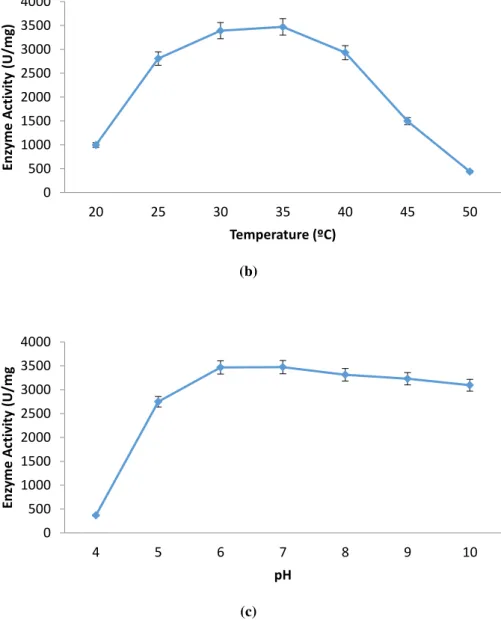
production of enzyme in fermentation industry. The production of α-amylase is demonstrated in Fig. 1. The production of the enzyme increased when the incubation
Braz. Arch. Biol. Technol. v.61: e18160399 2018
(Fig. 1a) and the enzyme production decreased after 36th. After this incubation period,
there was a decrease in the production of α-amylase. This is because the cells have
reached the decline phase and displayed low α-amylase synthesis. The decrease in the enzyme production may be due to consumption of the nutrients in the fermentation culture or due to accumulation of toxic by-products. The fermentation temperature and pH were also significant parameters, which clearly affect enzyme production. The fermentation temperature and pH were tested between 20 to 55 °C and 4.0 to 10.0
respectively in an incubator shaker to define the temperature and pH influences on α
-amylase production. The highest α-amylase production was determined at 35 °C.
When the fermentation temperature went up higher than 35 °C, α-amylase production diminished (Fig. 1b). The enzyme yield reduced 87.3%, while the fermentation
temperature increased from 35 to 50 °C. The α-amylase activity found to be increasing
as the fermentation pH rose from 4.0 to 7.0 (Fig. 1c). This was followed by a slight
reduction in α-amylase activity above the 7.0. The highest enzyme activity was
recorded at pH ranges of 6.0-7.0. The optimum fermentation conditions for α-amylase
production were recorded at 36th hour, 35ºC and pH 6.0-7.0 by B. mojavensis SO-B11.
(a) 0
500 1000 1500 2000 2500 3000 3500 4000
12 24 36 48 72 96
En
zy
m
e
Ac
tiv
ity
(U/m
g)
(b)
(c)
Figure 1 Impact of time cources (a), temperature (b), and pH (c) on α-amylase production.
Purification of α-amylase
The enzyme purification steps were (NH4)2SO4 precipitation (80%), dialyzed and
DEAE-cellulose ion-exchange chromatography, respectively. The purification fold and yield were determined as 34% and 18 % respectively completion of purification
steps. The purification results are represented in Table 1. The α-amylase secreted by
Geobacillus stearothermophilus was purified to homogeneity (65-fold and 46% yield)
through a series of steps 20. Recently, Xie et al. 15 have indicated 13.1 purification fold
and 7.0% yield, Abdel-Fattah et al. 21 have pointed out 59.3 purification fold and 12.6
% yield, and Shukla and Singh 22 have reported 37 purification fold and 16.8% yield
using chromatography methods.
0 500 1000 1500 2000 2500 3000 3500 4000
20 25 30 35 40 45 50
En
zy
m
e
Ac
tiv
ity
(U/m
g)
Temperature (ºC)
0 500 1000 1500 2000 2500 3000 3500 4000
4 5 6 7 8 9 10
En
zy
m
e
Ac
tiv
ity
(U/m
g
Braz. Arch. Biol. Technol. v.61: e18160399 2018
Table 1 Purification of amylase from B. mojavensis.
Step Total
activity (U)
Total protein (mg)
Specific activity (U/mg)
Yield (%)
Fold
Crude extract 283.374 188.444 1.504 100 1
NH4)2SO4
precipitation/Dialysis
106.705 8.746 12.201 38 8
DEAE-Cellulose 50.929 0.982 51.870 18 34
Molecular mass determination on SDS–PAGE
The molecular mass of the purified enzyme which appeared as a single band on
SDS-PAGE was found to be 73 kDa (Fig. 2). Murakami et al. 23 reported α-amylases
having molecular masses of 105 and 75 kDa, respectively. Asoodeh et al. 24
determined the molecular weight of α-amylase as 68.9 kDa. Michelin et al. 25
demonstrated amylase as a single band of about 75 kDa by SDS-PAGE. Another α
-amylase with molecular weight of 70 kDa was indicated by Zafar et al. 26. Different
molecular masses of the α-amylases from various Bacillus sp. ranging from 42 to
150 kDa have been reported 27.
Figure 2 Molecular mass determination on SDS–PAGE. Lane a: standard proteins; Lane b: after dialyze c: purified
enzyme from DEAE cellulose; Native-PAGE (using iodine stain) Lane d: standard a-amylase; Lane e: purified enzyme from DEAE cellulose.
Determination of kinetic parameters
Kinetic studies of α-amylase were determined using soluble starch as substrate. The
Km and Vmax values were estimated from a Lineweaver–Burk plot (Fig. 3). Values of
V max and Km for the purified enzyme were 0,007964 mM and 2, 77 µmol min−1
respectively. Aguilar et al. 28 declared the K
m value of α-amylase as 3.44 mg/mL.
Aguloglu Fincan et al. 29 determined K
m and Vmax as 0.005 mM and 3.5 µmol min−1,
Figure 3 Lineweaver–Burk plot of purified α-amylase from B. mojavensis.
Impact of temperature on purified amylolytic activity and stability
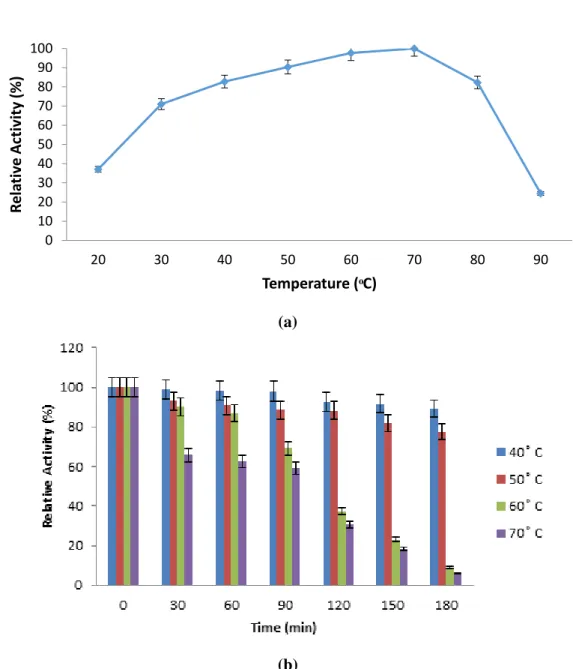
The impact temperature on amylolytic activity is shown on Fig. 4a, and the residual activities of purified enzyme were found as 37.1%, 70.9%, 82.7%, 90.3% and 97.6%
at 20, 30, 40, 50, and 60 °C, respectively. The purified amylase produced from B.
mojavensis SO-B11 exhibited optimal activity at 70 °C. The results revealed that the relative amylolytic activity sharply declined from 82.3% to 24.4% with increasing
temperature from 80 °C to 90 °C, respectively. The optimum temperature for α
-amylase from Bacillus sp. ferdowsicou 24, Bacillus subtilis 8 and Anoxybacillus
flavithermus 14 were found as 70, 60, and 70 °C, respectively. This reveals that the
optimum temperature of purified amylase obtained from B. mojavensis SO-B11
showed well parallelism with these studies. Thermal stability of the purified enzyme
produced by B. mojavensis was examined by incubating the enzyme at different
temperatures (30-180 min). The results of thermal stability are represented in Fig. 4b. The purified enzyme was steady at temperature of 40 °C and 50 °C up to 180 min. The 87.1% and 85.7% of residual enzyme activity was retained after 30 min of incubation at the temperature of 60 °C and 70 °C, respectively. According to the
results obtained from thermal stability of purified α-amylase, the enzyme can be
applied in brewing and food processing.
-0,5 0,0 0,5 1,0 1,5 2,0 2,5
Braz. Arch. Biol. Technol. v.61: e18160399 2018
(a)
(b)
Figure 4 Impact of temperature on purified amylolytic activity (a) and stability (b).
Effect of pH on purified α-amylase activity and stability
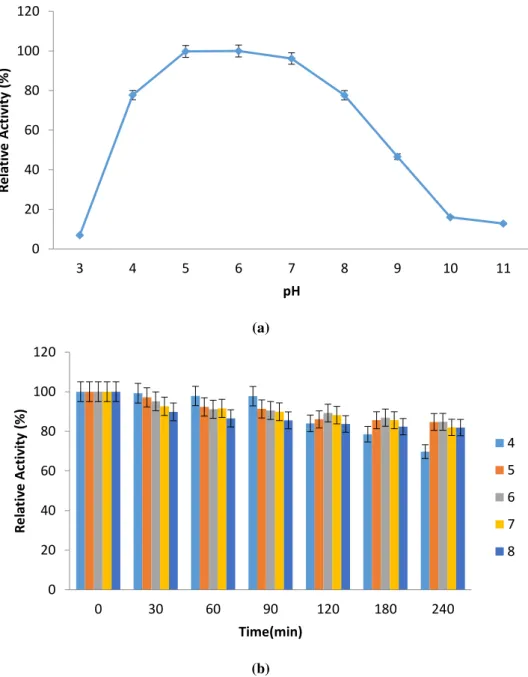
The pH profile of the purified enzyme activity is depicted in Fig. 5a. As shown in Fig. 5a, the amylolytic activity is nearly the same at pH 5.0-7.0. The amylolytic activity sharply decreased from pH 4.0 to 3.0 and from pH 8.0 to 9.0. The purified
α-amylase showed optimum activity at pH 5.0-6.0. Parallel results were found by
some researchers such as Hamilton et al. 30, Sarikaya and Gürgün 31 and Kikani and
Singh 32. The retained enzyme activity was about 96.2% at pH 7.0. The purified
enzyme pH stability experimental results are depicted in Fig. 5b. The amylolytic activities did not significantly change between pH ranges of 4.0-8.0 for 120 min. The
retained α-amylase activities obtained from B. mojavensis SO-B11 were defined as 84.1%, 86.1%, 89.2%, 88.2% and 83.8% at pH 4.0, 5.0, 6.0, 7.0, and 8.0 respectively
0 10 20 30 40 50 60 70 80 90 100
20 30 40 50 60 70 80 90
Re
la
tiv
e
Ac
tiv
ity
(%)
for 120 min. These results indicated that purified novel enzyme can be utilized in starch saccharification and detergent industries.
(a)
(b)
Figure 5 Effect of pH on purified amylolytic activity (a) and stability (b).
Effect of Different Cations and Inhibitors on Purified α-Amylase Activity
The influences of Zn2+, Mg2+, Hg2+, Mn2+, Ca2+, Cu2+ and Fe2+ and different inhibitors
on purified α-amylase activity are depicted in Table 2. When compared with the
control group, the enzyme activities in presence of Zn2+, Mg2+, Hg2+, Mn2+, Ca2+,
Cu2+, and Fe2+ were determined as 82%, 86%, 38%, 119%, 121%, 79%, and 94%
respectively. The purified enzyme was activated by Ca2+ and Mn2+, but slightly
inhibited by Fe2+, Zn2+, Mg2+, and Cu2+. Lin et al. 33 suggested that enzyme was
activated with Ca2+, while it was inhibited in the presence of Hg2+. The effect of
various metal ions on purified α-amylase activity was reported by Mamo and
Gessesse 34, Aguloglu Fincan and Enez 20, and Liu et al. 35. Our results are very close
0 20 40 60 80 100 120
3 4 5 6 7 8 9 10 11
Re
la
tiv
e
Ac
tiv
ity
(%
)
pH
0 20 40 60 80 100 120
0 30 60 90 120 180 240
Re
la
tiv
e
Ac
tiv
ity
(%
)
Time(min)
4
5
6
7
Braz. Arch. Biol. Technol. v.61: e18160399 2018
to their studies. The highest inhibitory effect was obtained with EDTA. This
inhibition can reveal that the purified α-amylase produced by B. mojavensis SO-B11
is a metalloenzyme. Our results completely match with the results obtained by other
investigations on the α-amylase 15, 36, 37. PMSF and β-mercaptoethanol did not show
important influence on the purified α-amylase activity. This can make it obvious that
serine residues and disulfide bonds are not essential for the amylolytic activity 38.
Table 2 Effects of inhibitors and some metal ions on amylase activity
Agent Concentration (mM) Relative activity of purified α-amylase (%)*
PMSF 1 77
5 74
10 65
DTT 1 97
5 93
10 92
β-mercaptoethanol 1 96
5 95
10 92
EDTA 1 78
5 78
10 64
Mn+2 1.5 119
Fe+2 1.5 94
Zn+2 1.5 82
Mg+2 1.5 86
Hg+2 1.5 38
Cu+2 1.5 79
Ca+2 1.5 121
Control 0 100
*Activity remaining after incubation for 30 min at 37 ◦C.
Determination of the end products of soluble starch by TLC
The purified α-amylase was incubated with soluble starch for 15, 30 and 240 min. It
is seen from the Fig. 6 that the purified α-amylase produced by Bacillus mojavensis
SO-10 hydrolyzed the soluble starch. There were various end products after hydrolysis of soluble starch by amylase. Maltose (G2), maltotriose (G3), maltotetraose (G4), and maltooligosaccharides occurred after 15 min and glucose (G1), maltose (G2), maltotriose (G3), maltotetraose (G4), and maltooligosaccharides after 30 min. After 240 min, whole soluble starch hydrolyzed into (G1). Parallel finding was described by
Takasaki 39. These results described that purified α-amylase can be used in starch
Figure 6 End products of soluble starch by Thin-layer Chromatography TLC. Lane A, glucose (G1), maltose (G2), maltotriose (G3) and maltotetraose (G4); Lane B-D, reaction time for 15 min, 30 min and 240 min, respectively
.
Industrial applications of purified α-amylase
The capable of raw starch hydrolyzing of corn and wheat by purified α-amylase
Purified α-amylase capable of hydrolyzing raw starch was examined by defining the
percentages of hydrolyzing of corn and wheat starch grains. After 4 h of incubation,
the purified α-amylase hydrolyzed the raw wheat and corn grains in the ratio of 36.7%
and 39.2% respectively. Parallel results were reported by Božić et al. 40 and Hayashida
et al. 41. Considering the literature, this is the first study to hydrolyze the raw starch by
α-amylase obtained from B. mojavensis SO-B11. It is too important to degrade the raw
starch grains under the gelatinization temperature of starch due to the economic
approach. α-Amylase produced by B. mojavensis SO-B11 can be utilized for
Braz. Arch. Biol. Technol. v.61: e18160399 2018
Figure 7 Raw starch hydrolyzing. (A) Corn starch before hydrolyzing; (B) Corn starch after hydrolyzing; (C) Wheat starch before hydrolyzing; (D) Wheat starch after hydrolyzing.
.
Influence of some commercial detergents and surfactants on purified enzyme activity
The influence of some surfactants and trading domestic washing detergents on the
purified B. mojavensisα-amylase was experimented. As demonstrated in Fig. 8, the
purified B. mojavensisα-amylase exhibited significant stability with surfactants and
domestic washing detergents such as Omo (44.7%), Tursil (51.9%), Alo (63.1%), SDS (60.9%), Tween-10 (97.2%), Tween-40 (99.5) and Triton X-100 (98.2%) for 60 min and Omo (41.3%), Tursil (53.2%), Alo (73.8%), SDS (69.7%), Tween-10 (102.9%), Tween-40 (99.5%) and Triton X-100 (101.3%) for 120 min. Parallel findings were
indicated by Goyal et al. 42 and Pathak and Rekadwad 43.
The starch amounts of immature apple juices (green and red) and theirs clarification by purified enzyme
Immature starch amounts of red and green apple were tested by using process of Carrín
et al. 19. The starch amounts of immature red apple were determined as 0.59 g/L for
soluble starch and 3.87 g/L for insoluble starch and the starch amounts of immature green apple were determined as 0.52 g/L for soluble starch and 3.68 g/L for insoluble starch. Digesting of soluble starch of immature red and green apple was experimented for 30, 45, and, 60 min. The degrading percentages of soluble starch contents of red apple and green apple were found as 61% and 58%, 74% and 71%, 85%, and 80% for
30, 45, and 60 min, respectively. The finding results demonstrated that purified α
-amylase should be applied in apple juice industry.
CONCLUSIONS
A thermo and pH stable α-amylase were produced, purified, characterized and utilized for various starch industries. The amylolytic activity did not meaningfully change between pH ranges of 4.0-8.0 and temperature degrees of 40, 50, and 60 °C for 120 min. The purified enzyme exhibited stability in the presence of surfactants and metal
ions. The purified enzyme obtained from B. mojavensis SO-B11 was capable of
hydrolyzing wheat and corn raw starch granules. G1, G2, G3, G4, and maltooligosaccharides were obtained after TLC analysis. In addition, the newly purified alpha amylase should be used in domestic washing detergents and apple juice clarification industries.
ACKNOWLEDGEMENTS
This study was supported by Scientific Research Projects Unit of Siirt University (Project code: BAP-2011-SIUFED-F3), Turkey.
REFERENCES
1. GuptaR, Gigras P, Mohapatra H, Goswami VK, Chauhan B, Microbial α-amylases: A biotechnological perspective. Process Biochem. 2003; 38: 1599–1616.
2. Roy I, Gupta MN, Hydrolysis of starch by a mixture of glucoamylse and pullulanase entrapped individually in calcium alginate beads. Enzyme Microb. Technol, 2004; 34: 26-32.
3. Balkan B, Ertan F. Production of α-Amylase from Penicillium chrysogenum Under Solid State Fermentation by Using Some Agricultural By-Product. Food Technol. Biotechnol. 2007; 45: 439-442.
4. Kumagai Y, Satoh T, Inoue A, Ojima T. Enzymatic properties and primary structures of two α-amylase isozymes from the Pacific abalone Haliotis discus hannai. Comp Biochem Physiol B: Biochem Mol Biol. 2013; 164: 80–88.
5. Wiseman A. The application of enzyme in ındustry. Handbook Enzyme Biotechnol. 1987; 3: 275–373.
6. Lama L, Nicolaus B, Di Donato P, Poli A, Oner ET, Finore I. A raw starch digesting
α-amylase from the thermophilic Anoxybacillus amylolyticus. Purification and characterization. New Biotechnol. 2009; 25: 91–92.
7. Ozdemir S, Güven K, Baysal Z, Uyar F. Screening of various organic substrates and the development of a suitable low-cost fermentation medium for the production of α -amylase by Bacillus subtilis. Food Technol Biotechnol. 2009; 47: 364–369.
8. Ozdemir, S., Matpan, F., Guven, K., Baysal, Z., Production and characterisation of
partially purified extracellular thermostable α-amylase by Bacillus subtilis in Submerged fermentation (SmF). Prep. Biochem. Biotechnol. 2011, 41, 365–381. 9. Kelly CT, Tigue MM, Doyle EM, Fogarty WM. The raw starch degrading alkaline
Braz. Arch. Biol. Technol. v.61: e18160399 2018
10. Itkor P, Tsukagoshi N, Udaka S. Purification and properties of divalent cation-dependent raw starch digesting α-amylase from Bacillus sp. B. 1018. J Ferment Bioeng 1989; 68:247–251.
11. Singh H, Soni SK. Production of starch gel digesting amyloglucosidase by Aspergillus
oryzae HS-3 in solid state fermentation. Process Biochem. 2001; 37:453–459.
12. Shiau JR, Hung HC, Jeang CL. Improving the thermostability of raw starch digesting amylase from a Cytophaga sp. by site directed mutagenesis. Appl Environ Microbiol 2003; 69:2383–2385.
13. Sun HY, Zhao PJ, Ge XY, Xia YJ, Hao ZK, Liu JW, PengM. Recent advances in microbial raw starch degrading enzymes. Appl. Biochem. Biotechnol. 2010: 160; 988-1003.
14. Ozdemir S, Matpan F, Okumus V, Dündar A, Ulutas MS, Kumru M. Isolation of a thermophilic Anoxybacillus flavithermus sp nov. and production of thermostable α -amylase under solid-state fermentation (SSF). Annals Microbiol. 2012; 62: 1367– 1375.
15. Xie F, Quan S, Liu D, Ma H, Li F, Zhou F, Chen G. Purification and characterization of a novel α-amylase from a newly isolated Bacillus methylotrophicus strain P11-2. Process Biochem. 2014; 49: 47–53.
16. Bernfeld P. Enzymes carbohydrate metabolism. In Methods In Enzymol Academic Pres. 1955; 17: 149–158.
17. Laemmli UK. Cleavage of structural proteins during the assembly of the head of bacteriphage T4. Nature. 1970; 277: 680–685.
18. Mitsuiki S, Mukae K, Sakai M, Goto M, Hayashida S, Furukawa K. Comparative characterization of raw starch hydrolyzing α-amylases from various Bacillus strains. Enzyme Microb Technol. 2005; 37: 410–416.
19. Carrín ME, Ceci LN, Lozana JE. Characterization of starch in apple juice and its degradation by amylases. Food Chem. 2004; 87: 173–178.
20. Aguloglu Fincan S, Enez B. Production, purification, and characterization of thermostable α-amylase from thermophilic Geobacillus stearothermophilus. Starch/Stärke. 2014; 66: 182–189.
21. Abdel-FattahYR, Soliman NA, El-Toukhy NM, El-Gendi H, Ahmed RS, Production, Purification and Characterization of Termostable α-amilase Produced by Bacillus
licheniformis Isolate AI20. Journal Chemistry. 2012; 2013: 1–11.
22. Shukla RJ, Singh SP. Production optimization, purification and characterization of α -amylase from thermophilic Bacillus licheniformis TSI-14. Starch/Stärke. 2015; 67: 629-639.
23. Murakami S, Nishimoto H, Toyama Y, Shimamoto E, Takenaka S, Kaulpıboon J, Prousoontorn M, Limpaseni T, Pongsawasdi P, Aoki K. Purification and characterization of two alkaline, thermotolerant α-amylases from Bacillus halodurans 38C-2-1 and expression of the cloned gene in Escherichia coli. Biosci Biotechnol Biochem. 2007; 71: 2393–2401.
24. Asoodeh A, Chamani JK, Lazgian M. A novel thermostable, acidophilic α-amylase
from a new thermophilic “Bacillus sp. Ferdowsicous” isolated from Ferdows hot mineral spring in Iran: Purification and biochemical characterization. Int J Biol Macromol. 2010; 46: 289–297.
25. Michele Michelin TM, Silva VM, Benassi SC, Peixoto-Nogueira LAB, Moraes JM, Leão JA, Terenzi HF, Polizeli Mde L. Purification and characterization of a thermostable α-amylase produced by the fungus Paecilomyces variotii. Carbohyd Res. 2010; 345: 2348–2353.
26. Zafar A, Aftab MN, Ud Din Z, Aftab S, Iqbal I, Ul Haq I. Cloning, Purification and Characterization of a Highly Thermostable Amylase Gene of Thermotoga petrophila into Escherichia coli.Appl Environ Microbiol. 2015; 2: 1–18.
27. Pandey A. Nigam P., Soccol C.R. Soccol V.T. Singh D. & Mohan R. Advances in microbial amylases. Biotechnol Appl Biochem. 2000;31: 135–152.
manihotivorans LMG 18010T, an amylolytic lactic acid bacterium. Enzyme Microb Technol. 2000; 27: 406–413.
29. Aguloglu Fincan S, Enez B, Ozdemir S, Matpan Bekler F. Purification and characterization of thermostable α-amylase from thermophilic Anoxybacillus
flavithermus. Carbohydr Polym. 2014; 102: 144–150.
30. Hamilton LM, Kelly CT, Fogarty WM. Production and properties of the starch-digesting α-amylase of Bacillus sp. IMD 435. Process Biochem. 1999; 35: 27–31. 31. Sarıkaya E, Gürgün S. Increase of the α-Amylase Yield by Some Bacillus Strains.
Turkish J Biol.2000; 24: 299–308.
32. Kikani BA., Singh SP. The stability and thermodynamic parameters of a very thermostable and calcium-independent α-amylase from a newly isolated bacterium,
anoxybacillus beppuensis TSSC-1. Process Biochem. 2012; 47: 1791–1798.
33. Lin LL, Chyau CC, Hsu WH. Production and properties of a raw-strach degrading amylase from thermophilic and alkaliphilic Bacillus sp. TS-23. Biotechnol Appl Biochem. 1998; 28: 61–68.
34. Mamo G, Gessesse A. Purification and characterization of two rawstarch-digesting thermostable α-amylases from a thermophilic Bacillus. Enzyme Microb Technol. 1999; 25: 433–438.
35. Liu J., Weiguang X, Abdullahi A, Fan WQA, Dingyuan F, Jianjun Z. Purification and Partial Characterization of an Acidic α-Amylase from a Newly Isolated Bacillus
subtilis ZJ-1 that may be Applied to Feed Enzyme. Prep Biochem Biotechnol. 2015;
45: 259–267.
36. Chakraborty S, Khopade A, Kokare C, Mahadik K, Chopade B. Isolation and characterization of novel α-amylase from marine Streptomyces sp. D1. J Mol Catal B: Enzym. 2009; 58: 17–23.
37. Hmidet N, Bayoudh A, Berrin JG, Kanoun S, Juge N, Nasri M. Purification and biochemical characterization of a novel α-amylase from Bacillus licheniformis NH1 Cloning, nucleotide sequence and expression of amyN gene in Escherichia coli. Process Biochem. 2008; 43: 499–510.
38. Shafiei M., Ziaee AA, Amoozegar MA. Purification and biochemical characterization of a novel SDS and surfactant stable, raw starch digesting, and halophilic α-amylase from a moderately halophilic bacterium, Nesterenkonia sp. strain. Process Biochem. 2010; 45: 694–699.
39. Takasaki Y. An amylase producing maltotriose from B. subtilis. Agric Biol Chem. 1985; 49: 1091–1097.
40. Božić N, Ruiz J, Santίn JL, Vujćić Z. Production and properties of the highly efficient raw starch digesting α-amylase from a Bacillus licheniformis ATCC 9945. Biochem Eng J. 2011; 53: 203–209.
41. Hayashida S, Teramoto Y, Inoue T. Production and characteristics of raw potato-starch-digesting α-amylase from Bacillus subtilis 65. Appl Environ Microbiol. 1988; 54: 1516–1522.
42. Goyal N, Gupta JK, Soni SK. A novel raw starch digesting thermostable α-amylase from Bacillus sp. I-3 and its use in the direct hydrolysis of raw potato starch. Enzyme Microb Technol. 2005; 37: 723–734.
43. Pathak AP, Rekadwad BN. Isolation of thermophilic Bacillus sp. strain EF_TYK1-5 and production of industrially important thermostable α-amylase using suspended solids for fermentation. J Sci Ind Res. 2013; 72: 685–689.