Application of decolourized and partially purified polygalacturonase and
a
-amylase
in apple juice clarification
Tapati Bhanja Dey
1,2, Rintu Banerjee
11
Microbial Biotechnology and Downstream Processing Lab,
Agricultural and Food Engineering Department, Indian Institute of Technology, Kharagpur, India. 2
Lignocellulose Biotechnology Laboratory, Department of Microbiology, University of Delhi South Campus, Benito Juarez Road, New Delhi, India.
Submitted: October 12, 2012; Approved: April 4, 2013.
Abstract
Polygalacturonase and a-amylase play vital role in fruit juice industry. In the present study, polygalacturonase was produced by Aspergillus awamoriNakazawa MTCC 6652 utilizing apple pomace and mosambi orange (Citrus sinensisvar mosambi) peels as solid substrate whereas,a -amy-lase was produced fromA. oryzae(IFO-30103) using wheat bran by solid state fermentation (SSF) process. These carbohydrases were decolourized and purified 8.6-fold, 34.8-fold and 3.5-fold, spectively by activated charcoal powder in a single step with 65.1%, 69.8% and 60% recoveries, re-spectively. Apple juice was clarified by these decolourized and partially purified enzymes. In presence of 1% polygalacturonase from mosambi peels (9.87 U/mL) and 0.4% a-amylase (899 U/mL), maximum clarity (%T660nm= 97.0%) of juice was attained after 2 h of incubation at 50 °C in presence of 10 mM CaCl2. Total phenolic content of juice was reduced by 19.8% after clari-fication, yet with slightly higher %DPPH radical scavenging property.
Key words:polygalacturonase,a-amylase, activated charcoal, decolourization, apple juice clarifi-cation.
Introduction
Clarified apple juice is one of the most consumed fruit juices in the world next only to orange juice (Ceci and Lozano, 1998; Kahleet al., 2005). Raw apple juice ob-tained after pressing apples is turbid, brown in colour, very viscous and tends to settle during storage, so it must be clar-ified prior to its commercialization. Polysaccharides (pec-tin, cellulose, hemicellulose and starch), proteins, tannins, metals and microorganisms are mainly responsible for the apple juice turbidity. Conventional clarification processes aim to eliminate the insoluble solids and destroy pectic sub-stances by degrading pectin and starch with specific en-zymes, flocculating cloudiness with clarifying agents (ben-tonite, gelatine and/or silicasol) (Grampp, 1977) and filtering through plate and frame or vacuum Oliver-type fil-ters. Pectin is the main substance responsible for cloudiness of apple juice. The process of depectinisation involves the
use of commercial enzymes, generally a blend of pectinases (e.g., pectinase, polygalacturonase, pectinlyase) to degrade pectic substances. Another potential contributor to the hazi-ness of juice is starch. In presence of starch, the following problems may occur: (i) slow filtration, (ii) membrane foul-ing, (iii) gelling after concentration and (iv) post concentra-tion haze (Carrinet al., 2004). Both depectinisation and destarching are essential for most of the juice clarification process. Starch can be degraded by amylase together with the pectinases during depectinization of the juice. Amylase eliminates the possible action of starch molecules agglom-erating with proteins, pectins and thus eliminates haze for-mation.
A common substrate for a-amylase production by solid state fermentation (SSF) is wheat bran, whereas for pectinases (polygalacturonase, pectin methylesterase and pectinlyase) the substrate is pectin containing fruit peel. Enzyme extracted from these substrates contains various
Send correspondence to T.B. Dey. Lignocellulose Biotechnology Laboratory, Department of Microbiology, University of Delhi South Campus, Benito Juarez Road, 110021 New Delhi, India. E-mail: [email protected], [email protected].
impurities including a significant amount of melanine-like colouring matter, which can interfere in the juice clarifica-tion process if the enzymes are used in crude form. Gen-erally enzymes are purified from this colour extract by various purification steps. The purification of the targeted biomolecules should be such that the selection of number of steps should be minimum and cost-effective, as the yield and the steps of operation are inversely proportional to each other. In the present study, for the commercial application of thea-amylase and polygalacturonase in apple juice clar-ification, those enzymes were purified partially by acti-vated charcoal in a single step.
a-Amylases are calcium containing enzymes, bind-ing at least one calcium ion per monomeric unit. The cal-cium ions impart resistance to pH, temperature, proteolysis and denaturation by urea and heat. Thermostability of a-amylase is increased by the calcium ion. Recently, many food industries have proposed the use of apple juices forti-fied with calcium as healthy and non-fat alternative, espe-cially for children (Ceci and Lozano, 2002). Therefore, apple juice has been clarified in presence of calcium chlo-ride.
Materials and Methods
Organism, inoculum and chemicals
Fungal strain A. oryzae (IFO-30103) donated by NIIST-Trivandrum, India and locally isolatedA. awamori
nakazawa were used for the present study. They were culti-vated and maintained in potato dextrose agar (PDA). Spore suspension was prepared having a spore count of 1 x 10⁶ spores/mL. For the production ofa-amylase, locally avail-able wheat bran was used as a substrate which was screened to particle size 2-3 mm. Apple pomace and mosambi ( Cit-rus sinensisvar mosambi) peel procured from local market were used for the polygalacturonase production. All chemi-cals and solvents used were of analytical grade.
Fermentation conditions
Polygalacturonase production
Apple pomace and mosambi peels were dried in a hot air oven at 80 °C for 24 h and ground in mixer grinder. SSF was carried out in 250 mL Erlenmeyer flask taking 5 g of ground substrate. Czapek-dox medium [NaNO3(2.5 g/L), KH2PO4(1 g/L), KCl (0.5 g/L) and MgSO4.2H2O (0.5 g/L)] with pH 4.0 was mixed with substrate in 1:2 ratio (w/v) and autoclaved at 15 lb/ inch2pressure and 121 °C temperature for 20 min. Then it was cooled and inoculated with 10% (w/v) spore suspension ofA. awamori Nakazawa. Poly-galacturonase production was carried out at 30 °C for 72 h.
a-Amylase production
Production ofa-amylase was carried out in a newly configured bioreactor (NB) according to the process
de-scribed by Dey Banerjee (2012). Fermentation was carried out at 32 °C and pH 6.0 for 48 h.
Extraction of enzyme from fermented mass
In case ofa-amylase, enzyme was extracted accord-ing to the method described by Dey Banerjee (2012). In case of polygalacturonase, after fermentation, 20 mL water was mixed with the fermented biomass obtained after the fermentation of 5 g of ground apple pomace or mosambi peels and then it was soaked for 1 h in agitation mode. The mixture was centrifuged at 10, 000 rpm and the supernatant was assayed for polygalacturonase activity.
Decolourization and purification of crude enzyme with activated charcoal
Decolourization and purification of enzymes were done according to the method of Aikatet al.(2001). Experi-ments were conducted in 1.5 mL micro-centrifuge tubes. Samples (1 mL) of crude enzyme from apple pomace (C0= 1.984) and mosambi peel (C0= 2.767) were treated with 20-120 mg of activated charcoal powder (purchased from Hi Media, India) and kept at room temperature (30 °C) for 15 min. Crudea-amylase (1 mL) fromA. oryzae
fermented wheat bran (C0 = 2.799) was treated with 20-320 mg of activated charcoal for 30 min. The sample was centrifuged at 10,000 rpm for 10 min and micro-filtered. The filtrate was analyzed for colour intensity, en-zyme activity and total protein content.
Apple juice clarification
Raw apple juice preparation
Unripe apples (Golden delicious) were picked two weeks before usual harvest date. Some of these apples were stored at room temperature for one week. Apples were cut to cubes and mashed in a mixer grinder and manually pressed using double layer cheesecloth to obtain raw or unclarified apple juice. In the extracted juice calcium chlo-ride was added and the final concentration of this salt was 10 mM. Aliquots of this juice were pasteurized (5 min at 90±1 °C) and immediately cooled to 50 °C.
Polygalacturonase concentration optimization
a-Amylase concentration optimization
CaCl2 treated and untreated unclarified apple juice was mixed with decolourized polygalacturonase from mosambi peels (9.87 U/mL) at 1% (v/v) concentration. Then decolourizeda-amylase (899 U/mL) was added at various concentrations (0.1-1.25%; v/v). The mixture was incubated at 50 °C for 2 h.
Evaluation of different properties of clarified juice
Decolourized polygalacturonase from mosambi peel (1%) (v/v) anda-amylase (0.4%) (v/v) were added in the unclarified juice and incubated at 50 °C for 2 h. The reac-tion was stopped by increasing the temperature of the mix-ture to 90 °C for 1 min. Then it was centrifuged at 10,000 rpm for 10 min. The supernatant was analyzed for clarity (%T660 nm), colour (absorbance at 440 nm) and vis-cosity reduction (%) etc. Turbidity was determined using a portable turbidity meter and results were reported as Nephelometric Turbidity Units (NTU). Viscosity was mea-sured using Oswald viscometer.
Analytical methods
Polygalacturonase assay
The reaction mixture (1 mL) containing equal amounts of polygalactouronic acid as substrate (1%) pre-pared in acetate buffer (pH 4.5) and suitably diluted en-zyme was incubated in water bath at 50 °C for 10 min. After incubation, 3 mL DNS solution was added to stop the reac-tion and tubes were kept in boiling water for 15 min. After that 1 mL of 40% Rochelle’s salt solution was added and cooled. After cooling, absorbance was read spectrophoto-metrically at 575 nm according to Miller method (Miller, 1959). One unit (U) of Polygalacturonase activity was cal-culated as the amount of enzyme required to release one mmol equivalent of galacturonic acid per min under assay condition and it was expressed in U/mL.
a-Amylase assay
a-Amylase activity was estimated according to the method described by Bhanjaet al.(2007). One unit (U) of a-amylase activity is defined as the amount of enzyme that liberates onemmol of reducing sugar (glucose) per min un-der the assay conditions. Results were expressed in U/mL.
Starch detection and quantification
Starch content was analyzed using iodine-starch reac-tion following the method of Carrinet al.(2004). Iodine so-lution (126.9 mg/L) was prepared by mixing same volume of 0.1 M iodine and 5% potassium iodide. An aliquot of 5 mL appropriately diluted sample was mixed with 2.5 mL of cold iodine solution and after 10 min at 25 °C the absor-bance was read at 615 nm with the Spectrophotometer. Re-sults were compared with a calibration curve made with corn starch solutions of different concentrations.
Determination of Total Phenolic Content (TPC)
Total phenolic content was estimated according to Emmons and Peterson (2001). The amount of total phenolic content was calculated as gallic acid equivalent from the standard calibration curve of gallic acid and expressed as mg gallic acid equivalent.
DPPH (2, 2-diphenyl-1-picrylhydrazyl) Radical Scavenging Assay
The free radical scavenging activity of apple juice was measured by the DPPH•scavenging method according to Brand-Williams et al. (1995). DPPH (Sigma-Aldrich Chemie, Steinheim, Germany) solution of 0.1 mM concen-tration in methanol was added to 0.1 mL of phenolic ex-tracts and 0.4 mL methanol. The change in absorbance at 515 nm was measured after 30 min of incubation. The DPPH radical-scavenging activity of phenolic extract from apple juice was calculated according to the following equa-tion.
%of PDDHscavenging activity 1 Abs Abc = -æ
è
ç ö
ø ÷ é
ë
ê ùûú ´100
where, AbC was the absorbance of the control and AbS was the absorbance in the presence of the test compound.
Results and Discussion
Decolourization of crude enzyme with activated charcoal
During the decolourization process of polygalacturo-nase, 100 mg charcoal was required per mL enzyme extract of both apple pomace (Figure 1A) and mosambi peel (Fig-ure 1B) for the literat(Fig-ure value of 10% remaining colour in-tensity (Gutcho, 1974). The corresponding polygalacturo-nase recoveries were nearly 65.1% and 69.8%, respectively and fold purification were 8.6 and 34.8, respectively.
on a-amylase and polygalacturonase purification by ex-ploiting activated charcoal. In the present study, purifica-tion fold and enzyme recovery were significantly high in this single step purification process.
Apple juice clarification by charcoal purified enzymes
Polygalacturonase treatment
It was observed that in presence of 1% (v/v) poly-galacturonase from mosambi peel (9.87 U/mL), maximum clarity (%T660 nm= 96.4) of juice was attained after 2 h of in-cubation at 50 °C. After 3 h of inin-cubation, %T660 nm re-mained constant. Although the polygalacturonase activity was lower in case of mosambi peel fermented product, it was most effective compared to polygalacturonase from apple pomace. Similarly, Nakkeeran et al. (2011) found that high activity polygalacturonase did not result in good juice clarity. Hence, 1% polygalacturonase from mosambi peel (9.87 U/mL) was taken as optimum concentration for apple juice clarification. Results are presented in Table 1. Upon enzymatic treatment, polygalacturonase broke down the pectin molecules of apple juice, which facilitated the formation of pectin-protein flocs leaving a clear super-natant and significantly removing the colloidal part of the juice (Yusof and Nurzarina, 1994; Alvarezet al., 1998). In general, enzyme concentration is the most important factor influencing the enzyme clarification. Increase in polygalac-turonase concentration increased the %T660 nm or rate of clarification (Table 1) by exposing part of the positively charged protein beneath, thus reducing electrostatic repul-sion between cloud particles which cause these particles to aggregate to larger particles and eventually settle out. Ishii and Yokotsuka (1972) found a slight stimulation by 0.7% CaCl2in experiments on the clarification of Golden deli-cious apple juice by pectinlyase. Szajer and Szajer (1982) observed that enzymatic clarification of apple juice was stimulated by Ca2+ ions in a concentration of 10-2 M by pectinlyase fromPenicillium paxilii. Pectinlyase needs this ion as a cofactor. In the present study, there was no signifi-cant effect of 10 mM CaCl2 on polygalacturonase treat-ment.
a-Amylase treatment
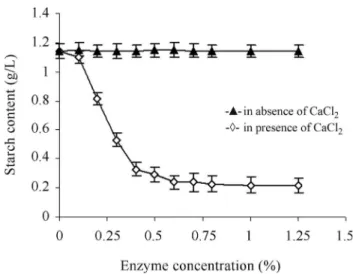
a-Amylase, decolourized by 12.5% activated char-coal was utilized for apple juice clarification. Unclarified juice contained 1.143 g/L starch. Figure 2 shows that in presence of CaCl2, with 40mLa-amylasei.e.0.4%a -amy-lase concentration, starch content reduced to 0.33 g/L then it remained constant. Therefore, 0.4%a-amylase was taken as optimum concentration for starch degradation. On the other hand, starch was not degraded in absence of CaCl2 as pH of the apple juice was 3.4 and incubated at 50 °C for 2 h. In such a condition a-amylase activity ofA. oryzae
should be very less (Sahnounet al., 2012). Some amount of
Ca2+might be present in the juice, yet that amount might not have been sufficient. Therefore, CaCl2in 10 mM con-centration was used in the present investigation.
Different properties of clarified apple juice
The juice yield in percent (mL/100 g of fresh apple slice) was calculated taking 142 g of apple slice. From 142 g of apple slice, the volume of extracted raw juice (Fig-ure 3U) was 110 mL and after clarification (Fig(Fig-ure 3C) extracted volume increased to 112 mL. The yield of uncla-rified juice was 77%, but increased to 79% after clarifica-tion. Commercial sources of fungal pectic enzymes have been used in fruit juice processing since 1930’s for clarify-ing fruit juices and disintegratclarify-ing plant pulps to increase
juice yields. In the present study, although the yield in-creased only 2%, it will be cost-effective for large-scale juice production.
Table 2 shows that after clarification, the %T660 nmof juice was 97%, without gelatin/bentonite treatment and ultrafiltration. It was also observed that there was no differ-ence of %T660 nmvalue of 10 mM CaCl2treated and un-treated unclarified juice. Hence, without enzymatic treatment, CaCl2was not participating in depectinization of apple juice.
After enzyme treatment, the colour intensity of the juice reduced (A440 nm= 0.280) and the viscosity came down by 40%. The turbidity decreased from 31.6 to 3.9 NTU in clarified juice and after two months of storage at 4 °C it was 4.1 NTU. There was no difference in turbidity values
be-Table 1- Effects of incubation period and polygalacturonase concentration on apple juice clarification
Type of enzyme Enzyme con-centration (%)
% Transmittance at 660 nm
1 h 2 h 3 h
With 10 mM CaCl2
Without 10 mM CaCl2
With 10 mM CaCl2
Without 0 mM CaCl2
With 10 mM CaCl2
Without 10 mM CaCl2
Polygala-cturonase from apple pomace (14.3 U/mL)
0 42.6±0.5 44.0±0.7 43.0±0.9 44.5±0.8 44.0±0.5 44.5±0.6
0.25 47.2±0.6 48.9±0.8 83.3±0.7 83.4±0.4 84.1±0.7 84.5±0.7
0.50 50.9±0.3 50.5±0.3 86.7±0.6 87.6±0.5 87.9±0.6 88.0±0.6
0.75 52.0±0.5 52.1±0.5 86.8±0.7 87.8±0.5 89.9±0.4 90.1±0.4
1.00 52.3±0.5 53.7±0.8 89.3±0.8 88.7±0.4 90.3±0.4 91.0±0.8
1.25 52.4±0.6 53.7±0.9 89.6±0.6 88.9±0.9 91.0±0.3 91.8±0.5
Polygala-cturonase from mosambi peel (9.87 U/mL)
0 44.5±0.6 44.0±0.7 43.0±0.7 44.5±0.9 44.5±0.9 44.5±0.6
0.25 84.5±0.7 47.4±0.7 86.7±0.9 87.9±0.5 87.9±0.5 86.1±0.4
0.50 88.0±0.6 54.1±0.5 91.5±0.8 91.1±0.4 91.1±0.4 93.1±0.3
0.75 90.1±0.4 58.4±0.8 92.6±0.8 92.8±0.5 92.8±0.5 94.4±0.7
1.00 91.0±0.8 69.1±0.9 96.4±0.4 95.0±0.3 95.0±0.3 95.0±0.2
1.25 91.8±0.5 70.2±0.4 96.7±0.5 95.6±0.5 95.6±0.5 95.5±0.5
Data are represented by the mean±SD of three replications.
Figure 2- Degradation of apple starch with different concentrations of
tween 10 mM CaCl2 treated and untreated unclarified juices.Total reducing sugar content increased after clarifi-cation of juice (Table 2).
Clarity (%T650) is an important index of clarified juice. The most effective clarification (%T650, 85%; p < .001) was achieved by Singh and Gupta (2004), with 15 IU/mL of pectinolytic enzyme preparation fromA. niger
van Tieghem, in presence of 0.01% gelatine, at 45°C in 6 h holding time. Immobilized pectolytic enzyme (24 U) at 45 °C and 1 h incubation time increased the transmittance of apple juice by about 55% at 650 nm (Saxena et al., 2008). However, in the present study, it was found that only in presence of 1% (v/v) decolourized polygalacturonase from mosambi peel (9.87 U/mL) and 0.4% (v/v) decolou-rizeda-amylase (899 U/mL) the %T660 nmof clarified juice was 97%. Such a high clarity is rare without ultrafiltration and fining agent like gelatin/bentonite.
Colour is an important sensory attribute. A dark prod-uct is usually less pleasing to the consumers as it may indi-cate deterioration. As absorbance at 440 nm was very low for clarified juice, it should be more appealing. The value supported the result of Dianoet al.(Dianoet al., 2008), where immobilized pectolytic enzymes were used for apple juice clarification.
Turbidity in fruit juices can be a positive or negative attribute, depending on the expectation of the consumers (Hutchings, 1999). In the case of orange and tomato juices, the juices are usually cloudy and have colloidal suspen-sions. However, this cloud is desirable and acceptable by the consumers. For clarified fruit juices, a juice that has an unstable cloud or whose turbidity is considered “muddy” is unacceptable to be marketed as clear juices (Floribethet al., 1981). After the clarification of juice, the amount of pectin in the juice decreased, while galacturonic acid monomers and oligomers remained in the juice. The galacturonic com-pounds did not contribute to juice turbidity. Moreover, after two months of storage at 4 °C, the turbidity was not in-creased too much.
It was also found that there was no difference of %T660 nm and turbidity values between unclarified juice
treated with and without 10 mM CaCl2. Hence it could be concluded that only Ca2+was not involved in the sedimen-tation process, moreover enzymes in presence of 10 mM CaCl2was clarifying the juice.
It is shown that fruit juices with high viscosity may lead to problems during the filtration process (Alvarezet al., 1998; Kashyapet al., 2001; Vaillantet al., 2001). Solu-ble pectinacious materials, hemicellulose, soluSolu-ble polysac-charides and colloids are responsible for high viscosity. Enzymes degrade these materials by hydrolysis leading to easy filtration of the juice. Viscosity reduction of fruit juice by enzymatic hydrolysis of pectin was reported by Urlaub (1996). Similarly, during enzymatic treatment of apple juice, viscosity reduction of ~4.5%, ~36%, and ~35% were reported by Yuanet al.(2011), Singh and Gupta (2004) and Bustoet al.(2006) respectively, while in the present study, 40% reduction was observed. On the contrary reduction in viscosity of juice by ~ 66% and 82-91% were observed by Nakkeeranet al. (2011) and Oszmianskiet al.(2009) re-spectively. There might be many factors like type of en-zyme preparation, apple variety, treatment and pressing conditions, which were responsible for such variation of viscosity reduction.
Starch was also responsible for the slow filtration or high viscosity of juice. In the present study,a-amylase syn-ergistically acted with polygalacturonase for the reduction of viscosity.
Total reducing sugar content was increased in clari-fied apple juice after polygalacturonase and a-amylase treatment. This is because the enzymes released galac-turonic acid, glucose, dextrin, maltose and other reducing sugars from pectin and starch during hydrolysis.
TPC of juice was reduced by 19.8% after clarification (Unclarified: 1.26 mg gallic acid equivalent/mL; Clarified: 1.05 mg gallic acid equivalent/mL) might be due to the fact that very small amount of charcoal might be present in the decolourized enzymes although they were centrifuged pro-perly and filtered through 0.33mm filter membrane. Pheno-lics, which are responsible for haze formation and browning during storage of clear apple juice and
concen-Table 2- Properties of unclarified and clarified apple juice.
Properties Unclarified juice without
10 mM CaCl2
Unclarified juice with 10 mM CaCl2
Clarified juice with 10 mM CaCl2
Juice recovery (%) (v/w) 77% 77% 79%
%T660 nm 44.5% 43.0% 97.0%
Absorbance at 440 nm 1.427 1.489 0.280
Viscosity reduction 0% 0% 40%
pH 3.4 3.4 3.2
Turbidity (NTU) 31.6 33.9 3.9
Reducing sugar 102.6 mg/mL 103.0 mg/mL 110.8 mg/mL
TPC (mg gallic acid equivalent) 1.26 mg/mL 1.25 mg/mL 1.01 mg/mL
trates, should be selectively removed. A number of agents including gelatine, bentonite, activated charcoal, casein, ion-exchange waxes and polyvinylpolypyrrolidone (PVPP) have been studied for the removal of phenolics from fruit juices. However, these are all used in batch processes, which lead to additional costs in the existing processing line (Bornemanet al., 2001, Younet al., 2004; Benitez and Lozano, 2007). In the present study, the decolourized and partially purified enzymes improved the clarity of the juice as well as reduced the amount of some of the haze active phenolics.
Interestingly, a higher %DPPH radical scavenging property was noted (Unclrarified: 77%; Clarified: 81%). Phenolics occur primarily in conjugated form in unclarified juice with one or more sugar residues binding to the hydro-xyl group. This condition lowered the antioxidant activity in unclarified juice, since availability of free hydroxyl group on the phenolic structure is an important characteris-tic for the resonance stabilization of free radicals. Carbohy-dratases like polygalacturonase and a-amylase, exposed the hydroxyl group. That might be the reason for enhanced antioxidant property in clarified juice though lesser amount of phenolic compounds was present in it. Hence, it is estab-lished that the enzymatic hydrolysis improves the nutra-ceutical potential of apple juice by releasing the free agly-cones. Again, it is proved that not only the phenolic content, but also phenolic composition or structure plays a major role for antioxidant activity (Bhanjaet al., 2008).
Conclusions
a-Amylase and polygalacturonase were successfully decolourized and purified by activated charcoal with signifi-cantly high purification fold and recovery. Hence, activated charcoal having efficient adsorption power can be utilized for cost-effective downstream processing of these enzymes. The method can be easily applied in large scale purification process for commercial use. Decolourizeda-amylase and polygalacturonase were utilized for the clarification of apple juice fruitfully. The influence of calcium ions was remark-able as enzymatic clarification of the juice was stimulated by Ca2+ions. The clarification process was very simple, easy and cost-effective and the clarified juice was stable above two months. The clarified juice had less phenolic content, however, with higher DPPH radical scavenging property. It can be concluded that the calcium fortified antioxidant rich apple juice would be a good health drink.
Acknowledgement
The authors are thankful to Late Prof. B.C. Bhatta-charyya for providing the novel NB system designed by him. The authors gratefully acknowledge the Department of Biotechnology, Govt. of India, New Delhi for financial assistance.
References
Aikat K, Bhattacharyya BC (2001) Regeneration of activated charcoal used in decolorization and purification of crude protease from Rhizopus oryzae.Biotechnol Lett 23:1915-1919.
Aikat K, Maiti TK, Bhattacharyya BC (2001) Decolorization and purification of crude protease fromRhizopus oryzaeby acti-vated charcoal and its electrophoretic analysis. Biotechnol Lett 23: 295-301.
Alvarez S, Alvarez R, Riera FA, Coca J (1998) Influence of depectinization on apple juice ultrafiltration. Colloids Surf A 138:377-382.
Benitez EI, Lozano, JE (2007) Effect of gelatin on apple juice tur-bidity. Lat Am Appl Res 37:261-266.
Bhanja T, Rout S, Banerjee R, Bhattacharyya BC (2008) Studies on the performance of a new bioreactor for improving anti-oxidant potential of rice. LWT-Food Sci Technol 41:1459-1465.
Bhanja T, Rout S, BanerjeeR, Bhattacharyya BC (2007) Compar-ative profiles ofa-amylase production in conventional tray reactor and GROWTEK bioreactor. Bioproc Biosys Eng 30:369-376.
Borneman Z, Gokmen V, Nijhuis HH (2001) Selective removal of polyphenols and brown colour in apple juices using PES/PVP membranes in a single ultrafiltration process. Sep Purif Technol 22-23:53-61.
Brand-Williams W, Cuvelier ME, Berset C (1995) Use of a free radical method to evaluate antioxidant activity. LWT-Food Sci Technol 28:25-30.
Busto MD, Garcia-Tramontin KE, Ortega N, Perez-Mateos M (2006) Preparation and properties of an immobilized pectinlyase for the treatment of fruit juices. Bioresour Technol 97:1477-1483.
Carrin ME, Ceci LN, Lozano JE (2004) Characterization of starch in apple juice and its degradation by amylases. Food Chem 87:173-178.
Ceci LN, Lozano JE (1998) Determination of enzymatic activities of commercial pectinases for the clarification of apple juice. Food Chem 61:237-241.
Ceci LN, Lozano JE (2002) Amylase for apple juice processing: Effects of pH, heat, and Ca2+ions. Food Technol Biotechnol 40:33-38.
Dey TB, Banerjee R (2012) Hyper activea-amylase production by Aspergillus oryzaeIFO 30103 by solid state fermenta-tion. Lett Appl Microbio 54:102-107.
Diano N, Grimaldi T, Bianco M, Rossi S, Gabrovska K, Yor-danova G,et al.(2008). Apple juice clarification by immobi-lized pectolytic enzymes in packed or fluidized bed reactors. J Agri Food Chem 56:11471-11477.
Emmons CL, Peterson DM (2001) Antioxidant activity and phe-nolic content of Oat as affected by cultivar and location. Crop Sci 41:1676-1681.
Floribeth V, Celsa L, Cooke RD (1981) A study of the production of clarified banana juice using pectinolytic enzymes. Food Technol 16:115-125.
Grampp E (1977) Hot clarification process improves production of apple juice concentrate. Food Technol 31:38-43. Gutcho SJ (1974) Microbial Enzyme Production. pp. 230-237.
Hutchings JB (1999) Food colour and appearance. 2 ed. An As-pen Publication, USA.
Ishii S, Yokotsuka T (1972) Purification and properties of pectin trans-eliminase from Aspergillus sojae. Agr Biol Chem 36:146-153.
Kahle K, Kraus M, Richling E (2005) Polyphenol profiles of apple juices. Mol Nutr Food Res 49:797-806.
Kashyap DR, Vohra PK, Chopra S, Tewari R (2001) Applications of pectinases in the commercial sector: A review. Bioresour Technol 77: 215-27.
Kumar CGP (2003) Activated charcoal: a versatile decolorization agent for the recovery and purification of alkaline protease. World J Microbiol Biotechnol 19:243-246.
Miller GL (1959) Use of dinitrosalicylic acid reagent for determi-nation of reducing sugar. Anal Chem 31:426-429.
Murthy PS, Naidu MM (2011) Improvement of Robusta Coffee Fermentation with Microbial Enzymes. Eur J Appl Sci 3:130-139.
Nakkeeran E, Kumar SU, Subramanian R (2011) Aspergillus carbonarius polygalacturonases purified by integrated membrane process and affinity precipitation for apple juice production. Bioresour Technol 102:3293-3297.
Oszmianski J, Wojdylo A, Kolniak J (2009) Effect of enzymatic mash treatment and storage on phenolic composition, anti-oxidant activity, and turbidity of cloudy apple juice. J Agri Food Chem 57:7078-7085.
Pradhan BK, Sandle NK (1999) Effect of different oxidizing agent treatments on the surface properties of activated car-bons. Carbon 37:323-332.
Sahnoun M, Bejar S, Sayari A, Triki MA, Kriaa M, Kammoun R (2012) Production, purification and characterization of two
a-amylase isoforms from a newly isolated Aspergillus oryzaestrain S2. Process Biochem 47:18-25.
Saxena S, Shukla S, Thakur A, Gupta R (2008) Immobilization of polygalacturonase from Aspergillus niger onto activated polyethylene and its application in apple juice clarification. Acta Microbiologica et Immunologica Hungarica 55:33-51. Singh S, Gupta R (2004) Apple juice clarification using fungal
pectinolytic enzyme and gelatine. Indian J Biotechnol 3:573-576.
Szajer I, Szajer C (1982) Clarification of apple juices by pectin lyase fromPenicillium paxilli.Biotechnol Lett 4:553-556. Urlaub R (1996) Advantages of enzymatic apple mash treatment
and pomace liquefaction. Fruit Processing 6:399-406. Vaillant F, Millan A, Dornier M, Decloux M, Reynes M (2001)
Strategy for economical optimization of the clarification of pulpy fruit juices using crossflow microfiltration. Food Eng 48:83-90.
Youn KS, Hong JH, Bae DH, Kim SJ, Kim SD (2004) Effective clarifying process of reconstituted apple juice using mem-brane filtration with filter-aid pretreatment. J Membr Sci 228:179-186.
Yuan P, Meng K, Huang H, Shi P, Luo H, Yang P, Yao B (2011) A novel acidic and low-temperature-active endo-polygalac-turonase fromPenicilliumsp. CGMCC 1669 with potential for application in apple juice clarification. Food Chem 129:1369-1375.
Yusof S, Nurzarina I (1994) Quality of soursop juice after pectinase enzyme treatment. Food Chem 51:83-88.