Effect of phyllanthus niruri on metabolic parameters
of patients with kidney stone: a perspective for disease
prevention
_______________________________________________
Nidia D. Pucci
1, Giovanni S. Marchini
2, Eduardo Mazzucchi
2, Sabrina T. Reis
3, Miguel Srougi
2, Denise
Evazian
1, William C. Nahas
21 Divisão de Nutrição e Dietética, Instituto Central, Hospital das Clínicas, Universidade de São Paulo, Faculdade de Medicina. São Paulo, Brasil; 2 Divisão de Urologia, Hospital das Clínicas, Universidade de São Paulo, Faculdade de Medicina, São Paulo, Brasil; 3 Laboratório de Investigação Médica, Universidade de São Paulo, Faculdade de Medicina, São Paulo, Brasil
ABSTRACT
ARTICLE
INFO
______________________________________________________________ ______________________ Phyllanthus niruri (P.niruri) or stone breaker is a plant commonly used to reduce stone risk,
however, clinical studies on this issue are lacking.
Objective: To prospectively evaluate the effect of P. niruri on the urinary metabolic param-eters of patients with urinary lithiasis.
Materials and Methods: We studied 56 patients with kidney stones <10mm. Clinical, meta-bolic, and ultrasonography assessment was conducted before (baseline) the use of P. niruri infusion for 12-weeks (P. niruri) and after a 12-week (wash out) Statistical analysis includ-ed ANOVA for repeatinclud-ed measures and Tukey’s/McNemar´s test for categorical variables. Significance was set at 5%.
Results: Mean age was 44±9.2 and BMI was 27.2±4.4kg/m2. Thirty-six patients (64%) were women. There were no significant changes in all periods for anthropometric and several serum measurements, including total blood count, creatinine, uric acid, sodium, potassium, calcium, urine volume and pH; a significant increase in urinary potassium from 50.5±20.4 to 56.2±21.8 mg/24-hour (p=0.017); magnesium/creatinine ratio 58±22.5 to 69.1±28.6mg/ gCr24-hour (p=0.013) and potassium/creatinine ratio 39.3±15.1 to 51.3±34.7mg/gCr24-hour (p=0.008) from baseline to wash out. The kidney stones decreased from 3.2±2 to 2.0±2per patient (p<0.001). In hyperoxaluria patients, urinary oxalate reduced from 59.0±11.7 to 28.8±16.0mg/24-hour (p=0.0002), and in hyperuricosuria there was a de-crease in urinary uric acid from 0.77±0.22 to 0.54±0.07mg/24-hour (p=0.0057).
Conclusions: P.niruri intake is safe and does not cause significant adverse effects on serum metabolic parameters. It increases urinary excretion of magnesium and potassium caused a significant decrease in urinary oxalate and uric acid in patients with hyperoxaluria and hyperuricosuria. The consumption of P.niruri contributed to the elimination of urinary calculi.
INTRODUCTION
Risk factors for urolithiasis include conge-nital, genetic, environmental, dietary and
meta-bolic aspects; chronic diseases including obesity, hypertension and diabetes are also associated with urinary calculus formation (1). Overall, urinary
Keywords:
Kidney Calculi; Disease; Urolithiasis
Int Braz J Urol. 2018; 44: 758-64
_____________________
Submitted for publication: September 24, 2017
_____________________
Accepted after revision: February 13, 2018
_____________________
calculi derive from a combination of some of the factors involved in its pathophysiology (1). The worldwide prevalence of urinary calculi is 8.8% and is more frequent in Caucasians, obese indi-viduals, and those with a low income (1). The re-currence rate of urinary calculi is 50% within 10 years of the first episode (2). In addition to the conditions stated above, metabolic disorders such as hypercalciuria and hypocitraturia are typically involved in the genesis of urinary calculi (3).
Knowledge of the pathophysiological me-chanisms involved and their risk factors, such as low urinary volume and high intake of calories, sodium and protein are important for modifying the natural history of the disease (2). Indeed, a re-duction in the recurrence of urinary calculi of at least 50% can be achieved with dietary guidelines, lifestyle changes and the use of specific medica-tions (4, 5).
In addition to conventional treatment for lithiasis, medicinal plants have long been used worldwide (6). Phyllanthus niruri or “stone bre-aker tea” is one such natural alternative that is inexpensive, easy to obtain and has a low inci-dence of adverse effects (7). To date, anti-inflam-matory (8), anti-hyperuricemic (9), and diuretic properties have been described for this plant (10). Although many studies have shown the beneficial effects of P. niruri and its potential to inhibit the formation of kidney stones, clinical studies remain scarce (11, 12).
Thus, the aim of this study was to evaluate the effects of P. niruri on metabolic parameters in patients with urolithiasis.
This protocol was submitted to and appro-ved by the Ethics Committee for Research Project Analysis of the Clinical Hospital, University of São Paulo, Medical School under number 0304/11. It was also approved and sponsored by the Foun-dation of Research Support of São Paulo (FAPESP) under number 12/50031-7.
MATERIALS AND METHODS
The study was developed at the Urologic Division of the Clinical Hospital, University of São Paulo, Medical School. All patients included pre-sented one or multiple stones smaller than 10mm.
Diagnosis was based on ultrasonography or com-puted tomography (CT). The age of the patients ranged between 18 and 60 years.
Exclusion criteria included patients with a serum creatinine level >2.0mg/dL, urinary tract infection, non-controlled diabetes, chronic liver disease, cancer or pregnant women.
The study was divided into three stages: baseline, P. niruri and washout. The baseline sta-ge was that prior to intervention. The P. niruri stage consisted of 12 weeks of ingestion of an infusion tea prepared with the dry extract of P. niruri, according to literature recommendations (13), a week of rest was included without using the plant after each week of consumption (2 weeks). The final step, called washout, involved 12 weeks without ingestion of P. niruri. The patients the-mselves were the controls, and each patient was followed for 26 weeks. The patients were subjec-ted to clinical, anthropometric, serum and urinary metabolic analyses at all stages of the study.
Demographic data included age, race, sex, family history and medication use. Clinical data comprised systolic and diastolic blood pressure and anthropometric evaluation (weight, height, body mass index (BMJ). Serum biochemical and urinary analyses and renal ultrasonography were performed at baseline, immediately after P. niruri use and at the end of the washout period. Image evaluation was performed for all patients by the same radiology physicians who were blinded to the group composition.
Serum biochemical analysis was perfor-med during the baseline, P. niruri and washout periods and included a complete blood count and assessment of urea, creatinine, sodium, potassium, glucose (fasting), uric acid, total and ionized cal-cium, beta human chorionic gonadotropin (HCG; females only), total cholesterol and fractions, tri-glycerides, alanine aminotransferase, aspartate aminotransferase, gamma-glutamyl transpeptida-se, amylase and bilirubin levels. Serum samples were collected from all participants after fasting for 12 hours.
measurement and a urine culture was performed using spontaneous voided urine.
The criteria for evaluation of metabolic ab-normalities in 24-hour urine samples (mg/g creatini-ne) were hypercalciuria (calcium >240/>200mg/24--hour), hyperoxaluria (oxalate>40mg/24>240/>200mg/24--hour), hypocitraturia (citrate<320/<290mg/24-hour), hypernatriuria (sodium >150mg/24-hour) hype-ruricosuria (uric acid >0.75/>0.6g/24-hour), ab-normal pH (<5.8 and >6.2) and low urine volume (<2L/day) for men and women, respectively.(4).
After receiving clinical, laboratory and ab-dominal ultrasound evaluations, the patients in-cluded in the study received a monthly visit and 60 sachets of P. niruri as a dry extract containing 4.5g of the herb. The patients were instructed to prepare an infusion containing 250mL of boiling water for each 4.5g herb sachet and to drink two sachets/day.
Extracts of P. niruri (family Euphorbiace-ae) were obtained from qualified manufacturers and from medicinal plant laboratories, and we obtained physicochemical and microbiological analysis reports for all lots used in this study. The plant was produced in Brazil, subjected to a shade drying method, stored at a temperature of 15-35°C in a dry place and conserved with gamma irradia-tion to avoid contaminairradia-tion by fungi or bacte-ria. The minimum tannin content was 1.5%, and the moisture content was 17%. Indications for use in disorders of the urinary tract include renal li-thiasis, cramps, cystitis and nephritis. The plant is known to have analgesic, anti-inflammatory and hepatoprotective properties.
The use of medications for hypertension or other diseases was not discontinued for the study or considered in the analysis. Only patients using potassium citrate were instructed to discontinue its use two months prior to initiation of the study to avoid interference with the results of 24-hour urine citrate dosing.
Statistical analysis was performed with SAS-Statistical Analysis Software Version 9. Continuous variables are presented as the mean and standard deviation, and categorical variables are presented as frequency percentages. We used analysis of variance (ANOVA) for repeated measu-res, which takes into account patients being
eva-luated at three different times (repeated measures) for comparing the results. Significant differen-ces between periods or stages of evaluation were compared with Tukey’s test and the McNemar test. The significance level was set at 5%.
RESULTS
In total, 430 patients were enrolled and initially screened, and 75 patients were conside-red eligible according to the inclusion criteria. Fifty-six patients completed the study after a few dropped out due to work or personal problems, surgeries or other treatments for non-urological (breast carcinoma, biliary calculus) diseases.
Of the 56 patients who remained, 36 (64.3%) were women, and 52 (92.8%) were Cau-casians. The mean age was 44±9.2 years (22-58 years), and the baseline BMI was 27.2±4.4kg/m2. Thirty patients (53.6%) had a family history of calculi, 53 (94.6%) were sedentary, 27 (48.2%) had hypertension, and 26 (46.4%) had metabolic syn-drome.
Of the studied cohort, 26 patients (46.4%) were using antihypertensive drugs; one pa-tient (1.8%) was under hypoglycaemic medica-tion, and four patients (7.1%) were using anti-depressants, among other medications. Diastolic blood pressure showed a slight increase, though not significant, during the P. niruri period, rea-ching 76.0±10.5mmHg and then decreasing to 72.5±10.5mmHg (p=0.02) during the washout pe-riod.
Abdominal pain was reported by 37 (66.1%) patients during the P. niruri period; dysu-ria occurred in 11 (19.6%) cases, haematudysu-ria in ei-ght (14.3%) cases, and nausea and epigastric pain in six cases each (10.7%). However, these symp-toms did not lead to discontinuation of infusion use in any case.
No significant changes in serum measure-ments, except for a significant decrease in alkaline phosphatase after the use of P. niruri when compa-red to the baseline period (67.7±22.2x63.5±20.6mg/ dL; p=0.017), were found.
47.3±16.7mg/24--hour to 56.2±21.8mg/2447.3±16.7mg/24--hour (p=0.017). Howe-ver, a trend towards increased urinary potassium was noted during the use of the tea.
Analysis of electrolytes adjusted for 24-hour urine creatinine (Cr) revealed an increase in potassium and magnesium levels. This increase reached statistical significance in the washout pe-riod, as summarized in Table-1.
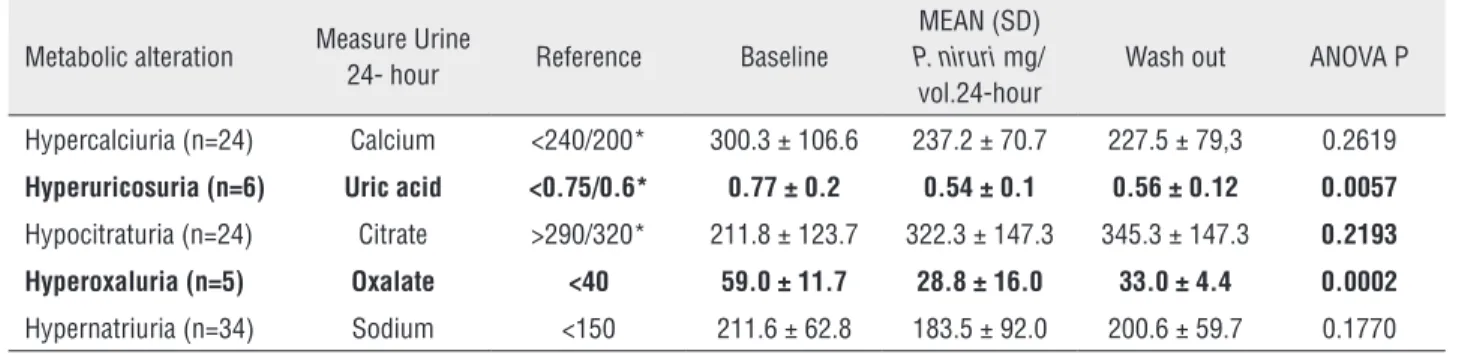
In the baseline stage, hypernatriuria was the most frequent urinary disturbance, occur-ring in 34 patients (60.7%). Hypocitraturia and hypercalciuria were observed in 24 (42.8%) cases, hyperuricosuria in six (10.7%), hyperoxaluria in five (8.9%), and low urine volume in 31 (55.3%). Furthermore, the pH value changed in 21 (37.5%) patients.
Evaluation of patients with urinary ab-normalities at the baseline stage showed a ten-dency towards an increase in urinary citrate among the hypocitraturic patients (211.8±123.7 to 322.3±145.8mg/24-hour, p=0.2193). In addition, oxalate was significantly reduced, from 59.0±11.7 to 28.8±16.0mg/24-hour (p=0.0002), among those
with hyperoxaluria, and uric acid was significan-tly decreased, from 0.77±0.22 to 0.54±0.07mg/24--hour (p=0.0057), among hyperuricosuric patients (Table-2).
Ultrasonography evaluation performed in the three periods of the study revealed that the to-tal number of stones decreased in 38 (67.8%) pa-tients, as summarized in Table-3 (from 3.2±2.02 to 2.0±2.07) and size. In 10 patients (17.8%), no alte-rations in the number of calculi were noted, and in eight patients (14.3%), an increase in the number of upper urinary stones was observed after the P. niruri period. Some patients reported spontaneous stone passage between the 21st and 70th day of the P. niruri period: four patients eliminated six stones, and another five individuals reported the presence of sandy fragments in the urine during the P. niruri period.
DISCUSSION
The formation of urinary calculi is asso-ciated with different risk factors. Its prevalence is
Table 1 - Urinary parameters in patients treated with P. niruri.
Measure
MEAN (SD)
ANOVA P
TUKEY
Baseline
mg/vol.24-hour
P. niruri
Wash out
Baseline x
P. niruri
Baseline x Wash out
P. niruri
x Wash out
Calcium 202.7±116.1 211.8±96.2 190.3±92.6 0.401 0.849 0.675 0.371
Uric acid 0.5±0.2 0.5±0.2 0.5±0.2 0.875 0.870 0.990 0.934
Sodium 171.6±74.0 166.1±78.9 182.7±62.2 0.368 0.881 0.610 0.344
Urea 20.1±6.0 18.6±7.7 20.9±8.4 0.070 0.278 0.679 0.063
Potassium 47.3±16.7 50.5±20.4 56.2±21.8 0.023 0.536 0.017 0.192
Citrate 379.9±191.1 398.1±219.0 412.8±175.8 0.515 0.922 0.488 0.739
Oxalate 24.4±15.5 23.9±14.5 22.3±9.7 0.639 0.952 0.619 0.795
Creatinine 1.3±0.5 1.3±0.5 1.2±0.5 0.672 0.682 0.773 0.989
Phosphorus 755.3±308.8 792.4±324.6 684.9±281.1 0.090 0.817 0,265 0.085
Magnesium 73.8±35.4 85.6±37.6 82.3±37.6 0.114 0.113 0.299 0.864
*Mg/Cr 58.0±22.5 66.1±23.4 69.1±28.6 0.012 0.081 0.012 0.736
*K/Cr 39.3±15.1 42.7±19.3 51.3±34.7 0.009 0.587 0.008 0.095
pH 6.1±0.9 6.0±0.9 6.1±0.9 0.6698 0.7916 0.9705 0.6663
Volume 1927±614.5 2028.8±790.6 2014.7±656.6 0.4361 0.4044 0.8567 0.7481
high worldwide with an increase in morbidity and health costs in a number of countries. However, fully effective treatment and prevention have yet to be established, and the use of medicinal plants may be helpful as coadjuvants. The use of P. niru-ri, a very common plant found in different coun-tries, has been shown to be a viable alternative, though more clinical studies are necessary.
In the present study, we sought to evaluate the use of P. niruri in patients with small urinary stones. When we analysed urinary variables, we found no significant changes in urinary volume for a 24-hour period with the use of an infusion of the plant. The urine volume was close to the minimum recommended in the literature, which is 2L/day (3, 4). The patients in this study exhibited average values of 1927mL, 2029mL, and 2015mL daily for the baseline, P. niruri and washout pe-riods, respectively. It is possible that the patients were aware of the importance of fluid intake to prevent the formation of new calculi and were thus already consuming the quantity of liquid
recommended at the beginning of the study; this would have resulted in no significant change in urine volume. The diuretic effects of P. niruri have been described in experimental studies (10, 15), though Nishiura et al. (11) reported different re-sults in a clinical study.
The increase in the 24-hour urine elec-trolytes found in this study may be related to the decrease in the number of calculi during the ima-ging evaluation. Increases in urinary potassium and magnesium levels lead to alkalinisation of the urine and consequently to an increase in urinary citrate, a potent inhibitor of calcium stone forma-tion (5).
Potassium can moderate the concentration of sodium in urine and promote the elevation of citrate, which acts to correct urinary pH and aci-dity, possibly contributing to an increase in cal-cium solubility (5). These changes may interfere with some stages of crystallization in urine, such as a reduction in the nucleation, growth and ag-gregation of calcium oxalate crystals (5, 14). We Table 2 - Metabolic alterations in 24-hour period urine at baseline and when taking P. niruri and Wash out.
Metabolic alteration Measure Urine
24- hour Reference Baseline
MEAN (SD)
P. niruri mg/
vol.24-hour
Wash out ANOVA P
Hypercalciuria (n=24) Calcium <240/200* 300.3 ± 106.6 237.2 ± 70.7 227.5 ± 79,3 0.2619
Hyperuricosuria (n=6) Uric acid <0.75/0.6* 0.77 ± 0.2 0.54 ± 0.1 0.56 ± 0.12 0.0057
Hypocitraturia (n=24) Citrate >290/320* 211.8 ± 123.7 322.3 ± 147.3 345.3 ± 147.3 0.2193
Hyperoxaluria (n=5) Oxalate <40 59.0 ± 11.7 28.8 ± 16.0 33.0 ± 4.4 0.0002
Hypernatriuria (n=34) Sodium <150 211.6 ± 62.8 183.5 ± 92.0 200.6 ± 59.7 0.1770
* = value reference for men/women; SD =standard deviation
Table 3 - Number and size of upper urinary calculi in patients treated with P. niruri.
Measure MEAN (SD)
ANOVA P
TUKEY
Baseline P. niruri Wash out Baseline
x
P. niruri
Baseline x Wash out
P. niruri
x Wash out
Total calculi (n) 3.2±2.0 2.0±2.1 2.2±2.2 0.0005 0.0005 0.015 0.672
Right kidney (n) 1.6±1.4 1.1±1.2 1.2±1.4 0.0176 0.0176 0.201 0.587
Left kidney (n) 1.6±1.4 0.9±1.1 1.0±1.1 0.0003 0.0003 0.003 0.938
Size (mm) 15.6±10.6 9.4±8.9 11.2±11.1 0.0002 <0.0001 0.045 0.206
observed a significant increase in potassium in 24-hour period urine samples between the baseline and washout periods, which was also noted in the chan-ge in the potassium/g Cr 24-hour ratio and in the change in the magnesium/g Cr 24-hour ratio. The increased potassium and magnesium levels observed in the study patients may help to explain the norma-lization of metabolic changes observed following the use of P. niruri.
Urine pH in the sample urinalysis did not change throughout the study and remained at a mean value between 6.0 and 6.1.
Diastolic blood pressure showed a significant reduction between the P. niruri and washout periods (16). A report of a hypotensive effect of P. niruri can be found in the literature (8).
The calculus imaging evaluation performed showed a reduction in the number of calculi after the P. niruri stage, as shown in Table-3, considering that the number of stones shown on ultrasound was lower due to the fact the some patients probably pas-sed some of them during the study.
Although the same method of evaluation was utilized in the study performed by Nishiura et al., those authors did not show a change in the num-ber and size of calculi before and after the use of a P. niruri extract in individuals with urinary lithiasis (11). In contrast, it has been reported that P. niruri promoted a reduction in the number of calculi and their appearance in relation to the most fragile as-pect of the calculi structure (7, 17-19).
Although ultrasonography is not considered a gold standard for the evaluation of small calculi, we performed this evaluation for the purpose of clinical monitoring of the patients because repeated CT scans in a short period of time can result in undue radioac-tivity exposure, which is not recommended (20).
Some patients experienced haematuria and abdominal pain. The exact cause of these events not was clear and continuous monitoring of patients at monthly visits was implemented as a precaution during the study. The haematuria and abdominal pain may be related to small calculi eliminated du-ring that period, as patients observed the presence of sand fragments in the urine. Regardless, we cannot attribute the pain reported to the consumption of P. niruri because this symptom is very frequent in pa-tients with lithiasis.
In this study, there were no changes in serum levels of liver enzymes, urea and serum creatinine. In previous experimental studies, no adverse acute or chronic toxic effects, such as kidney, heart, liver or neurological effects, were reported with the use of P. niruri (17, 18). In a human study, Wang et al. (21) found the normalization of liver enzymes when the plant was used in patients with chronic liver disease. However, Nishiura et al. (11) reported no change in serum and urinary parameters when analysing 69 patients and a control group with and without the use of P. niruri (11).
Most studies to date have focused on the hepatoprotective effects of P. niruri, and the genus Phyllanthus has been utilized in the treatment of various liver disorders (8). The reduction in alkaline phosphatase levels observed in this study was bene-ficial. In addition to showing that there was no to-xicity with the use of the plant extract, this decrease may have contributed to the reduction in the num-ber of calculi at the end of the study, because alka-line phosphatase is a biochemical marker of bone metabolism and may be involved in the mechanism of calculus formation in hypercalciuria (22).
According to our evaluation of patients with metabolic alterations at the baseline and P. niruri periods, a significant normalization of urinary uric acid and oxalate values occurred in those with hype-ruricosuria and hyperoxaluria, respectively. Citrate levels tended to norma lize in the same cohort, thou-gh without statistical significance, likely due to the small sample size. Moreover, no significant change was noted for patients with hypercalciuria or hyper-natriuria at the basal stage.
Overall, clinical studies with more patients are needed to validate the use of P. niruri in daily practice, particularly in patients with baseline uri-nary metabolic disorders. P. niruri is an abundant natural resource available in many countries, and it can reduce the health system expenses associated with conventional drugs, which are often inaccessi-ble to the majority of the population for long-term treatment.
CONCLUSIONS
metabolic changes. The use of the tea of this plant increases urinary excretion of magnesium and po-tassium. Patients with specific urinary metabolic changes such as hyperuricosuria and hyperoxalu-ria may benefit from ingestion of this tea.
CONFLICT OF INTEREST
None declared.
REFERENCES
1. Stamatelou KK, Francis ME, Jones CA, Nyberg LM, Curhan GC. Time trends in reported prevalence of kidney stones in the United States: 1976-1994. Kidney Int. 2003;63:1817-23. 2. Curhan GC, Willett WC, Knight EL, Stampfer MJ. Dietary
factors and the risk of incident kidney stones in younger women: Nurses’ Health Study II. Arch Intern Med. 2004;164:885-91.
3. Worcester EM, Coe FL. New insights into the pathogenesis of idiopathic hypercalciuria. Semin Nephrol. 2008;28:120-32. 4. Pearle MS, Calhoun EA, Curhan GC; Urologic Diseases of
America Project. Urologic diseases in America project: urolithiasis. J Urol. 2005;173:848-57.
5. Ettinger B, Pak CY, Citron JT, Thomas C, Adams-Huet B, Vangessel A. Potassium-magnesium citrate is an effective prophylaxis against recurrent calcium oxalate nephrolithiasis. J Urol. 1997;158:2069-73.
6. Cruces IL, Patelli THC, Tashima CM, Mello-Peixoto ECT. Plantas medicinais no controle da urolitíase. Rev Bras Pl Med. 2013;15(4 Supl 1):780-8.
7. Campos AH, Schor N. Phyllanthus niruri inhibits calcium oxalate endocytosis by renal tubular cells: its role in urolithiasis. Nephron. 1999;81:393-7.
8. Bagalkotkar G, Sagineedu SR, Saad MS, Stanslas J. Phytochemicals from Phyllanthus niruri Linn. and their pharmacological properties: a review. J Pharm Pharmacol. 2006;58:1559-70.
9. Murugaiyah V, Chan KL. Mechanisms of antihyperuricemic effect of Phyllanthus niruri and its lignan constituents. J Ethnopharmacol. 2009;124:233-9.
10. Devi MV, Satyanarayana S, Rao AS. Effect of Phyllanthus niruri on the diuretic activity of Punarvana tablets. J Res Edu Ind Med.1986; 5:11-3.
11. Nishiura JL, Campos AH, Boim MA, Heilberg IP, Schor N. Phyllanthus niruri normalizes elevated urinary calcium levels in calcium stone forming (CSF) patients. Urol Res. 2004;32:362-6.
12. Micali S, Sighinolfi MC, Celia A, De Stefani S, Grande M, Cicero AF, et al. Can Phyllanthus niruri affect the efficacy of extracorporeal shock wave lithotripsy for renal stones?
A randomized, prospective, long-term study. J Urol. 2006;176:1020-2.
13. Brasil. Ministério da Saúde. ANVISA. Diário Oficial da União, 9 de março de 2010, 46, seção 1, 1677-7042. Agência de Vigilância Sanitária (RDC 10, ANVISA), ISSN Março 2010, p. 16-17. Dispõe sobre a notificação de drogas vegetais junto à Agência Nacional de Vigilância Sanitária (ANVISA) e outras providências. Disponivel em: <http://bvsms.saude.gov.br/ bvs/saudelegis/anvisa/2010/res0010_09_03_2010.html> 14. Reungjui S, Prasongwatana V, Premgamone A, Tosukhowong
P, Jirakulsomchok S, Sriboonlue P. Magnesium status of patients with renal stones and its effect on urinary citrate excretion. BJU Int. 2002;90:635-9.
15. Udupa AL, Sanjeeva, Benegal A, Prusty V, Prabhath G, Kodancha P, Satish Kumar MC, Bhat V, Ratnakar UP. Diuretic activity of Phyllanthus niruri (Linn) in rats. J Health. 2010; 2:511-2.
16. Brazilian Cardiology Society, Brazilian Hypertension Society, Brazilian Society of Nephrology.VI Brazilian Guidelines on Hypertension. Arq Bras Cardiol. 2010; 95 (1 Supl.1):1-51. 17. Freitas AM, Schor N, Boim MA. The effect of Phyllanthus
niruri on urinary inhibitors of calcium oxalate crystallization and other factors associated with renal stone formation. BJU Int. 2002;89:829-34.
18. Barros ME, Lima R, Mercuri LP, Matos JR, Schor N, Boim MA. Effect of extract of Phyllanthus niruri on crystal deposition in experimental urolithiasis. Urol Res. 2006;34:351-7.
19. Ramsout R, Rodgers A, Webber D. Investigation of the effects of Phyllanthus niruri L. on in vitro calcium oxalate crystallization. Eur Urol Suppl. 2011;10:461-74.
20. Fahmy NM, Elkoushy MA, Andonian S. Effective radiation exposure in evaluation and follow-up of patients with urolithiasis. Urology. 2012;79:43-7.
21. Wang BE. Treatment of chronic liver diseases with traditional Chinese medicine. J Gastroenterol Hepatol. 2000;15 Suppl:E67-70.
22. Bikle DD. Biochemical markers in the assessment of bone disease. Am J Med. 1997;103:427-36.