http://dx.doi.org/10.1590/2317-1545v40n3179617
Germination of Psidium friedrichsthalianum (O. Berg) Nied.
seeds under different temperature and storage conditions
1Daniel Felipe de Oliveira Gentil
2, Sidney Alberto do Nascimento Ferreira
3*,
Elizabeth Rodrigues Rebouças
3ABSTRACT – Psidium friedrichsthalianum is a species whose fruit can be used to make juices, jellies/jams and sweets, and its seedlings serve as rootstocks with resistance to Meloidogyne spp. The aim of this study was to evaluate the performance of seeds
of this species at different germination temperatures, and to verify the effects of different moisture levels on their storage in two experiments. In the first, six germination temperatures (15, 20, 25, 30, 35, and 40 ºC) were evaluated, and in the second, seeds with different moisture levels (15.4, 9.8, 9.0, 8.4, and 8.2%) were stored in sealed containers at 20 °C for 0, 1, 3, 6, 9, and 12 months. Seed germination was favored by temperatures of 20 ºC and 25 ºC, reaching 93% and 87%, respectively, along with the highest germination speed indexes (2.582% day1 and 2.568% day-1) and shortest germination times (37.9 and 36.9 days). Temperatures of 30 °C and 35 °C maintained the seeds quiescent, while 40 °C was lethal. In storage, the seeds tolerated desiccation to 8.2% moisture content and could be stored in sealed containers at 20 ºC for 12 months, with germination higher than 70%.
Index terms: quiescence, desiccation tolerance, Myrtaceae.
Germinação de sementes de
Psidium friedrichsthalianum
(O. Berg) Nied. em
função da temperatura e do armazenamento
RESUMO - Psidium friedrichsthalianum é uma espécie cujos frutos podem ser usados na preparação de sucos, geleias e doces, além das mudas servirem de porta-enxertos pela resistência a Meloidogyne spp. O objetivo deste trabalho foi avaliar
o desempenho de sementes em diferentes temperaturas de germinação, bem como verificar os efeitos de diferentes graus de
umidade no armazenamento de sementes dessa espécie, em dois ensaios. No primeiro, foram avaliadas seis temperaturas
(15, 20, 25, 30, 35 e 40 ºC) e, no segundo, sementes com diferentes graus de umidade (15,4; 9,8; 9,0; 8,4 e 8,2%) foram armazenadas em recipientes herméticos a 20 ºC, durante 0, 1, 3, 6, 9 e 12 meses. A germinação de sementes foi favorecida pelas temperaturas de 20 e 25 ºC, alcançando 93 e 87%, onde também foram observados os mais altos índices de velocidade de germinação (2,582 e 2,568% dia-1) e menores tempos de germinação (37,9 e 36,9 dias, respectivamente). As temperaturas de 30 e 35 ºC mantiveram as sementes quiescentes, enquanto a de 40 °C foi letal. No armazenamento, foi verificado que as sementes toleraram dessecação até 8,2% de água, podendo ser armazenadas em recipientes herméticos a 20 ºC, por 12 meses, com germinação superior a 70%.
Palavras-chave: quiescência, tolerância à dessecação, Myrtaceae.
1Submitted on 05/06/2017. Accepted for publication on 05/11/2018.
2Universidade Federal do Amazonas, 69080-900 – Manaus, AM, Brasil.
3Instituto Nacional de Pesquisas da Amazônia, 69067-375 – Manaus, AM, Brasil.
*Corresponding author <[email protected]>
Introduction
Psidium friedrichsthalianum – Myrtaceae, known as
“cas”, in Costa Rica, or “Costa Rican guava”, is a fruit-bearing plant, originating from higher altitude forests and savannas
from Honduras to Panama (Fouqué, 1972), which develops naturally from the south of Mexico to the north of South
America (Lorenzi et al., 2006). The fruit has a rounded shape, slightly flattened at the poles, with a longitudinal diameter of 35.68 mm, transversal diameter of 42.90 mm, dry matter of 42.19 g, and pulp yield of 94% (Rebouças et al., 2008). It can be used to make juices, jellies/jams, and sweets (Lorenzi et al., 2006). The high number of seeds per fruit (on average, 73)
for the species (Rebouças et al., 2008), including seedlings
to be used as rootstocks for Psidium guajava L., providing
resistance to Meloidogyne enterolobii Yang and Eisenback
(Carneiro et al., 2007; Freitas et al., 2014), M. incognita (Kofoid and White) Chitwood, and M. javanica (Treub) Chitwood (Aristizábal and Piedrahíta, 2013).
In seed management, the speed of seed deterioration
must be minimized up to sowing time. Physiological quality
of seeds declines at variable intensity after physiological maturity, depending on conditions to which they are exposed. A preponderant factor in conservation of seed viability and vigor is moisture content, which implies the need for drying
for success in storage (Santos, 2015).
Seed tolerance to desiccation varies among species. Thus,
Roberts (1973) classified seeds as orthodox and recalcitrant. Ellis et al. (1990) included the intermediate category in this classification,
based on the response of Coffea arabica L seeds. It is understood that orthodox seeds tolerate desiccation to moisture content near
5%; intermediate seeds tolerate desiccation to moisture contents of around 10-12.5% and have reduced viability at lower moisture contents; and recalcitrant seeds lose viability when dried to 15-20% moisture (Hong and Ellis, 1996). A simple way of determining
the nature of seeds in the laboratory consists of the germination
test after desiccation to less than 10% moisture content: when
the seeds germinate, they are considered tolerant to desiccation
(orthodox) and when they do not germinate, they are probably recalcitrant (Silva and Ferraz, 2015). Among the native and exotic fruit-bearing Myrtaceae grown in Brazil whose seeds have been classified as recalcitrant are the following: Eugenia brasiliensis Lam. (Kohama et al., 2006; Delgado and Barbedo, 2007), E. involucrata DC., E. uniflora L. (Delgado and Barbedo, 2007), and E. pyriformis Camb. (Delgado and Barbedo, 2007; Scalon et al., 2012). Those with intermediate behavior include Acca sellowiana (O. Berg) Burret (Gomes et al., 2013). Those classified
as orthodox seeds are Campomanesia phaea (Berg) Landr. (Maluf and Pisciottano-Ereio, 2005), Psidium guajava L. (Hong et al., 1996), P. cattleianum Afzel. ex Sabine (Silva et al., 2011), and P. guineensis Swartz (Masetto et al., 2014). Therefore, knowing the
nature of seeds is essential for establishing storage conditions and,
consequently, seed longevity (Silva and Ferraz, 2015).
In seed germination, temperature is an important
environmental factor, which affects the germination percentage
and germination rate of non-dormant seeds, the ability to overcome primary and/or secondary dormancy, and the induction
of secondary dormancy of seeds (Bewley et al., 2013). Thus,
germination occurs within certain temperature limits that are
characteristic of each species; above upper limits and below lower limits, germination does not occur. Within these limits,
there is a temperature or range of temperatures in which
the process occurs most efficiently, i.e., when maximum
germination is obtained in the shortest period of time
(Carvalho and Nakagawa, 2012). Nevertheless, according to Lamarca et al. (2011), there may be variations even within the
same species, probably due to the oscillation of environmental factors during seed development and maturation.
In evaluation of seed quality, the germination test is carried
out under partially or totally controlled laboratory conditions for the purpose of determining the maximum germination
potential of seed lots (Brasil, 2009). For that reason,
environmental factors have been studied, such as temperature
(Lamarca et al., 2011; Alves et al., 2015; Santos et al., 2015; Gomes et al., 2016), to bring about more regular, fast, and
complete germination of samples of seeds from a determined
species (Brasil, 2009). Furthermore, the temperature or range
of temperatures most suitable for germination is likewise useful for obtaining uniform stands in commercial nurseries for production of plant seedlings.
Thus, knowledge regarding the physiological characteristics of seeds from fruit-bearing species that involves germination and storage is indispensable for generating technologies suitable for propagation and conservation of these genetic resources. In this context, the aim of this study
was to evaluate the germination of seeds under different temperatures, as well as observe the effects of different
moisture contents on storage of P. friedrichsthalianum seeds.
Material and Methods
The study was conducted in the seed laboratory and germination nursery of the Biodiversity Coordination of
the National Amazon Research Institute (Instituto Nacional de Pesquisas da Amazônia - INPA), in Manaus, Amazonas, Brazil. Ripe fruit (epicarp of greenish-yellow color), originating from twelve plants on the INPA–V8 campus (3º5’32.64”S; 59º59’36.10”O), was collected after abscission.
The seeds were manually extracted from the fruit with the aid of a spoon. After remaining immersed in water for
24 hours, they were rubbed in a sieve and washed in running water. They were then immersed in 0.5% sodium hypochlorite for 15 minutes and washed in running water. After that, two
independent trials were set up as described below.
Seed germination at different temperatures
The seeds were sown in gerbox type plastic boxes (11 x 11 x 3.5 cm) on two sheets of blotting paper moistened with 15 mL of water (equivalent to three times the weight of the non-hydrated substrate). The boxes were placed in transparent plastic bags
with a 12-hour photoperiod regulated at the following temperatures: 15, 20, 25, 30, 35, and 40 ºC.
Germination was evaluated every five days, considering
the seed with primary root growth as germinated. From this
data, germination percentage, germination speed index (GSI), and mean germination time (MGT) were calculated (Ranal and Santana, 2006). For statistical analysis, the germination
percentages were transformed in arcsin , and the means of the original values were presented in the results.
After concluding the germination test (90 days), the seeds of the treatments in which germination did not occur (30, 35, and 40 ºC) were transferred to the temperature of 20 ºC, which exhibited the best response, and they were evaluated for 50
days more.
A completely randomized experimental design was used,
with six treatments (temperatures) and three replications, containing 25 seeds per plot. Data were subjected to analysis
of variance and mean values were compared by the Tukey
test at the level of 5% probability. Analyses were made in the Assistat 7.7 beta program (Silva and Azevedo, 2016).
Storage of seeds with different moisture contents
After processing, the seeds were exposed to
environmental conditions (relative humidity of 60%, mean minimum temperature of 29 ºC, and mean maximum temperature of 32 ºC) for different periods (1, 3, 5, 7, and 9 days), which resulted in different moisture contents (15.4, 9.8, 9.0, 8.4, and 8.2%, respectively). Reaching each one of
the moisture contents, the seeds were placed in six amber glass bottles, sealed with a stopper and plastic screw cap,
and then stored in a chamber at a temperature of 20 ºC for 0, 1, 3, 6, 9, and 12 months. After each one of these periods,
one bottle of seeds at each moisture content was removed from storage, and the seeds were sown in plastic boxes
containing sand and sawdust substrate (1:1; v:v) and kept in a nursery (mean minimum temperature of 24 ºC and mean maximum temperature of 38 ºC).
Emergence evaluations were made every five days,
and seedlings that exhibited hypocotyl growth above the level of the substrate and expanded cotyledonary leaves were considered as emerged. From the emergence data, the emergence speed index and the mean emergence time were
calculated (Ranal and Santana, 2006). For statistical analysis,
the emergence percentages were transformed into arcsin
√(x + 0.5)/100, and the means of the original values were
presented in the results.
A completely randomized experimental design was adopted in split-plots in time, with four replications, each one
containing 25 seeds. Five different seed moisture contents
were considered in the plots, while six storage periods were considered in the split-plots. Data were subjected to analysis of variance and means were compared by the Tukey test at the
level of 5% probability. Analyses were made in the Assistat 7.7 beta program (Silva and Azevedo, 2016).
Results and Discussion
Seed germination at different temperatures
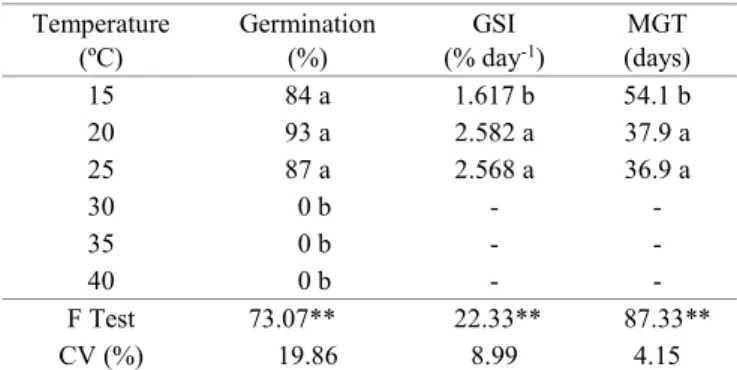
Germination of P. friedrichsthalianum seeds was greater
than 80% at the temperatures of 15, 20, and 25 ºC (Table 1). Santos et al. (2004), in a study with other Myrtaceae, found germination greater than 75% in A. sellowiana, Campomanesia xanthocarpa (Mart.) O. Berg, and P. cattleianum at constant
temperatures of 15, 20, 25, and 30 °C. In P. guajava, germination
exceeded 90% at temperatures of 20, 25, and 30 °C (Sugahara and Takaki, 2004).
The P. friedrichsthalianum seeds under the higher
temperatures of 30, 35, and 40 ºC (Table 1) did not germinate in the period of 90 days (Figure 1). After transfer of the plots of these treatments to the temperature of 20 ºC, the seeds of the 30 and 35 ºC treatments achieved values near 70% germination, indicating that they were in a quiescent state (Carvalho and Nakagawa, 2012). Maeda et al. (1999)
observed this phenomenon in germination of P. guajava under
a temperature of 35 °C.
The P. friedrichsthalianum seeds of the 40 ºC treatment
did not exhibit a germination response after transfer to the
temperature of 20 ºC (Figure 1), showing that the temperature of 40 ºC is above the maximum germination temperature of
seeds of this species. In P. guajava, Sugahara and Takaki (2004)
Table 1. Germination, germination speed index (GSI), and mean germination time (MGT) of Psidium friedrichsthalianum (O. Berg) Nied.– Myrtaceae seeds, under different germination temperatures.
Temperature
(ºC) Germination (%) (% dayGSI -1)
MGT (days)
15 84 a 1.617 b 54.1 b
20 93 a 2.582 a 37.9 a
25 87 a 2.568 a 36.9 a
30 0 b - -
35 0 b - -
40 0 b - -
F Test 73.07** 22.33** 87.33**
CV (%) 19.86 8.99 4.15
Mean values followed by the same letter in the column do not differ significantly by the Tukey test at the level of 5% probability. ** significant by the F test at the level of 1% probability.
(Santos et al., 2015). In P. guajava (Maeda et al., 1999), P. rufum Mart. ex DC. (Soares et al., 2015), A. sellowiana, and
C. xanthocarpa (Gomes et al., 2016), the temperature of 25 ºC
allowed better germination performance of the seeds. The temperatures that occur in the habitats of the species are important parameters for selection of the temperatures to
be used in this type of experiment (Baskin and Baskin, 2014).
Furthermore, a distinct germination response among populations of the same species, common among species of the same region, suggests that selection pressure of the environment is
expressive over germination potential, adapting the requirements
of germination to the thermal conditions of the place of origin
(Lamarca et al., 2011). Thus, the fact of P. friedrichsthalianum
originating in higher altitude forests and savannas of Central
America (Fouqué, 1972) may be related to the germination response of seeds to the temperatures of 20 and 25 ºC.
The interaction between temperature and light merits attention in continuing research on germination of P. friedrichsthalianum
seeds. In P. guajava, Sugahara and Takaki (2004) found that
seeds can germinate in the dark at alternating temperatures and under lighting at constant temperatures, due to the participation of
phytochromes (A and B, respectively) in control of germination.
The amplitude between the highest and lowest temperatures can
also affect the germination response of the seeds of this species (Bhanuprakash et al., 2008). At any rate, in the present study, the 12-hour photoperiod at constant temperatures seems not to have
impaired the germination of P. friedrichsthalianum seeds.
Storage of seeds with different moisture contents
The variables observed showed a significant effect of
0 20 40 60 80 100
0 20 40 60 80 100 120 140
Ge
rmina
tion (%
)
Period after sowing (days)
15ºC 20ºC 25ºC 30ºC 35ºC 40ºC
Figure 1. Accumulated germination of Psidium friedrichsthalianum (O. Berg) Nied.– Myrtaceae seeds, in relation to temperature; at ninety days after sowing, the seeds of the treatments in which there was no germination (30, 35, and 40 ºC) were transferred to the temperature of 20 ºC.
considered that the maximum seed germination temperature
is situated between 35 and 40 ºC. According to Carvalho and Nakagawa (2012), exact determination of the cardinal
temperatures of each species is impeded by a series of problems, among which are the seed vigor level and the adoption of an
adequate methodology. In the case of P. friedrichsthalianum, it was not possible to establish the maximum temperature, but
results indicated it to be between 25 and 30 ºC.
Germination began at 20, 25, and 40 days at the temperatures of 25, 20, and 15 ºC, respectively, with stabilization at 90 days (Figure 1). At the temperature of 15 ºC, the values of germination speed and mean germination time were significantly different than in the other treatments (Table 1) because decrease in
temperature promoted reduction in germination speed and an increase in the mean time of the germination process, indicating it to be near the minimum temperature for germination of the species. For A. sellowiana, which occurs naturally at high
altitudes, Gomes et al. (2016) expected that the temperature of 15 ºC would be a factor favorable to the germination process,
which did not occur. In P. guajava, germination also did not
occur under the temperature of 15 ºC, but exhibited a minimum temperature of germination between 15 and 20 ºC (Sugahara and Takaki, 2004).
The highest germination speed indexes (GSI), as well as the lowest mean germination times (MGT) were achieved under the temperatures of 20 and 25 ºC, which did not differ significantly from each other (Table 1). Thus, these
temperatures can be suggested as suitable for germination of P. friedrichsthalianum seeds. In P. guineense, the
interaction (moisture content x storage period). Therefore, it was
decided to compare the means taking into account each one of
the moisture contents in relation to the storage periods (Table 2).
At the beginning of storage, it was observed that the P. friedrichsthalianum seeds tolerated desiccation to the level of
8.2% moisture (Table 2), indicating that the species does not
have recalcitrant behavior. To check if they are orthodox or intermediate seeds, it is still necessary to test viability after
desiccation to 5% moisture content, as well as storage at -20 ºC for three months, according to the protocol suggested by Hong and Ellis (1996). In spite of that protocol, the seeds of P. cattleianum were considered orthodox by Silva et al. (2011)
since they maintained viability for more than three years stored
in different packages and environments at a moisture content of 7.1%. In the same way, Masetto et al. (2014) concluded that P. guineensis seeds had an orthodox response to desiccation,
tolerating drying to 5% moisture content and storage for up to 90 days under a temperature of 5±1 °C.
In P. friedrichsthalianum seeds with lower moisture
content (8.2%), emergence was initially lower (57%), exhibiting a rise after the first month (greater than 80%) and a small decrease at the end of storage (74%). In P. guajaja seeds,
Maeda et al. (1999) also found an increase in germination at 30 days of storage in a sealed container at 20 °C.
The P. friedrichsthalianum seeds with moisture contents
of 9.8, 9.0, and 8.4 % exhibited high emergence at the beginning and throughout storage (greater than 70%). In contrast, seeds at 15.4% moisture content had high emergence up to the third month (greater than 70%), but arriving at null
values at six months of storage on.
With moisture contents of 15.4%, the emergence speed index did not significantly change in the first three months of storage, while the mean emergence time was greater in the first month (Table 2). As there was no emergence from six months on,
these variables were no longer estimated, making visualization of data in reference to the degenerative process in progress
impossible. According to Bewley et al. (2013), when damage
to the key functional systems exceeds seed repair capabilities,
Table 2. Emergence, emergence speed index, and mean emergence time of Psidium friedrichsthalianum (O. Berg) Nied. – Myrtaceae seedlings, in relation to moisture content and storage period of the seeds.
Storage period
(months) 15.4 9.8 Moisture content9.0 (%) 8.4 8.2 Emergence (%)
0 83 a 85 a 72 a 79 a 57 b
1 88 a 83 a 81 a 84 a 86 a
3 72 a 87 a 83 a 86 a 89 a
6 0 b 75 a 81 a 89 a 86 a
9 0 b 82 a 78 a 82 a 81 a
12 0 b 76 a 76 a 70 a 74 ab
F test interaction = 19.81** CV plot (%) = 10.72 CV split-plot (%) = 11.69 Emergence speed index (% day-1)
0 2.496 a 2.592 bc 2.369 ab 2.633 abc 1.774 c
1 2.243 a 2.259 c 2.173 b 2.359 bc 2.430 abc
3 2.288 a 3.695 a 3.043 a 3.119 a 3.098 a
6 - 2.891 bc 3.005 a 3.323 a 2.906 a
9 - 2.976 b 2.796 ab 2.917 ab 2.737 ab
12 - 2.209 c 2.145 b 1.925 c 2.094 bc
F test interaction = 14.23** CV plot (%) = 12.35 CV split-plot (%) = 12.09
Mean emergence time(days)
0 33.6 b 33.1 b 30.7 b 31.0 b 33.2 ab
1 40.1 a 37.4 a 37.9 a 36.2 a 35.8 a
3 33.3 b 24.3 d 28.1 b 28.2 bc 29.3 c
6 - 26.5 cd 27.7 b 27.2 c 30.4 bc
9 - 28.2 c 29.1 b 28.8 bc 31.8 bc
12 - 35.5 ab 36.4 a 37.8 a 36.2 a
F test interaction = 95.11** CV plot (%) = 5.64 CV split-plot (%) = 6.09
the systems begin to fail and begin a trajectory toward death, resulting in loss of viability. Therefore, at some point beginning at three months of storage of P. friedrichsthalianum seeds with
a moisture content of 15.4%, a decline in physiological quality
began, which culminated in death at six months of storage. The impermeable packaging probably favored deterioration
because, according to Carvalho and Nakagawa (2012), its use requires moisture contents ranging from 5% to 9%.
At all moisture contents of P. friedrichsthalianum seeds,
except for 15.4%, the values of emergence speed index increased and the mean emergence times decreased at 3, 6, and 9 months of storage. This behavior was similar to that found by Maeda et al. (1999) in P. guajava seeds, suggesting that dormancy is overcome after six months of storage. The loss of dormancy that occurs during storage of dry seeds is
called post-maturity (Bewley et al., 2013). Nevertheless,
proof of the occurrence of dormancy in P. friedrichsthalianum seeds requires more specific studies.
The P. friedrichsthalianum seeds tolerate desiccation up
to 8.2% moisture content and maintain high physiological quality for twelve months stored at 20 ºC in closed containers with germination greater than 70%. This information
can subsidize actions related to seedling production, to maintenance of germplasm banks, and to restocking of areas of natural occurrence of the species.
Conclusions
The best temperatures for germination of P. friedrichsthalianum seeds were 20 and 25 °C. The temperatures of 30 and 35 ºC maintained seeds in quiescence, whereas the temperature of 40 °C was lethal.
Seeds of P. friedrichsthalianum can be desiccated up to
the moisture content of 8.2% and maintain viability and vigor
at high levels for twelve months.
Acknowledgments
Our thanks to Dr. Marinete da Silva Vasques for assistance
in obtaining the information in this study.
References
ALVES, C.Z.; SILVA, J.B.; CÂNDIDO, C.S. Metodologia para a
condução do teste de germinação em sementes de goiaba. Revista Ciência Agronômica, v.46, n.3, p.615-621, 2015. http://www.scielo.
br/pdf/rca/v46n3/0045-6888-rca-46-03-0615.pdf
ARISTIZÁBAL, A.D.; PIEDRAHÍTA, O.A.G. Comportamiento de materiales de guayabo (Psidium guajava Linneo) al parasitismo del nematodo formador de agallas [Meloidogyne incognita (Kofoid
& White) Chitwood y Meloidogyne javanica (Treub) Chitwood]. Revista Luna Azul, n.37, p.130-154, 2013. http://www.redalyc.org/
pdf/3217/321729206010.pdf
BASKIN, C.C.; BASKIN, J.M. Seeds: ecology, biogeography, and evolution of dormancy and germination. 2.ed. San Diego: Elsevier,
2014. 1586p.
BEWLEY, J.D.; BRADFORD, K.J.; HILHORST, H.W.M.; NONOGAKI, H. Seeds: physiology of development, germination
and dormancy. 3.ed. New York: Springer, 2013. 392p.
BRASIL. Ministério da Agricultura, Pecuária e Abastecimento.
Regras para análise de sementes. Ministério da Agricultura, Pecuária
e Abastecimento. Secretaria de Defesa Agropecuária. Brasília, DF: MAPA/ACS, 2009. 395p. http://www.agricultura.gov.br/arq_editor/ file/2946_regras_analise__sementes.pdf
BHANUPRAKASH, K.; YOGEESHA, H.S.; VASUGI, C.; ARUN, M.N.; NAIK, L.B. Effect of pre-soaking treatments and temperature on seed germination of guava (Psidium guajava L.). Seed Science and Technology, v.36, p.792-794, 2008. http://www.ingentaconnect.
com/content/ista/sst/2008/00000036/00000003/art00030
CARVALHO, N.M.; NAKAGAWA, J. Sementes: ciência, tecnologia
e produção. 5.ed. Jaboticabal: FUNEP, 2012. 590p.
CARNEIRO, R.M.D.G.; CIROTTO, P.A.; QUINTANILHA, A.P.; SILVA, D.B.; CARNEIRO, R.G. Resistance to Meloidogyne mayaguensis in Psidium spp. accessions and their grafting compatibility with P. guajava cv. Paluma. Fitopatologia Brasileira,
v.32, n.4, p.281-284, 2007. http://www.scielo.br/pdf/fb/v32n4/01.pdf DELGADO, L.F.; BARBEDO, C.J. Tolerância à dessecação de
sementes de espécies de Eugenia. Pesquisa Agropecuária Brasileira,
v.42, n.2, p.265-272, 2007. http://www.scielo.br/pdf/pab/v42n2/16.pdf ELLIS, R.H.; HONG, T.D.; ROBERTS, E.H. An intermediate category of seed storage behaviour? I. Coffee. Journal of Experimental Botany, v.41, n.230, p.1167-1174, 1990. https://www.
jstor.org/stable/23695125?seq=1#page_scan_tab_contents
FOUQUÉ, A. Espèces fruitières d’Amérique tropicale: famille des
myrtacées. Fruits, v.27, n.2, p.120-139, 1972. http://agritrop.cirad.
fr/424603/
FREITAS, V.M.; CORREA, V.R.; MOTTA, F.C.; SOUSA, M.G.; GOMES, A.C.M.M.; CARNEIRO, M.D.G.; SILVA, D.B.; MATTOS, J.K.; NICOLE, M.; CARNEIRO, R.M. D.G. Resistant accessions
of wild Psidium spp. to Meloidogyne enterolobii and histological characterization of resistance. Plant Pathology, v.63, p.738–746,
2014. http://onlinelibrary.wiley.com/doi/10.1111/ppa.12149/abstract GOMES, J.P.; OLIVEIRA, L.M.; SALDANHA, A.P.; MANFREDI, S.; FERREIRA, P.I. Secagem e classificação de sementes de Acca sellowiana (O. Berg) Burret – Myrtaceae quanto à tolerância à dessecação e ao armazenamento. Floresta e Ambiente, v.20, n.2,
This is an Open Access article distributed under the terms of the Creative Commons Attribution License, which permits unrestricted use, distribution, and reproduction in any medium, provided the original work is properly cited.
GOMES, J.P.; OLIVEIRA, L.M.; FERREIRA, P.I.; BATISTA, F.
Substratos e temperaturas para teste de germinação em sementes de
Myrtaceae. Ciência Florestal, v.26, n.1, p.285-293, 2016. https://
periodicos.ufsm.br/cienciaflorestal/article/view/21120/pdf_1 HONG, T.D.; ELLIS, R.H. A protocol to determine seed storage behaviour.In: ENGELS, J.M.M.; TOLL, J. (Eds.). Rome: IPGRI,
1996. 62p. (IPGRI Technical Bulletin n.1). http://cropgenebank. sgrp.cgiar.org/images/file/learning_space/technicalbulletin1.pdf HONG, T.D.; LININGTON, S.; ELLIS, R.H. Seed storage behavior: a compendium. Rome: IPGRI, 1996. 104p. (Handbooks
for Genebanks, 4). http://www.bioversityinternational.org/ fileadmin/_migrated/uploads/tx_news/Seed_storage_behavior__a_ compendium_1576.pdf
KOHAMA, S.; MALUF, A.M.; BILIA, D.A.C.; BARBEDO, C.J.
Secagem e armazenamento de sementes de Eugenia brasiliensis
Lam. (grumixameira). Revista Brasileira de Sementes, v.28, n.1,
p.72-78, 2006. http://www.scielo.br/pdf/rbs/v28n1/a10v28n1.pdf LAMARCA, E.V.; SILVA, C.V.; BARBEDO, C.J. Limites térmicos
para a germinação em função da origem de sementes de espécies de Eugenia (Myrtaceae) nativas do Brasil. Acta Botanica Brasilica,
v.25, n.2, p.293-300, 2011. http://www.scielo.br/pdf/abb/v25n2/ a05v25n2.pdf
LORENZI, H.; BACHER, L.; LACERDA, M.; SARTORI, S. Frutas brasileiras e exóticas cultivadas: (de consumo in natura). São Paulo:
Instituto Plantarum de Estudos da Flora, 2006. 640p.
MAEDA, J.A.; LIOLINO, J.H.; NISHIMORI, L.K.; MEDINA, P.F. Goiabeira (Psidium guajava L.): características dos frutos e
peculiaridades das sementes que afetam sua qualidade fisiológica.
Revista Brasileira de Sementes,v.21, n.2, p.103-109, 1999. http://www.
bibliotekevirtual.org/revistas/RBS/v21n02/v21n02a17.pdf
MALUF, A.M.; PISCIOTTANO-EREIO, W.A. Secagem e
armazenamento de sementes de cambuci. Pesquisa Agropecuária Brasileira, v.40, n.7, p.707-714, 2005. http://www.scielo.br/pdf/pab/
v40n7/a12v40n7.pdf
MASETTO, T.E.; NEVES, E.M.S.; SCALON, S.P.Q.; DRESCH, D.M. Drying, storage and osmotic conditioning of Psidium guineense Swartz seeds. American Journal of Plant Sciences, v.5 p.2591-2598,
2014. http://file.scirp.org/pdf/AJPS_2014073116091867.pdf RANAL, M.A.; SANTANA, D.G. How and why to measure the
germination process? Revista Brasileira de Botânica, v.29, n.1,
p.1-11, 2006. http://www.scielo.br/pdf/rbb/v29n1/a02v29n1.pdf REBOUÇAS, E.R.; GENTIL, D.F.O.; FERREIRA, S.A.N. Caracterização física de frutos e sementes de goiaba-da-costa-rica, produzidos em Manaus, Amazonas. Revista Brasileira de Fruticultura, v.30, n.2, p.546-548, 2008. http://www.scielo.br/pdf/
rbf/v30n2/a48v30n2.pdf
ROBERTS, E.H. Predicting the storage life of seeds. Seed Science and Technology, v.1, p.499-514, 1973. http://www.citeulike.org/
user/Schia/article/666485
SANTOS, C.M.R.; FERREIRA, A.G.; ÁQUILA, M.E.A. Características de frutos e germinação de sementes de seis espécies de Myrtaceae nativas do Rio Grande do Sul. Ciência Florestal,
v.14, n.2, p.13-20, 2004. https://periodicos.ufsm.br/cienciaflorestal/ article/view/1802/1066
SANTOS, S.R.G. Secagem, extração e beneficiamento. In: PIÑA-RODRIGUES, F.C.M.; FIGLIOLIA, M.B.; SILVA, A. Sementes
florestais tropicais: da ecologia à produção. Londrina: ABRATES,
2015, p.206-218.
SANTOS, M.A.C.; QUEIRÓZ, M.A.; BISPO, J.S.; DANTAS, B.F. Seed germination of Brazilian guava (Psidium guineense Swartz.). Journal of Seed Science, v.37, n.4, p.214-221, 2015. http://www.
scielo.br/pdf/jss/v37n4/2317-1537-jss-37-04-00214.pdf
SCALON, S.P.Q.; NEVES, E.M.S.; MASETO, T.E.; PEREIRA, Z.V. Sensibilidade à dessecação e ao armazenamento em sementes
de Eugenia pyriformis Cambess. (uvaia). Revista Brasileira de Fruticultura, v.34, n.1, p.269-276, 2012. http://www.scielo.br/pdf/
rbf/v34n1/v34n1a36.pdf
SILVA, A.; FERRAZ, I.K.D. Armazenamento de sementes. In: PIÑA-RODRIGUES, F.C.M.; FIGLIOLIA, M.B.; SILVA, A.
Sementes florestais tropicais: da ecologia à produção. Londrina:
ABRATES, 2015. p.219-242.
SILVA; A.; PEREZ, S.C.J.G.A.; PAULA, R.C. Qualidade fisiológica
de sementes de Psidium cattleianum Sabine acondicionadas e armazenadas em diferentes condições. Revista Brasileira de Sementes, v.33, n.2, p.197-206, 2011. http://www.scielo.br/pdf/rbs/
v33n2/01.pdf
SILVA, F.A.S.; AZEVEDO, C.A.V. The Assistat software version 7.7 and its use in the analysis of experimental data. African Journal of Agricultural Research, v.11, n.39, p.3733-3740, 2016.
http://www.academicjournals.org/journal/AJAR/article-full-text-pdf/5E8596460818
SOARES, I.D.; NOGUERA, A.C.; KALIL FILHO, A.N.; MIRANDA, R.O.V.; EBLING, A.A. Germination behavior of
Psidium rufum DC. seeds at different temperatures, substrates and conditions of light. Australian Journal of Basic and Applied Sciences, v.9, n.7, p.564-570, 2015. http://ajbasweb.com/old/
ajbas/2015/April/564-570.pdf
SUGAHARA, V.Y.; TAKAKI, M. Effect of light and temperature on seed germination in guava (Psidium guajava L. – Myrtaceae). Seed Science and Technology, v.32, n.3, p.759-764, 2004. http://www.