Approaches for
in silico
finishing of microbial genome sequences
Frederico Schmitt Kremer
1, Alan John Alexander McBride
1and Luciano da Silva Pinto
11
Programa de Pós-Graduação em Biotecnologia (PPGB), Centro de Desenvolvimento Tecnológico,
Universidade Federal de Pelotas, Pelotas, Brazil.
Abstract
The introduction of next-generation sequencing (NGS) had a significant effect on the availability of genomic informa-tion, leading to an increase in the number of sequenced genomes from a large spectrum of organisms. Unfortunately, due to the limitations implied by the short-read sequencing platforms, most of these newly sequenced genomes re-mained as “drafts”, incomplete representations of the whole genetic content. The previous genome sequencing stud-ies indicated that finishing a genome sequenced by NGS, even bacteria, may require additional sequencing to fill the gaps, making the entire process very expensive. As such, severalin silico approaches have been developed to opti-mize the genome assemblies and facilitate the finishing process. The present review aims to explore some free (open source, in many cases) tools that are available to facilitate genome finishing.
Keywords: microbial genetics, molecular microbiology, genomics, microbiology, draft genomes.
Received: September 25, 2016; Accepted: March 13, 2017.
Introduction
The advent of second generation of sequencing plat-forms, usually referred to as Next Generation Sequencing (NGS) technologies, promoted an expressive growth in the availability of genomic data in public databases, mainly due to the drastic reduction in the cost-per-base (Chainet al., 2009). Compared to the Sanger sequencing technique
(Sangeret al., 1977), NGS platforms, like Illumina HiSeq,
IonTorrent PGM, Roche 454 FLX, and ABI SOLiD, are able to generate a significantly higher throughput, resulting in a high sequencing coverage. However, they typically have a lower accuracy (in terms of average Phred-score in the raw data) and, in most cases, can only generate short-length reads (short-reads) (Liu et al., 2012). The term
“short-read” is commonly used to refer to the data gener-ated by platforms such as Illumina, IonTorrent and SOLiD, as the length of their reads usually range from 30 bp (eg: SOLiD) to ~120 bp (e.g., Illumina HiSeq), which is smaller
than the length usually obtained by Sanger sequencing (~1 kb), and by the PacBio and Oxford Nanopore platforms (commonly referred to as “long-reads”).
The higher throughtput obtained by NGS has stimu-lated the development of new algorithms and tools that are capable of dealing with a larger volume of data and generat-ing genomic assemblies in a reasonable time. Traditional sequence assemblers, like Phrap (http://www.phrap.org/
phredphrap/) and CAP3 (Huang and Madan, 1999), were replaced with new ones, such as Velvet (Zerbino and Bir-ney, 2008), ABySS (Simpsonet al., 2009), Ray (Boisvertet al., 2010), SPAdes (Bankevich et al., 2012) and SOAPdenovo (Luoet al., 2012), many of which were based on theDe Bruijn graph algorithm (Pevzner et al., 2001; Compeauet al., 2011). A large number of these software offerings are capable of assembling data from different se-quencing platforms, called “hybrid assembly”; however, all of them exhibit some limitations and, even after several corrections and optimization steps, the generation of a fin-ished genome continues to represent a complex task (Alkan
et al., 2011).
Genome finishing is achieved by converting a set of contigs or scaffolds into complete sequences that represent the full genomic content of the organism without unknown regions (gaps) (Mardiset al., 2002), and aims a “closed” and full representation of the chromosome organization. On the contrary, a draft genome may be composed of a set of a few or several contigs or scaffolds (Landet al., 2015). Although useful for many studies, the unfinished and frag-mented nature of draft genomes may difficult analysis on comparative genomics and structural genomics (Rickeret al., 2012). In addition, some genes may be missed if located in a region without coverage (e.g., edges of contigs/scaf-folds), or due to assembly errors (e.g., repetitive regions that are “collapsed” into a single one) (Klassen and Currie, 2012).
Genome finishing represents a relevant step to reduce data loss and lead to a more accurate representation of the genomics features of the organism of interest. The tradi-Genetics and Molecular Biology, 40, 3, 553-576 (2017)
Copyright © 2017, Sociedade Brasileira de Genética. Printed in Brazil DOI: http://dx.doi.org/10.1590/1678-4685-GMB-2016-0230
Send correspondence to Frederico Schmitt Kremer. Centro de Desenvolvimento Tecnológico, Universidade Federal de Pelotas, Campus Universitário, S/N, CEP 96160-000, Capão do Leão, RS, Brazil. E-mail: [email protected].
tional way to close gapped genomes includes: (1) design primers based on the edge of adjacent contigs, (2) PCR am-plification, (3) Sanger sequencing, and (4) local assembly, usually with (5) manual curation. As this process is very time consuming, newin vitroapproaches were developed to speed it up, including multiplex PCR (Tettelinet al., 1999), optical mapping (Latreilleet al., 2007), and hybrid sequencing and assembly (Ribeiroet al., 2012). This, how-ever, usually results in a drastic increase in the cost of the sequencing project. Therefore it is not surprising that from the 87,956 prokaryote genomes available in GenBank until December 2016 (GenBank release 217), only a small frac-tion (~6,586) is finished (http://www.ncbi.nlm.nih.gov/ genbank/).
In the last years, the availability of third-generation sequencing technologies, such as PacBio SMRT and Ox-ford Nanopore, has also provided another way to achieve finished genomes (Ribeiroet al., 2012). As these platforms usually generate reads with length > 10 kb, the assembly al-gorithms have to deal with less ambiguities and problem-atic regions (Koren and Phillippy, 2015). This makes the reconstruction of the chromosome sequences easier, but just like second generation technologies, both platforms have their own limitations. In the earlier versions of the PacBio SMRT platform, for example, it used to present a high error-rate, so it was recommended to correct part of these errors using short-reads data (e.g., Illumina) (Korenet al., 2012; Auet al., 2012; Salmela and Rivals, 2014) before using its result for any analysis. Although this problem has been minimized with the improvements in the sequencing chemistry and base-calling process over the last years, the time required for the sequencing, the cost of each run, and the price of the equipment itself are still drawbacks, and these are some of reasons as to why it is not more frequently applied. In the case of Oxford Nanopore, there is a limited number of tools that can be used to pre-process and analyze its data, and some types of errors (e.g., under-represen-tation of specific k-mers) are still recurrent (Deschampset al., 2016). Therefore, second-generation platforms are still the most popular ones for a wide variety of applications, and remain as the cheaper alternative to obtain genomic data.
Previous reviews that focused on genome assembly and whole-genome sequencing analysis have already de-scribed some of thein silicotools that have the potential to improve a genome assembly without the need for experi-mental data. Edwards and Holt (2013), Dark (2013) and Vincentet al. (2016) have provided very comprehensive descriptions of some of the main steps of data analysis in microbial genomes sequenced by next-generation technol-ogies, includingde novoassembly, reference-based contig ordering, genome annotation and comparative genomics, and these are useful starting points for those that are new to microbial genomics with NGS. Nagarajan et al. (2010) have also made some useful considerations regarding
nome assembly and presented some methodologies for ge-nome finishing, but limited to a small set of approaches that they have developed to improve assemblies. Ramoset al.
(2013) exemplified some assembly and post-assembly me-thods for genomes sequenced with IonTorrent platforms. Finally, Huntet al.(2014) have also made a complete and accurate benchmark analysis of different tools for assembly scaffolding based on paired-end/mate-pair data. However, although very instructive, these reviews provide descrip-tions of some specific procedures, but do not give an in-depth view of the different finishing strategies, nor of the algorithms that are used in background by different tools from each category. Therefore, a more complete descrip-tion of these tools may be useful, especially for those re-searchers that are starting to work with microbial genome analysis and want to achieve better assemblies without re-lying on re-sequencing or manual gap-closing.
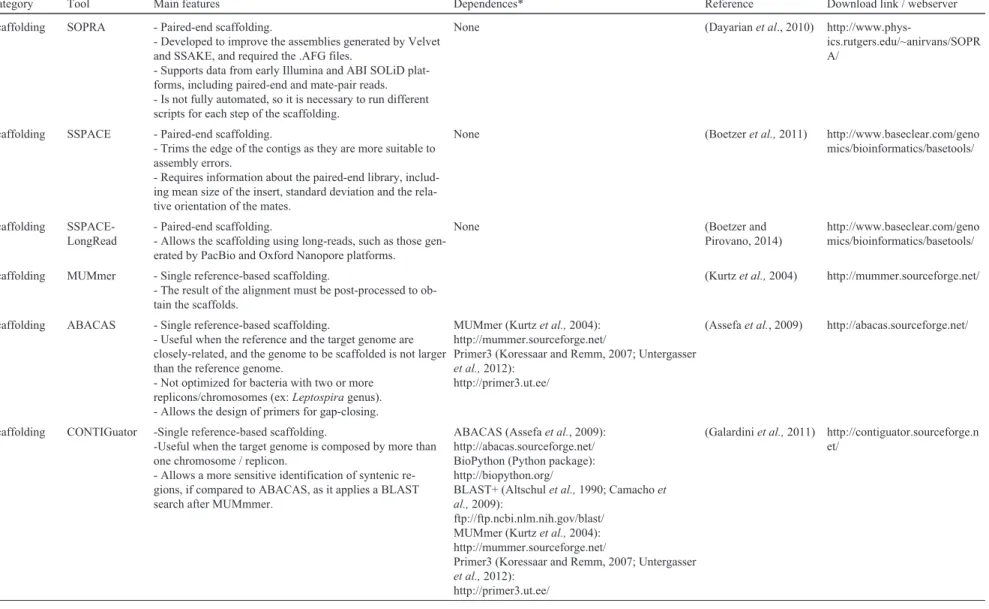
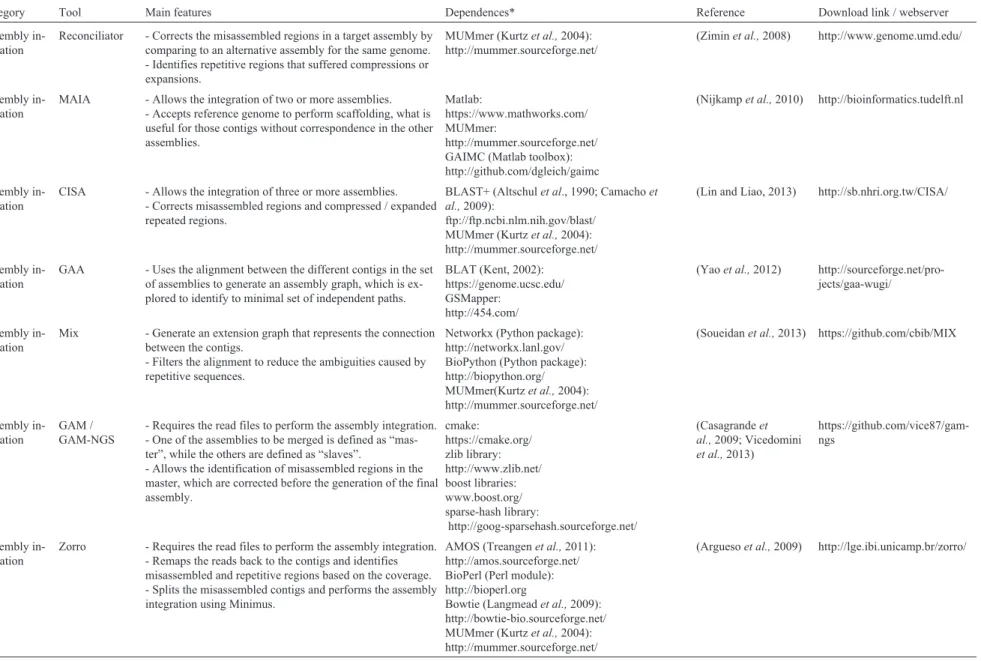
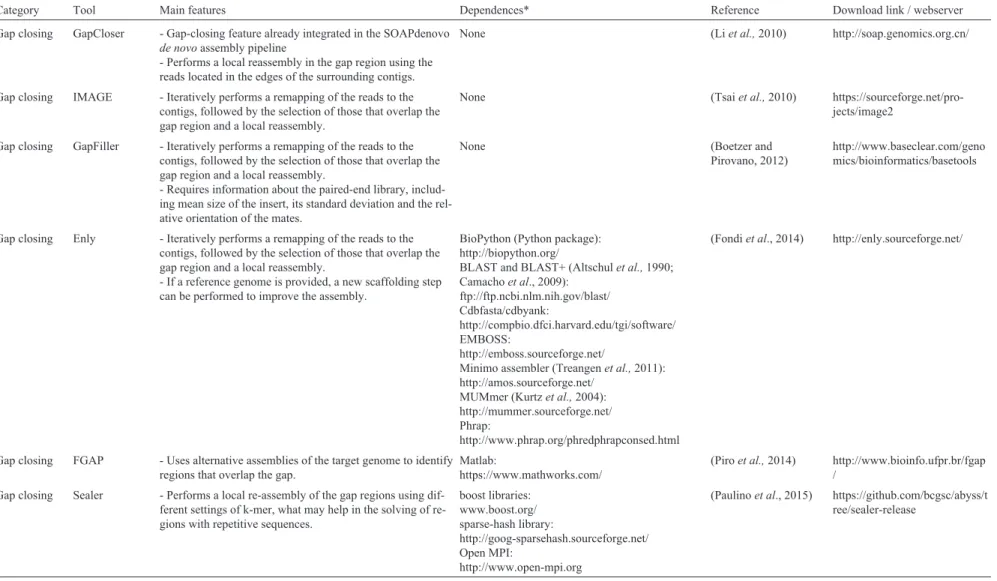
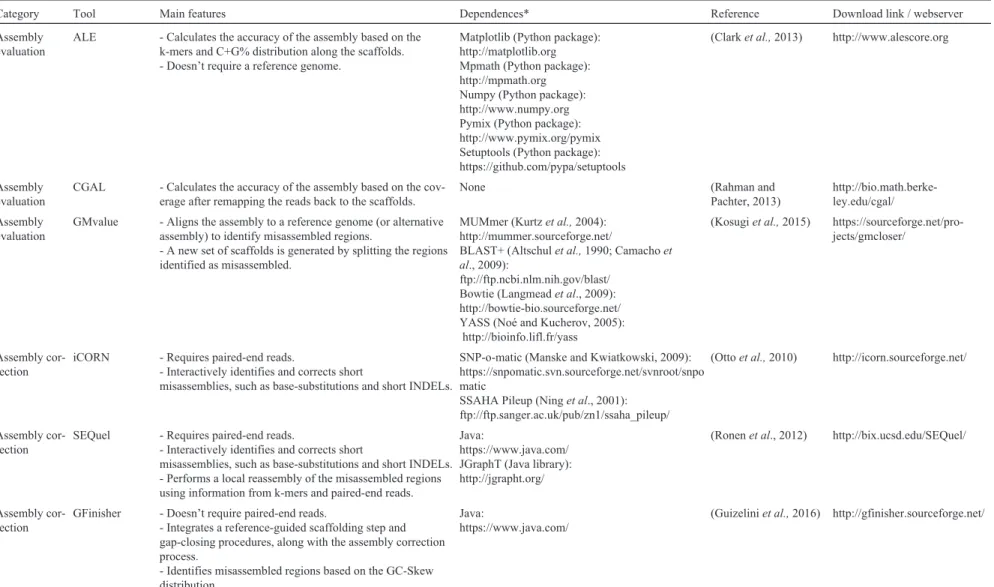
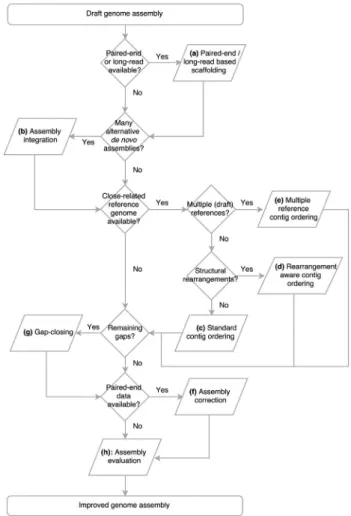
The present review aims at discussing some of the categories of software that may be applied in the process of assembly finishing, especially in the context of microbial genome sequencing projects. A particular focus is placed on those that do not require additional experimental and/or new sequencing data. The review intentionally focuses on tools that are freely available, at least for academic use, and omits proprietary software, like the CLC Genomics Work-bench (http://www.clcbio.com/), for example. This was not due to anticipated differences in the performance or quality of the results, but to adhere to the original intention: an overview of tools that could be used by most researchers. As different approaches have been developed to improve genomic assemblies, the description of these programs was divided into four main categories:scaffolding(placement of contigs into larger sequences by using experimental data or information for closely-related genomes, and joining them by gap regions), assembly integration(generation of a consensus assembly using multiple assemblies for the same genome), gap closing (solving gaps by identifying their correct sequence),error correction(removal of misidenti-fied bases or misassembled regions) andassembly evalua-tion(quantification of the reliability of a genome assembly and identification of its erroneous regions) (Table 1). These different categories of programs can be combined, accord-ing to the type of data that is available (e.g., sequencing platform and library that was used), and may help to reduce the fragmentation and improve the reliability of a genome assembly. Based on the categories of software that are dis-cussed in the present review we have created the flowchart showed in Figure 1, which may of help in choosing the most appropriate approach for genome finishing, depend-ing on the type of the data that is available. Examples of ge-nome projects that used some of the tools discussed in the present review are shown in Supplementary material (Ta-ble S1).
Finishing
microbial
genomes
555
Table 1- Overview of the tools described in the present review
Category Tool Main features Dependences* Reference Download link / webserver
Scaffolding ABySS - Paired-end scaffolding.
- Scaffolding feature already integrated in the ABySSde novoassembly pipeline.
- Uses the estimated distances generated by the program DistanceEst (from the same package) as input.
- Allows the scaffolding using long-reads, such as those gen-erated by PacBio and Oxford Nanopore platforms.
boost libraries: www.boost.org/ Open MPI:
http://www.open-mpi.org sparse-hash library:
http://goog-sparsehash.sourceforge.net/
(Simpsonet al.,2009) http://www.bcgsc.ca/plat-form/bioinfo/software/abyss
Scaffolding Bambus 2 - Paired-end scaffolding.
- Can be easily integrated with assembly projects that are built on top of the AMOS package.
- Supports the scaffolding of metagenomes.
- Requires experience with the AMOS package and its data formats.
AMOS package (Treangenet al.,2011): http://amos.sourceforge.net/
(Korenet al.,2011) https://sourceforge.net/pro-jects/amos/
Scaffolding MIP - Paired-end scaffolding.
- Supports both paired-end and mate-pair (long range) reads.
lpsolve library:
http://sourceforge.net/projects/lpsolve/ lemon li-brary: http://lemon.cs.elte.hu/
(Salmelaet al.,2011)
https://www.cs.hel-sinki.fi/u/lmsalmel/mip-scaffold er/
Scaffolding OPERA - Paired-end scaffolding.
- Identifies potential spurious connections caused by chime-ric reads and repetitive genomics elements that may affect the reliability of the scaffolding.
- Contigs identified as misassembled may be used in the con-struction of more than one scaffold, but sometimes it may lead to new assembly errors.
BWA (Li and Durbin 2009): http://bio-bwa.sourceforge.net/ Bowtie (Langmeadet al.,2009):
http://bowtie-bio.sourceforge.net/ Samtools (Liet al.,2009): http://samtools.sourceforge.net/
(Gaoet al.,2011) https://sourceforge.net/pro-jects/operasf
Scaffolding SCARPA - Paired-end scaffolding.
- Only uses for scaffolding those contigs with length greater than the N50 of the assembly.
- Allows multiple libraries to be used in the same scaffolding project.
None (Donmez and
Brudno, 2013)
http://compbio.cs.to-ronto.edu/hapsembler/scarpa.ht ml
Scaffolding SGA - Paired-end scaffolding.
- Scaffolding feature already integrated in the SGA assembly pipeline, which is optimized for Illumina data and large genomes.
- Uses the estimated distances generated by the program DistanceEst (from the package ABySS) as input, along with the read mapping file in .BAM format.
- Allows multiple libraries to be used in the same scaffolding project.
Bamtools (Barnettet al.,2011): https://github.com/pezmaster31/bamtools BWA (Li and Durbin, 2009):
http://bio-bwa.sourceforge.net/ Samtools (Liet al.,2009): http://samtools.sourceforge.net/
Sparse-hash library:
http://goog-sparsehash.sourceforge.net/
(Simpson and Durbin, 2012)
556
Kremer
et
al.
Category Tool Main features Dependences* Reference Download link / webserver
Scaffolding SOPRA - Paired-end scaffolding.
- Developed to improve the assemblies generated by Velvet and SSAKE, and required the .AFG files.
- Supports data from early Illumina and ABI SOLiD plat-forms, including paired-end and mate-pair reads. - Is not fully automated, so it is necessary to run different scripts for each step of the scaffolding.
None (Dayarianet al., 2010)
http://www.phys-ics.rutgers.edu/~anirvans/SOPR A/
Scaffolding SSPACE - Paired-end scaffolding.
- Trims the edge of the contigs as they are more suitable to assembly errors.
- Requires information about the paired-end library, includ-ing mean size of the insert, standard deviation and the rela-tive orientation of the mates.
None (Boetzeret al.,2011) http://www.baseclear.com/geno
mics/bioinformatics/basetools/
Scaffolding SSPACE-LongRead
- Paired-end scaffolding.
- Allows the scaffolding using long-reads, such as those gen-erated by PacBio and Oxford Nanopore platforms.
None (Boetzer and
Pirovano, 2014)
http://www.baseclear.com/geno mics/bioinformatics/basetools/
Scaffolding MUMmer - Single reference-based scaffolding.
- The result of the alignment must be post-processed to ob-tain the scaffolds.
(Kurtzet al.,2004) http://mummer.sourceforge.net/
Scaffolding ABACAS - Single reference-based scaffolding.
- Useful when the reference and the target genome are closely-related, and the genome to be scaffolded is not larger than the reference genome.
- Not optimized for bacteria with two or more replicons/chromosomes (ex:Leptospiragenus). - Allows the design of primers for gap-closing.
MUMmer (Kurtzet al.,2004): http://mummer.sourceforge.net/
Primer3 (Koressaar and Remm, 2007; Untergasser et al.,2012):
http://primer3.ut.ee/
(Assefaet al., 2009) http://abacas.sourceforge.net/
Scaffolding CONTIGuator -Single reference-based scaffolding.
-Useful when the target genome is composed by more than one chromosome / replicon.
- Allows a more sensitive identification of syntenic re-gions, if compared to ABACAS, as it applies a BLAST search after MUMmmer.
ABACAS (Assefaet al., 2009): http://abacas.sourceforge.net/ BioPython (Python package): http://biopython.org/
BLAST+ (Altschulet al.,1990; Camachoet al.,2009):
ftp://ftp.ncbi.nlm.nih.gov/blast/ MUMmer (Kurtzet al.,2004): http://mummer.sourceforge.net/
Primer3 (Koressaar and Remm, 2007; Untergasser et al.,2012):
http://primer3.ut.ee/
(Galardiniet al.,2011) http://contiguator.sourceforge.n et/
Finishing
microbial
genomes
557
Category Tool Main features Dependences* Reference Download link / webserver
Scaffolding Mauve - Single reference- based scaffolding.
- Can be used both through a commandline interface (CLI) and a graphical user interface (GUI).
- Allows the identification of genomic inversions and translocations.
- Not optimized for bacteria with two or more replicons/chromosomes.
Java:
https://www.java.com/
(Darlinget al., 2004; Rissmanet al.,2009)
http://darlinglab.org/mauve/ma uve.html
Scaffolding FillScaffolds - Single reference- based scaffolding. - Not optimized for bacteria with two or more replicons/chromosomes.
- Results may require post-processing to reconstruct the se-quence of the scaffold.
Java:
https://www.java.com/
(Muñozet al.,2010) Supplementary data of Muñoz et al.(2010).
http://dx.doi.org/10.1186/1471-2105-11-304
Scaffolding SIS - Single reference-based scaffolding.
- Allows the identification of genomic inversions. - Not optimized for bacteria with two or more replicons/chromosomes.
MUMmer (Kurtzet al., 2004): http://mummer.sourceforge.net/
(Diaset al., 2012) http://marte.ic.unicamp.br:8747.
Scaffolding CAR - Single reference-based scaffolding.
- Allows the identification of genomic inversions and translocations.
- Also available as a webserver.
- Not optimized for bacteria with two or more replicons/chromosomes.
MUMmer (Kurtzet al., 2004): http://mummer.sourceforge.net/ PHP:
https://php.net/
(Luet al.,2014)
http://ge-nome.cs.nthu.edu.tw/CAR/
Scaffolding RACA - Multiple reference-based scaffolding.
- Optimized for large genomes and with multiple chromo-somes.
- Can also use paired-end data.
None (Kimet al.,2013):
http://bioen-compbio.bioen.illi-nois.edu/RACA/
Scaffolding Ragout - Multiple reference-based scaffolding.
- Uses phylogenetic information to identify the most proba-ble orientation of the contigs / scaffolds.
Networkx (Python package): http://networkx.github.io/ Newick (Python package):
http://www.daimi.au.dk/~mailund/newick.html Sibelia:
http://github.com/bioinf/Sibelia
(Kolmogorovet al.,2014)
https://github.com/fenderglass/ Ragout
Scaffolding MeDuSa - Multiple reference-based scaffolding.
- Accepts both finished and draft genomes as reference.
BioPython (Python package): http://biopython.org/ Java:
https://www.java.com/ MUMmer (Kurtzet al., 2004): http://mummer.sourceforge.net/
(Bosiet al.,2015) https://github.com/combogeno mics/medusa
Assembly in-tegration
Minimus - Can be easily integrated with assembly projects that are built on top of the AMOS package.
- Requires experience with the AMOS package and its data formats.
AMOS package (Treangenet al.,2011): http://amos.sourceforge.net/
(Sommeret al.,2007) https://sourceforge.net/pro-jects/amos/
558
Kremer
et
al.
Category Tool Main features Dependences* Reference Download link / webserver
Assembly in-tegration
Reconciliator - Corrects the misassembled regions in a target assembly by comparing to an alternative assembly for the same genome. - Identifies repetitive regions that suffered compressions or expansions.
MUMmer (Kurtzet al.,2004): http://mummer.sourceforge.net/
(Ziminet al.,2008) http://www.genome.umd.edu/
Assembly in-tegration
MAIA - Allows the integration of two or more assemblies. - Accepts reference genome to perform scaffolding, what is useful for those contigs without correspondence in the other assemblies.
Matlab:
https://www.mathworks.com/ MUMmer:
http://mummer.sourceforge.net/ GAIMC (Matlab toolbox): http://github.com/dgleich/gaimc
(Nijkampet al.,2010) http://bioinformatics.tudelft.nl
Assembly in-tegration
CISA - Allows the integration of three or more assemblies. - Corrects misassembled regions and compressed / expanded repeated regions.
BLAST+ (Altschulet al., 1990; Camachoet al.,2009):
ftp://ftp.ncbi.nlm.nih.gov/blast/ MUMmer (Kurtzet al.,2004): http://mummer.sourceforge.net/
(Lin and Liao, 2013) http://sb.nhri.org.tw/CISA/
Assembly in-tegration
GAA - Uses the alignment between the different contigs in the set of assemblies to generate an assembly graph, which is ex-plored to identify to minimal set of independent paths.
BLAT (Kent, 2002): https://genome.ucsc.edu/ GSMapper:
http://454.com/
(Yaoet al.,2012) http://sourceforge.net/pro-jects/gaa-wugi/
Assembly in-tegration
Mix - Generate an extension graph that represents the connection between the contigs.
- Filters the alignment to reduce the ambiguities caused by repetitive sequences.
Networkx (Python package): http://networkx.lanl.gov/ BioPython (Python package): http://biopython.org/ MUMmer(Kurtzet al.,2004): http://mummer.sourceforge.net/
(Soueidanet al.,2013) https://github.com/cbib/MIX
Assembly in-tegration
GAM / GAM-NGS
- Requires the read files to perform the assembly integration. - One of the assemblies to be merged is defined as “mas-ter”, while the others are defined as “slaves”.
- Allows the identification of misassembled regions in the master, which are corrected before the generation of the final assembly.
cmake:
https://cmake.org/ zlib library: http://www.zlib.net/ boost libraries: www.boost.org/ sparse-hash library:
http://goog-sparsehash.sourceforge.net/
(Casagrandeet al.,2009; Vicedomini et al.,2013)
https://github.com/vice87/gam-ngs
Assembly in-tegration
Zorro - Requires the read files to perform the assembly integration. - Remaps the reads back to the contigs and identifies misassembled and repetitive regions based on the coverage. - Splits the misassembled contigs and performs the assembly integration using Minimus.
AMOS (Treangenet al.,2011): http://amos.sourceforge.net/ BioPerl (Perl module): http://bioperl.org
Bowtie (Langmeadet al.,2009): http://bowtie-bio.sourceforge.net/ MUMmer (Kurtzet al.,2004): http://mummer.sourceforge.net/
(Arguesoet al.,2009) http://lge.ibi.unicamp.br/zorro/
Finishing
microbial
genomes
559
Category Tool Main features Dependences* Reference Download link / webserver
Gap closing GapCloser - Gap-closing feature already integrated in the SOAPdenovo de novoassembly pipeline
- Performs a local reassembly in the gap region using the reads located in the edges of the surrounding contigs.
None (Liet al.,2010) http://soap.genomics.org.cn/
Gap closing IMAGE - Iteratively performs a remapping of the reads to the contigs, followed by the selection of those that overlap the gap region and a local reassembly.
None (Tsaiet al.,2010)
https://sourceforge.net/pro-jects/image2
Gap closing GapFiller - Iteratively performs a remapping of the reads to the contigs, followed by the selection of those that overlap the gap region and a local reassembly.
- Requires information about the paired-end library, includ-ing mean size of the insert, its standard deviation and the rel-ative orientation of the mates.
None (Boetzer and
Pirovano, 2012)
http://www.baseclear.com/geno mics/bioinformatics/basetools
Gap closing Enly - Iteratively performs a remapping of the reads to the contigs, followed by the selection of those that overlap the gap region and a local reassembly.
- If a reference genome is provided, a new scaffolding step can be performed to improve the assembly.
BioPython (Python package): http://biopython.org/
BLAST and BLAST+ (Altschulet al.,1990; Camachoet al., 2009):
ftp://ftp.ncbi.nlm.nih.gov/blast/ Cdbfasta/cdbyank:
http://compbio.dfci.harvard.edu/tgi/software/ EMBOSS:
http://emboss.sourceforge.net/
Minimo assembler (Treangenet al.,2011): http://amos.sourceforge.net/
MUMmer (Kurtzet al.,2004): http://mummer.sourceforge.net/ Phrap:
http://www.phrap.org/phredphrapconsed.html
(Fondiet al., 2014) http://enly.sourceforge.net/
Gap closing FGAP - Uses alternative assemblies of the target genome to identify regions that overlap the gap.
Matlab:
https://www.mathworks.com/
(Piroet al.,2014) http://www.bioinfo.ufpr.br/fgap /
Gap closing Sealer - Performs a local re-assembly of the gap regions using dif-ferent settings of k-mer, what may help in the solving of re-gions with repetitive sequences.
boost libraries: www.boost.org/ sparse-hash library:
http://goog-sparsehash.sourceforge.net/ Open MPI:
http://www.open-mpi.org
(Paulinoet al., 2015) https://github.com/bcgsc/abyss/t ree/sealer-release
560
Kremer
et
al.
Category Tool Main features Dependences* Reference Download link / webserver
Gap closing GMCLoser - May use both paired-end reads and alternative assemblies to perform the gap-closing.
- Applies a likelihood analysis to avoid the effect of misassemblies in the alternative assemblies.
MUMmer (Kurtzet al.2004): http://mummer.sourceforge.net/
BLAST+ (Altschulet al., 1990; Camachoet al., 2009):
ftp://ftp.ncbi.nlm.nih.gov/blast/ Bowtie (Langmeadet al., 2009): http://bowtie-bio.sourceforge.net/ YASS (Noé and Kucherov, 2005):
http://bioinfo.lifl.fr/yass
(Kosugiet al.,2015) https://sourceforge.net/pro-jects/gmcloser/
Gap closing MapRepeat - Performs a reference-based scaffolding using a closely-related genome provided by the user. - Uses a reference-guided assembly to perform the gap-closing process.
BLAST+ (Altschulet al.,1990; Camachoet al., 2009):
ftp://ftp.ncbi.nlm.nih.gov/blast/ BioPython (Python package): http://biopython.org/ MIRA:
http://mira-assembler.sourceforge.net MUMmer (Kurtzet al., 2004): http://mummer.sourceforge.net/
(Marianoet al., 2015) http://github.com/dcbmariano/ maprepeat
Gap closing GapBlaster - Allows a manual gap-closing using an alternative assembly of the target genome.
BLAST and BLAST+ (Altschulet al., 1990; Camachoet al.,2009):
ftp://ftp.ncbi.nlm.nih.gov/blast/ MUMmer (Kurtzet al., 2004): http://mummer.sourceforge.net/
(de Sáet al., 2016) https://sourceforge.net/pro-jects/gapblaster2015/
Assembly evaluation
REAPR - Calculates the accuracy of the assembly based on the cov-erage after remapping the reads back to the scaffolds. - Misassembled regions can be identified as they usually present a discrepant coverage.
- A new set of scaffolds is generated by splitting the regions identified as misassembled.
File::Basename, File::Copy, File::Spec, File::Spec: :Link, Getopt::Long and List::Util (Perl modules): http://www.cpan.org/
R:
https://www.r-project.org/
(Huntet al.,2013) http://www.sanger.ac.uk/sci-ence/tools/reapr
Assembly evaluation
QUAST - Calculate several assembly metrics, such as C+G%, N50 and L50.
- Can be used to compare different assemblies for the same genome, and / or compare then to a reference genome.
boost libraries: www.boost.org/ Java:
https://www.java.com/ Matplotlib (Python package): http://matplotlib.org Time::HiRes (Perl module): http://www.cpan.org/
(Gurevichet al., 2013) http://bioinf.spbau.ru/quast
Finishing
microbial
genomes
561
Category Tool Main features Dependences* Reference Download link / webserver
Assembly evaluation
ALE - Calculates the accuracy of the assembly based on the k-mers and C+G% distribution along the scaffolds. - Doesn’t require a reference genome.
Matplotlib (Python package): http://matplotlib.org Mpmath (Python package): http://mpmath.org Numpy (Python package): http://www.numpy.org Pymix (Python package): http://www.pymix.org/pymix Setuptools (Python package): https://github.com/pypa/setuptools
(Clarket al.,2013) http://www.alescore.org
Assembly evaluation
CGAL - Calculates the accuracy of the assembly based on the cov-erage after remapping the reads back to the scaffolds.
None (Rahman and
Pachter, 2013)
http://bio.math.berke-ley.edu/cgal/ Assembly
evaluation
GMvalue - Aligns the assembly to a reference genome (or alternative assembly) to identify misassembled regions.
- A new set of scaffolds is generated by splitting the regions identified as misassembled.
MUMmer (Kurtzet al.,2004): http://mummer.sourceforge.net/
BLAST+ (Altschulet al.,1990; Camachoet al., 2009):
ftp://ftp.ncbi.nlm.nih.gov/blast/ Bowtie (Langmeadet al., 2009): http://bowtie-bio.sourceforge.net/ YASS (Noé and Kucherov, 2005):
http://bioinfo.lifl.fr/yass
(Kosugiet al.,2015) https://sourceforge.net/pro-jects/gmcloser/
Assembly cor-rection
iCORN - Requires paired-end reads.
- Interactively identifies and corrects short
misassemblies, such as base-substitutions and short INDELs.
SNP-o-matic (Manske and Kwiatkowski, 2009): https://snpomatic.svn.sourceforge.net/svnroot/snpo matic
SSAHA Pileup (Ninget al., 2001): ftp://ftp.sanger.ac.uk/pub/zn1/ssaha_pileup/
(Ottoet al.,2010) http://icorn.sourceforge.net/
Assembly cor-rection
SEQuel - Requires paired-end reads.
- Interactively identifies and corrects short
misassemblies, such as base-substitutions and short INDELs. - Performs a local reassembly of the misassembled regions using information from k-mers and paired-end reads.
Java:
https://www.java.com/ JGraphT (Java library): http://jgrapht.org/
(Ronenet al., 2012) http://bix.ucsd.edu/SEQuel/
Assembly cor-rection
GFinisher - Doesn’t require paired-end reads.
- Integrates a reference-guided scaffolding step and gap-closing procedures, along with the assembly correction process.
- Identifies misassembled regions based on the GC-Skew distribution.
Java:
https://www.java.com/
(Guizeliniet al.,2016) http://gfinisher.sourceforge.net/
* = Considering a computer running UNIX, Linux or Mac OS operating systems (OSs). As Make, sed, awk, GCC, Perl, Bash, Python and the GNU/Unix standard utility set are already included in most of the distri-butions / versions of these OSs, these programs were not listed as dependences.
Scaffolding
By definition, a contig consists of a contiguous se-quence has no unknown regions or assembly gaps (but may contain “N” that represent base-calling errors) (Staden,
1979). On the other hand, a scaffold consists of two or more contigs that have been joined according to some linkage in-formation (e.g., paired-end reads, genome maps) (Husonet al., 2002). Paired-end or mate-pair libraries can be very useful inde novogenome assembly, and several tools use the relative position information to connect contigs into scaffolds (Huntet al., 2014). In a similar way, with the in-crease in the availability of genomic sequences from a wide variety of species, other scaffolding alternatives were de-veloped to use one or multiple genomes as reference to or-der the contigs.
Paired-end scaffolding
Most of thede novogenome assemblers usually inte-grate scaffolding steps after the contig constructions, al-though it is also possible to use third-party tools aiming a more reliable result. The A5 assembly pipeline (Trittet al., 2012), for example, usesde novoassembler IDBA (Penget al., 2010) to construct the contigs and SSPACE (Boetzeret al., 2011) to generate scaffolds. The scaffolding with paired-end reads usually consist of the alignment of reads to the contigs, followed by the identification of connections between different contigs using the relative-orientation in-formation and the estimated insert-size. ABySS (Simpson
et al., 2009), SOPRA (Dayarianet al., 2010), SOAPdenovo (Li et al., 2010), Bambus 2 (Koren et al., 2011), MIP (Salmelaet al., 2011), Opera (Gaoet al., 2011), SSPACE (Boetzeret al., 2011), SLIQ (Royet al., 2012), SGA (Sim-pson and Durbin 2012), SCARPA (Donmez and Brudno 2013), WiseScaffolder (Farrant et al., 2015) and ScaffoldScaffolder (Bodilyet al., 2016) are examples of scaffolding tools based on paired-end information. More recently, the use of long-reads was also incorporated into scaffolding tools such as AHA (Bashiret al., 2012) and SSPACE-LongRead (Boetzer and Pirovano, 2014).
ABySS (Simpsonet al., 2009):The program abyss-scaffold, which comes with the ABySS assembly package (Simpsonet al., 2009), uses the estimated mate-distance distribution in paired-end reads to connect contigs and gen-erate scaffolds. The distance distribution can be calculated by DistanceEst, that is also part of the package, and is also used by other assembly pipelines, such as SGA (Simpson and Durbin, 2012). ABySS was developed to be used both with small and large genomes, and can be executed in a computer clustering by using the Message Passing Inter-face (MPI), this being useful also in case of high-coverage data and when dealing with multiple libraries. Like most scaffolding programs, abyss-scaffold can be used also in the scaffolding of contigs generated by third-party pro-grams. Finally, ABySS also supports scaffolding with long-reads by using BWA-MEM for read alignment (Li and Durbin, 2009). The source code of the ABySS package is available at the address http://www.bcgsc.ca/platform/ bioinfo/software/abyss, and is developed to work on the Linux operating system.
562 Kremeret al.
SOPRA (Dayarianet al., 2010): This scaffolding tool was designed to improve assemblies generated by Velvet (Zerbino and Birney, 2008) and SSAKE (Warrenet al., 2007), and targets the earlier sequencing platforms from Illumina and ABI SOLiD. The program parses the read-placing file generated by these assemblers and extracts in-formation of paired-end/mate-pair reads, that is used to cal-culate the mean distance between pairs and the correct orientation. Based on this file, SOPRA also infers the con-nections between contigs by searches of those pairs of reads where mates are in different contigs. The program is not fully automated, so each step of data processing must be ex-ecuted by a different script before the main scaffolding pro-cess. Another drawback is the limited support for different
de novoassemblers, as it requires read-placing files in AFG format, and this is only produced by a few assemblers now-adays (e.g., Velvet, Ray and AMOS). SOPRA can be ob-tained from the website http://www.physics.rutgers.edu/ ~anirvans/SOPRA/.
Bambus 2 (Korenet al., 2011):It is part of the AMOS package (Treangenet al., 2011) and is both a genome and metagenome scaffolding tool and an updated version of the Sanger-based program Bambus targeting NGS data (Popet al., 2004). The program requires read-placing information to construct a contig-graph, and explore the graph to find consistent connections between the contigs. As Bambus2 can also be used to scaffold metagenomic assemblies, dif-ferent from other programs, it considers the effect of DNA samples containing mixes of closely related organisms in the assembly processes and reduces the chance of fragmen-tation and miss-joining by analyzing the molecular vari-ants. However, the use of Bambus 2 is not as simple as for other scaffolding tools, as it requires some experience with the AMOS tools to generate its input file and processes the outputs (Treangenet al., 2011). The AMOS package can be obtained from the SourceForge repository: https://sourceforge.net/projects/amos/.
MIP (Salmelaet al., 2011):uses the concept of mixed integer programming to generate a set of scaffolds from a genome assembly and a set paired-ends/mate-pair reads. First, readaligner (Mäkinenet al., 2010) is used to map the read-pairs back to the contigs. Then, the pairs are filtered to remove inconsistent connections, and the distances be-tween the contigs are estimated based on the mean distance between the mates, which is calculated for each library used in the assembly. The connections in the generated scaffold graph have a minimum and maximum estimated length, de-rived from the library information. The MIP source code, along with usage instructions, is available at https://www.cs.helsinki.fi/u/lmsalmel/mip-scaffolder/.
Opera (Gaoet al., 2011):takes as inputs a collection of contigs and mapped reads and generates a scaffold graph based on the paired-end information. Frist, the program fil-ters the connections between contigs to remove possible miss-joining errors caused by chimeric pairs. The graph is
contracted, and the optimum orientation of the contigs inside the scaffolds is inferred by a dynamic programming algorithm that explores the search space. The algorithm can also infer the occurrence of repeated genomic regions, usu-ally assembled into a single contig in case of short-reads. In this case, repeated regions are identified by comparing the coverage of the contigs to the mean coverage of the whole genome and selection those with value greater than 1.5 times the genomic mean. The identification of these regions allows a contig to be used in more than one scaffolds, which can provide a better assembly of repeated regions, but can also result in misassemblies. Opera can be obtained from its SourceForge repository https://sourceforge.net/projects/ operasf/.
SGA (String Graph Assembler) (Simpson and Durbin 2012):is ade novogenome assembler developed for the memory-efficient assembly of small and large genomes by applying the method proposed by Myers (2005). As part of its assembly pipeline, SGA also provide a scaffolding tool that uses information from read alignment (in .BAM for-mat), that can be generated by a wide variety of mapping tools (Liet al., 2008; Langmead et al., 2009; Lunter and Goodson, 2011), and estimated distance between mates, generated by DistanceEst, from the ABySS package, to connect contigs into scaffolds. SGA also supports scaffold-ing from multiple libraries, with different insert sizes, and was optimized to work with Illumina data. SGA is available from the GitHub repository https://github.com/jts/sga.
SCARPA (Donmez and Brudno, 2013): uses paired-end information to generate scaffolds, but takes into account that not only chimeric reads may be to responsible for inconsistent linkages between contigs but also mi-sassembled sequences. It estimates the mean and standard deviation of the distance between the mates, but only uses information from those contigs with length greater than the assembly N50. The connections between the contigs are es-timated based on the mate information and the calculated metrics, and if more than one library is provided, SCARPA process the scaffolding iteratively starting from the library with smaller insertion size. The program can be obtained from the URL http://compbio.cs.toronto.edu/hapsembler/ scarpa.html.
SSPACE (Boetzer et al., 2011) and SSPACE-LongRead (Boetzer and Pirovano, 2014): these scaffolding programs are currently distributed by BaseClear (http://www.baseclear.com), which also distributes the gap-closing program GapFiller (Boetzer and Pirovano, 2012). SSPACE requires information about paired-end li-brary, including mean and standard deviation of distance between the mates and the expected orientation, whose val-ues can be predicted with the script “estimate_in-sert_size.pl”, distributed along with the program. The user may choose between BWA (Li and Durbin, 2009) and Bowtie (Langmeadet al., 2009) for read mapping, the mini-mum number of connections to link two contigs, the
ber of bases that will be removed from the border of the contigs (as they usually contain errors), and the number of iterations. For SSPACE-LongRead, the target assembly is aligned to a collection of long-reads using BLASR (Chai-sson and Tesler, 2012) and the alignments are filtered and refined to find the best orientation. Both SSPACE and SSPACE-LongRead can be requested from the BaseClear website http://www.baseclear.com/genomics/ bioinformatics/basetools/.
Huntel al.(2014) have performed an extensive com-parison of the scaffolding tools and demonstrated that the quality of the resulting scaffolds is directly affected by the read-mapping program and the complexity of the genome. For the tested datasets, the best results were obtained by SGA, SOPRA and SSPACE, although all tested tools pre-sented a certain percentage of miss-joined scaffolds in their outputs. Some scaffolding tools (e.g., SGA) use pre-aligned reads as input, so the user is able to test and choose the read mapper. In this case, it is important to try different read mappers, taking into account that platform-specific bias and read quality may have a drastic effect on the qual-ity of the alignment (Hatemet al., 2013; Cabocheet al., 2014). When using mate-pair libraries (long-insert
paired-end reads) it is also important to check if the scaffolder was designed to support it, or if it was just designed for stan-dard, short-insert, paired-end reads. As mate-pairs may present a relatively high rate of “false mates”, special care may be taken when working with this type of data.
Single reference-based scaffolding
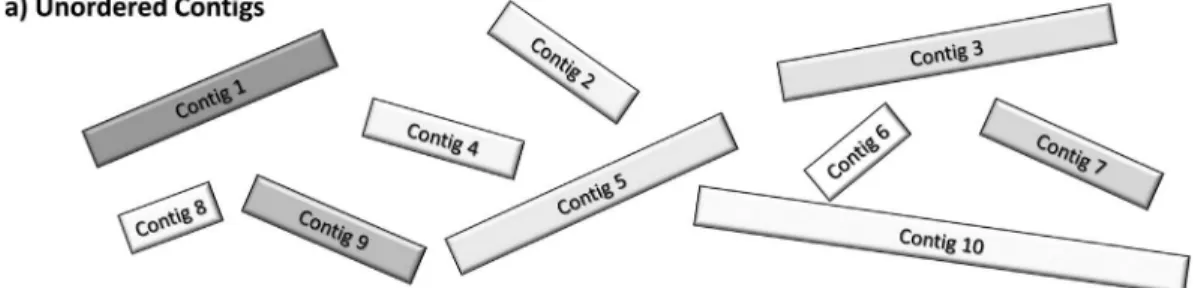
In many cases the pairing information is not enough to generate a reliable reconstruction of the genome’s struc-ture, or simply, the genome was not sequenced using paired-reads, but with single-end sequencing. In order to overcome this, some tools were developed to use a refer-ence genome as a template to perform the contig ordering and relative positioning (Figure 2). Software like MUMmer (Kurtz et al., 2004), ABACAS (Assefa et al., 2009), CONTIGuator (Galardiniet al., 2011) and Mauve (Darling
et al., 2004; Rissmanet al., 2009) are able to identify the most probable orientation of the contigs, but may generate incorrect results in the case of genome inversions of trans-locations. On the other hand, SIS (Diaset al., 2012), CAR (Luet al., 2014), and FillScaffolds (Muñoz et al., 2010) consider the occurrence of changes in the genomic struc-ture and take these phenomena into account during the
564 Kremeret al.
analysis, generating a more accurate reconstruction. All these tools use information from a single genome as refer-ence, however more recently, some tools, such as Ragout (Kolmogorovet al., 2014) and MeDuSa (Bosiet al., 2015), were developed to use information from multiple reference genomes, allowing an evolutionary-based inference of structural re-arrangements. These multiple reference-based contig ordering tools will be discussed in the next section. MUMmer (Kurtzet al., 2004): is a genome-scale se-quence alignment tool which can be applied to perform the alignment of a set of contigs/scaffolds to a reference ge-nome, allowing a wide variety of applications in genomic analysis and NGS data processing, including reference-guided scaffolding. The two main algorithms of the MUMmer package are NUCmer, which performs a stan-dard DNA-DNA alignment, and PROmer, which performs an alignment of the six reading frames of both sequences (leading to a more sensitive result, especially in the case of highly divergent organisms). The package also includes other tools, such as delta-filter, that can be used to remove the ambiguities in the alignments and select those that are more relevant for the analysis. Many scaffolding tools, like ABACAS (Assefaet al., 2009), CONTIGuator (Galardini
et al., 2011) and MeDuSa (Bosiet al., 2015), are built on top of MUMmer and take advatange of its performance, but also add new features to improve the output. MUMmer it-self does not provide the sequence of the scaffold, just the positions of the alignments. Therefore, it is necessary to perform a post-processing of the results to obtain the se-quence of the scaffolds. MUMmer can be obtained from its SourceForge repository http://mummer.sourceforge.net/.
ABACAS (Algorithm-based Automatic Contigua-tion of Assembled Sequences) (Assefaet al., 2009): can use NUCmer or PROmer from the MUMmer (Kurtz et al., 2004) package to align the contigs against a reference ge-nome. The regions that do not have an equivalent sequence in the contig set are filled with Ns, indicating gaps. ABACAS can also be used to design PCR primers to am-plify the unknown regions by integrating Primer3 (Ko-ressaar and Remm, 2007; Untergasser et al., 2012). ABACAS can be obtained from its SourceForge repository http://abacas.sourceforge.net/, and as part of the PAGIT package (Swainet al., 2012), available at http://www.sang-er.ac.uk/science/tools/pagit.
CONTIGuator (Galardini et al., 2011): uses ABACAS (Assefaet al., 2009) to perform the contig order-ing, but adds support to multiple references, which may be useful in the case of organisms that have more than one chromosome. BLAST (Altschulet al., 1990; Camacho et al., 2009) is used to align the contigs used as input with the reference sequences to identify the correct reference for each sequence. Then, ABACAS (Assefaet al., 2009) is used, and its results are integrated with the BLAST align-ment to generate a final assembly. CONTIGuator can be obtained from its SourceForge repository
http://contiguator.sourceforge.net/, and is also available as a webserver http://combo.dbe.unifi.it/contiguator.
Mauve (Darlinget al., 2004; Rissmanet al., 2009): is an alignment tool that can handle and align multiple ge-nomes and identify regions of high similarity called Lo-cally Collinear Blocks (LCBs). One of the program’s fea-tures, Mauve Contig Mover, performs contig ordering using the same algorithm (Rissmanet al., 2009). The pro-gram runs in an iterative mode, generating and optimizing the contig orientations based on the reference until no change is possible that can improve the model. A directory is generated for each iteration that contains inputs to visual-ize the genome in Mauve and a FASTA file with the sorted contigs. The Mauve aligner can be obtained from the URL http://darlinglab.org/mauve/mauve.html.
FillScaffolds (Muñozet al., 2010): analyzes the nomic distance between the contig set and a reference ge-nome and generates an ordered sequence through identifying orthologous genes. It considers the effects of the evolutionary distance in the case of missing genes, and then uses the position of the orthologos present in the refer-ence to order the contigs. The source code of FillScaffolds is available as a supplementary data of the Muñozet al.
(2010) paper at:
http://bmcbioinformatics.biomedcentral.com/arti-cles/10.1186/1471-2105-11-304.
SIS (Scaffolds from Inversion Signatures) (Dias et al., 2012): takes as input a set of contigs in FASTA format and a coordinate file generated by NUCmer or PROmer (Kurtzet al., 2004) after these contigs have been aligned with the reference sequence. Using the coordinates, the program searches for inversion signatures and generates a collection of orientations of the sequences that can be used to construct the scaffolds. The source code of SIS can be obtained from the URL http://marte.ic.unicamp.br:8747.
CAR (Contig Assembly using Rearrangements) (Lu
et al., 2014): uses NUCmer and PROmer in combination, unlike ABACAS (Assefaet al., 2009) and SIS (Diaset al., 2012), that use the result of only one. Based on the coordi-nates, CAR uses a block permutation model to generate the contig order by considering not only the effect of the ge-nomic inversions, but also the occurrence of transpositions (Li et al., 2013). CAR can be used from the webserver http://genome.cs.nthu.edu.tw/CAR/, where the source code is also available for download.
Considering the main algorithm of each program, it is important to keep in mind that the most appropriate tool for a given task will depend on the organism and the availabil-ity of the reference genomes. ABACAS (Assefa et al., 2009) is very useful if the reference genome is larger than the target genome (considering the sum of the length of all contigs, and that all contigs have a homologous region in the reference), and the primer designing tools might be helpful in some cases; however, its sensibility decreases in cases of structural divergence. In such cases, other tools,
like CONTIGuator (Galardini et al., 2011) and Mauve (Darlinget al., 2004; Rissmanet al., 2009), may be more effective. Finally, SIS (Diaset al., 2012) and CAR (Luet al., 2014) are indicated if the draft genome may present genomic inversions or transpositions. For most of the appli-cations, these tools usually provide reliable results, espe-cially for organisms that do not show a very variable ge-nomic organization, and/or when there are enough finished genomes to properly choose the best reference. However, in some situations it may be necessary to evaluate different tools and references to check which one provides the best results. Finally, a single-reference may also lead to an “overfitted” ordering, especially when the reference is smaller, or in case of genomic inversions and translo-cations.
Multiple reference scaffolding
Sometimes it is very difficult to identify the most ap-propriate reference genome to use for contig ordering, es-pecially when structural rearrangements are common events in the genus/species of interests. Additionally, when using BLAST to identify the most “close-related” strain from a database of already finished genomes, it is not usual to find different strains as best hit for each contig. Finally, there are also those cases where no finished genome is available, but there are draft genomes of related strains. In these cases it would not be appropriate to use programs that take into account alignments against only one reference, so data from multiple organisms should be considered. The use of multi-references is relatively recent and another con-sequence of the advent of NGS, as there is more draft genomes than finished ones available in public databases. Examples of algorithms and programs that use this ap-proach are RACA (Kimet al., 2013), Ragout (Kolmogorov
et al., 2014) and MeDuSa (Bosiet al., 2015).
RACA (Reference-Assisted Chromosome Assem-bly) (Kimet al., 2013): uses local sequence alignment to
identify co-linear synteny blocks.The synteny blocks are
filtered using a length threshold, and based on the reference genomes, the probability of each synteny block adjacent to the others is calculated. This probability can also be com-bined with paired-end information to identify the most probable set of scaffold. The source code of RACA can be obtained from the URL http://bioen-compbio.bioen.illi-nois.edu/RACA/.
Ragout (Kolmogorovet al., 2014): uses phylogenetic information and synteny blocks to order a set of contigs from a target genome using multiple genome references. First, Sibelia (Minkin et al., 2013) is used to identify synteny blocks shared by the target and the reference se-quences. Based on the synteny, the nucleotides of the ge-nomes are represented as sequences of blocks, and the best “block orientation” is identified by a maximum parsimony, taking into account the block order in the reference ge-nomes. The source code of Ragout can be obtained from its
repository at GitHub https://github.com/fenderglass/Ra-gout.
MeDuSa (Multi-Draft based Scaffolder) (Bosiet al., 2015): is a graph-based scaffolder that uses information from multiples references, which can be finished or draft genomes. The program uses NUCmer to alignment the tar-get genomes to the references and construct a weighted graph based on the alignments were the nodes of the graph are connected by identifying those contigs that aligned to the same sequence in the references. In the next step, the orientation of each contig is assigned based on the align-ment information and the most-probable ordered identified in the graph. The source code of MeDuSa can be obtained from the repository at GitHub https://github.com/ combogenomics/medusa.
Assembly integration
Different assemblers, or even the same assembler ex-ecuted with different configurations, may produce different results. Minimum coverage, coverage cut-offs, minimum contig length, and k-mer size are examples of just some pa-rameters that can affect the decisions of the assembler dur-ing the construction of the contigs (Baker, 2012). The way low-quality reads are treated, or how the correct paths in the assembly graph are constructed, is also different for each program. As different assemblies may present different representations of a given region in the genome, the con-struction of a “consensus assembly” can be an effective method of reducing assembly errors and generating an opti-mized set of contigs. This process, which is sometimes called “assembly reconciliation,” “assembly merging,” or “assembly integration,” can receive as input only a set of assemblies, as implemented in Minimus (Sommer et al., 2007), Reconciliator (Ziminet al., 2008), MAIA (Nijkamp
et al., 2010), CISA (Lin and Liao 2013), GAA (Yaoet al., 2012) and Mix (Soueidanet al., 2013), or both a set of as-semblies and the reads used for the assembly, as is the case with GAM-NGS (Vicedomini et al., 2013) and Zorro (Arguesoet al., 2009).
Minimus (Sommeret al., 2007): is an assembly tool
from the AMOS package (Treangenet al., 2011). Initially
conceived to perform assembly of small genomes, it was posteriorly adapted for assembly integration. The main al-gorithm is based on the overlap-layout-consensus paradigm (Peltolaet al., 1984), which involves taking a set of
se-quences and performing several alignments to identify overlaps. The information provided by the alignments is used to construct a graph that is minimized by a combina-tion of algorithms (Myers, 1995, 2005) to generate a final assembly. Minimus is available as part of the AMOS pack-age, which can be obtained from the SourceForge reposi-tory https://sourceforge.net/projects/amos/.
Reconciliator (Zimin et al., 2008): uses NUCmer, from the MUMmer package (Kurtzet al., 2004), to identify assembly errors by comparing a template with a secondary
assembly. With the alignments, the tool is able to identify the regions that have possibly suffered compression or ex-pansion due to assembly errors in repetitive DNA se-quences. The source code of Reconciliator is available from the URL http://www.genome.umd.edu/.
MAIA(Multiple Assembly Integrator) (Nijkamp et al., 2010): uses the overlap-layout-consensus paradigm in a similar way to Minimus to construct a graph based on the overlaps identified by MUMmer (Kurtzet al., 2004). The connections in the graph are used to construct a new assem-bly, and contigs that have no connection can be integrated with the assembly using a reference genome as a template. MAIA was implemented on top of the Matlab program-ming language and is available as a package for it that can be obtained from the URL http://bioinformatics.tudelft.nl.
GAA (Graph Accordance Assembly) (Yao et al., 2012): is an assembly integration software that is based on a homonymous data structure. Taking a set of contigs as in-put, the tool uses BLAT (Kent, 2002) to generate align-ments, identify overlaps and then generate a graph that represents the connections between the contigs. GAA is available from the SourceForge repository http://sourceforge.net/projects/gaa-wugi/.
CISA (Contig Integrator for Sequence Assembly) (Lin and Liao, 2013): uses a four-step algorithm to generate the merged assembly. First, a set of representative contigs is chosen from the individual assemblies. Assembly errors are identified by aligning all sets to one another, and any re-gions that are present in only one sequence are considered to be erroneous. In the event of errors, the contigs are bro-ken in the incorrect portion into smaller sequences. The third step consists of generating several alignments using BLAST (Altschulet al., 1990; Camachoet al., 2009), and NUCmer (Kurtzet al., 2004) to identify the optimal length of repetitive sequences. The information generated in the third step is used to construct the merged assembly in the fi-nal stage of the program. CISA can be obtained from the URL http://sb.nhri.org.tw/CISA/.
Mix (Soueidanet al., 2013): uses alignments gener-ated by NUCmer (Kurtzet al., 2004) to generate an exten-sion graph where the contigs are connected by their borders. The alignments are filtered to remove repetitive sequences, and this information is used to generate a graph. Finally, the algorithm parses the graph to identify the Maxi-mal Independent Longest Path Set (MILPS) that represents the final assembly. The Mix source code is available at the GitHub repository https://github.com/cbib/MIX.
GAM (Genomic Assemblies Merger) (Casagrandeet al., 2009) and GAM-NGS (Genomic Assemblies Merger for Next Generation Sequencing) (Vicedomini et al., 2013): GAM takes an assembly as a template, which is re-ferred to as the “master”, and extends it using one or more sets of auxiliary assemblies (called “slaves”) by identifying blocks inside the sequences that were generated by the same reads. GAM was designed to run using contigs that
are generated by Sanger sequencing, and it needs an AFG layout file that contains the position information of the reads used to construct the contigs. AFG files are only pro-duced by a few NGS assemblers, like Velvet (Zerbino and Birney, 2008) and Ray (Boisvertet al., 2010). A newer ver-sion, called GAM-NGS (Vicedominiet al., 2013), was de-veloped to work in the modern context of genome assembly and to avoid the requirement for a template file by using a read alignment file (BAM) (Liet al., 2009) instead. Addi-tionally, GAM-NGS can also identify misassemblies and perform corrections before generating the final assembly. The source code of GAM-NGS is available from the GitHub repository https://github.com/vice87/gam-ngs.
Zorro (Arguesoet al., 2009): Combines a preprocess-ing step based on the maskpreprocess-ing of repetitive DNA in the se-quences, followed by the split of possible misassembled regions, and the assembly integration performed by Mini-mus (Sommeret al., 2007). The misassembled regions are identified by using Bowtie (Langmeadet al., 2009) to re-map the reads used for the assembly back to the contigs and by analyzing the coverage along the sequence. Zorro can be obtained from the URL http://lge.ibi.unicamp.br/zorro/.
The use of read alignment information, usually taken from BAM/SAM files, may help Assembly integrating tools to properly choose and identify bocks that are derived from the same genomic region, but, just like scaffolding, the quality of the process be directly affected by the se-quencing platform and settings of the read mapper. Addi-tionally, assembly integration with paired-end reads is usu-ally much more time and memory consuming than scaffolding, so it is important to its important to check the system’s availability before choose use this approach.
Gap closing
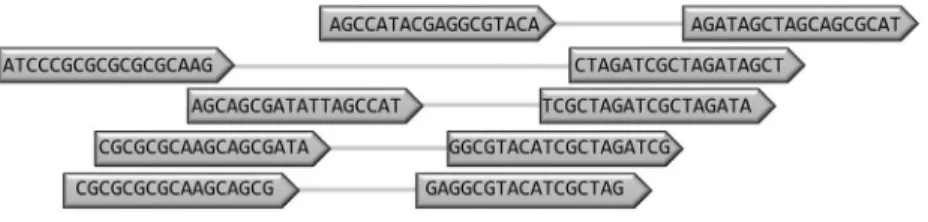
As described in the first section, different kinds of in-formation may be used to generate scaffolds, like paired se-quence, optical and/or genomics maps, and a reference genome. To improve the assembly, some algorithms were designed to close the gaps inside the scaffolds. One ap-proach (Figure 3), which is used by tools like GapCloser (Li
et al., 2010; Luoet al., 2012), IMAGE (Tsaiet al., 2010),
GapFiller (Boetzer and Pirovano, 2012), Enly (Fondiet al.,
2014), MapRepeat (Marianoet al., 2015) and Sealer
(Pauli-no et al., 2015), utilizes the information of
single-end/paired-end reads to extend, and sometimes locally-reassemble, the contigs and close the gaps. Another ap-proach, which is employed by FGAP (Piroet al., 2014) and
GapBlaster (de Sá et al., 2016), uses an auxiliary set of
contigs to find sequences that may fill the region based on local alignment. Finally, hybrid approaches, such as GMcloser (Kosugiet al., 2015), may use a combination of
paired-end data, alternative assemblies and long reads in the gap-closing process.
GapCloser (Li et al., 2010): is part of the SOAPdenovo software package (Liet al., 2010). This
ule uses the alignment algorithms from the package to re-align the reads to the scaffolds. Based on the reads located near the gap, a localde novoassembly is performed con-structed using a De Bruijn algorithm. In SOAPdenovo2 (Luoet al., 2012), the GapCloser module was updated to deal with the possible errors caused by high divergent reads that might be used during the construction of the consensus sequence. GapCloser is distributed both as a stand-alone application or as part of the SOAPdenovo package, and can be obtained from the URL http://soap.genomics.org.cn/.
IMAGE (Iterative Mapping and Assembly for Gap Elimination) (Tsaiet al., 2010): takes as inputs a library of
Illumina paired-end reads and a set of scaffolds and per-forms a remapping of the reads back to the sequences using SSAH2 (Ninget al., 2001). Alternatively, the user can pro-vide only the reads, and ade novoassembly is performed by Velvet (Zerbino and Birney, 2008) before the gap-closing step. The program maps the reads to the scaffolds and iden-tifies those that are located at the border. Then, the reads pairs that have at least one of the mates on the border are se-lected, and ade novoassembly is performed by Velvet us-ing the selected reads and contigs where the reads were mapped as inputs. After the assembly, the contigs are ex-tended, and this increases the probability that the mates will
568 Kremeret al.
align with the adjacent contigs or the gap will be filled after the assembly increases as more iterations are performed. At the end of the process, the contigs that were linked during the assembly can be ordered according to their previously known relative position. IMAGE https://sourceforge.net/ projects/image2/ can be obtained from its SourceForge re-pository or as part of the PAGIT package www.sang-er.ac.uk/science/tools/pagit.
GapFiller (Boetzer and Pirovano 2012): In a similar approach to that used by the previous tools, GapFiller per-forms a remapping of the paired-end reads back to the scaf-folds. However, to run the program, it is necessary to know (or at less have an estimation of) the insert size and the ori-entation of the library used. If this information is not avail-able, it is possible to calculate it using the script “estimate_insert_size.pl” that is distributed along with SSPACE. To perform the gap filling exercise, the program trims the contigs on both sides to reduce the possible as-sembly errors caused by low coverage and then applies an iterative process of read remapping and extension of the contigs. The alignment of the reads can be performed using BWA (Li and Durbin, 2009) or Bowtie (Langmeadet al., 2009) and the pairs that have one of the mates on the border of the contig and the other inside the gap region are identi-fied. The contig extension uses ak-mer based assembly ac-cording to the reads found inside the gap. GapFiller, in the same way than SSPACE, is available for download at the BaseClear website http://www.baseclear.com/genomics/ bioinformatics/basetools/.
Enly (Fondiet al., 2014): is a simple gap-closing pro-gram that works by re-mapping reads, in FASTA format, back to a target assembly using BLAST (Altschulet al., 1990; Camachoet al., 2009), followed by a local assembly using Phrap (www.phrap.org/) or Minimo, from the AMOS package (Treangenet al., 2011). If a reference genome is provided, a modified version of CONTIGuator (Galardini
et al., 2011) is used to order de target assembly and verify the accuracy of the gap-closing. The program can be
ob-tained from the SourceForge repository
http://enly.sourceforge.net/.
FGAP (Piroet al., 2014): Unlike the other gap-filling
tools, which utilize paired-end reads, FGAP’s algorithm uses a supplementary set of long sequences, which can be a library of long-reads or an alternative assembly of the ge-nome. After trimming the contigs, BLASTn, from the NCBI-BLAST+ package (Altschulet al., 1990; Camacho et al., 2009), is used to identify sequences in the
supple-mentary set that overlaps the gap. FGAP can be download
and used as a webserver from the URL
http://www.bioinfo.ufpr.br/fgap/.
Sealer (Paulinoet al., 2015): The program was devel-oped to be applied in large genomes, although can be ap-plied in small prokaryote genomes as well. The main algorithm consists in the selection of nucleotides in the sembly that flank the gap-regions, followed by a local
as-sembly by Konnector (Vandervalket al., 2014) using data from end reads. Konnector, which takes the paired-end reads and generates pseudo-long reads by applying a combination of Bloom filter andDe Bruijngraph, is distrib-uted alongside with the recent versions of ABySS (Sim-psonet al., 2009). Sealer evokes Konnector with different
k-mers, what allows a more efficient closing of gaps caused by low coverage (usually closed by shorterk-mers) and re-petitive elements (usually closed by longerk-mers). As it was developed aiming large genomes, Sealer tends to be more memory-efficient, but some steps of the program are executed serially, not in parallel, increasing the computa-tion time. Sealer can be obtained from its GitHub repository https://github.com/bcgsc/abyss/tree/sealer-release.
GMCLoser (Kosugiet al., 2015): combines informa-tion from paired-end reads and an alternative assembly, or long-reads, to fill gaps inside scaffolds. Paired-end reads are mapped to the target, and alternative assembly with Bowtie (Langmeadet al., 2009) and MUMmer (Kurtz et al., 2004) is used to align the alternative assembly to the tar-get assembly. To reduce the effect of misassembled regions that may be present in alternative assemblies, the program uses a likelihood approach to evaluate the contig joining by verifying the consistence based on the mate information. The likelihood algorithm available to evaluate assemblies can be accessed with the GMValue program, distributed alongside with GMCloser. The program can be obtained from its SourceForge repository https://sourceforge.net/ projects/gmcloser/.
MapRepeat (Mariano et al., 2015): is both a gap-closing and reference-guided scaffolding program. This software receives a genome assembly (in FASTA format), a reference genome (in Genbank format) and the sequenc-ing reads (FASTA or FASTQ format). First, the assembly is ordered using the reference genome using CONTIGuator (Galardini et al., 2011), and for each gap the adjacent contigs are aligned back to the reference using BLAST (Altschulet al., 1990; Camachoet al., 2009), aiming the identification of the region in the reference that is analo-gous to the missing region inside the gap in the target as-sembly. MIRA (www.chevreux.org) is used to align the reads to the reference and generate a consensus sequence, and the regions analogous to the gap are selected and used to close it. The source code of MapRepeat can be obtained from its GitHub repository http://github.com/dcbmariano/ maprepeat.
GapBlaster (de Sáet al., 2016): is a gap-closing pro-grams that, in contrast with most of the other tools, allows a manual curation of the gaps in a draft assembly instead of providing an automated gap-closing algorithm. The user may choose between the legacy NCBI-BLAST package , NCBI-BLAST+ (Altschul et al., 1990; Camacho et al., 2009) or Nucmer (Kurtzet al., 2004) to perform alignments between a set of contigs and the draft genome of interest,