Pia Ripatti
Creating a Marine Cluster
From Product Supply to System Solutions
Helsinki Metropolia University of Applied Sciences Master in Business Engineering
Business informatics Master’s Thesis 19.01 2014
Preface
Making this study for the Business Informatics Master’s program has been a very edu- cating and interesting experience for my personal and professional education. It has forced me to evaluate my opinions and professional view in a new way, which has been very informative. I believe that this experience will help me tremendously in my further career and life. Even though there were tough times and moments when the obstacles seemed impossible to conquer, the journey as a whole has been a very re- warding one.
I would like to thank my employer and my colleagues for their support and help during this process. Without their flexibility it would not have been possible to complete this program. I would also like to thank the interviewees for giving their time and expertise to help complete this thesis.
My special thanks go to Thomas Rohweder for his commitment in the program, support and good advice for this Master’s Thesis.
I would also like to take the opportunity to thank my family for their support and firm but gentle nudges in the right direction when I was stuck.
Kirkkonummmi, 19th January, 2014
Pia Ripatti
Abstract Author(s)
Title
Number of Pages Date
Pia Ripatti
Creating a Marine Cluster
From product supply to system solutions 70 pages + 1 appendices
19 January 2014
Degree Master in Business Engineering
Degree Programme Business Informatics
Instructor(s) Thomas Rohweder, Principal Lecturer
The purpose of this study was to produce a cluster model for system supply of products and services for the case company, which is facing a changing market situation and the problem that this situation creates. The main aim was to create a model that would help the company identify the problems and risk and offer solutions for the transition phase to go through as smooth as possible. The study was carried out for a global provider of air conditioning products.
The study was made as a case study which explored the specific business problem and the background leading to the situation today. Data was collected both from the case com- pany and by using external experts for interviews. The existing data and the data collected for the study were analyzed to create the cluster model.
The findings of this study show that there are a few key areas in the planning and initializa- tion part of the process that will need special consideration. The study also identifies some problem areas that need to be tackled before implementing the model. These problems are mainly related to communication and internal leadership structures. Thus, partner se- lection makes a key process investigated in this study, and the study identifies the key features in the desired partner for the case company.
Keywords Cluster model, system solutions, marine, offshore
Contents
Preface Abstract
Table of Contents List of Figures List of Tables Acronyms :
1 Introduction 1
1.1 Case Company Overview 2
1.2 Business Problem, Objective and Outcome 3
2 Research approach 7
2.1 Research Design and Research Process in This Study 7
2.2 Data Collection and Analysis 8
3 Best Practises in Supply Chain Clusters 9
3.1 Basic Concepts 9
3.1.1 Clusters 10
3.1.2 Supply Chain 13
3.2 Risk Analysis 15
3.3 Planning the Cluster 18
3.3.1 Goals 18
3.3.2 Communication 23
3.3.3 Partner Selection 29
3.3.4 Leadership 33
3.4 Conceptual Frame Work 35
4 Results and Analysis 37
4.1 Data Collection in Qualitative Interviews 38
4.2 Interview Details 40
4.3 Key Points When Building a Cluster: Analysis of the Results 41
4.3.1 Preparing for a Project 41
4.3.1 Teamwork and Best Practices 42
4.3.2 Communication Flow 44
4.3.3 Improvement Points 45
4.3.4 Indicators of a Reliable Partner 46
4.4 Conclusions 47
4.4.1 Communication Aspect 47
4.4.2 Leadership Aspect 48
4.4.3 Partner Selection Aspect 48
5 Developing a Cluster Model 49
5.1 Cluster model 49
5.1.1 Initial Cluster Model 50
5.1.2 Review of the Initial Cluster Model 51
5.1.3 Final Cluster Model 53
6 Conclusions 60
6.1 Summary 60
6.2 Functional Implications 61
6.3 Reliability and Validity in this Study 64
6.3.1 Objective vs. Outcome 64
6.3.2 Reliability and Validity 65
Appendices
Appendix 1. Sample of semi structured interview questions
List of figures
Figure 1, Shares of new ship orders in the world....…..………3
Figure 2 Cluster lay-out for system supplies for shipyards………5
Figure 3 Research design in this study...7
Figure 4 Porter’s competitiveness model………..………10
Figure 5 Example of a maritime cluster……….………11
Figure 6 Innovation factors inside a cluster……….….12
Figure 7 Michael Porter’s model of a value chain...13
Figure 8 Knowledge flow in a cluster……….15
Figure 9 Life cycle of a cluster………16
Figure 10 3C model used to define a process……….………18
Figure 11 3Cs model...19
Figure 12 Communication model...22
Figure 13 The Shannon-Weaver model ………...…23
Figure 14 Grapevine communications………….………….……….25
Figure 15 Communication forms inside an organization….………27
Figure 16 Dickson’s table for vendor selection criteria…..……….29
Figure 17 Selection factors………..…..……….31
Figure 18 Partnership selection model ...32
Figure 19 The three levels of leadership………..……….33
Figure 20 Conceptual frame work for this study………..36
Figure 21 Initial cluster model………..……….………..50
Figure 22 Final Cluster model……….………53
List of Tables Table 1 Relevant situations for different research strategies...39
Table 2 Overview of interviewees………...40
Table 3 Cluster model phases and elements………...54
Acronyms
AHU Air handling unit ATD Air terminal device
CRM Customer relationship management HVAC Heating, ventilation and air conditioning KPI Key performance indicator
MOG Marine, Oil& Gas
OEM Original Equipment Manufacturer R&D Research and development
1 Introduction
European shipyards have a long tradition in designing and building ships. Over the last 200 years about ten thousand ships have been built in Europe. Due to this, there has been a big market evolving around the shipbuilding industry. The 1990s was the boom- ing period for the European shipbuilding, with all the shipyards having full order books.
However, this period of low rivalry and a big bargaining power of the suppliers, there was little development efforts made as there was enough work for all companies. This led to that the threat of entry became high as new companies with a high focus on R&D could introduce new solutions and penetrate the market easily. As illustrated in Porter’s five forces (2008), this led to the rise of competition within the European market at the end of the 1990’s. Many of the big players were forced into a position on the side-lines, or even forced out from the business totally. The last years of the new millennium changed the business in ways that have remained to this day.
In the 21st century, the marine market in Europe has been shrinking, due to decreasing volumes of orders within the shipyards as projects have been moved to Asian ship- yards in effort to cut costs, and financing has been difficult to get for larger vessels.
This is in spite of the fact that the amount of cruise passengers continue to grow with 7% yearly, and is anticipated to continue growing at least until 2017 (Cruise Market Watch 2013)
The turbulence in the order books has led to downsizing and outsourcing in most or- ganizations throughout the marine segment. Labour costs comprise a major part of the production costs, and to be able to stay competitive against low cost countries, Euro- pean companies have been forced to focus on their strongest products and sacrifice some parts of the business. The same trend is also visible within the European ship- yards.
The purpose of the thesis is to explore the possibility for product suppliers within the marine segment to build a cluster and perform as a system supplier thus gaining ac- cess to the advantages which system suppliers have as compared to product suppliers.
The thesis aims to evaluate how the vital parts, internal and external communication, partner selection criteria and leadership within the cluster can be achieved.
1.1 Case Company Overview
The case company is a global manufacturer of ventilation products and a major player within its field. The first AHU/ATD product delivery to Cruise ship was in 1937, followed by the first AHU delivery to a platform in the end of 1970’s.
After this, the company continued as a strong system supplier, providing all major new building projects with HVAC until 2001 when the company was demerged and the ma- rine section was split up and sold to different companies.
As only the production sites were kept, the marine products are still manufactured, but the engineering and commissioning side were lost. Presently, the company has marine and offshore offices throughout the world, and has tried to attack the market through local presence.
As the market took a downward trend in the beginning of the 2000’s, price competition became especially heavy. Companies needed to adapt to the new situation, and cost saving initiatives were introduced everywhere. As a result, production costs and labour costs were cut down, resulting in very small organizations; and opportunity to use per- sonnel in low cost countries was also considered. The possibility to utilize China as a production site was also explored, but fluctuation in quality levels led the company abandoning this idea. High inflation in China has also caused labour costs to increase by 15-20% by year, bringing the labour costs closer to a European level.
(BIS Working papers, 2013).
As some projects require products to be manufactured in Europe, the company’s strength lies in the local production. Keeping a steady volume in the production facili- ties and ensuring as low as possible production costs has become one of the com- pany’s vital strategies. Larger volumes mean better prices for raw materials, and a higher efficiency per production unit.
As it has not been feasible to start building up a system supplying organization within the case company in Europe, the company has decided to look for other options to reach new customers and attack new markets. Working as a cluster with other strong brand names is a natural next step in this, and this thesis will determine if this makes a viable option for the company and how the dynamics within the cluster look like. This
thesis will also try to determine which features are the most important ones in the part- ner companies, and how to identify these.
1.2 Business Problem, Objective and Outcome
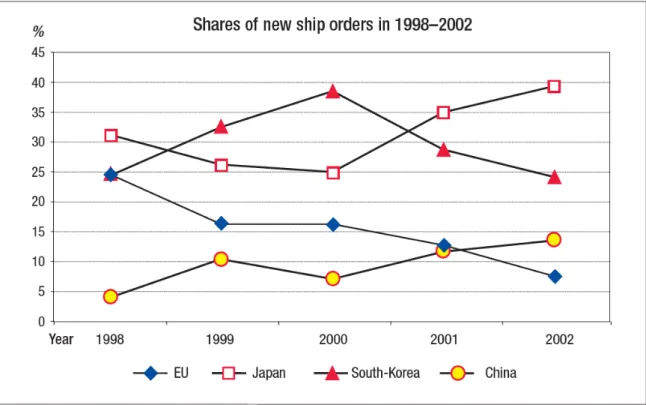
During the last 20years, the work load within the marine market has been constant, until recent times when shipyards in Europe have started struggling to fill their order books. This has happened mainly because of the increased price competition, financ- ing problems and a limited amount of new building projects started. Ship owners have also started focusing more and more on a green line in their new projects, and have become more interested in what kind of equipment are being installed on board their ships. Figure 1 below indicates how the shares of orders have been divided between different areas of the world.
Figure 1 Shares of new ship orders in the world (AWES 2003: 4)
As seen from Figure 1, the amount of orders concentrating in the Asian market is ever increasing and the order share of Europe plummeting. This is a result of the cost com- petition that has been the driving factor in the new projects.
To achieve cost effectiveness, shipyards have been looking to cut the delivery chain as short as possible and in some cases, relocate the projects outside of Europe, in hopes of lower labour costs. Labour costs in China have been increasing by 15-20% yearly, bringing them closer to a European level. Still there are a lot of shipyards outside China with lower labour costs than Europe. Quality problems, mainly problems in keeping an even result in the production and a lack of experience in prototype vessels, have so far kept the big cruise projects in Europe, but it’s only a matter of time before the first one is tried an carried out in Asia.
As another option, shipyards have started looking to buy from OEMs directly. Some companies have responded to this by building their own organization that can handle projects from a system design and delivery point of view. As well as cutting down on cost within the supply chain, this also gives the shipyards direct access to the product manufacturers. This arrangement also can result in product development together with the manufacturer, thus giving the system supplier in question an advantage towards their competitors within the shipyard and as long as the patent is valid, no other sup- plier can substitute that supplier.
As Porter’s diamond model (2008) indicates, investing in technical excellence, such as a cooperation project, can give the company an advantage in engineering and create a cluster of expertise around that company. Even if it is not good for the shipyards to have a single dominant supplier, it has its advantages to have a supplier that has inside knowledge; and that bond might be very hard to break and enter that market at least for a limited time period.
As it is not possible for all companies for different reasons to build up an organization that can handle a project delivery of this magnitude, alternative options need to be ex- plored. The next option to explore is building a cluster of companies with different ser- vices and components to fulfil this need.
The central elements of the cluster are the various networks. The cluster can be seen as a network of know-how, the value of which is increased by the other know-how net-works in- tegrated in it. (Finnish maritime cluster, Technology review 145/2003)
There have been a lot of studies on clusters, starting with Mikael E. Porter’s study on competitive advantage of nations in 1990. Since that, a number of economic models have been produced, mainly with a view from a specific company or group. The data
from these studies will be used as a guideline to help determine the central parts in the cluster.
The objective of the
gether as a substitute for a system supplying HVAC supplier. Main iss
cluster is to understand how the communication between the different entities should function, who will assume the leadership role and why and which criteria are the vital ones for selection a viable partner.
broken down and analysed separately before compiling them into a model of a working cluster.
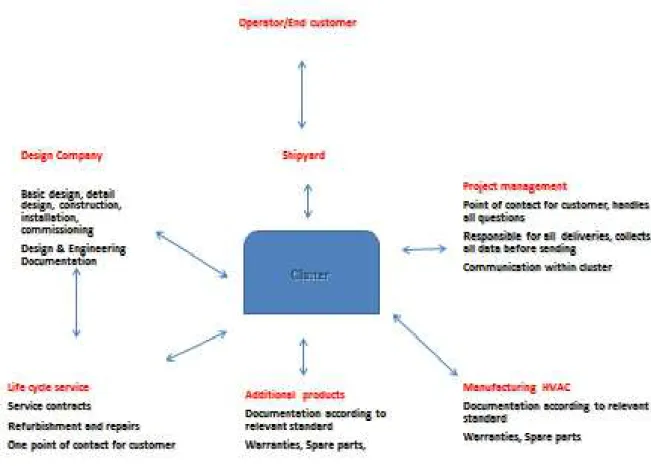
Figure 2 below illustrates how a standard HVAC delivery to a new building project will look like after the cluster model is implemented.
Figure 2
from these studies will be used as a guideline to help determine the central parts in the
objective of the thesis is to study how to build a cluster of companies working t gether as a substitute for a system supplying HVAC supplier. Main iss
cluster is to understand how the communication between the different entities should function, who will assume the leadership role and why and which criteria are the vital ones for selection a viable partner. To determine it, these points wi
broken down and analysed separately before compiling them into a model of a working
Figure 2 below illustrates how a standard HVAC delivery to a new building project will after the cluster model is implemented.
Cluster lay-out for system supplies for shipyards
from these studies will be used as a guideline to help determine the central parts in the
of companies working to- gether as a substitute for a system supplying HVAC supplier. Main issues within the cluster is to understand how the communication between the different entities should function, who will assume the leadership role and why and which criteria are the vital , these points will first need to be broken down and analysed separately before compiling them into a model of a working
Figure 2 below illustrates how a standard HVAC delivery to a new building project will
for system supplies for shipyards
Figure 2 shows the structure of a standard HVAC delivery to a new building project to a shipyard. It also illustrates the different components included in a package delivery. As the projects are big, communication within the cluster will play a central part in evaluat- ing the success of the cluster, both on the internal and external levels.
To achieve these goals, this study will start with identifying the key functions for the cluster. After these are identified, the next step is to set up a model for the cluster. A model for how the functions within the cluster are handled is also needed to clarify the role for each partner and the communication levels and routes within the cluster. Some thought also needs to be given on cost, as there can’t be overlapping costs between the companies. Overlapping costs will push the price to a higher level and make the package unsellable. To determine this, the 3Cs model created and developed by Ken- ichi Ohmae will be used to help define the cost structure. As this model focuses on both customers, competitors and the corporation itself, it can also be used to give in- sight on the internal processes in a cluster.
The outcome of this thesis is a model which can be used for setting up the cluster. The model is also intended to be used after the initial setup to help maintain the cluster and improve its functions.
The study was conducted in a time when the marine and offshore market is in a difficult economical situation, and the whole market segment is suffering from the market fluc- tuations and financial problems. If the study were to be carried out in a different time, for example during a peak period with a high work load, the outcomes might be slightly different. The operations today focus on streamlining the organizations and making the whole process as cost effective as possible. In some cases this will result in a lack of resources, and organizations have problems in coping with the workloads and re- sponse times. If this study had been conducted during a time of a big order flow, the focus might have shifted to the problems of finding enough competent employees in- stead of finding ways to get as much out from the small organization as possible. A person working for a different part of the case company might also place emphasize on some other aspects.
2 Research approach
This section describes the research approach towards the study, and how the research question was formulated. It also explains how the data collection was done and the main themes for the study.
2.1 Research Design and Research Process in This Study
The focus on the thesis is to identify the vital factors for setting up a cluster, and inves- tigate how the internal processes within the cluster can be handled. In the internal processes, the special focus is placed on the internal communication and leadership structures which need to be set up and some preplanning for resources and operating methods.
The research question is formulated as follows:
Which factors are the most important in the cluster setup, and how should the internal communication and leadership roles be defined?
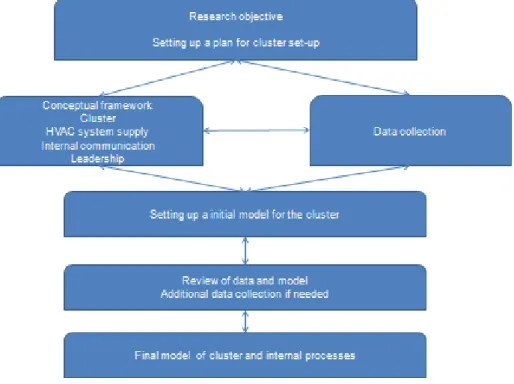
Figure 3 Research design in this study
Figure 3 shows how the research was carried out. First, the current data was analyzed and knowledge was gathered from the literature and applied to the supply process as it exists today. To collect the data, qualitative interviews were developed and carried out with key partners and customers; experts within the company were also asked to give their input to the data. With the data in hand, an initial model of the cluster was created for review. After the vital factors were identified and the cluster defined, it was deter- mined how these affect cost, productivity and quality, This also required a basic under- standing of how the cluster is set up, what the basic functions are and how the internal processes should be handled. After that, the initial model of the cluster was submitted for review. Corrections to this model were then implemented into the final proposal.
2.2 Data Collection and Analysis
The interviews were the main method to collect data in the thesis. The interviews were carried out as qualitative interviews by email due to geographical difficulties. Experts from customers and possible cluster partners were used to gain information on what they consider to be the most important issues. The interviews were carried out as semi- structured qualitative interviews.
As the main themes in the thesis are leadership, communication and partner selection criteria, these were also the key issues in the interviews. The interviews were divided in three different parts to help keep them separated from each other, and by that get an- swers that reflected the correct part. As the number of contacts that can be used was limited, the selected subjects were chosen to represent as many areas as possible.
The interviews were also structured to support the original research question and help to conclude how the final model should be designed. Even though it would have been interesting to have a quantitative amount of interviews, it was decided to only include the key companies at this point. This was mainly because the intention of the thesis is not to do the actual partner selection, but only create a model on how to do that selec- tion in the future.
After the data was collected, the interviews were analysed and the most important top- ics identified and verified. As the interviews gave a new aspect on some of the issues,
they also helped with the construction of the model and helped me gain a deeper knowledge of the problem. Those topics were then transported to create the backbone of the model as they represent the key findings in the interviews. The results of the interviews can be found documented in the corresponding sections.
3 Best Practises in Supply Chain Clusters
This section overviews different parts of the cluster and discusses some basic con- cepts of how the supply chain works.
3.1 Basic Concepts
To fully understand the business problem, some light needs to be shed on the basic concepts in the supply chain. In this chapter, the basic HVAC supply chain will be ex- plained, along with existing information on cluster and their function in the marine in- dustry.
The material for this section was mainly collected for research reports and other scien- tific literature for marine clusters and marine industry. As there is scarcely any informa- tion on this specific issue, a more general overview of the problem was used.
A business cluster is commonly defined as a concentration of connected businesses and suppliers in a specified field. Clusters are considered to increase productivity and by that help the companies to compete within their field. This idea was first mentioned by Porter (1990) as a way to define the advantages of companies working together.
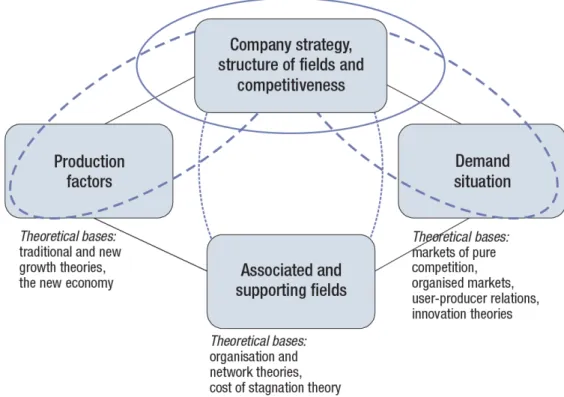
As illustrated in figure 4 below, Porter’s competitiveness model (2008) can be used to explain the internal dependencies inside the cluster.
Figure 4 Porter’s competitiveness model (Tekes 2003: 22).
As shown in Figure 4, the surrounding companies help to diversify the area of exper- tise, making the cluster for flexible for the customer expectations. As each part of the cluster is specialized in its own field with its own organization, there should be very few points of overlapping operations, thereby increasing the production costs. As each company of the cluster is allowed to focus on their key competences, the resulting product is expected to be of better quality than a similar one, where secondary func- tions need to be carried out at the same time.
As the projects are very global, different companies may have local presence in differ- ent countries, making the access to spare parts and service easier for the customer, which can also be an advantage in the market.
3.1.1 Clusters
Clusters have been used to create new business opportunities and strengthen the competitiveness throughout the business world. The idea of a cluster was first intro- duced by Michael Porter (1990), and has since been analyzed and used in most fields. Por- ter’s idea was that clusters can have a key position in a market, if enough resources
and competence is available. Three points are the central advantages within the clus- ter;
- Productivity can be increased inside each company - Can be the innovator in its field
- Can create new business opportunities (Porter 1990)
Porter also claims that the geographical location is of importance, therefore it’s vital for the cluster to have a correct location compared to its market.
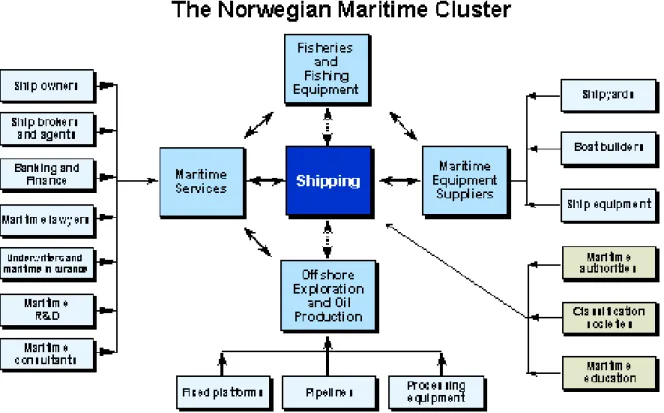
In Porter’s view (1990), a cluster is normally built up by companies working inside the same business, but without any rivalry. Basically they are companies supplying prod- ucts that support each other’s businesses. Figure 5 gives an example of a cluster within the Norwegian maritime industry.
Figure 5 Example of a maritime cluster, (Porter 1998).
As seen from Figure 5, the example of a Norwegian maritime cluster comprises the vital functions needed for a successful setup. Although the business is slightly different, it gives a good idea of how the cluster is set up to help with the demand.
Innovation within the cluster is also of big importance. With the amount of competence that resides within each company, a cluster has the possibility to shape the market through new products and design. A high technical level in the products helps to fight low cost countries and possible subsidizing. This also helps to prevent product copying, which is an increasing problem in Asia that the European authorities so far have had little luck in battling.
Innovation is also closely related to the green building thinking that has become im- portant during the last years due to increasing oil prices. With several product manufac- turers working together, the whole heating, ventilation and air conditioning process can be streamlined and made as energy efficient as possible. This will increase the com- petitive advantage achieved by the cluster.
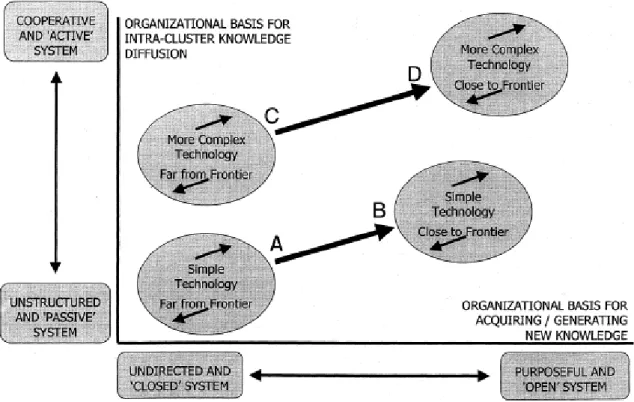
Paul Krugman (1991) also stated that a cluster is not merely a combination of compa- nies, but the organization where social aspects inside the cluster also are of im- portance. When the members get to know one another, they create a social bond that influences the way of working in a positive way. Figure 6 illustrates other innovation factors inside a cluster.
Figure 6 Innovation factors inside a cluster (Gnyawali & Srivastava 2013)
As each cluster is unique, the existing material also indicates that each cluster has its own life cycle, and that the appropriate time is needed for a cluster to start working.
There are no shortcuts, and results are not likely to happen overnight, but only trough well devised strategies and hard work.
3.1.2 Supply Chain
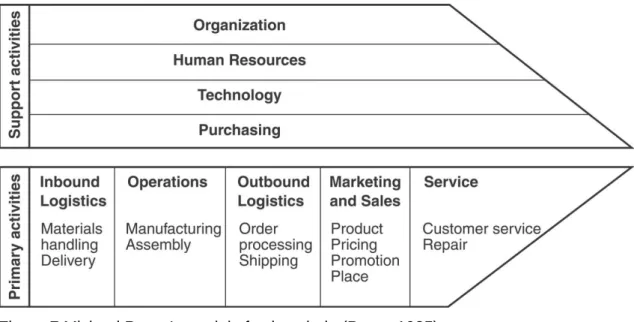
A supply chain is defined as a flow of materials or services from the manufacturer to the customer. Michael Porter (1985) also defines it as a value chain, based on the fact that is delivers a product that the customer needs and that is important to them. As illustrated in figure 7 below, each process that the product passes will add some value to the product itself.
Figure 7 Michael Porter’s model of value chain (Porter 1985)
As shown in Figure 7, each process that the product passes adds some value to the product. The same approach is applicable to a cluster, even though the products come from different companies. Each company adds their value to their part of the supply, creating a completed package at the end of the line. As the value chain model is versa- tile, it can be used to evaluate both product and service supply. Internally, the model can be used to evaluate the profit that the company produces, and externally the value to the customer that the supply chain creates. Globalization in the markets has led to a global value chain being introduced globally. It allows companies to evaluate the pro- cesses if the production is carried out in different countries. As this is going to be the case for the cluster in this thesis, this tool can be used to evaluate different parts of the cluster offerings.
According to the study carried out by Tekes (2003) in Finland on the Finnish maritime cluster, it would not have been possible for the industry to survive without the network- ing that the cluster has created. Sharing know-how and experience helps the increase the competitiveness of the whole cluster. It also helps to attract work force to the indus- try which with all companies struggling alone would be a challenge. The study also concludes that as most projects are for export, they are very important for the national economy of the companies. Adding all the supporting industries needed for large ma- rine projects, the cluster can bring welfare to the whole community (Tekes 2003:179- 187). To evaluate the cluster as a form of working, a risk analysis is needed to be made. This can help to identify potential hazards in an early stage and find appropriate solutions.
3.2 Risk Analysis
When evaluating the risks in a cluster, there are a few issues that rise above the rest.
Risk analyses done on different types of clusters share the conclusion that the biggest risks that the clusters face are the stagnation in the knowledge flow and exhausting the innovation within the cluster.
According to a study done for the conference board of Canada (Munn-Venn and Voyer, 2004), there are both risks and opportunities to be found in clusters. They evaluate the advantages of a cluster for a local economy and consider if the government should help clusters survive due to the value they bring to the community both directly and through supporting industries.
3.2.1 Knowledge Flow
Clusters rely on the exchange of knowledge between the companies. The study also introduces the “local buzz” as an important factor. This relates to the community that the company is situated in, and the knowledge that resides within this community. A good interaction between the community and the company will result knowledge flow- ing into the company, knowledge that flow into the region from other areas and an ad- vantage in attracting work force to the area (Munn-Venn and Voyer 2004:5).
If the cluster is unable to keep the interaction going, it may face the risk of destroying itself as the local support will stop. It can also become isolated as the channels it has been using to gain knowledge from other areas may be interrupted or cancelled. There is also the risk of the cluster becoming too orientated with its local information that it stops acquiring data globally, and thereby slowly removing itself from the market area it once started to serve and not receiving any innovations from the outside. A healthy balance between the local information and the global field is there for essential to main- tain.
The study names Boston’s route 128 as an example of this stagnation (Munn-Venn and Voyer 2004:23). According to the study, the inability to communicate with its surround- ings may have been the downfall for the companies here. The companies were started in the 1970’s, mainly by MIT graduates in the computer science field. The community was however built up on old strategies from earlier companies and were unable to sur-
vive with the rise of Silicon Valley. They lacked the flexibility to adapt to the change in the markets and products, and were eventually run down by their competitors. As Por- ter claims “if companies in a cluster are too inward looking, the whole cluster suffers from a collective inertia” (1999), meaning that if even a few companies within the clus- ter stops being innovative, they can stop the entire cluster from embracing new ideas.
Figure 8 Knowledge flow in a cluster (Gnyawali & Srivastava 2013)
Figure 8 above shows how the competitiveness of a cluster develops and changes during the clusters life cycle, and the cluster may end up in a state of passiveness and possible breakdown if these factors are not considered.
3.2.2 Exhausting the Innovation Bank
According to the research materials, all clusters have a certain amount of knowledge within them to use. If the knowledge is used to extensively, there is a risk of the knowledge bank drying out. Again the study compares clusters to mining work done in the past. If you extract too much of the value, you will reach a point where the innova- tion stops and the replication of products begin (Trefor Munn-Venn and Roger Voyer, 2004:24). At the same time the cluster is affected by the surrounding economy and the stage in which the cluster is within its own life cycle. If these factors are positive, the
cluster can experience a big upswing, but with a negative trend, the results can be catastrophic. Worst case scenario with a depleted innovation bank is that a leader in the field becomes the underdog, its only option to compete with low cost products. With economies in Europe, this is not a very viable option, as labour costs are high com- pared to low cost countries i.e. Asia. Not investing in the R&D departments is a poor choice for companies as new innovations are a good way to compete in a highly com- petitive market.
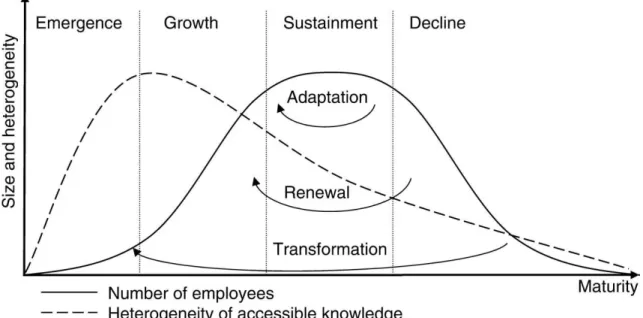
Figure 9 below illustrates the life cycle of a cluster.
Figure 9 Cluster life cycle (Menzel & Fornahl 2009)
As seen from Figure 9, the problems with innovation depletion are usually a problem in the sustainment phase. This is also linked to the knowledge flow. If the knowledge flow stops, the bigger the risk for internal depletion becomes. With no new ideas and inputs coming from the outside market to help with the renewal of processes, the cluster in forced to rely solely on its internal competence. Some clusters may be able to do this, but in most cases it will result in burning out the experts within the companies.
When this point is reached, the company will have to revise its strategy urgently to avoid the company from entering the decline phase. In a cluster, this will require a joint effort from all the companies, as each rely on the other for continued success. Wether
this will mean investing fore capital in the company or an aggressive recruitment of additional personnel, is case sensitive and needs to be evaluated separately.
When the decline phase is reached, the companies will start to face other risks as well.
For example, keeping up with competitors will be more difficult, as their products will continue to improve and at some point pass in quality and features. Also the customers expect to see new products and improvements at some interval. Employees will start leaving the company, taking their knowledge with them and in the worst taking it to a competitor. The research material refers to this as an intellectual property risk (Syman- tec 2013). According to a study carried out by Symantec (2013), close to 62% of the employees share sensitive information from their company on a daily basis and close to half take information with when leaving for a new job. Close to 40% of these intend to use that data in their new job
These risks create big problems for companies, and continuous renewal is needed for all companies, regardless of the field they operate in. This also applies to people, even experts in their field need to continuously develop themselves, both for the good of their own intellect as for the well-being of the company.
3.3 Planning the Cluster
This section of the thesis will focus on the different parts and processes in the cluster.
The targets of the cluster need to be defined, as well as the internal processes in the cluster. An important part is also to define how the communication within the cluster should be handled. There are different models to help to determine this, as both exter- nal and internal communication needs to be clearly defined. The last section is how the cluster should be lead. Which company will assume which role, and how the re- sponsibilities will be divided to exclude any grey areas?
3.3.1 Goals
For each project there needs to be a clear goals and targets. The goal for the cluster is to find a functional way of working and develop a competitive way to do a HVAC sys- tem supply to different customers. As each customer is unique and each project differ- ent from the other, an overview of the general goals for the cluster is needed. This re-
quires looking at both customer and company needs and goals, and defying what the best way is to fulfil these.
Figure 10 3C model used to define a process (Beeharry 2010:4)
As with all changes in an organization, a clear plan needs to be developed to monitor the change. As illustrated in figure 10 above, the 3C model can also be used to define a process such as this. As this thesis will concentrate on evaluating things with the help of this model, it gives a good way to consider the lay-out for the future cluster.
The first goal for the cluster is to make a plan on which companies are going to be in- cluded; basically those are the key parts to fulfil the delivery. Once this is completed, key customers need to be identified and a plan how to fulfil their needs need to be de- veloped. Once done, the plan needs to be taken into operation, monitored and re- evaluated if needed.
There are different ways to evaluate how the goals should be monitored. This thesis has chosen to use the 3Cs model by Kenichi Ohmae. The model in based on a strat-
egy triangle consisting of the corporation, the customer and the competitors. This choice is motivated by the simplicity and accuracy in this model. The base functions in a achieving the goals for the business cluster, is that the customer’s needs are met, and that the products and services provided exceeds the ones that the competition can supply.
Figure 11 3C:s model (Ohmae 1997)
As seen from Figure 11, the model by Ohmae indicates that only when these three parts are in balance, a competitive advantage can exist. Depending on the lay-out of the cluster, different companies can basically be each other’s internal customers and part of the same corporation; the idea behind this model is very useful in evaluating the goals for the clusters function.
In the long run, the goal of the cluster needs to be serving its customers and the fulfil- ment of the obligations towards them. However, this can be broken down according to Figure 11 above.
As the customer is the most important part in the process, and the basic services and products need to be up to standard. The needs of the customer will vary during the process, and the product offering needs to adapt to the changes flexibly. Understand- ing that the customer success is also the clusters success is also vital. If the customers
can be kept interested, that will also keep the investors interested according to Ohmae (1997). The first objective is to understand that the same product can be used in differ- ent ways with different customers. For one customer the product may be a simple ne- cessity, but for others it may be a way to increase comfort. This is called segmentation by objectives. To understand the difference, each customer need to be listened to closely, and the product offering made based on a detailed pre study of the needs.
Marketing costs are a dilemma in a company. It is difficult to determine the needed input compared to the expected value. As the budget is usually fixed for the year, a strategy needs to be made according to customer location and possible competitor investment. This will also require an analysis on which customers are the key ones, and which market area has the most potential. This is referred to as segmenting by customer coverage.
As things change during time, these points need to be re-evaluated with a certain fre- quency. The situation may change quite rapidly, depending on the competition in the market. As the marine market is a highly competitive environment with many factors contributing to the outcome, the analysis would need to be made twice every year. As this is time and money consuming, allowance need to be made in the budget, and each analysis evaluated for its value.
The companies need to clearly define their strategies and goals for a short and long period. Only by having a clear strategy, can the company create an advantage towards its competitors. As no company can be the best in each part of its field, it is important to define the key processes and develop them to a maximum level. If the most important functions are at a market leader level, the company can gain a competitive advantage, allowing it to focus on the weaker performing parts later. Keeping this strategy clear, the company will be able to strengthen its secondary function later, until the whole process is optimized. For this, it is essential that the company has claimed a market leader role, and has the capital and opportunity to work on these issues. This is called selectivity and sequencing.
As a cluster, the companies have the luxury to some extent to divide the needed ser- vices between themselves. If there is a function that is non-profitable to one company, another one might be able to produce it for a lesser cost. If this option is not possible, the company can decide to outsource the product in question to a company that is
more competitive with it. Cutting an expensive and non-vital part of the process, in- creases the profitability of the process and removes unnecessary functions within the organization. This also relates to the previous chapter that a company ca not be the best in each area.
Cost effectiveness is a key point to consider. There are different ways to achieve this, depending on the path the company chooses. The first option is to reduce the basic cost. Basic cost with raw materials are based on the volumes that the company pur- chases. With a high volume, the company will have a strong position to discuss the purchase prices. To avoid fluctuations in the volumes due to market instability, the companies within the cluster can share the purchasing functions and thereby increase their negotiation power. The third option is to exercise selectivity. This is the most diffi- cult option as there is a very limited amount of suppliers in the market. Partner agree- ments can be made with suppliers in an effort to cut cost, but the main cost is still tied to raw material prices and the price for that ca not be influenced by the purchasers.
To stand out compared to the competitors, the cluster need to find an edge that the others do not have. As the products are quite standard and there are no quick solutions to gain a technical advantage, a different strategy needs to be considered. Image is a very useful item to use when being compared to competitors with similar products and services. Providing an image of a customer orientated company, can give the final ad- vantage that will be the deal breaker for a project.
Another option is to capitalize on profit and cost structure differences. If the production costs are lower than the competitor has, the company can lower its prices and force the competitor out, or gain market share. This is a risky move, as it will determine the fu- ture price level in the market, and the previous price level might be hard or impossible to achieve once again. Dropping prices to increase market share should therefore the considered a last option. A more viable option is trying to develop a product together with the customer and thereby achieve a first mover advantage. Creating a new solu- tion can give a long term advantage with patents protecting the new product for several years. A joint effort development also means less cost for the company as there usually is expertise and/or development money available with the customer.
Getting a long term contract with the customers is essential, as it will give the company time to develop its internal functions. Contracts continuing for several years also help to
keep investors confident in the company’s future. This provides positive signal to the market and improves the company’s brand and image. Having many strong brand names in the cluster will most definite give a competitive advantage towards the com- petitors.
3.3.2 Communication
Communication between the companies and to the customers is one of the most im- portant functions in the cluster. Without a well-defined model there is a risk that vital information will not be shared internally to the processes that need it, and that the cus- tomer will not receive confirmations or other updates. In some cases payment may be bound to documentation or similar, and if this is neglected due to communication is- sues, there could be big financial consequences. This thesis has used the insights of the Business Communication University to help understand the different communica- tion models.
Figure 12 Communication model (Communication Theory 2010)
As illustrated in Figure 12 above, the external communication relates to all communica- tion going outside the company. For this cluster, the most important external communi- cation will be towards customers and classification societies. With customers, there is both formal and informal data exchange, as there is also a personal relationship form- ing with the personnel in the customer’s organization. With classification societies, the
exchange is always forma, as this is an official bureau. Communication can be done in different ways, including letter, reports, emails, conferences, phone call and actual face-to-face meetings. Also exhibitions and similar presentations are a way of commu- nicating, reaching a larger cliental than usual. The external communication should al- ways be done in a professional way, as this is the company’s way to face out towards its customers. Poorly executed it can end in a catastrophe, with upset customers or problems with getting products classified and approved.
Because of this, the cluster needs to have a very clear plan on how the external com- munication is done. Who has the responsibility and mandate to communicate, and to which extent. A different organization should be ready also for crisis situations as these require special attention and approach.
One of the first communication models was introduced by Claude Shannon in 1948.
Figure 13 The Shannon-Weaver model (Shannon-Weaver 1949)
This model, as seen in Figure 13 above, already introduced the possibility of noise or other barriers interfering with the communication. As there are different ways to com- municate, there are also different things that can influence the information passing from the sender to the receiver. The more noise is influencing the message, the more likely it is that the message will be misunderstood in the other end. This creates a barrier in communication.
There are different factors that can influence that the receiver gets a distorted message in the other end. In some cases there can be a language barrier, with one talking their
native language and the other not. Technical content is a difficult area, as in this case, the sender is a product supplier and an expert in his field, but the receiver is possibly not so familiar with the products. It is easy to be too technical, and use terminology that is incomprehensible to the receiver. If you are trying to send a message while upset, there is likely to be emotional interference. Especially with emails that are a quick way to communicate, there is a big risk of sending something out while the emotions have the best of you. If the subject is sensitive, reclamations etc., it might be a good option to always wait until the following day before addressing the issue. Taking a step back from the problem will give more clarity and avoid the risk of getting to personally in- volved in a business problem.
The quality of the information is also important. As messages to customer or similar are always an official statement from the company, it is important that the message is re- viewed before sending. Wanting to simply get the task done by sending something out quick, can prove to be wrong decision that will complicate things are require more time to correct than it would have taken to communicate in the first place I a proper way.
How information is sent also need to be considered.
The accuracy in the data is vital, if there is any thought that the data might be incorrect, that message should never be forwarded. Sending wrong data can influence the per- sonal relationship to the receiver, and create mistrust. The language in the message should also be considered in the aspect of cultural differences, jokes or inappropriate language can be considered very offensive in some cultures. Lastly the sender should be able to listen to the feedback from the receiver in a good fashion, not just listening, but considering the information flow and reacting to problems or difficulties. Unattended issues in the beginning can come back in a later stage of the project as problems that can impact the whole delivery plan.
Although there are things that need to be considered when communicating externally, communication is not something that should be feared. It is the only way to keep clients and suppliers informed about products, progress and goals. As things change con- stantly and the project progresses, all parties need to have the latest data and infor- mation. Without a proper communication channel, that data will be lost, and other parts of the project might move forward with the wrong information, creating big problems.
There is also a need for internal communication within the cluster. The information needs to flow between different entities to ensure that the production stays on time and with the correct parameters. Although internal communication can be made a bit more informal, the same principles still apply. The data needs to be correct, the receiver must understand what the sender is trying to say, communication needs to be done in a professional way that does to create mistrust in the receiver and most importantly that the person gets the information on time and nothing is withheld. As the internal communication is sometimes informal, there are some ways of communication that is not standard in the business world. Rumors and gossip are likely to travel inside an organization, and discussions around a cup of coffee are a standard. As illustrated in figure 14 below, there are four different ways how information spreads internally. The single strand chain is one person spreading the information to a single person, who
then possibly forwards the information to yet another person. Gossip chain is where someone goes around the office telling a selected group of people what he has heard.
The probability chain is information shared to the whole office, regardless of personal
relationship. When the selected group of people from the gossip chain in turn reveals the information they heard to their own group of people, this will become a cluster chain.
Figure 14 Grapevine communications (Communication Theory 2011).
Figure 14 above shows the type of grapevine communication likely to occur inside an organization. Although there is a risk with this type of information sharing, mainly in the fact that inaccurate information can cause speculation and sometimes fear, there is also advantages in this type of information sharing. It can be a good addition to the formal channels and give the feeling of partnership among the employees. This type of communication needs to be monitored to avoid that someone starts creating panic in the organization with inaccurate information.
Immediate information should also be supplied if the goals or strategies of the company have changed, or if there are changes in the organization that influences the project.
Keeping openness in the company will help all employees to understand the goals of the company. With an open communication possible problems can be identified earlier, before they become blocking points. This will also strengthen the bond between em- ployees and the management, increasing motivation and team spirit. Keeping every- body in the loop indicates that everybody is equally important for the company. When communicating from the management level to the employees, there need to be a cer- tain authority and respect for the management, but feedback from the lower levels should also be accepted as the lower levels usually have a better insight to the prob- lems on production level. Direct orders are sometimes a necessity, but should not be the only way of communicating. Downward communication is normally conducted in short announcements and meetings to relay information on a corporate level.
Upward communication is the flow of information to the management level. It can be
problems that need to be solved on a higher level, suggestions for needed upgrades or resource question for example. Keeping an open mind towards suggestions coming from a lower level can sometimes prove to be difficult for some managers. Once again, the key is to try to communicate on a professional level, and not let emotions interfere with the information. Getting information from the production level can help the compa- ny to understand the possible problem points in the manufacturing process, and help to redefine the goals and the resources needed to achieve them.
As this thesis will focus on a cluster with different companies involved, lateral commu- nication will be crucial to achieve. Information needs to flow between the different pro-
duction facilities, and the sub departments in each factory. A chain of communication is required to share quality, transport, documentation and other production issues be- tween the companies. Also, as one company will assume the overall responsibility to interact with the customer, there needs to be channel to share this information to all necessary departments throughout the cluster.
This will require both internal communication between similar departments, and a more corporate level communication on strategies and revised goals.
Figure 15 below illustrates how the communication travels inside an organization.
The ideal situation is that the idea from the figure can be implemented throughout the cluster, creating communication channels between companies. The departments with similar functions need to create a personal relationship to help with the interaction. If persons feel comfortable with each other, the threshold to take contact is much lower.
A good communication flow prevents similar problems to arise in different processes as information can be shared and known problems eliminated in all parts of the project.
Resource problems can also be helped, as similar professionals might be able to take some of the work load.
Figure 15 Communication forms inside an organization (Collins 2007).
As a summarization from Figure 15 above, it is important that all these ways of com- munication are used in a good way, as not only one form is enough to keep the infor- mation flow on a correct level. The communication part is the most critical part for any organization, without it, all projects are bound to fail from the beginning. Still, this is a problem that occurs in every organization and project. The relevant information is not passed on to all the partners that need it, creating a path where the execution can go critically wrong because of lack of feedback. Communication should be taken seriously
and the personnel should be educated and reminded of the importance of proper i formation sharing.
3.3.3 Partner Selec Selecting the right partners example such options as: s graphic location, global presence partner selection process
Weber et al. (1991) and
The model created by Weber
various criteria to be used in the partner selection process. The model is meant to evaluate vendors rather than business partners, but is in many ways applicable to par ner selection as well.
Dickson (1996) on the other hand suggests a rating system for vendors based on di ferent factors, as illustrated in Figure 16 below.
Figure 16 Dickson’s table
and the personnel should be educated and reminded of the importance of proper i
election
Selecting the right partners can be made considering different factors, including for example such options as: strong brand names, suitable products or services
lobal presence, resources etc. Various studies were
partner selection process, and many of them frequently cite the ideas developed by and Dickson (1966) as especially significant.
The model created by Weber uses both qualitative and quantitative data collection as e used in the partner selection process. The model is meant to evaluate vendors rather than business partners, but is in many ways applicable to par ner selection as well.
Dickson (1996) on the other hand suggests a rating system for vendors based on di erent factors, as illustrated in Figure 16 below.
Dickson’s table for vendor selection criteria (Dickson 1966:5).
and the personnel should be educated and reminded of the importance of proper in-
can be made considering different factors, including for uitable products or services, geo- etc. Various studies were done on the , and many of them frequently cite the ideas developed by
uses both qualitative and quantitative data collection as e used in the partner selection process. The model is meant to evaluate vendors rather than business partners, but is in many ways applicable to part-
Dickson (1996) on the other hand suggests a rating system for vendors based on dif-
As shown in Figure 16, the rating system for a vendor is made of 23. These 23 factors were identified by out a survey to 170 purchasing agents. After collecting the data a rating system was created to determine how important each function is. Based on his research, the quality of the products and vendor was determined as the most important factor for purchasers. Surprisingly, the factors are also quite accurate in today’s busi- ness world, even though a similar survey today would probably push the price to a higher rank.
As the number of criteria above indicates, there are many factors that influence the selection of vendors and partners. The partner candidate needs to be known to the organization, to be able to determine if the partner is a good choice. The financial data also needs to be reviewed before negotiating any contracts. The final stage of the process is to sign a contract.
Figure 17 below is a combination of the partner selection factors suggested by Porter (1190, 2000a, 2008). This model can be used to help identify a possible partner com- pany.
Figure 17 Selection factors, (Porter 1990, 133; Porter 2000a, 258; and Porter et al.
2008: 55).
As seen from Figure 17, the first part of the process is to identify a viable partner. The possible partner can be a known associate, or something that is identified through other partners or media. As presented in Figure 17 above, the cluster needs to have a synergy effect between the companies. Only with a good synergy effect will the cluster become successful in competing in the market both locally and globally. Porter (1190, 2000a, 2008) suggests that all partners need to fill the knowledge gaps that the other have, and the knowledge needs to be transferred between the partners also. All parts in the partner process from the selection until contract signing needs to done with this evaluation in mind. If the process is done badly, the results will be increased expenses and decreased trust between the companies.
The role of the suggested partner might also change during this process, as illustrated in Figure 18 below.
Figure 18 Partnership selection model (Bivanis 2006:23).
As seen from Figure 18, the role change can be used to the cluster’s advantage if iden- tified early enough and properly communicated between the companies. Slow reaction could end in eroding the stability of the partnership decreases, leading to a break-up in the cluster or internal problems, most likely accompanied with a breakdown in commu- nication.
Thus, although the partner selection could be seen as the easiest part of the cluster set-up, it is also the most central part as the quality of the partners will determine the quality of the cluster and the products it supplies.
3.3.4 Leadership
When it comes to the discussion on available in the published
handled. Leadership is a very cultural thing,
how it is implemented depending on the region where the company is situated.
A recent research done by Scouller
that has become quite popular in developing leaders and their capabilities.
Figure 19 The three levels of leadership
As seen in Figure 19, the leaders
leadership. The first represents the personal level, the second makes the private level and the third is the public level. Since
a lot of employees, the outer ring marked as
most of all. Scouller defines this as a way to influence two or more people at a time. To lthough the partner selection could be seen as the easiest part of the cluster t is also the most central part as the quality of the partners will determine the quality of the cluster and the products it supplies.
the discussion on leadership issues, there is
available in the published research presenting different views on how things should be handled. Leadership is a very cultural thing, as there is a difference
s implemented depending on the region where the company is situated.
A recent research done by Scouller (2011), and the 3P model presented in that has become quite popular in developing leaders and their capabilities.
The three levels of leadership (Scouller 2011).
seen in Figure 19, the leadership model by Scouller (2011) includes three levels of leadership. The first represents the personal level, the second makes the private level and the third is the public level. Since the cluster will consists of many companies and a lot of employees, the outer ring marked as public is the area
. Scouller defines this as a way to influence two or more people at a time. To lthough the partner selection could be seen as the easiest part of the cluster t is also the most central part as the quality of the partners will determine the
is a number of models different views on how things should be difference in the approaches s implemented depending on the region where the company is situated.
, and the 3P model presented in Figure 19 that has become quite popular in developing leaders and their capabilities.
hip model by Scouller (2011) includes three levels of leadership. The first represents the personal level, the second makes the private level of many companies and the area affecting the cluster . Scouller defines this as a way to influence two or more people at a time. To
reach a group of people effectively, the idea of four dimensions of leadership was in- troduced by Scouller (2011).
These dimensions define how a leader should act in order to reach his employees.
According to the study by Scouller (2011) there are 34 leadership behaviours that can be broken down into four main dimensions as follows:
1. A shared, motivating group purpose or vision.
2. Action, progress and results.
3. Collective unity or team spirit.
4. Individual selection and motivation
According to Scouller (2011), the leader needs to be flexible and adapt to the fact that the surroundings change at all times. To stay in a right level, the leader needs to edu- cate himself continuously and to make sure that his values and ethics stay firm even in difficult situations. Being untrue to one’s organization will lead to the trust disappearing within the organization and the leader losing all respect, and following that, his leading position. At the same time it is important to be able to divide his time effectively be- tween decisions and strategies. It is important for a leader to define which way the or- ganization needs to go, but without sacrificing the day to day functions that need to be upheld. This may be referred to as the personal level in the model by Scouller (2011).
The private level makes basically the same model as the previous one, but mostly re- flecting on how the leader handles situations on a one-to-one level. This is most appli- cable within the companies own organization, where the leader might have direct con- tact with the employees. Even though there is a group of people in the company that makes things happen, it is important for a leader to not forget the individuals in the group. Each member needs to feel that they are treated with respect and acknowl- edged for their personal input. Some leaders fear this interaction as you need to invest something of yourself in these contacts. According to Scouller, that is why a leader needs to invest his time into development of these skills to remove any personal fears that might influence his behavior.
Personal level of leadership is defined as the person’s inner feelings, knowledge and skills according to Scouller (2011). The model indicates that this level shows what
leaders should do to keep improving in their role. Scouller has divided these skills to three points:
1. Developing one’s technical knowhow and skill.
2. Cultivating the right attitude toward other people.
3. Working on psychological self-mastery. (Scouller 2011:37)
Scouller’s conclusion is that a leader cannot be effective without working well in all three levels. He compares leadership as throwing a stone in the water, the ripples of the water will spread outwards, and in the same way a leaders inner values will spread to the organization (Scouller 2011:15). A leader’s behavior will influence the whole groups’ behavior, and how they work to achieve the goals set. A group believing that all members are equally important and that their leader is working on the same level as them, will function much better that a group with a leader setting himself above every- body else. A leader should carry his organization in tough times to ensure that the trust and respect is there when things start going well and the work load increases. Thus, employees that are content feel that the leader is appreciating them will return that trust and show better performance and higher loyalty.
Even if charisma is considered to be a big part of a leader, Scouller suggests that this is in fact not the case. A leader that is there for his personnel will be more respected than one that is good on acting. A leader should concentrate on developing his inner presence in order to meet up to the standards. This includes being in control over one’s emotions, have respect for others, be driven to be better, live in the present, have a good self-esteem and have a clear sense of the goal according to Scouller.
3.4 Conceptual Frame Work
Reviewing the collected data and the studies conducted before, it can be concluded that there are many factors that need to be considered to build a winning concept. Ac- cording to a study by the European commission (2008), the strength of a business clus- ter is in its strong focus to find solutions to business problems and the ability to develop new technologies. It also identifies the advantage of a cluster in its single point of con- tact for its customers. At the same time, it also identifies the problems with decision making and communication due to the fact that the companies may not be in balance