The case company representative saw a need within the organization and felt there was room for potential improvement within the organization. This theory base was then used to design and conduct a quantitative survey for the Central Finland office of the case company. Based on the data collected, the author tried to provide consistent findings and conclusions for the case organization to use in their internal communication process.
Introduction
- Background of the study
- Theoretical framework
- The structure of the thesis
- Limitations
- Case Company presentation
In addition to the literary data, primary data was also collected from the case company's employees. The thesis is structured so that it begins with the basic introduction of the thesis concept. At the request of the case company, no identifying information about them will be disclosed in this thesis.
Communication and internal communication
- Defining communication
- The Communication Process
- Information
- Models of Communication
- Linear Model
- Transactional Model
- Variables in the communication process
- Attitudes
- Social Organization
- Thought Patterns
- Roles
- Communication channels
- Informal and Formal communication channels
- Internal Communication
- Organizational Communication
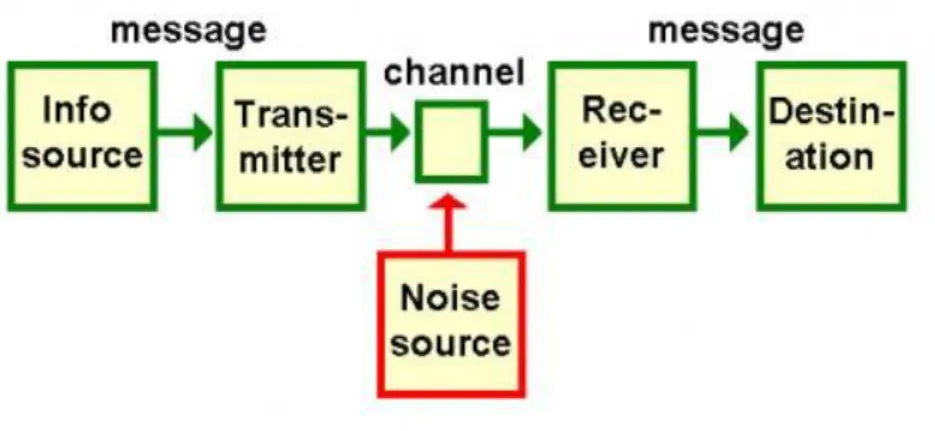
Internal communication is a process of communication, but from the perspective of the communication process within an organization, and in this thesis, within a company operating in Finland. The process of internal communication differs to some extent from the normal process of communication, and these differences are explained in depth in this part of the literature review. This part of the communication chapter depicts some of the most commonly used models of communication.
This means that the individual's culture becomes an important factor in the meaning of the message. The idea for this chapter is also to distinguish organizational communication from the internal communication of the previous chapter.
Research objectives, questions and methodology
- Methodology
- Quantitative research method
- Survey Design
- Data Analysis
To summarize organizational communication, it can be said that it looks at how individuals in organizations give meaning to various messages, verbal and non-verbal communication, communication skills and the effectiveness of communication within an organization (Hargie & Tourish 2004.) From this statement it can be we see, that many of the previous definitions can be moved up in this one definition of organizational communication. By identifying the communication process and the communication tools, and comparing them with the views of the employees, we can try to derive potential improvements if any are found. The purpose of this research was to identify the most effective methods of internal communication and to provide tangible improvement methods that the upper management of the organization can use so that their employees will feel that the flow of information is more reliable.
Before defining the methods used in the study, this paper must define the validity of the research itself. The definition of validity in its simplest form means that the truth value of the. External validity defines whether the research is applicable outside, for example, the case organization in this study (Newman & Benz 1998).
A quantitative research design tends to lean towards the structured end of the spectrum in terms of research designs (Punch 2013.) As a result, the author chose to use a structured survey as his data collection method. The choice of the survey design was justified for this research as it could provide quantitative or numerical description trends, attitudes and opinions from the study sample (Creswell 2013.) It was the best possible method to collect data for this research as the author wanted to obtain as much data as possible from as large a sample size as was viable from the case company and to identify the trends related to, attitudes towards and opinions about their internal communication procedures. After the data was collected, the author took it from the structured survey and subjected it to a thorough analysis.
By performing percentage calculations and an analysis of the distribution of respondents' answers, the author tried to find deviating trends from the norm.
Results and Analysis
The survey questions and structure
This section will not cover all 18 questions and their answer options one by one, as they can all be found in the appendices section of this paper. Additionally, the point of this section is to take a look at what the queries were trying to get at in terms of data. These questions were chosen, since even by combining multiple answers we could not identify a single respondent from the 42 answers given.
The second demographic question was simply gender, with options for male, female, and other. The third question about the working hours at your current employer was implemented to identify how the division between long-term employees and newer workers plays out. By combining these three demographic questions and comparing them to a given questionnaire analysis, we can draw meaningful data about what demographic group thinks about the internal communication procedures.
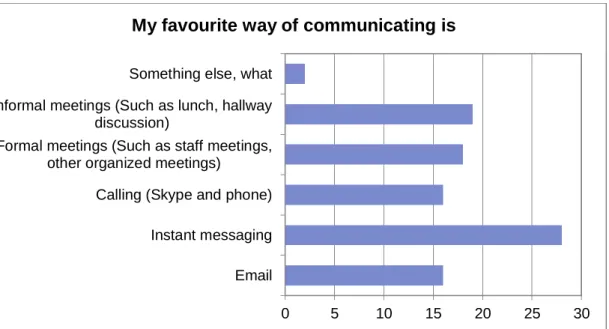
The following 12 questions were structured with response options rated from 1 to 5, where 1 was strongly disagree and 5 was strongly agreed. These questions mostly related to the communication process within their day-to-day work groups, outside of their day-to-day work. The last three questions, which had predetermined answer options with the possibility of giving an open answer with questions with multiple possible answers, tried to find out which way of communication the employees have, their most suitable way of communication for the entire company. information and finally what they consider to be the issues affecting the organization's internal communication processes.
This last question in particular, with its open-ended option provided some solid and interesting insights into the communication process and what it lacks.
Results
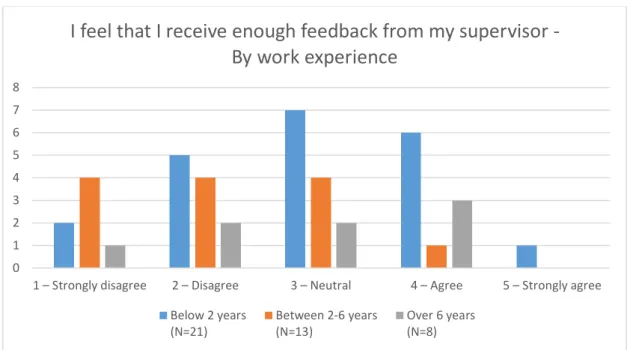
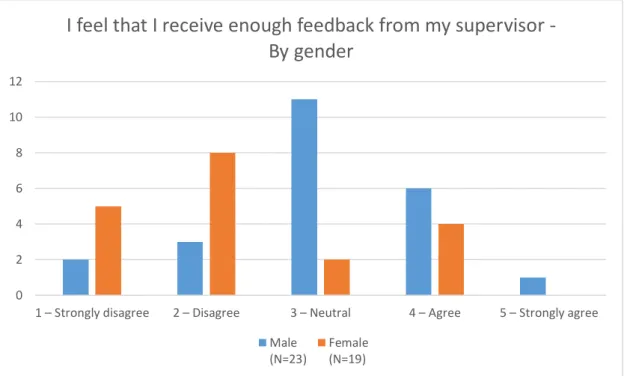
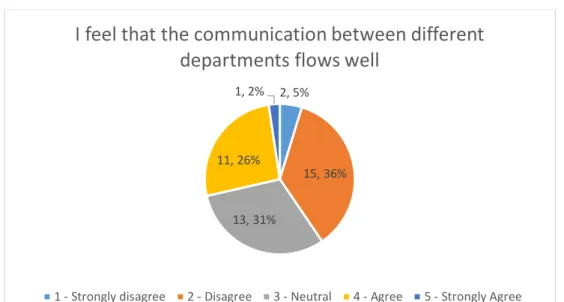
Next, we will focus on question number 8, which was labeled "I feel that I get enough feedback from my supervisor". The first notable problem with this question is that 13 people out of the 42 respondents (31%) gave a response value of "neutral". Of the remaining respondents, 11 people or 26 percent gave a positive value of "agree" or "strongly agree".
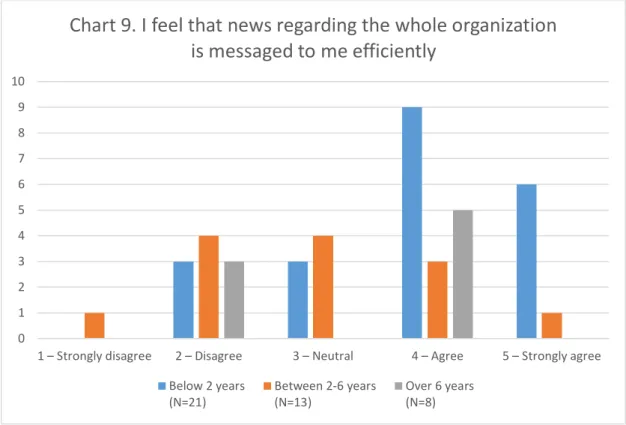
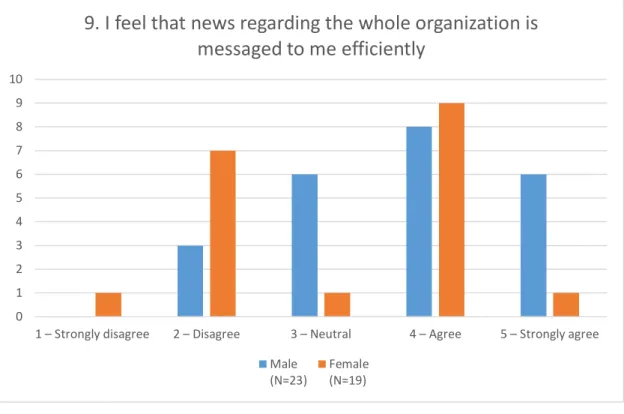
Women gave more negative feedback on this question, with 13 out of the 19 female respondents (68%) giving a negative value to this question. Question number 9 was labeled as follows; "I feel that news about the whole organization is sent to me effectively". One of these answers was with the value "Strongly Disagree", others with the value "Disagree".
The last question with a significantly remarkable number of negative values was question number 12; “I feel that I can easily transfer my ideas to higher ups. One idea the researcher made, which had no particularly negative or positive aspects, was that question number 14; "I feel that the staff meetings are relevant to enable me to work more efficiently" had given many "neutral" values; 11 of the 42 responses, or 26% of the respondents, gave a neutral value to this question. Question number 4, I feel it is easy for me to communicate with the team I work in on a daily basis, a clear majority of respondents seemed to agree or even strongly agree with this statement.
I feel that the company has provided me with sufficient tools to communicate efficiently” there were 28 responses, or 67%, that had a positive value of “Agree” or.
Multiple choice questions and open-ended answers
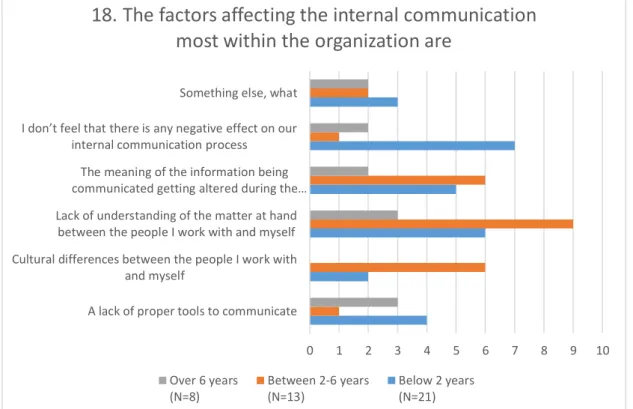
As previously mentioned, 4 out of the 15 questions mapping employees' feelings towards subjects had negative values that stood out from the responses. The remaining 11 questions had mostly positive responses - the researcher believes that it would not be an efficient way to use time and space to cover all these 11 responses and their percentage of positive responses. The last multiple choice question and the last question in the entire survey received a total of 64 responses from 42 respondents, so a total of 1.5 choices chosen per respondent.
The answer option that received the most responses to this question was the one labeled "Lack of understanding of the matter between the people I work with and myself," with a total of 18 responses, or 43% of the total number of respondents' . Lack of understanding of the matter between the people I work with and myself. The meaning of the information being communicated changes during the. The option with the second highest response rate was the one labeled "The meaning of information being communicated is changed during the information exchange process", with a total of 13 responses, or 31% of all respondents.
In terms of demographic information, no trend seems to stand out in this question type; all the answers given to this question seem to be in line with the number of respondents from each demographic section of the employees of the organization. It should also be noted that since the answers deal with some sensitive opinions about the organization and the communication process, no demographic data of the respondents will be provided for this section. A few of the answers given touched more on the management side of the problem, with one saying that “management doesn't seem to value communication and it's not equal for all people in the company.
Two respondents seemed to have problems with how information is received in the organization.
Discussions and conclusion
Conclusion
To briefly conclude this communication model of the organization, the researcher could say that there are many employees who have spent so little time in the.
Final Recommendations
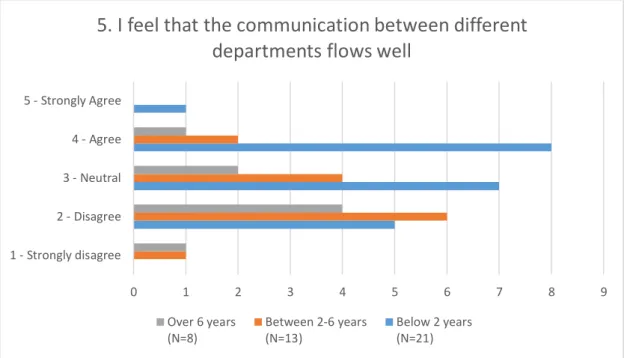
The organization's leadership should then listen to what the long-time employees have to say, come up with a new communication plan that spans the entire organization, and implement it so that every employee becomes an advocate for this culture. In addition, the silo mentality of teams and their communication is something that should be addressed quickly by interviewing different teams about their views on how they see communication improving between them and other teams in the organization. The interviews could potentially try to identify how individuals within different teams communicate with each other, and then implement these methods into company-wide communication models.
It must be said that this silo mentality can be very detrimental to the organization's business operations, and can potentially cost them a lot of resources. to summarize; Individual interviews for the people who were talkative and have first-hand knowledge about the issues within the organization's communication process need to be heard because they are the key to solving the issues this company is facing. I feel that it is easy for me to communicate with the team I work in on a daily basis.
What would be the best way for senior management to communicate information regarding the entire organization (changes, events, etc.).