Karikoski was the lead author of the publication and wrote the majority of the manuscript. Karikoski was lead author of the publication, wrote most of the manuscript, and collected and analyzed the data.
Introduction
- Background and motivation
- Objectives and scope
- Research approach
- Thesis structure
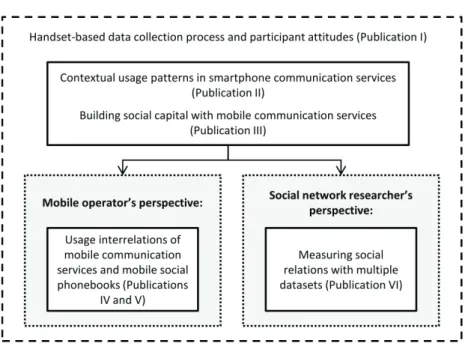
The research approach of the dissertation therefore has more to do with testing theories than with creating theories. The implications of the results are then discussed from the perspective of mobile operators and social network researchers in the discussion section.
Theoretical background
Communication research
- Communication channels
- Communication technology affordances
The possibilities of communication channels and the composition (size and diversity) of the personal network both influence channel use. These mean that communication choices are influenced by the forms and technological capabilities of channels (eg, screen size and input capabilities of a device), financial costs and perceptions of channels. 11 communicators, physical proximity of communications, social location of communicators (or context as defined by Bouwman &.
Van De Wijngaert (2002) has identified a number of other factors that influence the choice of communication channels, including the user's characteristics (own customs and preferences), possibilities and specificities of the channels, availability of communicators and characteristics of the task. For example, Van Cleemput (2012) has distinguished between three criteria based on which the possibilities of communication technologies differ. This approach assumes that communication media are chosen to be used when the opportunities afforded by the medium and the characteristics of the bonds with which the medium is used to communicate are congruent.
Social network analysis
- Strength of ties and social capital
- Circles of acquaintanceship
Granovetter's (1973) theory on the strength of weak ties is one of the fundamental issues in sociology. Numerous definitions for social capital exist, but as Wilken (2011) pointed out, the works of Coleman (1988) and Putnam (2000) have been fundamental in the way social capital research has developed in the last decade. Weak ties form the foundation for bridging social capital, which is external social capital that includes networks of people across diverse social backgrounds.
Strong ties, on the other hand, form the foundation for bonding social capital, which refers to introspective social capital that reinforces exclusive identities. Thus, bridging social capital refers to connecting groups from different social circles, forming new relationships and spreading information, while connecting social capital refers to already established relationships where we share the same social circles. Inner circles are more emotionally close (than outer ones), which means they are characterized by strong bonds and bonding social capital.
Related empirical research
Service usage and social networks
- Bottom-up research
- Top-down research
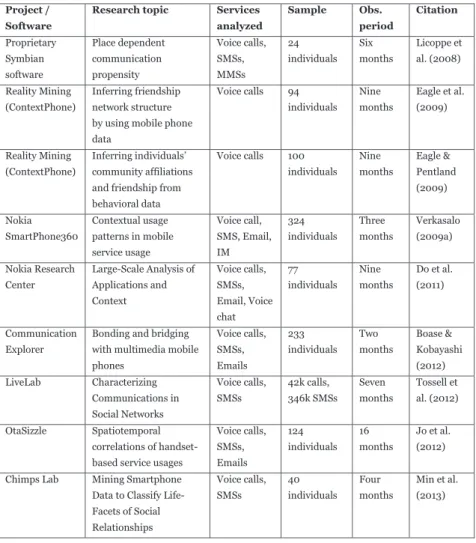
Regarding the social context, Do et al. 2011) noted that the use of voice calls and text messages is higher in contexts with a large number of Bluetooth devices nearby. The datasets collected through the top-down approach are also typically limited to a specific domain (or communication service), such as voice calls or text messages. The majority of top-down research examines voice calls and/or text messages and the mobility data collected as a byproduct.
Other studies in Table 2 present examples of top-down studies based on voice calls and SMS. Hidalgo & Rodriguez-Sickert (2008) and Kovanen et al. 2011) studied the reciprocity (i.e., the degree of reciprocity in a relationship) of mobile voice calls. They claim that voice calls are used for coordination calls just before face-to-face meetings.
Service usage interrelationships
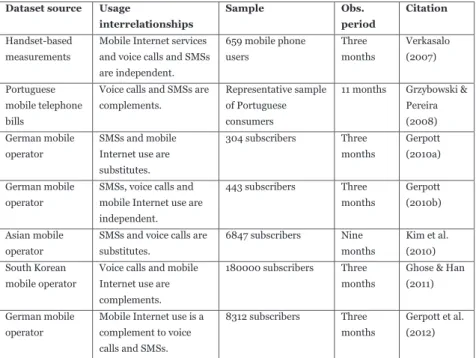
2011) studied the interaction between voice calls and face-to-face interactions using CID location information. A complementary relationship has also been observed between intensity of mobile Internet use and voice call consumption (Ghose & Han, 2011). Similar to Grzybowski & Pereira (2008), Ghose & Han (2011) also acknowledge that user characteristics influence user-level interactions. 2012) have observed that the intensity of mobile Internet use is a complement to voice calls and SMS.
The complementary interrelationship maintained even if the users were charged for fixed rate from mobile internet access, and on usage basis of SMS and voice calls (i.e. However, the operationalization of mobile internet usage intensity was quite broad, measured on the basis of mobile internet traffic Verkasalo (2007 ) reported an independent interrelationship between mobile Internet service use, and text messages sent or frequency and duration of voice calls made.
Methods and data
- Methodological research approach
- Handset-based measurements
- Context detection
- Experience sampling
- Surveys
- Semi-structured interviews
Observed data is collected using the software installed in the participants' mobile phones regarding, for example, communication service use and location. Finally, the context detection algorithm used in this thesis enables the inference of contextual information from the participants, which belongs to the category of inferred data. Those participants who do not have suitable devices can only participate in the survey part of the survey.
This approach was successful in increasing the number of participants in the mobile-based part of the research. This variant of the Experience Sampling Method (ESM) (Hektner et al., 2007) is used in this thesis (Publication III) to sample the participants' experiences regarding the use of mobile interpersonal communication services. Experience refers to any of the contents of consciousness of an individual (Hektner et al., 2007).

Results
- Measurement development
- Contextual and social usage patterns
- Service usage interrelationships
- Social network analysis
- Results summary
Handset information used in context sensing (Publication II) includes the time-stamped CID (one second resolution) of the mobile network base station to which the handset is connected and the surrounding WLAN access points detected by the device (scanning takes place every 30 minutes and each time a user connects to an access point). The analysis also takes into account non-use and length of voice calls. The longest voice calls are made in the home context, where voice calls are used the least intensively.
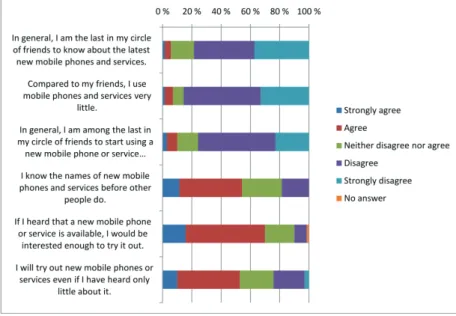
The thesis also uses mobile phone communication data collected with mobile-based measurements, and data from an online social media service developed in Aalto University's OtaSizzle project in order to study how social networks change arising from special communication services (Publication VI) . According to the surveys conducted in this thesis, the sample used in mobile-based measurements is biased towards early adopters or innovators of mobile phones and services, who are also interested in research activities in general. In addition to the context of mobile phone use and the strength of the connection between the people communicating, discussed above, a number of other factors influencing the use of communication services were identified in the interviews.

Discussion
Communication and social network research implications . 53
With most cross-platform services, such as WhatsApp, you still need to have the app running on the device. Adopting a systems view of different communication services and their possibilities is particularly prominent in the case of mobile communication, as Helles (2013) points out. One can also claim that the reliability of data collection for social connections has increased, due to the automatic recording of data, for example, in online services and CDRs of mobile operators.
However, the authors report that the magnitude (or practical significance) of the relationship is quite low. The interrelationships of using services will evolve in the future, and we contend that Mobile Social Phonebooks (MSP) will have an effect on interrelationships. One of the main assets is the phone number that forms the basis of their relationship with customers.
Methodological implications and privacy
However, in the Netherlands, for example, there is a net neutrality law that prohibits such restrictions. This has led to widespread adoption of OTT communication services, especially WhatsApp, in the Netherlands. Odlyzko (2009) has argued that it would be better from a social point of view to enforce net neutrality and thus stimulate innovation on the mobile network by others (e.g. OTT providers).
However, the types of personal data (voluntary, observed and inferred (World Economic Forum, 2011)) are constantly evolving, and the term personal data also has various meanings in the digital world. Research ethics therefore play a critical role in this type of measurement, and it is essential that the participants know and understand how personal data is processed in the measurements (Kosta & Dumortier, 2008). In the future, the participants' control over the data collected from them may be increased, so that they can choose what data is collected, and delete data if they wish.
Limitations
Furthermore, although the data anonymization process used in the thesis (Figure 5) is adequate in a university setting where participants have chosen, there are always concerns about de-anonymization (Lane et al., 2012), re-identification (Beach et al. al., 2010) or deductive discovery (Eagle, 2009) of participants to be considered. As discussed earlier in this thesis, the sample used in the mobile-based measurements is biased towards early adopters of mobile phones and services (Finnish university students in their early twenties). The usage patterns of early adopters may also reflect those of the future majority.
In the case of voice calls and SMS, however, we argue that the platform does not play a significant role in the analysis, as these services are available for all mobile phones. The practical limitations that different mobile operating systems present to data collection should be further explored in the future. In our analysis of social networks (Publication VI), we were limited by the type of data we could obtain from online services.
Future research
There is also a need for more emphasis on the validity of the research, especially in relation to what kind of social bonding is being measured. Related to the contextual part of this thesis, the context detection (Publication II) will be developed in the future by adding data from multiple sensors (e.g. acceleration sensor) to the input data of the algorithm. Finally, on the brink of the open data era, we hope to see more datasets openly published in academia and enable ground-breaking work across research disciplines.
I: Proceedings of The 6th ACM International Workshop on Mobility in the Evolving Internet Architecture (ACM MobiArch 2011). I: Proceedings of the 5th International Conference on Next Generation Mobile Applications, Services and Technologies (NGMAST2011). Proceedings of the 9th International Conference on Mobile Business and 2010 Ninth Global Mobility Roundtable (ICMB-GMR 2010).