
The purpose of this thesis was to increase understanding of the role students' situational epistemic feelings play in authentic contexts of science education. The first overall aim of the study was to examine the relationship between different teaching activities and the students' experience of epistemic emotions.
What are emotions and why are they important?
Emotions in educational contexts
Academic emotions can be further divided into four categories based on their stimulus or object of focus (Pekrun et al., 2018; Pekrun & Linnenbrink-Garcia, 2014a). Fourth and finally, epistemic emotions such as surprise or confusion are related to learning itself, and have an object focus on knowledge or knowledge construction (Pekrun et al., 2017).
Epistemic emotions
Science learning in the school context
Relevant to the teaching and study of science is the interweaving of conceptual and procedural knowledge, as described above. Although inquiry and experimentation are fundamental parts of science education, science classes typically also include other activities, such as reviewing homework, teaching new content, and independent class work (Burns & Anderson, 1987; Mortimer & Scott, 2003).
Emotions and science learning
Studying and teaching involve intentional activities aimed at learning, and in the school context these goals and objectives are typically defined in curricula. Thus, some researchers suggest that teachers should not try to minimize these negative emotions in the classroom, but rather support students in their experience of them as part of the learning process (DeBellis & . Goldin, 2006; Jaber & Hammer, 2016).
The present study
The perspective adopted
The studies that make up this dissertation were conducted in a real science learning environment in the context of upper secondary physics education. The Experience Sampling Method (ESM) was used in the studies comprising this dissertation to examine students' situational experiences of epistemic emotions.
The aims of the thesis
In the substudies, versatile natural science learning environments were used, in which different epistemic emotions were supposed to be awakened. The methods are described only briefly here, and in more detail in the original publications.

The research context: Finnish upper secondary science education
In other words, quantitative and qualitative data were collected to address the various questions addressed in the three studies. Qualitative data are first interpreted and quantified to enable quantitative verification of emotions and learning situations in the final stages of data analysis.
Experience sampling method (ESM)
Participants and data collection procedures
My involvement in the planning and implementation of the data collection dates back to 2018. The data has been collected as part of normal class work in four of the participating classes.
Measures
Epistemic emotions
The pre-test was administered just before the beginning of the study period to measure students' knowledge of the topic, and the post-test was administered after the study period as part of the course exam to measure learning outcomes. However, in the spring of 2021, as part of distance learning due to the COVID-19 pandemic, the students of two classes completed the computer-based learning task at home. The EES was implemented as part of a broader ESM questionnaire that also included other items on social, emotional, and contextual aspects.
After each POE situation, as part of the task, students were asked to self-report their experience of situational epistemic emotions.
Instructional activities
Students participating in Studies I and II were asked: “What do you think about the activity you did. The study period for Study I included six class hours, so each student had 18 opportunities to complete the questionnaire. To keep the questionnaire as short and easy to answer as possible, only four epistemic emotions were surveyed in Study III.
The epistemic emotions of surprise, curiosity, and confusion were chosen because they were expected to occur in this type of research activity with contradictory and inconsistent information.
Science learning
Data analyses
The variable-oriented versus the person-oriented approaches
Analyses of the qualitative data
In study I, the categories were clearly nominal, but in study III a closer consideration was needed. Finally, it was concluded that a nominal approach would better represent the data, although an ordinal approach would also have been justifiable.
Statistical analyses
A mediation analysis is a special type of path analysis, in which the effect of independent variable (IV) on dependent variable (DV) is explained by a third, mediating, variable. A multilevel modeling approach is needed if one or more of the variables in a mediation analysis are measured at the within level. A two-level, parallel mediation analysis was conducted in Study II to estimate the direct and indirect (i.e., mediation) effects of prior knowledge and epistemic emotions on learning outcomes.
LCGA was used in Study III to identify groups of students with characteristic longitudinal trajectories of epistemic emotions.
Ethical considerations
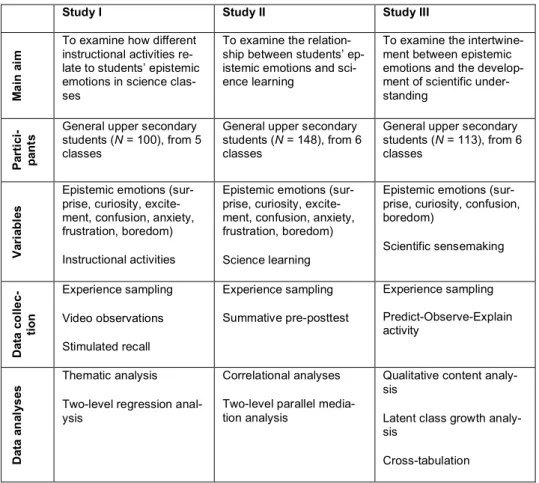
The number of latent classes was determined based on five criteria: BIC, AIC, VLMR, entropy criterion and clarity and interpretability of the classes. Review of studies I, II and III: main objectives, participants, variables, methods of data collection and data analysis used in the original studies. To examine how different learning activities relate to students' epistemic emotions in science classes.
To examine the interplay between epistemic emotions and the development of scientific understanding.
Instructional activities predicting epistemic emotions in Finnish upper
The purpose of Study II (Vilhunen, Turkkila, et al., 2022) was to clarify the hypothesized relationship between epistemic emotions and learning. RQ1: How do epistemic emotions relate to students' performance and learning in high school science. In order to investigate the causal relationships between prior knowledge, situational epistemic feelings and learning outcomes, a mediation analysis using MSEM approach was conducted.
Correlational analyzes also showed that epistemic emotions were related to pre- and post-test performance.
Epistemic emotions and observations are intertwined in scientific
The empirical aims of the thesis were to explore how teaching activities as contextual factors in science lessons relate to students' experiences of epistemic emotions, and how their epistemic emotions relate to their science learning. At the theoretical level, the aim was to improve understanding of the role that epistemic emotions play in authentic contexts of science learning, thereby contributing to the discussion about students' academic emotions. The main methodological goals were to apply advanced and versatile statistical methods in the investigation of situational emotions, and to combine qualitative with quantitative data to better contextualize students' situational experiences in authentic science learning environments.
The practical aim was to provide new insights and recommendations for teachers and other practitioners in the field of science education through which they could give students more support in their science learning.
Empirical findings
Instructional activities related to students’ experiences of situational
Enthusiasm and curiosity are likely to emerge when the teacher's goal is to direct students toward learning and engage them in learning. The cognitive load of the POE task increases towards the end of the activity, as many students experience the information in the last situation as inconsistent. Thus, in addition to working on skill- and content-focused tasks, data analysis and model development can be seen as the most challenging activities in the classroom from the students' perspective: they are associated with higher levels of confusion, frustration and anxiety than some. other learning activities.
Almost half of the students in the data were noticeably bored during the learning task, and many also gave relatively short and vague answers to the POE items.
Associations between students’ epistemic emotions and science
It has also been suggested in previous research that passive participation in learning activities induces boredom (Minkley et al., 2017). These results are in line with and complement previous findings of a negative relationship between boredom and learning (Pekrun et al., 2014; Tze et al., 2016). This implies that boredom may have an inhibiting effect on making observations and developing understanding, as has been suggested in previous research (Muis et al., 2015; Pekrun et al., 2014; Tze et al., 2016).
Furthermore, curiosity especially plays a role in critical thinking, related to applying previous knowledge to new situations and evaluating information (Muis et al., 2015).
Theoretical considerations
The trait versus state nature of epistemic emotions
Even if it is a negative emotion based on its valence, it can be considered positive in terms of learning. In addition, the regression coefficient from pretest performance to situational confusion in MSEM was negative (and statistically significant), but the regression coefficient from situational confusion to posttest performance was positive (but not statistically significant, p = 0.07), underlining the complexity. of the interplay between learning and situational confusion (D'Mello et al., 2014). These findings are consistent with the results of previous research suggesting a positive relationship between confusion and learning (D'Mello et al., 2014; Muis et al., 2015; Watkins et al., 2018), but contradict other research. findings suggesting that confusion impairs learning (Jacobson et al., 2021; Schneider et al., 2016).
However, further research needs to be conducted to establish the role of confusion in science learning.
Activating versus deactivating emotions
Methodological contributions
Practical implications
In conclusion, in order to promote the development of positive meta-affects, lessons must be planned in such a way that the learning process as a whole is positive for students. Therefore, in order to support the development of positive meta-effects, teaching and learning should take place in the proximal zone of student development (Vygotski, 1978). It is therefore worthwhile for teachers to observe the emotional states of students in order to direct support and support to those who seem, for example, frustrated or bored.
On the other hand, observing students' emotional states can be difficult, as underlying feelings are not necessarily outwardly visible (Loukomies et al., 2015).
Limitations
It is likely that some personal characteristics influenced their willingness to participate, so the sample does not represent the population (ie, participating schools or classrooms) in an optimal way. The specific aims were to explore how learning activities in science lessons relate to students' emotions and to examine the relationship between emotions and science learning. First, the findings revealed that students' emotional experiences in science lessons can be managed through instructional activities.
Therefore, the role of students' situational emotions needs to be acknowledged in future research, as well as in school settings, teacher training, and educational policy making. Students' engagement with science in early adolescence: The contribution of enjoyment to students' continued interest in learning about science. Academic emotions in self-regulated learning and student achievement: A program of qualitative and quantitative research.
