EVALUATION OF THE
SMALL-SCALE IRRIGATION PROJECT (SIP)
ZAMBIA
Draft report Joss Swennenhuis
April 2015
PICTORIAL SUMMARY
Location of SIP irrigation schemes
This report presents the result of the evaluation of the Small-scale Irrigation Project (SIP) funded by AfDB (€7.4m) from 2003 to 2010 and by MFA Finland from 2010 to date (€9.3m), with €1.9m GRZ counterpart funding. The project is implemented by MAL through a dedicated PIU.
SIP has rehabilitated 1 irrigation scheme (Buleya Mulima), developed 3 new schemes (Sinazongwe, Nzenga and Manyonyo) and completed the designs for a 5th scheme (Kanakantapa). The total area of the completed schemes is around 840 ha, benefiting 500 households. The new schemes will be centrally managed through a farmer-owned company that employs professional scheme management staff. Markets have been secured for Manyonyo (sugarcane) and Nzenga (Irish potatoes) schemes with first income generating yields expected later this year.
Construction effectiveness - The cost and time effectiveness of the scheme construction have been hampered by an inadequate project design, considerable underestimates of scheme construction costs and bureaucratic rules caused by a hybrid procurement and No Objection system that has to comply with both GRZ and AfDB rules. Of the overall budget of €17.8 million,
€11.81 million, has gone into construction, giving an average construction cost of €14,100 per hectare brought under irrigation, considerably higher than comparable schemes. It translates into a cost of around
€23,700 per beneficiary household.
Estimated construction costs per hectare for different schemes
“Soft” aspects - SIP has been very successful in developing a management model and in securing markets.
Although these aspects were only addressed late in the project, the achievements have been remarkable: an innovative management model and secured markets and loans for production of sugarcane in Manyonyo (Zambia Sugar) and Irish potatoes in Nzenga.
Contract with Top Fruit & Vegs for purchase of Irish potatoes. It includes a minimum price guarantee
1 This includes already disbursed but not yet used funds
Impact - The rehabilitation of Buleya Mulima scheme was completed in 2007. The 0.25 ha plots have since generated good income to the beneficiaries of around €1270 per household per year from selling winter maize, tomatoes, ocra, green beans and other crops to wholesale buyers who come to their village. The potential benefits of the other schemes (where the first crops have yet to be harvested) is also good, with the cost-benefit analysis showing net incomes of around €2,500 per beneficiary per year. With at least double that income possible in Sinazongwe / Nzenga if more than 1 crop per year is planted.
Buleya Mulima is the only scheme managed by an (existing) cooperative. From the scheme income the cooperative is now branching out to other income generating activities like chicken broilers and cattle
Communities have been mobilised and consulted throughout the project lifetime
Sustainability - The sustainability prospects for the developed schemes are generally good. Ownership has been promoted through a continuous community mobilisation effort, and the communities have been directly involved in identifying a scheme selection and beneficiary selection. In spite of this, a social conflict around land issues has arisen in Sinazongwe, where the further scheme development is now on hold.
The management model developed by SIP promises to balance farmer ownership with professional and cost-efficient scheme management.
The business plans show good commercial viability, and initial financial needs have been covered through loans negotiated with FNB (a commercial bank) and through facilitation by Zambia Sugar.
Management support provided to the irrigation companies by AMSCO through separate funding from Finland will help ensure institutional sustainability.
Comparison of estimated net profits per ha (for Nzenga / Sinazongwe based on 2 crops per year) Sustainability is currently hampered by a number of
technical issues, in particular in Manyonyo. This is primarily due to the fact that the schemes were not designed for sugarcane and the fact that the technical quality of the designs was not always satisfactory.
<- Good: Lined canals in Sinazongwe and Nzenga Not so good: leaking earth canals and wrong type and location of control structures in Manyonyo ->
Not ideal: Makeshift control structures in Manyonyo
Siphons at work at Manyonyo A well constructed reservoir at Manyonyo, but with an outlet that might be too small
Old and new: the old diesel pump at Buleya replaced with an
electrical one.
Temporary setback: ZESCO removed transformers recently
at Sinazongwe and Nzenga
Impressive pumping station at Manyonyo. Some minor issues with debris / silt entering the foot valves Gender and social inequality - These aspects
have not received due attention. While women are included as beneficiaries they are not in any decision-making position in the irrigation committees. Some gender and HIV/AIDS awareness training was provided but has not led to any mainstreaming strategies. The current work by AMSCO presents an opportunity to improve on these aspects.
Men still better off than women ....
Exceptional heavy rains during April visit. Too late for the crops after a 3-week drought spell
Environment and climate change – Minor environmental
impacts. Climate change evident, and
irrigation a key coping strategy for
small farmers
Some bush clearing unavoidable for irrigation development
Project management – The PIU generally performed well, with delays mostly caused by factors outside their control. Quality assurance of construction work however leaves to be desired, while impressive results were achieved on the soft elements of management and marketing. Some motivational fatigue has been observed. Lack of a clear results framework has hampered results based management.
The Project Steering Committee has functioned in line with its
mandate, with the supervision missions proving to be very useful. The socio-economist (left) and irrigation engineer of SIP during the field visit
Project level conclusions & recommendations
Achievements Conclusion: When compared with the initial project proposal as described in the appraisal document for the first phase, the project has underachieved when it comes to the number and size of the irrigation schemes to be constructed (hardware) and the time required to do so. However, the initial design was unrealistic both in budget and in time planning, while bureaucratic combined GRZ / AfDB procedures caused many delays.
Recommendations: The PIU should analyse all outstanding issues and work with all stakeholders to prioritise and resolve the most pressing ones. MAL should appoint Boards for the irrigation companies as soon as possible.
Sustainability Conclusion: Sustainability prospects are good, but require some technical adjustments and continued support to the irrigation companies (possibly beyond support that AMSCO is currently providing).
Recommendations: The work of AMSCO is crucial and should if needed be extended.
The PIU should work closely with Zambia Sugar to resolve technical issues at Manyonyo and also urgently address the remaining technical issues at Nzenga. SIP should support the Nzenga Irrigation Company with the development of markets and related business plans for additional crops for the Nzenga / Sinazongwe schemes. This should be done in close collaboration with ZNFU.
Cross-cutting objectives
Conclusion: Gender and social inclusion have not received enough attention.
This can still be addressed through AMSCO’s work with the companies, including promoting inclusion of poor people in the schemes as labourers.
Environmental impacts are minor. Irrigation is a key climate change adaptation strategy.
Recommendation: The PIU should work with ZEMA on mitigating key outstanding environmental issues at Manyonyo.
Project management &
governance
Performance of the PIU and PSC has generally been satisfactory. The main weakness is inadequate technical quality assurance and current motivational fatigue leading to an inclination to not collaborate fully with key stakeholders like Zambia Sugar.
The PIU should remain fully committed to SIP until the end and maintain a positive collaboration attitude. The PSC should consider playing an active role in resolving the outstanding issues in Manyonyo. The PIU should closely monitor Nzenga and Manyonyo crop management and yields and resulting benefits and document the lessons learnt.
Broader lessons for a possible future support programme for the smallholder irrigation sector
1. The “zero option” should not be considered because (i) Development of smallholder irrigation is a key livelihoods diversification strategy and very much in line with Zambian and Finnish development policies; (ii) Irrigation is very important in building the resilience of small farmers against climate change impacts; (iii) A future programme would allow for continued low-level engagement with the schemes developed under SIP, which will increase their sustainability prospects.
2. A future support programme for the development of smallholder irrigation schemes in Zambia should include a sufficiently long preparation phase (1 to 2 years) which allows for a thorough analysis of technical, marketing, management, social and environmental issues at potential sites for irrigation development support.
3. A future support programme should not start with the development of new schemes based on the SIP management model until this model has proven itself. At least one to two years are still needed to assess how well the SIP model will be functioning once the schemes (at least Nzenga and Manyonyo) are actually producing and marketing crops. This will allow all stakeholders to learn crucial lessons that can help avoid or
mitigate any challenges that this management model faces.
4. For effective management and governance of a future support programme,, five issues are considered crucial:
a) The right composition of the project management team b) A clear results framework
c) Strong accountability and oversight mechanisms (including performance based contracts with clear annual deliverables for all project staff)
d) Realistic budget & time planning
e) Efficient procurement and financial management procedures
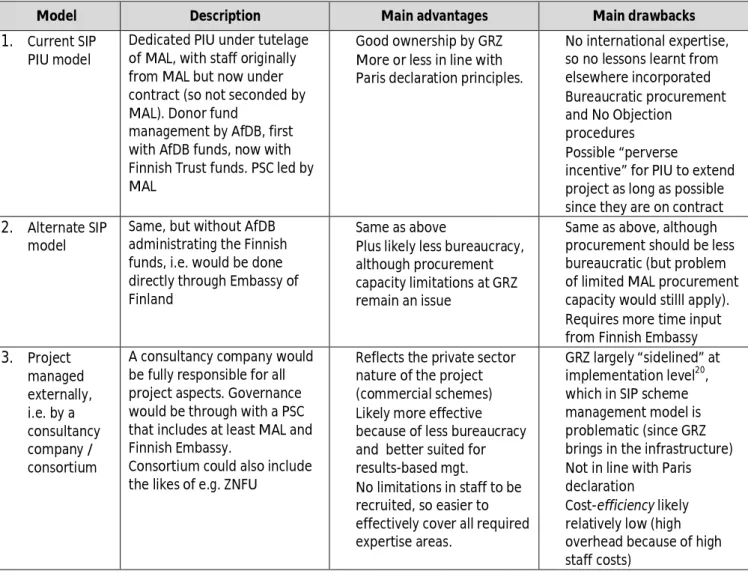
5. Several management models can be considered, each with its advantages and drawbacks. The five issues mentioned above should ultimately be guiding the choice of project management model.
TABLE OF CONTENTS
1 Introduction... 1
2 Project description ... 3
3 Detailed findings... 5
3.1 Achievements ... 5
3.1.1 Introduction ... 5
3.1.2 The hardware – Construction of irrigation schemes ... 5
3.1.3 The software – Capacity building, community mobilisation, marketing and management ... 9
3.1.4 (Potential) impact ...10
3.2 Sustainability issues ...11
3.2.1 Ownership ...11
3.2.2 Technical aspects ...12
3.2.3 Institutional aspects ...13
3.2.4 Commercial and financial aspects ...16
3.3 Cross-cutting objectives ...17
3.3.1 Gender and social equality ...17
3.3.2 Environment and climate change ...18
3.4 Relevance ...20
3.5 Project management and governance ...21
3.5.1 Project Implementation Unit ...21
3.5.2 Project governance ...22
4 Project level conclusions and recommendations ...24
4.1 Overall achievements ...24
4.2 Sustainability ...25
4.3 Cross-cutting objectives ...26
4.4 Relevance ...27
4.5 Project management & governance ...28
5 Broader lessons learnt for possible future support to the irrigation sector ...29
5.1 Zero option ...29
5.2 Project design issues ...29
5.3 Project management & governance ...31
5.3.1 Key factors ...31
5.3.2 Possible project management models ...33 Annex I Terms of Reference
Annex II Summary of main expected and achieved results Annex III Characteristics of the SIP irrigation schemes Annex IV List of people met (still to be done)
Annex V List of documents consulted (still to be done)
Acronyms
AfDB African Development Bank
AMSCO African Management Services Company DPM District Project Manager
DPP Department of Policy and Planning (MAL) ESIA Environment and Social Impact Asssessment
FNB First National Bank
GRZ Government of the Republic of Zambia
ha hectare
HH household
IDSP Irrigation Development Support Programme MAL Ministry of Agriculture and Livestock
MFA Finland Ministry for Foreign Affairs of Finland
MIC Manyonyo Irrigation Company
MSCGT Mazabuka Sugar Cane Growers Trust
NIC Nzenga Irrigation Company
O&M Operation & Maintenance PIU Project Implementation Unit PSC Project Steering Committee SIP Small-scale Irrigation Project
TA Technical Assistance
T-COBSI Technical Cooperation project on Community Based Smallholder Irrigation TSB Technical Services Branch (MAL)
ZMK Zambian Kwacha (rebased)
ZNFU Zambia National Farmers Union
1 Introduction
This report presents the results of the evaluation of the Small-scale Irrigation Project – SIP. SIP was funded during a first phase from 2003 to 2009 by AfDB (around €6.7 million), and from 2010 onwards by Ministry for Foreign Affairs (MFA) of Finland (around €9.3 million2), with the Government of the Republic of Zambia (GRZ) providing counterpart funding (€1.8 million) during the whole project period, with total disbursed funds amounting to around €17.8 million. The Ministry of Agriculture and Livestock (MAL, previously the Ministry of Agriculture and Cooperatives-MACO) is the Executing agency for the project and has delegated the project management to a Project Implementation Unit (PIU) with dedicated staff.
After a number of extensions, SIP will come to an end in September 2015. This evaluation can therefore be seen primarily as an end-of-project evaluation, although recommendations have also been developed for the remaining few months of implementation.
The overall objective of the evaluation, as per the ToR (see annex I) is to assess the sustainability and potential for irrigated small scale agriculture in the schemes implemented by SIP, in the context of the agricultural value chains and markets, with an aim to:
1. Provide the competent authorities of the Government of Finland and the Ministry of Agriculture Zambia with qualified views, conclusions and evidence on the project results, relevance and feasibility of the project design and the implementation methods for reaching the stated objectives.
2. Provide key lessons learnt and give guidance to the competent authorities on future support, or discontinuation of the support after the current phase of the project has been completed;
3. Provide the competent authorities and stakeholders’ recommendations for improvements and the future orientation of the project.
The evaluation should also develop recommendations for a possible future support programme to the irrigation sector, including an analysis of the zero option.
The evaluation consisted of an inception phase (desk study, briefing meeting, inception report), field visit to implemented irrigation schemes, meetings with a large number of stakeholders (both in Lusaka and in the field) and two debriefing meetings in which preliminary findings were presented to the Ministry of Agriculture and Livestock (MAL) and to MFA Finland.
The assignment was undertaken by an independent consultant, Joss Swennenhuis, who is responsible for the findings, conclusions and recommendations contained in this report. During the field visit, he was accompanied by two officers from MAL: one from the Technical Services Branch (TSB) of the Department of Agriculture, and one from the coordinating Department of Policy & Planning (which is also responsible for monitoring of projects under the Ministry’s responsibility).
The report starts with a short description of the project, followed by detailed findings3. The final two chapters present conclusions and recommendations at project level, and broader lessons learnt as input for a possible future support programme to the irrigation sector.
2Total committed amount was Euro 10 million, but not all funds were disbursed and the amount also included a management fee for AfDB.
3 More detailed than initially envisaged, based on a request by MFA Finland to provide as many details as possible.
A note on the financial numbers:
If not otherwise explicitly stated, all amounts in this report are in Euros.
Where USD amounts are at the basis of some calculations, these were converted into Euros at a rate of 1 Euro : 1.35 USD. This is more or less the average exchange rate over the project implementation period.
Conversion of AfDB’s UA currency to Euros is based on information provided by SIP showing USD equivalents of UA amounts. On average 1 UA = 1.55 USD = 1.15 Euro
The bulk of project construction expenditures took place in the period 2008 to 2014. Average annual inflation during this period was less than 2% for both the USD and the Euro. This is considered low enough to not require recalculation of all expenditures to present-day values. The exception is the expenditures for the rehabilitation of the Buleya scheme, which was completed by 2007. An inflation correction of 1.3 was applied to calculate the cost/ha for Buleya to present day values. In a few other relevant cases inflation corrections were also applied. This is mentioned explicitly in the text.
2 Project description
The Small-scale Irrigation Project (SIP) originated from the efforts of the Government of the Republic of Zambia (GRZ) to support the Tonga people who were displaced from the Zambezi valley during the construction of the Kariba dam in the 1950s. As such, the project targeted a number of areas where the displaced people have been resettled, with the objective to increase food production and farm income of the target group in the project area through irrigation. The original project design comprised 3 components: Irrigation Development (including Community Mobilisation); (B) Rural Saving and Credit; and (C) Capacity Building.
The first phase of SIP formally started in 2002, with funding (loan + TA grant) provided by the African Development Bank (AfDB) and by GRZ as counterpart funding. The initial appraisal report proposed to develop 6 irrigation schemes (5 in Southern Province, 1 in Lusaka province) with a total irrigation area of 1,890 ha , targeting 1,650 households, in a 6-year period.
At the start of the project, feasibility studies for the proposed sites were not yet available, and the first few years of the project were therefore used to contract companies to develop these studies and design the irrigation schemes, while at the same time creating awareness amongst communities through a community mobilisation effort. From the results of the technical studies it soon became clear that the original project budget of UA 8.04 million (around Euro 10 million at current exchange rates) fell considerably short of the amounts required to develop all proposed schemes.
After the Mid Term Review (2007) it was therefore decided to only implement 3 schemes: Buleya Mulima (rehabilitation only), Nzenga and Sinazongwe (both around 100 ha) and Nega-Nega (595 ha). For a fourth scheme, Kanakantapa, the project only developed the design but it will not be implemented under the project due to the high dam construction costs. See map below. It was also decided to cancel the credit component and use the funds for the construction of the irrigation schemes.
Figure 1 - Map showing approximate location of irrigation schemes
The Mid Term Review also proposed to extend the project with 2 years to 2009. However, it soon became clear that neither the additional time nor the available financial resources were sufficient to complete the revised list of activities by the end of 2009. In December 2008, the Government of Finland therefore agreed to provide additional funding to the tune of Euro 10 million for the continuation of project activities beyond 2009 and in particular to allow for completion of the irrigation schemes Sinazongwe, Nzenga and Nega- Nega4. The Finnish funds were channelled through the Finnish Trust Fund at the AfDB and the latter continued to manage the project funds (of the Euro 10 million funding, Euro 500,000 was set aside for AfDB management fees).
At the time of this evaluation (March / April 2015), the Finnish funded second phase had been extended several times because of further delays in implementation, with the last and final extension seeing the project end in September 2015. While the main construction works have been completed, land levelling is still ongoing, and much of the supporting infrastructure such as offices, sheds and some roads has not yet been constructed. It is unlikely that all planned infrastructure will be completed by September, due to lack of time, lack of funds and the AfDB rules that no new expenses can be approved in the last 6 months of a project.
From the start, SIP has been managed by a Project Implementation Unit (PIU), on behalf of the Ministry of Agriculture and Livestock (MAL). Two members of the PIU, the coordinator and the irrigation engineer, have been with the project the whole time, while the current socio-economist was recruited during the second phase of the programme (in October 2012). At district level, the project is coordinated by a District Project Manager.
It was halfway during the second phase, in 2012, that the project shifted from a purely technical construction approach to a more holistic approach that also looks at scheme management and marketing issues. SIP has developed an innovative model to this effect, which is based on the registration of a company which is responsible for both the scheme management and the marketing. The scheme beneficiaries are the shareholders of the company and as such the recipients of the net profits that are generated through production and sale of crops grown in the schemes. Additional income can be generated by way of providing unskilled or semi-skilled labour in the scheme. Two such companies have been registered: Nzenga Irrigation Company (NIC) for Sinazongwe and Nzenga schemes, and Manyonyo Irrigation Company (MIC) for the scheme in Nega-Nega (now generally referred to as the Manyonyo scheme). The latter currently has a management team of 2 (scheme manager, agronomist) while the former only has a scheme manager. To support the development of these companies into effectively managed and governed entities, the Embassy of Finland has, with funding from the Fund for local cooperation, contracted AMSCO (African Management Services Company) under a 1-year contract (Jan 2015 – Jan 2016).
At the time of this evaluation, Manyonyo scheme was partly in operation (95.5 ha planted), growing sugar cane that is sold to Zambia Sugar. The Nzenga scheme was awaiting approval of a loan from First National Bank (FNB) to allow the start of planting of Irish potatoes for which SIP, with support from the Zambian National Farmers Union, has facilitated a contract with a buyer (Top Fruits & Vegs). The Sinazongwe scheme has been put on hold because of conflicts within the proposed group of beneficiaries, while Buleya Mulima was temporarily not in use because receding waters of Lake Kariba had left the pumps dry, but it is otherwise in full use.
4 Initially Kanakantapa scheme was also to be covered under the Finnish grant but the construction costs for the proposed dam were too high to be covered by the Finnish funding.
3 Detailed findings
3.1 Achievements 3.1.1 IntroductionSIP is lacking a clear results framework against which performance can be measured (see also section 3.5).
Therefore this assessment of SIP’s achievements is based on comparing the actual situation with intended quantitative and qualitative results described in the main reference documents: the appraisal document for the AFDB/GRZ funded first phase of SIP and the programme document for the Finnish/GRZ funded second phase. The actual situation has been derived from progress reports, meetings with all stakeholders and verbal feedback provided by SIP and the Finnish Embassy.
As already mentioned, the third component on credit / savings was cancelled at an early stage, so the assessment looks at achievements for the development of the schemes (the hardware) and achievements relating to capacity building, community mobilisation, marketing and management (the software). This is followed by an assessment of the (potential) impact of the schemes.
Annex II provides a summary of the main achieved versus expected results. Annex III provided an overview of the characteristics of each scheme.
3.1.2 The hardware – Construction of irrigation schemes
The initial appraisal document proposed to develop 6 sites (5 in Southern Province, 1 in Lusaka province) with a total irrigation area of 1,890 ha, targeting 1,650 households, in a 6-year period i.e. from 2002 to 2008. By the end of 2009 (one year after the original project end date), the only completed infrastructure was the rehabilitation of the Buleya Mulima scheme (46 hectare5). For the second phase with MFA Finland funding, the targets were adjusted, with a total of 1,413 hectares to be put under irrigation through development of 4 schemes (Nzenga, Sinazongwe, Manyonyo (Nega-Nega), Kanakantapa), targeting over 997 HHs.
At the time of the evaluation, the main construction works at Nzenga, Sinazongwe and Manyonyo had been completed, totalling 793 ha, with approximately 500 households6 as potential beneficiaries. Of this total area, 95.5 ha had actually been planted (sugarcane in Manyonyo), with planting in the rest of the areas being held up by a combination of factors (see section 3.2). It was decided not to develop the largest scheme, Kankantapa, because the cost of building the dam alone would amount to between 11 and 18 million Euro and that level of funding was not available.
Effectiveness
Considering the project has been running for over 10 years and has invested a total amount of around Euro 17.8 million, the rehabilitation of a 46 hectare scheme, construction of 3 schemes with a total of 793 ha and design (but not implementation) of a 5th scheme does not seem a very cost-effective and time-effective operation. It also doesn’t contribute significantly to the proposed national targets of expansion of small- scale based irrigated land from around 4,000 ha (in 2013) to 17,500 ha in 2016 (a target pronounced by the late President Michael Sata in 2013).
5 The totally fenced area is 71 ha, but the remaining 26 ha is not under irrigation due to insufficient water availability.
6 around 100 HHs in both Sinazongwe / Nzenga (1 ha / HH), around 150 HHs in Manyonyo (4 ha / HH), and around 150 HHs in Buleya Mulima (0.25 ha / HH)
Regarding the cost-effectiveness: when counting all costs (goods, works, services and operational costs), the cost per hectare is around Euro 21,0007. When only considering cost of construction work, this goes down to between Euro 10,800 and Euro 14,100 per hectare8. This compares unfavourable with estimated development costs of some other irrigation schemes in Zambia, as illustrated in table 1. It is also much higher than the originally estimated costs of around Euro 4,000/ha during appraisal, and the revised cost estimate of Euro 8,920/ha of the Mid Term Review in 2007 (both amounts at present day prices i.e.
corrected for inflation).
Table 1 - Comparison of irrigation development costs
Scheme When
developed Scheme size Scheme type Total cost / ha (Euro)
Construction cost / ha (Euro)
Kaleya scheme 1980s 2,500 ha
Furrow irrigation -
pumps approx. 12,500 approx. 10,000 Zambia Sugar
(general estimate) - Large (commercial) Central pivot -
pumps 7,000 to 9,000 7,000 to 9,000 IFAD smallholder
irrigation –
Zambia 1995-2001 Total area 657 ha (of which 17 rehabilitation)
Furrow
irrigation - ? ? ?
SIP 2006-present Total 839 ha (of which 46 rehabilitated)
Furrow irrigation -
pumps 22,000 10,800 to 14,100
JICA T-COBSI
“permanent
weirs” 2009-present up to 50 ha
Furrow irrigation -
gravity approx. 2,000 approx. 1,800 While it remains difficult to compare different type of schemes, SIP’s cost per hectare are definitely on the high side. Comparison with the JICA scheme is not so much to analyse cost effectiveness (the JICA schemes are very simply gravity-based schemes so have a very different cost structure than the other schemes in the table), but to emphasise the fact that other, considerably less costly, options for small-scale irrigation are available, and should be taking into consideration when developing new schemes, especially in areas where market potential is limited.
A comparison of effectiveness between the SIP schemes is provided in table 2, based on data on construction expenditures per scheme provided by SIP (so not including projected expenditures from the disbursed but not yet used funds). The main discrepancy is with the Sinazongwe and Nzenga schemes:
while they are very similar schemes, the cost/ha for Nzenga is more than 2.5 times the cost/ha at Sinazongwe. This seems unlikely and might be due to the fact that some construction contracts covered works in both schemes but with the expenditures allocated to one scheme only. The table therefore also includes a row for the combined Sinazongwe/Nzenga data. The high average construction costs for these 2 schemes should mainly be attributed to the fact that all canals are lined, an investment that will pay itself back in the long term through higher irrigation efficiency levels and hence lower operational costs.
7 This also includes costs such as the design of Kanakantapa dam/scheme, which has not been implemented
8 Lower amount is based on current level of expenditure; higher estimate is based on assumption that all disbursed but not yet used funds will be used for construction works.
The high (inflation corrected) cost/ha for Buleya can be explained by the fact that it is a very small scheme, yet requiring high equipment investments to be able to pump water from the inlet channel to the scheme.
Table 2 - Construction cost comparison between SIP schemes
SIP Scheme Scheme size Scheme type Construction
cost / ha (Euro) Buleya 46 ha Furrow irrigation – rehabilitated; earth canals;
pumping direct into scheme 15,593 Sinazongwe 100 ha Furrow irrigation – new, with lined canals and
lined reservoir 8,751
Nzenga 98 ha Furrow irrigation – new, with lined canals and
lined reservoir 23,762
Sinazongwe / Nzenga
combined 198 ha Furrow irrigation – new, with lined canals and
lined reservoir 16,181
Manyonyo 595 ha Furrow irrigation, new with earth canals (except
one) and 3 lined reservoirs 10,171
In terms of cost per beneficiary household, the overall numbers for SIP show an average cost of around Euro 35,500 / HH if all costs are considered, and between Euro 18,100 and Euro 23,700 / HH9 when only construction work is considered. Comparisons with other schemes were not possible, for lack of reliable data on beneficiary numbers and/or because some of the other schemes combine smallholder irrigation and large-scale commercial irrigation in one operation.
The key factors that contributed to the relatively low effectiveness of the development of the SIP schemes are design, budget and bureaucracy.
Design - The fundamental design elements of the SIP irrigation schemes were determined during the appraisal phase. These designs do not seem to have been based on a thorough market/value chain analysis, nor on an assessment of different potential management models for the schemes. Furrow irrigation with farmers irrigating their own plots are the basic parameters on which the designs were based. The highly technical approach to developing an irrigation scheme was neither questioned by the PIU (at the time not including any staff with an economic / agribusiness background) nor by the PSC. Even as late as during the formulation of the programme document for the Finnish funded second phase in 2010, marketing and management aspects received little to no attention with for example the responsibilities listed for the PIU not referring at all to marketing and management.
More details on technical design issues in section 3.2.2
Budget - The required budgets for the construction of the proposed irrigation schemes has been consistently underestimated. This has led to a constant scaling down of the number and size of schemes to be developed, to required shifts in budget allocations for the different project activities and to related delays in implementing the schemes. The original appraisal document had budgeted around Euro 4.2 million for the construction of the 6 schemes totalling 1,890 ha. In reality, the project will spend around Euro 11.8 million for a total of 839 ha of land brought under irrigation, with some construction / land preparation work still to be completed (see table 1). In other words, the costs for construction were underestimated by around 80%. The main reason for this high variation between budget and actual costs
9 See footnote 8
lies in the fact that the project started before any full feasibility studies had been undertaken. The budgets developed during appraisal stage were therefore based on very limited data. Once the scheme designs had been developed, it became clear that the actual construction costs were much higher than anticipated. The AfDB in fact indicated that it normally only comes in for infrastructure funding after bankable feasibility studies with detailed budgets have already been completed.
Further cost increases occurred in particular for Manyonyo when it was decided to grow sugarcane, which requires design adaptations such as a larger road network, higher capacity of the water supply infrastructure and a specific field layout.
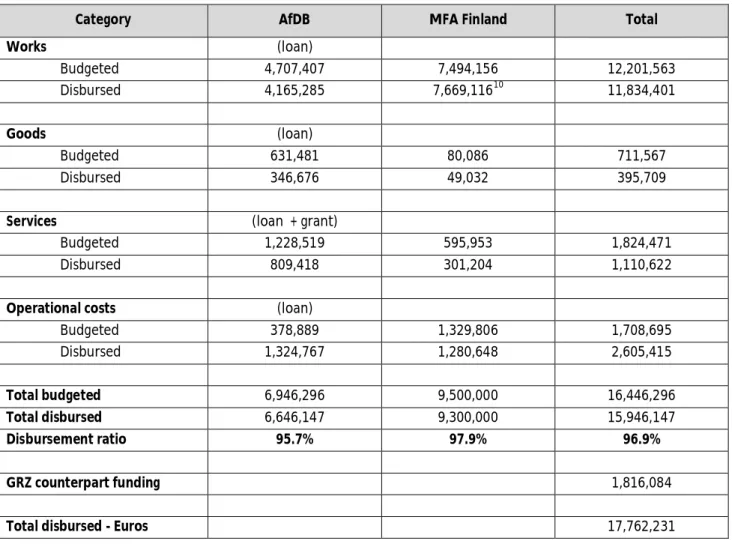
Table 3 - Overview of budgets and disbursements to SIP (all amounts in Euros)
Category AfDB MFA Finland Total
Works (loan)
Budgeted 4,707,407 7,494,156 12,201,563
Disbursed 4,165,285 7,669,11610 11,834,401
Goods (loan)
Budgeted 631,481 80,086 711,567
Disbursed 346,676 49,032 395,709
Services (loan + grant)
Budgeted 1,228,519 595,953 1,824,471
Disbursed 809,418 301,204 1,110,622
Operational costs (loan)
Budgeted 378,889 1,329,806 1,708,695
Disbursed 1,324,767 1,280,648 2,605,415
Total budgeted 6,946,296 9,500,000 16,446,296
Total disbursed 6,646,147 9,300,000 15,946,147
Disbursement ratio 95.7% 97.9% 96.9%
GRZ counterpart funding 1,816,084
Total disbursed - Euros 17,762,231
Bureaucracy - Almost all stakeholders interviewed for this evaluation made mention of the bureaucratic procedures involved in procurement of goods and services and in obtaining approval of changes to the project. Procurement was done by MAL but was following AfDB procurement rules and was subjected to AfDB “No objection” procedures. This hybrid model for procurement has led to procurement delays of up to 2 years. Whether the problem lies largely with the AfDB rules, or with the limited procurement capacity in MAL (an issue acknowledged by MAL itself), or with the GRZ requirement to have major procurements approved by the Ministry of Justice, or with lack of a dedicated procurement specialist in the PIU is difficult to tell. It is however clear that the procurement problems and “No Objection” requirements are the main cause for the low time-effectiveness of SIP. The problem at AfDB level is aggravated by the fact that that projects funded from trust funds (like in this case Finnish trust funds) are not using AfDBs standard
10 Based on the assumption that the balance of disbursed funds will all be used for Works.
automated project management software (SAP), but are managed separately, which leads to more back and forth with AfDB head quarters.
The most recent example of a seemingly unnecessary long delay is the time it took for AfDB to approve a final extension of the programme from November 2014 to September 2015 that was agreed at PSC level.
The request was submitted to the AFDB on 28 November 2014, but the No Objection was only received on 19 February 2015. During that period of delay, SIP could not progress with urgent issues such as procurement processes and variation orders. With the AfDB rules stipulating that all expenses need to be committed 6 months before the end of the project, it meant that SIP only had from 19 February to end of March to get approval for new expenditures or for variation orders on existing contracts. Given the slow procurement process, this period was very short and this means for example that office blocks can likely not be constructed at the schemes even if available funding amounts would have allowed it.
3.1.3 The software – Capacity building, community mobilisation, marketing and management Much of the community mobilisation was undertaken during the first few years of the project through a concerted effort of the SIP PIU and staff from MAL. The mobilisation included awareness building and involving beneficiaries in the design of the schemes. At all schemes, the beneficiaries confirmed that multiple meetings were held and that they were involved in important scheme design aspects such as deciding on the size and location of the schemes. However, they also expressed their disappointment with the long delay between the first mobilisation efforts and the actual construction / completion of the schemes. It has made the communities somewhat weary of the project and of all the promises it has made and not been able to keep. These sentiments are likely to be overcome once the schemes start producing revenues for the farmers, so it is vital that this happens as soon as possible.
Capacity building under the first phase of the project focused on building the knowledge and capacity of the executing agency MAL (both at national and district level), through training in areas such as community development, irrigation design, marketing, crop management, project management and M&E. According to the MTR, a total of 170 people were trained against a target of 104, but a qualitative analysis of these capacity building efforts (held between 2003 and 2007) was not undertaken.
Training of farmers was also foreseen in the first phase but only really took off in the 2nd phase, in particular after the recruitment of a socio-economist for the SIP PIU. Through collaboration with a.o. the Zambia Development Agency training sessions were provided on a series of subjects such as “How to be a successful farmer”, “Success in irrigation farming”, “Contract farming”, Productivity in farming” and “Basic record keeping for a farming business”, as well as on cross-cutting issues HIV/AIDS and gender (see section 3.3.1) . A total of around 240 farmers were exposed to these trainings (some to all, some to only a few).
Based on an analysis of the training material and feedback received from the beneficiaries, it appears that, while the trainings were useful as a first exposure to these issues, much more investment in capacity building would be required for farmers to fully grasp the issues discussed. It will be important for farmers to have a good understanding of the technical, management and marketing aspects of the irrigation schemes if they are to play an effective role in the scheme management model, e.g. as Board members.
As mentioned earlier, management and marketing aspects were not prominent in the original project design nor in the programme document for the Finnish funded 2nd phase. However, it is arguably in these two areas that SIP has achieved its most impressive results, especially considering these aspects only received due attention after the addition of a socio-economist to the PIU (on instigation of the Finnish embassy).
On the marketing side, the main achievement has been the securing of markets for Manyonyo (sugar cane) and Nzenga (Irish potatoes). Sugar cane will be bought by Zambia Sugar (at a fixed price that it pays to all its outgrowers) while Irish potatoes will be bought by a South African company Top Fruits & Vegs, through a deal facilitated with the help of the Zambia National Farmers Union. The related business plans developed for Nzenga and Manyonyo were of such good quality that First National Bank (FNB) has been found prepared to provide loans for the initial costs of inputs and scheme management (staff salaries) related to the first season of these crops, without there being any physical collateral to secure the loan.
SIP has also been able to develop a very promising management model for new schemes, based on a farmer-owned company with professional staff that manages the scheme on behalf of the beneficiaries.
More on this in section 3.2.3.
3.1.4 (Potential) impact
At the time of the evaluation, actual benefits for the target group in line with the project purpose of increased food production and farm income were only achieved in the 46 ha Buley Malima scheme, which is managed by a farmer cooperative. The 140 to 150 farmers in this scheme grow a variety of crops such tomatoes, ocra, green beans and maize, which are mostly marketed by selling to buyers from outside who come to the area. The farmers earn an average of ZMK 10,000 / year (around Euro 1270) off their quarter hectare of land. The income is partly invested in income generating activities such as cattle and buying fertilizer, and partly used to pay for school fees, food, house construction etc. From the discussions with the Buleya farmers, it is obvious that behavioural changes have occurred, with the cooperative showing good commercial instincts and developing other income generating activities such as a hammer mill (for maize milling) and a chicken broiler. One should however not forget that the cooperative has been in operation for decades, and has benefited from long term external advisory and financial support.
The potential impact of the Sinazongwe, Nzenga and Manyonyo schemes on farm income is also considerable. Net profits from one yield of Irish potatoes in Nzenga are expected to be at least ZMK 20,000 (Euro 2540) / ha, which also translates into ZMK 20,000 / beneficiary HH given that each beneficiary brings in 1 ha of land. Higher incomes are expected since at least 2 crops can be grown in the irrigation scheme each year as long the water supply is guaranteed. Since Irish potatoes can only be grown once every 4 years (for agronomical reasons), other crops need to be grown. Business plans for these crops (such as soya bean, onion, winter wheat) have not yet been developed. Potential markets are however good, as confirmed by ZNFU, although net profits are likely to be somewhat lower than for the potatoes (based on experience with these crops in another irrigation scheme (Chiansi)). The sugarcane in Manyonyo scheme is expected to provide around Euro 4,200 net profits to the beneficiaries (based on 4 hectares per beneficiary).
Although it is too early to see clear behavioural changes amongst the intended beneficiaries in these new schemes, the project appears to have managed to instil a more commercial attitude amongst the target group. They are generally fully supportive of the proposed commercial approach adopted, and understand that the schemes should best used for cash crops like Irish potatoes, wheat and sugar cane, rather than for the production of subsistence crops like maize.
3.2 Sustainability issues 3.2.1 Ownership
Ownership was analysed at the level of the beneficiaries and the level of the Government of the Republic of Zambia (GRZ), through its executing agency MAL.
At the basic level, ownership of beneficiaries is strong. In all schemes, the beneficiaries confirmed that it was they themselves who requested support from GRZ for implementation of irrigation schemes. In particular for the schemes in the Zambezi valley (Buleya Mulima, Sinazongwe, Nzenga), irrigation can significantly increase food security since the risks of rainfed agriculture are high because of erratic and relatively low rainfall11. The beneficiaries were also directly involved in selecting the areas where the irrigation schemes were to be implemented. Although only farmers in Manyonyo have formal title deeds to the land that they have brought in for irrigation, the beneficiaries in Sinazongwe and Nzenga are for the main part farmers who have traditional land use rights in the area to be brought under irrigation. Such traditional rights are recognised under customary law and as such provide a good security against land alienation.
Through the continuous community mobilisation efforts, the project has also kept communities informed about progress with construction contracts, management issues, etc. However, by continuously under- estimating the time required to deliver on outputs, in particular on completing the infrastructure, the commitment of the communities has been partly undermined. Also, the management model that SIP has developed for the new schemes, is not yet well understood by the beneficiaries, with e.g. the scheme managers seen more as project coordinators than as staff of the farmer-owned irrigation companies who are ultimately accountable to the farmers. At this level therefore, ownership is not yet as strong as it should be, and it remains to be seen how the relationship between farmers and scheme management staff will develop in the future. Some minor conflicts have already surfaced in Manyonyo, where the scheme manager and agronomist are sometimes hampered in their activities because requests for resources like fuel are sometimes not approved by the farmer representatives (chairman and secretary of the Manyonyo Irrigation Company in this case). When talking to beneficiaries, also of non-SIP schemes like Magobo, the impression is that they are very much looking at maximising their short term income instead of maximising long term sustainability by ensuring (and paying for) professional management of the schemes.
All projects within MAL are coordinated by the Department of Policy and Planning, but there is always a technical department more directly involved in implementation. In the case of SIP, this is the Department of Agriculture, and their involvement has been good at both national level (in particular strong involvement of an irrigation expert of the Technical Services Branch, and involvement of higher management in the supervisory missions and in the Project Steering Committee), and even better at district level, where one technical staff person was designated as District Project Manager (DPM), in charge of day-to-day coordination of the project at the district level . There is one DPM in Sinazongwe district covering Buleya, Sinazongwe and Nzenga schemes. There was one DPM in Mazabuka (now Chikankata district) who covered Manyonyo but that position has now been vacant for a while. The Department of Policy and Planning has participated in the PSC and in supervisory missions but its active involvement in important policy-related
11 This was evident during the field visit which came at the end of a so-called “partial drought” of 3 weeks, which had severely reduced the prospects of a decent maize harvest. The heavy rains that fell during the field visit only exarcebated the problems by increasing the risk of rot in the crop.
issues (such as whether the SIP type of irrigation schemes should be promoted nationwide) appears to have been somewhat limited.
In how far GRZ can effectively take over future support to the SIP schemes remains to be seen. A positive sign is the fact that capacity building of extension staff is more and more incorporating irrigation and agribusiness aspects. However, the resources available to do their work effectively, in particular transport means, are severely limited in districts where there are no projects to provide such resources. With the main portion of GRZ’s agriculture budget still going to maize and fertilizer subsidies, this situation seems unlikely to change significantly in the near future. On the other hand, GRZ has shown its commitment to irrigation by providing more than the planned counterpart funding to SIP such as paying for the salaries of the PIU staff during the current extension phases of the project.
3.2.2 Technical aspects
The appraisal document laid down the basic parameters for the technical design of the irrigation schemes:
they were to be based on furrow irrigation (rather than f.ex. central pivot irrigation) using earth canals (rather than lined canals). The proposed design parameters were not substantiated with detailed business plans based on a cost-benefit analysis or a well-defined management model. The appraisal document merely mentions the following production estimates (of all 6 schemes considered at that point): 2,900 tons of maize, 2,500 tons of paprika, 4,200 tons of onion, 3,600 tons of cabbage, 4,000 tons of vegetables, 1,200 tons of green maize, 800 tons of sugar beans, 850 tons of sunflower, and 165 tons of soya beans. 60% of this production would be for own consumption, and the remaining 40% to be sold mainly on nearby markets. The schemes were to be managed by farmer cooperatives, presumably with each farmer responsible for its own plot of land.
It is questionable whether relatively high-tech (pumping stations, large reservoirs, long intake-canals, pipes) and expensive schemes like the SIP schemes are economically viable when used primarily for own production and local markets. The consultant fully agrees with the approach followed by SIP in the second phase of developing the schemes on a more commercial basis with centralised scheme management, an approach that is likely to provide higher levels of incomes and hence a better justification for the high investments in infrastructure. The main drawback of this approach is the fact that the original technical designs of the schemes are sub-optimal for the chosen commercial approach. For all 3 new schemes, central pivot irrigation is considered the most efficient option when the scheme is under central management, yet all schemes are under furrow irrigation. This requires higher initial capital investment as well as higher operational costs. The schemes can still be profitable, but both construction costs / ha and profits per ha would be more favourable under central pivot.
Also, under a furrow irrigation system where water is not provided for free (it has to be pumped at a cost), the normal approach would be to invest in lined canals rather than earth canals to minimise water losses and ensure high irrigation efficiency. SIP has (belatedly) recognised this issue and has opted for lined canals in Sinazongwe and Nzenga. Unfortunately, in Manyonyo, the biggest scheme, all canals except one are earth canals and water leakage is high. Irrigation efficiency has not been measured but for long earth canals conveyance efficiency is typically around 70% for loamy soils (FAO). Combined with furrow irrigation through siphons, overall efficiency is likely around 30 to 50% at Manyonyo. Sinazongwe / Nzenga efficiency should be considerably higher at probably around 60% thanks to lined canals. With central pivot efficiency could have reached around 70%.
Manyonyo has other serious technical problems in fact:
The scheme consists of 3 blocks A, B and C, with only block C having large contiguous fields. Block A and B consist of smaller blocks, with in between land of farmers who did not want to participate in the scheme. This negatively affects irrigation efficiency.
Some part of the canals lies lower than the land to be irrigated, and one field in block C is not linked to a canal yet and will require a separate supply pipe.
The outlets at the reservoirs are smaller (300 mm) than designed (400 mm) and this may lead to water shortages if the 3 blocks are fully planted with sugar cane. Apparently the contractor could not procure 400 mm pipes in Zambia and thus opted for 300 mm. This was accepted to avoid further construction delays but undermines the long term technical sustainability of the scheme.
There are some problems at the foot valves at the pumping station, mostly due to the lack of silt traps and sieves to keep deposits and hubris away from the valves.
Control structures in the canals are in the wrong place for effective sugar cane irrigation; makeshift weirs and plastic pipes are now used to supply the feeder canals.
Sugar cane requires a good road haulage network (for trucks up to 80 tons), which hasn’t been foreseen in the original design.
According to Zambia Sugar, only block C (210 ha) can at the moment be fully developed for sugar cane production, with the full development of block A and B requiring an additional Euro 2.2 million investment.
The SIP PIU concurs that additional work is needed, but believes that with the remaining available SIP funds block C and block B can be fully developed.
More in general, the technical designs of the schemes appear to have been of limited quality and provided insufficient details for the development of accurate Bills of Quantities for the tenders, leading to a large number of changes (variation orders) required during construction. With variation orders having to go through bureaucratic approval procedures, this has contributed to a lot of delays.
A specific problem, potentially related to climate change, is the fact that the pumps in both the Buleya Mulima and the Nzenga scheme are currently not in water due to receding water level of Lake Kariba. This is discussed further in section 3.3.2.
3.2.3 Institutional aspects
At Buleya Mulima, the scheme is managed by a farmer cooperative, which has been in operation for several decades. Although neither scheme management nor cooperative management are 100% effective, the scheme can be considered institutionally and commercially sustainable. The cooperative has branched out to other income generating activities such as provision of domestic water (they operate a borehole), providing maize milling services and producing fruits. They are currently constructing a chicken broiler as yet another source of income. The main issue of concern with Buleya Mulima may be the governance of the cooperative. Information from indirect sources seems to indicate that the profits of the cooperative are not shared equally amongst all members. In how far this is correct could not be established during the visit to the scheme.
For the 3 new schemes developed by SIP, an innovative management model has been designed, with the following main characteristics:
The farmers in the scheme register a company, with themselves as the shareholders. They bring in their land in the scheme as shares. In principle, each farmer brings in the same amount of land. Where
farmers have more land, they can bring in relatives into the scheme. Shares in Sinazongwe and Nzenga represent 1 ha each; in Manyonyo it is 4 ha each.
The company is responsible for all aspects of growing and marketing crops: Operation & Maintenance of the scheme, planting of crops, applying herbicides / fertilizers, irrigating the crop, harvesting, marketing the crops to buyers. To this effect, the company (i.e. the farmers) employs professional staff (a manager, agronomist and accountant as a minimum).
Gross revenues generated through the sale of crops grown in the scheme are first used to pay for all operational and investment costs of the company, as well as for paying off any loans that the company may have secured as working capital. The remaining net revenues are then paid out to the farmers as dividend, on an equitable basis i.e. each shareholder receives the same amount, irrespective of how much their plot contributed to the total yield.12
Farmers can, but don’t have to, be engaged as labourers in the scheme.
The infrastructure of the scheme remains the property of the GRZ, but is leased to the company free of charge.
The company has a Board of Directors, which includes representatives of the farmers, of GRZ, and of any other key stakeholders. The Board of Directors is appointed by GRZ, through MAL.
For both Nzenga and Manyonyo schemes the companies have been set up and are called Nzenga Irrigation Company (NIC) and Manyonyo Irrigation Company (MIC) respectively. At the time of the evaluation, the Boards were not yet appointed but board members were identified and the process is at MAL for approval.
Staff for the companies was initially recruited and paid for through SIP. At Manyonyo, current staff includes a scheme manager and an agronomist, and both are now paid through a loan provided to MIC by the Mazabuka Sugar Cane Growers Trust (a Trust set up by Zambia Sugar to represent the interests of smallholder sugarcane farmers). In NIC there is currently only a scheme manager. His salary is paid by GRZ until a loan from First National Bank is approved (expected anytime).
In the view of the consultant, this is a very promising management model, but it still needs to prove itself and it has some peculiarities that may hamper its effectiveness. For example, the professional staff recruited by the farmers to run the scheme double as their bosses when they work in the scheme as labourers. Also, it is still to be seen whether the farmers accept that around 50% of gross revenues will go to paying for the management of the scheme (inputs, staff salaries, marketing, transport, O&M), rather than straight into their pockets. To address these and other possible weaknesses of the management model (quality of governance, quality of hired staff, systems and tools in place, etc.), the Embassy of Finland has, under a separate contract, recruited AMSCO – African Management Services Company. This company will between January 2015 and January 2016 provide organisational and institutional capacity development support to both MIC and NIC. This will hugely increase the prospects for institutional sustainability of the companies.
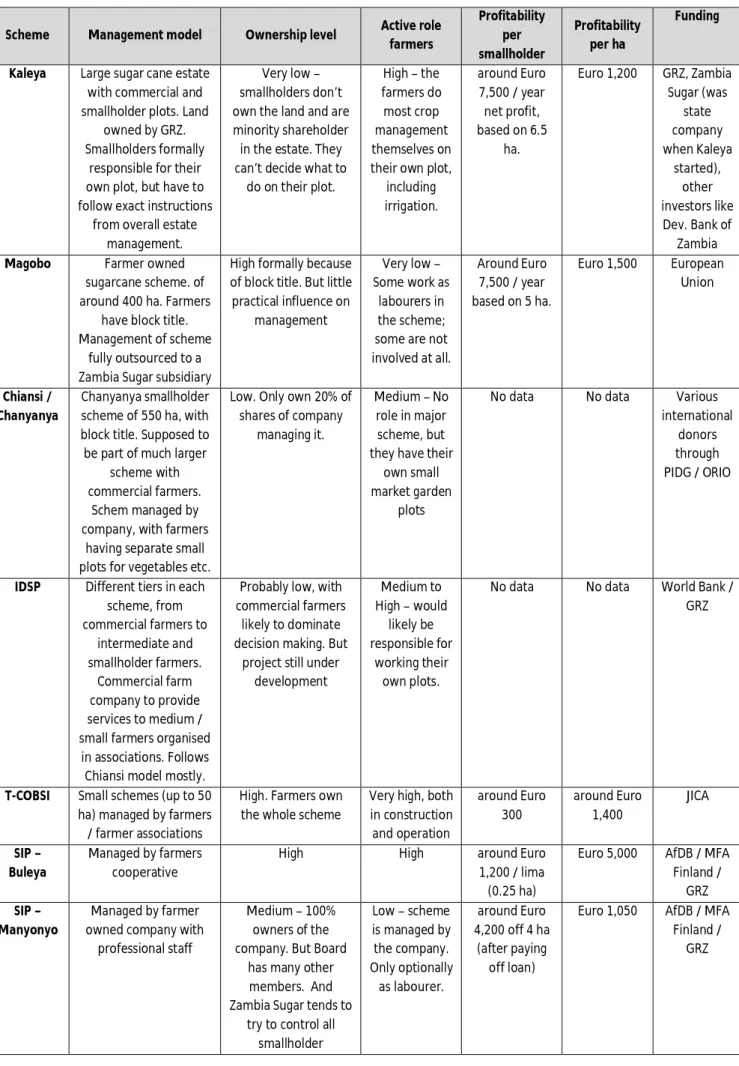
As part of the consultancy, some non-SIP irrigation schemes were visited to compare SIP’s management model with existing other models. Table 3 compares these different schemes in terms of ownership issues and profitability.
12 E.g. in Manyonyo, only block C and (part of) block B will likely be fully planted the first years. The net revenues will however be shared equally between all shareholders of block A, B and C.
Table 4 - Comparison between different irrigation management models Scheme Management model Ownership level Active role
farmers
Profitability per smallholder
Profitability per ha
Funding
Kaleya Large sugar cane estate with commercial and smallholder plots. Land
owned by GRZ.
Smallholders formally responsible for their own plot, but have to follow exact instructions
from overall estate management.
Very low – smallholders don’t own the land and are minority shareholder in the estate. They can’t decide what to
do on their plot.
High – the farmers do
most crop management themselves on their own plot,
including irrigation.
around Euro 7,500 / year net profit, based on 6.5
ha.
Euro 1,200 GRZ, Zambia Sugar (was
state company when Kaleya
started), other investors like
Dev. Bank of Zambia Magobo Farmer owned
sugarcane scheme. of around 400 ha. Farmers
have block title.
Management of scheme fully outsourced to a Zambia Sugar subsidiary
High formally because of block title. But little practical influence on
management
Very low – Some work as
labourers in the scheme;
some are not involved at all.
Around Euro 7,500 / year based on 5 ha.
Euro 1,500 European Union
Chiansi / Chanyanya
Chanyanya smallholder scheme of 550 ha, with block title. Supposed to be part of much larger
scheme with commercial farmers.
Schem managed by company, with farmers
having separate small plots for vegetables etc.
Low. Only own 20% of shares of company
managing it.
Medium – No role in major scheme, but they have their
own small market garden
plots
No data No data Various international
donors through PIDG / ORIO
IDSP Different tiers in each scheme, from commercial farmers to
intermediate and smallholder farmers.
Commercial farm company to provide services to medium / small farmers organised
in associations. Follows Chiansi model mostly.
Probably low, with commercial farmers
likely to dominate decision making. But
project still under development
Medium to High – would
likely be responsible for
working their own plots.
No data No data World Bank / GRZ
T-COBSI Small schemes (up to 50 ha) managed by farmers / farmer associations
High. Farmers own the whole scheme
Very high, both in construction and operation
around Euro 300
around Euro 1,400
JICA
SIP – Buleya
Managed by farmers cooperative
High High around Euro
1,200 / lima (0.25 ha)
Euro 5,000 AfDB / MFA Finland /
GRZ SIP –
Manyonyo
Managed by farmer owned company with
professional staff
Medium – 100%
owners of the company. But Board
has many other members. And Zambia Sugar tends to
try to control all smallholder
Low – scheme is managed by the company.
Only optionally as labourer.
around Euro 4,200 off 4 ha
(after paying off loan)
Euro 1,050 AfDB / MFA Finland /
GRZ