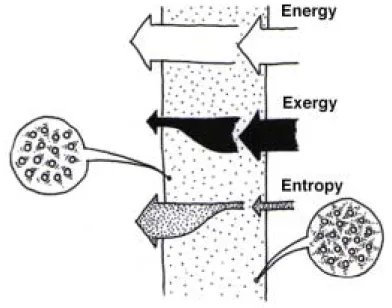
This report is a product of the Annex 37 Working Group and has not been submitted to the ECBCS Executive Committee for approval. Introduction to the concept of exergy – for a better understanding of low temperature heating and high temperature cooling systems. All systems, not only technical systems but also biological systems, including the human body, work feeding on exergy, consuming its part and thereby generating the corresponding entropy and dissipating the generated entropy into their environment.
General characteristics of the exergy-entropy process of passive systems, which would be a prerequisite for realizing low-exergy systems, are discussed together with the exergy-entropy process of the global environmental system. The questions of gaining a better understanding of low exergy systems for heating and cooling are raised. It is suggested that a prerequisite for low-exergy systems would be rational passive design of greenhouse systems.
This report is part of the work carried out within the project realized for the International Energy Agency (IEA): Energy Saving in Buildings and Community Systems (ECBCS) programme, "Annex 37: Low Exergy Systems for Heating and Cooling". The general objective of the Schedule 37 is to promote rational use of energy by facilitating and accelerating the use of low valued and environmentally sustainable energy sources for the heating and cooling of buildings.
Introduction to the concept
- Introduction
- Description of a system as an exergy-entropy process
- Exergy balance equation
- Warm exergy and cool exergy
- Radiant exergy
- Exergy-entropy process of passive systems
- The global environmental system
- Conclusion
This means that the amount of entropy contained in the entire building envelope system is constant. By removing the generated entropy from the system, space is created to feed and consume exergy. Removing the generated entropy from the system creates new space to feed exergy and consume it again.
In this case, “warm” exergy flows into the interior surface and out through the exterior surface of the building envelope system. Most of the generated entropy is spontaneously discharged into the atmosphere through the building envelopes (Shukuya and Komuro, 1996). The entropy generated during the composting process is discarded into the environment of the container and ultimately into the nearby ground atmosphere.
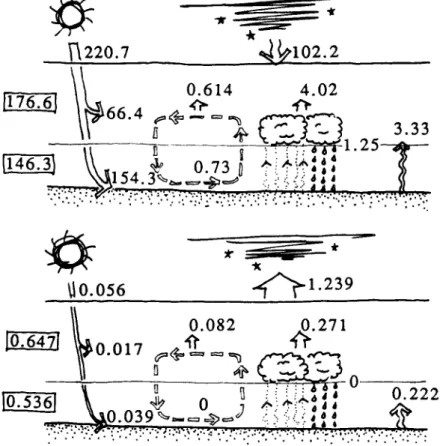
4 shows schematically and numerically the exergy-entropy process of the global environmental system (Shukuya and Komuro, 1996). The amounts of exergy consumption and entropy generation are indicated by the numbers in the squares. The structure and function of the exergy balance equation were outlined, as well as the characteristics of 'hot' exergy and 'cool'.
The general characteristics of the exergy-entropy process of passive design were also described together with the global environmental system.
Mathematical formulations
- Introduction
- Exergy balance
- Definitions of exergetic efficiencies
- Conventional exergetic efficiency
- Rational exergetic efficiency
- Utilizable exergy coefficient
- Air-conditioning applications
- Conclusion
The irreversibility rate is calculated based on the Gouy-Stodola relationship, which states that the irreversibility rate of a process is the product of the entropy generation rate for all systems participating in the process and the temperature of the environment. In this case, traditional exergetic efficiency gives a false impression of the thermodynamic performance of the reactor. The rational exergetic efficiency is defined by Kotas (1985) as the ratio between the desired exergy output and the exergy used or consumed. is the sum of all exergy transfers from the system, which should be considered the desired output, plus any byproducts produced by the system.
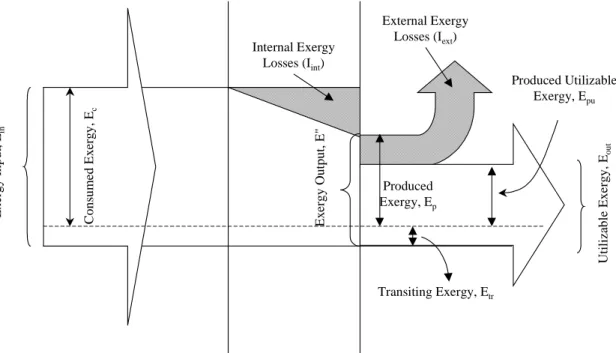
7, part of the exergy effect from the plant can be spread to the environment, e.g. heat loss, sewage waste or chimney waste water. Only part of the usable exergy is produced by the system through the physicochemical phenomena that take place within its boundaries. The rest of the exergy that leaves the system with the usable exergy flow is part of the exergy input that has simply passed through the system without undergoing any transformation.
This fundamental fact was first recognized by Kostenko (1983), who gave the name transiting exergy, Etr, to this fraction of the exergy delivered to a system. Typically in a chemical reactor, some (but not all, due to temperature and pressure changes) of the exergy associated with unreacted feed or inerts will constitute transit exergy. As demonstrated by Sorin and co-workers (1998), the decrease in transit exergy, E•tr, improves the conversion performance of the system.
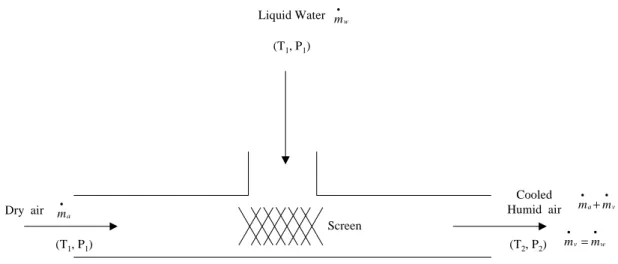
This section presents the use of the concept of exergy in the assessment of air conditioning applications. The specific total flow exergy of moist air is derived from the definition of the physical flow exergy applied to a mixture of ideal gases. Question: How much water is required to reduce the temperature of the output mixture to a prescribed level T2.
Assume that the function of the evaporative cooling process is to reduce the temperature to T2 = 15ºC = 288.15 K. This means that the evaporative cooling process, due to thermodynamic irreversibility, destroys two-thirds of the exergy delivered to the control volume. An important observation that needs to be addressed is that the choice of environmental conditions influences the numerical results of the exergy analysis quite strongly.
9 shows how the numerical results of the exergy efficiency are affected by the choice of T0 and φ0. The mathematical formulations of the different forms of exergy and the exergy efficiency factors were presented.

Space heating example
An example of heating exergy calculation
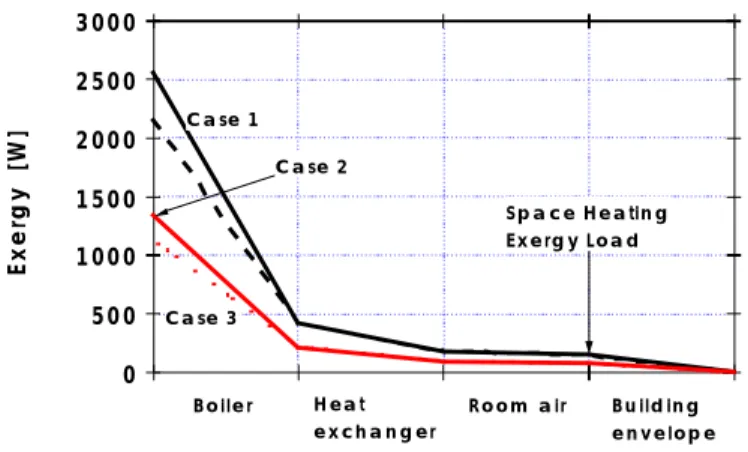
This, in turn, results in higher exergy consumption in the water-air heat exchanger and also in the air in the room, in which the required temperature is 293 K (20°C). These facts indicate that the extremely high efficiency of the boiler in itself cannot necessarily significantly contribute to the reduction of exergy consumption in the entire space heating process. The room air temperature is in all cases ideally controlled and constant at 293 K (20 °C), while the outside air temperature is assumed to be constant at 273 K (0 °C).
The ratio of the chemical exergy to the higher heating value of liquefied natural gas (LNG) is 0.94. The thermal efficiency of the power plant, i.e. the ratio of electricity produced to the higher heating value of LNG supplied, is 0.35. Exergy consumption is the difference in exergy between input and output; for example, in case 1, 2554 W of exergy is supplied to the boiler and 420 W of "hot".
The heat exergy load, which is the exergy effect from the room air and the exergy input to the climate screen, is 148 W in case 1 and 78 W in cases 2 and 3. It is only 6 to 7% of the chemical exergy input to the boiler, so one can consider a measure that reduces the heat exergy load as marginal. However, as can be seen from the difference in the entire exergy consumption profile between case 1 and case 2, it is more beneficial to reduce the heat exergy load by installing thermally well-insulated windows and outer walls than to develop a boiler with an extremely high thermal efficiency, in order to reduce the rate of the total exergy consumption.
The reduction in exergy consumption of the boiler subsystem, indicated by the difference between Case 2 and Case 3 due to the improvement of boiler efficiency, essentially becomes meaningful together with the improvement of the thermal insulation of the building envelope. Those interested in the numerical calculation of the example explained above are encouraged to consult Appendix E, which describes the detailed calculation procedure to obtain Figure 1.
Conclusion
Ek represents the rate of kinetic exergy, where C0 is the flow rate of the stream relative to the surface of the earth. Eph represents the thermomechanical exergy based on flow temperature and pressure. Ech represents the chemical exergy based on the chemical potentials of the components in the flow.
Chemical exergy is equal to the maximum amount of work that can be obtained when the substance in question is brought from the ambient state (T0, P0) to the dead state (T0, P0, µ0i) by processes involving heat transfer and exchange of substances alone with the environment. The specific chemical exergy at P0 can be calculated by bringing the pure component into chemical equilibrium with the environment. For pure reference components, which also occur in the environment, the chemical exergy consists of the exergy, which can be obtained by diffusing the components to their reference concentration P00.
For many fuels, chemical exergy can be estimated based on net combustion value (NCV). The use of three different forms of efficiency will be demonstrated in the air distillation column (Cornelissen, 1997) shown in Fig. In case (ii), the desired effect is considered to be an increase in the chemical exergy and the thermal component of the exergy.
However, if the chemical exergy of the mixture were much higher than that of crude oil separation, the conventional exergy efficiency would be close to unity. Rational efficiency is easy to use, but determining the desired exergy output and exergy used for a unit requires a clear understanding of the function of the unit in the context of the plant. The next step is to calculate the net "warm" exergy provided by the air circulating through the water-to-air heat exchanger, which is the difference between the "warm".
The exergy demand for the fan is assumed to be 30 W for Case 1 and 16 W for Case 2; this corresponds to a condition that the fan efficiency is 0.6 and the pressure drop between the air inlet and outlet of the heat exchanger is around 100 Pa. Here, the number 0.94 is the ratio between chemical exergy and the higher heating value of liquid nature. gas (LNG); and the number, 0.35, is the thermal efficiency of the LNG-fired power plant. The chemical load of 81 W or 43 W chemical load required by the fan is comparable to the amount of space heating exergy load, 148 W or 78 W.
The net “warm” exergy provided by water circulation is the difference in thermal exergy of water between the inlet and the outlet; it will be 419 W for case 1 and 219 W for case 2.