The task of the MASTER project is to provide recommendations for speed management strategies and policies, and to develop guidelines for the development of innovative speed management tools. Any harmonized European speed management strategy must be based on the knowledge of the current speed limits, current national speed management strategies and speeds on European roads. The task of the MASTER project is to provide recommendations for speed management strategies and policies and to develop guidelines for the development of innovative speed management tools.
Data on speed limits were collected for the European Conference of Transport Ministers held in Budapest in 1996 (ECMT, 1996), but details of European data collection have not been published. The effects of speed enforcement on driving behavior; R.2.3.1 The effects of changes in the driving environment on speed behavior - Literature study; R.3.1.1. Questions about local speed limits (in residential areas, in traffic-calmed zones, higher speed limits on part of the urban road network, in school zones, on bicycle and pedestrian streets, at railway crossings, at bicycle crossings, at pedestrian crossings).
Questions regarding the country's speeding penalty system, broken down by speed limit and level of speed limit offence. The questionnaire was distributed to all EU countries and most of the other European countries, including many Central and Eastern European countries (33 countries in total).
General speed limits
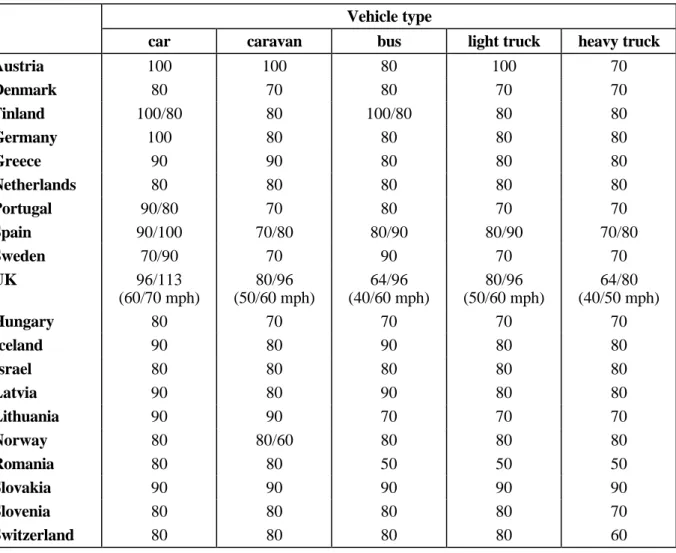
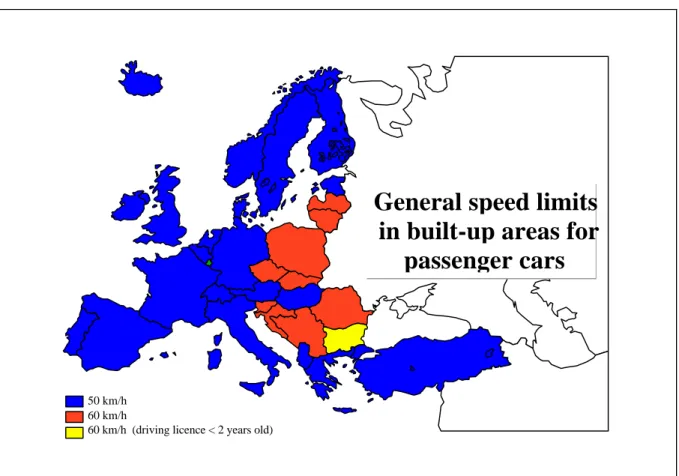
Speed limits for cars in urban areas in Europe are also shown in Figure 1, which is based on another source, not our questionnaire. Overall speed limits on rural roads are much less homogeneous than in urban areas (Table 2). General speed limits on rural mixed traffic roads by vehicle category in km/h Vehicle type.
The speed limits are somewhat higher on motorways than on ordinary country roads and lower than on motorways. Speed limits for cars are generally set between 90 and 110 km/h, but only 80 km/h in Denmark, Norway and Romania. Speed limits for other vehicle categories are even more varied, from 50 km/h in Romania for buses and trucks to 100 km/h in Finland, Switzerland and Germany for buses and 110 km/h in Greece for caravans.
Germany is the only country in Europe where there is no speed limit for cars on motorways. In Austria and Slovakia, the speed limit for cars is 130 km/h, in Norway and Sweden it is 90 km/h on some highways, and in Romania it is 80 km/h.
Speed limits at specific locations
Places where speeding is frequent
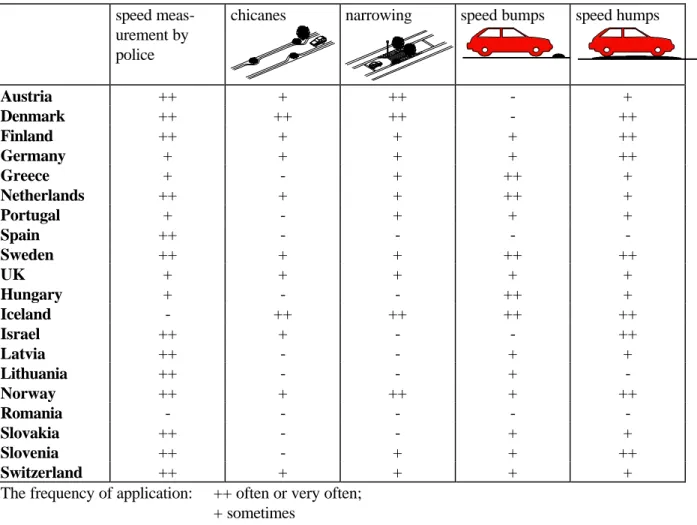
Speed management and enforcement methods
Fast urban roads where the speed limit is higher than the general urban speed limit is common practice in most of the European countries. It is often or very often applied in most of the countries, sometimes in some of them, and only the Icelandic and Romanian respondent said that it is never used in their countries. One can see from Table 7 that in most of the countries there are two or three levels of punishment for speeding.
The second level is revocation of the driver's license, called revocation in the table. The speed level is defined in most countries at "X" km/h over the limit, independent of the existing speed limit at the place of speeding. Some countries apply different rules for urban areas than for the rest of the road network (Germany, the Netherlands and Switzerland), while other countries define speeding as a percentage so that the existing speed limit is taken into account.
Denmark fines of varying magnitude, if the speed is >70% above the limit, disqualification Finland if the speed is <16 km/h above the limit, fixed fines. Portugal if the speed is >20 km/h above the limit, fines; and possible disqualification for drivers of heavy vehicles.
Actual speed levels in Europe
Speed measurement methods and speed level indicators
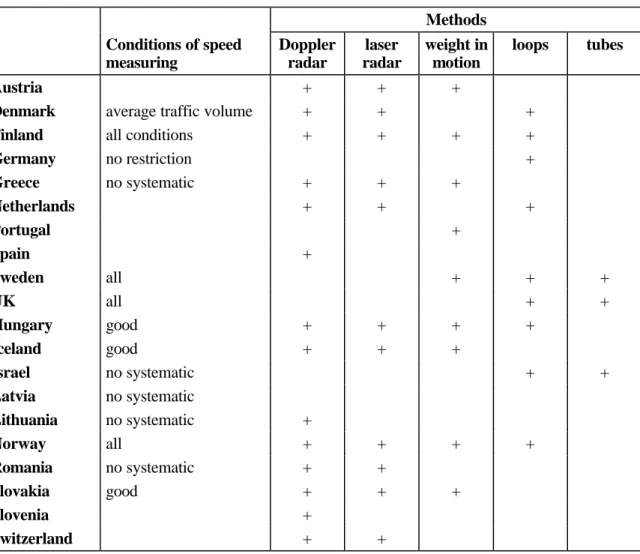
Doppler radar is a speed measuring instrument that calculates distances and speeds by Doppler effect, based on the reflection of the emitted noise. Laser radar also calculates speed and distance by Doppler effect, but it is based on the reflection of the emitted light. Weight-in-motion is a method by which vehicle speed, vehicle category, weight, axial distance, interval between vehicles, etc.
It appears that speeds on European roads are measured using many different methods, which can cause problems when comparing results. The initial expectation that information on current speeds on different parts of the road network can be obtained, and even speeds on different road, weather and visibility conditions will be available, has not been fulfilled. Systematic speed measurements are not carried out in many countries, and none of the respondents indicated that speeds under different road, weather, visibility conditions are measured systematically and did not provide us with this type of speed data.
Speed measurement methods are varied and differ depending on road category and authority. The most common speed indicator on a road section is the mean and standard deviation. Speeding violation rate and V85 are also commonly used indicators, while V15 is only used in Finland, V50 in Sweden and speed distribution in Great Britain.
The difficulties of comparing roads, the different methods of measuring speed and the variability of indicators make it difficult to compare speed data originating from different countries.
Actual speeds on European roads
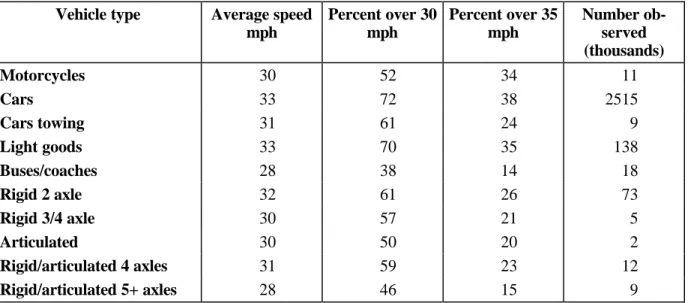
Vehicle speed limits on 40 mph urban roads by vehicle type in the UK Vehicle type Average speed. Vehicle speeds on single carriageway rural roads by vehicle type in the UK Average vehicle type. Vehicle speed on two-carriageway rural roads by vehicle type in the UK Average vehicle type.
Speed level of cars on different roads in Austria (1996) Speed limit Average speed Standard de-. The following speed distribution data was provided by VTI on the Swedish roads (Vägverket, 1996). The percentage of drivers driving below the speed limit is added up in one cell in each line.

The change of the speed level on European roads
Some Hungarian speed data illustrate the process of speed change after the reduction of the city speed limit from 60 km/h to 50 km/h (Table 26). Residential areas, school areas and traffic restricted zones can be found in almost every country, where the speed limit is lower than in the city, and varies between 6 km/h and 40 km/h. It is also common that on larger urban arterial roads a higher speed limit may apply than the general urban 50 km/h.
The speed limit on those roads is 60-70 km/h, sometimes even 80 km/h, depending on the quality of the road and the surrounding area, i.e. 5.5% of the cars drive faster than the 90 km/h - speed limit on the rural road in Portugal where the speed measurement was carried out. Almost 60% of Finnish drivers exceed the speed limit on roads of 80 km/h speed limit, and 50% exceed the speed limit on 100 km/h speed roads.
In Sweden, 76% of all vehicles drive faster than the speed limit of 30 km/h, 58% faster than the speed limit of 50 km/h in urban areas. Norwegian data from the seventies and eighties indicate a permanent increase in drivers exceeding the speed limit on all road categories. Some Hungarian data demonstrate the process of speed change due to the change of speed limit.
This suggests that speeding is more common today than before the speed limit was lowered. In recent years, many countries have adopted an overall speed limit of 50 km/h in urban areas. Residential areas, school zones, and traffic calming zones are found in almost every state where the speed limit is lower than the general city speed limit.
It is also a common practice that major urban arterial roads may have a higher speed limit than the general urban 50 km/h. The most widespread method of speed control is the enforcement of speed limits. Actual speeds in most European countries exceed speed limits by a high percentage, especially in low-speed urban areas and on motorways.
If yes, please describe its characteristics and speed limit in the categories provided. Please describe your penal system by indicating the indicators of the severity of speeding (exceeding the speed limit by ..%, or ..km/h, or ..mph, or..) and the legal consequences (prison /i) /, fine in national currency /f/, disqualification /d/, penalty points /p/, ..) for speeding on different road categories and speed limits.