MASTER (Managing Speeds of Traffic on European Roads) aims to provide recommendations for speed management strategies and policies and develop guidelines for the development of innovative speed management tools. The aim of MASTER (Managing Speeds of Traffic on European Roads) is to provide recommendations for speed management strategies and policies and to develop guidelines for the development of innovative speed management tools.
The relationship between speed and accidents
MASTER: effects of att and non-att systems and treatments on driver behavior at speed. This report reviews the literature on current ATT systems and, through alignment with Research Area 2 (impacts on speed behaviour), will also identify the most promising non-ATT approaches to speed management.
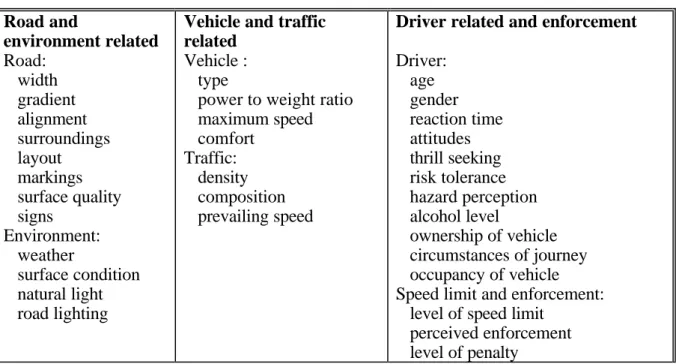
Why do drivers speed ?
An additional finding is that lower speed deviation is correlated with fewer accidents (see e.g. Salusjärvi, 1981; Finch et. al., 1994; O'Cinnéide and Murphy, 1994). Research findings imply that there is a need for certain measures to influence the drivers' speed adjustment at critical sites and in critical conditions associated with increased accident risk.
Influencing speed behaviour
Significant speed drops only occurred in the presence of the marked police vehicle. This working paper summarizes and evaluates both ATT and non-ATT systems that attempt to modify drivers' speed behavior.
Road design treatments
- Edgeline treatments
- Lane width reductions
- Transverse carriageway markings
- Delineators, guideposts and chevrons
This treatment resulted in speed reductions in the approach zone of the curve, but not in the curve itself. The author stated that "the increase in speed indicates that the drivers were more comfortable and confident on the road surface and the path they had to follow".
Traffic calming measures
- Speed humps and tables
- Road cavities
- Chicanes and narrowings
- Rumble strips
- Mini roundabouts
- Village gateway schemes
- Environmentally adapted roads
It was found that most locations showed a small decrease in 85th percentile speed following the installation of rumble strips. Measurements two years after the introduction of the measures showed that the effects are permanent.
Signing
It was found that the signs did not affect the speed on nearby streets or the opposite side of the street where they were placed. There was some indication that characteristics of the site where the sign was located may be an important factor in determining the extent of the sign's effectiveness. However, Zwahlen (1987) questions the validity of the results due to the small sample size and lack of control and found that advisory speed signs were no more effective in getting drivers to reduce their speed through curves than curve warning signs alone .
Rutley (1972) examined the effects of adding speed advisory signs to existing cornering warning signs at approximately 150 locations. Before and after the introduction of the bend, the approach speeds of regular road users and the visual search patterns of test drivers were measured. The other four subjects did not fixate the sign immediately or did so for less than 1% of the available time.
Almost half of the drivers indicated that they start to slow down when they see signs indicating that they should do so, but a large number of drivers did not attach much importance to the signs.
Speed monitoring devices
Trials of speed limit countdown signs and roundabouts were carried out in several rural villages in the UK (Barker and Helliar-Symons, 1997). Countdown signs show a black speed limit symbol with three, two or one black diagonal lines on a white background. They are located at 300, 200 and 100 m respectively from the start of a new speed limit (such as on the approach to a rural village).
Roundabouts are elongated circles with the speed limit in the middle, laid in white thermoplastic on the road surface at one or more positions within a speed-restricted area. Overall, the findings indicate that while the 40 mph roundabouts caused a reduction in speed of approximately 3 mph (statistically significant), the 30 mph roundabouts and the countdown signs had no significant effect on average speed. There is a technological distinction between ATT systems that are based at the roadside site, those that are based in the vehicle itself, and those that combine information from both on-site and in-vehicle sources.
On-site systems concentrate on feedback on traffic measured by equipment outside the vehicle, while in-vehicle technology relies on the modeling of vehicle parameters.
Road based measures
- Variable speed limits
- Feedback signs
- Speed detection and enforcement systems
- Incident warning systems
The effect of the measure was a significant speed reduction by 4–8 km/h for the speeders. The biggest effect was the reduction in the percentage of vehicles exceeding 90 km/h, but as in previous studies, vehicle speed increased again with the removal of the sign. The Highways Agency admits that "the effectiveness of the camera installations may diminish as drivers become familiar with the locations".
It was concluded that the IWS had a significant effect on the speed behavior of the single drivers, but the effect was short-lived. The results of the road surveys indicated that the smooth road VMS signs used in the surveys were noticed by the drivers. Only 8% of the drivers thought that the VMS could cause safety problems due to driver distraction.
The duration of the speed effect of the sign warning of slippery road conditions was about 3 km.
Vehicle based measures
Head-up display speedometer
The main results of the study showed that accurate speedometers increased the average driving speed by 6-8 km/h and reduced the number of overtakings by 22-67%, depending on the level of speed entered into the simulation model. A head-up display (HUD) speedometer, which continuously displays speed information to the driver in his normal field of vision, can improve speed behavior and increase safety, as each glance at a conventional speedometer lasts an average of 1.5 seconds, which can be in some cases dangerous. situations. Rutley's (1975) experiment with such speedometers in conjunction with sharp cornering speed advisory signs showed better compliance with posted speeds when the vehicle was equipped with HUD speedometers than when conventional speedometers were used.
However, as Ward and Parkes (1994) state, care must be taken that in complex driving situations the HUD does not create distraction or overload the driver in any way.
In-car information
There were few effects of the display in terms of speed, except in the 50 km/h limit zones. In addition, it was clear that some subjects used the continuous feedback to keep their speed in the margin. In the Swedish town of Umeå, approximately 100 vehicles were equipped with a speed tester with the aim of investigating user acceptance (Vägverket, 1997).
The device was activated only on two separate road segments with a speed limit of 30 km/h in the vicinity of schools. More than 60% of respondents perceived that if all vehicles were equipped with speed controllers, the average speed in the city would decrease. More than half of respondents stated that it became easier to maintain the 30 km/h limit with a speed controller activated in the car.
It was noted that in the last control session the young drivers returned to their original baseline number of speeding offences, while the elderly drivers continued to commit fewer.
Adaptive cruise control
The largest violations were committed during the first session, while the average amount of speeding was reduced by more than 8 km/h between session 2 (when tutoring was provided) and again for session 3. During the second drive, the “control” was the speed was automatically set to the current speed limit or to the recommended speed depending on the situation (sharp corner, zebra, etc.) using the intelligent cruise control. The results showed that speed limit violations were frequent in the "informative" mode.
The test route was a 100 km long two-lane motorway with a speed limit of 110 km/h. Drivers with ACC drove more in the left lane on the highway than drivers without ACC, perhaps to avoid the speed reductions when overtaking a vehicle in front. The results showed that respondents' attitude towards intervening functions (speed control due to the prevailing conditions and automatic distance control to the vehicle in front) was negative, while they were positive about the speed recommendation function.
Nilsson (1992) found similar results, the general attitude towards support system recommendation was positive, while it was neutral towards systems that automatically adjust speed.
Active gas pedal
The results showed that when drivers approached a standing queue, few crashes occurred in the ACC user group. The possible explanation for this was that the drivers trusted the system and realized too late that KKSH would not act and therefore had to intervene. When a car suddenly changed lanes ahead, test drivers in both groups (with and without ACC) reacted identically by braking immediately before the warning appeared.
It was pointed out that if this effect manifests itself when driving on roads with oncoming traffic, it can negatively affect safety.
Speed limiters and intelligent speed adaptors
The results of the evaluation of the experiment (observations of driver behavior, speed profiles and interviews) are expected to be available at the end of 1997. The effects may be long-lasting, but their effect in space mostly ceases outside the vicinity of the measures. and driver acceptance is not always high. Demarcation systems are roadway markers that provide the driver with information about the route and road requirements.
The effectiveness of traffic safety materials in influencing the driving performance of the general driving population. Proceedings of the First World Conference on Applications of Transportation Telematics and Intelligent Systems for Vehicles and Highways, Paris, 1994. Proceedings of the First World Conference on Applications of Transportation Telematics and Intelligent Systems for Vehicles and Highways, Paris, 1994.
Proceedings of the Conference "Road Safety in Europe and Strategic Highway Research Program (SHRP)", Prague, Czech Republic, 1995. Prepared for the ACT Administration of the Department of Art, Sport and the Environment, Tourism and Territories. Proceedings of the Conference "Road Safety in Europe and Strategic Highway Research Program (SHRP)", Prague, Czech Republic, 1995.