This thesis considers the nucleation and growth, synthesis and catalytic application of metallic nanoparticles at liquid/liquid interfaces. The main difference when nucleation occurs at a liquid|liquid interface is that for the latter this interaction is very small. This thesis presents three publications on electrochemical nucleation at liquid|liquid interfaces, one publication on the synthesis of nanoparticles with conducting polymers, and one publication demonstrating the use of a metal colloid as an electrocatalyst in an immiscible liquid|liquid system.
Preparation of metallic nanoparticles
Understanding electrochemical reactions at liquid|liquid interfaces requires knowledge of the interface structure. The first capacitance model for the liquid|liquid interface was developed long before any detailed electrochemical study of polarized liquid|liquid. However, if the structure is evaluated on longer time scales, a gradual change of solvent properties in the interfacial region is obtained.
Ion transfer across the liquid|liquid interface
This model was a generalization of the Gouy-Chapman model and took into account the diffuse double layers in the two adjacent phases [108]. A modification of this model, incorporating ion-free inner layers in the interfacial region of the respective phases, was presented by Gavach et al. [109]. In the model of Girault and Schiffrin [112], the properties of the two liquids were allowed to change gradually in a mixed solvent layer.
Heterogeneous electron transfer at liquid|liquid interfaces
Girault and Schiffrin [134] considered the electron transfer reaction as a series of steps, in which the formation of a precursor complex from the reactants is followed by reorganization of the precursor, electron transfer and dissociation of the products. The lattice gas approach indicated that the Gibbs energy of the reaction is only weakly dependent on the applied potential and that the main changes occur in the concentrations of the reactants in the interfacial region. The existence of the inverse region in electron transfer reactions at liquid–liquid interfaces has also been reported [144].
Catalysis and reactions at liquid|liquid interfaces
However, it has been found that the Butler-Volmer kinetics is satisfactory at small overpotentials [143]. Interestingly, the electron transfer reaction was found to be slow, which was attributed to the exclusion of the hydrophobic particles from the interfacial region. The advantage of this type of system is the easy separation of the catalyst and the reaction products.
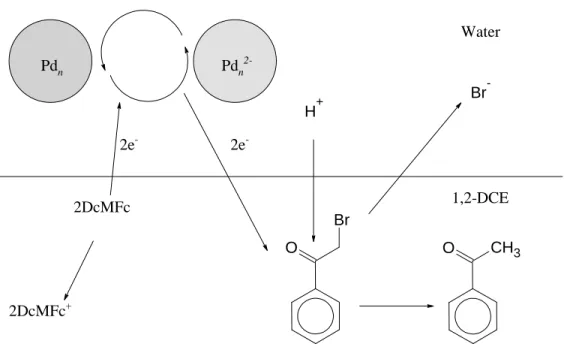
It was demonstrated by cyclic voltammetry that the colloids can be charged with electrons originating from decamethylferrocene (DcMFc) in the organic phase. In the dehalogenation reaction, the substrate, 2-bromoacetophenone, is reduced by decamethylferrocene in the organic phase, mediated by metal particles, see Figure 1. The reaction requires two electrons, one for proton reduction and one for bromine.
Because protons and bromide readily transfer across the liquid/liquid interface at the applied potential, a net positive charge flows from the aqueous to the organic phase.
Electrodeposition at liquid|liquid interfaces
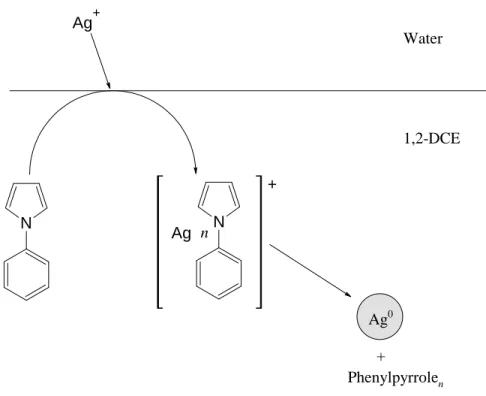
The particles were shown to grow in the membrane pores and reach a maximum size determined by the pore dimensions. However, the formation of the silver ion–phenylpyrrole complex serves to bring the reactants closer to each other, which was assumed to be crucial for the reduction reaction and oligomerization of phenylpyrrole. Assuming first-order reaction kinetics, a rate constant of 0.8×10⁻³ s−1 was obtained by cyclic voltammetry for the consumption of the silver-phenylpyrrole complex.
However, the emphasis is on modeling nucleation and three-dimensional diffusion-controlled growth, and comparing the models presented in this thesis with those found in the literature. The initial stages of formation and growth of new phases are of particular interest for conventional industrial electrodeposition processes, but also for the great interest in nanometer-sized materials [169]. An initial energy barrier is formed for small nucleation sizes by the proportionally faster increase of the surface energy than the energy released by the formation of the bulk material, see Figure 3.
As the size of the cluster increases, the fraction of surface atoms decreases, and correspondingly, the significance of the surface energy term. The height of the energy barrier is commonly called the nucleation overpotential, while the cluster size at the energy maximum is called the critical size. In the atomistic approach, the frequencies of attachment and detachment of atoms are defined as functions of the number of atoms in the cluster and the applied potential [172].
For small clusters, the intervals are large and the use of classical kernel theory is not valid.
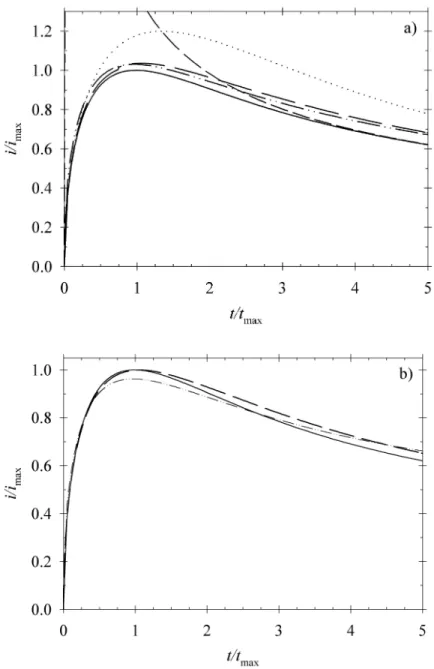
Diffusion controlled three-dimensional nucleation and growth . 22
Attention was focused on the evolution of the particle size distribution as a function of the experimental variables. It was found that the particle size distribution initially converges, but as the diffusion fields begin to overlap, the particle size distribution diverges. The radius of the diffusion zone is determined by equating the fluxes for the hemispherical and planar diffusion fields.
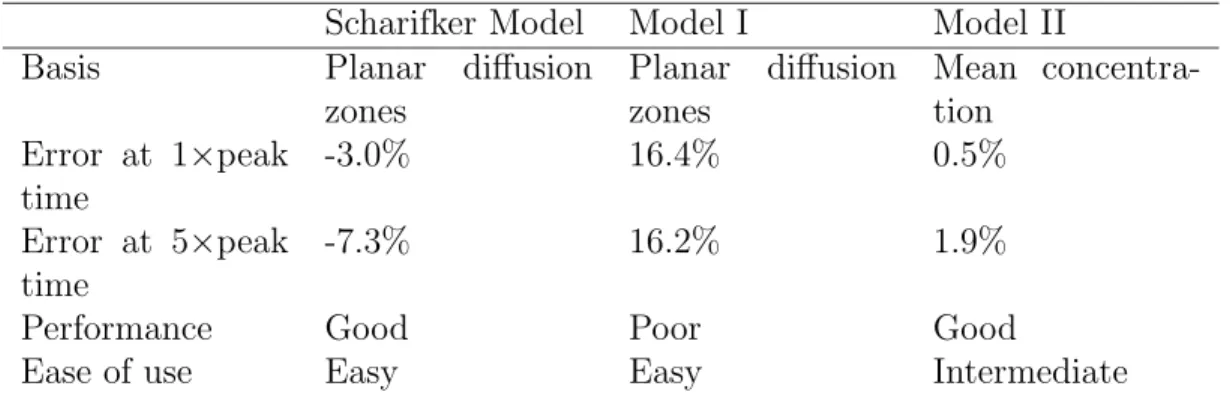
The first assumption in this model is that for a distribution of nuclei with interacting diffusion fields, the solution to the real diffusion problem can be approximated by the flux in the fraction of the surface covered by the diffusion zones. The transient current in the core group is obtained by multiplying the fraction of the surface covered by the Cottrell equation initialized at the beginning of the potential step, where the fraction of the surface covered by randomly distributed circles is calculated by Avram's theorem [177]. The definition of planar diffusion zones was also revised in release I, in that the growth of diffusion zones was calculated by continuously assuming linear flow conditions as the fraction covered by planar diffusion zones expands.
Thus, in this model the thickness of the diffusion layer, and consequently the flux density, depends on the coverage time of the considered point. While models based on planar diffusion zones reproduce experimental transients following potential steps to a satisfactory level, the physical basis of the concept is controversial. The average interface concentration can be easily calculated from the convolution of the experimentally obtained current.
The solubility properties of the particles can be adjusted by changing the pH of the aqueous medium.
Experimental
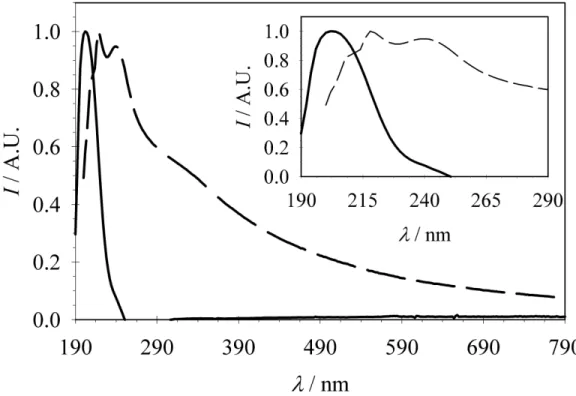
Oxygen was determined from Auger O(KLL), since the Pd 3p core level affects the O 1s level. UV-Vis spectra were recorded on a Hewlett Packard HP8451A diode array spectrophotometer in a quartz cuvette with a light path length of 1 cm from dilute solution b.
Results
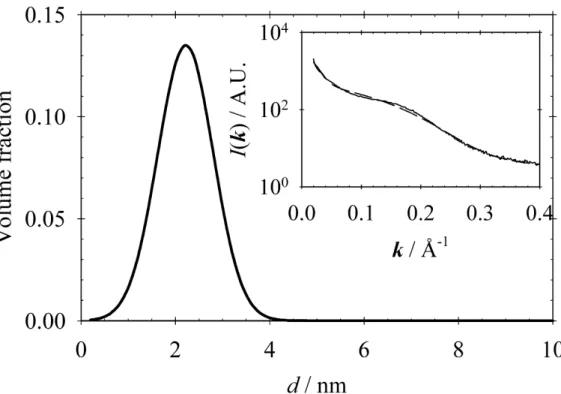
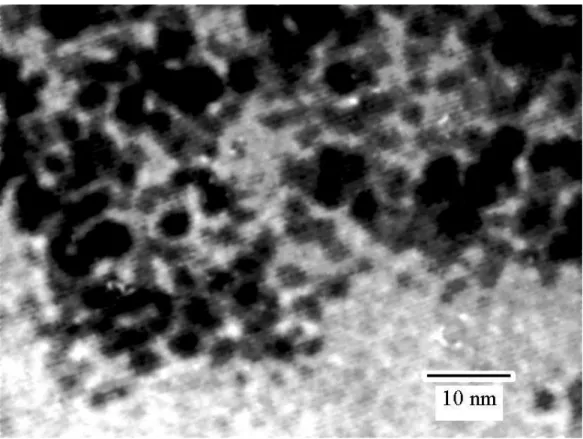
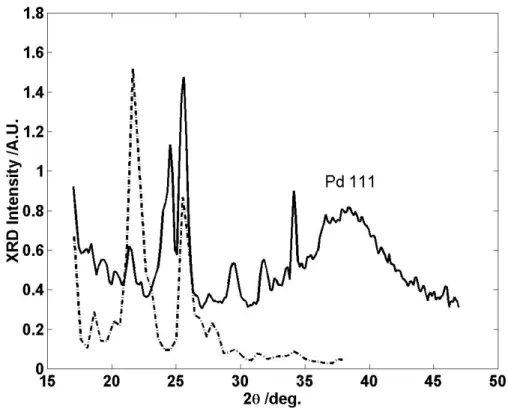
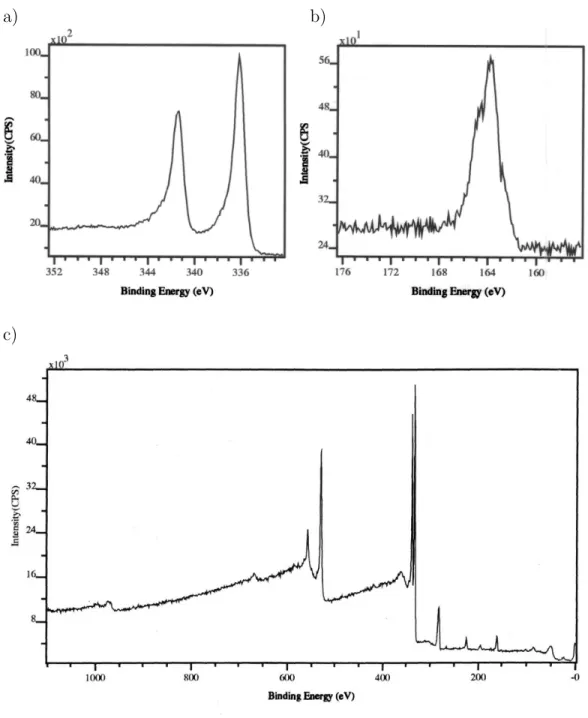
The size distribution was not calculated due to the poor quality of the TEM photograph. These are in the 2–3 nm size range, which compares favorably with the size distribution calculated from the SAXS data. The chemical composition and oxidation states of the elements in a have been investigated by XPS.
In the XPS spectrum, see Figure 8a, a doublet of Pd 3d5/2 at 336.2eV with two narrow peaks is further evidence that palladium is present in its metallic state. It is also consistent with that found for a vapor deposited palladium metal standard obtained with the same equipment. For a close-packed structure, the majority of thiophene groups can be directly adsorbed at the metal surface.
The size range found in this study is at the lower end of this range, so the conclusions should be taken as tentative only. These wavelengths correspond to the absorption of poly(thiophene-3-acetic acid) and thus may be indicative of the formation of poly(thiophene-3-acetic acid). Unfortunately, the corresponding absorption band would be masked by the absorption of the colloid, so it is difficult to resolve it.
This peak is not present in the colloid, indicating that thiophene-3-acetic acid is not present in significant concentrations in its free form.
Discussion
It is noted here that the absorption spectra of metal particles between 3-20 nm only weakly depend on the particle size [195]. A possible connection between peaks (1), (2) and (3) was not resolved in this study, but the shifts towards longer wavelengths may relate to higher conjugation of the π-orbitals. a) b). Proton loss followed by monomer coupling results in a lower reaction free energy and is thus energetically more favorable than simple monomer oxidation.
However, thiophene has been shown to polymerize on Pt electrodes from aqueous solutions, where it is solubilized by surfactants, to overcome low water solubility [199]. In this study, a shoulder was found in the UV-Vis spectrum at wavelengths corresponding to poly(thiophene-3-acetic acid), i.e. 340-400 nm, and also the absorption peak of thiophene-3-acetic acid is shifted to longer wavelengths.
XPS spectra show that the thiophene ring is present on the surface of the particles and that sulfur is present only in thiophene. A possible reaction mechanism involves the formation of a precursor complex, which promotes polymerization by approaching the thiophene moieties. The evidence supporting polymerization in this study is not conclusive, and other reaction mechanisms must be considered.
Conclusions
Special emphasis was placed on reactivity and formation of such particles at liquid/liquid interfaces. The electrodeposition studies presented in publications I-III show that the electrified liquid|liquid interface is suitable for studying the initial steps of nucleation with the advantage of controlling the growth reaction with the applied potential, while not suffering from the presence of strong interactions between the electrode and the new phase. It was shown that this approach is inconsistent and therefore not generally applicable to the liquid|liquid interface, since the overlap and thus the flow is dependent on the species under consideration.
Moreover, it was shown that the average interfacial concentration can be used as a good approximation for the overlap of the diffusion zones. The interpretation of the experimental results shows that the particles formed at the interface aggregate. In experimental work, it was shown that the addition of phospholipids destabilizes the embryonic groups in the initial stages of growth and thus reduces the rate of nucleation.
In the study, silver ions were transferred by facilitated ion transfer from the aqueous to the organic phase where their reduction and agglomeration to form particles takes place. 1-Phenylpyrrole functions both as the complexing agent in the facilitated ion transfer reaction and as the reductant in the electron transfer reaction. Although no direct evidence has been obtained, it is believed that the oxidation of thiophene-3-acetic acid leads to oligomerization.
Furthermore, it was shown by cyclic voltammetry and electrophoretic light scattering measurements that the aqueous colloids can be charged with electrons by a two-phase process involving decamethylferrocene as an electron donor.