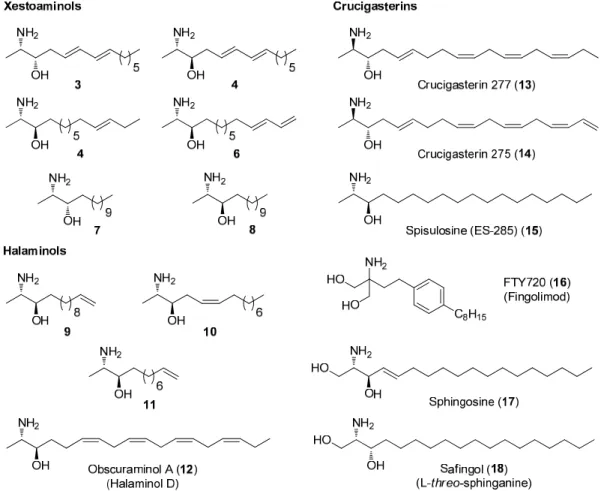
This thesis describes the total synthesis of amaminol A using an enantioselective intramolecular Diels-Alder organocalytic reaction as one of the key steps. A certain part of the work was done by other researchers in collaboration with the author.
Introduction
Biological pathways of sphingosine
Most of the sphingosine 17 formed is rapidly converted to sphingosine-1-phosphate (S1P) 25 or N-methylated to various N-methylsphingosines 28-30. After sphingosine 17 was shown to inhibit protein kinase C, it was postulated that sphingoid-derived compounds might act as secondary messengers.8 This is indeed the case, and the most intriguing metabolite is sphingosine-1-phosphate 25 (S1P), which .
Synthesis of C5-C18 tetraene building block
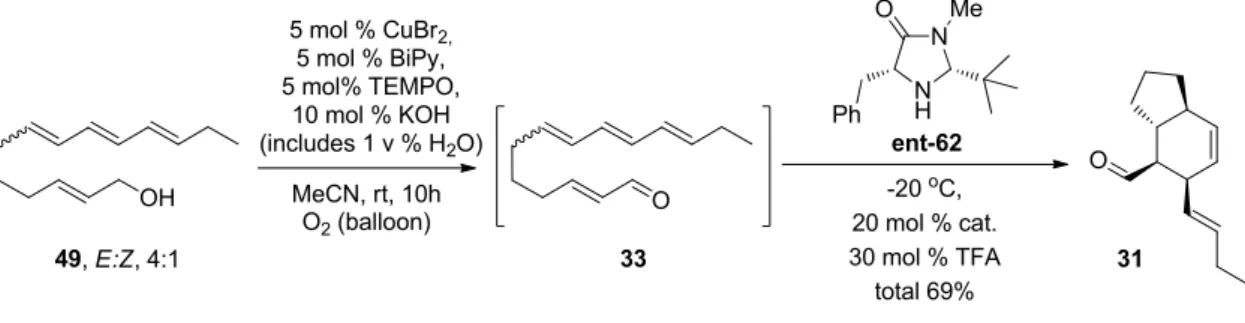
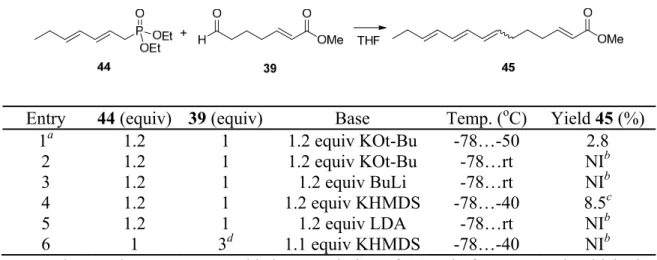
The chain extension was planned to be performed using the Horner-Wadsworth-Emmons reaction (HWE). This tetraene alcohol 49 was found to be stable and solidified at -18°C, yielding a white crystalline wax.
Organocatalytic intramolecular Diels-Alder reaction
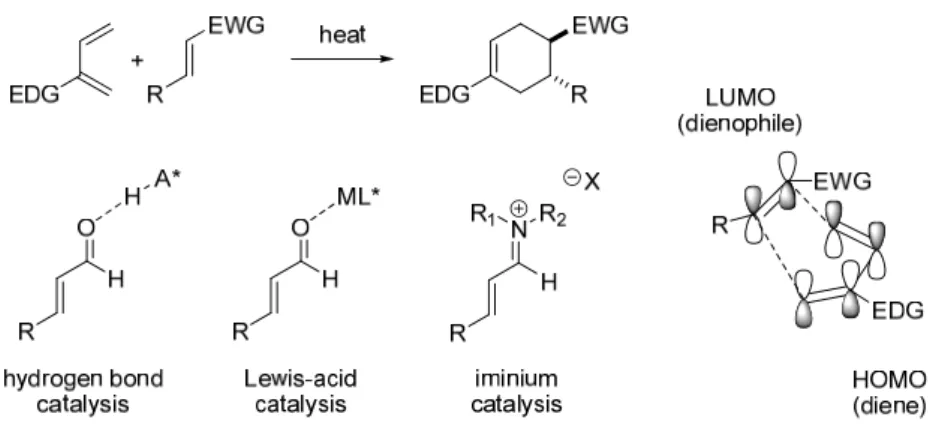
A major development occurred in 2000 when MacMillan and co-workers reported the first asymmetric organocatalytic Diels–Alder reactions for α,β-unsaturated aldehydes (Scheme 8).30 They used an imidazolidinone-based catalyst 58 in combination with HCl for Diels catalysis. -Alder reactions of aldehydes and various dienes. My former instructor Sami Selkälä worked on the total synthesis of amaminol A 1 (Scheme 9).25 After the unsuccessful removal of the chiral auxiliary by thermal intramolecular Diels–Alder (IMDA) reaction, he became interested in organocatalytic Diels–Alder reactions. developed by MacMillan and co-workers.30,31 He first developed solid-supported catalysts similar to 58, which was used in Diels-Alder reactions.32 He then focused on aminol A 1 and the organocatalytic IMDA.
Selective conjugate reductions
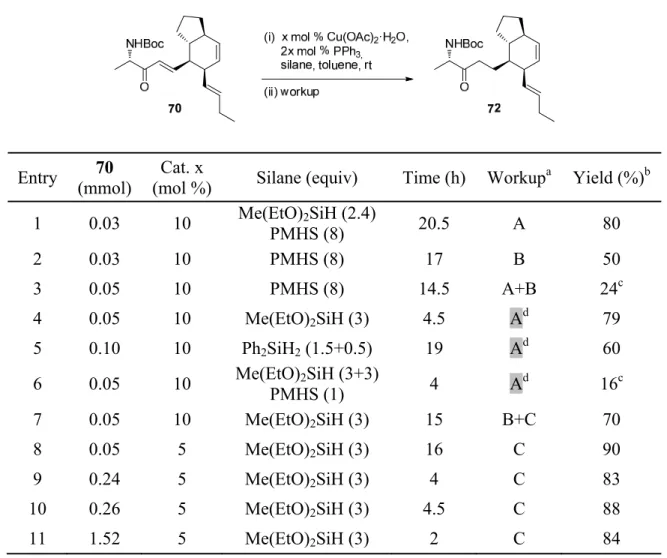
Finally, the reaction was quenched with TBAF and the desired ketone 72 was obtained in a good 80% yield (Table 2, entry 1). When the reaction was repeated with only PMHS, we obtained the ketone 72 in a poorer 50% yield after aqueous workup (entry 2).
Selective ketone reductions
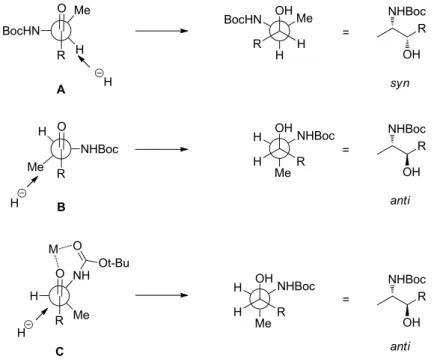
Both isomers were also found to be crystalline and can be further purified by recrystallization. Finally, Boc protection was removed with trifluoroacetic acid, yielding amaminol A1 and epi-amaminol A 75 after aqueous basic work-up.
Structural evaluation of amaminol A
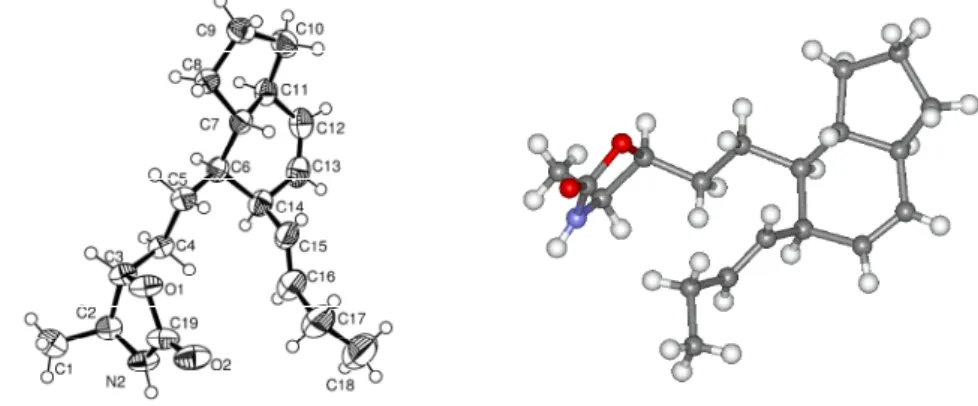
Fortunately we were able to crystallize carbamate 76 to obtain its crystal structure and verify the absolute stereochemistry (Figure 7). A plot of the X-ray crystal structure of carbamate 76 with atom labels and thermal shift parameters at the 50% probability level.

Biologigal activity of amaminol A
Early results using copper hydride obtained during the total synthesis of aaminol A 1 (Table 2) led us to further investigate these reactions. Furthermore, existing reviews have mostly focused on the use of readily available Stryker reagent or in situ generated copper hydride catalyst in asymmetric reactions.49,50 Practical procedures for non-asymmetric catalytic in situ generated copper hydride reactions have been extremely difficult to find.

Conjugate reduction with stoichiometric Stryker’s reagent
Stryker’s reagent in the reduction of other α,β-unsaturated systems
The solution to this problem was to use Stryker's reagent in the conjugate reduction, which led to good yields in all cases. Georg and co-workers used Stryker's reagent to saturate α,β-unsaturated nitriles in the total synthesis of (-)-salicylic halamides.100 Initially, the C13 hydroxyl contained a p-nitrobenzoate functionality, resulting in lower reduction yields ( Scheme 56). Stryker's reagent has been widely used in the synthesis of complex targets over the past two decades.
Conjugate reduction with catalytic Stryker’s reagent and hydrogen
The only example using this technology found in the literature was reported by Hamada and co-workers in 2002.106 They reduced enone 188 to the saturated ketone 189 using Stryker's reagent under a hydrogen atmosphere (Scheme 58). It is unclear whether the reaction was truly catalytic, as the amount of Stryker's reagent was not reported.
Conjugate reduction with catalytic copper hydrides and silanes
Stoichiometric copper hydride reductions
The first copper reductions using silanes as the stoichiometric reducing agent.107 Almost a decade later, Hosomi and co-workers reported in 1997 the formation of copper(I) hydride from PhMe2SiH and CuCl in highly polar solvents such as DMF and DMI.108 Other silanes such as e.g. since Et3SiH and Ph2SiH2 also showed activity in the σ-bond metathesis. They were able to show that copper can act as a catalyst when α,β-unsaturated ester 195 was reduced with various amounts of copper(I) chloride in the presence of 2 equivalents of PhMe2SiH (Scheme 60). This method was catalytic in some cases, but required stoichiometric amounts of copper for more challenging substrates.
Catalytic copper hydride reductions
In this publication, Lipshutz and co-workers focused on reductive aldol reactions and gave only one example of a conjugate reduction of an enone to its saturated ketone. Desrosiers and Charette published a copper hydride-catalyzed reduction of α,β-unsaturated sulfones in 2007.118 Their main focus was on enantioselective synthesis, but they also reported a non-asymmetric method, which used tributylphosphine as the ligand and copper (II)fluoride as the copper source (Scheme 71). In 2008, Liphutz and co-workers reported a very active copper catalyst for conjugate reduction of various α,β-unsaturated functionalities.119 They used copper(II) acetate, bisphosphine ligand 243 (o-BDPPB or BDP) and PMHS to provide the copper generates hydride catalyst in situ (Scheme 72).
Conjugate reductions with NHC-stabilized copper hydride
In 2005, Yun and co-workers reported an alternative to Buchwald's catalyst.123 They were able to complex copper(II) acetate with 1,3-bis(2,6-di-isopropylphenyl)-imidazolium ylidene and thus the to obtain air and moisture. stable catalyst 262 (Scheme 76). The major difference between Buchwald's catalyst 253 and Yun's catalyst 262 is that the latter does not require preactivation with NaOt-Bu, but undergoes direct formation of copper hydride in the presence of silanes. Conjugate reductions using air- and moisture-stable NHC precatalyst.123 Catalytic copper hydride reductions continue to receive growing interest, and several methods for reductions for various α,β-unsaturated systems have been reported.
Reductive tandem reactions with copper hydrides
Reductive cyclization with stoichiometric Stryker’s reagent
They used different substrates which usually gave a mixture of products when treated with Stryker's reagent (Scheme 81). Stryker's reagent could also be used as a catalyst when PHMS was used as the stoichiometric hydride donor. They also showed that Stryker's reagent is slightly basic, which could have caused some epimerization at α-stereocenters.
Reductive tandem reactions with catalytic copper hydrides
Lipshutz and Papa further developed these reductive aldol reactions by changing the stoichiometric hydride donor to diethylborane (Scheme 85).131 This modification provided excellent control over the geometry of intermediate boron enolates. Acyclic enones yielded thermodynamically favorable Z-enolates, which underwent aldol reactions with aldehydes and produced syn-aldol products in good yields and some diastereomers. The yields of these reductive aldol reactions were generally good, but the diastereoselectivities appeared to be poor in all cases.
Conclusions
In 2006, Riant and co-workers performed some intermolecular reductive aldol reactions catalyzed by the NHC–copper complex 324 (Scheme 88).134 They performed their initial experiments with PhSiH3 and then began to look for more economical sources of silane.
Results and discussion
Based on these results, we chose to use P(Oi-Pr)3 in the reduction of different substrates in order to check the applicability of this method.136 We also used our new improved method in the synthesis of amaminol A 1. However , purification became easier since PPh3 has a similar retention time in silica gel chromatography as product 72, and P(Oi-Pr)3 hardly moves on silica gel. The pure N -Boc-protected aminol A 73 was isolated after silica gel chromatography in 59% yield along with a mixture of isomers in 30% yield.
Bio-inspired alcohol oxidations
Galactose oxidase mimetics
Stack and co-workers reported that their catalyst affords an oxidation process of 2e by a mechanism identical to that of galactose oxidase. Wieghardt and co-workers reported an extremely active GO mimic in 1999.148 They synthesized the ligand H4(L1) (Scheme 92) which could be converted into a stable copper(II) complex by complexing the ligand with copper(I) and exposing that in oxygen. According to the authors, the mechanism is similar to that of GO, except that the redox process occurs on the ligand.
Copper catalyzed alcohol oxidation mediated by nitroxyl radicals
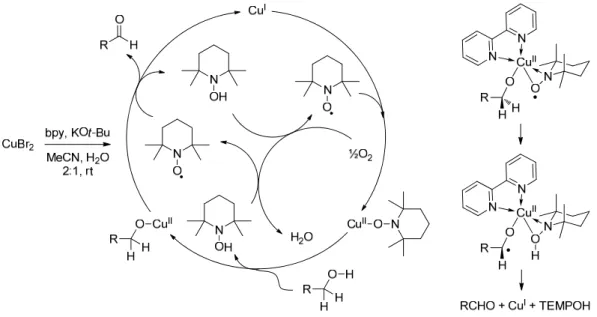
A similar catalytic system was reported by Sheldon and co-workers in 2003.154 A major improvement of this new catalytic system was the use of a bipyridine ligand. Sheldon and co-workers also found that copper(I) is oxidized by TEMPO faster than oxygen. In 2007, Repo and co-workers reported a slightly modified mechanism (Scheme 96).158 Their proposal mainly followed Sheldon's mechanism.
Other copper catalyzed alcohol oxidations
Repo and co-workers analyzed the reaction intermediates by high-resolution ESI-MS and were able to identify many interesting complexes. Although the mechanism is totally unrealistic, this work by Sawyer and colleagues has been the starting point for research by other groups. Maumy and co-workers described a mechanism in which oxidation of (bpy)CuIOCH2Ph results in a binuclear copper(II) 1,2-μ-peroxo species.
Results and discussion
When the amount of BiPy was increased from 2 to 4 mol%, the reaction rate increased slightly (Figure 15). Initially it seemed that the amount of ligand does not have a major influence on the reaction. Therefore, we reduced the initial concentration of alcohol 331 to 0.1 M to slow down the reaction.
Conclusions
In 2008, Jacobs and Christmann reported the first total synthesis of aaminol B 2.165 Their synthetic route was found to be identical to the one we described for aaminol A.16 This is not surprising, as they adopted a late-stage synthesis strategy from Selkälä's doctoral theses. in a different approach. These two problematic steps were the ones I was determined to improve upon in the synthesis of amaminol A 1. These goals were achieved and we were able to report the first total synthesis of amaminol A 1 in 12 linear steps in 20% overall yield starting from cyclopentene.
General experimental
Copies of relevant NMR spectra can be found in the supporting information section of these articles.16,136,167.
Synthesis of amaminol A
- Early steps of the synthesis
- Horner-Wadsworth-Emmons reaction approach
- Julia-Kocienski olefination approach
- Wittig olefination approach
- Construction of C1-C18 carbon skeleton of amaminol A
- Selective reductions
- amaminol A (1)
The combined organic extracts were washed with brine (100 mL), dried over anhydrous sodium sulfate, and evaporated to dryness. The combined organic extracts were washed with brine (300 mL), dried over anhydrous sodium sulfate, and evaporated to dryness. The combined organic extracts were washed with brine (50 mL), dried over anhydrous sodium sulfate, and evaporated to dryness.
Aerobic oxidation experiments
Ligand synthesis
Aerobic oxidation in amaminol synthesis
Typical oxidation experiments
To the subsequent green solution, a solution (20 mM, 1 mL) of BiPy (0.02 mmol, 2 mol%) in acetonitrile was added, transforming the color to brown and back to green. Finally, a solution (1 M, 40 μL) of DBU (0.04 mmol, 4 mol%) in acetonitrile was added, causing the color to change to brown and gradually back to green. The reaction mixture was filtered through celite and partitioned between hexane (30 ml) and distilled water (30 ml).