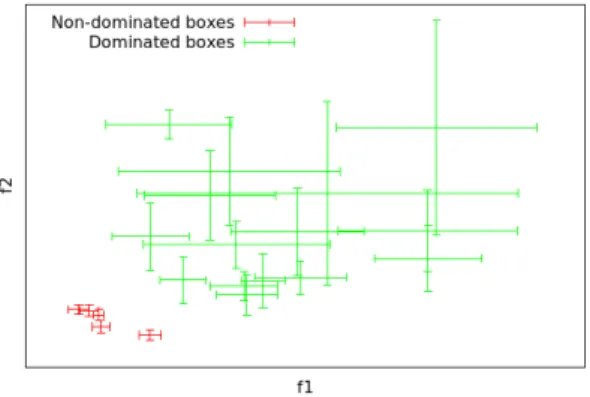
In many real-world applications, the evaluation of the objective functions may be affected by a source of uncertainty, noise, or error. The main strategy to account for uncertainty on the objective functions is to use a probability ranking of the individuals. The bounding-box approach makes it possible to adjust the reliability of the statistic calculation depending on the proximity to the Pareto front.
The first contribution of this paper is based on providing some mathematical evidence on the convergence of the Bounding-Box approach for multi-objective optimization problems with adaptively tuned objective values. The work [22] showed that although significant gains can be achieved in the early stages of the optimization, the convergence of the optimizer to the Pareto front reduces the efficiency of the Bounding-Box approach. If the box is dominated orεel(x)≤s2, it is no longer refined; . f) The value returned to the optimizer is the center of the box, i.e.
As a fundamental assumption, the scope of this paper is to consider one expensive solver, where the simulation outcome provides all the objective functions.
Surrogate-assisting strategy
This strategy is part of the flowchart (Fig. 3), and the blue color of the “Bounding-Box Approach” box indicates the significant computational cost associated with estimating the objectives. The SA model is updated with the knowledge of the newly calculated box at each optimization iteration t. The valuefopt(x) returned to the optimizer then depends on the value of the surrogate error compared to a user-defined threshold s1.
The aim of this section is to provide some evidence of the convergence of the proposed strategy. We then illustrate the convergence of the method, also in combination with a surrogate assisting strategy.
Bounding-Box definition and convergence analysis
Otherwise, the Bounding-Box approach is applied and the bounding box is calculated and refined. The purpose of this section is to provide some definitions and introduce the so-called recursive Bounding-Box strategy. Therefore, we consider the fidelity l as a strictly increasing sequence at eachx during the optimization process.
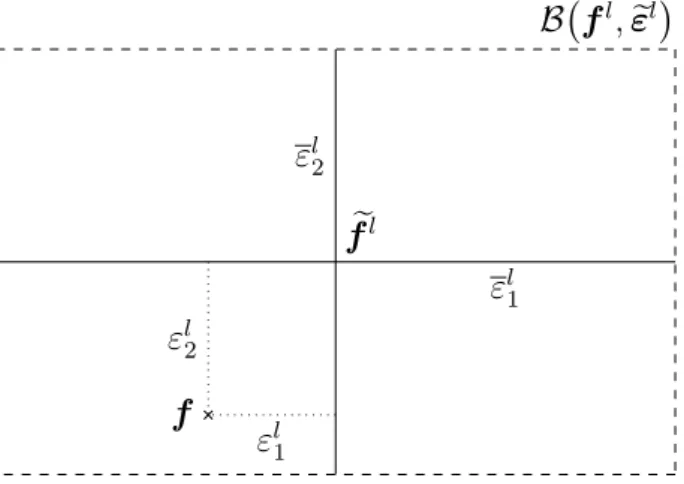
Note that the following development is written in design space, but can easily be transposed to objective space. The classical approach refers to a double loop or nested optimization, where the objective functions are estimated with increasing fidelity on the entire design set Xef,0. As raised in Assumption 2, the most time-consuming step is the decrease of the conservative error εel through higher fidelity calculations.
More precisely, the goal is to demonstrate the convergence of the continuous approximate Pareto front Pec built on the approximate objective field Xef,k. In this context, the impact of the proposed strategy on the convergence can be studied. A novelty of this paper compared to Fusi's Bounding-Box approach in [22] is the choice of an accuracy threshold for the estimation of the objective functions.
This first theorem extends the robust behavior presented in Lemma 1 to the recursive Bounding-Box strategy introduced in Definition 10. It relies on several assumptions about the computability of conservative errors and the well-behavior of the optimizer and objective functions. Performing improvements on this set alone results in significant cost reductions, especially during the optimizer's exploration phase.
Surrogate-Assisting model
If a pattern, linearity or simple behavior of the objective functions is detected, it can drastically reduce the overall optimization cost. The values1 are compared to the surrogate error to determine whether or not the surrogate can be used. The thresholds2 are compared to the error of the estimated objective functions, to decide if higher higher fidelity estimates are required.
It contains all the non-dominated designs and is updated at each refinement of the objective functions. The main steps of Algorithm 2 are the following: i) in the subroutine compareDesignSA, if the surrogate error is below s1, the associated objective values are returned. A low-fidelity objective estimate is calculated for the other designs and added to D0; ii) the inner while loop refines each design from D0 to the 2-threshold within the iterateRefinement subroutine and checks for new dominances at each iteration to discard boxes from D0; iii) finally the surrogate is updated and new designs can be analyzed.
Returns a set of non-dominated models that can be improved (not derived from the SA approximation), the associated low-fidelity estimate of the objective functions and the coupled objective functions with the field size meter. For each new design, the error of the SA model is compared to thresholds1. The proposed framework (SABBa) is an adaptive strategy for approximating the Pareto front of an optimization problem by adjusting the accuracy of objective estimates based on their effectiveness to significantly reduce the computational burden.
The goal here is to provide a proof-of-concept of the proposed framework on analytical test cases, ie. Note also that in this perspective, the point is not to assess the framework's behavior regarding the dimensionality and complexity of the optimization problem, since these last affect the optimizer and the surrogate model, which are choices independent of the framework. The second test case illustrated in Section 5.3 highlights the increase in computational cost in [22] when the optimizer converges towards the Pareto front.
Tools
Finally, the robustness of SABBa to the complex Pareto front is illustrated in a third test case, presented in Section 5.4. In the following, the SABBa framework is compared with three different approaches: i) the classical nested approach (denoted byClass), i.e. The non-recursive Bounding-Box approach defined in Def. 10, where each box is refined up to threshold s2; ii) recursive approach, i.e. Fus's Bounding Box refinement strategy [22], where only non-dominated boxes are refined in thresholds2; iii) a substitution-assisted classical approach (denoted by Class-acc).
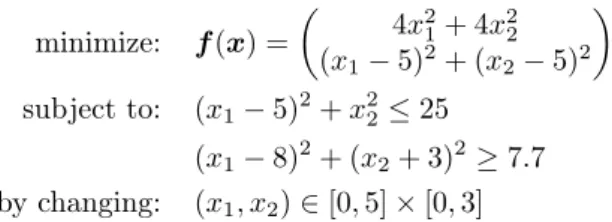
Test-case 1: The BNH problem
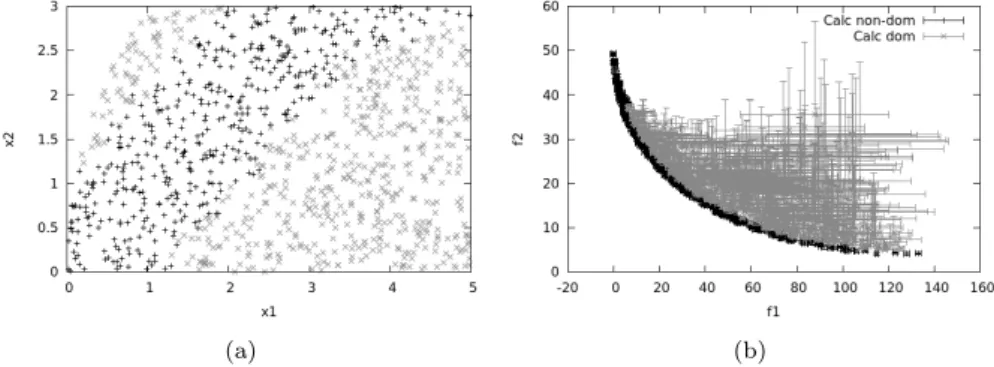
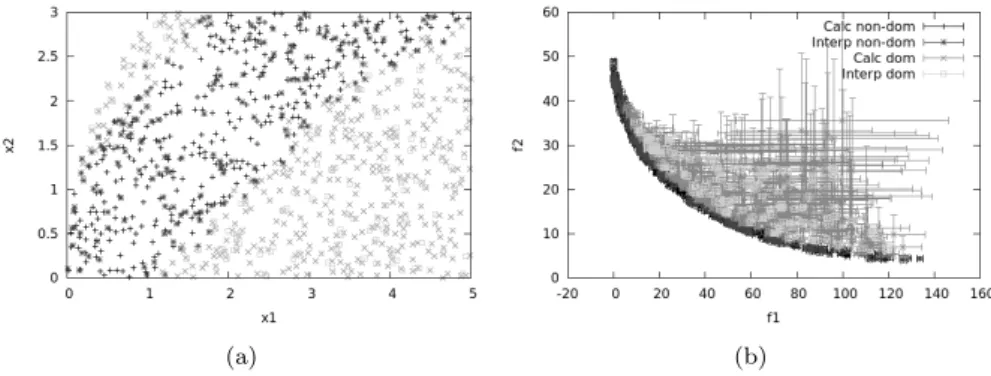
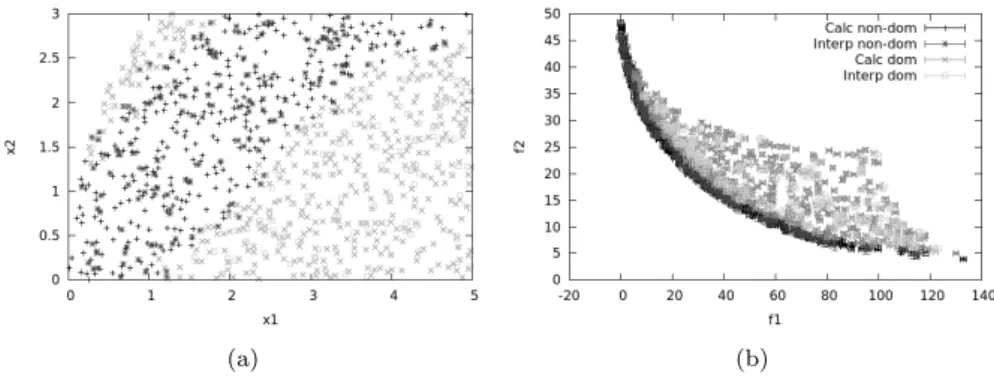
Below, the SABBa framework is compared with three different approaches: i) the nested classical approach (denoted by Class), i.e. non-recursive Bounding-Box approach defined in Def. 10, where each box is refined to the threshold s2; ii) the recursive approach, i.e. Fusi's Bounding-Box refinement strategy [22], where only non-dominated boxes are refined up to the thresholds2; iii) a surrogate-assisted classical approach (denoted by Class-acc). a) (b). In Figures 7 and 8, the Surrogate-Assisting (SA) strategy is applied to the classical approach and the recursive (Fusi) approach, respectively. SA designs and boxes are drawn dark gray if not dominated, and light gray otherwise.
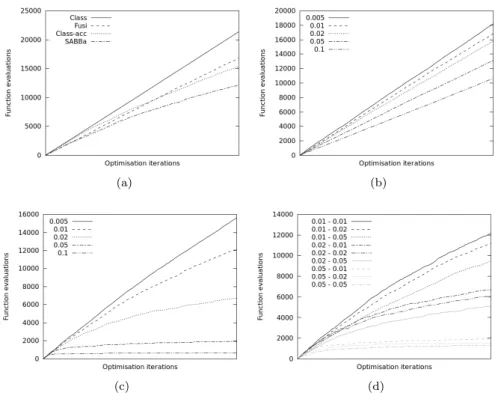
The non-dominated design region and the approximate Pareto front are similar to the fully calculated ones in Figure 5. Since the tools are analytically simulated, the number of function evaluations allows only an asymptotic comparison and should not be compared to real applications. It reduces the slope of the cost curve by a ratio that can be interpreted as the average computational cost in the recursive strategy relative to the full convergence cost.
During the first iterations, the surrogate is not yet accurate and the slope is similar to unsupported strategies. Increasing the threshold implies higher accuracy for all these boxes and significantly increases the global cost. Figures 9c and 9d illustrate the large cost reduction that can be achieved with the SA strategy, at the expense of Pareto pre-accuracy.
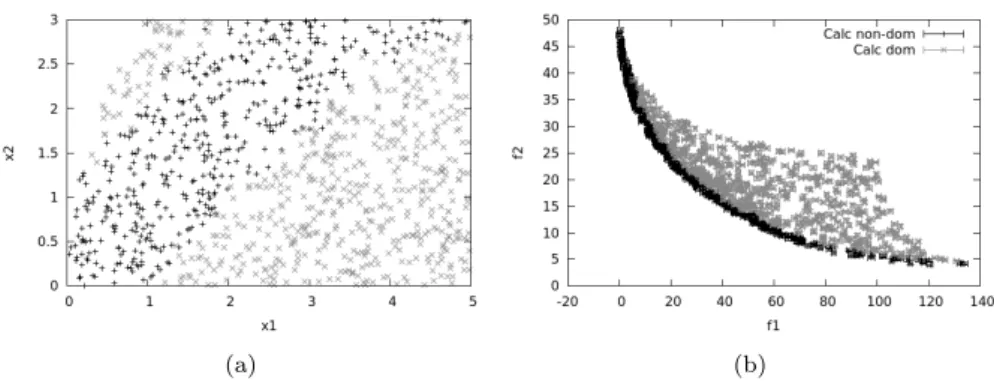
Test-case 2: The Triangle problem
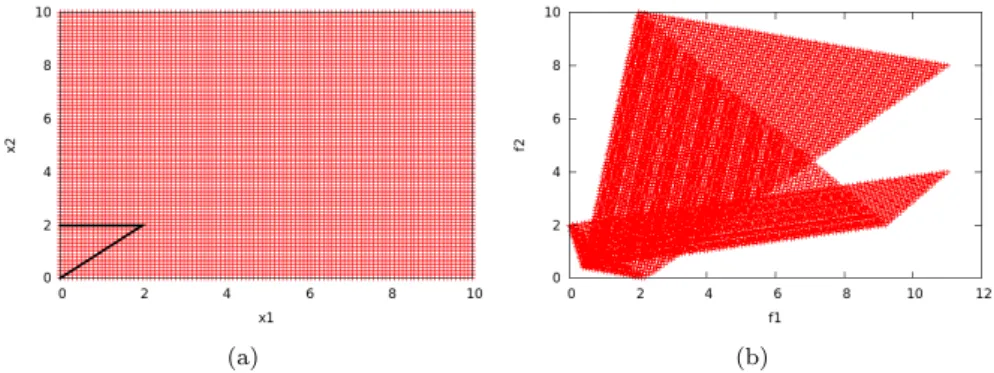
Outputs with s¯2= 0.1in c) design space and d) objective space. example 2: a) acceptable design and Pareto optima (thick line), b) image in objective space. In practice, by optimization iteration, new designs are drawn as follows for iin{1,2},. As mentioned in [22], convergence to the optimal region results in less impact of the recursive strategy.
The slope of the associated cost curve (dashed) slowly returns to the slope of the classical one (solid) in Fig. SABBa relies on the SA strategy to eventually bypass function evaluations in the optimal region. 14b, both substitution assistance strategies (Class-acc and SABBa) benefit from convergence to reach their cost plateau faster.
Despite the increasing slope of the Fusi strategy alone, SABBa exploits the convergence by constructing a locally highly refined surrogate model in the optimal region. Remark The increasing number of non-dominated designs in the converging case also induces an increasing impact of the threshold s¯2 throughout the optimization process.

Test-case 3: The Kursawe problem
However, this gives a first rough approximation of the optimal region with only a computational cost of 3546 evaluations (gain = 93%). a) (b). The efficiency of the SABBa framework is not directly related to the complexity of the optimization problem. In this context, SABBa can achieve consistent cost reduction through accurate allocation of the high-fidelity calculations and robust use of the Surrogate-Assisting model.
The intuitive idea is to use the Bounding-Box approach to quickly converge to the optimal region through low-fidelity calculations of the non-efficient designs and simultaneously build the Surrogate-Assisting model, whose refinement is driven by the optimization process. We first provided a mathematical proof of the robustness of the framework and of its convergence under some assumptions. A numerical validation was then performed to validate the convergence, quantify the computational gain and make explicit the key behavior of the strategy.
The accuracy of the results is qualitatively analyzed in relation to the associated cost reduction. SABBa is based on several assumptions, such as the possibility to calculate a conservative approximation of the error and the convergence of the optimization process. Note also that the bounded error assumption is critical for calculating conservative errors, which ensure a proper convergence of the framework.
Finally, the behavior of the framework when dealing with a large number of parameters has not been addressed here. Moreover, the choice of the thresholds1 could be of particular importance and allow to balance the computational burden with respect to the accuracy of the Pareto-optimal region. Future developments will focus on the application of the proposed framework to a problem of uncertainty-based multi-objective optimization in an engineering context and on the management of constraint functions.
Using the explicit definition of the Pareto front as in Equation 4, the proof is immediate, since Assumption 1 gives ∀x ∈ X,∀j ∈ J1, NK, fj(x). An Adaptive Error Strategy of Objective Functions for Uncertainty-Based Derivative-Free Optimization.