ADEPT Political Commentaries
September-December 2004
Concerns on the eve of elections Igor Botan, 15 September 2004
Democracy and governing in Moldova e-journal, II year, no. 37, August 30 - September 12, 2004 With the launch of the fall political season analysts and media alike engaged in assessing preparations for parliamentary elections. According to their estimates, elections might be held late May or even June next year. The source for such predictions is the Constitution itself. Paragraph 3 Article 61 of the Constitution provides that "election of Parliament members will be started not later than 3 months from the end of the previous mandate or from the dissolution of the previous Parliament". Article 63 specifies that "the mandate of the current Parliament may be extended until the structure of the new Parliament has been completed and the latter can meet in full session" that according to the same article is held "within at most 30 days from election day". That is why it is considered that Parliament mandate commences on the day of its first session. Given that the last parliamentary elections were held on February 25, while the Parliament was convened on a first session via a Presidential Decree on March 20, 2001, it is expected that parliamentary elections would be held sometime during the three months March 21 - June 21, 2005.
This estimation is logical and at the first glance seems accurate. Arguments cited by those who claim election date would be set for the end of May or even June cite, derive from the supposed interests of the ruling party. It is believed that Party of Communists would like to exploit for propaganda purposes April religious holidays (Easter) and turn again bringing the Holy Fire from Jerusalem into a political show.
Celebration of the 60th anniversary of the victory day on May 9, in the middle of electoral campaign, promises additional political dividends. The more so as the CIS chief of states were already invited by President Putin to celebrate the anniversary in Moscow. The latter might prove to be crucial in convincing a 30% Russian-speaking electorate that President Voronin is on good terms with the Russian leadership.
It is said that by mid-May electorate gets more tolerant with the ruling elite as the hardships of winter are long forgotten. This time however winter promises to be particularly hard due to the forecasted shortages of electricity and natural gas as a result of the would-be "adequate measures" undertaken by Transdnistrian authorities in response to so-called "economic blockade" from Chisinau. Given the string of provocations contrived by the Tiraspol leaders, it may well happen that the "adequate measures" would be scheduled precisely for the cold period of the year, i.e. during pre-electoral campaign and would therefore considerably tarnish ruling party's rating.
Those expectations led some newspapers into believing that worsening relations between Moldova and Transdnistria might serve grounds for the governing to declare a state of emergency, which would allow it to postpone elections a month or two for a more favourable period. In addition, it is said that ruling party would seek to amend Constitution so as the President be elected directly by people.
Those speculations should be viewed with scepticism. For a start, the latter supposition is no longer valid as according to Article 143 (1) of the Constitution
"Parliament has the right to pass a law for revising the Constitution after no less than 6 months from the date when the revising initiative was submitted." Article 74/2 of
the Law on Parliament Regulation provides that debates on constitutional laws may start only "after six months after the submission of the relevant draft law together with the Constitutional Court endorsement". So far no such draft was submitted to the Constitutional Court. Therefore, ruling party simply does not have the six months necessary for the Constitution revision, as its mandate expires in five months and a half, when it would no longer be able to adopt or amend Constitution or any organic law.
As for the speculations on declaring a state of emergency, we better not disregard those arguments but rather take them seriously. On top of worsening relations between Chisinau and Tiraspol, a string of events have happened and numerous quite suggestive laws have been passed. Thus, on May 24 President signed a Decree on establishing Supreme Security Council (SSC). Opposition dubbed it as President's
"politburo" or "pet government" seeking to replace Government and "serve dictatorial ambitions and usurpation of state power" and having the function of electoral headquarters entrusted to bring the victory to the ruling party in the 2005 parliamentary elections. One month later, on June 24, 2004 Parliament passed the Law no. 212-XV on the State of Emergency, Siege and War. About the same time government affiliated media predicted that opposition would stage a putsch right on the eve of elections, the so-called "Sun Flower" (Moldovan version of the 2003 Georgian scenario)1. And finally on September 13 the Director of Information and Security Service (ISS) announced that "Five persons, including Defence Ministry officials were detained in suspicion of embezzling large quantities of weapons from the National Army warehouses"2. ISS Director noted "it is quite symptomatic that the theft coincided with the escalation of the Transdnistrian conflict and activation of certain socio-political forces". In fact it is as symptomatic that SSC Director's statement regarding "separatist authorities' inclination towards violent actions" was published on the front page of the governmental "Moldova Suverana" besides the editorial where the author referring to Russian Federation's support to Transdnistrian regime claimed that "all the appeals by the international community to Russian Federation are made to it as a guarantor-country, but they should be made to an aggressor state, as it was publicly acknowledged in the ECHR' judgement on Ilascu case". Quite bold allegations from official press given the approaching negotiations between Moldovan Government and Gazprom on the country's debt on gas.
Insinuation on "activation of socio-political forces" is also quite obvious, referring to the opposition parties' support to Teleradio-Moldova journalists in strike. Major opposition parties voiced their support to the protesting journalists and pointed that upcoming elections would not be free and fair unless Teleradio-Moldova issue is settled, meaning it is no longer under governors' control. To maximize protest actions that are going on for two months now, it was planned to move them downtown close to main public institutions. Under those circumstances, when governors identified their domestic foes (opposition and Transdnistrian regime) and foreign ones (Romania -" the last European empire", Ukraine - allowing smuggling from Transdnistria through its 460 km border with Republic of Moldova and Russia - "aggressor-state which the West refuses to treat accordingly"), a dramatic deterioration of socio- political situation is to be expected right on the eve of elections.
Going back to the date of elections, it is worth mentioning that the aforesaid arguments do not take into account some important political and legal factors. Firstly, they ignore Resolution no.31 of 10.11.1997 of the Constitutional Court providing that
"Parliament mandate commences on election day and ends after 4 years". This ruling is quite interesting, meaning that for about a month there are in fact two Parliaments in the Republic of Moldova. The new one, whose mandate commences on election day and the old one whose mandate is extended for about one month until the former convenes on its first session. In fact, this curiosity does not bear any risk. Anyway Constitutional Court rulings are final and binding for all. In this particular case, Court's ruling narrows only by one month the berth for manoeuvres to ruling party in setting election date. However, in line with Article 2 of the Law on the Procedure of Electing the President of the Republic of Moldova, presidential elections are to be held "at most 45 days prior to mandate expiry of the incumbent President". The first article of the same law, amended in June, provides that "Parliament of the same legislature gets to elect the President of the Republic of Moldova only once". The incumbent Parliament has already elected the President once, therefore by April 8, 2005 when the President's mandate expires, a new Parliament should be elected so as to be able to elect a new President within the time frame allotted by the law.
Therefore if the governors were to abide Constitutional provisions and electoral law on parliamentary and presidential elections, then by the end of its session in December Parliament would set the date for parliamentary elections. The latter would therefore be held in the last Sunday of February or any Sunday in the first half of March, i.e. February 27 - March 13, 2005. And this because sufficient time should be allotted: to tabulate election results, Constitutional Court to validate election results, President to convene the newly-elected Parliament, Parliament to elect its governing bodies, establish Special Commission for the Presidential Elections, and conduct those elections by April 8, 2005. Most importantly, Constitutional Court ruled in its Resolution no. 4 of 12.01.2001 that terms for presidential elections specified in an organic law should be strictly observed.
Under the given circumstances, Government would better dispel lingering concerns, rapidly settled Teleradio Moldova conflict, and conduct elections under the aforesaid terms. It would be a terrible mistake for the main state institutions - Parliament and Presidency - to operate longer under expired mandates and respectively limited prerogatives, especially given tensed relations between Chisinau and Tiraspol pushed to the brink of renewed conflict.
1 Puciul "Floarea soarelui", Accente libere, #15, 8.07.2004 ("Sunflower" putsch)
2 Din depozitele armatei nationale a fost susrtras armament, Moldova Suverana, # 152-153, 14.09.2004 (Weapons were stolen from the National Army warehouses)
Astana Summit: an evidence to the CIS crisis Igor Botan, 29 September 2004
Democracy and governing in Moldova e-journal, II year, no. 38, 13-26 September, 2004
President Voronin's ostentatious absence from CIS Summit
President Voronin's absence from the Astana Summit held on September 15-16 is an illustration of the worsening relations between Republic of Moldova and Russia.
The reasons cited by Voronin for not attending the Summit indicate his elaborate and consistent position on Community of Independent States (CIS). One year ago, during the Yalta Summit Vladimir Voronin severely criticized Single Economic Area (SEA) established by four industrialized CIS states: Russia, Ukraine, Kazakhstan, and Belarus, seeking to create mutual benefits that other CIS members were denied. Back then Moldovan President warned that SEA would undermine CIS itself and would turn it into a mere discussion club. In his latest interview to Novosti-Moldova Agency reprinted by the governmental Moldova Suverana1 Vladimir Voronin reiterated the same arguments pointing that the four countries had some common pragmatic interests, that is, to synchronize their economic policies in view of joining WTO. In Astana leaders of the four SEA founders had a separate agenda, which included:
follow up on the enforcement of the Yalta agreements; defining priorities and documents that are to be signed in the future; developing a single mechanism for VAT taxation; and simplifying travel and communications between those countries. The rest of CIS heads of states had to simply confine themselves with the status of Russia's loyal partners, who in the aftermath of terrorist attacks sought to fight terrorism, organized crime, drug smuggling and illegal migration - issues that topped the agenda of the Astana Summit. Under those circumstances, President Voronin decided that Prime Minister was suited enough to tackle those issues.
Still those excuses are not compelling enough. And there are a number of reasons for this. Firstly, great majority of the CIS states, who were also not invited into SEA, did attend Astana Summit, including Caucasus countries that are struggling with the same kind of secessionism problems Moldova is, whose resolution greatly depends on Russia.
Secondly, following July informal CIS Summit in Moscow there were all the reasons to expect that Azerbaijan and Georgian Presidents, and not Moldovan President, would not show up at the Astana Summit. The former refused to sign the Declaration criticizing OSCE, drafted at the initiative of President Putin. Probably they realized that despite OSCE' deficiencies, its documents (including Final Act and those signed at 1999 Istanbul Summit) were the cornerstones of regional security. Albeit anti- OSCE Declaration did not target the gist of the organization, but only some of its facets, the two Caucasus Presidents struggling with secessionism refrained from signing it. Having said that, one may well understand why Armenian President allied with Russia against OSCE, as did other countries that do not struggle with secessionism and have Russian troops stationed on there soil, however one fails to
comprehend Moldovan President's decision to endorse the document, even if only conditionally.
Thirdly, neither of the Caucasus President ever voiced their attachment to CIS in general, and Russia in particular, as did President Voronin. Nevertheless, they flew to Astana to discuss issues of common interest, while Georgian Mihail Saakashvili even conditioned his solidarity with Russia in its efforts to fight terrorism by its refraining from double standards when resolving secessionist conflicts it had inspired. The contrast with the behaviour displayed by Moldovan President becomes even more striking if considering Article 27 of the Treaty on Friendship and Cooperation between Republic of Moldova and Russian Federation, thereby contracting parties undertake to cooperate within CIS, or Article 14 of the same document thereby they undertake to cooperate in fighting "terrorism, drug smuggling" etc. Those were exactly the issues topping the agenda of the last CIS Summit. Therefore Voronin's absence may only be viewed as an ostentatious dodge from his obligations undertaken via the Law on Ratifying the Friendship and Cooperation Treaty. Still there is much more to this.
Russia's aspirations and their impact
Astana Summit was held just after the series of terrorist attacks by Chechen secessionists in Russia, from the murder of the Chechen President Akhmad Kadyrov on May 9 to Beslan tragedy in early September. That is why Russia needed CIS heads of states to commit fighting terrorism. At the very same time, Russian leadership and its foreign affairs took actions and made statements highlighting their attitude towards secessionist regimes throughout CIS.
For instance, secessionists in Abkhazia and North Osetia enjoy the support of the Russian Duma Deputy Speaker, Dmitriy Rogozin. During Ajara crisis last spring two of the forefathers of the Transdnistrian secessionist regime - member of the State Duma Victor Alksnis and General Iurii Netkacev, former commander of the 14th Army - flew to Batumi to share "positive experience" of the Transdnistrian success story. However Russian officials' cynicism reached its highest at the time terrorists held more then one thousand hostages in a Beslan school. At that time Transdnestrian separatist regime was celebrating the 14th anniversary of its independence. Deputy Speaker of the Russian State Duma, Serghei Baburin, attending the ceremony stated:
"Assessing the situation on Dniester, we should acknowledge the reality: Moldova consists of two states - Dniester Moldovan Republic and Republic of Moldova, Transdniestrians have proven already that they have the right to their own destiny … Neither economic blockade nor the attempts to withdraw from the Memorandum where Dniester Moldovan Republic is acknowledged as a state, would change the reality"2. Yet another Deputy Speaker of the Russian Duma, Vladimir Jirinovski, sent his congratulations to Transdnistrian leader Igor Smirnov reading "by joining our efforts we would be able to get Dniestrian Moldovan Republic recognized and later on joined to Russian Federation"3. Thus, secessionist leaders presenting themselves as internationalists have the committed nationalists in Russia among their supporters.
Indeed, Baburin, Rogozin, Jirinovskii (all Deputy Speakers of the Russian Duma sharing nationalist and chauvinist ideals) are so-far marginal political players;
however in the past they were voicing things Kremlin would not dare as it was bound to diplomatic etiquette. All of the aforesaid is already known, though under crisis those facts look different. President of the National Strategy Institute, Serghei Belkovski, boasting his closeness to Kremlin, explained why Russia needs secessionist regimes throughout CIS, namely "Unknown states are the ones enabling Russia to keep the levers of influence tight in its hands, to take the role of arbitrator and mediator in conflicts throughout post-Communist area, and keep its military presence in the farthest corners of CIS, which results in a mono-polar structure in CIS.
The belt consisting of unrecognized states is nothing but a tool for securing Russia's presence in the trouble spots of the former URSS. Once this belt disappears Russia would loose its role as a moderator in the post-soviet area. Under given circumstances, CIS would break apart and would be replaced by a conglomerate of 12 equal countries, each of them directly addressing its problems together with global players (USA, EU, China) or regional ones (Turkey, Iran), while Moscow would no longer be an attraction pole for them"4. Of course, political scientist's words should also be taken with a grain of salt; still the judgement of the European Court for Human Rights on "Ilascu case" proves that he was right.
On the other hand, the main Kremlin strategist, President of the Efficient Policy Foundation, Gleb Pavlovski, identified the main foes in the aftermath of Beslan and explained why Russia would not allow conflicts it had inspired and frozen throughout CIS to be defrozen: "It's hard to identify the enemy in a modern world. Individuals and organizations, which in some cases are our diplomatic partners, in others support killers, like Brussels which legitimizes them by calling them insurgents. Another example - strengthened EU promotes an enlargement doctrine, raising the issue of defreezing old conflicts in Caucasus and Black Sear. As the notion of security is an essential one for Brussels, it is also applied to the neighbouring territories, i.e.
Bessarabia, Transdniestria, Abkhazia, South Osetia, and Armenia so as to take an account of the territories at its borders. Those conflicts were frozen by us as part of another approach - national security that operated in the last 10 years. Saakashvili that plays the card of defreezing conflicts does it because he needs US and Europe support and is trying to get them in the game. In fact Basaev was the one to benefit from Saakashvili defreezing the conflict. Russia is entitled to rephrase the question to Saakashvili as follows: we are certain that those who plotted Beslan terrorist act wouldn't have chosen North Osetia as their target, if Georgia had not defrozen South Osetia conflict"5.
Pavlovski's statement came immediately after Beslan and on the eve of CIS Summit.
In Astana Georgian President picked up the issues raised by Pavlovski saying "It is important not to apply double standards in addressing problems under litigation. We know far too well who the terrorists are. Let's take Basaev. In mid 90's he was a hero for secessionists in Abkazia, whose hands a stained in blood"6. In response Vladimir Putin indicated that "economic sanctions and military pressure wouldn't bring any results. This is not the path leading to the House of God". The curious thing here is that West has been sending this message to Putin for some time now when referring to ways of settling Chechen conflict, however it declined it. Thus, what is Russia may do in Chechnya, Georgia may not in South Osetia and Abkhazia. Russia may venture to inspire secessionist movements that it would later freeze so as to keep its military
presence in CIS countries, whose independence and sovereignty it recognized.
However CIS countries are not allowed to defreeze conflicts on its soil if it does not suit Russia's interests. Those who make such attempts are viewed as enemies. Under those circumstances, Russian officials call on the West to give up on "double standards"7. On September 23, Russian Foreign Minister, Serghei Lavrov, introduced a UN draft resolution "On better interaction in fighting global terrorism". Albeit it is a very important, one should not forget that in the case of Russia terrorism is deeply rooted in secessionism. That is why one should not confuse the cause and effect, that is, the correct wording of the draft resolution should be "in fighting secessionism and terrorism". Russia wants to exploit the interference of secessionism and Islamic terrorism so as to replace the former with the latter. Obsession about Western "double standards" would simply vanish if Russia was to apply the same criteria in dealing with secessionist conflicts in CIS.
Conclusions
Clearly, the way political and economic issues are addressed in CIS greatly undermine the future of this structure. The fate of SEA remains unclear due to the economic selfishness of Russia. Elections in Kazakhstan, electoral campaign in Ukraine, and referendum initiated by Lukashenko in Belarus on extending the number of presidential mandates - all of them indicate that they slide towards authoritarianism as is Russia. It is all-too-clear that "verticals of power" generates new conflicts. As for the three Central Asian countries, they are confronted with too specific problems to contribute to CIS stability.
As for the Caucasus countries, they don't place much hope in the CIS development, but rather hope Russia would play a positive role in settling the conflicts they are trying to get to grips. "I believe Russia should play a positive role in conflict resolution. There is potential for negotiations" those were the words of President Saakashvili at the Astana Summit.
The fact that President Voronin did not use the CIS Summit as an opportunity to talk with President Putin and Kucima about Transdnistrian conflict resolution signals that the potential for negotiations in the current five-sided format with the participation of Russia and Ukraine has been fully exhausted. Voronin's absence at Astana comes as a surprise, considering his statement on Independence Day "There would be no negotiations with Tiraspol. We would only continue the dialogue with those whom Tiraspol reports directly to". Refraining to mention who they are, President Voronin claims the 460 km border with Ukraine are open to smuggling "bringing dividends to Tiraspol, Ukraine, and Russia to such an extent as it defies international law". On September 1 in an interview to BBC President Voronin reiterated "Transdnistrian regime is a marionette one controlled by Russia and Ukraine". Therefore, one may well understand why President Voronin refuses to sit at the negotiation table with
"Tiraspol marionette", however it's strange why he refuses to talk to "puppeteers from Moscow and Kiev" as he had promised in his message on Independence Day.
In fact, in his statement Voronin accused Russia of violating Article 5 of the Friendship and Cooperation Treaty signed by the Republic of Moldova and Russian Federation on 19.12.2001, providing that "Parties condemn secessionism in all its forms and undertake to refrain from supporting secessionist movements". By doing so he probably wanted to anticipate any accusations to Moldova alleging it failed to comply with its cooperation obligations within CIS. The move would have some serious consequences which would be the subject of separate consideration.
1 "Integrarea Moldovei in structurile europene nu necesita iesirea din cadrul CSI"
(Joining European structures does not require Republic of Moldova to leave CIS), Moldova suverana, nr.155, 16.09.2004
2 http://www.olvia.idknet.com/ol13-09-04.htm
3 http://www.olvia.idknet.com/ol11-09-04.htm
4 "Начало трагедии" (Beginning of a tragedy), Ведомости, 12.05.04
5 "Судороги рождения нации" (Nation labor pains), Русский журнал, 4.09.04
6 "СНГ - страна советов" (CIS - country of the soviets), GazetaSNG.ru, 17.09.04
7 "Лавров пытался разобраться с англичанами на нейтральной территории"
(Lavrov tried to deal with the Brits on neutral grounds), Независимая газета,¹206, 24.09.04
To friends - everything, to enemies - the law Igor Botan, 20 October 2004
Democracy and governing in Moldova e-journal, II year, no. 39, 27 September - 17 October, 2004 Relations between main political players have morphed into a full-fledged information war. With the elections coming, this information war is set to escalate.
Media largely reports on the way scores are settled with political foes, on public and disguised threats, on arrests of the key followers of political foes; that has turned information wart into the main instrument of political fight. It seeks to denigrate political foes and tarnish their image. Albeit in Moldova as in other post-communist countries information wars have always gone hand in hand with political fight thus becoming an attribute of the multiparty system development, with the comeback of Communists to power it has got a new twist.
Ruling party has launched a number of information wars and it waged them without any scruples. Nor did opposition parties hesitate to denigrate their foes. Hence, the means and possibilities of each side are quite different, to say the least, therefore their impact is also quite different.
a) Previous ruling party's information campaigns against its political foes
Once they got to power in February 2001, Communists did not bothered distinguishing between state-owned and public media outlets that it subdued; or private or party affiliated outlets that it widely used in polishing its image while denigrating political foes. Information wars varied in intensity depending on political opportunity. What is striking is that Communist party media has been much more critical of the party achievements than the state-owned or public media. Currently, Communist party is the only party endowed with financial, administrative, and media resources allowing it to conduct a successful electoral campaign.
Let us consider the main stages of the "multi-vectorial" and "asymmetric" information campaign started by Communist party against its political foes:
1. The first campaign targeted at "people of the former President Lucinski" in the Vasile Tarlev's Government voted by communist parliamentary majority, was launched on October 23, 2001 when President Voronin addressed the Government with the following message: "Not only, transformations that we have started bring no visible results, but they also might push us to the brink of a political crisis. It might end with us loosing the power. Loosing the power is not only the problem of the party itself or President for that matter. The country may not develop without any political stability. If the new power falls, political instability would take over the country for many years ahead, this might lead to the disappearance of the Republic of Moldova, or even worse, corrupt clans would take over the power in the country. Then, in conspiracy with the incumbent power in the Moldovan Dniester Republic they would turn Moldova into a "black hole" of the region governed by corrupted power that would exploit the people to its own advantage".
A number of articles followed President's message targeting Ministers believed to be
"people of the former President Lucinski". Initially, Prime-Minister Tarlev himself was among those accused of economic sabotage. Observers said the campaign sought to redistribute control over much-coveted branches of economy and private businesses. The campaign ended with the first massive "cleansing" in Government, followed by many others. Undoubtedly, the campaign was a successful one.
2. About the same time an information war against separatist leader in Transdnistria, Igor Smirnov, was launched so as to prevent his re-election. This time, however the campaign was a failure. Smirnov was re-elected with a landslide victory, while relations between Chisinau and Tiraspol deteriorated and ended in a deadlock.
3. Several months later a new information war was started. This time it was targeted at Christian Democratic Peoples' Party that at the time was staging protest rallies against revision of history curricula in schools and obligatory Russian language courses in primary schools. Meanwhile, on the pretext of fighting corruption, state- owned media targeted concrete individuals, namely: Gagauz-Yeri Governor; Minister of Economy and his Deputy; and more importantly Chisinau Mayor Serafim Urechean.
The latter was the big target. On the eve of early local elections scheduled for April 7, 2002 governmental media and national TV accused Urechean of lack of managerial skills in administering capital city, corruption, and most importantly of heading "the mafia" in the Republic of Moldova.
The results of the campaign remain contradictory. Former Gagauz-Yeri Governor accused by President of frittering money away was ousted, however later on he was appointed as Republic of Moldova Ambassador to WTO in Geneva. As for Minister of Economy, Andrei Cucu, he was replaced by Stefan Odagiu close to Prime-Minister Tarlev, while his Deputy Marian Lupu accused by the President of smuggling kept his position, later on he became Minister of Economy and one of the most influential persons in the Cabinet of Ministers due to his high professionalism. Those were the
"victims sacrificed" in the war against "people of Lucinski" and "Smirnov supporters".
As regards, the flak against Mayor Serafim Urechean, behind whom stood the very same Lucinski as the press alleged, it was a pre-electoral "false start". The fact is that a ruling of the Constitutional Court made it impossible to hold early local elections.
4. The next information war began with the approach of May 2003 local elections.
Serafim Ureachean running for mayoralty and at that time leader of "Moldova Noastra" electoral block was the main target. That was the dirtiest campaign ever.
Final OSCE report reads "heavily biased state media providing distorted information to voters". Nevertheless, Communists have lost the battle as they failed to accomplish their main goal - throwing out Urechean from Chisinau Mayoralty.
b) Ruling party's new information campaigns against its political foes
Early this year a new information war started against a possible consolidation of opposition forces on the eve of 2005 parliamentary elections. Communist leader realized the danger of such a consolidation when opposition parties came together on November 24, 2003 under the Committee for Defending Independence and Constitution thus opposing his initiative to sign "Kozak Memorandum". Yet another reason for launching a war against opposition was the declaration issued by Christian Democratic Peoples' Party "On the need to keep opposition united" addressed to opposition leaders members of the Committee. Christian Democrats wanted opposition to go "as a single electoral block" in the parliamentary elections because
"that is the only formula able to bring an alternative ruling".
To put an end to the would-be unification drive among opposition parties, ruling party has started the procedure of suspending Christian-Democrats MPs' parliamentary immunity. That in turn enabled a penal investigation against them to be started for staging unauthorised protest rallies and burning Russian Federation state symbols in protest for Russia's failure to comply with undertaken engagements at Istanbul OSCE Summit, i.e. withdrawing its troops from Transdnistria.
Later, in March when the negations on establishing Democratic Moldova Bloc had started, whose leader Serafim Urechean was set to become political foe no.1 of the Communist Party, governmental Moldova Suverana published an anonymous article taken from "Novosti Moldovi" agency reading: "investigations against Mayor Urechean and a number of decision makers in Mayoralty and organisations in its subordination are almost completed …", "Investigation on embezzlement of industrial machinery worth 8 million Lei by Chisinau Mayoralty in the person of Serafim Urechean." As a result of this illegal and unfair deal, "NFJ-Gazgrup" had a huge gain.
In addition, investigation of Urechean abuses, in particular signing a guarantee letter to Energoimpexgrup enabling it to take a bank loan, without prior approval of the Municipal Council…"1.
Curiously, when asked to comment on investigations, Serafim Urechean knew nothing about them; he himself had learned from the press about investigations against him, not to speak that the prosecution was ready to go to court.
The aforesaid examples illustrate that ruling party is determined to stick to its propaganda campaigns against political foes by using all the means at hand and public institutions. Most importantly, with the elections coming additional backup measures were taken so as to increase the effect of the informational war. Probably, they resorted to new measures because the previous ones were not successful.
Apparently, the aforesaid allegations made by governmental media needed a legal back-up to gain more credibility. In this respect, on May 24 President signed a Decree on establishing Supreme Security Council (SSC). Its new enlarged membership included Prosecutor General, Head of the Centre for Combating Economic Crime and Corruption (CCECC). In the eyes of opposition leaders the new SSC was a
"politburo", "pet government" of the President that was to serve as "electoral headquarters that shall bring the victory to the ruling party in the upcoming parliamentary elections".
One may well understand opposition's fears. Article 12 of the Law on State Security provides that "President approves the number, membership, responsibilities, and action plan of the SSC". And opposition fears have been brought to fruition recently.
Media2 has come in possession of a SSC Secretary's letter of 30.07.2004 addressed to the President, asking his consent for CCECC and Prosecution, i.e. newly appointed members of the SSC, to examine within a month "all the cases of abuses and violations" elucidated in the Court of Accounts resolution no. 44 of 2.07.2004 on
"Results of control over developing and enforcing Chisinau Municipality budget for year 2003". That letter had President's resolution on it, thereby he consented
"Organize the execution".
Article 6 of the Law on State Security outlines basic principles for ensuring state security, among them legality and opportunity. Article 4 of the same law clearly provides that "cases of organized crime and/or corruption undermine state security".
That's why, in principle, Court of Accounts' resolution on "Results of control over developing and enforcing Chisinau Municipality budget for year 2003" might serve as grounds for invoking the opportunity of CCECC and Prosecution undertaking control.
At the first glance everything seems legal, however at a closer look there are two other principles outlined in Article 6, namely non-partisanship and equality under law. Several issues arise in this respect.
A closer look at the resolutions no. 44 and 45 of the Court of Accounts of July 2004 as regards enforcement of the budgets in Chisinau, Balti and rayons of the country leads us to the conclusion that negative trends mentioned in the SSC letter to the President are common not only to Chisinau Municipality, but also to Balti and the rest of the country's rayons. Irregularities found in Chisinau are not more severe than, lets say, in Balti where the Court of Accounts specifically requested CCECC to interfere.
Noteworthy, as a result of local elections almost all 31 rayons and Balti Municipality are controlled by Communists. It is even more interesting that Court of Accounts resolution no. 53 of 23.07.2004 found similar irregularities after controlling Ministry of Transportation and Communications headed by Vasile Zgardan, Communist Party candidate in local elections competing with Serafim Urechean.
SSC din not follow-up on the aforesaid irregularities, while the state media remained tight lipped. In such cases, governors undertake some quite curious measures. Thus via presidential decree no.985-XIII of 13.11.2002 Anatol Cuptov, former Minister of Transportation promoted by the President was ousted. He was publicly accused by the President of embezzlement. The curious thing is that several weeks after being ousted Mr. Cuptov was appointed via Governmental resolution no. 1566 of 6.12.2002 as senior manager of the state enterprise "Giurgiulesti Commercial Port".
Going back to the campaign against Chisinau Mayoralty, it is quite interesting that although on August 31 one month passed since the deadline set by SSC Secretary for control, actions undertaken by authorities in September had little if nothing to do with irregularities found by the Court of Accounts. Practically, all the previous allegations made by state media on the alleged investigations against Urechean were forgotten.
On September 24, CCECC arrested three Municipality employees for "misinforming Municipal Council" that allegedly resulted in illegal privatisation by a private company of a 0.42 hectare plot in downtown in view of constructing a hotel. The curious thing is that there is a decision of the Economic College of the Supreme Court
of Justice (SCJ)3 confirming the legality of the transaction, however General Prosecutor appealed in SCJ Economic Court decision. Several days later, Prime- Minister Vasile Tarlev, also member of the SSC, issued a resolution no. 1071 "On controlling the legality of allotting plots for construction in Chisinau Municipality".
Under the resolution, Department of Constructions and Territory Planning, Ministry of Interior, State Cadastre Agency assisted by the territorial office of the State Chancellery, Ministry of Environment and Natural Resources, and License Chamber had to verify within one month the "information on the irregularities found" while granting 546 plots and "issuing construction authorizations".
In fact, there are many questions as to how Mayoralty allotted the 546 plots to private companies and natural entities, especially as the decision was taken on a weekend in the eve of municipal elections of May 25, 2003. That alone was a reason enough for the state TV and radio to engage with new forces in yet another campaign against political foes of the ruling party. Reports and articles like "Corruption campaign" pop up one after another about "Serafim Urechean, also known as opposition leader..."4 Undoubtedly, allotment of plots would remain the "cherry on the cake" of the campaign against centrist opposition headed by Serafim Urechean. State media already discovered prosecutors, judges, employees of the Ministry of Interior and Court of Accounts, and many other moguls among the beneficiaries of the plots.
Those details are probably used to show that all the previous campaigns to fight corruption in Chisinau Municipality have failed. Apparently, this last campaign is intended to be a very successful one for the governors, and at the same time a big blow on centrist opposition.
Christian-Democrats were not neglected either. During one of the recent sessions of the Parliament, at the initiative of Communist deputies, including Chair of the Parliament Commission on State Security, also member of the SSC it was decided to establish an investigation commission that would check how Christian Democrat leader Iurie Rosca came into possession of several real estates, a newspaper and a printing house. Rosca's claims that his property was legal, declared, and all the taxes has been paid attracted a new storm of accusations, this time as regards his alleged involvement in money forgery as reported by Ukraine Special Service. The move was also aimed to denigrate the leader in the eyes of his electorate, but mainly raise discord among the party members. Apparently, it was no longer possible to prosecute Christian-Democrat leaders for burning Russian state symbols in February during unauthorised protest rallies and it was necessary to find fresh target. Indeed, several months ago Moldovan President launched a campaign against Russia for supporting Transdnistrian secessionism.
All the aforesaid examples pose the reasonable question: do authorities and SSC really observe the principles of non-partisanship and equality of all under law, as provided for in the Law on State Security, when they claim to fight corruption? This seems to be a rhetoric question, especially as the President himself answered the question immediately after 2003 local elections in his message of June 11, 2003 addressed to voters - "Mayor Urechean shall learn a lesson"5. He continued "as a President, I have univocally opposed Serafim Urechean's candidature". Rather, during the electoral campaign President endorsed Communist candidate Vasile Zgardan. The thing is that Court of Accounts found similar irregularities in the Ministry of Transportation under the incumbent Vasile Zgardan and his predecessors,
Anatol Cuptov and Vasile Iovv who were also affiliated or even members of the Communist Parthy, nevertheless SSC headed by the President chose to investigate only Serafim Urechean. In fact, may the Commander in Chief of the Armed Forces, Chair of the Supreme Security Council be a party member or not? If so, then how can the principles of non-partisanship and equality under law be observed when it comes to fighting corruption that undermines state security? When the President acts as an electoral player, he does so in the name of the people as provided in Article 2 of the Constitution, or in the name and in favour of Communist Party? Until the interested persons find an answer to this question, Republic of Moldova citizens may get the impression that so far, in this country the principle outlined by Franco is triumphing: To friends - everything, to enemies - the law!
Conclusions
Indeed, opposition parties undertake campaigns or even wide scale information wars of their own targeted against ruling party. The latter should be considered separately.
The major distinction, however, is that ruling party resorts to state-owned media when waging information wars against its political foes. The negative side of both ruling and opposition' campaigns is that electorate is left with the impression that all the political elite is corrupt in Moldova. Only that ruling party may protect "its own corrupt ones", by directing political flak at opposition. So far, no judgement was issued by a Moldovan court against high-rank moguls or party leaders accused of corruption. However, it is this issue that is widely exploited during information wars.
The situation might radically change on the eve of 2005 parliamentary elections by applying the aforesaid formula. And this of course unless the targets back off and accept much-coveted positions of ambassadors, managers of important institutions, etc. Again, this might not be the case, as it is too late and things have gone too far already, to the extend that "execution" has become inevitable.
1 "Un sir de dosare deschise primarului de Chisinau sint aproape finalizate" (A number of investigations against Chisinau Mayor almost completed), Moldova suverana, nr. 42, 17.03.2004
2 "Generalul a ordonat "Organizati executarea" (General ordered "Organize execution"), Timpul, nr.36, 01.10.2004
3 "Voronin a dat startul electoral al represiunilor politice" (Voronin launched political repressions), Timpul, nr.36, 01.10.2004
4 "Caravana coruptiei" (Corruption campaign), Moldova suverana, nr.170, 6.10.2004
5 "Primarul Urechean trebuie sa traga invatminte", Moldova suverana, nr. 106, 11.06.2003
"3D" strategy - from "extremism" to consensus?
Oazu Nantoi, 3 November 2004
Democracy and governing in Moldova e-journal, II year, no. 40, 18 October - 31 October, 2004 Immediately after the armed conflict in the Eastern regions of the Republic of Moldova (Transdniester) in the summer of 1992, the interest of Moldovan society to that issue was fading. Politicians of every ideological stripe that succeeded each other in power have unofficial set a taboo on Transdnistrian conflict. It didn't come to the mind of Moldovan governors to question the format of the peacekeeping troops in the security zone, as it was outlined on July 21, 1992 in the "Agreement on Peaceful Settlement of the Armed Conflict in the Transdniester Region of the Republic of Moldova", document that in fact legalized paramilitary structures of the so-called Moldovan Dniestrian Republic (MDR). As for the Russian troops and munitions illegally located on the soil of the Republic of Moldova, there were of more concern to Americans than domestic patriots.
While governors and opposition were jostling for influence, the generous gesture made by Chisinau on February 7, 1996 when it handed over to Tiraspol customs seals of the Republic of Moldova, was left unnoticed. Back then Igor Smirnov decided it was the right time to appoint his son as the Chair of the State Customs Committee.
Even the Memorandum of May 8, 1997 being truly unconstitutional was left unnoticed by the Moldovan society as it was struggling with dire social-economic straits. Indeed, politicians and public officials in Chisinau who realized that in political meddling with Tiraspol they might earn a fortune, fully exploited this apathy in society.
Thus Moldovan society was split into two parallel worlds. One - society indifferent to the conflict. The other - the underworld merged with the political elite in Chisinau, Kiev and Moscow that fully benefited of the "frozen" conflict. Sporadic attempts by journalists, publicists to draw the attention of the public to the things happening failed, but those who dared to speak up were immediately labelled as "extremists" . In the spring of 2000 Institute for Public Policies embarked on studying regional conflicts and Transdniestrian conflict in particular. Step by step a number of studies were produced, all of them pointing to the effect that both the "unique" formula of the peacekeeping forces and "five-sided" negotiated format were imposed so as to allow Russian Federation to keep the situation under its control and prevent the resolution of the conflict.
Things started to change immediately after parliamentary elections of February 2001.
Reintegration of the country has taken centre stage. In many of his declaration and actions President Voronin draw public's attention to the Transdnistrian issue, teetering from huge concessions to Tiraspol to dubbing Igor Smirnov "bandit and mafia", move followed by the introduction of new customs seals.
The idea to settle Transdnistrian conflict by turning Republic of Moldova into a federative state was yet another challenge for the Moldovan society. For the first time, West formed a joint front with OSCE and Russia and endorsed the initiative. For the first time the pages of governmental media were open to opposition forces to have their say on the federalisation. Debates that followed highlighted the weaknesses of the federalization idea - holding a referendum and questionable viability of the federative state established by mechanically assembling Transdnistrian regime, dubbed as criminal by Moldovan authorities, and what currently is the Republic of Moldova. None of the proponents of federalization was able to tell what would happen to the Republic of Moldova in case the referendum on federalization was to fail, or how viable the "reunited" state would be if the repressive structures of the Tiraspol regime were not eliminated first.
3D strategy was launched in the summer of 2003 after it became clear that ideas formulated in IPP's studies needed a "packaging" able to compete with the
"federalisation" formula. The end-goal was very clear while developing the 3D strategy. The reintegrated state was to become viable, democratic, prosperous, European-oriented and "immune" to any recurrence of secessionism. This is feasible as citizens on both sides of Dniester do not view each other as enemies. This last thing, has led us to the conclusion that Igor Smirnov's clan should not be allowed to the negotiation table, as it represents foreign geopolitical and economic-criminal interests and seeks to hinder conflict resolution.
Respectively, 3D strategy provides for eliminating all the obstacles for the reintegration of the Republic of Moldova, establishing efficient mechanisms and mobilizing resources necessary. At the same time, the strategy also envisages blocking any possibility for Tiraspol regime to pursue the aforesaid interests (geopolitical and international organized crime network) that kept them alive. The gist of the strategy resumes to three major goals - Demilitarization of the Moldovan Dniestrian Republic (withdrawing Russian Federation troops and dismantling its MDR's potential) Decriminalization of the entire region by halting smuggling and Democratization of the Republic of Moldova as a whole.
3D strategy includes a psychological element as well - for 15 years MDR's public opinion is manipulated; it was raised in the fear for the enemy from the right bank of Dniester. It would take time to demolish those stereotypes, time in which some positive expectations should be brought to the people of Transdnistria as regards perspective of country reintegration, democratization of entire society, and European future of the Republic of Moldova.
In the summer of 2004 a group of independent experts from Moldova and abroad decided to draft and present to the public 3D strategy and a Road Map that would clearly outline to be undertaken actions and responsibilities of the actors involved in the process of reintegrating Moldova. This initiative of the civil society has a twofold goal. On the one hand, to provide a document to the political elite and society at large that would pave the way to a national consensus on settling Transdnistrian conflict.
Similarly, 3D and Road Map are to show the West that at last Republic of Moldova has realized what it wants as regards Transdnistrian conflict, that it knows how to reintegrate the country and is ready to assume its share of responsibility. So far twenty six NGOs endorsed the document that was presented to the major political parties of
Moldova. Latest declarations made by President Voronin as regards Transdnistrian conflict are to a large extend in line with the main principles of 3D strategy.
Apparently, all the premises for achieving a national consensus on Moldova reintegration seem to be there, however the time will show to what extent Moldovan society and its so-called political elite are ready to this breakthrough. There is only one alternative to reintegrating the country and a very tough one - continuous degradation of the idea of Republic of Moldova statehood.
Stability and Security Pact for the Republic of Moldova Igor Botan, 18 November 2004
Democracy and governing in Moldova e-journal, II year, no. 41, November 1-14, 2004
a) Initiative of the Head of the State
On 1 June 2004, President Vladimir Voronin proposed to Russia, USA, Romania, Ukraine and European Union (EU) to hold a political conference at the level of heads of foreign policy departments, within which to sign a Stability and Security Pact for the Republic of Moldova (SSPRM), "with the status of international law document"1. SSPRM was intended to underlie "an efficient system of long-term guarantees for the entire Moldovan state, which would offer the ground for unique approaches to the issues related to the development of democratic institutions, for ensuring civil concord in the country and for solving as soon as possible the Transdniestrian problem". The head of the state identified five problems that require the adoption of a consensual position by the mentioned parties, so that they further guarantee support of: 1) realization of territorial integrity of the Republic of Moldova (RM); 2) creation of conditions in view of the participation of the entire society in the free democratic process on the entire territory of RM; 3) cultural, ethnical and linguistic diversity as a fundamental value of the poly-ethnical state RM; 4) creation of a common defense system on the entire soil of the Republic of Moldova and guarantee of permanent strategic neutrality of the country; 5) full and final settlement of Transdniestrian issue based on the federative principles.
b) Reasons for launching the initiative
Upon launching the SSPRM idea, President Voronin mentioned that he was thus proposing finding a "multilateral compromise in a number of principle issues related to Moldova's statehood", which can "constitute the guarantee of a long-term stability in this region"2. Otherwise, if the parties do not reach a mutual understanding on the Pact "this will have obvious repercussions for the stability and security in this region".
Obviously, this was a warning. Finding a "multilateral compromise" is timely if the mentioned parties are engaged in a dispute or competition for the realization of some antagonistic interests. The signing of such a document would mean acknowledging the existence of such antagonistic interests and committing to stop pursuing them on the territory of RM.
The ideologists of the governing party themselves have demonstrated the truthfulness of this. In this regard quite relevant is the article published in the semi-official newspaper Nezavisimaya Moldova signed by the MP of the majority faction, member of the Parliamentary Commission for Foreign Policy, Ivan Grec. The main purpose of the article entitled "Let's dot all 'i's and cross all 't's"3 was to justify President's refusal to sign one year ago, on 25 November 2003, the Kozak Memorandum on solving the Transdniestrian conflict, after he had initialed it. The author's main theses were the following: 1) RM entered the zone of interest of the West after NATO extension, which, headed by USA, started to strengthen its military-strategic presence in the
South-Eastern Europe; 2) after signing the agreement within the Istanbul summit on the withdrawal of troops and munitions from Transnistria, Russia lost the capacity of influencing by itself the process of solving the Transdniestrian conflict; 3) the West and Russia have entered into a geostrategic competition in the region, the latter opposing to the extension of the West through its available means (military presence and support of the Transdniestrian regime); 4) the West's plan for solving the Transdniestrian conflict by federalizing RM (proposal of OSCE in Kiev) began to compete with the Russian plan (Kozak Memorandum); 5) the West holds "the necessary levers (financial-economic and political) to destabilize the situation in RM", while Russia has lost its levers of influence on RM.
Conclusion: 1) the West got scared that the signing of the Kozak Memorandum would include RM in Russia's geostrategic influence sphere for ever, thus devaluing the agreement signed at the OSCE summit on the withdrawal of troops and munitions from RM; 2) "the Kozak Memorandum was not signed due to the tough rivalry between two geopolitical forces for influence in RM"; 3) the geopolitical forces preoccupied with the promotion of their interests do not understand the deadlock in which RM found itself; 4) "without a compromise, without a consensus, between the West (OSCE, EU, USA) and Russia, the Transdniestrian problem cannot be solved observing the sovereignty and independence of RM"; 5) it is not President Voronin's fault to have renounced signing the Kozak Memorandum, "somebody out there does not like the independence in adopting decisions and the independence of the Moldovan President's behavior".
There is no doubt that the respective conclusions make allusions that President Voronin had allegedly given up in front of a blackmail from the West, which "holds the necessary levers (financial-economic and political) to destabilize the situation in RM". In these circumstances, the author suggested that: 1) the Transdniestrian conflict cannot be solved without a consensus between Russia and the West, therefore "the five-sided format of negotiations should be changed, so that the OSCE inefficiency is replaced with EU as an adequate partner for Russia, and these should agree to engage in finding a compromise in an extremely important problem for our country"; 2) RM must "triple its efforts in the mediation of Russia-EU relations in order to make them look for a solution that is acceptable and favorable for Moldova's reintegration"; 3)
"in no way should the freezing of the conflict be admitted, which in such a case could last for tens of years, which is extremely dangerous for our state".
c) Internal reactions to SSPRM
The Moldovan public opinion showed its reserved attitude towards the President's initiative. Non-affiliated press qualified the SSPRM idea as an attempt to transform RM into a protectorate of the neighboring countries and of the big powers4.
The main reasoning for the skeptical attitude towards the initiative referred to the fact that SSPRM could become "an international law document" only being ratified by the legislative forums of the signing states. Taking into account that Moldovan authorities took those whom they invited to sign the SSPRM by surprise, without consulting with them in advance, it was hard to imagine how it would be possible to get to the stage
when, for example, the US Congress, the Russian State Duma, or the Supreme Rada of Ukraine would include in their agendas the examining SSPRM.
d) Reactions of parties invited to sign the SSPRM and their effects - SOS!
As it was to be expected, those invited to sign the SSPRM did not hurry to give an answer, affirming, as usual, that "the initiative is interesting and it will be carefully examined". In those circumstances, the semi-official Nezavisimaya Moldova published one more article entitled "At the intersection of all difficulties5", signed by the same author, in which he practically reiterates the same theses, only completing them as follows: 1) Russia made a big mistake on 4 July 2003, when, on the occasion of signing a Friendship and Cooperation Treaty with Romania, it also signed the
"Common Declaration" by which the parties condemned the Ribbentrop-Molotov Pact; 2) Russia shows political short-sightedness because it does not realize its own interest in RM, which consists in supporting the current governors, and not the separatist regime; 3) USA, EU, OSCE and EC, after "having sunken the signing of the Kozak Memorandum" do not hurry to help RM with solving the Transdniestrian conflict; 4) the continuation of the geopolitical rivalry between the West and Russia leaves few chances for RM's reintegration; 5) Chisinau cannot change the format of negotiations, nor can it abandon it, if the East and the West do not come with alternative propositions; 6) It is more and more difficult for RM to promote a bi- dimensional foreign policy, therefore, the Transdniestrian deadlock endangers the fate of the Moldovan state itself.
e) "We write one, while have two in mind" formula
After the breaking out of the "school war", the response measures of the Moldovan authorities on the imposition of restrictions on the export of goods from the separatist region were not supported by Russia and Ukraine, states which President Voronin accused of supporting the separatist regime and violation of the bilateral agreements.
As a result, RM announced: 1) renunciation on dialogue with the current Transdniestrian leaders; 2) giving up on the five-sided process of negotiation; 3) renunciation on the federalist formula of conflict solving.
Thus, half a year before the parliamentary elections, the governors found themselves in a deadlock both as regards perspectives to settle Transdniestrian conflict, and from the viewpoint of foreign relations. Indeed, what kind of foreign policy successes and mutual trust relations with the main foreign partners of RM can we talk about, if they are publicly suspected of plotting obscure plans against RM?
In order to find a justification of the deadlock situation, the press service of the governing party "The Communist" published in September-October 2004 a series of articles with the generics "Who and what fishes in the Transdniestrian whirlpool"6, in which it imputes to the countries invited to sign the SSPRM, that in their relations with RM, they say one thing, but think and do another, in accordance with the formula - "we write one, while have two in mind". Actually, the Communist reproduces the older, above-mentioned, theses but sets them forth more explicitly, blaming Romania, Russia, USA and Ukraine for pursuing setting the border on Dniester River.
f) Vicious circle or fate's irony
At present, USA, EU and Romania declare themselves favorable to the signing of a Declaration on the Stability and Security of RM, this meaning only assuming some moral obligations to support RM's requests. No mention about singing a Pact, which, as the Moldovan President was insisting, was to be "an international law act". The irony is that the Declaration would have to be signed during the OSCE Inter- Ministerial Summit to be held in Sofia at the beginning of December 2004. And this after the head of the state signed the anti-OSCE declaration, condemning "the disparity between the increased activism of OSCE regarding its support of democratic standards and its passivity in the settlement of the "frozen" conflicts on the CIS territory".
Also interesting is the fact that exactly the same persons said to have convinced President Voronin not to sign the Kozak Memorandum have recently met, in September-October this year, and had a telephone conversations with him, after which followed the idea of signing within OSCE the Declaration of Stability and Security for RM. We are talking about the Secretary General of NATO, Jaap de Hoop Scheffer, who was then the Acting Chairman of OSCE; US Ambassador to RM, Heather Hodges; and the High Commissioner of EU for Foreign Policy and Security, Javier Solana. On the other hand, Ukraine and Russia are avoiding giving a final answer on whether they will sign the Declaration. In this sense, it is curious that USA, EU and RM are making an appeal to Russia and Ukraine to sign the Declaration through the Permanent Council of OSCE in Vienna7. Should this mean that direct communication channels with the strategic partners of RM are not functioning already?
It is not excluded that Russia and Ukraine will condition the signing of the Declaration with Chisinau's return to the table of negotiations with the Transdniestrian leaders, observance of all previous agreements within the five-sided framework, acceptance of the federalist formula of solving the conflict. And this the more so as USA and EU did the exactly the same thing, stating in addition that they did not insist on becoming mediators, being satisfied with the status of observers in the process of conflict resolution. Otherwise, the status quo preceding the launching of the SSPRM would be restored.
g) Conclusions
1. The West is offering President Voronin a solution to get out honorably from the deadlock created after the launching of SSPRM initiative, even though it only accepted to sign a simple Declaration.
2. If Russia and Ukraine do not agree to sign the Declaration, this could mean that they are staking on the change of negotiators on behalf of RM in the process of settlement of the Transdniestrian conflict, obviously, after the parliamentary elections to take place in spring 2005. This might explain the outbreak of phobias and concerns on behalf of governing party ideologists and governmental mass media.
3. The governmental press acknowledges that there is a big question mark there with regards to "the efficacy of this document"8. Still, it is launching itself into a propagandistic campaign blaming the opposition of skepticism and affirming
"it is easy to presume that this Declaration will also mean an assurance given by Chisinau administration to the West that Moldova entirely commits to democracy and Western values". The state press cannot admit that Chisinau authorities have the obligation to observe their own Constitution, without having to assure the West about it. Thus, we must be talking about a bargain:
the West signs the Declaration on Stability and Security of RM, and Chisinau commits to observe its own Constitution.
4. The main propagandistic trick consists in the fact that "public" mass media do not refer to the signing of the Pact or Declaration, but of the "document" on the Stability and Security of RM. It is the simplest and most comfortable way of exploiting the ignorance of the ordinary citizens; it is not necessary to explain the difference and eventual consequences of signing "the document".
5. The verbal, extremely tough, statements about ending negotiations with the separatist leaders, renunciation to the five-sided format of negotiations and the federalist formula etc., as usual, are not followed by the denunciation of bilateral documents or of those signed within the five-sided framework. Thus, the governors leave the doors open to go back to the status quo. When the President declares a radical measure, the official propaganda presents him as extremely courageous; when he must go back to the status quo; the same propaganda presents him as a wise pacifier. The courage and wisdom of the Moldovan authorities are thus permanently alternated, although things do not change in RM.
6. An incontestably positive factor is observed in the external policy of RM. It is related to the evolution from the Presidency's intention in 2001 to "play on the contradictions between the big powers and neighbors of RM", to the policy of
"mediating the compromise between the big powers and the neighbors of RM"
within the SSPRM.
7. However, for a future progress in foreign policy, solving the Transdniestrian conflict, etc., the Moldovan Parliament should have adopted the relevant legal acts clearly outlining foreign policy priorities and Transdniestrian conflict resolution benchmarks, thus putting an end to the teetering improvisations that only harm RM. The strategic relations among the big powers are characterized by a high degree of inertia, while teetering and unfocussed policy of RM only creates confusion and perturbations in those relations.
1 "Stability and Security Pact for Moldova - a new initiative of President Vladimir Voronin", Moldova suverana, no. 89, of 2 June 2004
2 Ibidem
3 "Let's dot all 'i's and cross all 't's" (Russ.), Nezavisimaya Moldova, no. 8-9, of 16 January 2004
4 Voronin signed his weakness (Russ.), Moldavskie vedomosti, no. 41á of 2 June 2004
5 "At the intersection of all mischief. Can the Transdniestrian loop throttle Moldova?"
(Russ.), Nezavisimaya Moldova, no. 162-163, of 6 August 2004
6 "Who and what fishes in the Transnistrian whirlpool" (Russ.), Communist, no. 34- 38, of 24 Sept. 2004 - 22 Oct. 2004
7 "USA and EU have called Russia to sign the declaration about the stability and security for Moldova", Moldova suverana, no.199 of 12 Nov. 2004
8 "How Western chancelleries will sign the Pact for Moldova", Moldova suverana, no.
193 of 5 Nov. 2004
Barometer of Public Opinion: deja vu or ... change may be?
Viorel Cibotaru, 1 December 2004
Democracy and governing in Moldova e-journal, II year, no. 42, 15 November - 28 November, 2004 Since 1998 Soros-Moldova Foundation launched a project on fair and transparent coverage of the socio-political and economic developments, on access to information for civil society by means of Barometer of Public Opinion. So far, eleven polls were produced the last one being released for October-November 2004. Topics covered by the research are many: political options, rating of the major political parties and leaders, living standards, Government's economic and social policies, other areas1. It has become already a tradition for the results of the Barometer to be released twice a year in spring and fall. Usually this event triggers stringent debates in the political and media circles of the Republic of Moldova.
Several factors contribute to the credibility of the research: 1) a group of well-known independent experts supervise elaboration of questionnaires and validate the results;
2) correctness of the opinion polls conducted by the most credible sociological institutions in Moldova are verified by another institution so as to avoid any distortion; 3) each new opinion poll includes 30-40% of general questions that enable a though analysis of developments and trends in the public opinion, similarly new questions that are high on the political, social and economic agenda are included in the poll; 4) every time new techniques, methods and approaches are used so as to enable the use of the opinion poll results in developing public policies.
Once the results were released on November 16, 2004 media and analysts alike turned their attention to the immediate impact of the results, leaving the analysis of tendencies and changes for later. Still, it is exactly those changes that are of great interest given the upcoming parliamentary elections in Moldova, as well as recent developments as regards elections in Ukraine, Romania, but also Russian Federation, Belarus and Georgia.
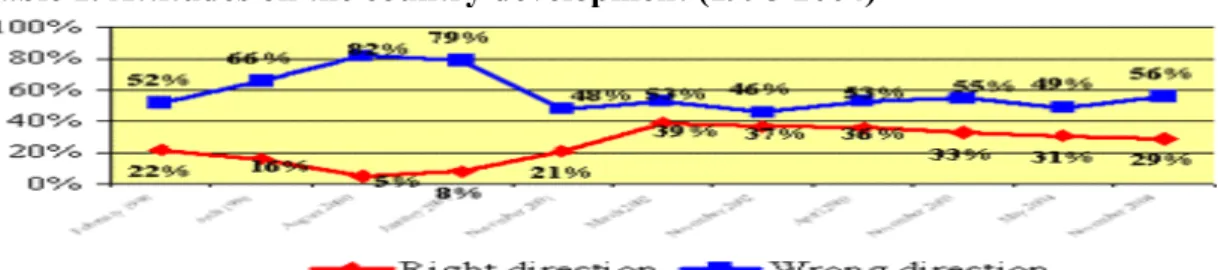
The latest Barometer clearly shows a change in peoples' attitudes as regards country development. Commencing February 1998 opinions on this issue teetered.
Throughout 1998-2000 the number of respondents who believed Republic of Moldova stepped on the wrong path surged from 52% to 82% and dropped in 2002 to 46%.
Table 1. Attitudes on the country development (1998-2004)