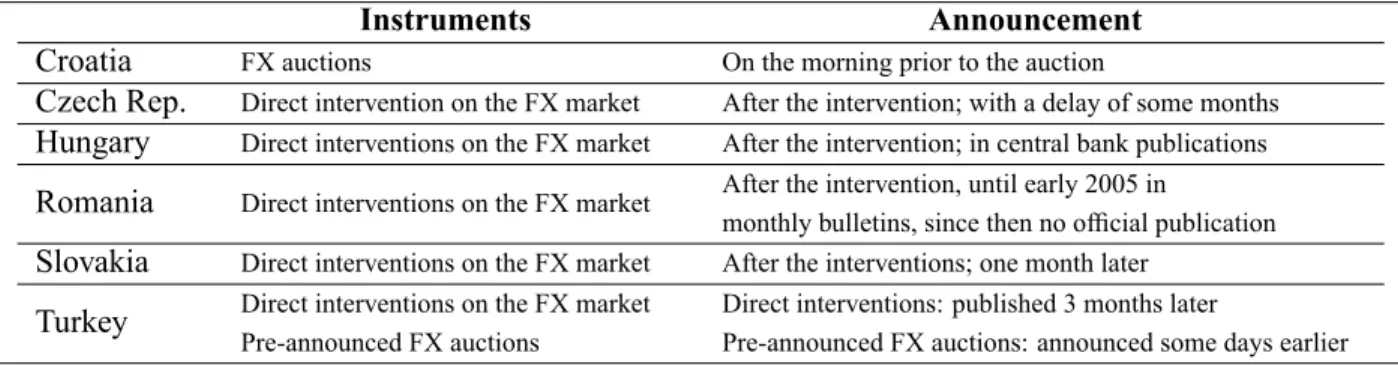
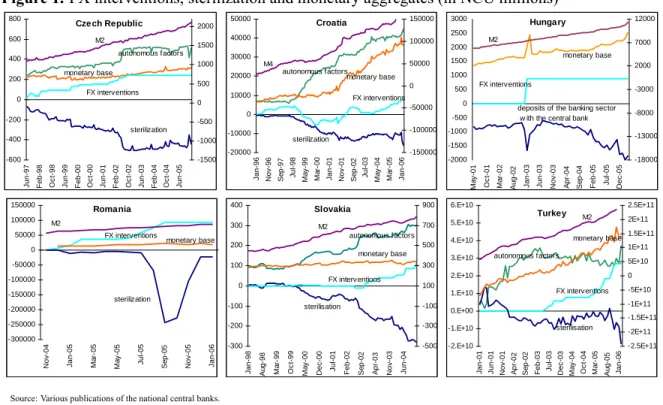
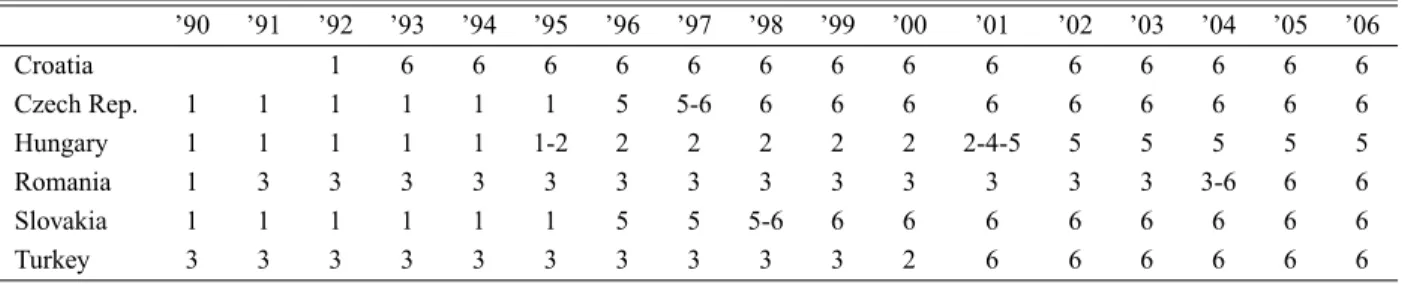
While de facto exchange rate flexibility is highest in the Czech Republic, it is lowest in Croatia. They were justified in avoiding major deviations of the exchange rate from its fundamental principles. Smoothes exchange rate movements: the central bank slows down the appreciation or the depreciation of the domestic currency, i.e.
Finally, we not only analyze exchange rate changes, but also focus on changes in exchange rate volatility. Similarly, the exchange rate is likely to depreciate (appreciate) less, but not go into appreciation (depreciation) in the event of exchange rate equalization. For our purposes, it is also important to separate the effect of pure changes in interest rates (without actual and verbal interventions) and pure verbal interventions (without actual interventions and changes in interest rates) on the exchange rate.
Smoothing of exchange rate movements: a decrease (increase) in the domestic interest rate leads to less appreciation (devaluation) in the post-event window than in the pre-event window.
Net Effect of FX Interventions – Overall Impact
In the first series, we consider only discretionary interventions, because the central bank asserted in a series of statements and publications that foreign exchange auctions were not intended to influence the exchange rate, but were used to create foreign reserves. However, because foreign exchange auctions were conducted over long periods of time with a large number of foreign exchange transactions, we also use intervention data, which combine discretionary and foreign exchange auction interventions. For the Czech Republic, the investigated period ends at the end of 2002, as there was no intervention after 2002.
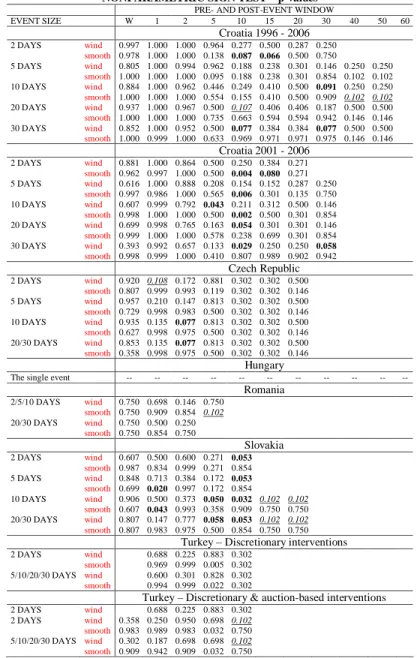
Since the Hungarian central bank simultaneously used real and verbal interventions and the interest rate instrument during the only intervention episode in January 2003, we found no pre- and post-event windows without overlap. Therefore, the net effect of real interventions on the exchange rate cannot be assessed for this country. The results of the non-parametric sign test show weak or non-existent effects of total real interventions on the exchange rate (see Appendix).
The reported p-values clearly indicate that real interventions do not have a significant influence on the exchange rate in Romania and Turkey. In the Czech Republic, the results are sensitive to the definition of the intervention event with respect to the number of days elapsed without intervention activity between two individual intervention acts: while leaning against the wind for the 2-day pre- and post-event window on the 10% significance level is detected with the 10-, 20- or 30-day event definition, interventions seem to have no systematic influence on the exchange rate with the 2- and 5-day event definitions. Although all event definitions yield significant results for the 10-day pre- and post-event window size if we analyze only the second half of the sample, i.e.
From 2001 to 2006, the type of success remains controversial (exchange rate smoothing or headwind support).
Net Effect of FX Interventions: Does Direction Matter?
Net Effect of Verbal Interventions and Interest Rate News
Interest rate news adjusted for actual and verbal interventions has no effect on the exchange rate in Croatia, Romania, Slovakia and Turkey. Interest rate changes were able to smooth the exchange rate but not to reverse developments in the Czech Republic and Hungary at 20-day and 30-day horizons, respectively, but only when used to counteract exchange rate appreciation. Verbal interventions adjusted for actual interventions and interest rate news were not effective in all countries except Hungary, where very short-term effects could be identified for the cases where central bank communications aimed to weaken appreciation pressure.
Combined Effect of Actual and Verbal Interventions and Interest Rate News
However, an increase in the number of assessable windows does not necessarily lead to better results. The reason why the success rate – and therefore the statistical impact of currency interventions on the exchange rate – increases is that, if actual and verbal interventions and interest rate moves are clustered, they will often go in the same direction, i.e. it is precisely this mutual support of the three factors most likely form the core of the greater effectiveness.
Combined Effect: Does Direction Matter?
Cumulative Effect of Actual Interventions
Impact of FX Interventions on FX Volatility
Combined effect of currency interventions, central bank communications and interest rate news. Excluding overlaps between currency intervention events. Overall represents aggregate data, while weaken and strengthen indicate the respective effect of interventions on the domestic currency. For Turkey, where the currency volatility target is a very salient feature, we find that the net effects of discretionary currency interventions indeed systematically reduced currency volatility in the event that the central bank sold the Turkish lira to counter the currency's appreciation .
However, this effect disappears when we take into account the effect of central bank communications, interest rate news and possible overlaps between actual intervention events. Interventions that include auction-based interventions do not in themselves affect exchange rate volatility, but do result in lower currency volatility once the other factors are taken into account. For Slovakia, the second country with the main objective of reducing currency volatility, we found neither a positive nor a negative impact on currency volatility when using data broken down by purchases and sales.
Nevertheless, FX volatility appeared to increase due to FX interventions for the 10-day windows before and after the event. Changes in the volatility of the exchange rate due to foreign exchange interventions can be considered as a side effect of the intervention activity aimed at influencing the level of the exchange rate. For Croatia, net foreign exchange interventions tend to increase exchange rate volatility in the 5- to 15-day windows before and after the event, especially as the central bank tries to counter appreciation pressures.
In Romania, central bank interventions turn out to be neutral in relation to exchange rate fluctuations, while in Hungary, exchange rate volatility decreased after the individual intervention episode.
Comparison with the Existing Literature
While volatility decreased in the short 5-day period following foreign exchange interventions, it increased (as in Croatia) in the 10-15-day period when the Czech National Bank sold the local currency. Scalia (2006) finds a quantitatively much stronger effect for intraday exchange rate data from July to September 2002. Using an event study approach to monthly data, Geršl and Holub (2006) find that interventions are successful in changing the exchange rate.
Égert and Komárek (2006) use the sign bias test and shed light on the fact that actual interventions are only effective if they are combined with interest rate increases of up to 40 days. Our results add more color to the picture, as they illustrate that selling korunas on its own can reverse an appreciation trend, albeit only in the very short term, and that combining interventions with central bank communications and interest rate news is very is powerful in changing interest rates. trend of the exchange rate even up to 60 days. This suggests that appropriate central bank communication can amplify the effects of actual interventions and interest rate news.
Finally, Gereben, Gyomai and Kiss (2006) estimate the effectiveness of central bank interventions in Hungary by including interventions in an order ow model of the exchange rate. The results indicate that interventions were successful only during the January 2003 crisis period, but not thereafter. The first result is consistent with our results, which are, however, dependent on the effects of interest rate news and central bank communication.
We argue that FX interventions after the January crisis were limited to the sale of the reserves accumulated during the crisis, and to FX purchases for the government to service FX-denominated government debt. Accordingly, the presence of the central bank on the FX market was not intended to influence the exchange rate. Nevertheless, Gereben, Gyomai and Kiss (2006) consider FX sales and purchases as proper central bank interventions after January 2003 and reveal their ineffectiveness, which - in our opinion - only confirms that the central bank had no intention of changing the exchange rate not to influence. with these measures.
Sterilized vs. Unsterilized Interventions
We found that central bank interventions adjusted to other factors are successful in the short term in slowing down or reversing the exchange rate trend, i.e. Using the event study methodology, it is difficult to determine which intervention channels affect the course. The Central Bank of Turkey is not achieving the single objective of systematically reducing exchange rate volatility through discretionary interventions through a combination of verbal interventions and interest rate news.
In addition, a side effect of discretionary and also auction interventions is their significant impact on the exchange rate. Due to economic reforms, both FDI and portfolio investment began to rise, pushing the exchange rate to the stronger end of the range. Within the framework of institutional targeting, introduced in June 2001, much weight was given to the exchange rate.
In fact, the exchange rate has remained on the stronger side of the uctuation band ever since. The main tools to stabilize the exchange rate were interest rate policy and verbal interventions. The new exchange rate regime is a managed oat, and the central bank occasionally intervenes in the foreign exchange market.
In order to mitigate the strong appreciation of the kuna against the euro, the central bank purchases a total of USD 122.9 million from banks." CNB (1999, p. 45): "the exchange rate of the krona was affected by the interventions of the CNB in order to prevent excessive appreciation of the krona ". NBS (2001, p. 65): "The National Bank of Slovakia may intervene in the interbank foreign exchange market in case of excessive volatility of the Slovak krona exchange rate".
NBS (2002, p. 60): "This led to increasing pressure for appreciation of the rate of the Slovak koruna in the first half of November. NBS (2003, p. 70): "The National Bank of Slovakia intervened in the foreign exchange market in case of excessive volatility in the rate of the Slovak koruna and/or if the exchange rate did not correspond to the indicators of macroeconomic development."