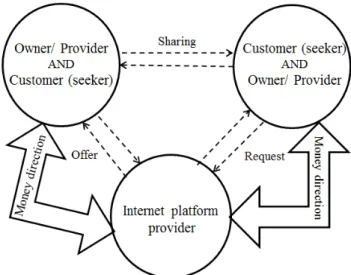
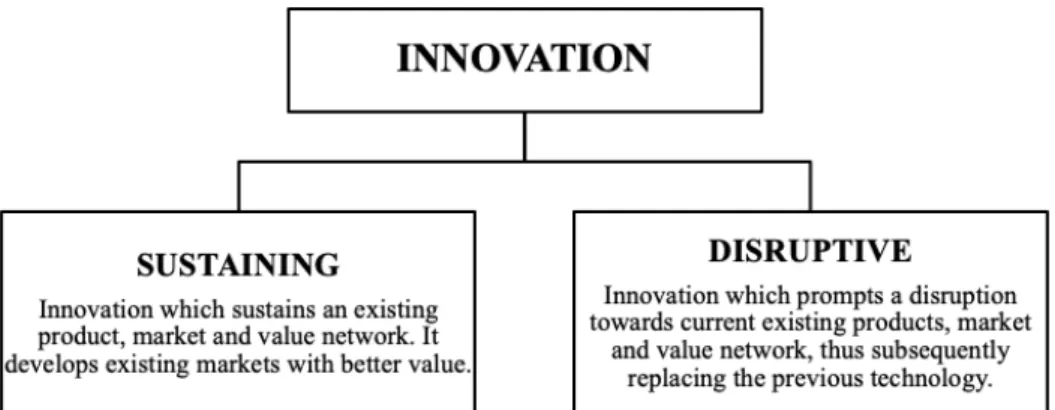
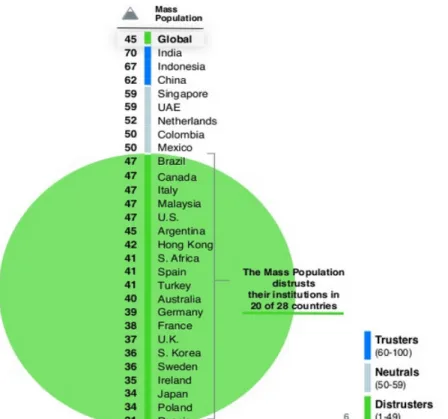
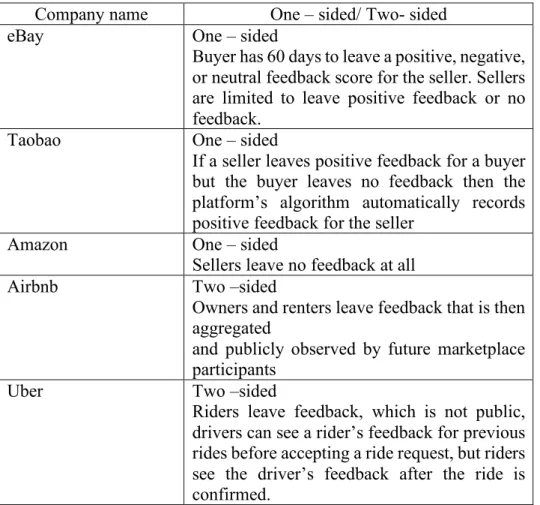
Based on their findings, the most appealing aspects of the sharing economy are: saving money (32%), feeling active and useful (13%), reducing consumption/carbon footprint (13%). In their paper Geissinger et al. 2019) examines the sustainability connotation in the sharing economy platforms. However, other researchers emphasize the negative side of the sharing economy (Cohen and Kietzmann, 2014; Schor, 2014).

Dataset and methodology
7For example, there are several excellent research articles (e.g. Wang and Nicolau, 2017) that analyze the pricing properties of co-location, but I do not address this aspect in this research. In the case of the Airbnb offer data, I have data for 4 consecutive years, but in the case of the other three variables, I only found data available for one year (2018). Some of the variables are from previous literature: for example, economic variables (GDP, income, unemployment), related to tourism (Air transport of passengers, overnight stays in tourist accommodation facilities), related to the hotel industry (Number of hotel rooms), social variables and population.
At the beginning of the research, I developed and tested several models: I conducted the research in two main steps: In the first step I used correlation analysis one by one because my goal was to investigate possible relationships between different variables. Then I used regression analysis. The strength of the relationship is measured by the value of the correlation coefficient (r), which varies between +1 and -1. The direction of the relationship is indicated by the sign of the coefficient; a + sign indicates a positive relationship and a – sign indicates a negative relationship (Rovai et al., 2013).
The multiple regression analysis is an extended form of the simple linear regression analysis by describing the relationship between a dependent variable and several independent variables. Where ()$ is an unknown intercept for each entity absorbing time-invariant variables and ($ represents coefficients for each of the independent variables.

Results (1): Correlation Analysis in case of Airbnb market
The first part is confirmed by the data in Table 10: all accommodation types are highly correlated with the number of hotel rooms. Furthermore, the strongest correlation is seen between entire residences and the number of hotel rooms. If the number of hotel rooms increases, the number of available entire homes also increases and increases more than the share of private rooms.
I ran Pearson correlation analysis and tested factors related to the number of hosts with multiple listings. The results can be seen in table 11) the strongest correlation can be observed in the case of nights spent in tourist accommodation facilities (Pearson coefficient is 0.845) and the number of hotel rooms (0.881). One of my sub-hypotheses is that GDP is negatively related to the number of multi-listing hosts, meaning that an increase in GDP causes a decrease in the number of multi-listing hosts.
One of my main research questions is what factors affect the number of listings on Airbnb. Factors related to Airbnb's supply are the same as the number of multi-listing hosts, rental type, and actual accommodations booked; however, the variable of home ownership (owner or renter) also shows correlation with the number of accommodations available on Airbnb.

Results (2): Examination of Airbnb supply with panel data
Its covariate is the proportion of renters, where is the correlation factor, indicating a weak positive correlation with the Airbnb offering. My sub-hypothesis is that the ownership structure is related to the Airbnb supply: changes in the ownership structure cause a change in the Airbnb supply. I expected to find a correlation between average apartment size and Airbnb listings, and I hypothesized that the larger the apartment size, the stronger the correlation with Airbnb listings.
The ownership structure is linked to the Airbnb offering: changes in the ownership structure result in changes to the Airbnb offering. I expect a positive and significant correlation also in the case of owner with mortgage and renter, which means that an increase in the proportion of people with a mortgage and an increase in the number of renters increases the supply of Airbnb. However, even with this review, I can't find a correlation between the unemployment rate and the Airbnb offer, so I decline.
Furthermore, if we look at the nature of the unemployment rate (Table 17 shows the descriptive statistics of our model), the change in the unemployment rate is relatively small and therefore did not really impact Airbnb supply. The owner with the variables mortgage interest and tenant interest also shows no correlation with the Airbnb supply.

Results (3): Stepwise regression analysis in case of entire homes
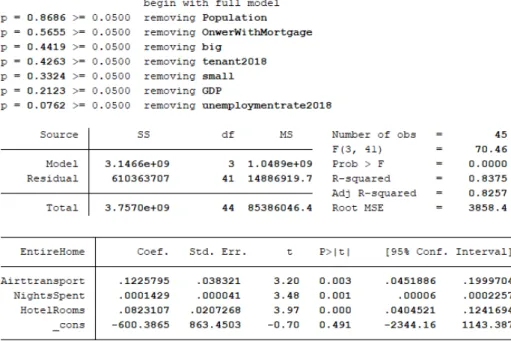
The dependent variables (Y) are the number of available entire houses and the number of available private rooms. The 'small' home category is smaller than 50 square meters, 'average' is between 50 and 100 square meters and the 'large' category is larger than 100 square meters. First, I tested multicollinearity between dependent variables; the results of the VIF tests can be found in the appendix.
Based on its result, I excluded redundant variables and applied stepwise regression with backward selection method for both selected dependent variables. My third main hypothesis is that the effect of tourism growth (measured by the number of tourists, air passenger transport, and the number of hotel rooms) is more important in the case of the full Airbnb home supply than the private room supply. With Pearson correlation analysis I proved that all types of accommodation (whole house, private room, shared room) are related to the number of hotel rooms and the correlation coefficient was slightly higher in the case of whole houses than private rooms.
Based on this, I accept my hypothesis that the effect of increasing tourism is more significant in the case of the number of available Airbnb whole houses than private rooms.
Results (4): Examination of belonging to Eurozone and Airbnb
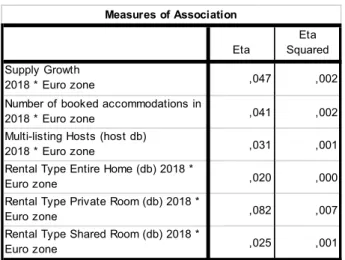
In table 20 we can see that Eta is close to 0 in the case of all the main variables, which means that the nominal variable of the Eurozone is not related to any of them and has no effect on the examined variables. Therefore, according to this examination, I cannot accept my hypothesis that belonging to the Eurozone significantly affects the supply of Airbnb. Due to the fact that the market for sharing short-term accommodation and Airbnb is quite new, at this stage I could not apply the time variable (before and after the joining of the selected areas to the Eurozone) and measure it with another method for example difference-in-difference analysis.
I assume that if the Airbnb market is regulated in the selected cities, it will have an effect on the supply. In the case of cities where local authorities have already implemented short-term home-sharing laws, it would be great to compare the number of available Airbnb homes before and after the regulatory year, and is a good starting point for future studies.
Conclusion and discussion
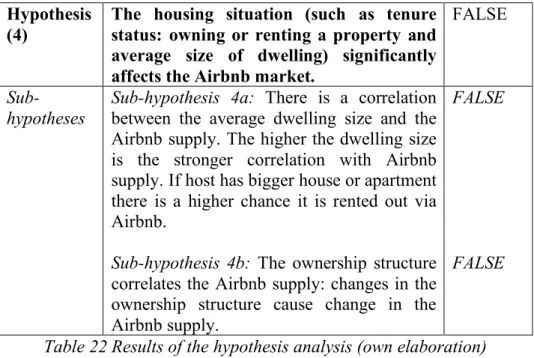
Hypothesis 1c: Belonging to the Eurozone has a significant influence on the number of Airbnb accommodations booked, the number of multi-list hosts and the Airbnb offer. Subhypothesis 3b: There is a relationship between the supply of hotel accommodations and the supply of Airbnb and the growth of the supply of hotel rooms is positively related to the growth of the supply of Airbnb. Household income correlated strongly and positively with Airbnb supply in all selected years.
The reason behind this may be that the unemployment rate does not really matter in the case of Airbnb supply and the participation of people (hosts) in short-term accommodation sharing for other purposes. In the case of hotel rooms, if its number increases, the supply of Airbnb increases and the number of available whole houses also increases and to a greater extent than the share of private rooms. Its pair variable is the share of renters where the correlation coefficient shows a weak positive correlation with Airbnb supply, which means that as the share of renters increases, so does the Airbnb supply.
Furthermore, I assumed that the larger the home size, the stronger the correlation with Airbnb supply. However, during my test I found no correlation between home size and Airbnb listings.
NEW SCIENTIFIC RESULTS
I assumed that changes in housing conditions such as ownership with or without a mortgage and changes in the share of tenants with long-term contracts have an effect on the Airbnb supply. I expected that more renters and more owners with loans would mean a greater number of available Airbnb properties, but I found no correlation or relationship between these factors. The increasing number of tourists, number of hotel rooms and growing number of passengers carried by air transport are the main factors behind its expansion.
SUMMARY
Fast Company, Retrieved from https://www.fastcompany.com/3046119/defining-the- sharing-economy-what-is-collaborative-consumption-and-what-isnt 31. Retrieved from http://www.campbell- mithun.com/678_national-study- quantifies-reality-of-the-sharing-economy-movement (12 Feb 2015) 36. regulatory models well adapted to technology-facilitated sharing economies. Retrieved from https://hbr.org/2015/12/what-is-disruptive-innovation. 2019) "Incumbents and Business Model Innovation for the Sharing Economy: Implications for Sustainability".
2015) „A megosztási gazdaság: miért vesznek részt az emberek a kollaboratív fogyasztásban”, Journal of the Association for Information Science and Technology, 67(9), pp. Letöltve: https://www.ingwb.com/insights/articles/european-sharing-economy-tipped-for-rapid-growth. ING (2015) "Sharing Economy 2015", Retrieved from https://www.ezonomics.com/ing_international_surveys/sharing_econ omy Megosztás megosztás nélkül - az Airbnb átalakulása és a budapesti szálláspiac", Közgazdasági Szemle 65(3), p. . 2018).
Camb J Regions, Econ Soc 10(2), p. 2014) “Debating the Sharing Economy” Retrieved from http://www.greattransition.org/publication/debating-the-sharing-economy (accessed November 10, 2016). The Economist (2013a) “The rise of the sharing economy: Everything is for rent on the internet”, The Economist, Retrieved from https://www.economist.com/leaders the-rise-of-the-sharing-economy . TIME Magazine (2015) “The Sharing Economy”, TIME Magazine. 2017) Personal urban mobility in the context of sustainable development, PhD thesis, Corvinus University Budapest.
Marrë nga: http://image-src.bcg.com/Images/BCG- Hopping-Aboard-the-Sharing-Economy-Aug-2017_tcm104-. 2017).