I I nt n t er e rn na at ti io on na al l C Ce en nt t er e r f fo or r E Ec co on no om mi ic c G Gr ro ow wt th h E E u u r r o o p p e e a a n n C C e e n n t t e e r r
W W O O R R K K I I N N G G P P A A P P E E R R S S
NR N R. . 1 1 9 9 . .
MA M AC C R R O O EC E CO O N N OM O MI IC C ST S TU U D D IE I ES S
N N O O V V E E M M B B E E R R 2 2 0 0 0 0 2 2
G UNTHER S CHNABL :
The Emergence of the Euro Zone
An Informal Euro Standard as a First Step for EMU Membership of the Central and Eastern European
Countries
The Emergence of the Euro Zone
An Informal Euro Standard as a First Step for EMU Membership of the Central and Eastern European Countries
Gunther Schnabl
Tübingen University, Department of Economics and Business Administration Nauklerstrasse 47, 72074 Tübingen, Germany
Tel. +49 7071 297 4145 – Fax. +49 7071 29 5077 E-mail: [email protected]
The enlargement of the European Union is approaching fast. Eight Central and Eastern European (CEE) countries are planning to join the EU by 2004 and two CEE countries are expected to follow by 2007. Although the adoption of the Acquis Communautaire by the accession candidates requires a large degree of macroeconomic convergence and also leads one to expect ERM2 and EMU membership, the Central and Eastern European countries still pursue rather heterogeneous exchange rate policies. While one group has—though not always openly admitted—adopted tight pegs to the euro, a second group has moved towards more exchange rate flexibility. This paper argues that currency baskets and flexible exchange rates are not sustainable with respect to EU, ERM2 and EMU accession. It explains the rationale for the emerging markets to stabilize their exchange rates in general, and the rationale for the CEE countries to peg their exchange rates to the euro in specific. Building upon the strong motivation to peg the exchange rates to the euro the paper recommends an informal euro standard as a first step for the EMU membership of the CEE countries. The informal euro standard would facilitate EMU accession by enhancing both nominal and real convergence.
Keywords: Foreign Exchange Policy, EMU, EU enlargement, EMU accession, euro zone, euro bloc, monetary union, Central and Eastern Europe.
F 31, G 1
Table of Contents
1. Introduction ... 4
2. A Shift towards more Exchange Rate Flexibility in Eastern Europe? ... 4
2.1. The Rationale for Exchange Rate Stabilization ... 7
2.1.1. Importing Macroeconomic Stability ... 7
2.1.2. Reducing Risk for International Trade... 9
2.1.3. Underdeveloped Capital Markets and Original Sin ... 11
2.2. Formal Tests for Exchange Rate Flexibility ... 13
2.2.1. Calvo-Reinhart Criteria ... 14
2.2.2. Daily Exchange Rate Volatilities ... 19
3. The Shift towards an Euro Zone in Eastern Europe... 21
3.1. EU Accession, EMU Membership, and Macroeconomic Convergence ... 24
3.2. Integration of Goods and Capital Markets ... 27
4. An Informal Euro Standard as the Optimal Exchange Rate Strategy ... 29
4.1. The Case against the Currency Basket... 29
4.2. The Merits of an Informal Euro Standard with Respect to EMU Accession... 30
5. Conclusion... 34
I I n n t t r r o o d d u u c c t t i i o o n n
The European integration process has gained new momentum. In December 2002 the European Council approved the EU accession of 10 mostly Central and Eastern European countries (the Czech Republic, Estonia, Hungary, Latvia, Lithuania, Poland, the Slovak Republic, Slovenia, Cyprus, and Malta) by the year 2004. Bulgaria and Romania did not qualify for the first wave of EU east enlargement, but are expected to follow by 2007.
The EU accession of ten CEE Countries raises the question of their EMU membership.
As far as the optimum currency area criterion is concerned, as of 2002 most Central and Eastern European countries did not qualify for the EMU. The economic divergence between the EU and the CEE countries is still large, and the flexibility of labour markets is too low.
Furthermore, most CEE countries still fail to meet all Maastricht criteria for EMU accession, i.e., convergence of inflation, long-term interest rates, budget deficits, cumulative government debt, and exchange rates.
Nevertheless, although EMU membership is neither a necessary nor a sufficient condition for EU membership, many accession candidates have expressed their strong intention to join the EMU as soon as possible. Even more than words paid, a rapid monetary convergence of the CEE countries towards the Euro Area heralds EU and EMU accession.
This begs the question as to the adequate exchange rate strategies. Although eight out of ten CEE countries intend to join the EU within a few years there is still no coherent exchange rate strategy in Central and Eastern Europe. While one group of countries is preparing for EMU accession by close pegs to the euro, a second group has recently moved towards more exchange rate flexibility.
My argument holds that under the presumption that all CEE accession candidates want to join the EMU, currency baskets and exchange flexibility are not a sustainable exchange rate strategy. Instead I recommend an informal euro standard in Central and Eastern Europe, which would enhance economic stability, intra-regional trade linkages and real convergence.1
A A S S h h i i f f t t t t o o w w a a r r d d s s m m o o r r e e E E x x c c h h a a n n g g e e R R a a t t e e F F l l e e x x i i b b i i l l i i t t y y i i n n C C e e n n t t r r a a l l a a n n d d E E a a s s t t e e r r n n E E u u r r o o p p e e ? ?
1 Real convergence is understood as catching-up in terms of GDP per capita, implementation of structural reforms and the termination of the transition process. The concept of real convergence is rather vague, and no specific indicators are formulated in quantitative terms (Lavrač 2002: 12-13).
While the expected EU accession of ten CEE countries implies a shift towards exchange rate stabilization against the euro, some Central and Eastern European countries have recently moved towards more exchange rate flexibility.
The shift towards flexible exchange rates is rooted in the capital market related crisis of the second half of the 1990s. During the 1980s and 1990s many emerging markets—
including some CEE economies—opened their capital markets to short-term international capital inflows. The international capital market liberalization improved the access to international funds and thus accelerated their economic catch-up process. But it also made the emerging markets vulnerable to financial and currency crisis: the Mexican Tequila crisis (1994), the Asian crisis (1997/98), the Russian flu (1998), the Turkish crisis (2000), and the long tumbling and final fall of Argentina (2002) are the most prominent cases.
Although the CEE countries were not as strongly affected by the financial turmoil of the 1990s as many Asian and South American countries, the Central and Eastern European currencies were also targets of speculative attacks. In 1997/98 abrupt short-term capital outflows and sudden short-term interest rate hikes caused strong economic downturns in the region.
Learning from the financial crises in Asia, South America and Central and Eastern Europe, the IMF recommends emerging markets open to international capital flows to float their exchange rates (more) freely (Fischer 2001). According to Stanley Fischer, many emerging markets with soft peg arrangements suffered from speculative attacks and burdensome devaluations. In contrast, emerging markets with greater exchange rate flexibility (for instance Mexico, Israel, South Africa and Turkey in 1998) have mastered the recent crisis period better, as flexible exchange rate arrangements allowed them to absorb adverse shocks more easily.
The IMF concludes that in emerging markets open to international capital flows pegged exchange rate regimes are inherently prone to crisis and these countries “it is essential that floating exchange rates really float” (Mussa et. al. 2000: 34). The IMF even sometimes pressures countries to announce an internal monetary standard—such as inflation targeting—
as a substitute for nominal exchange rate anchors. For the CEE countries, which are required by the Acquis Communautaire to dismantle all long-term and short-term capital controls, the IMF recommends more exchange rate flexibility to cope with high and volatile capital inflows during the accession period (Corker et. al. 2000).
The result of the shift toward more exchange rate flexibility is what Fischer (2001) calls a bi-polar world: While some countries have adopted hard pegs or even monetary
unions, a large number of emerging markets and developing countries are moving towards exchange rate flexibility.2
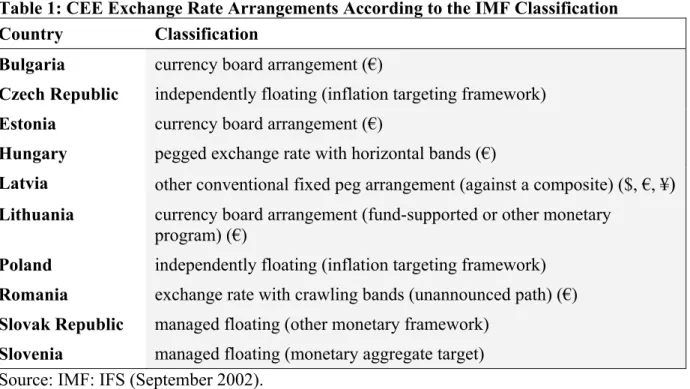
In the view of the IMF the drift towards corner solutions—the “hollowing of the middle”—takes place in Central and Eastern Europe as well (Corker et. al. 2000). According to the official IMF classification, since 1997 three CEE countries have moved towards more exchange rate flexibility (Table 1). The Czech Republic abolished its DM and dollar-based currency basket in May 1997 and floated its currency. The IMF reclassified the Czech exchange rate regime as a managed float. In January 1998, the Czech central bank adopted an inflation target monetary framework which was followed by a reclassification of the Czech exchange rate arrangement as independently floating.
Table 1: CEE Exchange Rate Arrangements According to the IMF Classification Country Classification
Bulgaria currency board arrangement (€)
Czech Republic independently floating (inflation targeting framework) Estonia currency board arrangement (€)
Hungary pegged exchange rate with horizontal bands (€)
Latvia other conventional fixed peg arrangement (against a composite) ($, €, ¥) Lithuania currency board arrangement (fund-supported or other monetary
program) (€)
Poland independently floating (inflation targeting framework) Romania exchange rate with crawling bands (unannounced path) (€) Slovak Republic managed floating (other monetary framework)
Slovenia managed floating (monetary aggregate target) Source: IMF: IFS (September 2002).
Similarly, in October 1999, the Slovak Republic abandoned its currency basket arrangement in favour of a (managed) floating exchange rate regime. Poland followed suit in April 2000, and decided to adopt an inflation-targeting framework and floated the Polish zloty. Because the Slovenian tolar has been classified as (managed) floating currency since the early 1990s, the official IMF classification of exchange rate arrangements declares four out of ten CEE
2 Managed floating and independently floating exchange rates are classified as flexible exchange rate arrangements. Exchange rate arrangements with no separate legal tender, currency board arrangements and other conventional fixed peg arrangements are classified as fixed exchange rate arrangements. Pegged exchange rates with horizontal bands, crawling pegs and exchange rates with crawling bands are classified as intermediate exchange rate arrangements.
countries to be maintaining flexible exchange rate arrangements (Table 1). Four countries (Bulgaria, Estonia, Latvia, Lithuania) have fixed exchange rates, while Hungary (pegged exchange rate with horizontal bands) and Romania (crawling peg with unannounced band) are classified as so-called “intermediate exchange rate regimes”.
The Rationale for Exchange Rate Stabilization
Although the IMF classification of the CEE exchange rate arrangements fits Fischer's (2001) notion of a bi-polar world, two caveats remain. First, the official IMF classifications might not correspond to the de facto exchange rate regimes of the respective countries. Second, if a country maintains de facto flexible exchange rates, the flexible exchange rates might not be sustainable with respect to EU and EMU accession.
Do the official IMF classifications of the Czech Republic, Poland, Slovenia, and Slovakia as floating exchange rate regimes correspond to the de facto exchange rate policies?
Recently, several authors have argued that in emerging markets and development countries the de jure exchange rate arrangements reported to (and by) the IMF might not correspond to their de facto exchange rate policies. In an influential paper, Calvo and Reinhart (2002) found a pervasive “fear of floating” in emerging markets. Reinhart (2000: 69) summarizes the rationale for exchange rate stabilization in emerging market as follows:
“When circumstances are favorable (i.e., there are capital inflows, positive terms of trade shocks, etc.) many emerging markets are reluctant to allow the nominal (and real) exchange rate to appreciate. … When circumstances are adverse, the fear of a collapse in the exchange rate comes from pervasive liability dollarization. Devaluations are associated with recessions and inflation, and not export-led growth.”
Based on the arguments of Calvo and Reinhart, the rationale for the stabilization of the CEE currencies is threefold. First, emerging markets might choose to stabilize the exchange rates to import macroeconomic stability. Second, stable exchange rates reduce uncertainty for international trade. Third, incomplete capital markets (original sin) might give an incentive to reduce the exchange rate risk of international debt and short-term capital flows.
Importing Macroeconomic Stability
Most emerging markets and in particular the former communist countries of Central and Eastern Europe lack a history of macroeconomic stability. With price controls being removed
at the beginning of the transformation process in the early 1990s, and hidden inflation emerging as a direct consequence, the CEE transition economies suffered from substantial inflation. In addition, as tax systems were underdeveloped and central banks were not independent, inflation tax has been a common means to finance government expenditure. In the early 1990s the inflation rates in all CEE countries were far above the Western European level. In some cases—as Bulgaria and Romania—even hyperinflation emerged.
High inflation increases uncertainty and discourages private consumption and investment. From an international perspective inflation and depreciation deter international trade and foreign direct investment. Thus, in moving from a planned regime to a market economy a key objective of the transformation process has been to establish credibility by macroeconomic stability. Because creating a reputation of monetary stability is difficult and time consuming, nominal exchange rate pegs—which help anchor both inflation and expectations—have been an important tool in importing macroeconomic stability.
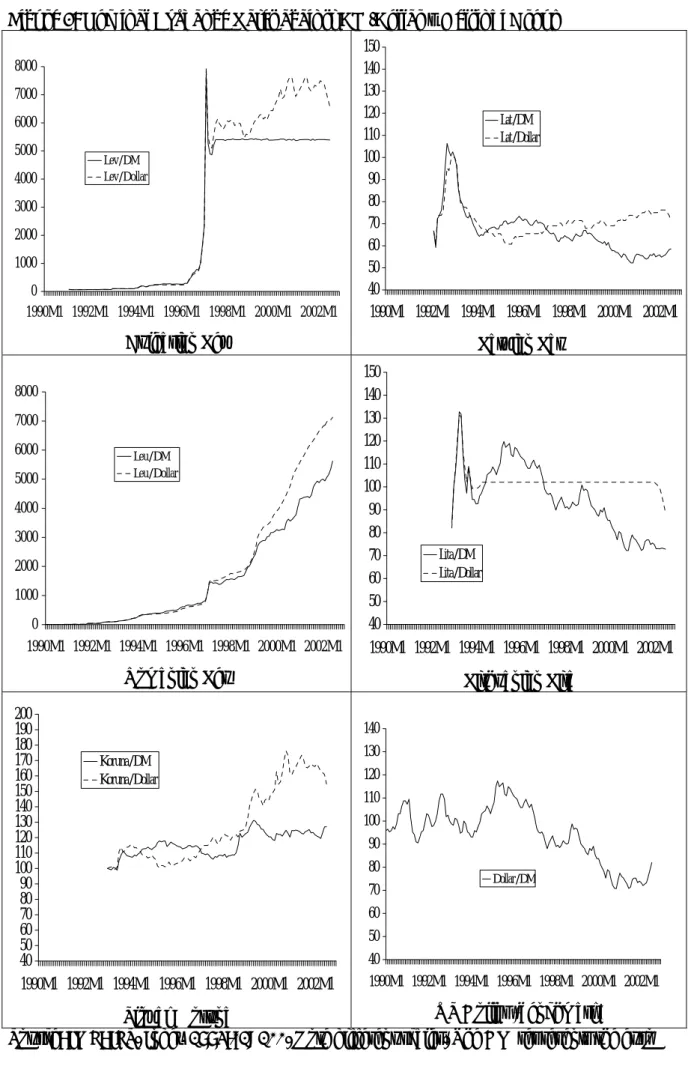
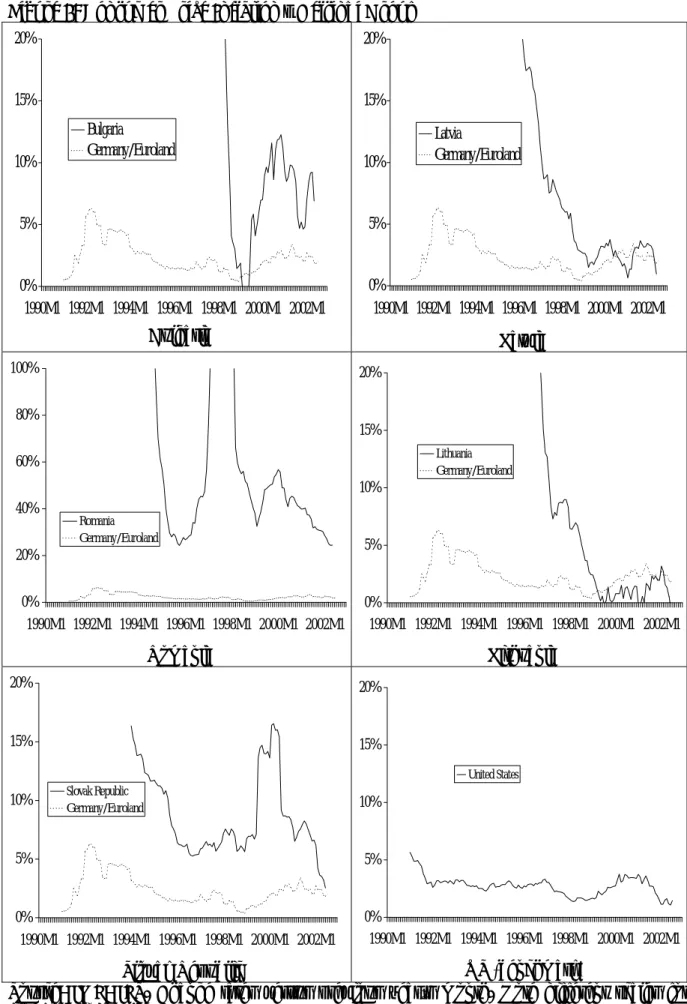
In Central and Eastern Europe, Estonia has been a forerunner in its efforts to stabilize macroeconomic performance based on a nominal anchor. The Estonian currency board has been in place for more than 10 years without any significant change in the German mark (and later euro) exchange rate (Figure 3 in the appendix). The unwavering hard peg contributed to a slow but steady decline of inflation towards the Western European benchmark (Figure 5 in the appendix). Short-term interest rates had already reached the Western European level in the mid 1990s (Figure 7 in the appendix).
Although most other CEE countries followed less stable exchange rate paths, all of them used a variety of exchange rate systems to control inflation. Poland tried a hard peg to the dollar in the early 1990s and then switched to a currency basket with declining rates of monthly depreciation. Bulgaria started its transformation process with a hard peg to the dollar which ended in the hyperinflation of the mid 1990s. Since 1998 a currency board ensures exchange rate (and price) stability against the German mark and later the euro. Also the Czech Republic, Hungary, Latvia and the Slovak Republic adopted currency baskets with different and varying compositions.3 Only Romania made no recognizable attempts to stabilize inflation and allowed significant depreciations of the leu up to the present time (Figure 4 in the appendix).
As a direct result of the fixed exchange rate arrangements, inflation and short-term interest rates in all of Central and Eastern Europe (except Romania) could be gradually
3 Halpern and Wyplosz (2001) give a survey.
stabilized. While inflation in most CEE countries was far above 20% in the early 1990s, a steady decline could be observed in every country (Figure 5 and Figure 6 in the appendix). In the late 1990s the decline of inflation and inflation expectations was accelerated by the expected EU accession. As required by the Acquis Communautaire inflation rates of the CEE countries (except Romania) approached the EU level. Reflecting the slowing path of consumer price inflation, short-term interest rates declined as well (Figure 7 and Figure 8 in the appendix).
Besides the positive impact on the stability of (consumer) prices in the CEE countries, the nominal anchors also helped to curtail government expenses. With the planned EU and possible EMU accession, the fulfilment of the fiscal Maastricht criteria4 by the CEE accession candidates has been widely discussed. The public deficits of the CEE countries have been surprisingly small—even by the standards of the Western European industrialized countries.
Public deficits have been low and cumulative debt has been far below the EU average (De Grauwe and Lavrač 1999: 2).5
Low government expenses and public debt is not specific for the CEE emerging markets, but a widely observed phenomenon in emerging markets. For instance in East Asia, the World Bank (1993) praised the sound government expenditure of the East Asian emerging markets in the early 1990s. The IMF found low public deficits and cumulative East Asian government debt in the aftermath of the Asian crisis.
In developing countries and emerging markets, fiscal, monetary and foreign exchange discipline are closely linked because tax systems and domestic bond markets are underdeveloped (Chin and Miller 1998). If governments are unable to raise money by collecting taxes or issuing bonds, printing money is the common means to finance public expenditure. Dependent central banks give credit to the governments. If, however, an exchange rate peg hinders the government from printing money because it would bring the exchange rate under depreciation pressure, fiscal discipline is the only way to ensure exchange rate stability.
Reducing Risk for International Trade
Exchange rate stability contributes to a stable and growing trade performance. All developing countries, emerging markets and transition economies share the characteristic that
4 According to the Maastricht treaty the general government balance must be lower than 3% of GDP. Gross government debt must be lower than 60% of GDP (Art. 109j EC Treaty) and the respective protocol.
5 But recently growing budget deficits have become a matter of concern in some countries as the Czech Republic and Poland.
international trade is mostly invoiced in foreign currency. Instead, exports and imports are traded in the currencies of the major industrial countries which enjoy the confidence of the international business community. Dollar, euro and yen are the most prominent invoice and vehicle currencies.
With most trade denominated in foreign currency, exchange rate fluctuations deteriorate the performance of the export sector. If we assume that the government of an emerging economy allows the exchange rate of the domestic currency to float freely, the volatile international capital flows cause large nominal exchange rate fluctuations—which are reflected in profits.
Because trade contracts are made in foreign currency and fixed for several months, the dollar or euro prices remain stable in the foreign markets. This “pricing to market” has the merit of stabilizing foreign sales. But if the domestic currency depreciates, profits fall or even become negative. If the currency appreciates, profits increase and might compensate for former depreciation losses. But even if—despite short-term swings—the value of the currency remains by and large constant in the long-term the exchange rate fluctuations cause high volatility and risk.6 The transaction costs of international trade rise, which is associated with less international trade, less international partition of labour and, to this end, welfare losses.
To shield the domestic export industry against such pronounced fluctuations of their revenues, the government can stabilize the exchange rate. Domestic wholesale prices are pinned down to the level of the anchor currency. The prices of traded goods remain stable at home and abroad. As price signals and expectations remain reliable, transaction costs fall.
International trade is fostered and the economy gets an additional growth impulse.
The incentive to stimulate international trade by stable exchange rates is all the greater, the larger the share of exports in GDP. While large industrial countries such as Euro Area, US or Japan can afford to address the monetary policy to domestic targets because the export sector is comparatively small. Small open economies have a larger incentive to stabilize the export revenues because their real output depends heavily on international trade. Stabilizing the exchange rate is equivalent to stabilizing the domestic business cycle. Stimulating international trade by exchange rate stability is equivalent to stimulating real growth.
As the emerging markets in Central and Eastern Europe are very open economies—
international trade (exports + imports of goods and services) as the percentage of GDP ranges
6 This risk can even not be avoided if the export enterprises of the emerging market decided to shift the exchange rate fluctuations to the prices in the foreign markets. The exchange rate fluctuations would be reflected in volatile foreign sales.
from 66% in Poland up to 196% in Estonia (2000)—the incentive to stabilize exchange rates is high. Poland, as the largest and least open CEE economy, might have some incentive to float its currency more freely—as it has since the year 2000.
Underdeveloped Capital Markets and Original Sin
While macroeconomic stabilization and reduced risk for international trade are the traditional arguments in favour of fixed exchange rates, the discussion about the pros and cons of exchange stability has recently shifted to (international) capital markets. Starting in the 1970s the capital markets of most industrial countries were gradually liberalized and opened to international capital flows. During the 1990s, many emerging markets followed this liberalization process.
In Central and Eastern Europe—where free and open capital markets did not exist under communist rule—the built up of a competitive banking sector and robust capital markets has been a prominent goal of the transformation process. This included the (gradual) access of international capital flows to domestic capital markets.
Although the former communist economies have proceeded substantially with the liberalization of their capital markets, the task is far from being fulfilled. Lanoo and Salem (2001) argue that “as compared to developed economies, banking and securities markets are still in early stages of development, and many further steps will have to be taken before arriving at levels of mature markets.” Although in countries such as Hungary or Poland short- term government securities have contributed significantly to the creation of capital markets, the development of medium- and long-term bond markets in Central and Eastern Europe is far from being accomplished.7 As Barry Eichengreen and Ricardo Hausmann (1999: 3) put it, the capital markets of emerging economies suffer from “original sin”:
“Original sin” … is a situation in which the domestic currency cannot be used to borrow abroad or to borrow long term, even domestically. In the presence of this incompleteness, financial fragility is unavoidable because all domestic investments will have either a currency mismatch (projects that generate pesos will be financed with dollars) or a maturity mismatch (long-term projects will be financed by short-term loans).
Critically, these mismatches exist not because banks and firms lack the prudence to hedge their exposures. The problem rather is that a country whose external liabilities are necessarily denominated in foreign exchange is by
7 The Economist (2002) comments: “Perhaps it was too much to expect Central European countries to develop mature and properly regulated securities markets within a few years when it took centuries to develop them in the West.”
definition unable to hedge. Assuming that there will be someone on the other side of the market for foreign currency hedges is equivalent to assuming that the country can borrow abroad in its own currency. Similarly, the problem is not that firms lack the foresight to match the maturity structure of their assets and liabilities; it is that they find it impossible to do so. The incompleteness of financial markets is thus at the root of financial fragility.
Original sin applies to exchange rate stabilization on both low and high frequencies of exchange rate volatility.8 Calvo and Reinhart (2002) as well as Hausmann, Panizza and Stein (2001) find a strong relationship between the ability of a country to borrow internationally and the pattern of floating: developing countries and emerging economies have a strong incentive to keep exchange rates stable at low frequencies—i.e. monthly, quarterly or yearly swings of the exchange rate—because liabilities are overwhelmingly denominated in foreign currency.
At the root of the problem is the currency mismatch: domestic banks borrow in euro, dollar or yen for lending to domestic firms in domestic currency. Domestic firms borrow in foreign currency to invest in projects that generate domestic currency. This currency mismatch causes risk as the exchange rate fluctuates. If for instance, the government of an emerging market were to allow a sustained or sudden depreciation of the domestic currency the balance sheets of the domestic banking sector would be placed at risk. If the real value of euro or dollar denominated debts in domestic currency increases, the equity ratio of the domestic financial institutions falls.
Even gradual swings of the exchange rate are harmful, because banks and enterprises suffer from a high volatility of their real liabilities. The overall risk for the financial system increases.9 “Floating is counterproductive” (Eichengreen and Hausmann 1999: 13). The monetary authorities of emerging markets are tempted to stabilize exchange rates.
While Calvo and Reinhart (2002), Hausmann, Panizza and Stein (2001) and Eichengreen and Hausmann (1999) base their perception of “fear of floating” on low frequency exchange rate fluctuations, McKinnon and Schnabl (2002a) explain the motivation
8 I define low frequency exchange rate changes as the monthly, quarterly or yearly gradual swings of the exchange rate. High frequency exchange rate changes are defined as daily and weekly percentage exchange rate changes.
9 Even if the domestic currency comes only under depreciation pressure the banking sector might be at risk due to the maturity mismatch. If a government seeks to defend a peg by increasing interest rates, domestic money supply contracts. The financial institutions will shift the rising interest rates to the enterprises or call their loans. Long-term projects which have been financed with short-term loans become unprofitable. The enterprises are unable to repay the debt. For the domestic banks currency risk is transformed into default risk.
Again a banking crisis might result.
of emerging markets to keep their exchange rates stable at high frequencies—i.e. daily or weekly exchange rate changes.
On a daily or weekly basis original sin creates an incentive to stabilize exchange rates, because—with incomplete capital markets—the foreign exchange risk of daily or weekly international payment transactions is difficult to hedge. In the highly developed capital markets of the industrial countries an investor can hedge an open position in foreign currency by financial derivates (forwards) at low cost. This is impossible in the emerging markets and transition economies because forward markets don’t exist. As foreign investors don’t accept bonds denominated in domestic currency the aggregated10 foreign exchange risk of short-term external liabilities remains—by definition—unhedged.
Without an efficient forward market risk-adverse importers and exporters cannot easily hedge, nor can banks cover open foreign exchange positions. To shield banks and enterprises against the risk of exchange rate flexibility the government of emerging markets might want to provide a substitute for the missing private forward market. If enough foreign exchange reserves are available, the government could issue forwards on its own and thus
“create” a forward market. But as financial markets are incomplete, the interest rate structure might not be deep enough to determine the adequate forward rate. The government might be tempted to support “friends” in banks and enterprises by setting the forward rate lower than it would be set under free market conditions.
Thus, the government could provide a more comprehensive (informal) hedge for short- term international payment transactions by keeping the exchange rate stable in the short terms. Many forward commercial transactions including trade credit are repaid in foreign currency on a daily or weekly basis. If the exchange rate remains stable on a day-to-day or week-to-week basis, these transactions receive an informal insurance against foreign exchange risk. High frequency pegging allows the private banks and enterprises to repay their short-term foreign currency liabilities with minimal foreign exchange rate risk.
Formal Tests for Exchange Rate Flexibility
The need for macroeconomic stability and the high risk of exchange rate volatility for international goods and capital transactions explain the pervasive fear of floating in emerging markets. In Asia, Africa, South America, and Central and Eastern Europe exchange rate stabilization at low and high frequencies is an important pillar of economic policy. Does this
10 A single bank or enterprise can hedge foreign exchange risk by rolling over the currency risk to another domestic bank or enterprise.
strong rationale for stable exchange rates fit with the official IMF policy in favour of more flexible exchange rates? And do four out of ten CEE accession candidates not only de jure but also de facto pursue flexible exchange rate strategies?
Two criteria are applied to test whether or not the exchange rates of the Czech koruna, the Polish zloty, the Slovak koruna, and the Slovian tolar are floating currencies as classified by the IMF. First, the criteria of Calvo and Reinhart (2002) are used to test for low-frequency exchange rate volatility against the euro and dollar. Second, the daily volatilities of ten CEE currencies are compared with the daily volatility of the euro/dollar exchange rate as freely floating benchmark currency.
Calvo-Reinhart Criteria
Calvo and Reinhart (2002) use three criteria to measure the extent of open and hidden exchange rate stabilization for 155 exchange rate arrangements in 39 countries: monthly (percentage) exchange rate changes, monthly percentage changes of official foreign reserves, and monthly absolute changes in nominal short-term interest rates. For all three criteria they set (arbitrary) probability limits to measure the extent of foreign exchange stabilization.
First, the degree of exchange rate fluctuations itself indicates stabilization efforts. If, for instance, the probability is high that monthly exchange rate changes fall outside a band of
±2.5%, the currency is rated as freely floating. With a low probability that the monthly exchange rate changes fall outside the predetermined band, the currency is classified as fixed.
Second, governments stabilize exchange rates by intervening in foreign exchange markets.
For instance, to prevent the domestic currency from appreciating, the monetary authorities sell domestic currency in exchange for dollars, euros or yen. The official foreign exchange reserves increase. To prevent the domestic currency from depreciation monetary authorities will sell foreign against domestic assets. Thus, if the government tries to stabilize the exchange rate of the domestic currency, the probability is high that the monthly changes of official foreign reserve changes fall outside a predetermined band of ±2.5%. High probabilities indicate high intervention activity and fixed exchanges rates. Low probabilities indicate freely floating exchange rates.11
Third, monetary policy can be used instead of foreign reserves for exchange rate stabilization. For instance, to prevent the domestic currency from devaluation the government might increase interest rates. International capital flows are redirected towards the domestic
11 Given that the governments report the changes in official reserves properly.
capital markets and the appreciation pressure abates. If the probability is high (low) that absolute interest rates changes fall outside the predetermined band of ±4.0% Calvo and Reinhart see indication that these countries stabilize (don’t stabilize) the exchange rates via monetary policy.
Table 2 gives an overview over the Calvo-Reinhart exchange rate criterion (ε), the foreign reserve criterion (ϕ) and the interest rate criterion (ι) and their respective (arbitrary) bands.
According to Calvo and Reinhart (2002) their probability criteria are superior to the use of standard deviations as a measure of exchange rate volatility12 because they avoid distortions by outliers, particularly in the case of interest rates. Here both approaches are applied to measure the exchange rate flexibility of the CEE currencies.
Table 2: Calvo-Reinhart Criteria
Exchange Rate (ε) Foreign Reserves (φ) Interest Rate (ι) Criterion
t t t
e e e −
= +1 ε
t t t
F F
F −
= +1
ϕ ι=it+1−it
Band ±2.5% ±2.5% ±4.0%
The original Calvo-Reinhart criteria are modified in two regards. First, because the exchange rates of the CEE currencies can be pegged to either the euro or the dollar in principle, both exchange variability against the euro and the dollar is measured. Second, Calvo and Reinhart (2002) chose an arbitrary band of ±4.0% for their interest rate criterion ι. Such a band of ±400 basis points seems primarily apt to distinguish between high and low interest rate countries.13 In the CEE emerging markets the probability that short-term interest rates change by more 400 basis points from one month to the other is extremely small. Therefore, I narrow the band (arbitrarily) to monthly changes of ±0.4%.
The observation period is from January 1999 to July 2002 for three reasons. First, turmoil in the international capital and foreign exchange markets might distort the results. The wave of currency crisis in the emerging markets of the years 1997/98 can be assumed to have abated by January 1999. Second, the official introduction of the euro in January 1999 might
12 As, for instance, used by Hernández and Montiel (2001).
13 For low interest rate (industrial) countries the probability that the interest rate changes from one month to the other by more than ±4.0 percentage points is (close to) zero, independent from the exchange rate arrangement.
have influenced the exchange rate policies of the CEE countries. Third, the EU accession negotiations of all CEE accession candidates had started by January 1999.
Table 3 reports the results for the Calvo-Reinhart criteria. The euro/dollar exchange rate as well as the foreign reserves and the short-term interest rates of the Euro Area and the US are used as benchmarks. The exchange criterion ε yields the following results. First, all four countries officially classified as fixed exchange rate regimes show low exchange rate volatility against the euro. Notably the Bulgarian lev (0.60%), the Estonian kroon (4.65%) and the Latvian lat (16.28%) have a significantly lower probability that the exchange rate changes against the euro exceed ±2.5% than the benchmark euro/dollar exchange rate (39.53%).
Lithuania, which re-pegged its exchange rate from the dollar to the euro in February 2002, had a very low exchange rate variability against the dollar up to January 2002, but starting in February 2002 low exchange rate fluctuations against the euro can be assumed. Hungary, classified as having an “intermediate” exchange rate arrangement, has the same probability (4.65%) as the hard peg of Estonia.
Table 3: Results for the Calvo-Reinhart Criteria (1999:01–2002:07)
Exchange Rate
Euro
Exchange Rate Dollar
Foreign Reserves
Interest Rate
P σ P σ P σ P σ
Bulgaria 0.60% 0.44% 37.21% 2.54% 55.81% 5.22% 60.00% 1.12%
Czech Republic 4.65% 1.46% 39.53% 3.07% 32.56% 5.00% 9.30% 0.28%
Estonia 4.65% 0.82% 32.56% 2.41% 60.47% 8.77% 60.00% 3.26%
Hungary 4.65% 1.23% 27.91% 2.48% 65.12% 3.90% 21.95% 0.42%
Latvia 16.28% 1.86% 2.33% 1.24% 51.16% 5.27% 73.81% 1.27%
Lithuania* 32.56% 2.47% 0.00% 0.00% 67.44% 7.60% 74.42% 1.59%
Poland 42.86% 2.65% 28.57% 2.68% 30.95% 2.60% 55.00% 1.57%
Romania 38.10% 2.47% 38.10% 2.47% 60.98% 6.93% 92.50% 8.38%
Slovak Rep. 34.88% 2.87% 34.88% 2.47% 55.81% 11.62% n.a. n.a.
Slovenia 0.00% 0.46% 44.19% 2.62% 59.52% 4.90% 41.86% 0.66%
US ($/€) 39.53% 2.57% 34.88% 3.17% 13.95% 0.23%
Euro Area (€/$) 39.53% 2.57% 11.90% 1.54% 9.30% 0.19%
Source: IMF: IFS. P marks the probability that the respective criterion falls outside the predetermined band. σ marks standard deviation of the respective indicator. * As Lithuania changed the nominal anchor from the dollar to the euro in February 2002, the observation period is from 1999:01 to 2002:01.
Second, the Latvian lat, which has been stabilized against an SDR14currency basket since 1994, has low exchange rate variability against both euro (16.28%) and dollar (1.24%).
The exchange rate variability is lower against the dollar because the dollar has a larger weight in the Latvian currency basket.
Third, out of the group of de jure free floaters—the Czech Republic, Poland, the Slovak Republic and Slovenia—two countries seem to peg their currencies de facto to the euro. Both the Czech koruna (4.65) and the Slovenian tolar (0.00%) have a very low probability that monthly exchange rate fluctuations against the euro are larger than ±2.5%.
For the Slovenian tolar the probability is even the lowest of all CEE countries. This corresponds to the notion that Slovenia had been shadowing the DM before 1999 and is now shadowing the euro. Only Poland15, Romania16 and the Slovak Republic have comparable or higher probabilities against both euro and dollar than the benchmark euro/dollar exchange rate and thereby can be classified as free floaters according to the exchange rate criterion ε. The standard deviations widely support these results.
While the Calvo-Reinhart exchange rate criterion ε is a sound criterion for exchange rate stabilization, the foreign reserves criterion φ and interest rate criterion ι have to be interpreted diligently. All CEE countries show a significantly higher probability that monthly changes of official foreign reserves exceed ±2.5% than the benchmark free floater Euro Area.
However, the probabilities of Poland (30.95%) and the Czech Republic (32.56%) are close to the probability of the benchmark free floater US (34.99%). According to the exchange rate criterion ε however, the Czech koruna is classified as a fixed currency and the Polish zloty is classified as a freely floating currency.
One possible explanation for this puzzle is that the stock of foreign reserves can bias the Calvo-Reinhart foreign reserves criterion φ.17 The same absolute purchase (selling) of reserves can be reflected in high percentage foreign reserve changes in a country with low foreign reserves and low percentage changes in a country with high foreign reserves, even if the two countries are the same size. In particular, the US as benchmark free floater has a low stock of foreign reserves. Small intervention volumes show up in comparatively large percentage changes of official foreign reserves.
14 The SDR’s composition is 45% US dollar, 29% euro, 15% Japanese yen, 11% British pound.
15 Although Poland floated its currency only since April 2000.
16 Romania is classified by the IMF as a “crawling peg” (Table 1).
17 For further evidence see Schnabl (2002).
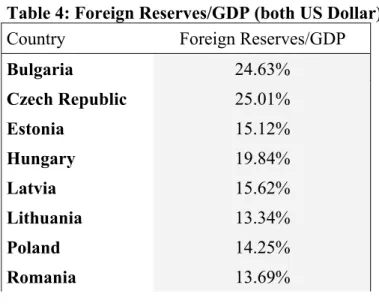
To put more emphasis on the foreign reserve criterion, the stock of foreign reserves can be used as an additional indictor for exchange rate stabilization. High stocks of foreign reserves indicate high past or high intended foreign exchange intervention. Low stocks of foreign reserves indicate benign neglect towards the exchange rate. Table 4 shows foreign reserves as percentage of GDP (in terms of dollars) giving a notion of this criterion. The stock of foreign reserves as percentage of GDP is much higher in the small CEE countries (13.3% – 25.0%) than in large industrial benchmark free floaters US, Germany18 and Euro Area (0.3% – 3.4%).
The highest percentage is measured for the Czech Republic (25.0%) which might explain the lower probability for the Calvo-Reinhart foreign exchange criterion.
Further, Figure 9 and Figure 10 in the appendix, which plot the development of the official foreign reserves of the CEE countries and the benchmark free floaters, (Germany/Euro Area and the US) show the time path of foreign exchange accumulation. The official foreign reserves of Germany/Euro Area and the US have been by and large constant since the early 1990s—even with a light downward drift. In contrast, the foreign reserves of the CEE countries have been growing steadily, indicating clearly a fear of floating. In Poland foreign reserves grew until 2000 when Poland switched to the independent float and have remained constant since then. We also observe that in the Slovak Republic and Romania official foreign reserves have recently increased strongly. This might herald that exchange stabilization against the euro has started.
Table 4: Foreign Reserves/GDP (both US Dollar)
Country Foreign Reserves/GDP
Bulgaria 24.63%
Czech Republic 25.01%
Estonia 15.12%
Hungary 19.84%
Latvia 15.62%
Lithuania 13.34%
Poland 14.25%
Romania 13.69%
18 Note the special status of Germany. The DM exchange rate has been floating freely against the dollar, but up to December 1998 the DM was stabilized against the currencies of the European Monetary System (EMS).
Thus, while the EMS membership is expected to have no direct effect on the DM/dollar and DM/yen exchange rate, foreign exchange reserves and interest rates might reflect the exchange rate stabilization against other EMS currencies. After the introduction of the euro in January 1999 intervention between the former EMS currencies has ceased and the Euro Area as a whole can be regarded as a free floater.
Slovak Republic 20.23%
Slovenia 22.56%
USA 0.29%
Germany 2.37%
Euro Area 3.38%
Source: IMF: IFS. Foreign reserves in US dollars 2001:12. GDP 2001 in US dollars.
Finally, the (modified) Calvo-Reinhart interest rate criterion ι indicates the probability that short-term interest rates change more than ±40 basis points. This probability is significantly higher for all CEE countries than for the Euro Area and the US except the Czech Republic.
The low probability that monthly interest rate changes are larger than ±0.4% might indicate the advanced monetary and exchange rate convergence of the Czech Republic towards the Euro Area. If the Czech Republic follows the ECB interest rate policy tightly and credibly, fluctuations of euro exchange rate and foreign reserves are low.
For all other countries the high probabilities of larger monthly interest rates changes might indicate both exchange rate stabilization as in the case of the hard pegs of Bulgaria, Estonia, Latvia and Lithuania as well as a (still) higher level of short-term interest rates as observed in Poland, Hungary and Romania. An estimation of monetary policy reaction functions is necessary for a more precise statement about the impact of the exchange rate on monetary policy (Schnabl 2002).
All in all, the Clavo-Reinhart criteria draw a clear picture of exchange rate stabilization in Central and Eastern Europe. Bulgaria, the Czech Republic, Estonia, Hungary, Lithuania and Slovenia build a euro club that is striving towards ERM2 and EMU accession. Latvia still adheres to a currency basket. Poland, Romania and the Slovak Republic pursue floating exchange rate policies.
Daily Exchange Rate Volatilities
The Calvo-Reinhart criteria were used to identify hidden exchange rate stabilization on a monthly basis, i.e., at low frequencies. To complete the picture of foreign exchange stabilization in Central and Eastern Europe day-to-day exchange rate fluctuations are analysed. High-frequency data have gained importance for the analysis of exchange rate policies as the integration of the emerging markets in the world capital markets proceeds (Wickham 2002). As outlined in section 0 the daily exchange rate returns reflect the attempts
of the central bank to reduce the exchange rate risk of short-term international payment transactions. A systemized reduction of daily exchange rate volatility is also the prerequisite for exchange rate stability at low frequencies. To assess the degree of day-to-day exchange rate stabilization the euro/dollar exchange rate is again used as a benchmark.
The daily returns of the exchange rate of the CEE currencies against the euro are plotted in Figure 11 and Figure 12 in the appendix. At a first glance, the patterns of daily exchange rate returns correspond to the result of the Calvo-Reinhart criteria. Seven currencies seem to have a significantly reduced exchange rate volatility against the euro as opposed to the benchmark dollar/euro exchange rate: the Bulgarian lev since 1997, the Czech koruna, the Estonian kroon, the Hungarian forint, the Latvian lat, the Lithuanian lita (since February 2002) and the slovenian tolar. For the Lativian lat the exchange rate volatility can be assumed to be even smaller against the US dollar. In contrast, the daily volatilities of the Polish zloty (since 2000), the Romanian leu and the Slovak koruna (since 1998) show the characteristics of a freely floating currency.
For a more formalized comparison of day-to-day exchange rate fluctuations, Table 5 reports the standard deviations of the daily exchange rate returns against euro and dollar for the CEE sample. The observation period is from January 1st 1999 up to May 23rd 2002. As Table 5 shows, the standard deviations of daily percentage exchange rate changes are lowest for the currency board arrangements of Bulgaria (0.05% against the euro), Estonia (0.10%
against the euro) and Lithuania (0.03% against the euro since February 2002).
Further, the standard deviations of the Czech koruna (0.36% against the euro), the Hungarian forint (0.34% against the euro), the Latvian lat (0.46% against the euro and 0.25%
against the dollar), and the Slovenian tolar (0.23% against the euro) are significantly smaller than the standard deviation of the benchmark euro/dollar rate (0.64%). In accordance with the conclusion drawn from the Calvo-Reinhart criteria, the Polish zloty, the Romanian leu, and the Slovak koruna have high standard deviations against both euro and dollar and thereby can be classified as freely floating currencies.
Table 5: Daily Exchange Rate Volatilities against Euro and Dollar 01/01/99 – 05/23/02 Euro Dollar
Bulgarian Lev 0.05% 0.63%
Czech Koruna 0.36% 0.67%
Estonian Kroon 0.10% 0.64%
Hungarian Forint 0.34% 0.65%
Latvian Lat 0.46% 0.25%
Lithuanian Lita* [0.66%] (0.03%) [0.02%] (0.43%)
Polish Zloty 0.75% 0.63%
Romanian Leu 0.89% 0.62%
Slovak Koruna 1.32% 0.78%
Slovenian Tolar 0.23% 0.66%
Dollar/Euro 0.64% 0.64%
Source: Datastream. Volatility defined as standard deviations of daily exchange rate returns. * Note two sub-samples for Lithuania due to the shift in exchange rate regime: [01/01/99 – 01/30/02] (02/01/02 – 05/23/02)
I conclude that the de facto exchange rate arrangements of the ten Central and Eastern European EU accession candidates can be subdivided into three groups. First, there is a dominating euro club with six members: Bulgaria, the Czech Republic, Estonia, Hungary, Lithuania, and Slovenia. Second, one country—Latvia—pegs its currency to a currency basket which is dominated by the dollar (45%) and the euro (29%). Third, there is a group of three countries—Poland, Romania, and the Slovak Republic—with widely flexible rates. I conclude that the majority of Central and Eastern accession countries have already built an informal euro zone that heralds ERM2 and EMU accession.
T T h h e e S S h h i i f f t t t t o o w w a a r r d d s s a a n n E E u u r r o o Z Z o o n n e e i i n n C C e e n n t t r r a a l l a a n n d d E E a a s s t t e e r r n n E E u u r r o o p p e e
Given the fact that the euro has already become the dominating anchor currency in Central and Eastern Europe, what will be the future path of the CEE foreign exchange policies? The dynamics of European integration suggest that the euro zone in Central and Eastern Europe will grow further. Neither dollar pegging nor flexible exchange rates are sustainable (ECOFIN 2000).
In the early 1990s the dollar still seemed to be a valuable choice for an exchange rate anchor. Since then the European currencies—in particular DM, ECU19 and later euro—have steadily gained ground as anchor currencies. In 1990, Poland started its transformation process with a hard peg to the dollar, which was soon abandoned in favor a currency basket
19 European Currency Unit.
with a weight of 55% for four European currencies.20 The dollar was left with a weight of 45%. Bulgaria also opted for a hard peg to the dollar at the very beginning of its transformation process, but after a number of discretionary devaluations (1991-1995) the dollar peg collapsed. After a period of hyperinflation (1996/97), Bulgaria introduced a hard peg to the DM in August 1997 (later euro).
The development of the Hungarian currency basket represents the gradual drift from the dollar to the euro (Table 6). The first Hungarian currency basket (February 1990) gave several European currencies a weight of 57.4%, and 42.6% was devoted to the dollar. In 1991, the weight of the European currencies dropped to around 50.0%. Parity with the dollar remained in place until May 1994 when the weight of the European currencies (ECU) was raised to 70% (dollar 30%). Finally, in January 2000 the euro gained “a weight” of 100%
heralding Hungary’s ERM2 and EMU accession.21
Figure 1 compares the development of euro and dollar as anchor currencies in Central and Eastern Europe. At the vertical axis a value of 100% corresponds to a complete dollar or euro zone respectively. The quarterly values for euro and dollar are computed as follows: For all ten CEE countries the composition of the currency baskets is taken from the official IMF classifications (IMF various issues).22 The specific weight of the dollar and the aggregated weight of all European currencies are listed in the respective quarters of observation starting in the first quarter 1990. For instance, for Hungary in the first quarter of 1990, a value of 0.426 (42.6%) is attributed to the dollar and a value of 0.574 (57.4%) is attributed to the European currencies (Table 6).
Table 6: Development of the Hungarian Currency Basket
Date Dollar European Currencies
February 1990 42.6% 57.4% (DM, ATS, CHF, ITL, FRF, GBP, SEK, NLG, FIM, BEF) March 1991 50.9% 49.1% (DM, ATS, CHF, ITL, FRF, GBP, SEK, NLG)
December 1991 50.0% 50.0% (ECU) August 1993 50.0% 50.0% (DM) May 1994 30.0% 70.0% (ECU) January 1997 30.0% 70.0% (DM) January 1999 30.0% 70.0% (Euro)
20 DM, French Franc, Pound Sterling and Swiss Franc.
21 The horizontal band of ±15.0% around the euro parity shadows ERM2.
22 There is no evidence that the officially reported weights of the currency baskets did not correspond to the de facto foreign exchange policies.
January 2000 0.0% 100.0% (Euro)
Source: National Bank of Hungary. DM = German mark, ATS = Austrian shilling, CHF = Swiss franc, ITL = Italian lira, FRF = French franc, GBP = British pound, SEK = Swedish krona, NLG = Dutch gilder, FIM = Finnish markka, BEF = Belgian franc.
If a country has adopted a unilateral peg to the euro (dollar), the maximum value of 1 (100%) is attributed to the euro (dollar), and 0 is attributed to the dollar (euro). If there is no information about exchange rate stabilization or if the exchange rate is independently floating the value of 0 is listed for both euro and dollar. Further, if there is evidence that a currency is de facto pegged to the euro while de jure classified as a free float—as in the case of Slovenia and the Czech Republic since 1998—1 instead of 0 is attributed to the euro. When the exchange rate arrangements or the weights in the currency baskets change, the values are adjusted in the respective quarter. Finally, the arithmetic middle of the respective values of all ten CEE countries is calculated for every quarter and plotted in Figure 1.23
Figure 1 shows the respective time path of Central and Eastern European pegging to the dollar and the European currencies. The role of the European currencies as anchor currencies in Central and Eastern Europe has steadily increased and outperformed the dollar since 1997. Even the shift of some countries to more exchange rate flexibility starting in 1997 could not stop the trend in favour of euro pegging. In the new millennium, the drift towards the euro zone has reached a new record high.
Figure 1: Development of Euro and Dollar as Anchor Currencies in the CEE Countries
23 A weighted average by country seize (GDP) would lead to a lower level of exchange rate pegging since 1997, as the larger countries (Poland and Romania) tend to allow for more exchange rate flexibility.
0%
10%
20%
30%
40%
50%
60%
70%
80%
90%
100%
1990Q1 1992Q1 1994Q1 1996Q1 1998Q1 2000Q1 2002Q1
quarter
percent
European Currencies/ECU/Euro US Dollar
Source: IMF (several issues) and own calculations (arithmetic averages).
There are three reasons why this trend in favour of a growing euro zone will persist.
First, the EU accession of the CEE countries requires a convergence of macroeconomic policies and thus implicitly a convergence of the exchange rates. Second, the CEE countries want to join the ERM2 and EMU as soon as possible. Third, EU accession heralds further growing trade linkages with the EU and integration into the European capital markets.
EU Accession, EMU Membership, and Macroeconomic Convergence
The EU accession of the CEE countries provides a strong rationale for pegging the exchange rate to the euro. Although the EMU accession is neither a necessary nor a sufficient condition for EU membership the adoption of the Acquis Communautaire as the EU legal framework requires macroeconomic convergence. This implies implicit exchange rate stabilization against the euro as the foreign exchange policy becomes a matter of common interest.
The EC Treaty, which is the fundament of the Acquis Communautaire, states that the economic policies of the respective EU countries are of common concern and shall be coordinated (art. 103). Central Banks are not allowed to give loans to the government and related organizations (art. 104). The member states must avoid excessive budget deficits and have to comply with the rules of the stability and growth pact (art. 104c).
Thus, as the adoption of the Acquis Communautaire by the accession candidates requires significant degree of macroeconomic convergence, EU membership is a first step for compliance with the Maastricht criteria and thus EMU membership. As many Eastern European countries want to join ERM2 and EMU as soon as possible, this tendency will even be stronger after EU accession.24 In short: “It would look odd if the candidate countries invested a lot of effort in the EU accession, but would then not be willing to participate in the crowning project, the EMU.” (De Grauwe and Lavrač 1999: 4).
Indeed, many EU accession candidates have clearly expressed their intention to join the EMU as soon as possible—independent from the pro-and-cons of flexible exchanges rates during the accession period. For instance, Estonia planned to adopt the euro as official currency even before its EU accession in 2001.25 The Hungarian Central Bank states that the
“accession to the Economic and Monetary Union is one of the most important steps in Hungary’s European integration, which will entail abandoning the national currency and adopting the euro as domestic legal tender.” (National Bank of Hungary 2002: 1). The Bank of Slovenia has clearly defined the medium-term monetary goal “to gain access to the EMU as soon as possible” (Bank of Slovenia 2002: 8). The Lithuanian government decided to re- peg its currency from the dollar to the euro in order to join the ERM2 and EMU as soon as possible after EU accession (Alonso-Gamo et. al. 2002: 4).
Given the need for macroeconomic convergence and the clear intention of joining the EMU, the monetary and exchange rate policies have to be redirected towards closer pegs to the euro. More than any public declarations by central banks or governments, the monetary convergence between the EMU and the accession candidates heralds EMU accession—
including the freely floating economies Poland, Romania, and the Slovak Republic.
While the fiscal Maastricht criteria were already met in many CEE countries before the accession negotiations started (but have recently become a matter of concern)26, the monetary Maastricht criteria were far from being met in 1998.27 Since then the CEE countries
24 After EU accession the new member states are expected to join ERM2 soon (ECOFIN 2000). Further, the Acquis Communautaire requires EU member states to accomplish all obligations of EU membership including the monetary union. The candidate countries have to join the EMU as soon as they meet the Maastricht criteria without the possibility to opt out (as Great Britain and Denmark did). Nevertheless in practice the new Central Eastern European members could postpone their EMU membership by simply not meeting the Maastricht criteria (as Sweden did).
25 But as outlined by the ECOFIN Council (2000) unilateral euroization would run counter to the underlying economic reasoning of EMU in the EC Treaty, which foresees the eventual adoption of the euro as the endpoint of a structured convergence process within a multilateral framework.
26 As monetary convergence prevents budget financing by inflation tax, fiscal convergence gets more difficult.
27 Up to the present time, the monetary Maastricht criteria that had to be met by the actual EMU members were not redefined for the new members. The present Art. 109j EC Treaty and the respective protocol demand that
have shown an astonishing speed of monetary convergence. The inflation rates of the CEE countries have rapidly approached the EMU benchmark (Figure 5 and Figure 6 in the appendix). By mid 2002 the inflation rates of the Czech Republic, Poland, Latvia, Lithuania and the Slovak Republic had already reached the level of the Euro Area. Estonia, Slovenia and Hungary seem to be following. Only the two Central and Eastern European accession candidates whose accession has been postponed—Bulgaria and Romania—are still far from meeting the Maastricht inflation criterion.
The convergence of short-term (money market) interest rates in the CEE countries shows a similar pattern. Figure 7 and Figure 8 in the appendix show that the short-term interest rates of Bulgaria, the Czech Republic, Estonia, Latvia, Lithuania, and Slovenia have come close to the level of the Euro Area. Also Hungary, Poland and the Slovak Republic are converging to the euro level. Only Romania still maintains a considerable higher level of short-term interest rates.
Given the high degree of monetary convergence towards the EMU benchmark it is not surprising that since the start of the accession negotiations in 1998 the depreciation path of many CEE currencies has slowed down or even abated (Figure 3 and Figure 4 in the appendix). The exchange rate volatility against the euro can be expected to fall further as the new EU members are expected to join the ERM2 soon after their EU accession.28 To this end, at the latest with ERM2 accession, the monetary policy of the accession country becomes a matter of common interest and the exchange rate against the euro will become the target of monetary policy of all new ERM2 members—including the present free floaters Poland, Slovak Republic and Romania.29
inflation must not exceed the average inflation of the three EMU member states with the lowest inflation by more than 1.5%. The (long-term) interest rates must not be more than 2 percentage points above the average long-term interest rate of the three member states with the lowest long-term interest rate. But as long-term interest rates do hardly exist in Central and Eastern Europe, short-term interest rates might be the benchmark.
Convergence of short-term interest rates in combination with the convergence of CPI inflation implies the convergence of “shadow long-term interest rates”.
28 To join the EMU the nominal exchange rates have to remain within the ERM2 band of ±15.0% for at least two years (Art. 109j EC Treaty). In bilateral negotiations the EU and the new member countries determine a central rate with a permissible fluctuation band of ±15.0% around the central rate.
29 Nominal exchange rate stabilization, the concordance with the inflation criterion and real convergence are in contradiction, however. Fast real convergence and high productivity growth, particularly in the traded goods sector, imply price increases in the non-traded sector (Balassa-Samuelson-effect) and thus higher inflation in the accession countries. Real appreciation of the currencies of the accession countries are the inevitable consequence (Égert et. al. 2002).
Integration of Goods and Capital Markets
As macroeconomic policies and exchange policies in Europe converge, both growing trade linkages with the EU and further integration into the European capital markets can be expected. This gives an additional rationale to peg the exchange rates to the euro.
First, while the CEE economies have already reached a considerable degree of trade integration with the European Union, with the EU accession trade creation and trade diversion in favour of the euro zone are expected to continue. Intra-European trade will grow even further.
Table 7 shows how the direction of trade of the CEE accession countries has changed since the early 1990s. In Table 7 “EU+” is defined slightly broader than EU15, it encompasses the EU15 and other potential Western European members of the euro zone than the 15 EU countries—namely Island, Norway, and Switzerland. “CEE+” is a broader definition of the CEE accession countries which also contains the non-CEE EU accession candidates Cyprus and Malta as well as the Balkan countries which peg or are likely to peg their exchange rates to the euro. “CIS” defines the former member states of the Soviet Union excluding the Baltic countries. “ROW” is the Rest of the World including the United States and Japan. EU+ and CEE+ together are assumed to form the potential euro zone. ROW is assumed to by-and-large correspond to the dollar bloc.
As shown in Table 7 trade of the CEE countries with Western Europe has expanded quickly. In 2000 65% of the CEE exports were traded with the EU+, up from 52% in 1992/93.
58% of the CEE imports came from the EU+, up from 50% in 1992/93. If EU+ and CEE+ are added to a potential euro zone, 82% of CEE exports and 70% of CEE imports are traded within the euro bloc. If the CIS countries and ROW are added to the world dollar zone only 19% of CEE exports and 30% of CEE imports are traded within the potential dollar zone.
Thus, while the integration of the Central and Eastern European goods markets with the EU has already reached a high degree, further growing trade linkages and the creation of a coherent euro zone in Europe will further increase the incentive to invoice trade in euro and thereby to peg the exchange rates to the euro. In fact, the ECB (2002: 40-42) observes in Poland and Bulgaria—where data on trade invoicing are available—that the role of the euro as invoice currency is steadily growing.
Table 7: Direction of Trade of CEE Countries (Arithmetic Averages)
Exports EU+ CEE+ CIS ROW Imports EU+ CEE+ CIS ROW