THESIS OF DOCTORAL (Ph.D.) DISSERTATION
UNIVERSITY OF KAPOSVÁR FACULTY OF ANIMAL SCIENCE Production and Breeding of Ruminants and Horse
Head of the doctoral school Dr. PÉTER HORN
Member of the Hungarian Academy of Sciences
Supervisor:
Dr. JÓZSEF STEFLER Candidate of Agricultural Sciences
EFFECTS OF EMBRYO TRANSFER ON BREEDING OF HOLSTEIN FRIESIAN
Author:
MIKLÓS SZABARI
KAPOSVÁR 2008
1. INTRODUCTION
There is worldwide effect - and unfortunately Hungary is in this situtaion also - that the productional results of the dairy cattle breeding go with poor fertility and less fitness-qualities.
Nowadays the possibilities of the traditional breeding methods run out, and the intensity of genetic improvement is not appropriate. With the aim of being successful of the Hungarian cattle-breeding, modern breeding and biotechnological procedures are necessary to use (DOHY, 1999).
The modern biotechnological methods are well-known many decades ago by excperts. The spread of these processes, specially the embryo transfer (ET), fall behind the dairy breeding of market-concurrent (SOLTI, 2006).
This is why the analyses of the experiences about ET and the facts, which determinante its efficiency are necessary. For that very reason, the breeders need to have more information about the intensity and the aim of the further development to make decision.
Embryo transfer is that process when the embryo is removed by flushing from the horn of the uterus before implantation and transferred into the horn of the uterus of synchronized recipient (HARASZTI ÉS ZÖLDÁG, 1993).
The method was worked out to utilieze of the egg-capacity of females. The role of the ET in the dairy cattle breeding is important, because the breeding of females is in hazard nowadays: the average lactation-number is 2.3, which means that less than two heifers born (OSZA, 2008) per cows during their life from traditional breeding methods. This fact will cause difficulty in the aspect of economy and in the selection of female. During my work I studied the effect of ET on the Hungarian Holstein Friesian cattle breeding. Unfortunately in Hungary the ET is valuated by only a reproductional number (pregnancy rate, %).
Nevertheless the ET has an effect on the genetic composition of the whole population. I wanted to know that the population from ET has an advantage or not, against the population from traditional method and how can we increase this advantage.
In my thesis the results from Hungarian ET population and the data of the non-ET population were used.
During my study I had the followings main aims:
1. How can we maximalize the number of offsprings pro donor in field condition?
a) Does the age of donors (heifer or cow) have an impact on the number or the quality of flushed embryos?
b) Which treatment of superovulation causes the best result?
c) What kind of effect has the freezing on the efficiency of ET?
d) How does the conception of superovulated donors change?
e) Does the quality of embryo have effect on the efficiency of ET?
f) Does the age of recipient (heifer or cow) have an impact on the implantation of embryos?
g) Is there any correlation between milk- and embryo-production of donors?
2. What kind of effect has the ET on the Hungarian Holstein-Friesian population?
a) Is there any increasing in the number of offspring from female?
b) Is there any decreasing in the generation interval?
c) What kind of genetic improvement can be cause by ET?
2. MATERIALS AND METHODS
2. 1 The number of offsprings per donor and the determinant factors in the Hungarian Holstein-Friesian population
We made the technical part of the work in a dairy farm in Hungary, where the 70% of the Hungarian embryo-flushing occurred in 1998-2005. During this time 613 embryo-flushings and 2 633 embryo-transfers were performed.
I used the data of the records of embryo-transplantation to evaluate the ET.
2. 1. 1 The aspects of the donor-selection
Donors with appropriate pedigree, high milk production and the criterions of the bull-breeding cows (n=386), got into the program of ET. Beyonds the cows, heifers (n=227) from ET or with good pedigree were used as donors.
The selection of bull was performed with the help of top-pairing.
The embryo-flushings and transplantations were performed in the stalls. The donors and the recipient did not get any special nutrition.
2. 1. 2 The treatment of superovulation
The superovulations of the cows were provoked with FSH (OVAGEN, ICPbio) on two different patterns. The hormonal therapy started in the middle of the lutheal phase. In the first pattern among cows we used an injection in every 12 hours (during 4 days, twice a day; sum 17.6 mg FSH), and in the other case the dose of the treatment of superovulation was decreasing (first day 2.0 ml, second day 1.5 ml, third day 1.0 ml, fourth day 0.5 ml; sum 8.8 mg FSH). This was suggested by BECZE ET AL., (1991).
Among heifers we used the same patterns. Moreover we applied a smaller, standard 2.0 ml (14.18 mg FSH) dose because of the smaller size of the donors.
2. 1. 3 The fertilization of the superovulated animals, embryo-flushing The fertilization was performed in the following hour of the last injection, and after 12 hours. According to the intensity of the fertilization, the inseminator made a decision about the replicabilty of the fertilization.
During sacral epidural anaesthesia the eggs were flushed from the superovulated cows on the 7th day of the fertilization with the help of flashing catheter (Woerlein catheter, IMV) on a bloodless way.
2. 1. 4 The classification of the flushed structures
Embryos in the morula- and balstocyst-stage were qualified with stereo microscope (60X, OLYMPUS). According to the study of LEHN-JENSEN
(1986) we classified the development of embryos into 5 and its quantity into 4 classes.
2. 1. 5 The treatment, the freezing and the transplantation of the embryos
The embryos were filled into 0.25 ml straw with the help of micropipette.
The freezing of the embryos was performed in ethylene glycol (VOELKEL AND HU, 1992), with a refrigeratory (EUROTHERM), as occasion requires.
Straws were put into a pre-cooled refrigeratory. The seeding occurred on - 7oC, the speed of the freezing was 0.3oC/min until -30oC. After this process the straw were put into liquid nitrogen (DOCHI ET AL., 1998).
The smelting of the frozen straws occurred in a 37oC water-bath during 12 seconds. The fresh and frozen embryos were transfered directly on a bloodless way into the synchronized recipients.
2. 1. 6 The selection and the synchronization of the recipients
The synchronization of the recipients was performed with 2 ml intramuscular prostaglandin analog (ESTRUMATE; 500 μg cloprostenol/animal). The feeding and breeding of the animals were uniform. Heifers (n=785) and cows (n=1 848) were among the recipients, so I had a possibility to examine the age, as a various, alone and in a complexity.
2. 2 Methodological characteristics of my study: ET’s effect on the generation interval and the breeding improvement of the Holstein- Friesian
I worked with the data of 264 animals from ET and 21 810 relatives and stablemates from the National Cattle Data Bank after practical sortation.
Only the animals, which produced during at least two lactations, got into the study. The applied pedigree included 108 313 animals. The completeness of the pedigree of the population was 2.9; also the pedigree information about one animal was equivalent with almost 3 complete generations.
I recived the data from the Central Agricultural Office – Animal Breeding Directorate – Cattle Breeding and Breeding Hygiene Department in Hungary.
2. 3 Statistical analisys
The statistical examinations were performed with the STAT modul of the SAS program, on the way of “Proc GLM” (SAS, 9.1, 2004). I made a correlation study to demonstrate the tight connection between milk- and embryo-production. I examined the difference between the transplantations of the fresh and the frozen stage of the first class embryos with Chi-Square Test, the effects of the donors’ age (heifer vs. cow) on the quality of the embryos, and the effect of the quality of the embryos on the efficiency of
the transplantation. I made also a Chi-Square Test to evaluate the rate of embryos, which implanted into the different (heifer vs. cow) age of recipient. I compared the changing of the generation interval of animals from ET and non-ET with T-Probe, and the average of the results of the different kind of treatments of superovulation.
The estimation of the components of variance-covariance was performed with VCE-5 program (KOVAC AND GROENEVELD, 2003). The breeding values were estimated PEST UIUC V3.1 (GROENEVELD, 1990) program with repetability animal model.
The repetability of the animal model was the following:
y = Xb+Za+Wpe+e, where
y = vector of observation (at 305 days corrected milk kg, fat, protein) b = vector of the fixed effects, as breeding, the year of lactation, the year of birth, the number of birth, the month of birth
a = vector of the additive genetic effect
pe = vector of the permanent environmental effect e = residual, while X, Z, W are the incidence matrices
It is not a question, that an evaluation based on corracted data (305 day lactation) is not highly correct, evenso I evaluated it, because this plays important role in the adjudgement of Holsetin-Friesian population.
The arranging of the pedigree and the analysis of the relatives connections were examined with PEDIG software (BOICHARD, 2002). I calculated the generation interval, wich was the average age of the parents at the birth of their selected offspring according to FALCONER (1989).
3. RESULTS
3. 1 The effects of factors on the number of offspring per donor 3. 1. 1 The age of the donor
The rate of heifers was 37.03% from the studied flushings. The average number of the eggs (transportable embryo and others) was 8.63 during flushing. The age has a statistic effect (P<0.01) on the number of flushing structures (9.14±6.82 vs. 6.8±6.45). On an average with 2.29 more structures are available from cow, than heifer. The quality of embyros is better in the case of heifer donor (Figure 1.).
Figure 1: The rate of excellent embryo quality in various (cow vs. heifer) donors
76.56
66.39
60,0 62,0 64,0 66,0 68,0 70,0 72,0 74,0 76,0 78,0
cow heifer
age of donors
rate of excellent embryos (%) 4
There is a statistical difference between the columns with different letters. (Chi-Square Test P<0.001)
First class, intact embryos derive from heifers statistically proven (P<0.001) more often (+10.17%), than cows.
a
b
3. 1. 2 Correlation betwen the donor’s milk-production and the embryo-production
In the selection of the donors, the milk-production (milk kg, milk composition) is very imporatant. From this aspect, I examined at the 305 days corrected milk-production of the donors (average: 10 004.18 kg) and the numbers of the embryos from them (Figure 2.).
Figure 2: The correlation between corrected milk-production and the number of transferable embryos
0 2 4 6 8 10 12 14 16 18 20
0 2000 4000 6000 8000 10000 12000 14000 16000
corrected milk-production (kg)
number of transferable embryos (1)
y=-0,0004x+9,5026
I have assessed a statistically proven, weak negative correlation (r = -0.262;
P<0.01) between the two qualities. NOVOTNY ET AL. (2005) had the similar results (r = -0.35). This negative correlation is not suprising, because the ET is a biotechnical method of reproduction, and in the most cases this negative connection was found between the reproduction and the capability of milk- production.
My study confirmed the results of SEIDEL AND SEIDEL (1991) and BÉNYEI
(2004) and the theory about the disadventages of hormonal effects following the huge milk-production. The above-mentioned means that because of the selection we have to except the impariment of the donors’ embryo- production.
3. 1. 3 Effects of the treatment of superovulation on the embryo- production
The weakest point of ET is the treatment of superovulation. The essence of the problem is the individual sensibility of the animals on the hormone therapy, thus one standard treatment for superovulation is hardly exist. The result of it is the great standard deviation of the number of flushed embryos and structures. The applied hormonal therapy has influence on the efficiency of ET through the number of flushed embryo.
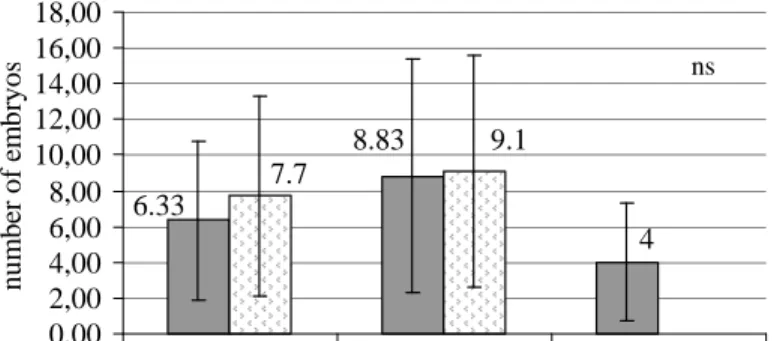
Because of the different treatments, the average number of embryo was different. The standard therapy resulted in 7.5-8 structures, whereas the decreasing hormonal treatment had an average above 9 structures (Figure 3).
The differences can not be statistically proven owing to the wide standard deviations between the individuals (P>0.05).
Figure 3: The applied treatment of superovulation and the number of flushed structure in the case of cows and heifers
4 8.83
6.33
9.1 7.7
0,00 2,00 4,00 6,00 8,00 10,00 12,00 14,00 16,00 18,00
standard (2,5ml) decrease (-0,5ml) standard (2,0ml)
treatments of superovulations
number of embryos (
heifer cow
(P>0.05)
In the case of heifers the decreasing hormonal treatment gave the best result against the two standard dose therapies. These differences can not be statistically proven (P>0.05). Besides these results, we can conclude that the decreasing dose of the applied hormon does not cause the decreasing of the number of the flushed embryos.
3. 1. 4 The treated donors’ capability of conception
We can correlate the applied amount of sperm’s straw with the number of pregnancy through the reproductional estimation. The changing of the calculated fertilizational indexes in the case of cows and heifers are showed in the following table (Table 1.).
ns
Table 1: The changing of the applied amount of sperm’s straw is refered to the transferable embryos and the borned calves
Donor (n) Sperm (n) Embryo (n) Pregnancy (n) Index1 (sperm/embryo)
Index2 (sperm/preg.)
247 437 998 271 0,44 1,61
It can be seen that the classical fertilizational index, which is the „Index2”, is very low. If we examine the fact, that in the studied interval the majority of donors were cows, this result is very appropriate, because 3-4 sperm’s straw are needed to fertilize one cow in the present practice.
My results showed that the ET can decrease the fertilizational index owing to the treatment of superovulation and the extra reproductional service. This is specially important in the aspect of the application of the high quality and high-prised sperm’s straw.
3. 1. 5 The effect of the quality of embryos on the efficiency of ET
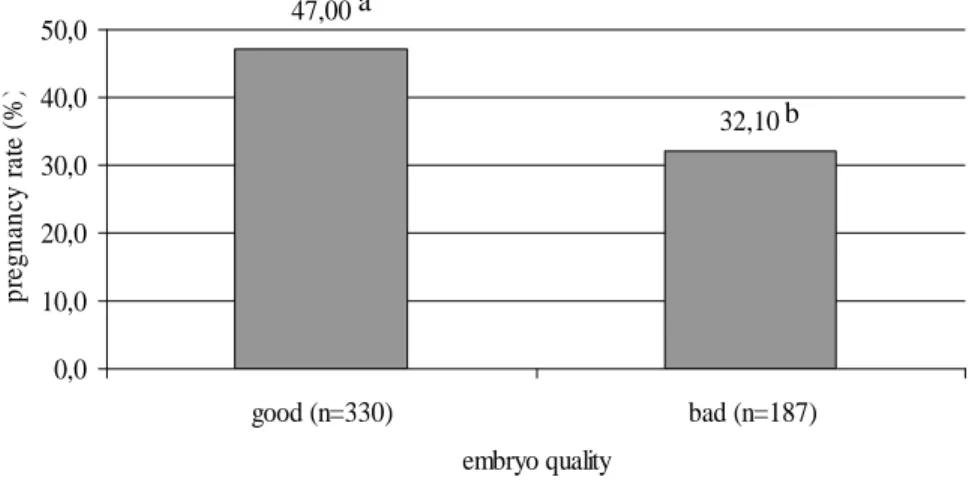
To prevent the subjectivity during the qualification, I drow a part of the classes together. The Figure 4. shows the effect of the „good” and „bad”
class embryos on the efficiency of the fresh stage transfer.
Figure 4: The effect of the quality of embryo on the efficiency of the fresh stage transplantation (n=517)
32,10 47,00
0,0 10,0 20,0 30,0 40,0 50,0
good (n=330) bad (n=187)
embryo quality
pregnancy rate (%)
There is a statistical difference between the quality groups with different letters (Chi- Square Test P<0.005).
The pregnancy rate during the fresh stage transfer of “good” embryos was significantly higher (47% vs 32.1%; P<0.005) than in the case of “bad”
embryos. I have got similar results about the post-frozen stage transfer, although in this case the pregnancy rates are lower (21.3% - 9.4%;
P<0.005).
According to my results I can assess that the morphological quality of the embryo has a significant (P<0.005) effect on the efficiency of the transplantation. This difference exists in the case of post frozen-stage and fresh-stage transplantation also. This is why the preselection of the embryos with stereo microscope is highly recommended. Thus we have a chance to consider which embryo should be transplanted in fresh stage or should be frozen, despite of the deteriorating effect of the freezing method on the vitality of embryos.
b a
3. 1. 6 The connection between the rezipients’s age and the efficiency of ET
The most determinant point of the ET is the quality and the quantity of the recipient population. I can not find a significant effect (34.59% vs. 36.03%;
P>0.05) on the efficacy of the transplantation based on the comparison of the recipient’s age (cows n=928 vs. heifers n=458).
According to the experts and the bibliography (HASLER, 2001) the advantage of heifers’ recipient comes from the fact, that the ET is more successful into intact endometrium. After all, heifers did not give birth, had not health problems because of amnion, or therapeutical interventions in the uterus. On the contrary this difference was not significant even in this huge studied population, probably because of the great individual differences. So we do not have to take attention the age by the selection of the recipient.
3. 1. 7 The effect of the frozen embryos on the efficiency of ET
I have found a significant difference between the results of the fresh-stage- and the post-frozen-stage embryo transplantations. In the case of fresh-stage embryos the result is 41.1%, whereas it is 16.35% in the case of the post- frozen-stage-embryos (Figure 5). These results can be statistically proven (P<0.005).
Figure 5: The results of the fresh-stage and the post-frozen stage embryo transplantation
16,35 41,10
0,0 5,0 10,0 15,0 20,0 25,0 30,0 35,0 40,0 45,0
fresh (n=781) frozen (n=416)
pregnancy rate (%) bla
P<0,005
There is a statistical difference between the quality groups with different letters (Chi- Square Test P<0.005).
The quality of embryo has an influence on the efficacy of the freezing process.
3. 2 Genetic improvement by ET
The elements of the genetic improvement are the decreasing genetic interval, the extra number of offsprings from one parent and the selection- differential between the basic- and the donor-popualtion. We can characterize the changes of the genetic abilities with the breeding value.
These factors have a tight connetion. If we would like to know the genetic opportunities in the ET, we should evaluate the above-mentioned factors.
3. 2. 1 The effect of ET on the number of offsprings
The number of the borned calves has a great influence on the selection of
a
b
selection, or family breeding or breeder trade. The increased number of offspring has a good effect on the intensity of genetic improvement. The number of borned calves could be not neglectable at the calculation of the average genetic interval.
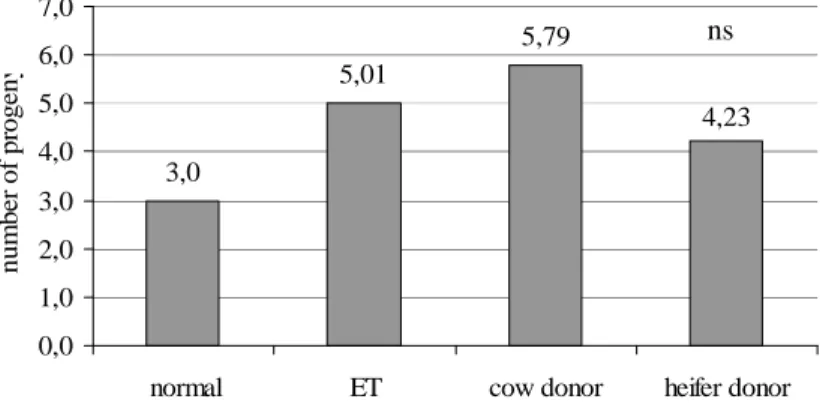
In the last decades the average life production of the cows is 3 claves (OSZA, 2008). This value comes from the traditional reproductional method. If I take this 100%, the effect of ET on the number of offsprings is showed in the Figure 6.
Figure 6: The rate of extra offspring with the help of ET
3,0
5,01
5,79
4,23
0,0 1,0 2,0 3,0 4,0 5,0 6,0 7,0
normal ET cow donor heifer donor
methods of reproduction
number of progeny
(P>0.05)
ET with its actual efficiency results in 2 more calves, which means one more heifer because of the 50%-50% female-male rate. If we examine the donors’ offsprings from ET and from traditional method, the increasing number of offsring is huge because this provokes almost +67% of offspring during their lifetime.
If I examine the donors in the different agegroups (cow vs. heifer), I can assess the followings: If the donors were cows, 23.83% of them has chance to be in the repeatedly flushing. In this case the number of offsprings will increase with 2.79. The increasing of the number of offspring is +93%.
ns
In the case of heifers repetition was not characteristic. In this agegroup flushing was repeated in just the 3.08% of the donors, resulting in 1.47 more claves, than without ET. This value could be more valuable, because after ET the fertilization and calv of heifers donor follow, thus at the beginning of the first lactation the animal has 2.47 claves, which means +41% increasing in the level of life production. Because of this the selection of the females could be more accurate and effective.
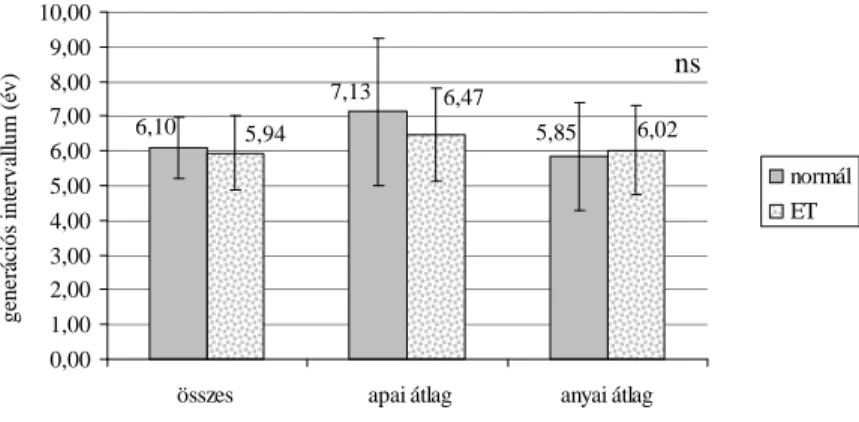
3. 2. 2 The effect of ET on the development of the generation interval In my study I calculated the generic interval in the studied termin based on the recived data in the population of ET and non-ET. The software (PEDIG) made an annually calculation based on the month of the birth. I averaged these values and the generic interval did not show significant decreasing (- 0.16 year; P>0.05) between the donor and the traditionally breeded population (Figure 7.).
Figure 7: The effects of the traditional reproductional methods and the ET on the development of generic interval
5,85 7,13
6,10 6,02
6,47 5,94
0,00 1,00 2,00 3,00 4,00 5,00 6,00 7,00 8,00 9,00 10,00
összes apai átlag anyai átlag
generációs intervallum (év) miki
normál ET
(P>0.05)
ns
Beyond the average generation interval of the parents, the generation intervals of the fathers and the mothers were calculated. In the aspects of fathers the generation interval is just shorter (-0.66 year). In the point of females the generation interval is longer a little bit (+0.17 year).
This small generation interval (-0.16) was caused by the small donor population of the heifers and the older animal, which were qualified as donors after more lactation, increasing the average value of the generation interval. The opportunities of storage based on the freezing may increase the adventage of the generation interval.
3. 3 The effect of ET on the breeding value
In my study I used the most important breeding signal, the milk-production (305 days corrected milk kg) in the repedately animal model besides the ET.
The estimation was performed about the female offspring and the bull of ET. The following diagram shows the genetic development of the population of the stablemates and the goup of offspring derives from ET (8.
diagram).
Figure 8: Genetic trend for the corrected (305 days) milk production of the animals born from ET and non-ET
y = 4,4845x - 8823,6 R2 = 0,3464 y = 36,35x - 72325
R2 = 0,2972
-100 0 100 200 300 400 500 600 700
1990 1992 1994 1996 1998 2000 2002
birth year
breeding value of corrected (305d) milk-productionmik
ET-ből született Nem ET-ből született
Lineáris (Nem ET-ből született) Lineáris (ET-ből született) from ET
linear trend (non-ET) linear trend (ET) non-ET
The diagram shows the average estimated breeding value for corrected milk- production per years in animals from ET (n=264) and nonéET (n=21 810) according to their birthdays. The offsprings from ET show faster genetic improvement (+36.35 kg/year). The value of R2 is low, because the standard deviation is really huge. The genetic development of the offsprings from non-ET is small, just 4.4 kg/year.
I found the same tendency in the detailed analysis of the milk-component (fat kg, protein kg).
The effect of ET on the studied population was determined by the above- mentioned factors and the spread of the method. Nowadays the ET affects less than 1% of the female population of Holstein Friesian. This is why its role in the genetic improvement of the whole population is hardly mesurable.
4. CONCLUSIONS AND SUGGESTONS
The theoretically expectable effect of ET on the cattle breeding depends on several factors:
1. Above all it depends on the genetic ability of the donor selection 2. depends on the size of the donor popualtion, which was involved
into the ET program (how many % of the donor population takes part in the embryo-production)
3. depends on the technical level of the ET (how many offspring derives form one donor during its life, which will be involved into the breeding)
I can conclude that the efficiency of ET is influanced by the biological characters of the female population in the program and the environmental factors.
Drowing a conclusion from this study, I can assess that more embryos can be flushed form cow donors (+ 2.29, P<0.01), than from heifers, but the rate of the quality of the good embryos is higher in the case of heifers (+ 10%;
P<0.001). This conclusion is very important, because we have a fast and simple microscopic method to qulify the flushed structures, and the morphological characters of the embryos has a significant influance on the efficiency of ET. This establishment is true in the case of fresh-stage (+
14,9%; P<0.005) and post-frozen-stage (+ 11.9%; P<0.005) embryos also.
Because of these the microscopic preselection of the flushed embryos is very useful and having these information, we can make a decision to freeze it or use it in fresh-stage. In the case of freezing we have to know its effect on the vitality-destorying of the embryo. Nowadays its degree is -24.75%
(P<0.005).
The decreasing FSH treatment of superovulation causes the best result in all kind of donors (P>0.05). It seems, that the decreasing of the total amount of FSH has no effect on the number of flushed embryos.
In the point of view of the number of offsprings from ET, the possibilities are not utilized. Cows donors product 5.79, heifer donors only 4.23 progenies. Usually in the Hungarian Holstein-Friesian cows calve three times on an average, the extra number of progeny is 2 calves. The reason of it is that the heifer donors repeatedly flushing is less (3%) than in the case of cow donors (23.8%).
Among other things, family-breeding, the selection of bull-mother cows are not available by ET, because the number of progeny is low.
In breeding and economical point of view, applying of ET decreases the appropriation of semen. This balances one part of total cost of the ET.
The effect of ET on the genetic improvement of the Hungarian Holstein- Friesian is less than it was expected.
We have to take attention to the carefully donor selections because there is statistically proven negatvie correlation (r = -0.26; P<0.01) between the milk- and embryo-production.
The milk-production of female progenies from ET is 9291.59 kg. The breeding value of female progeny of ET is higher (+32 kg/year) than in the non-ET population. Even so – because of the lower number of animals from ET - this has no effect on the generation improvement of the whole Holstein-Friesian population in Hungary. There is a same situation with its effect on the the generation interval. The ET decreases the generation interval with only 0.16 year (P>0.05). Its reasons are the small population of ET, using freezing embryos, and the age of donors because there are more cows than heifers between the donors. Applying increasing number of freezing embryos, the generation interval will increase.
Finally, the adventages of ET are not utilized. So far the ET played main role in the bull-breeding. With the aim of improvement, the better donor selection, higher proportinon of heifer donors, appropriate amount of good quality recipients, and a cooperation between breeding association and farmers are necessary. The cooperation like this will mean the basic of an opened nucleus.
It seems that the population of recipients would be the limitating factor of the widely spreading of ET. The ET can’t able to compensate the defficiency of manegement, but it could be effictive device for genetic improvement.
5. THE NEW SCIENTIFIC RESULTS
1. I evaulated the external and internal factors of embryo flushing and the embryo transfer in the Hungarian Holstein-Friesian population in field condition. I have found, that cows donor product more (2.29) embryos than heifer donors in the same conditions (P<0.01). The age of recipients (heifer vs. cow) has no statistical effect on the embryo implantation (P>0.05).
2. There are negatvie correlation (r = -0.26; P<0.01) between the milk- and embryo production of the donors of the Hungarian Holstein- Friesian population.
3. In the breeding and econamical point of view, applying of ET decreases the appropriation of semen. This balances the part of total cost of the ET.
4. The ET has no effect on generation interval (-0.16; P>0.05). Its reasons are the followings: using cow donors and embryo freezing.
The flushed embryos stored in freezing stage during longer or shorter interval before the transfer.
5. The ET has poor effect on genetic improvement of Hungarian Holstein-Friesian population, near actualities. The genetic gain is 36.4 kg milk (corr. 305 days) of the animals born from the ET and 4.4 kg milk (corr. 305 days) of the animals of the rest of the population per years.
6. PUBLICATIONS CONCERNING THE SUBJECT OF THE DISSERTATION
Articles
Articles in Hungarian language
Szabari, M., Nánássy, L., Szabó, L., Baranyai, B., Petrovics, Á., Kovács, A., Zomborszky, Z., Gócza, E, Bodó, Sz.: Spermaértékelés Peteburok Kötődési Teszt segítségével Állattenyésztés és Takarmányozás 2003. 52.
102-106. p.
Nánássy, L., Szabari, M., Szabó, L., Baranyai, B., Petrovics, Á., Kovács, A., Bali Papp Á., Gócza, E., Bodó, Sz.: Spermaértékelés Mikro Swim up eljárás segítségével Állattenyésztés és Takarmányozás 2003. 52. 107-111. p.
Szabari, M., Pinnyey, Sz., Boros, N., Sebestyén, J., Retter, Z.: Az embrió minőségének hatása az embrió-átültetés eredményességére üzemi körülmények között. Acta Agraria Kaposvárensis 2007. 11. 69-74. p.
Szabari M., Bokor Á., Sebestyén J., Bakos G., Boros N., Simai Sz., Sebestyén S., Stefler J.: Az embrió-átültetés hatása és perspektivája a hazai holstein-fríz fajta tenyésztésében Állattenyésztés és Takarmányozás (közlésre elküldve)
Articles in foreign language
M. Szabari, Sz. Pinnyey, N. Boros, J. Sebestyén, Z. Retter, G. Bakos, Á.
Bokor, J. Stefler: Some factors affect of embryo-flushing in dairy cattle, Acta Agraria Kaposvárensis 2008. 12. 113-120. p.
Abstracts
Abstracts in Hungarian language
Szabari M., Stefler J.: Az embriódonor tehenek szerepe a szarvasmarha- tenyésztésben, VIII. PSAK, Pécs, 2006 34. p.
Szabari M., Bokor Á., Simai Sz., Stefler J., Sebestyén S.: Az embrió- átültetés tenyésztői szempontból 14. Szaporodásbiológiai Találkozó, Szaporodásbiológiai gondozás a fenntartható állattenyésztésben 38. p.
Szabari M., Bokor Á., Sebestyén J., Bakos G., Boros N., Simai Sz., Sebestyén S., Stefler J.: Az embrió-átültetés hatása a holstein-fríz fajta tenyésztésére, I. Gödöllői Állattenyésztési Tudományos Napok, Gödöllő, 2008. 49. p.
Abstracts in foreign language
Szabari M., Bokor Á., Sebestyén J., Bakos G., Boros N., Simai Sz., Sebestyén S., Stefler J.: The results of embryo transfer in hungarian cattle breeding, Agrár- és Vidékfejlesztési Szemle 2008. 3. 21. p.
Presentations
Presentations in Hungarian language
Bodó Sz., Szabari M., Szabó L., Nánássy L., Hiripi L., Kiss A., Szabó M., Gódor N., Nagy Sz., Kovács A., Laczkó L., Horváth G., Baranyai B., Kobolák J., Gócza E.: Új spermaértékelési, embrió-mikromanipulációs és embrió-mélyhűtési módszerek, MBK Napok, Gödöllő, 2002. október
Szabari M., Stefler J.: Az embriódonor tehenek szerepe a szarvasmarha- tenyésztésben, VIII. PSAK, Pécs, 2006 november 23-25.
Szabari M., Bokor Á., Simai Sz., Stefler J., Sebestyén S.: Az embrió- átültetés tenyésztői szempontból 14. Szaporodásbiológiai Találkozó, Keszthely, 2007. október 5-6.
Szabari M., Bokor Á., Sebestyén J., Bakos G., Boros N., Simai Sz., Sebestyén S., Stefler J.: Az embrió-átültetés hatása a holstein-fríz fajta
tenyésztésére, I. Gödöllői Állattenyésztési Tudományos Napok, Gödöllő, 2008. április 11-12.
Szabari M., Bokor Á., Sebestyén J., Bakos G., Boros N., Simai Sz., Sebestyén S., Stefler J.: A hazai embrió-átültetés eredménye szarvasmarha- tenyésztői szempontból, „Multifunkcionális mezőgazdaság” c. Nemzetközi Konferencia, Hódmezővásárhely, 2008. április 24.
Educational articles
Szabari M.: Biotechnika a szarvasmarha-tenyésztésben. AgrárUnió, 2004.
IV. 1. 40. p.
Szabari M.: Szarvasmarha-tenyésztés a XXI. században. A magyartarka, 2005. 1. 14-15. p.
Szabari M., Bodó Sz.: Korszerű biotechnológiai eljárások a szarvasmarhatenyésztésben. Holstein Magazin, 2006. 3. 54-55. p.