The last part of the thesis corresponds to the aim of evaluating a possible integration of legislative, technological and educational approaches, for a joint action against disinformation. The contemporary world has entered the post-truth era, where alternative or supposed facts have become more important than real facts, to the point that the latter have been displaced from public attention, while feelings and emotions have become more important than real facts . objective evidence.
The era of post-truth
The concept of post-truth
I would be more precise: it would be nice if we all stopped using the phrase “now that we live in the post-truth era,” because it is baseless and misleading. Therefore, it is relevant to understand why the post-truth phenomenon is on the rise today.
The four conversational maxims of Paul Grice
The digital revolution, a typical phenomenon of the last thirty years, provides enormous ease to express and distribute one's opinions on the web, and reshuffle roles a bit. Violation of the relevant Greek maxim inevitably leads to the inflation of information and consequently to confusion, which affects communication.
Historical genealogy of post-truth: from modernism to postmodernism
An analysis of the previous points summarized by Duignan (2022) shows that modernism supports rational thought and the use of science and reason for human progress, while postmodernism believes in the irrationality of things. It was she who gave the scepter of the microphone to ordinary people without special skills.
From the remote control to the mobile phone
The reality mediated by television
As a result, the media themselves (mainly television), also because they are subject to the development of the most advanced technologies, increasingly present their images in a virtual and playful manner. It is only a short step from the reality of the media to the everyday reality of their users, as what happens in everyday life is increasingly reduced, presented and perceived according to the most successful models in the entertainment landscape. It follows from this that the media representation of reality, even the seemingly most brutal, no longer arouses horror and hurt in viewers, but, on the contrary, generates addiction and indifference (Welsch, 1997).
The author herself does not fail to highlight some characteristics of "truth television" that have marked its development, with increasing rates, from the end of the last century to the present era. In this sense, the participation of ordinary people, in large numbers, in which most of the spectators can recognize themselves, is of fundamental importance. In these cases, television functions not so much as a window on the world, but as a distorted mirror of the world."
Weak and strong documents
In general, the advantage of incumbents has turned out to be even more visible and decisive, compared to their opponents, in relation to the number of active television broadcasters in their districts of residence (Prior, 2006). It has been noted that the development of such artefacts, of networks of social behavior and of the obligations and requirements with which they are associated, is similar in some respects to the processes of biological evolution (Zamboni, 2008). The Peruvian economist Hernando De Soto, in The Mystery of Capital (De Soto, 2000), was the first to recognize the central role of documents in the social reality of the market economy.
Later, drawing on De Soto's work, Barry Smith and Leo Zaibert (2001 and 2007) proposed a theory of documentary documents, supplemented by an account of the ways in which working with documents made of paper and ink or processed by the document processor a computer, you can change the world. Indeed, Ferraris develops a phenomenology of the document, distinguishing between documents in the strong sense, that is, records of actions that generate consequences for the subjects recorded, and documents in the weak sense, which are simple records or historical reports of events that occurred. . An example of such conventions is the rule that the young person must greet first, or the use of the appellations "sir" or "lady" in formal approaches.
Documediality: redundancy of true and false
On the internet, documents are produced in large numbers and in a fully automatic manner (Ferraris, 2018). In this sense, the Web empowers the subjects who access it, transforming them into monads aware of their individuality and the possibilities of active communication, each with its own window on the world. In this sense, there is a gigantic mass of social objects circulating on the net, conceived as an enormous proliferation of documents, registrations and.
On the other hand, opacity is the result of the type of relationships and information exchanges that develop online. The person who is called on the network is invited to "answer" an appeal which, through the network, is addressed only to him, and which he therefore cannot ignore. In the era of documentary, online users act individually in the role of monads: individuals who assert themselves online by producing a continuous stream of documents (Ferraris 2020, p. 118 ff.).
Deepfakes
- Some notable examples of deepfake
In this connection, with reference to the subjects treated in the first chapter of this thesis, it must be emphasized that deep fake is only the last link (and not even the strongest) in the chain of delegitimization of knowledge and of authenticity of the facts that characterize the era of post-truth. Deepfakes gain credibility (and are therefore particularly insidious) also because they rest on a now sedimented background: the truth, as illustrated in the previous paragraphs, has been discredited and subordinated to the interpretation of the truth itself. Note that the strongest signals in favor of adopting automated systems to detect manipulations generated with artificial intelligence algorithms came from Facebook (which will be discussed in the next chapter) (Woodford, 2018).
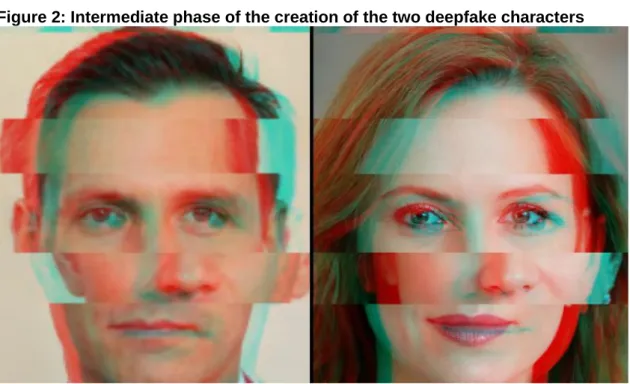
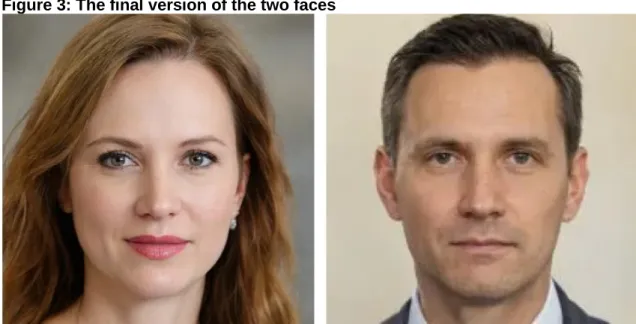
After mentioning some examples of possible advantages with the use of deepfake technology, it is right to also return to the important risks, already mentioned, arising from the fraudulent use of the same tools. It's a war in which contenders take advantage of the most advanced computing resources, and deepfakes are no exception. The two figures below show details of the technique for creating two deep forges and then the final result (Meo, 2022).

Mockumentality
In this regard, Conte states that although deepfakes are the result of modern methods in step with the most advanced technology, they are nevertheless the most current stage of the millennia-old tradition of faces and masks that make up modern evolution (Conte 2019, p. 11). The mask placed on the actor's face actually symbolizes fiction mixing with reality. The ancient masks, through which the voice of the actors (personae) echoed, were also used to "load" some of their facial features in order to better fit the features of the depicted characters.
Even in this modern version we are dealing with hyperrealistic representations, sometimes slightly caricatured or "enhanced" if compared to the original, which corresponds to the purpose of reproducing, in the most reliable and recognizable way, the physiognomy and features of characters thus represented, to the point of being confused with their real aspect. Therefore, as Conte (2019) points out, we have entered the era of mockumentality, a neologism that aims to describe the progressive resolution of the link between artificial replications, achieved with appropriate technologies, and objective truth. In fact, it follows a great ease of synthesis of human forms, but in parallel, as we have seen, the opportunities to create deepfakes multiply and are aimed at replacing truth with lies and creating disinformation, to the benefit of limited elites and to the detriment of the unwary (Conte, 2019).
Fake news in social media. The Facebook case
The role of large multinationals
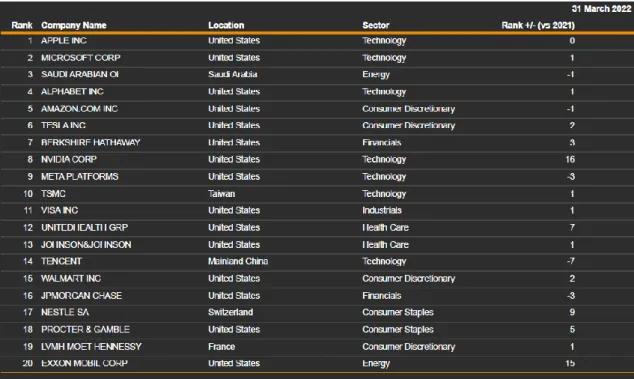
Amazon leads the E-Commerce Industry; Google (controlled by Alphabet) is the most important search engine in the world, and dominates the information and advertising fields. Over the Top (OTT) included in the top 20 (Figure 4) hold various monopolies in the world market of information technology and therefore are mandatory reference points for those who want to participate in the business. Consequently, the sharing of information on the network no longer occurs in a completely free and unrestricted way, as it did in the early days of the Web.
This reality led Berners-Lee, one of the creators of the World Wide Web, to express some well-founded concerns about Facebook in 2010 in the Guardian (Halliday, 2010). Today, given the great economic and commercial value inherent in web pages and digital content, companies exploit all possible means to bring the greatest number of clicks to their website, in the form of likes and comments on their posts, to gain popularity and good indexing. Moreover, in the aforementioned web scenario, intentional fake news must be disseminated in communities accustomed to digital practice (called smart mobs), or designed for certain social targets, to better grab users and spread more easily.
Occurrence and diffusion of fake news on Facebook
This allowed for a more in-depth assessment of the quality of news and information shared on the platform (Stinson, 2016). Therefore, it is not surprising that the strongest signals in favor of the adoption of automated systems capable of detecting manipulations created by artificial intelligence algorithms came from Facebook (Woodford, 2018). At the same time, users are advised not to share content that does not respect the community rules, and also report links to verified information from official sources.
This last point is very significant in order to oppose the closure of users in filter bubbles, to the point that the company clearly explains that, until now "in the results of Google Search the level of personalization based on the assumed interests of the users or their search history prior to the current session.” The topics just discussed show that the individual user, in order to avoid falling into the trap of misinformation, must be updated on the functioning of the digital world in which he spends most of his time. According to the report published by the European Commission (2020), only 42% of the population have basic digital skills, while 22% have slightly above average digital skills.
The role of truth
Many tailor-made truths
Bring out the truth
Let Google fight the disinformation. https://www.camera.it/application/xmanager/projects/leg18/attachments/upload_. Funke D., A Potential New Marketing Strategy for Political Campaigns: Deepfake Videos, Poynter 6 Giu. 2018, https://www.poynter.org/news/potential-new-marketing-strategy-political-campaigns-deepfake-videos. Tim Berners-Lee: Facebook Could Fragment Web. in "The Guardian", https://www.theguardian.com/technology/2010/nov/22/tim-berners-lee-facebook.
Facchini, Ousia, https://www.academia.edu/36893662/Kant_Critica_della_ragion_pura_pdf Keyes R. L'era della post-verità: disonestà e inganno nella vita contemporanea. CIVITAS, Anno VII Nuova Serie – n.http://www.agranelli.net/DIR_rassegna/ART_Civitas_TecnPsiche.pdf. MediaVSReality, Deepfakes e gli 8 pilastri dell'era della post-verità. https://mediavsreality.medium.com/deepfakes-and-the-8-pillars-of-the-post-truth-era-14205cfc5324. WIRED - La guerra in Ucraina, https://www.wired.it/article/ucraina-giornalisti-falsi-ai-propaganda-russia/. Fake news, ecco la strategia di Facebook.
2019b), Facebook, Youtube, Twitter must join forces to fight deepfake threat, experts say, C|net 13 Giu. https://www.cnet.com/news/facebook-youtube-twitter-must-team-up-to-fight- threat-from-deepfakes-experts-say/. editors, 2009), Handbook on Ontologies, Berlin Heidelberg, Springer-Verlag. Stinson L., Facebook Reactions, the totally redesigned like button, is here, Wired 24 Feb. 2016, https://www.wired.com/2016/02/facebook-reactions- totally-redesigned-like-button/. Deepfake: What you need to know, Forbes,.