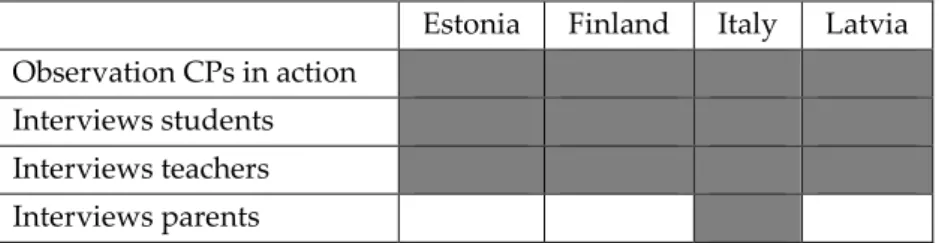
Report: This research memo presents empirical findings from three master's student projects in the Innovation Cluster for Entrepreneurship Education. Findings regarding the impact, drivers and barriers of EE were presented in the project's final report.
Estonia
Finland
An important aim is to convince universities to include EE in their teacher education. The Ministry of Education and Culture believes that the strong emphasis on EE is an important factor along with high unemployment among young people.
Italy
The national curriculum was updated in 2014-2015 with a strong emphasis on EE, focusing on work skills and entrepreneurship as a multidisciplinary approach. Continuous evaluation and research are also an important part of the Finnish strategy, especially by providing measurement tools to help teachers evaluate their own initiatives.
Latvia
The National Center for Education believes that together with the Ministry of Education and Science, JA Latvia and some schools are the most important driving force for EE.
3 R ESEARCH METHODS
Data collection
There was only one researcher in the individual interviews and for some of the group interviews, and then the researcher focused the conversation. Sometimes we witnessed the informants helping the interpreter to present their answers in the right way.
Interviews
In these interviews, the researcher had a list of specific topics and some follow-up questions, and in this way she maintained some control over the direction and content of the interview. The in-depth interview is one of the most common methods of data collection in qualitative research.
4 S TUDENTS WITH SPECIAL NEEDS (I TALY )
Research focus
The selection of participants
He participated in the mini-company the previous year and went through the whole process. The teacher I interviewed was the teacher for the mini-company that student 2 participated in the previous year.
Findings
In addition, he had dyslexia for which he had a support teacher to help him write. He was trained as an economics teacher and had been a teacher since the 1980s, working for the last 19 years at this school.
Process focus
I would like to start by presenting one of the most essential elements of the mini-company; practical work. Running a mini-company is a relatively long process and requires more than one academic year for these students, and the process contains several elements and stages that differ from regular teaching.
The future and working life
This is something that previous studies show as one of the strengths of EE for students with special needs (Johansen & Somby, 2016). Gaining skills in this way can bring advantages in the future by preparing for working life and helping to decide whether such a job is of any interest.
Independence
Collaborative learning
Togetherness in the class
I got a positive impression of this student's relationship with the teacher and classmates, in which acceptance and recognition clearly played a central role in the classroom. It is the teacher's perception of the student's position in the group; that he was very involved and relaxed.
Forced” collaboration
However, this requires an increased focus to gain a better insight into the importance of relationships for students with special needs in mini-companies. There were significant differences between the two students in general and in terms of their particular needs, and that one continued to work with the mini-company while the other had completed the process.
The students in the centre
Although he preferred working in groups, he hadn't learned anything new from working in groups in the mini-company, so it didn't make a big difference to him. I interpret this to suggest that although he enjoyed working with friends, this did not affect his learning outcomes from the mini-company.
Joint decision-making
The teacher could give some advice and perhaps give his opinion on what was better or less good, but ultimately it was the students who made all the decisions. In the mini-companies, the teacher worked with the students and was one of them, still motivating and supporting them.
Organisation and decisions
The majority of students participated in the decisions of Student 1's class, and voting determined the outcome. My findings suggest that there are solutions that can mitigate this, as in Student 2's class.
Involvement and engagement
He was responsible for designing the website and shared a lot about his experiences at various stages of the process. Through his experience with the mini-company, he had the opportunity to participate in the project under the same conditions as the rest of his group.
Obligations
He said that anyone could have done it and that he neither used his skills nor learned anything new. At this stage of the project, Student 1 stated that anyone could do what they were told and that they had not learned anything.
Individual involvement
This approach might have yielded different answers than those given when I only asked about increased influence in the project in general, but I cannot be sure of that. He was part of the finance group and had, among other things, been responsible for collecting money.
The significance of a mini-company
As part of the interview with the parents, a mother said that her son was not very fond of schoolwork. In saying this, I emphasize the extent of individual differences that must be taken into account, as well as the different importance of the inclusion criteria for individuals.
Interaction
I have already mentioned student 2's experience in terms of independent work in the mini-company and that it was important for him to be able to work on equal terms with the other students. As the teacher pointed out, there should be more focus on students with special needs and their individual needs in the organization of the program.
Final reflections
What student 2 says goes to the heart of educating children with special needs in school. In this work, I have shown only part of the complexity of integration, individual differences according to special needs and different ways of organizing a mini-company.
5 S TUDENTS ` SELF - EFFICACY (F INLAND AND L ATVIA )
Selection of participants
The students involved are between 17 and 18 years old and are in their second year of high school. The students were shared by five students from the school in Finland and seven from the school in Latvia.
About the learning environment
In this way, we see that the learner's expectation of mastery must be proportional to the possibility that the learner has to achieve it. As such, one aspect of raising students' mastery expectations is to equip them to deal with failure.
Effort matters
One aspect of working with mini business is that most work is done in groups. As this teacher points out, they don't always know why some students don't master working with a mini-business.
Willingness to take risks
All the students I have spoken to find working in a mini-company rewarding, motivating and giving them a sense of achievement. My impression is that students perceive starting a mini-business as risky.
Realism
If so, it is very likely that the student will not start working in a mini-company. She says that working with a mini-company is a kind of taste of how things will be in real companies.
Self-regulation
Of course, there may be some students who do not find the mini-company's working method meaningful, even when they give it a chance. However, Skaalvik & Skaalvik (2014) point out that it is important to be aware that self-regulated learning must be learned gradually and that the degree of self-regulated learning must be in relation to the student's maturity.
Conclusion
In my opinion, it should be possible to present the work in a way that all students would perceive as meaningful and motivating. The teacher should actively consider and adapt them so that all students have activities they can expect to master.
6 R EFLECTIONS OF TEACHERS ` (E STONIA AND I TALY )
The ability to detect blind spots and to lead through Theory U
One aspect concerns the way in which teachers experience their work in mini-companies as a contribution to their own personal growth. Another aspect concerns the way teachers describe how their work with mini-businesses is important for the students' personal growth.
Teachers` personal growth
The second factor relates to how the teacher's role changes when working with a mini-enterprise and how the teacher can take on the role of a mentor when interacting with students in a mini-enterprise. In the first statement, the teacher describes her experience of how the students enjoy teaching and how she herself enjoys learning from them.
Students’ personal growth
Several teachers mentioned it as a challenge to get all students to participate equally in the work in a mini-company. The teacher who described the changes in the students in the previous statements explained how her own change in attitude towards mini-enterprises was closely linked to her contribution to increasing the self-confidence of those same students (Waaktaar and Christie 2000).
The teachers strengthen students
I see the teacher who decides everything for the students to be one who acts at the download level and who listens as. The teacher explains in the quote how he managed to change the student group's belief in themselves.
The teacher role changes in a mini-company
The teacher seems to be describing her impression that the students are under pressure to perform in subjects other than the mini-company. I found that this teacher is interested and motivated by the mini-enterprise method; what Ryan and Deci (2000) refer to as intrinsically motivated.
Organisation of mini-company groups for students
The teacher explains his view that each individual student's sense of value in the community is the most important success criterion for both the individual and the mini-company. The teacher's role is to support and help students' feelings of mastery during the mini-company.
Cooperation and knowledge sharing between teachers
Several teachers believe that they find it useful to be on an equal footing with their students in the cooperative nature of a mini-company. I believe that teacher training in teaching mini-companies could include more knowledge about building relationships.
En kvalitativ intervjustudie av hvordan to elever med spesielle behov opplever å jobbe i en ungdomsbedrift, med fokus på inkludering. Selvmotivasjon for akademisk prestasjon: Rollen til tro på selveffektivitet og personlig målsetting.