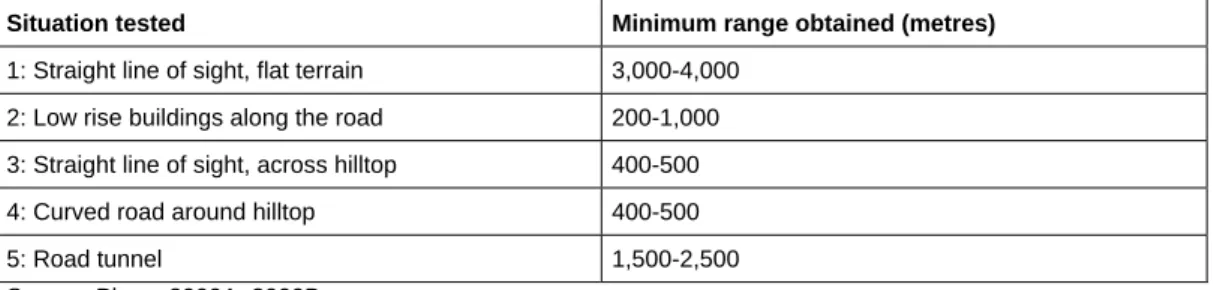
This report contains an assessment of the potential road safety impacts of this system. For a detailed technical description of the system, see the reports by Pleym (2000A, 2000B – the reports are confidential).
Vision Zero for Road Accidents
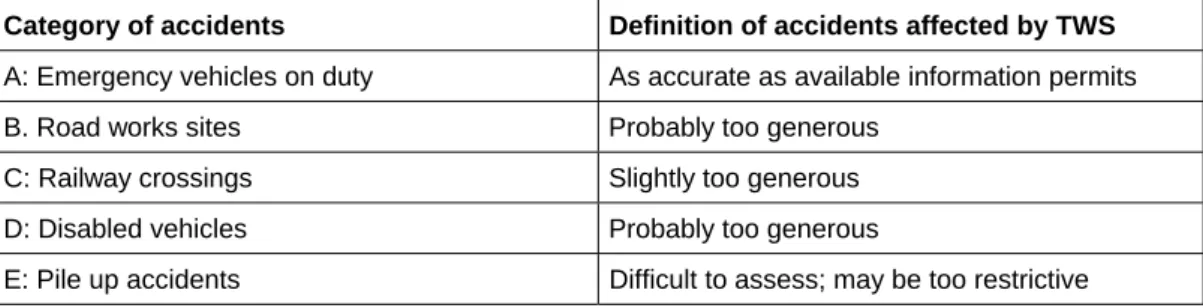
Types of Accidents that may be affected by Traffic Warning Systems
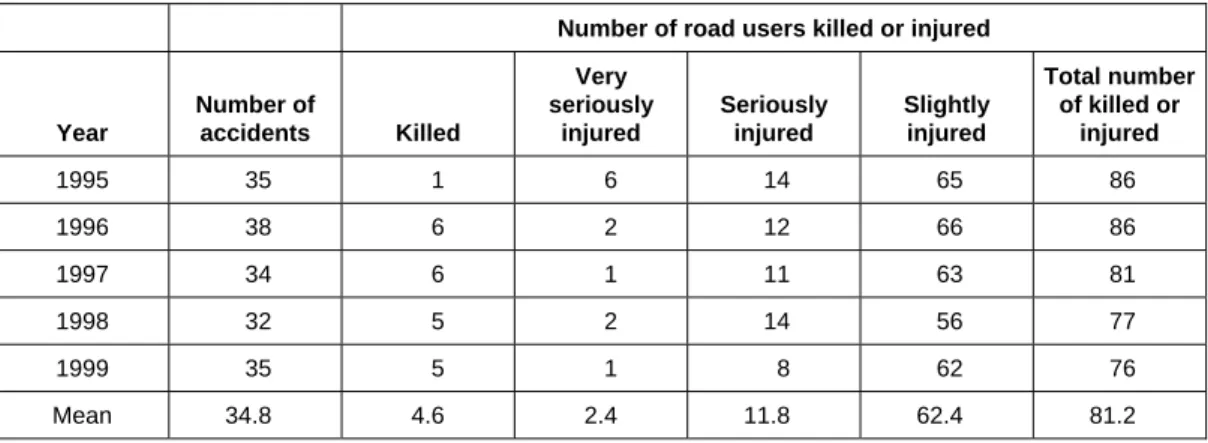
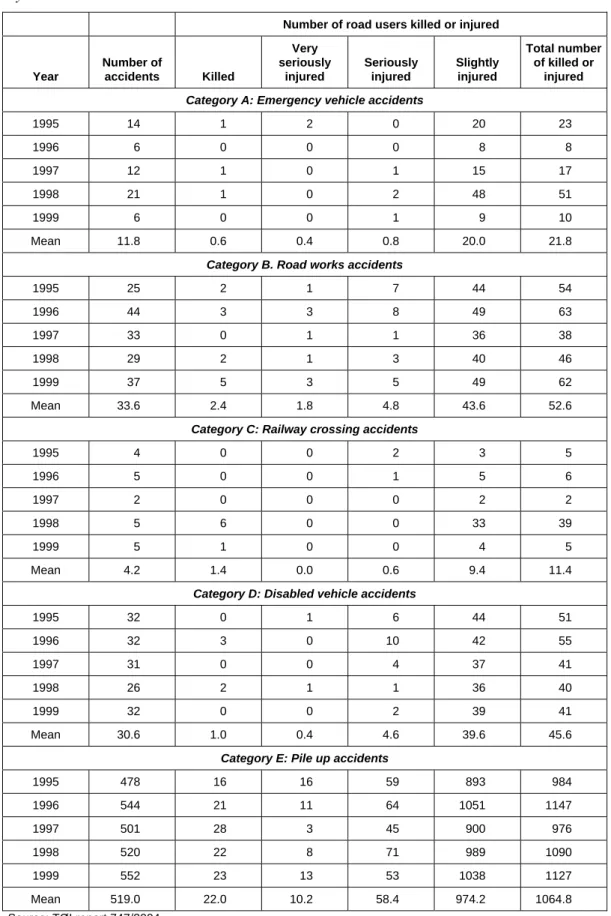
In order to estimate the expected annual number of accidents in each of these categories, the official traffic accident statistics for Norway were examined for the years 1995 to 1999 inclusive. It is in fact the only source where the types of accidents that may be affected by Traffic Warning Systems can be identified with reasonable accuracy.
Number of Accidents in Target Groups according to Official Road Accident
It was decided to use accident data over five years to smooth out random fluctuations from year to year and to detect whether there are long-term trends in the number of accidents. Finally, the annual number of accidents in category A, emergency vehicles on duty, and category C, level crossings, is very low, in most cases less than 20. The average number of injury accidents per year in the target groups is about 600, of which about 520 are pile-up accidents.
It can be seen that including motorcycle, snowmobile and moped accidents would increase the annual target number of accidents from 599 to 630, an increase of about 5%. However, motorbikes, snow scooters and mopeds account for 9% of all motor vehicles registered in Norway. Preliminary statistics show that the number of fatal accidents at railway crossings increased in the year 2000.
A Comparison of Official Road Accident Statistics and other Sources of Data
Statistics maintained by the Road Administration of the Republic of Slovenia include all injuries to employees of the state road agency, regardless of whether they occurred in traffic accidents or other accidents at work. Official traffic accident statistics are limited to traffic accidents that occur on roads open to the public. Despite these differences, the two data sources agree fairly well on the number of fatal injuries.
These differences can probably be attributed to the fact that many of the accidents recorded by public roads. The administration is likely to have occurred outside public roads, for example in road construction areas, asphalt plants, machine shops and so on. In the following analysis, figures from the official traffic accident statistics will be used throughout.
Potential Effects on Road Accidents of Traffic Warning Systems – Theoretical
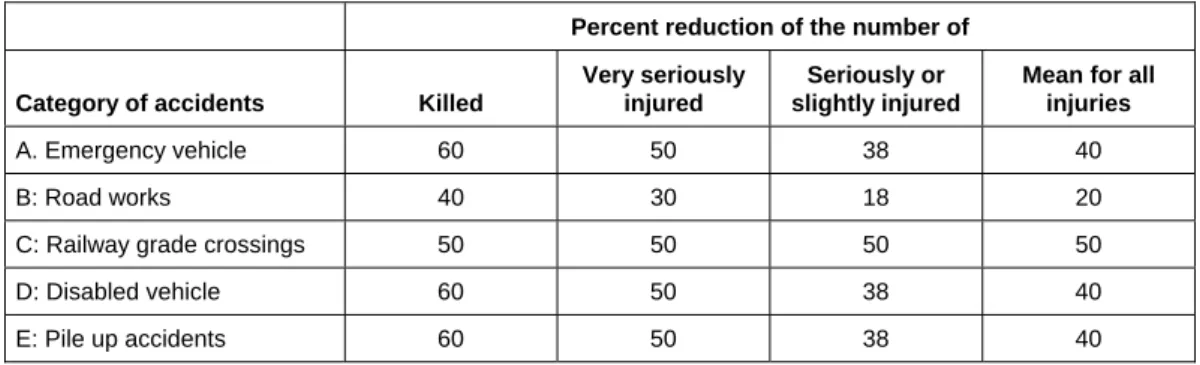
Potential Effects on Road Accidents of Traffic Warning Systems – A
- Category A: Emergency vehicle accidents
- Category B: Road works accidents
- Category C: Railway at-grade crossing accidents
- Category D: Disabled vehicle accidents
- Category E: Pile up accidents
It is assumed that Traffic Alert Systems can reduce the number of accidents at unprotected crossings by 50%. In light of this, it will be assumed that Traffic Warning Systems cannot prevent rear-end congestion. As an approximation, it will be assumed that pile-up accidents, except for rear-end accidents that occur in limited visibility conditions, may be affected by traffic warning systems.
In the following analysis, it is therefore assumed that the effect of traffic warning systems on traffic accidents only applies to conditions of limited visibility. The average annual number of serious injury crashes believed to be affected by traffic warning systems is 35. The magnitude of the effect of traffic warning systems on these crashes is difficult to determine.
Possible Variation in the Effects of Traffic Warning Systems according to
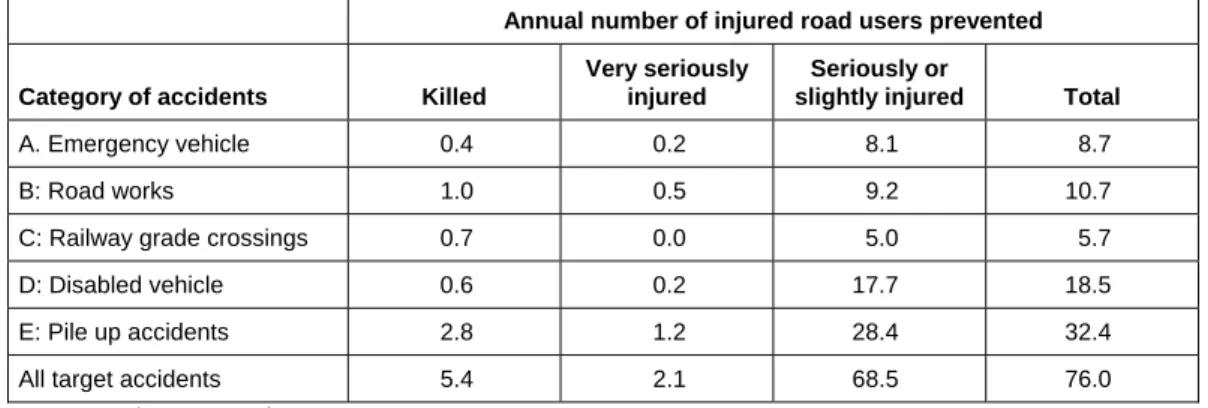
Number of injured Road Users prevented by a Universal Application of
Relatively speaking, the greatest uncertainty is in the estimates of the effects on the number of road users killed or seriously injured.
Potential Effects on Property-Damage-Only Accidents
Based on table 4, this difference is 6 accidents per year, corresponding to a frequency of slightly more than 1 property damage-only. This estimate indicates that there are just over 2 rear-end collisions with property damage for every rear-end collision that results in personal injury outside built-up areas. Finally, for pile up accidents, it is assumed that the number of such accidents that only result in property damage is approx. 20 for each pile-up accident resulting in personal injury.
The effects of Traffic Warning Systems in relation to property damage-only accidents are difficult to predict. It is therefore assumed that the effects of Traffic Warning Systems in preventing accidents with property damage alone are about 2/3 of the effects assumed for accidents resulting in minor injuries. Based on these assumptions, it is estimated that Traffic Warning Systems can prevent approximately 266 property damage-only accidents per year, in addition to the injury accidents that are prevented.
Potential Effects of Traffic Warning Systems on Traffic Operations
Potential Impacts of Traffic Warning Systems in other Countries
Very often, the behavioral changes that occur tend to reduce the safety effects of the measure, that is, its effect on accidents is smaller than it would be if the behavior of road users had remained unchanged. Changes in driving speed can be measured with reasonable accuracy, but changes in the level of attention paid to traffic are much more difficult to detect and measure reliably. Therefore, hypotheses about road users' adaptation to technical safety measures cannot always be tested as rigorously as researchers would ideally like.
Nevertheless, it is useful to discuss in qualitative terms the possibilities of behavioral adaptation to a new technical safety feature. Is it conceivable that the application of Traffic Warning Systems will lead to changes in the behavior of road users that negate the intended safety benefits of the system? This chapter addresses this question and points out some possible adverse effects of traffic warning systems.
Road User Response to Warnings that induce unresolved Uncertainty
The problem with Traffic Warning Systems in city traffic, is that there is no guarantee that the driver will get the additional information needed to know exactly why the warning signal came on. If this happens often, some drivers may start to ignore the warnings in city traffic, perhaps thinking that these warnings do not bother them, since they never pass the place where the warning signal is activated. The fact that a driver may feel that the warning signal did not bother him on a particular occasion does not mean that it will never bother him.
It could be argued that motorists do not need to know exactly why a warning signal is going off. All they need to know is that as long as the warning signal is on, they must be extremely attentive and prepared to react quickly. On the other hand, if motorists get annoyed because they don't know exactly why the warning signal comes on, the distraction caused by this annoyance can be detrimental to road safety.
The Problem of frequent Alarms being ignored
On the contrary, except for technical malfunctions, each warning signal will be real, and will only be activated when there is a real traffic danger in the area. It is therefore reasonable to conclude that warnings of roadworks are unlikely to be given so often that they will be interpreted as false alarms. The number of trains is also likely to be quite low, usually less than one per hour at the tracks where most of the unprotected crossings are located.
Regarding disabled vehicles, statistics for road tunnels suggest that there are around 40-80 incidents involving disabled vehicles for every injury accident reported to the police (Elvik, Mysen and Vaa 1997). Therefore, accumulation accident warnings, like the other warnings, are likely to be activated very rarely. In light of this, it seems highly unlikely that these warnings will be ignored by drivers because they come too often.
Problems related to Apparent Unreliability of the System
For a car driver who drives around 14,000 kilometers per year (which is the current average), this means that a disabled vehicle is encountered on average once every 4-5 years. Casual observation suggests that this is an underestimate, but even if the true frequency were, say, ten times higher than assumed in the estimate, an average driver would still encounter a disabled vehicle only about twice a year. For most drivers, several years pass between each time they witness an injury accident or pass by an injury accident scene.
In summary, the likely frequency of alerts triggered by Traffic Alert Systems is very low, certainly much less than once per trip, probably less than one per month, but perhaps more often than one per year.
Problems related to excessive Reliance on the System
Conclusions with respect to Behavioural Adaptation
Will drivers pay attention to the warnings, even if they cannot immediately see the danger that has activated the warning. Given that warnings are likely to be given quite infrequently, motorists are likely to be aware of them. The roads are very slippery today after the cold night.” Many drivers will pay attention to this message, although not all roads are smooth and some cars have better tires than others.
It is concluded that the possibility cannot be ruled out that unintended behavior modification may occur when Traffic Warning Systems are introduced. It is impossible to quantify in advance the nature and extent of any behavioral adjustment. However, based on the discussion in this chapter, it seems unlikely that any behavioral modification, if it were to occur, would completely offset the intended effects of Traffic Warning Systems on traffic safety.
The Benefits to Society of preventing Road Accidents
In principle, it is possible for a technical system, such as Traffic Warning Systems, to give a social benefit greater than the cost, while at the same time it is difficult to make a profit by marketing the system. This report does not contain an analysis of the market prospects of the system, only its benefits and costs from a socio-economic point of view.
Benefits and Costs of Traffic Warning Systems from a Societal Point of View
This reduces the present value of the annual cost of the system from NOK 325 to 163 million. There are many choices to be made and all of them affect the results of the assessment. The first choice that was made in this analysis was to define the target groups of accidents, that is, those accidents that can be assumed to be affected by Traffic Warning Systems.
The annual number of accidents in these categories was determined on the basis of official statistics on personal injury accidents in Norway. The benefits of the system were evaluated in monetary terms by applying the current official road accident costs for Norway. The present value of the benefits of the system then amounts to around NOK 1,150 million.