The out-of-equilibrium dynamics of strongly correlated quantum systems is one of the most challenging problems in many-body quantum physics. In fact, the dramatic advances realized in ultracold atoms make it possible to simulate the particle or spin Hamiltonians of condensed matter physics with unprecedented controllability of the parameters in time. For example, we claim that the dynamics of correlation maxima can be used as a witness to the elementary excitations of.
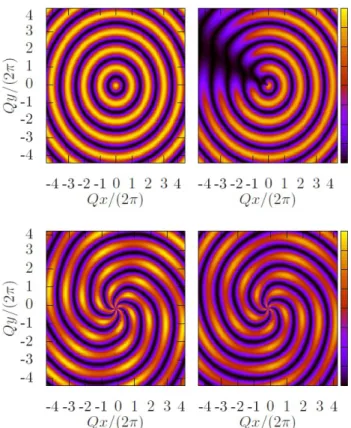
We present a study of the dynamics of a double-ring waveguide structure with spatially dependent coupling, linear amplification, and nonlinear absorption—a system that can be implemented in polariton condensates [1], optical waveguides [2], and nanocavities [3]. Through numerical simulations, we have shown that the distribution and net flux of atoms traveling from the ring to the waveguide depends on the rotational state of the atoms inside the ring.
It has been proven that the well-known quasi-classical model of the photodissociation [3] is not sufficient to describe the experiment with full quantum state control. The violation of the selection rule ΔJ = 0.±1 for the E1 transition in the magnetic field due to the Zeeman interaction was experimentally observed and supported by the quantum mechanical calculations [1]. We study a transfer from the non-interacting ground state ∣Ψ g=0〉 of the Hamiltonian to a strongly interacting ground state ∣Ψ g=10〉.
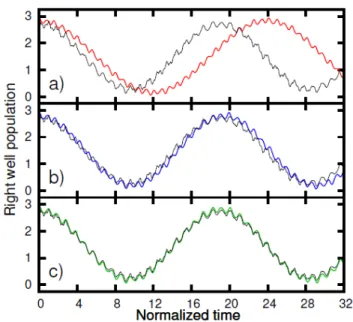
With the help of evolutionary algorithms, we find an optimal way to control the strength of the interaction g(t), which accelerates the transition from ∣Ψ g=0〉 to ∣Ψ g=10〉 state four times compared to the adiabatic process. The whole procedure is robust to small deviations from the optimal g(t), which is desirable from an experimental point of view.
In recent years, great progress has been made towards ultracold molecules consisting of an alkali and an alkaline earth atom, enhanced by the achievement of quantum degeneracy with alkaline earth-like atoms. Such open-shell heteronuclear molecules have a non-zero electronic spin angular momentum as well as a strong permanent electric dipole moment in their rovibrational ground state. These properties enable new ways to tune the interactions between molecules and open promising perspectives to create a quantum gas of ground-state molecules or to study lattice-spin systems (magnetic excitons, topological phases).
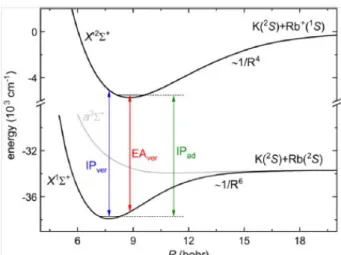
Since the ground state of these molecules is of 2 symmetry, they can also be used as sensitive magnetic field probes, measuring the electron-electric dipole moment, test time variation of the electron-to-proton mass ratio and test beds to study parity. transgressive effects [1-2]. If one can produce a quantum degenerate gas of such molecules, where all degrees of freedom are under control, one can study chemical reactions at a quantum level, and their dynamics at the most fundamental level, with full control over the reactants and a clear signal of the reaction products. However, to generate such molecules at ultracold temperatures, one must have accurate potential energy curves of chosen molecular electronic states, especially those that include the ground state potential.
The first is based on two-color photoassociation spectroscopy, while the second experiment uses thermoluminescence spectroscopy and LIF (Laser Induced Fluorescence) methods. By combining results from both experiments in a joint analysis and utilizing state-of-the-art abinitio calculations, we can provide a potential energy curve for the RbSr electronic ground state. The calculations performed with the final experimental potentials demonstrated their strength as we were able to predict positions of Feshbach resonances, confirmed in later experiments and currently exploited to attempt magnetoassociation in RbSr [3].
In the next steps, the results of this work will be used to guide RbSr two-color spectroscopy and stimulated Raman adiabatic transition (STIRAP) of weakly bound RbSr to the rovibronic ground state. Hada, Characterization of variation in the proton-to-electron mass ratio by precise measurements of molecular vibrational transition frequencies, J. Hutson, Observation of Feshbach resonances between alkali and closed-shell atoms, arXiv accepted by Nat.
The generation of non-classical states in atomic ensembles is a rapidly developing direction in trapped ion and cold-neutral atomic physics [1]. One of the possible states in which particles are entangled and which can be used to increase the sensitivity of precision measurements is the so-called twin-Fock state ∣n , n〉 [2, 3]. Such a state can be created in experiments generating pairs of atoms with well-defined impulses in quasi-one-dimensional systems.
To check this prediction, the pair formation process that occurs by modulating the interaction parameter has been theoretically analyzed. It was shown that parametric process is described by a single parameter δ describing the strength of the amplification, while the interaction between quasiparticles is described by a quasiparticle decay constant γ. In addition, it was found that the Cauchy-Schwarz inequality may not be violated depending on the parameters of the system.
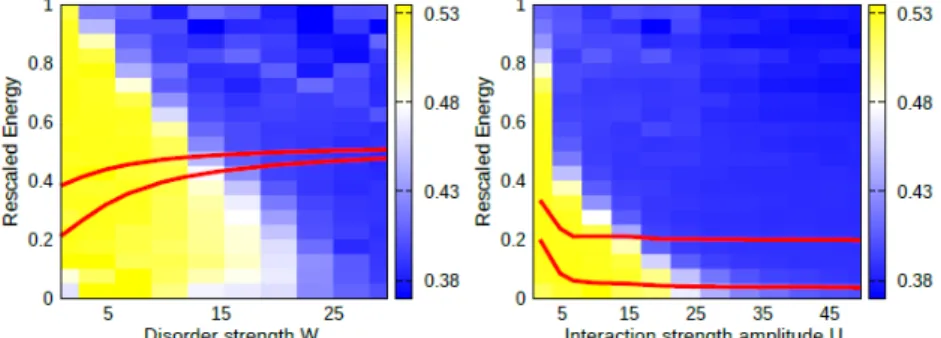
While the origin and character of the disturbance in both systems are different, they show interesting similar characteristics. In particular, many-body localization appears for a sufficiently large perturbation strength W and U as verified by a time evolution of initial density wave conditions as well as the use of statistical properties of energy levels for small system sizes. Starting with different initial conditions, we observe that the localization properties are energy dependent, revealing an inverted many-body localization edge in both systems - that finding is also verified by statistical analysis of energy spectrum - see Fig.
Moreover, we consider a computationally challenging regime of transition between many-body localized and extended phases where we observe a characteristic algebraic decay of density correlations attributable to subdiffusion (and Griffiths-like regions) in the studied systems. Ergodicity breaking in the disordered Bose-Hubbard models is compared to the slowing down of the time evolution of the clean system at large interactions. Yellow color corresponds to r ≈ 0.53 and to the ergodic regime, while the blue color indicates r characteristic for localized conditions.
Note that both systems are characterized by an inverse mobility edge - a characteristic of bosonic systems. 2] Piotr Sierant, Dominique Delande, and Jakub Zakrzewski, Many-body localization due to random interactions, Phys. 3] Piotr Sierant, Dominique Delande, Jakub Zakrzewski, Many-body localization for random interaction of bosons, Acta Physica Polonica A.
A modified classical field description has been constructed which no longer suffers from the UV divergence catastrophe or cutoff dependence, but whose computational efficiency scales similarly to standard classical field methods. To achieve this, an SGPE-like reservoir coupling is patterned to act as a constraint on the high-energy part of the system. The key to avoiding the UV divergence is then to preserve the quantum properties of this limiting reservoir coupling.
Frequencies of the m = 0 collective mode at high temperatures, in the widely studied Jila experiment [PRL 78, 764].
![Figure 1. Frequencies of the m = 0 collective mode at high temperatures, in the widely studied Jila experiment [PRL 78, 764]](https://thumb-eu.123doks.com/thumbv2/9liborg/19360026.0/31.892.160.733.515.955/figure-frequencies-collective-temperatures-widely-studied-jila-experiment.webp)
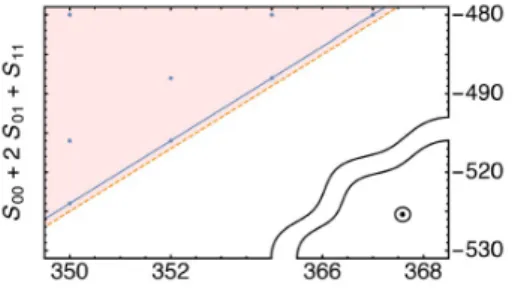
In summary, our method provides an efficient sufficient condition for the correlation set to be nonlocal and, of course, guarantees the Bell inequality that they violate. Section of the projected LHVM polytope of PS2 symmetric two-body correlations along two directions. The distance between the blue and orange lines is 1.000002, which means that the error of our method compared to tightly classically bound scales is 1=N.
5] David Avis, Hiroshi Imai, Tsuyoshi Ito, and Yuuya Sasaki, \Derivation of tight bell inequalities for 2 parties with many observable 2-values from facets of cut polytopes arXiv:quant- ph/0404014. 16] Roman Schmied, Jean-Daniel Bancal, Baptiste Allard, Matteo Fadel, Valerio Scarani, Philipp Treutlein and Nicolas Sangouard, \Bell correlations in a bose-einstein condensate," Science. 18] Matteo Fadel and Jordi Tura, \Bounding the set of classical correlations of a many-body system,” Phys.
Thomas, \Hoofstuk 7: Spektraëdriese benaderings van konvekse rompe van algebraïese stelle," in Semidefinite Optimization and Convex Algebraic Geometry (2012). Lasserre, Moments, Positive Polynomials and Their Applications, Series on Optimization and Its Applications Series (Imperial College Press, 22009). 23] Flavio Baccari, Daniel Cavalcanti, Peter Wittek en Antonio Acn, \Efficient device-independent entanglement detection for multipartite systems arXiv:1612.08551.
Anderson localization, the inhibition of transport in disordered potentials [1], has been thoroughly studied theoretically and realized in many experiments. In a naive guess, the velocity components of the packet are expected to become random, leading to the motion stopping, followed by the localization. A simple semi-classical analysis shows that the center of mass of the packet should reach the distance of the average scattering length L.
In the [2, 3] authors showed that due to Anderson localization the result of the evolution is very different. The center of mass indeed reaches the average scattering length L, but then returns to the initial position, where the localization takes place. This phenomenon called quantum boomerang effect has been carefully analyzed and understood in 1-dimensional systems for 1-particle systems.
The authors have also studied systems with weak nonlinearities, which describe particles in the mean-field approximation. In the systems of interacting particles, Anderson localization remained unexplored for a long time until influential papers by Basko et al. In our work, we analyze the boomerang effect in a presence of interactions using full many-body physics.
In this situation, particle interactions leading to many-body localization can influence the boomerang effect. In addition, our aim is to understand the role of interactions in the studied phenomenon based on a comparison between interacting and non-interacting systems.
We propose a method to obtain a regular two-level arrangement of atoms in a three-dimensional unit-fill optical lattice, where all atoms share internal state coherence and metrologically useful quantum correlations. Such a spin-squeezed atomic crystal is obtained by adiabatically lifting an optical lattice in an interactive two-component Bose-Einstein condensate.