Research goal: to identify institutional factors that encourage female entrepreneurship in two groups of countries: innovation-driven and efficiency-driven. Research objectives: carrying out an overview of the literature related to entrepreneurship, identifying the characteristics of female entrepreneurship, selecting the institutional framework that is most suitable for this study; select institutional factors based on the characteristics of female entrepreneurship and the identified framework and stated hypotheses; build regression models for both innovation-oriented and efficiency-oriented countries; analyze the results obtained; provide recommendations to various stakeholders based on the findings. Select institutional factors based on the characteristics of female entrepreneurship and the identified framework and stated hypotheses;.
Analysis of entrepreneurial context influencing female entrepreneurship
Definition of entrepreneurship, entrepreneur, entrepreneurial activity
But not only the academic world conducts research and studies on entrepreneurship, various international organizations also provide their own definitions of the concept in focus. For example, the OECD (Ahmad, 2008) has conducted a significant study and reviewed the existing definitions of the term. This high number of definitions is a result of the interdisciplinary nature of entrepreneurship, as it combines economics, business strategy, organizational behavior, psychology, sociology.
Overview of existing approaches to entrepreneurship
In many cases, it simply narrows down to the level of education entrepreneurs tend to possess (Xavier-Oliveira et al., 2015). In addition, social capital entrepreneurs tend to achieve is closely related to their human capital. When it comes to the motivation aspect, economists tend to distinguish between opportunity-driven and necessity-driven entrepreneurs (van der Zwan, et al., 2016).
Peculiarities of female entrepreneurship
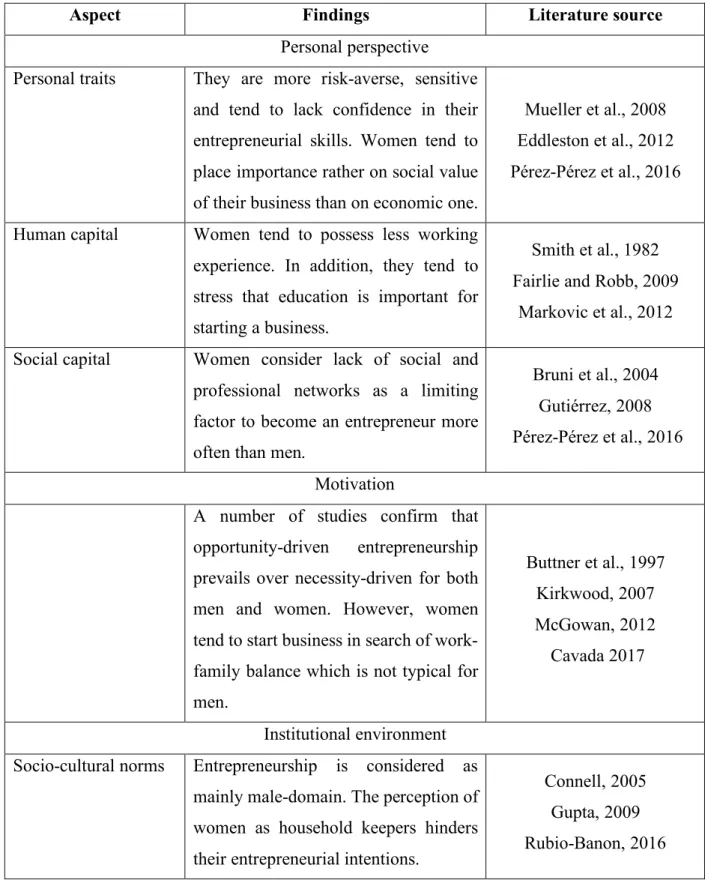
Furthermore, the sectors (retail, office administration, secretaries) of their previous work differ from those in which men work (executive management, scientific and technical sectors) (Brush, 1992; Allen et al., 2007). Finally, some researchers argue that women tend to place more importance on knowledge gained through formal and non-formal education (Markovic et al., 2012). Motivational factors for female entrepreneurs (Cavada et al., 2017) Pushing factors (necessity based) Pulling factors (opportunity based).

Implementation of institutional theory in entrepreneurship
In large cases, women tend to choose entrepreneurial activities as it gives more flexibility and work-life balance. All this makes it clear why female startups play an important role in economic activities and how society can benefit from supporting female entrepreneurship. Furthermore, it is essential to identify the framework that can be further used empirically.
Few articles that conduct this kind of analysis for entrepreneurship tend to implement the institutional theory established by Scott (Scott, 1995), and then further developed by him (Scott, 2013). Regulatory component of the institutional theory stands for formal rules that prescribe the behavior of organizations and individuals. This pillar can also be referred to as external one as it is set by the government and cannot be neglected.
The cognitive component consists of the individual's perception of the external environment, own skills and abilities, fear of failure. In order to promote entrepreneurial activity, in addition to the perception of the entire environment, the perception of one's own skills and abilities as sufficient to start a business is crucial (Bowen & De Clercq, 2008). One of the main advantages of the institutional approach is that it allows insight into the specificities of different countries based on the rules, norms and beliefs that exist there.
Although there is a recognition in literature of the importance of institutional context on the development of entrepreneurial activities' levels, limited attention has been paid to its impact on female entrepreneurship.
Research gap, factors selection and hypotheses statement
In addition, some of the above studies have mainly focused on female entrepreneurs (Marlow et al., 2005; Muravyev et al. 2009, Brana, 2013). On the one hand, some studies state that women have difficulties in obtaining financial resources (Marlow et al., 2005), which is explained by the fact that women generally have less or no work experience. credit history, less physical capital and social network when it comes to starting a business. When analyzing the supply side, it can be concluded that providers of financial resources tend to believe that there is an overall shortage of funding from formal financial institutions for women (Hill et al., 2006).
On the one hand, some authors believe that progressive tax system can encourage entrepreneurs and promote the level of entrepreneurship in the country (Keuschnigg et al., 2004). On the other hand, other authors found no direct relationship between the tax system and the level of entrepreneurship (Levie et al., 2008). Some researchers therefore argue that proper tax policies can encourage entrepreneurs to start and grow companies (Keuschnigg et al., 2004).
Overall, government regulations, labor market rules and high taxes are seen as a common barrier to starting a new business (Acs et al., 2008). Overall, government programs can reduce corporate transaction costs, develop the human and social capital of entrepreneurs, and address the skills gaps that currently exist in the marketplace (Delmar et al., 2006). In addition, access to resources such as offices, equipment, transportation, and telecommunications also facilitate entrepreneurial activity (Carter et al., 1996).
In addition, researchers believe that the socio-cultural aspect and norms that exist in the society greatly influence women compared to men (Croson et al., 2009).
Research methodology
- Data collection and processing methods
- Model description
- Research strategy
- Data analysis
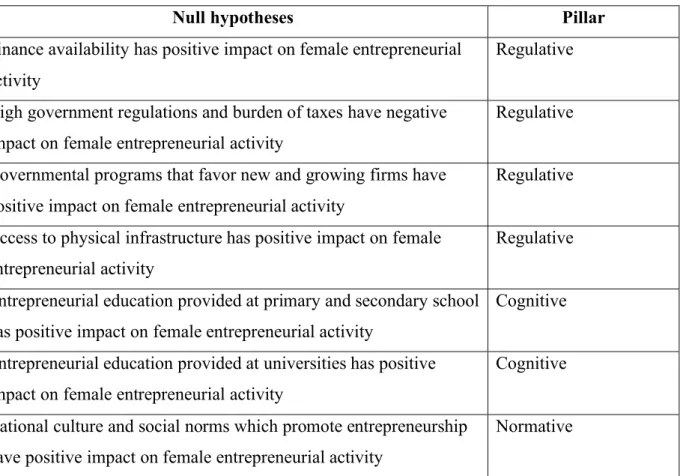
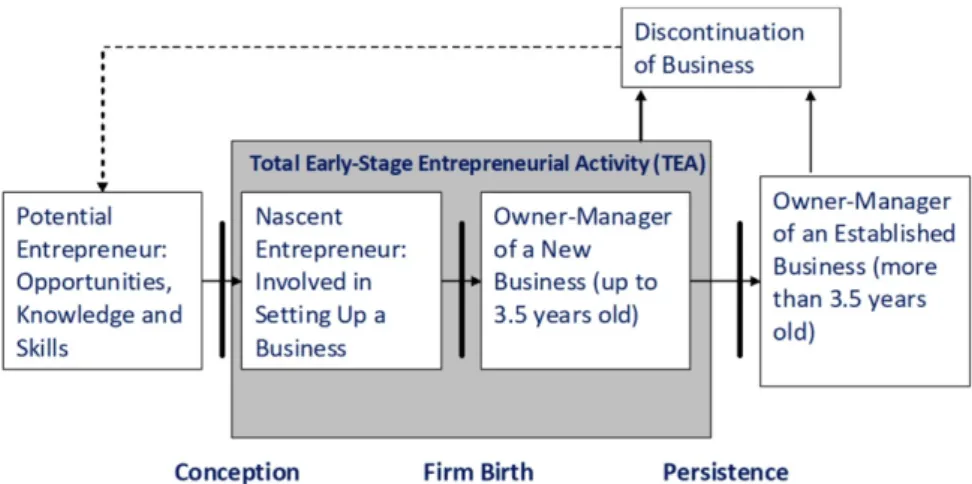
The dependent variable will be total female early-stage entrepreneurial activity (TEA) collected through the APS. In the table below, the description of the variables can be found with the corresponding institutional pillar. Thus, the following tests will be applied to select the most suitable model:.
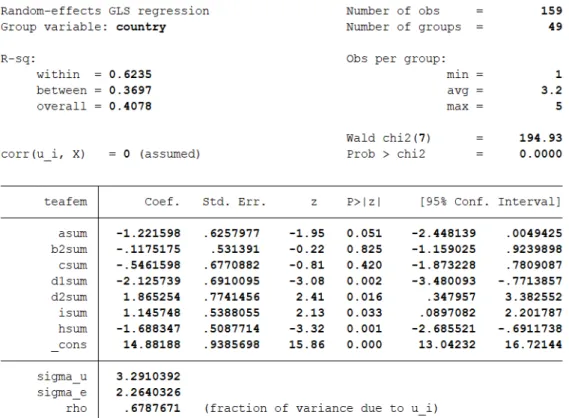
As can be seen from the STATA output, the Hausman test shows that the null hypothesis must be accepted. As can be seen in the output, multicollinearity is not violated as all the coefficients are below ± 0.5. It can thus be seen that the model is overall significant, and six factors have been shown to be statistically significant and have an influence on a dependent variable (proportion of women aged 18-64 who engage in early entrepreneurship).
After performing the Breush-Pagan Lagrarian test, it can be concluded that there is a heteroskedasticity and that simple Pooled OLS cannot be used. In this model, it can be seen that the model is again generally significant, and five factors appeared to be statistically significant and influence a dependent variable (proportion of women aged 18-64 involved in early stage entrepreneurship). In this model, it can be seen that the model is generally significant, and three factors appeared to be statistically significant and to influence a dependent variable (proportion of women in . the age of 18-64 involved in early-stage entrepreneurship ).
It can be seen that the results of efficiency-driven countries differ from those obtained for innovation-driven countries.
Discussion of the results and implications
Discussion of the results obtained
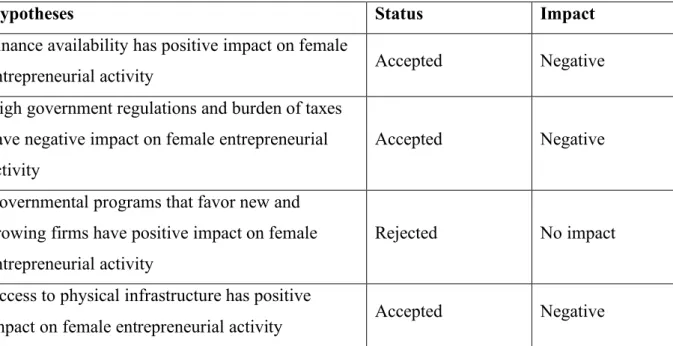
All in all, it can be concluded that women have limited access to the abundance of financial resources. This finding can be explained by the fact that efficiency-driven countries tend to have a heavier burden of bureaucratic procedures that new firms must go through. This can be explained by the fact that in this group of countries governments tend to have a lighter policy, they facilitate the process of new business creation, and support new and growing ones.
Thus, in general, we can conclude that high government regulations and taxes have a negative effect on the creation and development of new women-owned businesses, especially in efficiency-driven countries. This can be explained by the fact that government programs are usually not aimed specifically at female entrepreneurs, but at female entrepreneurs in general. Another reason for such a finding may be due to the type of data used to obtain this result.
This can be explained by the fact that TEA rates tend to increase with education level (GEM Women, 2019). Thus, taking into account the importance of education for women that was mentioned in the first part of this paper, it can be concluded that indeed women tend to get higher education first. This finding can be explained by the fact that education is closely related to national cultures, so the effect of entrepreneurial education on entrepreneurial intentions may vary in different countries (Bae et al., 2014).
Thus, it can be concluded that increasing the image of female entrepreneurship in society can greatly promote the creation and development of women-owned businesses.
Implications
Non-governmental programs: how business accelerators and technoparks affect the level of female entrepreneurship. The second part of the solution to the undercapitalization of female entrepreneurs is tailored financial tools. Taking into account some characteristics of female entrepreneurship, such as risk aversion and focus on social value creation, it can be concluded that the result of microfinance institutions' help will be twofold.
NGOs that support female entrepreneurship can become a gender bridge, connecting women with the necessary resources and building collaborative platforms that enable networking, communication and information exchange. Women entrepreneurship has been recognized to contribute to the overall economic and social welfare of society by reducing unemployment and increasing the gross domestic product of nations. The development of female entrepreneurship can thus improve the overall quality of life in nations.
Moreover, a number of articles confirmed that female entrepreneurship phenomena are unique and will be studied separately. After a thorough analysis of the existing literature on female entrepreneurship, a research gap has been identified. Thus, the aim of this paper was to provide a comprehensive overview of the impact of the institutional context on female entrepreneurship and to conduct a comparative analysis between innovation-driven and efficiency-driven countries by applying a quantitative method.
Considering the three pillars of the aforementioned framework, namely regulatory, cognitive and normative, as well as the characteristics of female entrepreneurship identified by the analysis of academic literature, seven factors were selected for further investigation in the models: availability of finance, government regulations and taxes, government programs, access to physical infrastructure, school entrepreneurship education, university entrepreneurship education and socio-cultural norms. From a theoretical point of view, the performed analysis partially covers the research gap in female entrepreneurship and provides the basis for further research. In addition, universities can foster female entrepreneurship by promoting interdisciplinary knowledge and developing soft skills.