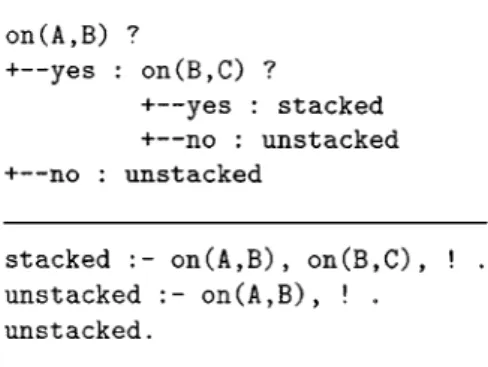
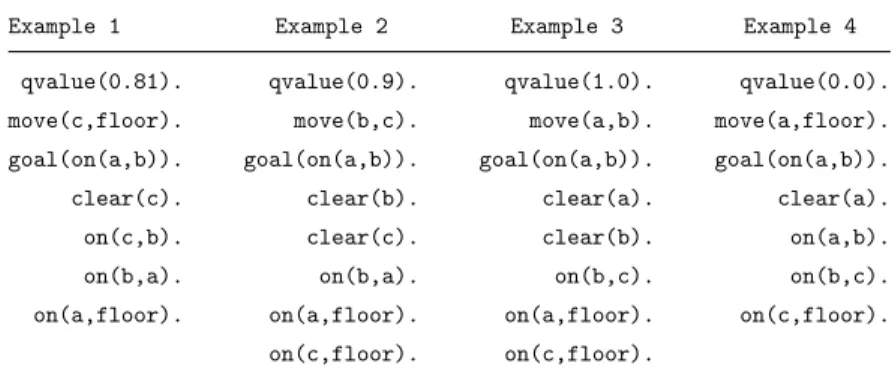
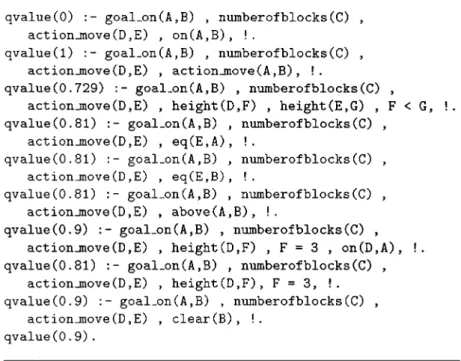
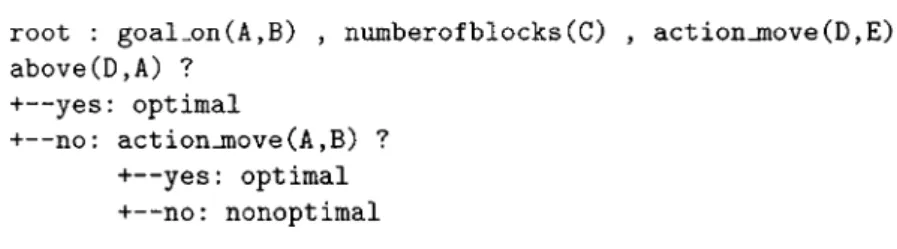
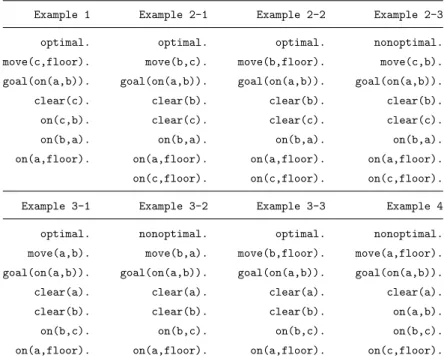
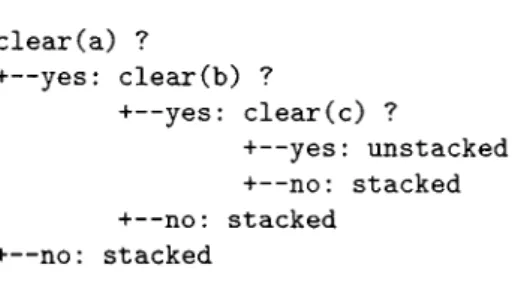
To make predictions with a decision tree, one starts at the root of the tree and applies the root's test to the example. Then you take the branch that corresponds to the result of the test in the example and propagate the example to the corresponding subtree. One then splits the data set according to the result of the test into the examples and propagates the examples to the resulting subtrees.
The other main difference is that logical decision trees use questions (Prolog) as tests on the internal nodes of the decision trees, e.g. on(A,c) (is there any block A in block c?). Because of the truncations, the various rules in the program behave like an if-then-else program. Then the tests considered in the subsequent branch of node(B,C) in Figure 2 will be (A,D),on(B,D)andon(C,D).
On the other hand, in the failing branch of the node(B,C), one would only think of(A,D) and of(B,D) because there is no point in referring to the variable C there. Background knowledge consists of the definitions of general predicates that can be used in the induced hypotheses.
Relational reinforcement learning 1. The need for relational representations
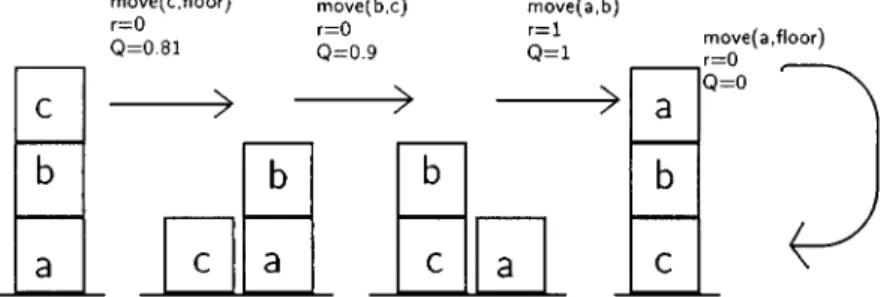
Applied to inductive logic programming, this means that it is important to specify the right predicates in the background knowledge. However, we would like to emphasize that RRL is a general approach and is applicable to domains other than scheduling in the block world. In the block world, you can move a block to another movement (A,B) or to the floor movement (A,floor).
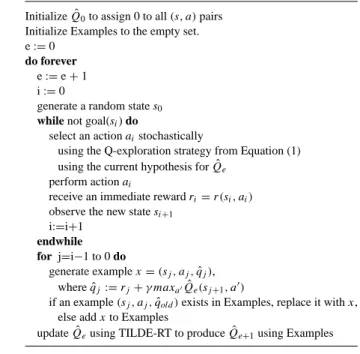
In the blockchain world, for example, we do not allow policies to refer to the exact identity of blocks. The main point where RRL differs from the algorithm in Section 3.2 is in the for loop where the Q-function is modified.ˆ. Because the root query succeeds for all instances, it propagates to all nodes in the decision trees.
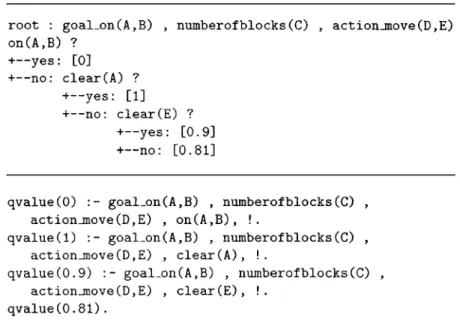
It is important to note that the individual blocks are not referenced directly in the tree itself, but only through the variables of the goal. The only difference between a logical decision tree and a logical regression tree is the information in the leaves.
Experiments
Moreover, when the number of blocks increases (after episodes 5 and 20) there is a temporary decrease in the performance of the learned policies (a small one for the P-trees and a more significant one for the Q-trees). As the number of blocks increases, the possible distance to the target also increases and the Q function must be adapted. Learning curves for three different targets in the block world, where the number of blocks is varied during learning.
The P-trees then abstract away from this number of blocks and the number of steps of the target. The ratio of the number of steps taken by the learned policy for on(a,b) and the optimal number of steps. The number of steps required to reach the goal is about double the optimal in late episodes.
The reason is that the Q-tree actually implicitly encodes the number of steps from the target state. For clear(a) this means that one must know the number of blocks that are above a. Learning curves for the target clear(a) for the world of blocks with a varying number of blocks during learning.
Learning curves for a goal at (a,b) in a world of blocks where the number of blocks changes during learning. There is also a big difference between the number of learning examples for different objectives. The reason for this is the large difference in the number of possible actions as one approaches the goal state.
This difference is the reason for the large difference in the number of learning examples for the different goals. Can P-RRL and Q-RRL learn optimal policy for state spaces with a fixed number of blocks. Can P-RRL and Q-RRL learn optimal policy for state spaces with varying number of blocks.
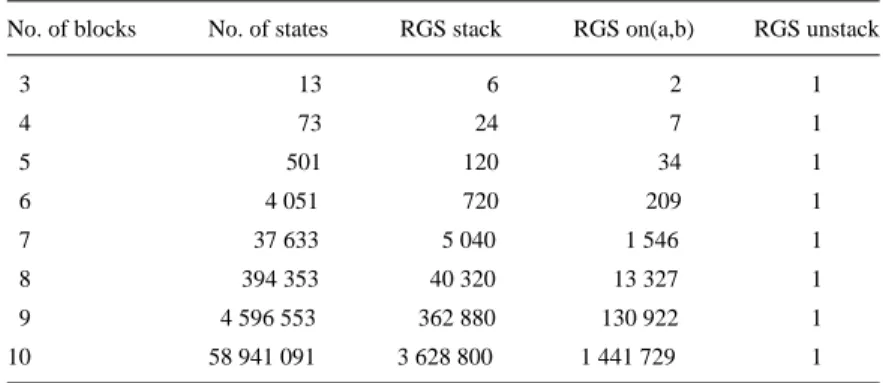
Can P-RRL and Q-RRL learn from experiences where the number of blocks is varied. Learning with a fixed number of blocks becomes increasingly difficult as we increase the number of blocks.
Discussion
Even for standard reinforcement learning, scaling up as the dimensionality of the problem increases can be a problem. However, the exact scaling behavior of relational reinforcement learning has yet to be determined experimentally. The experimental evaluation of our approach done so far is mainly intended to highlight the main advantages of using a relational representation for reinforcement learning.
The main contribution of our work is to address the generalization problem in reinforcement learning within a relational setting. The task of finding optimal plans within the block world was already considered by Langley in his book (Langley, 1996) to illustrate reinforcement learning. It was first proposed by Chapman's and Kaelbling's (Chapman & Kaelbling, 1991), who developed an incremental decision tree learning algorithm with special heuristics to handle concept drift (Widmer. & Kubat, 1998) in the reinforcement learning context.
The difference with relational reinforcement learning is that our approach is not dependent on a planner. The difference with relational reinforcement learning is that explanation-based learning relies on complete knowledge of the domain. Options are macro actions defined by a region of state space where execution can begin, a policy, and a termination condition.
We have taken a standard textbook description of reinforcement learning (Mitchell, l997) and incorporated an implementation of it into our approach. Other points where the reinforcement learning part could be improved include the initialization of the Q values and the exploration strategy. These problems are taken care of by Chapman and Kaebling's decision tree algorithm, which was designed specifically for reinforcement learning (Chapman & Kaebling, 1991).
A natural direction for further work is therefore to develop a first-order regression tree algorithm that combines the representations of TILDE-RT with the algorithm and performance measures of the approach by Chapman and Kaelbling. As mentioned above, options are macro actions defined by a region of the state space where execution can begin, a policy, and a termination condition. The TILDE and TILDE-RT algorithms are similar to classical decision trees except that only binary trees are induced and also that the calculation of the possible tests in a node may depend on the variables in nodes higher in the tree.
Background knowledge for TILDE
Also, when determining whether an instance satisfies a test, the tests higher up the tree must also be considered. Finally, the heuristics used by TILDE are the same as in C4.5, and those in TILDE-RT will minimize the variance of the target variable within each subnode and maximize the variance between two subnodes. Since the number of steps to the goal basically determines the function Q, the heights of the stacks and the differences between them and the number of blocks, their comparisons with constant values are allowed.
Since the optimality of actions does not depend on the number of steps to the goal, comparisons of heights and number of stacks with constants are not allowed. In the initial stages of this work, Luca De Raedt was supported by the Fund for Scientific Research of Flanders. The authors would like to thank Hendrik Blockeel for integrating TILDE and TILDE-RT into RRL, and Leslie Pack Kaelbling and Pat Langley for interesting discussions and suggestions regarding this work.
Finally, we would like to thank the referees for their patience, interest and suggestions, which helped to significantly improve the paper. The idea of experience iteration is to memorize all the experiences collected so far and repeatedly present them to the learning engines. Repetition of experience targets neural networks which will converge faster when processing evidence more than once.