Annual Report
2016/17
The year at a glance
This past year has been one of marked change as we have settled in to our new
accommodation on the Southmead Hospital site and adapted to a change in leadership. We have welcomed a closer connection with our clinical colleagues with Stef Ticehurst joining us as Clinical Lead and clinical SLTs contributing to our work through literature reviews and reliability assessments. These activities not only assist us in reaching our research objectives but enable those clinicians involved to get a taste of what it is like to work in a research capacity. In many cases, the work of the clinicians within BSLTRU will contribute to their individual plans to pursue applications for masters and doctoral fellowships alongside other funding, but also ultimately helps to build capacity in the unit.
Alongside these changes, BSLTRU has continued in its core function of bidding for research funding and carrying out research activity, with the ultimate aim of improving outcomes and life chances for individuals with speech, language and communication impairment. Our remit is broad and covers various client groups and topic areas, including child speech disorder, cleft palate, primary speech and language impairment, acquired aphasia and stammering.
During this time, we have supported three out of the four clinical SLTs who were successful in applications to the HEE/NIHR ICA Clinical Doctoral Research Fellowship Scheme and another who was successful in applying for a place on the Masters in Clinical Research. These PhD and masters students are now based part time in BSLTRU and supported by supervisors at the unit.
In addition, The Underwood Trust has continued to support us through infrastructure funding for which we are very grateful. In total, eight papers have been published and the impact of our research is demonstrated by our involvement with partners such as The Communication Trust and RCLST through which we are helping to inform evidence based clinical practice on the ‘CQ live’ online resource for SLTs. We are continuing to build on our collaborations and this last year has seen a new collaboration with colleagues in Portsmouth develop as well as an increase in the requests for PhD supervision.
Over the next year, we will develop our PPI
strategy, continue to submit high quality funding applications, work with our partners at North Bristol NHS Trust, the University of Bristol and UWE and continue to develop our profile and potential for impact in the field of speech, language and communication disorders.
Thank you for your support
Contents
1 BSLTRU Workforce 1
1.1 BSLTRU staff 1
1.2 Honorary staff and volunteers 1
1.3 Measures of esteem 3
2 Funding and Grant Applications 3
2.1 Infrastructure Grants 3
2.2 Research Grants 3
3 Project Updates 4
3.1 The RCSLT Speech, Language and Communication Needs (SLCN) Outcome Project: An Independent Evaluation
5 3.2 Exploring the involvement of children and young people with speech, language and
communication needs (SLCN) and their families in decision making: A research project.
6 3.3 RCSLT Online Outcome Tool (ROOT) for measuring outcomes: Proof of Concept Study.
Independent Evaluation
8
3.4 Aphasia Software Finder 9
3.5 A preliminary investigation into the effectiveness and cost-effectiveness of speech and language therapist led interventions for children with speech sound disorder versus programmes delivered by assistants
10
3.6 Collaborative work with the CLAHRC West with 2 components 11 3.7 COSTIS 1406: Enhancing children's oral language skills across Europe and beyond: a
collaboration focusing on interventions for children with difficulties learning their first language
11
3.8 Are mindfulness and other CBT techniques effective in improving communication in people with acquired, non-progressive aphasia?
12 3.9 Understanding the Causal Pathway for Persistent Speech Disorder 12
3.10 The Cleft Collective Speech and Language Study 13
4 Research Outputs and Engagement 15
4.1 Publications 15
4.2 Reports 17
4.3 Presentations and conferences 17
4.4 Public and patient involvement 20
4.5 Website 20
4.6 Social Media 21
5 Wider Impact of the work of the BSLTRU 21
Glossary of Terms 23
1 | P a g e
1. BSLTRU Workforce
1.1 BSLTRU staff
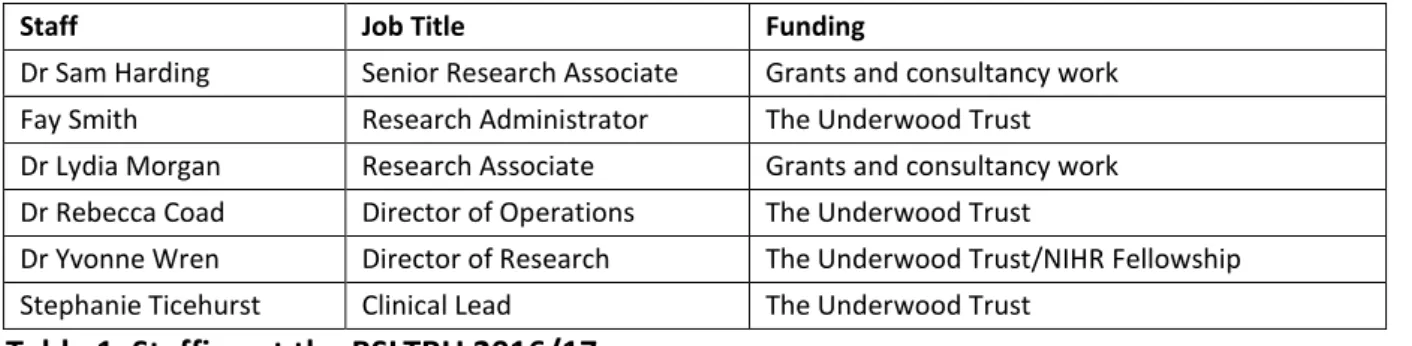
The BSLTRU has retained its skilled workforce over the last 12 months with the majority of staff working on a part time basis, equating to 3.19 whole time equivalent (WTE). In addition to working for the BSLTRU, Yvonne Wren also has a day a week of time funded through the University of Bristol, Rebeca Coad works for the Research and Innovation Office at North Bristol NHS Trust (NBT), Stephanie Ticehurst is the Professional Head of adult and Acute SLT Services for NBT and Lydia Morgan works as an SLT within the clinical team at NBT.
Staff Job Title Funding
Dr Sam Harding Senior Research Associate Grants and consultancy work Fay Smith Research Administrator The Underwood Trust Dr Lydia Morgan Research Associate Grants and consultancy work Dr Rebecca Coad Director of Operations The Underwood Trust
Dr Yvonne Wren Director of Research The Underwood Trust/NIHR Fellowship Stephanie Ticehurst Clinical Lead The Underwood Trust
Table 1. Staffing at the BSLTRU 2016/17.
1.2 Honorary Staff and Volunteers
We continue to work with our associate research leads to develop programmes of work in therapies and service delivery for children and young people with communication impairment (Sue Roulstone), technology to support aphasia (Brian Petheram) and effective therapies for stammering (Rosemarie Hayhow).
Staff Job Title Funding
Prof Sue Roulstone Emeritus Professor UWE Grants and consultancy work Dr Brian Petheram Associate BSLTRU member Grants and consultancy work Dr Rosemarie Hayhow Associate BSLTRU member Grants and consultancy work
Table 2. Honorary Associate staff at the BSLTRU 2016/17
In addition the BSLTRU has welcomed two new NIHR funded PhD students, co-supervised by Director of Research Yvonne Wren, who works between the unit and the University of Bristol:
Lucy Southby - Speech processing in children born with cleft palate and its
relationship to speech articulation at age 5. HEE/NIHR Integrated Clinical Academic Doctoral Fellowship. Registered at University of Bristol.
Sam Burr - The effect of different feeding methods and non-nutritive sucking behaviours on child speech development. HEE/NIHR Integrated Clinical Academic Doctoral Fellowship. Registered at University of the West of England.
2 | P a g e This year has also seen the establishment of more formal links with the clinical SLT service at North Bristol NHS Trust with clinical lead Stephanie Ticehurst undertaking a secondment to the BSLTRU for half a day a week. Through the charitable fund held by Stef we have been able to offer research placements to clinical SLTs, awarded through a competitive process and are pleased to be joined this year by Sophie Cottrell and Helen Spear.
Helen Spear will be undertaking patient public involvement exploring the process of awake craniotomy as well as looking at the clinical needs and adjustments required for working with patients during the actual awake craniotomy procedure.
Sophie Cottrell will be exploring impact of mindfulness and other cognitive behavioural approaches on the language performance of people with aphasia, through systematic review and PPI.
Hosting/supervisory/placements Supervised by
Lucy Southby NIHR fellowship University of Bristol Yvonne Wren & Carol Joinson (UoB)
Sam Burr NIHR fellowship University of the West of England
Yvonne Wren & Toity Deave (UWE)
Sophie Cottrell Research Placement NBT SLT Stephanie Ticehurst Helen Spear Research Placement NBT SLT Stephanie Ticehurst Table 3. Hosting and placements at BSLTRU in 2016/17.
The BSLTRU maintains a strong level of interest from students seeking volunteer work. This year we have hosted four volunteers who have supported the research team by undertaking data reliability checks and transcription. We have also employed Miriam Seifert, one of the SLTs from Bristol’s NHS Community Child Health Partnership, on a short term basis to contribute to reliability measures on one of Yvonne Wren’s fellowship studies.
Volunteers/short term workers Supervised by
Emma Hoggett Health Psychology student Sam Harding
Annie Mansfield SLT student Sam Harding
May Jacobson Deegan SLT student Sam Harding
Sarah Gibbin NBT SLT Yvonne Wren
Miriam Seifert CCHP SLT & Speech Masters student at University of Sheffield
Yvonne Wren Table 4. Volunteers and short term workers at BSLTRU 2016/17.
3 | P a g e
1.3 Measures of esteem
This year has seen several new ‘measures of esteem’ where staff have been externally recognised for their expertise, skills and achievements:
Wren Y. Appearance on BBC 2 World’s Weirdest Events programme, discussing language change following head injury
Wren Y. Interview on BBC radio promoting BBC2 programme
Wren, Y. invited to be Associate Editor of Folia Phoniatrica et Logopedica
Wren, Y. invited to be member of the Editorial Board of the journal Austin Psychiatry
Wren, Y. invited to be member of the Steering group committee member for Parent Led Articulation Therapy (PLAT) study – two centre randomised controlled trial
Wren, Y. invited to take on Chair of the Child Speech Committee of the International Association of Logopedics and Phoniatrics
Roulstone, S. Continues to sit on the steering groups for two RCSLT projects: National Outcomes Project; Children’s services project.
Ticehurst, S. Evidence Reviewer for the Methodology Group for the Royal College of Physicians Stroke Guidelines 2016
Wren, Y. on the organising committee for the 2017 RCSLT conference
Roulstone, S. invited to be on the Advisory Group for ‘Bercow: Ten Years On. (2017)
Roulstone, S. invited to participate in Afasic’s Knowledge Exchange day (January 2017).
Harding, S., Morgan, L. Nominated 'Striving for Excellence’ category of the People's awards at Research and Innovation, North Bristol NHS Trust event March 2016.
Coad, R. Nominated ‘Recognising the Person’ category of the People's awards at Research and Innovation, North Bristol NHS Trust event March 2016.
2. Funding and grant applications
The BSLTRU has been successful in pulling in new funding totalling £92,967 in 2016/17, made up of infrastructure and pump priming funding.
2.1 Infrastructure grants
The Underwood Trust has been a long term supporter of the BSLTRU and this continued into 2016/2017 through their agreement to provide funds to support the core admin and management function of the unit, to a total of £50,000. We are very grateful for the support of the Underwood Trust to enable us to further develop our research into speech, language and communication.
2.2 Research grants
This year has seen the submission of seven grants led by the BSLTRU, for a mix of pump- priming grants and project grants, to the ESRC, Leverhulme Trust and Royal Historic Palaces (evaluation project), with a 29% success rate, where the outcome is known.
4 | P a g e Both of the successful grants were for pump-priming funds from the Avon Primary Care Research Collaborative (APCRC) to develop new areas of work leading to larger grant applications the NIHR.
Wren, Y.E. & Morgan, L. A preliminary investigation into the effectiveness and cost- effectiveness of speech and language therapist interventions for children with speech sound disorder versus programmes delivered by assistants. APCRC RCF, Jul 2016,
£19,254. – work ongoing
Harding, S. The development of an evidence-based tool to support knowledge transfer to enhance parent’s engagement in speech and language therapy services.
APCRC, Feb 2016, RCF £6,393.00 - Complete. The work funded by this grant informed a NIHR Research for Patient Benefit (RfPB) application which was shortlisted to full stage.
The unit has continued to work collaboratively on grants and has been a co-applicant on three grant applications submitted this year, including a successful bid to the Nuffield Foundation, led by Solent NHS Trust.
Gibbard, D., Markham, C., Smith, C., Roulstone, S., Harding, S., Morgan, L. A randomised controlled trial of the effectiveness of parent-based models of speech and language therapy intervention for 2- to 3-year-old children with primary
language impairment in areas of social disadvantage. Nuffield Foundation, £17,320 for BSLTRU.
3. Project Updates
The BSLTRU staff have been busy working on 10 active projects this year of which three have been completed and the final reports submitted. A summary of these projects is provided below with outcomes where projects are complete.
29%
43%
29% Awaiting outcome (n=2)
Unsuccessful (n=3) Successful (n=2)
Chart 1. Grant activity summary 2016/17
5 | P a g e
Projects completed in 2016/17
3.1 The RCSLT Speech, Language and Communication Needs (SLCN) Outcome Project: An Independent Evaluation
Investigators: Sam Harding & Rebecca Coad Timelines: December 2015 - June 2016
Funder: Royal College of Speech and Language Therapists
This work was an independent evaluation, commissioned by the RCSLT, to evaluate the piloting of a new tool, nationally, for capturing outcomes. The evaluation sought to explore:
1) the practicalities of using the tool, 2) the benefits of the tool, 3) the potential of the tool to support Education Health and Care (EHC) plans, 4) how the tool could be developed.
The evaluation consisted of 2 phases, an online survey and telephone interviews, with people who had access to the tool. Fifteen people completed the survey and 12 participated in a telephone interview. Thematic analysis of the qualitative data was undertaken.
The findings of the evaluation were reported to the RCSLT and showed that feelings about the practicalities and the potential of using the tool were generally positive against the services who were piloting it. However they were moderated by the delayed development of the tool and participants’ limited ability to interact with it in its current iteration.
Information governance was cited as being the biggest limiting factor in the tool’s current use and in its future development and roll out. The benefits of the tool were identified as improving collaboration between services through: document sharing; improving evidence of the impact of services; and the ability to identify the individual agencies working with the child. The identified benefits translate to the tool’s potential ability to help with the
construction of EHC plans, through speeding up the process, improving the quality of the plans in setting targets and recording outcomes. Lastly, the interviewees identified some additional elements they would like to see in the tool and that they believe would enhance its usability.
Recommendations from the research
1. Production of information governance documents for services to facilitate their role in future tool development
2. Development of trial data sets which function across services
3. Development of a training package using the trial datasets for use by all services using the tool
Dissemination and impact
The findings of this evaluation will be used by RCSLT to inform the development of their outcome tool for SLCN.
6 | P a g e
3.2 Exploring the involvement of children and young people with speech, language and communication needs (SLCN) and their families in decision making a research project.
Investigators: Sue Roulstone, Sam Harding & Lydia Morgan Timescale: September 2015 - February 2016
Funder: The Communication Trust
The project collected data from small groups of children between the ages of 7 and 16 who had a range of SLCN (n-54). Children and young people were asked to talk about their experiences of starting school, learning in class, meetings, targets and people in school who are good at listening.
Telephone interviews were carried out with 16 parents; a further 100 parents from across England completed an on-line survey. These parents all had children who had a range of SLCN and were between the ages of 5 and 16 years of age. Parents were asked for their views on how their children had been involved in decisions about their individual support and their own experience of being involved in decision making around their child’s needs and services they accessed. Once the research was completed, two sets of stakeholders were asked for their views on the findings. The stakeholders included practitioners and officers from health and education services and members of a school council in a secondary school for children who have Statements or Education Health & Care Plans.
Recommendations from the research:
Knowledge of children and young people’s role in decision making
1. There is a need for accessible, relevant and interactive information to support children’s involvement in decisions. The materials needed to convey information about the process of involvement, the possibility and expectation that children and young people have a part to play and clear information about how they can express their preferences and wishes.
2. There is an ongoing need to work collaboratively with parents and parent
organisations to support parents’ awareness and understanding of the reformed SEND system and its impact on practice.
Relevant decisions
3. It would be useful for schools and/or services to conduct an analysis of the decisions made within their context in order to map the range of pupils that have been
actively involved in those decisions and to highlight if and where children and young people with SLCN are being left out or even excluded.
4. There is a need to identify the most appropriate level of involvement in decisions for any individual child or young person. This requires practitioners and parents to understand the different levels of involvement in decision making so that the most appropriate level can be selected, in association with the child or young person and with their parents.
7 | P a g e
Dissemination and Impact:
The research report was emailed out to The Communication Trust’s newsletter audience – that is 25,000 people who are interested in children and young people’s speech, language and communication.
It was also sent it to the 52 member organisations of The Communication Trust and their 273 Local Champions who work across England to support children and young people with SLCN.
The research findings went directly to the Department for Education at the end of March 2016. They are able to read the report, ask questions they have about it and find out how many people have been using it in their work.
Copies of the executive summary were taken to the Education Show (9000 people attend) and Nasen Live (1000 people attend). This was an excellent way for people who might not know so much about SLCN to find out more about the perspectives of children and young people with SLCN, and their families, on decision making and involvement.
The findings from the report have helped The Communication Trust (TCT) to write a toolkit for people who work in schools and colleges to help them with useful ideas and activities to better involve children and young people with SLCN. This toolkit is available on the TCT website. This is a really important way of turning the information provided by the children, young people and parents who took part in the research into practical support for teaching and school staff.
TCT will ensure that they use all the really useful information from the children, young people and parents in the future work of TCT.
The full report has been downloaded more than 45 times from TCT website.
Responsive to children and young people’s preference
5. Account should be taken of the child or young person’s preference regarding their level of involvement.
6. Processes of involvement should involve action and physical movement to support their level of engagement with the process.
7. There is a need to make the short term steps (or targets) between a child’s current achievement and their potential longer term outcomes more explicit so that everyone understands the purpose of a short term target, where it is leading and what future achievement will be.
8. Teachers and parents should work together with children and young people to identify manageable and timely processes to set targets collaboratively.
8 | P a g e
3.3 RCSLT Online Outcome Tool (ROOT) for measuring outcomes: Proof of Concept Study. Independent Evaluation
Investigators: Sam Harding & Rebecca Coad Timescale: July 2016 - November 2016
Funder: Royal College of Speech and Language Therapists
This work was commissioned by the RCSLT to undertake an independent evaluation of a pilot project developing and implementing an online outcome tool. The application records Therapy Outcome Measure (TOM) data and can generate reports to support practitioners and services to assess the impact of speech and language therapy across services and clinical disorders.
The evaluation consisted of two phases: an online survey and telephone interviews, with people who had been involved with leading the pilot project in their work setting.
Descriptive statistics were derived on survey data where suitable and thematic analysis of the qualitative data was undertaken. Twenty-eight people completed some or all of the online survey and five participated in a telephone interview.
This consultancy sought to explore five elements of the developed RCSLT Online Outcome Tool (ROOT): 1) the usability of the ROOT, 2) the foundations needed to enable services to use the ROOT, 3) the challenges and benefits of the ROOT, 4) the potential of the ROOT and 5) how the ROOT could be developed.
Feelings about the practicalities and the potential of using the ROOT were positive. The biggest impact being the ability to generate evidence based reports where a service can identify gaps in services and the impact of resources. This information could also be used to compare services and inform commissioners. The biggest hurdle to enabling greater
informed comment on the potential of the ROOT is the limited amount of time and contact any one person has had due to the challenges faced by the RCSLT team in setting up ROOT access with each service. Even with minimal contact the users have been able to identify some additional elements they would like to see in the tool, that they believe would enhance its usability. Lastly, it was identified that services will need to develop ongoing training for new staff to ensure accurate and reliable data is being coded and recorded. This could be aided with inclusion of web-based training modules.
The overwhelming message from the online survey and the interviews was that this pilot project is a great initiative to be supported by the RCSLT, but that the sites need more time to be able to generate reports and prove their usefulness with service commissioners.
9 | P a g e
Active projects 2016/17
3.4 Aphasia Software Finder
Investigators: Brian Petheram and Sarah Woodward Funder: The Tavistock Trust
Timelines: 2009-2020
The aim of this project is to provide a web based resource that will enable both
professionals and people with aphasia or their carers to find the most suitable apps or programs to support their particular needs in relation to aphasia rehabilitation. The project is funded by the Tavistock Trust for Aphasia with support from the Eranda Rothschild
Foundation. The project is coordinated by Nicole Campbell of the TTA; Brian Petheram is the BSLTRU lead and Sarah Woodward is the SLT lead.
This project is necessary due to the proliferation of aphasia apps of varying quality and the overall lack of other support in matching the available resources to the individual needs of a particular person with aphasia. It has been designed to be as “aphasia friendly” as possible but there also includes resources aimed at SLT professionals.
This year has been an exciting one for the ASF as it has been completely rewritten and redesigned to reflect both the proliferation of apps that are becoming more prevalent than traditional software packages, and also the increasing use of mobile devices such as smart phones and tablets which make very different demands on web sites.
Recommendations from the research
1. More time to embed in services - The use of the ROOT is well received, but more time is needed for it to be embedded into services in order to generate meaningful reports and comment on the usefulness or otherwise
2a. Embed all current TOMs scales into the ROOT
2b. Outside of the pilot project it was recognised that a greater number of disorder specific TOMs scales are required
3. A meeting or conference for those involved in the pilot to talk about lessons learnt and ways forward
4. Mapping of service codes with ICD10 coding or similar to standardise the use of clinical terminology
Dissemination and impact
The findings of this evaluation will be used by RCSLT to inform the development of the ROOT tool for measuring outcomes in SLT.
10 | P a g e
https://www.aphasiasoftwarefinder.org/
3.5 A preliminary investigation into the effectiveness and cost-effectiveness of speech and language therapist led interventions for children with speech sound disorder versus programmes delivered by assistants
Investigators: Yvonne Wren, Lydia Morgan and Rebecca Kandiyali Timelines: October 2016 - October 2017
Funder: APCRC RCF
SLT provision for children with speech sound disorder is sometimes in the form of generic programmes which have been written by SLTs and are delivered by therapy or teaching assistants. In other services, intervention is provided direct from SLTs. Decisions regarding which way to provide services for these children is typically led by service constraints and caseload demands rather than robust research evidence.
It is currently unknown whether intervention for children with speech sound disorder is more or less effective or efficient when delivered by a qualified SLT or by an assistant delivering a generic programme. The aim of this project is to undertake a retrospective analysis of assessment data to compare the outcomes and costs for the two types of provision from two services: Weston Area Health Trust and Torbay and South Devon Trust.
This study will also identify the range of programmes being used with children with speech sound disorder throughout the UK and complete a preliminary literature review to guide plans for a more detailed systematic review of the literature.
To date ethics approval for the study has been gained, and consent forms/information packs have been sent out for one of the sites. A survey has also been drafted to establish more about the programmes being used for children with speech sound disorder. Finally, literature searches have been conducted and a preliminary review of existing studies undertaken.
The findings from all three parts of the study will be used to provide the background data for applications for NIHR funding for a trial comparing the two approaches.
Data shows that there were 28,307 sessions in total for the Aphasia Software Finder over the last 12 months and 20,570 users, of which 72% were new users and 28% returning visitors, with an average session lasting 3.2 mins.
11 | P a g e
3.6 Collaborative work with the CLAHRC West with 2 components
a) The impact of child language impairment on educational outcomes.
b) Ethnicity and representation on service caseloads Investigators: Kate Northstone, Sue Roulstone, Yvonne Wren.
Timescales: 2016-2107
Funder: None (access to support through CLAHRC)
Support was negotiated from CLAHRC that will support future applications from BSLTRU that build on our speech and language research with ALSPAC and on Child Talk (NIHR PGfAR completed in 2015).
a) To complete small scale analyses of ALSPAC data that will lead to publications and future studies applications for funding for further investigation of speech and language development and disorder within the ALSPAC cohort.
b) To examine access and take up of local speech and language therapy services by diverse populations relative to speech, language and communication needs as identified in the National Pupil Database.
The research proposal has been submitted and approved by ALSPAC. Data was requested and received from the National Pupil Database. A request has been made for local data about children’s speech and language therapy services for Bristol and South Gloucester.
Unfortunately, this coincided with the move of these services to Bristol Community Health Partnership and we are waiting to discover whether we will be able to access these data.
3.7 COSTIS 1406 Enhancing children's oral language skills across Europe and beyond: a collaboration focusing on interventions for children with difficulties learning their first language
Investigators: Led by Prof James Law, Newcastle university, with 27 European partners. Sue Roulstone is one of the 2 invited UK researchers on the ‘Membership Committee’.
Timescale: April 2015 – March 2018.
Funder: European Union (The COST action funds expenses to attend the meetings but does not fund salaries or research per se).
Evidence to support intervention for children with developmental language disorder (DLD) is not well disseminated and services are inconsistent across Europe. The Action aims to enhance the science in the field, improve the effectiveness of services for children with DLD and develop a sustainable network of researchers well placed to answer the key questions in this area.
Sue Roulstone was invited as one of the two UK researchers on the ‘Membership
Committee’. Sue has presented work from the Better Communication Research Programme and from Child Talk at three meetings and was part of the teaching team at two training schools, show-casing methods used in Child Talk (an approach to systematic reviewing;
12 | P a g e qualitative methods for eliciting practice knowledge). BSLTRU has hosted a COST Action Short Term Scientific Mission (STSM) for a speech & language therapy researcher from Croatia. The purpose was to design a pilot project to replicate methodology used in Child Talk to investigate discharge, dosage and working with parents in Croatia. The pilot will run in Croatia from January – November 2017. It is hoped that the pilot will be followed by a European collaboration to seek funding to investigate speech & language therapists’
decisions regarding discharge, dosage and working with parents.
3.8 Are mindfulness and other CBT techniques effective in improving communication in people with acquired, non-progressive aphasia?
Investigator: Sophie Cottrell Timeline: Nov. 2016 – Nov. 2017
Funder: Southmead Hospital Charity - PAT fund (Stephanie Ticehurst)
Clinical practice tells us that anxiety has a significant impact on communication for people with aphasia. There is a substantial body of evidence in support of mindfulness-based approaches for a number of health and psychological conditions, including anxiety (e.g.
Kabat-Zinn et al. 1992). If anxiety can be more effectively managed, we might speculate that communicative effectiveness will be enhanced. Furthermore, mindfulness has also been shown to have a positive impact on attentional skills, which in turn have been shown to be compromised in people with aphasia.
A systematic review will be carried out in order to identify studies which investigate the impact of mindfulness and other cognitive behavioural approaches on the language performance of people with aphasia.
In addition, PPI activities are planned to explore the experiences and perceptions of people with aphasia in order to guide research questions at this early stage in the process. A group session has already been carried out consulting with 15 people who attend a local stroke group and further group and one-to-one sessions are planned.
3.9 Understanding the Causal Pathway for Persistent Speech Disorder
Investigators: Yvonne Wren, Paul White, ALSPAC Timescale: 2012-2017
Funder: NIHR Postdoctoral Fellowship
Children with speech sound disorder make up the largest single group referred to speech and language therapy services throughout the UK with over 38,000 children referred each year. While prevalence is high in the younger years at 16% of three year olds , as many as three quarters of these children will have typically developing speech by the time they start school. However, when problems persist beyond age 5, children are more likely to be bullied
13 | P a g e and have difficulties being understood and making friends than their peers and are at risk of low outcomes in education and employment.
Currently, there is no way to identify which children who present to speech and language therapy clinics at age 3 with delayed speech will have persistent speech disorder beyond age 5. The aim of this work is to use data from a population cohort study, the Avon Longitudinal Study of Parents and Children (ALSPAC), to identify risk factors which are associated with persistent speech disorder at age 5. These risk factors could then be used by clinical speech and language therapists to identify children who are at risk of persistent speech disorder and to prioritise them for early intervention.
Previous work for this study has involved the phonetic transcription of the speech recordings of over 700 5-year-old children. Analyses of these transcriptions have been carried out providing measures of speech accuracy and the primary outcome measure of percentage consonants correct. Over the past year, variables from the ALSPAC data set which are potential risk factors have been identified. A study specific dataset containing these variables for the 700+ children whose speech recordings have been phonetically transcribed and analysed has been obtained from ALSPAC. Regression analyses are ongoing to determine which of these variables are most important in identifying children at risk of persistent speech disorder.
3.10 The Cleft Collective Speech and Language Study
Investigators: Yvonne Wren, Sam Harding, Lydia Morgan, The Cleft Collective Team Timescale: 2012-2017
Funder: NIHR Postdoctoral Fellowship
Children born with cleft palate are at high risk of persistent speech disorder with 44%
children showing ongoing difficulties with their speech at age 5. As with speech disorder in the non-cleft population, it is currently not possible to predict which children are likely to have persistent rather than transient problems with their speech. Working with colleagues on a cross-sectional study of 248 non-syndromic children with unilateral cleft lip and palate (Cleft Care UK), considerable progress has been made towards the identification of risk factors for PSD in children born with cleft palate. However, this study is limited to a subgroup of the population. A larger, longitudinal and more inclusive study is needed to fully explore the risk factors for PSD in this population.
The Cleft Collective Speech and Language Study (CC-SL) is a national cohort study of children born with cleft palate in which data on speech and language and relevant risk factors are being collected. Carried out in partnership with the £2.4million funded joint University of Bristol/University of the West of England/Scarfree Foundation Cleft Collective Cohort studies, it is currently recruiting from 10 out of a maximum 17 clinical sites with a further
14 | P a g e four awaiting local site approval. At the time of writing, over 350 participants have been recruited to the CC-SL study with recruitment increasing month on month.
The CC-SL study is collecting data on a range of potential risk factors including parent-child interaction, infant vocalisations, the audio environment, SLT assessments at 18, 24 and 36months and hearing. Other important variables are available from the Cleft Collective Birth cohort (e.g. demographics, psychology, syndromic status, genetics, type/size of cleft, surgical interventions). This is an extensive dataset that is unprecedented in terms of its size and scale, and will be a unique resource which will be made available for other researchers and clinicians to access.
15 | P a g e
4. Research Outputs
4.1 Publications
The unit has maintained a strong record of publishing both as lead and co-authors this year with eight publications and four articles in press in respected journals for the field. In addition, one book chapter, written by members of BSLTRU with collaborators from the Sound Start study, is in press.
Invited Publications
Wren, Y.E. & Enderby, P.E. (2016) Speech, Language and Communication
Impairments - How the Practice Nurse Can Help. Nursing in Practice 91, 11th August, 2016. http://www.nursinginpractice.com/article/speech-language-and-
communication-impairments-%E2%80%93-how-practice-nurse-can-help
Publications
Lyons, R. & Roulstone, S. Labels, identity, and narratives in children with primary speech and language impairments. International Journal of Speech and Language Pathology, early online. [2015 Web of Knowledge Impact Factor 1.239, Scopus rank:
28/57 Speech and Hearing]
Sullivan, S., Hollen, L., Wren, Y., Thompson, A., Lewis, G. & Zammit. S. (2016). A longitudinal investigation of childhood communication ability and adolescent psychotic experiences in a community sample. Schizophrenia Research, 173, 54-61.
[2015 Thomason-Reuters Impact Factor 4.453, Rank: 25/142 Psychiatry 2015]
Klatte, I. & Roulstone, S. (2016) . The practical side of working with parent-child interaction therapy with preschool children. Child Language Teaching and Therapy ,
8
4 3
4
Published In press Submitted Rejected
Chart 2. Publication summary 2016/17
16 | P a g e 32, 345-359 [2015 Web of Knowledge Impact Factor 1.025, Scopus rank: 27/57 Speech and Hearing]
Wren, Y., Miller, L.L., Peters, T., Emond, A. and Roulstone, S., (2016). Prevalence and Predictors of Persistent Speech Sound Disorder at Eight Years Old: Findings From a Population Cohort Study. Journal of Speech, Language and Hearing Research, 59, 647-673. [2015 Web of Knowledge Impact Factor 2.072, Scopus rank: 12/57 Speech and Hearing]
Wielaert, S., Berns, P., Sandt-Koenderman, M, Dammers, N. & Sage, K. (2016). ‘Now it is about me having to learn something...’ Partners’ experiences with a Dutch conversation partner training programme (PACT). International Journal of Language and Communication Disorders, 52, 143-154. [2015 Web of Knowledge Impact Factor 1.471, Scopus rank: 13/57 Speech and Hearing]
Marshall, J., Harding, S., & Roulstone, S. Language development, delay and intervention – the views of parents from under-served communities in England.
International Journal of Language and Communication Disorders, early online. [2015 Web of Knowledge Impact Factor 1.471, Scopus rank: 13/57 Speech and Hearing]
McLeod, S., Crowe, K., Masso, S., Baker, E., McCormack, J., Wren, Y., Roulstone, S. &
Howland, C. Profile of Australian preschool children with speech sound disorders at risk for literacy difficulties. Australian Journal of Learning Difficulties, early online.
[2015 ResearchGate Impact Factor 0.72]
In Press
McCormack, J. M., Baker, E., Masso, S., Crowe, K., McLeod, S., Wren, Y., Roulstone, S, Implementation fidelity of a computer-assisted intervention for children with speech sound disorders. International Journal of Speech and Language Pathology.
[2015 Web of Knowledge Impact Factor 1.239, Scopus rank: 28/57 Speech and Hearing]
McLeod, S., Elise Baker, J., Wren, Y., Roulstone, S, Crowe, K, Masso, S., White, P., Howland, C. Cluster Randomized Controlled Trial Evaluating the Effectiveness of Computer-Assisted Intervention Delivered by Educators for Children with Speech Sound Disorders. Journal of Speech, Language and Hearing Research. [2015 Web of Knowledge Impact Factor 2.072, Scopus rank: 12/57 Speech and Hearing]
McLeod, S., Crowe, K., McCormack, J., White, P., Wren, Y., Baker, E., Masso, S., Roulstone, S. Preschool children’s communication, motor and social development:
What concerns parents and educators? International Journal of Speech and Language Pathology. [2015 Web of Knowledge Impact Factor 1.239, Scopus rank:
28/57 Speech and Hearing
Crowe, K., Cumming, T., McCormack, J., Baker, E., McLeod, S., Wren, Y., Roulstone, S. & Masso, S. Educators’ perspectives on facilitating computer-assisted speech intervention in early childhood settings. Child Language Teaching and Therapy. [2015 Web of Knowledge Impact Factor 1.025, Scopus rank: 27/57 Speech and Hearing]
17 | P a g e
4.2 Reports
Three reports published by the BSLTRU this year have been the final reports of evaluation projects commissioned by the RCSLT and The Communication Trust. These pieces of work were awarded to the unit following successful tendering bids and highlight the reputation the unit has for conducting high quality research.
Harding, S. & Coad, R. The RCSLT Speech, Language and Communication Needs (SLCN) Outcome Project – An Independent Evaluation. London: Royal College of Speech and Language Therapists. June 2016
Roulstone, S., Harding, S., Morgan, L. Exploring the involvement of children and young people with speech, language and communication needs and their families in decision making – a research project. London: The Communication Trust report Feb 2016
Harding, S. & Coad, R. Supporting and informing speech and language therapy services using the RCSLT Online Outcome Tool (ROOT) for measuring outcomes:
Proof of Concept Study – Independent Evaluation. London: Royal College of Speech and Language Therapists. Nov 2016
4.3 Presentations and conferences Invited presentations
Roulstone, S. (January 2016) ‘Learning to talk’. Flying Start conference Cardiff.
(Welsh Office funding)
Harding, S. (February 2016) UWE Prof Doc Health Psychology Evaluation in Consultancy
Roulstone, S. (April 2016) ‘Evidence-based practice and the implications for service’
Iceland Children’s services conference, Reykjavik.
Roulstone, S. (April 2016) ‘Knowledge Elicitation’. Presentation to COSTIS1406, Cyprus.
Hayhow R, (June 2016). Keynote 'Reflections on changes and choices over four decades'. The Roberta Williams Memorial Lecture, London.
http://www.city.ac.uk/health/about-the-school/division-of-language-and- communication-science/the-roberta-williams-memorial-lecture
Wren, Y. (July 2016) ‘The causal pathway of persistent speech disorder’. London Speech Clinical Excellence Network.
Wren, Y.E. (July 2016) ‘Speech sound acquisition in children growing up in multilingual environments’. Symposium – Language learning and bilingualism:
Cognition Institute Conference, Plymouth, UK.
Wren, Y. (July 2016) ‘Speech and Language in ALSPAC’. ESRC funded Seminar Series:
Born Talking, University of Bristol.
18 | P a g e
Wren. Y. (August 2016) The Cleft Collective Speech and Language Study: A UK National Cohort Study. International Association of Logopedics and Phoniatrics Conference, Dublin, Ireland
Wren. Y. (August 2016) How should we measure children’s connected speech? Using population data to determine which tool to use. International Association of
Logopedics and Phoniatrics Conference, Dublin, Ireland
Wren. Y. & Roulstone, S. (August 2016). Computerised intervention to support children’s speech (Panel), International Association of Logopedics and Phoniatrics Conference – Dublin, Ireland
Roulstone, S. (October 2016) Knowledge Elicitation. European COST Action meeting.
Cyprus
Roulstone, S. (December 2016) Involving parents and children. BANES SEND conference. Keynsham. (Based on the report to The Communication Trust, 2016
Roulstone, S. (January 2017) Qualitative methods and knowledge elicitation.
Training session for European COST Action In Aalborg, Denmark.
Wren, Y.E. (February 2017). Who’s talking? Using Birth Cohort data to understand the risk factors for persistent speech disorder. University of Portsmouth, UK.
Wren, Y.E. (May 2017) Risk factors for persistent speech disorders, Scottish Clinical Excellence Network, University of Strathclyde, Glasgow
Wren, Y.E. (November 2017) The Causal Pathway for Persistent Speech Disorder.
University of Ulster.
Wren, Y.E. (April 2018) Keynote speaker – The Craniofacial Society of Great Britain and Ireland Annual conference. Birmingham, UK.
Paper Presentations
Wren, Y.E., Moar, K., Slator, R., Richard, B., Bennett, R., Rumsey, N., Sandy, J. (April, 2016) Surgical practice in the UK Cleft Collective Birth Cohort study. Craniofacial Society of Great Britain and Ireland, Nottingham, UK.
McLeod, S., Baker, E., McCormack, J., Wren, Y., Roulstone, S., Crowe, K., & Masso, S.
(May 2016). Sound Start Study: Randomised controlled trial of software to enhance preschoolers' speech and pre-literacy skills. Speech Pathology Australia National Conference, Perth, Australia.
McCormack, J., Baker, E., Masso, S., McLeod, S., Crowe, K., Wren, Y., Roulstone, S.
(May 2016). Sound Start Study: Implementation of a computer-assisted intervention for children with speech sound disorders in Australian preschools. Speech Pathology Australia National Conference, Perth, Australia.
Baker, E., McLeod, S., Masso, S., Crowe, K., McCormack, J., Wren, Y., Roulstone, S.
(May 2016). Sound Start Study: The print knowledge of preschool children with speech sound disorders before and after intervention targeting speech and pre- literacy abilities. Speech Pathology Australia National Conference, Perth, Australia.
19 | P a g e
Wren, Y. (June 2016). Which measure is best? Use of population data to determine a suitable measure of children’s connected speech production. ICPLA (International Clinical Phonetics and Linguistics Association) conference, Halifax, Nova Scotia, Canada
McLeod, S., Baker, E., McCormack, J., Wren, Y., Roulstone, S., Crowe, K. & Masso, S.
(June 2016). Randomized controlled trial of Phoneme Factory Sound Sorter software addressing preschool children’s speech and pre-literacy skills. International Clinical Phonetics and Linguistics Association, Halifax, Canada.
McLeod, S., Baker, E., McCormack, J., Wren, Y., Roulstone, S., Crowe, K. & Masso, S.
(August 2016).Sound Start Study: A community-based randomized controlled trial of Phoneme Factory Sound Sorter. International Association of Logopedics and Phoniatrics, Dublin, Ireland.
Crowe, K., Cumming, T., McCormack, J., McLeod, S., Masso, S., Baker, E., Wren, Y., Roulstone, S., & (August 2016). Sound Start Study: Early childhood educators' experiences of implementing Phoneme Factory Sound Sorter. International Association of Logopedics and Phoniatrics, Dublin, Ireland.
Masso, S., Crowe, K., McLeod, S., Baker, E., McCormack, J., Wren, Y. & Roulstone, S.
& White, P. (October 2016). We need to talk about talking: Parents and educators’
concerns in the year before school. Early Childhood Education conference, Darwin, Australia.
McLeod, S., Baker, E., McCormack, J., Wren, Y., Roulstone, S., Crowe, K., Masso, S., (November 2016) Giving preschool children a sound start: A randomised controlled trial of Phoneme Factory Sound Sorter. American Speech-Language and Hearing Association Convention, Philadelphia, USA.
Crowe, K., Cumming, T., McCormack, J., Baker, E., McLeod, S., Wren, Y., Roulstone, S., Masso, S., (November 2016) Implementing computer-based intervention for children with speech sound disorder in early childhood settings: educators’
perspectives. American Speech-Language and Hearing Association Convention, Philadelphia, USA.
Y. Wren, L. Southby, A. Davies and The Cleft Collective Research Team (April 2017) Patterns of consonant production at 13 months old in children born with cleft palate:
Preliminary findings from the UK Cleft Collective Cohort Studies. Craniofacial Society of Great Britain and Ireland, Newcastle, UK.
Roulstone, S. Zwitserlood-Nijenhuis, M., Wiefferink, C., Harding, S., Goldbart, J., Klatte, I., & Davies, K. (July 2017) Symposium: An exploration of parent-child interaction therapy - IASCL Lyon, France.
Harding, S., Goldbart, J. Roulstone, S. (July 2017) A critical analysis of the evidence basis of parent-child interaction therapy - IASCL Lyon, France.
Klatte, I., Roulstone, S. (July 2017) Speech & language therapists’ perceptions of parents’ engagement in parent-child interaction therapy- IASCL. Lyon, France.
Davies, K. (July 2017) Changes in parents’ conceptions of roles during their children’s speech and language intervention- IASCL. Lyon, France.
20 | P a g e
Poster presentations
Harding, S. (April 2016) Seeking the views of preschool children with language impairment: Methodological challenges. Conference #CountMeIn - Plymouth, UK.
Harding, S. (April 2016) Capturing the impact of involving parents of children with primary speech and language impairment, as research partners in ‘Child Talk’.
Conference #CountMeIn - Plymouth, UK.
4.4 Public and Patient Involvement
The BSLTRU continues to actively engage with members of the public and patients to ensure that our activities are relevant and meaningful to the people that matter.
Over the last 12 months we have worked with local patients and members of the public through our ‘Child Talk’ parent group, the Cleft Lip and Palate Association and Cleft
Collective patient group as well as the Bristol branch of Parkinson’s UK to develop research ideas and deliver our research programmes. The aim for the next twelve months is to broaden our public and patient representation through use of social media to engage with patient groups, both in PPI activities and for recruitment into research studies and to continue to develop relationships with relevant patient groups and communities. The BSLTRU is also planning to hold a public and patient engagement event later in the year to bring together people with an interest in the research which we undertake to gather ideas and develop collaborative research applications.
4.5 Website
In 2017 we are planning to integrate the existing BSLTRU website content into a hub within the North Bristol NHS Trust’s (NBT) website. We have been working with the web team at NBT to create an accessible, innovative web site for the unit which will be managed through NBT but allow the research team to create and add content. This exciting new project will refresh the current ‘look and feel’ of the website, increase functionality and also raise the profile of the unit as a part of NBT, whilst redirecting users who try to access us at our old web address.
Current Website NBT website
www.speech-therapy.org.uk www.nbt.nhs.uk/BSLTRU
21 | P a g e The data on our current website usage shows that in 2016/17 we had 70,931 sessions on our website from 54,504 users (numbers are similar to 2015/16). There was an increase in first time visitors to the website over the last 12 months. It is hoped that the new website will attract more visitors and we will monitor this data following the new website launch.
4.6 Social Media
The BSLTRU has active social media accounts with a relatively small but targeted worldwide audience of key professionals, collaborators and colleagues as well as members of the public. These social media streams are an important way to help us to stay connected with the local, national and international speech and language therapy community as well as providing a route of public engagement activities and recruiting to research studies.
Ways to engage with us on social media
Our Facebook page saw a 42% increase in engagements over 2016/17 from the previous year and increase in likes/membership of 33%. Engagement rate is the percentage of people who saw a post that liked, shared, clicked or commented on it. Our twitter following also saw an increase in followers of 28% (total 1,073).
5. Wider Impact of the work of the BSLTRU
At the BSLTRU we capture the outcomes of our work through grants awarded, publications and wider dissemination and engagement but also through the wider impact that our work is having with regard to clinical practice and new collaborative activity.
This year, we have seen our work being recognised by the RCSLT in RCSLT ‘CQ live’ ( the online professional guidance for SLTs to support them to keep HCPC standards). The CQ live has published a list of resources for SLTs to find evidence about therapy under the heading of ‘Identifying outcomes that matter – review the outcome literature.’ The top two projects listed are outputs from the BSLTRU (July 2016).
https://www.rcslt.org/cq_live/introduction
https://www.facebook.com/BSLTRU/
@Bristol_SLTRU
Bristol Speech and Language Therapy Research Unit http://bsltru.blogspot.co.uk/
https://www.linkedin.com/company/bristol -speech-and-language-therapy-research- unit
22 | P a g e In November 2016 Sue Roulstonehosted a European COST Action Short Term Scientific Mission – a visit from a Croatian PhD student to learn about Knowledge Elicitation
techniques. This has led to the development of a pilot project to be run in Croatia in 2017.
Yvonne Wren has co-authored, (alongside Debbie Sell, Great Ormond Street) an online learning activity on developmental speech impairment for MIMS Learning. This educational website for GPs provides a practical overview of developmental speech impairment
including how to recognise children at risk of developmental speech impairment, and when to refer to speech and language therapy services:
http://www.mimslearning.co.uk/developmental-speech-impairment/activity/3932/
Additionally, Yvonne Wren contributed to Improving outcomes in speech, language and communication for children and young people, a report for Blackpool Centre for Early Childhood Development, and was the lead author on the RCSLT Clinical Resources section on Developmental Speech Difficulties:
https://www.rcslt.org/clinical_resources/developmental_speech/overview .
Published 1st May 2017
©North Bristol NHS Trust 2017 Contact - [email protected]
23 | P a g e
Glossary of Terms
ALSPAC Avon Longitudinal Study of Parents and Children APCRC Avon Primary Care Research Collaborative ASF Aphasia Software Finder
BANES Bath and North East Somerset BBC British Broadcasting Corporation
BSLTRU Bristol Speech and Language Therapy Research Unit CBT Cognitive Behavioural Therapy
CCHP Community Children’s Health Partnership CC-SL Cleft Collective Speech and Language Study
CLAHRC Collaborations for Leadership in Applied Health Research and Care COSTIS / COST Cooperation in Science and Technology
CQ live Communicating Quality live DLD Developmental Language Disorder EHC Education Health and Care
ESRC Economic and Social Research Council
GP General Practitioner
HCPC Health and Care Professions Council HEE Health Education England
IASCL International Association for the Study of Child Language
ICD10 International Statistical Classification of Diseases and Related Health Problems ICPLA International Clinical Phonetics and Linguistics Association
MIMS Medical Information Management System NHS National Health Service
NIHR National Institute for Health Research PGfAR Programme Grants for Applied Research PhD Doctor of Philosophy
PLAT Parent Led Articulation Therapy PPI Public and Patient Involvement PSD Persistent Speech Disorder RCF Research Capability Funding
RCSLT Royal College of Speech and Language Therapists RfPB Research for Patient Benefit
ROOT RCSLT Online Outcome Tool
SEND Special Educational Needs and Disability SLCN Speech Language and Communication Needs SLT Speech and Language Therapy
STSM Short Term Scientific Mission
TCT The Communication Trust
TOMS Therapy Outcome Measure TTA Tavistock Trust for Aphasia UoB University of Bristol
UWE University of the West of England
WTE Whole Time Equivalent