Big Energy Saving
Network Evaluation
July 2019
Skye Curtis
Contents
List of Charts 2
Summary
3Big Energy Saving Network: how it works
4Methodology
5Findings
8How the service is being delivered 8
Effectiveness of the approach 17
Learnings and recommendations
24List of Charts
Chart 1: How do Champions engage consumers?
10Chart 2: Were consumers referred onto other areas of advice?
11Chart 3: Average time taken to deliver one to one and group
sessions
12
Chart 4: How Champions had a prior relationship with frontline
workers?13
Chart 5: How helpful was the advice given by Champions?
17Chart 6: Has the frontline worker provided energy advice after
receiving training?
18
Chart 7: Summary of how long it took consumers to action
energy advice21
Summary
Citizens Advice delivers a suite of energy advice and information projects, including the Big Energy Saving Network (BESN) which is an outreach project, funded by the Department for Business, Energy & Industrial Strategy (BEIS).
From October 2018 to March 2019, we advised over 19,000 consumers.
● BESN is reaching a variety of people who have different energy needs, but it has been particularly effective at supporting older people who are at risk of experiencing poorly heated homes, and of being digitally excluded.
● Consumers found the energy advice they received from a BESN Champion helpful. 71% of those interviewed found the advice extremely helpful.
● 52% of the consumers we spoke to either intended or had switched, after receiving advice from a BESN champion. Consumers saved, on average, £144 a year by switching to a better deal.
● BESN champions are helping consumers to save on their energy bills by supporting them to apply for energy grants. Those who applied for eligible grants (such as the Warm Home Discount) saved, on average, £140 a year.
● BESN advice has helped 42% of the consumers we interviewed to make energy efficiency changes, and it has helped 79% to understand more about how to save money on their energy bills.
● Support provided by BESN Champions helped 64% of the consumers we spoke to, to meet their energy costs.
We also trained over 7,000 frontline workers.
● BESN Champions are working with a variety of frontline workers, from district nurses to housing officers.
● Champion’s prior relationships with frontline workers provides them with more opportunities to engage vulnerable consumers, and gain knowledge of local schemes.
● All of the frontline workers we spoke to found the energy training they received useful.
● As a result of receiving training by a BESN Champion, 91% of the frontline workers we spoke to think they know how to refer consumers to further energy advice, and 45% have already done so.
● After receiving training by a BESN Champion, 64% of frontline workers with no prior experience of providing energy advice, went on to support consumers with an energy issue.
● BESN Champions can find encouraging frontline workers to dedicate time to attending energy training challenging. Prior relationships can help with engagement.
Big Energy Saving Network
How it works
The Big Energy Saving Network (BESN) is delivered by Citizens Advice, and is funded by the Department for Business, Energy and Industrial Strategy (BEIS).
BESN is a community outreach project which helps consumers to take action to reduce their energy bills, and improve their energy efficiency. It is delivered by a network of over 170 Energy Champions who are based in organisations and charities across England and Wales.1 Each Champion receives £5,000 to deliver the programme.
Champions offer advice on energy saving in the home, switching energy suppliers, and guidance on how to access schemes that help vulnerable households stay warm and lower energy bills. They use their local networks and connections to deliver energy advice to existing community groups, and on a one to one basis with the consumers they engage via their existing services, drop-in events and through their partnerships.
Champions aim to further cascade energy advice amongst the community by training frontline workers so that they can go on to provide energy advice to the consumers they come in contact with.
Each Champion aims to:
1.
Deliver training to 40 frontline workers to enable them to provide advice on energy issues to the consumers they assist through their day-to-day work.2.
Deliver proactive advice to 100 vulnerable consumers on energy issues via an‘assisted action’ approach.
‘Assisted action’ means helping consumers take action to reduce their energy bills or access assistance they otherwise would not have done without BESN. The primary aim is to help vulnerable consumers switch to a cheaper tariff and/or supplier, but Champions also help with:
● accessing assistance such as Warm Home Discount, and Priority Service Register;
● accessing energy efficiency schemes or how to take small energy efficiency measures;
● helping people resolve debt problems with a supplier.
1 BESN is delivered in England, Wales and Scotland, but National Citizens Advice only manages the
service being delivered in England and Wales. Citizens Advice Scotland manages the delivery of services in Scotland.
Methodology
Scope and approach
This evaluation covers BESN, which is one of three funded energy programmes delivered by Citizens Advice. The programme works by funding 170 Energy Champions who each work to provide energy advice to consumers in groups, on a one-to-one basis, and by training frontline workers so that they can go on to cascade energy advice to consumers as well.
Our primary evaluation questions are:
By answering these questions the evaluation aims to:
● inform service improvement and ongoing delivery, with a specific focus on informing changes to be made to the programme for the next financial year (2019/20);
● provide evidence about how the programme can help consumers so that we can continue to capture outcomes, and evidence the effectiveness of our work.
Across all of our work on energy issues2, we aim to assist consumers in need of support in meeting their energy costs, and in improving energy efficiency within their homes.
To help us map our work across energy programmes, we have established shared outcomes (see page 5).
In addition to evaluating the BESN programme, this research will add to our broader understanding around the effectiveness of our work in achieving our shared energy outcomes. The findings of this evaluation will inform internal work that we are doing to add to our understanding of how we are delivering energy advice, and how this is helping consumers. We can use this knowledge to consider ways to improve our energy offer as a charity.
2Citizens Advice provides statutory energy advice through our consumer service and the Extra Help Unit.
We also delivery two other energy advice programmes: Energy Best Deal Extra and The Big Energy Saving Week.
Data collection
We collected quantitative and qualitative data from a proportion of consumers, Champions and frontline workers immediately after their training or session, and several months later. We analysed this data to produce descriptive statistics to describe the nature and outcome of the sessions.
We used the following data sources:
● Project reporting, including management information on the number and nature of sessions run and recorded outcomes (for consumers one to one sessions only).
● Follow-up interviews with consumers, frontline workers and Champions, undertaken with a sample of consenting session attendees, carried out by an independent research agency over the phone.
● Primary observation and focus group data captured while visiting three community groups and three front line worker organisations in two locations.
The questions asked in the interviews are tailored to be relevant to the session content and likely outcomes for these groups.
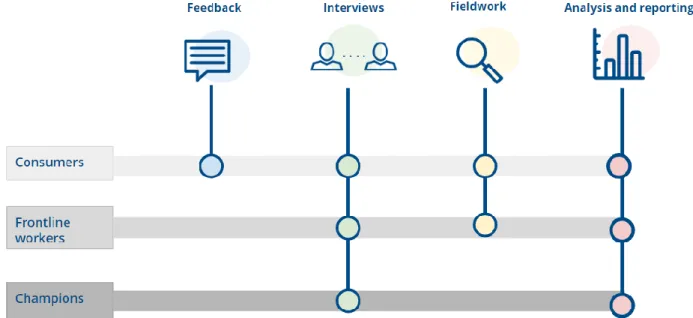
Our evaluation approach:
Table 1: Summary of the number of participants we got feedback from Consumer Frontline Worker Champion
Feedback forms 6518
(from one-to-one sessions only)
x x
Interviews 242 80 37
Observations and Focus groups
Over 50 5 2
Where we discuss the findings from the end of one to one session feedback, we can be fairly confident that the results are representative of the wider client base. When referring to the follow up survey results however, we make more cautious assertions as the number of follow up interviews doesn’t allow us quite the same level of confidence.
How is the service being delivered?
BESN has been delivered across a range of locations within England and Wales.3 To add to our understanding of how the programme has been working to help consumers, we captured data that would help us understand:
1. who we are helping;
2. how we are engaging people;
3. how we are helping people;
4. what barriers we are facing, and how we are working to overcome them.
Who are we helping?
We delivered advice to over 19,000 consumers, exceeding the 17,000 target across all Champions.
BESN’s primary audience is vulnerable consumers, this included people with existing health conditions, people on low incomes, and older people. This was in recognition that they are more vulnerable to the effects of fuel poverty,4 and less likely to take action on their energy matters to increase their income5.
Data from follow up research indicates that BESN is reaching a diverse group of consumers, including those vulnerable to fuel poverty. Of the consumers interviewed:
Nearly half (49%) are aged 65+
Over 1 in 4 (30%) live in social or temporary housing
More than half (55%) are disabled or have a long term
health condition
Over 1 in 4 (31%) find it difficult to meet their energy
costs
Champions also told us that the consumers they advised and supported have a variety of needs and vulnerabilities:
“We worked with a mixture. Some were old, disabled, mental health coffee mornings, parents of young children - so it's a mixture.” – Champion
“We have spoken to a range of people, so a range of vulnerabilities.” – Champion We collected information on whether consumers had been referred onto other services after being supported by a Champion. From this we can see that around 17% of consumers were referred onto other areas of advice including housing, debt and
3 BESN is also delivered in Scotland, but this is managed by Citizens Advice Scotland.
4 Energy Best Deal Evaluation, 2018
5 Energy tariff options for consumers in vulnerable situations, 2015.
benefits advice (see chart 2). This further suggests that a number of consumers helped by BESN are struggling to meet their financial needs, or are already in financial difficulty.
The management information data we have also indicates that Champions have been engaging a wide variety of people through local groups. Champions worked with over 750 different groups, which represented a wide spectrum of community groups and interests. This includes at least 185 groups who specifically engaged older people;
around 90 groups that engaged people with a disability or long term health condition;
and over 145 that aimed to engage people in vulnerable situations (including those on low incomes, reliant on food banks, lone parents, and those living in temporary or social housing).
BESN has been particularly effective at engaging older people. This likely reflects the fact that older people are more accessible during the day when a lot of group sessions take place. However, feedback from Champions and consumers does also suggest that they are a group in need of energy advice, and especially advice about accessing information online.
Previous research has found that cold temperatures can cause a rise in blood pressure, increasing the risk of strokes and other circulatory problems for older people6. The Champions we spoke to added that many of the older people they met often lived in older houses that are more expensive to run and less energy efficient, they are less likely to have switched recently, and they are often digitally excluded. One Champions said:
“A lot [of older people] that we are dealing with don't have access to a computer. We sit down, pull up all the various options and talk through what it might mean.
Sometimes people may not want to switch to a new organisation that they haven't been with before. It's really having access to good tools online which they don't have, and save people huge amounts and making sure they have the best deal. We tailor it to each individual.” – Champion
The older people we spoke to also said that they felt uncomfortable switching suppliers, especially because of the challenge of switching when they don’t have access to a computer.
One person said:
“I do feel that the over 60s are penalized because quite a lot of us are computer illiterate and try as I may - I haven't got a computer - and doing things over the phone does make it much dearer. Because the lady could therefore do it all online, it was much easier because someone was doing it for me. If I'd had to do it myself, I couldn't
6 Local action on health inequalities: Fuel poverty and cold home-related health problems, Public Health England, 2014.
have, because I don't have a computer and even if I did I couldn't use one. Additionally, quite a few people who are over 60 today live on their own and don't have anyone to help.” – Consumer
The evaluation has helped us to understand that BESN is reaching a wide variety of people, and especially a large number of older people who are more likely to be digitally excluded and to find switching challenging. However, because there was no requirement to report on the demographics of all consumers, we do not have a full picture of the diversity of consumers engaged overall.
How are we engaging consumers?
BESN is an outreach programme that uses multiple channels to engage consumers.
Feedback from Champions suggests that they are using multiple channels and referral routes to engage consumers. Most Champions shared marketing materials, and developed relationships with local community groups, local charities, and local authorities in order to engage consumers. Of the 37 Champions we spoke to:
34 (92%) used existing relationships with other organisations
to engage consumers
34 (92%) used existing relationships with
local community groups to engage
consumers
32 (86%) set up new relationships
with organisations and community groups to engage
consumers
28 (76%) used their existing services and programmes to
engage new consumers
Chart 1 summarises how Champions are using both new and existing relationships to engage consumers.
Other methods of engagement included using traditional advertising or marketing (such as sharing leaflets or posting on social media), and engaging people at pop-up events or drop-ins.
The diversity of engagement methods partly reflects the reality that the Champions, and their organisations, had existing relationships and contacts that they could use to get access to new consumers.
Data source: Champions follow up research (n=37)
Barriers to engagement
Champions faced a range of challenges when it came to engaging consumers. The most common challenges were:
● demonstrating the value and benefit of BESN so that consumers engage with the programme;
● a general lack of motivation, which is further affected by present bias;
● addressing suspicions about being helped by someone that is unknown to the consumer and the need to build trust.
Champions particularly talked about challenges in building the trust needed with vulnerable consumers. One Champion said:
“Vulnerable people are suspicious, and the most needy people are sometimes the hardest to help, such as food banks where everyone would benefit they often don't want to listen to you. The way you work with that is to have regular clinics there so they can build confidence in your organisation and what you're doing.” – Champion Champions tried to overcome this challenge by going to drop-ins, and community groups more than once so that consumers became more familiar with their presence.
As well as helping consumers to become familiar with the Champion, repeated visits could also act as a prompt, reminding consumers to switch, or take other actions. While this approach helped build trust, it did also have an effect on the time Champions had to reach their target of supporting 100 consumers (see Learnings and recommendations for more discussion).
Chart 1: How do Champions engage consumers?
How are we helping consumers?
BESN has supported both Champions and Frontline workers to support consumers with a wide variety of issues including: comparing tariffs and suppliers, understanding what energy grants and benefits are available, and to learn about energy efficiency techniques.
It has also been important in referring consumers onto further advice where needed, with 34% of consumers receiving one to one support going on to get further advice. A proportion of these consumers are going onto receive further energy advice (9%), but we also know that consumers are referred onto different areas of advice including advice on housing, debt and benefits. This further reflects the complex needs of some of the consumers.
Consumers are being referred onto a variety of external organisations and schemes.
Popular services included: Energy Best Deal Extra (delivered by Citizens Advice), Warmer Wales, and LEAP. Some of these organisations and schemes are specific to the local context, meaning Champions need to use their local knowledge to establish referral routes in and out to relevant services.
Data source: Consumer feedback data from one to one sessions (n=6518)
Champions and their organisations have established their own local referral routes which link with external organisations, and their own internal services. This helps create a more coherent advice pathways for consumers.
Chart 2: Were consumers referred onto other areas of advice?
Approaches to delivering Advice:
BESN delivers energy advice in groups and one to one. We asked Champions about the strengths and weaknesses of each approach so that we could add to our understanding of different approaches to delivering advice.
Champions said that one to one support enabled them to build trust with the consumer, and focus on the consumer’s specific needs. However, this approach is time consuming and some Champions felt that the funding available for BESN was not adequate enough to cover the one to one support required by some, especially the most vulnerable.
“It has to be a quick thing, not an in depth talk about their case, because of funding”–
Champion
“The funding wouldn't be enough for 1 to 1 sessions so you have to do groups” – Champion
Data source: Champions follow up research (n=37). Data is based on self-reported estimates.
Working with groups meant that Champions could reach a lot of people in one go, and they could use the group dynamics to encourage people to share experiences and to encourage switching behaviours. However, Champions also said that talking to groups makes it more difficult to support consumers’ specific issues, and it can mean that quieter people do not participate. Some Champions are trying to make the most of both approaches by going to existing group events, and delivering short one to one support to consumers in a separate room.
Chart 3: Average time taken to deliver one to one and group sessions
Groups are also a useful way to initially engage consumers before referring them on to one to one support. We collected data on the number of people receiving one to one support who originally went to a group session. The data suggests that around 10% (n=
699) of consumers who received one to one support were referred on from a group event.
How are we helping frontline workers?
Champions are supporting frontline workers by delivering energy advice and training sessions, in both group and one to one formats.
Champions used different methods to deliver training sessions, recognising the diversity of job roles and needs of the frontline workers they supported. Approaches included running workshops, delivering one off advice, and delivering training at team meetings.
Feedback from the follow up research indicates that delivering training at team meetings was a popular method across Champions. This reflects feedback that Champions found it difficult to engage frontline workers for extended periods of time, and therefore needed to fit in the training where they could.
Most Champions that we interviewed (36 out of 37) had a prior relationship with at least some of the frontline workers they provided training to, with 27 Champions saying that they had a prior relationship with half or more of the frontline workers they helped (see Chart 4).
Chart 4: How Champions had a prior relationship with frontline workers?
Data source: Champions follow up research (n=37). Data is based on self-reported estimates.
Having a prior relationship with frontline workers aids Champions by reducing the time needed to build new contacts, but it was also deemed as crucial in getting the frontline workers to engage with the training. When asked what was most important in enabling you to reach your targets of training 40 frontline workers, nearly half (19) of the Champions we interviewed mentioned their prior relationships. This factor is especially important considering that Champions reported that they often faced challenges in getting frontline workers to set aside the time needed to take part in the training.
Barriers to engaging frontline workers
Champions told us that most of the frontline workers they were trying to engage were too busy to take part in a training session. Prior relationships helped with engagement, and champions also tried to compromise by running training sessions as part of team meetings (see: ‘How are we helping frontline workers’, p. 13) . The challenge with this approach is that it could mean Champions do not have much time to deliver the training session, and Champions can start to run out of frontline workers to engage.
“We've been delivering this for a few years now and as a result we have been in contact with most community centres and vulnerable leadership schemes. So when you have trained them once it's hard to get them to reengage and so it's hard to find new front line workers.” – Champion
“Because everyone is busy and trying to find time within their schedules that they can fit you in, as well as you having a time scale to work with. The best bet is to get involved in team meetings that are already set up, but they can be quite time limiting.” – Champion
During field work we spoke to a frontline workers who had received BESN training. She said that she did find it difficult to set aside time for training and that her relationship with the Champion was important in encouraging her to organise a training session.
She also mentioned that the ongoing relationship and contact she had with the Champion was important in improving her confidence to talk about energy. This experience was reflected in some of the feedback we received from the frontline workers we interviewed. When asked what was most useful in enabling them to pass on energy advice to consumers, some frontline workers said:
“Because of doing ongoing updates [and] training. It gives me more confidence to relay the information to clients to help them.” – Frontline worker
“Having a general update each year on the energy sector and information on smart meters.” – Frontline worker
This feedback relates back to Champions comments that it often takes more than one meeting for Consumers to feel engaged enough to listen to advice about energy, or take action.
Feedback from frontline workers also shows that some do not necessarily see it as their role or responsibility to pass on energy advice, and instead feel more comfortable referring consumers onto experts. Providing training to these frontline workers can help by improving referral processes, but it may not necessarily encourage them to cascade the advice they receive.
“[Frontline workers] don't want more things added to what they are doing as they are volunteers. The information is really good but no one wants to suit through it as it's too long. They just want to know what support we provide and want it to be concise.
They don't mind being the referral tool.” - Champion
“A lot of frontline workers don't want to do this work themselves. So we have had to tailor the training a bit to make them aware of it so they can identify it, triage it and pass it onto ourselves.” – Champion
Using training to develop referral processes can benefit consumers by reducing the need to speak to multiple agencies, or by streamlining the process. However, there is the potential for this to also increase pressure on local energy advice services, especially considering that the programme is only available for six months of the year. Champions have fed back that the short term funding affects their ability to support consumers all year round.
“I feel that now we've been identified as an agency that can help with energy issues, clients will continue to call in for support but the funding is no longer there and whilst we will do our best to fulfil their needs, the problems do not stop in the summer - it's not just seasonal to winter.” – Champion
These findings indicate that prior relationships with frontline workers are key to enabling Champions to reach their target of training 40 advisers. However, they also indicate that an ongoing relationship could be important in supporting frontline workers to feel confident and knowledgeable enough to then use the advice provided in the training.
How is BESN impacting delivery organisations?
BESN has enabled Champions to support more consumers, and make new connections within the communities they are based.
Champions told us that the funding they received enabled them to engage more consumers (n=27), recruit additional staff (n=12), provide new training to staff (n=18), and develop new referral routes (n=16). Over half (n=18) of Champions thought that these changes had a positive impact on their organisation.
“[Funding helped me] get out to those community groups and the front line workers.
It's the only funding source that allows me to go out to those group meetings. This year particularly, we are working with the local health sector.” – Champion
“[We] worked with groups in a different way, we had more partnership type relationships.” – Champion
As well as have an immediate impact, the knowledge and information gained by the programme can help Champions provide advice to consumers in the longer term. The majority of Champions we spoke to as part of the follow up research (35 out of 37), said that they will continue to use the information they received to support consumers in the future.
However, feedback from the follow up research also indicates that, in some cases, Champions did not think that the funding enabled them to engage more consumers (n=8). This might be because some Champions have been funded to run BESN before and they plan their delivery expecting to achieve the funding.
We also know that BESN is likely one of many energy programmes delivered by the delivery partners, and we are currently conducting a bigger piece of work which aims to explore how our energy programmes fit within the bigger picture, in terms of the provision of energy advice within the UK.
Does the approach work?
BESN aims to support consumers to switch to a better energy deal, payment method or to make energy efficiency changes. It also trains frontline workers in the hope that they will then cascade this information onto the consumers they come in contact with.
As part of this evaluation we wanted to assess:
● whether frontline workers cascaded information to consumers, or referred consumers to energy advice, after receiving BESN training; and
● whether consumers made changes as a result of receiving energy support.
The effectiveness of the frontline worker training
Frontline workers were positive about the training they received. We interviewed 80 frontline workers to ask them how helpful the advice they were given was, and all of the frontline workers said it was either quite or extremely helpful (see chart 5).
“It was clear, relevant to our work and provided good examples of how to apply the training in a practical sense.” – Frontline worker
“I was made aware of information I did not know about, it all helps the families we deal with to tackle energy bills and energy saving.” – Frontline worker
“It is really really valuable. It translates immediately to money off client’s bills.” – Frontline worker
This feedback is especially useful considering that Champions initially faced challenges in engaging frontline workers to take part in the training.
Data source: Frontline workers follow up research (n=80)
Data from the follow up interviews indicates that the training is helping frontline workers to cascade information, or refer consumers to further energy advice.
Just over half (51%) of frontline workers we interviewed had already provided energy advice to consumers before receiving training. As expected, a high proportion (88%) of these frontline workers have given advice to consumers since going to the training.
However, it is still the case that over 60% of frontline workers who had no prior experience of providing energy advice, went on to support consumers. Therefore, there is a good indication that the training is supporting both those with and without prior experience, to cascade information (See chart 6).
Chart 5: How helpful was the advice given by Champions?
Knowledge Action
91% think that they know how to refer consumers onto further energy advice
45% have already referred consumers
onto further energy advice Frontline worker
receives training
89% have provided energy advice to
consumers 94% think they will use
the information they received to help consumers in the
future
Furthermore, over half (48 out of 80) of frontline workers we spoke to also went on to cascade the information to other frontline workers.
Frontline workers told us that they helped consumers with a wide variety of energy issues, but the most common ones were:
Switching to a cheaper supplier
53 frontline workers helped consumers with
this
Switching to a cheaper deal 48 frontline workers
helped consumers with this
Changing payment method 36 frontline workers
helped consumers with this
Applying for eligible support
21 frontline workers helped consumers with
this
Frontline workers are mostly cascading information about switching (supplier, deal or payment method) and about applying for eligible support (such as the Warm Home Discount or Priority Service Register). These are the main energy advice areas that BESN aims to support consumers with and so it is unsurprising that these were the most popular topics mentioned.
The effectiveness of the support received by consumers
Consumers were positive about the support they received by Champions. We interviewed 242 consumers to ask them how helpful the advice they were given was and all consumers said the advice was either extremely (71%), or quite helpful (27%).
BESN has helped at least 3000 consumers to save, on average, £140 on their energy bills.7 BESN has also helped consumers to apply for eligible benefits and schemes, deal with debt to suppliers, and to take up energy efficiency behaviours.
Switching to a better deal
BESN has helped over 1000 consumers to switch to a better deal. Those who switched saved an average of £144 a year.8
Our follow up research shows that, out of the 178 consumers who said they spoke to a Champion about switching to a better deal, 72 (40%), then went on to action this advice.
A further 21 (12%) said that they intended to switch in the future.
A large number of Champions are directly supporting consumers to switch, but they are also empowering consumers to switch by themselves. Out of the 72 that did switch, just over half (32) said that the advisor helped them to do this on the day, and a further 30 said they did it themselves at home.
Number of respondents receiving advice on the
topic
Number of respondents who actioned the advice
Number of respondents who intend to action the
advice in the future
178 72 (40%) 21 (12%)
7 We used data from the BESN volumes report which is a database of 121 feedback forms. On this form Champions were able to note how much the consumer was saving as a result of switching. We have financial data of this type on 2990 consumers. Data on the number of people helped is smaller than the real number as we only have data on consumer’s receiving one to one support, and who were helped to switch on the day. We used the median as the data is skewed.
8 We used data from the BESN volumes report which is a database of 121 feedback forms. On this form Champions were able to note how much the consumer was saving as a result of switching. We have financial data of this type on 1016 consumers. Data on the number of people helped is smaller than the real number as we only have data on consumer’s receiving one to one support, and who were helped to switch on the day. We used the median as the data is skewed.
Switching payment method
The consumer one to one feedback forms did not capture data on money saved by switching payment methods, but we asked this question to consumers as part of the follow up research.
Our follow up research shows that, out of the 56 consumers who said they spoke to the Champion about switching to a better payment method, 25 (45%), then went on to action this advice. These consumers saved an average of £240 by switching their payment method.9
Out of the 25 that did change, just under half (10) said that the advisor helped them on the day, and a further 9 said they did it themselves at home. These findings are similar to the proportions of people switching to a better deal, again, suggesting that BESN is both directly helping consumers to switch, and empowering them to make the switch themselves.
Number of respondents receiving advice on the
topic
Number of respondents who actioned the advice
Number of respondents who intend to action
the advice
56 25 (45%) 5 (9%)
Our follow up research also enabled us to see how long after receiving advice, consumers go on to switch. It showed that 70% of consumers switched payment methods, or to a better deal, within 2 weeks of receiving the advice, with 32% making the change on the day of receiving advice. This further highlights the benefit of programmes like BESN which supports consumers to switch, and action other simple money saving tips on the day.
9 This is based on 22 consumers who had already switched payment method and who could remember how much they saved. The estimate is self-reported and based on the median as the data is skewed.
Data source: Consumer follow up research. Data is based on 72 consumers who said they had switched to a better deal, and 25 consumers who said they had changed their payment method.
Helping consumers apply for schemes and benefits
BESN has advised consumers on their eligibility for a range of national and local grant initiatives. Consumers who applied saved an average of £140 a month.10
The most popular schemes were the Warm Home Discount and the Priority Service Register. Champions advised over 2280 consumers about applying for Warm Home Discount, and 2160 consumers about the Priority Service Register.
Our follow up research shows that 44% of consumers’ receiving advice about Priority Service Register, and 43% of consumer’s receiving advice about Warm Home Discount, went on to apply. A further 17% of consumers said that they intended to apply for the Warm Home Discount at a later date. Out of those that did apply to either scheme, around 41% of consumers said they were helped by an advisor.
Issue area Number of respondents receiving advice on
the topic
Number of respondents who actioned the advice
Number of respondents who intend to action the
advice Warm Home
Discount
136 58 (43%) 23 (17%)
Priority Service Register
74 33 (44%) 7 (9%)
10 We used data from the BESN volumes report which is a database of 121 feedback forms. On this
form Champions were able to note how much the consumer was saving as a result of switching. We have financial data of this type on 2990 consumers. This number is smaller than the real number as we only have data on consumers receiving one to one support. We used the median as the data is skewed.
Chart 7: Summary of how long it took consumers to action energy advice
We found that one of the main reasons why some consumers did not apply for the Warm Home Discount straight away was because the application period had closed when they received the advice. Recognising this, we aim to extend the BESN funding period so that there is more time to advise consumers to apply for the scheme.
What changed as a result?
BESN has helped consumers to meet their energy costs, and to improve the energy efficiency of their homes. Data from our follow up research shows that, as a result of receiving support form a BESN Champion:
64% of consumers are now more able to meet
their energy costs
79% of consumers understand more about
how to save money on their energy bills
42% of consumers have made energy efficiency
changes
These findings show that BESN is helping consumers to better meet their energy costs, and to understand more about how to save money and make energy efficiency changes. 42% of consumers that we interviewed had already made changes to the way they used energy within their homes, such as turning off lights, fitting foil behind radiators, and switching light bulbs.
These findings indicate that BESN has the potential to have a longer term impact on consumers by educating them about ways to reduce their energy costs, and improve energy efficiency within their homes.
How could the service be improved?
One of the aims of the evaluation was to learn, and reflect on the way BESN has been implemented so that we can consider ways to improve the service. Below we summarise some key areas of learning:
Supporting Champions
The majority of Champions we interviewed (35 out of 37) were either partly or very satisfied with the support they received from Citizens Advice. When asked what people found most useful a large number said that they found the opportunity to network, and receive new policy updates.
We also received constructive feedback on how we could improve our training offer.
Some Champions said that the training did not provide them with new knowledge and there was sometimes a lack of clarity regarding the programmes requirements.
“I've had the training 3 years running and so have had more detailed training in the 2 previous training sessions. There was uncertainty issues in the training.” – Champion
“They were a bit unclear on what they wanted us to do. I don't work for Citizens Advice and people there were working for them and we had very different questions about internal systems and they weren't able to answer.” – Champion
The BESN programme management team have already been working to modify the training in order to address some of the feedback on our training offer. For the 19/20 BESN programme, training will be provided in the format of e-learning modules so that the content can be accessed remotely by Champions. The network meeting will then focus more on supporting networking, collaboration and sharing learning.
Champions also told us that they felt we could offer more information on smart meters and energy efficiency. These are not priority areas for BESN, but our research indicates that they are topics Champions are having to advise on.
Recommendation 1 - BESN programme management team capture feedback on the new online training content, and the network sessions, in order to assess the effectiveness of the new approach.
Recommendation 2 – BESN Champion training includes more information about smart meters and energy efficiency so that Champions are better equipped to give simple advice and information about these topics to consumers.
Funding period
Champions told us that they found the programmes funding period, and timeline challenging. Only 13 out of the 37 (35%) Champions we interviewed thought that there was sufficient time between confirmation of funding and the inception of delivery.
Champions also suggested that the programme should be run earlier so that Champions can support more consumers to prepare for the winter months, and in recognition that energy issues are not seasonal.
Champions also told us that the limited funding period had an effect on their ability to engage consumers, and sustain relationships. The short term funding cycle can result in Champions finding it difficult to sustain relationships during the in-between funding moments, resulting in them having to spend significant time building relationships at the beginning of each new funding period. It can also reduce the offer available to consumers during summer months when most energy funding dips.
Continuing to improve our understanding
This evaluation aimed to use both quantitative and qualitative methods, and different data sources to capture the opinions and views from different people that have been involved in the BESN.
However, the evaluation was limited by the lack of feedback data we had from Champions, frontline workers and consumers attending group sessions. We commissioned follow up interviews so that we could ask more specific questions, and talk to more participants, but the evaluation findings are still limited by the small sample sizes. Response rates and engagement are often a challenge for evaluations, however it is possible to improve the quantity and quality of data captured by further integrating the evaluation within the programme’s existing processes.
Recommendation 3 – Going forward, the BESN programme management team should aim to start the BESN programme delivery phrase earlier in the year in order to give Champions more time to support awareness raising before the winter
months.
Recommendation 4 – BESN programme management team work with internal teams and funders, to assess the feasibility of running a year round energy programme that would allow for energy advice to be maintained at a certain standard throughout the year, and for referral pathways to be maintained.
The evaluation team began planning and implementing the BESN evaluation only a few weeks before the BESN funding period ended. This meant that most BESN sessions had finished before the evaluation team began the follow up research and went out to conduct field visits. This limited the opportunity for the team to speak to Champions (some had stopped working), and to oversee some delivery sessions.
We know that the organisations delivering BESN are usually delivering multiple energy programmes, and that these funding sources will differ by area. Champions told us that they are using these different funding schemes to develop energy advice pathways. This has the potential benefit of streamlining the consumers ‘energy journey’ locally, but the challenge for the evaluation is that by focusing on BESN, we have only been able to explore one element of these pathways.
Recommendation 5: Improve the quantity and quality of reporting data captured so that we have good quality data for Champions, frontline workers and
consumers. This includes getting more feedback from champions during the network sessions, and encouraging champions to improve the outcome data they collect on consumers (especially those attending group sessions).
Recommendation 6: Face to face meetings which focus on test and learn can encourage Champions to share their experiences and learnings, enabling for best practice to be shared across more areas. This also allows for qualitative data to be captured on an ongoing basis. Consequently, it is advised that the programme management team incorporate a test and learn approach to future evaluations, so that we can continue to improve the programme and encourage more
engagement from champions though face to face collaboration on an ongoing basis, as opposed to capturing feedback at the end of a programme.
Recommendation 7: We are already conducting a co-design project to see how we can better align our internal energy programmes. To support this project, and our understanding of how our funded energy programmes work together, it is
recommended that future energy evaluations are aligned, or delivered as one overall funded energy programme evaluation.
Free, confidential advice.
Whoever you are.
We help people overcome their problems and campaign on big issues when their voices need to be heard.
We value diversity, champion equality, and challenge discrimination and harassment.
We’re here for everyone.
citizensadvice.org.uk
Published July 2019
Citizens Advice is an operating name of The National Association of Citizens Advice Bureaux.
Registered charity number 279057.