These objectives were all part of the original CAP objectives, but had limited impact on the resulting ambition of the CAP strategic plans. It will also be essential to use these shortcomings to advocate for impactful annual reviews of the CAP NSPs.
Wallonia’s CAP Plan: Better late than never?
The article’s roadmap
The time-scape of CSPs
Belgium and Wallonia: the art of compromise
At the end of December, liberals and environmentalists were still debating the basics of CSP. Well, the Commission expects the Walloon government to take a final position on the CAP after 2022.
Inclusion and transparency, a priority lost on the way
This arm wrestling took place just three weeks before the presentation of the CSP, on 17 January 2022. The fact that many organizations across Europe reported difficulties in accessing information about the development of their CSPs, requires the necessary clarification and measures.
The Belgian blanc bleu in the living room
Overall, our EU-wide search for details on draft eco-schemes has revealed significant delays and shortcomings in the information made available to environmental stakeholders during this crucial phase of the design of CAP interventions. Of all major technical-economic sectors (including crops, milk and mixed production), beef farmers have earned only 60% of the average income in Wallonia's agricultural sector1.
Synergies and tensions in CAP interventions
To conclude: What’s to come
This article highlighted some of the main issues of the Walloon CSP, namely deviating from coupled income support, potential tensions and synergies between income support for couples and eco-schemes, environmental conditions to be attached to coupled income support, stakeholder engagement and more. The Commission will need to assess them carefully, supported by economic and environmental analysis, such as a strategic environmental assessment and a full preliminary assessment report (a summary should be included in an annex to the CSP).
What opportunities for change during the new 2022-27 presidential term?
Introduction
The first 100 days: amending the CSP before it is approved by the European Commission
What kind of changes are possible in that short-term period?
PUAP’s recommendations for modifications
1 st semester of 2023: paving the way for a progressive
What kind of changes are possible in that short/medium-term period?
1 st semester of 2024: taking full advantage of the CSP’s mid-term
What kind of changes are possible in that medium-term period?
From 2025: using France’s
What kind of changes are possible in that long-term period?
And what about elected deputies to the National Assembly? An influence to be
Bulgaria’s CAP Strategic Plan: Backsliding on nature and biodiversity
Bulgaria CAP Strategic Plan: Nature and Biodiversity Decline Bulgaria CAP Strategic Plan: Nature and Biodiversity Decline.
Decreasing budget and inconsistent monitoring
Target values for biodiversity protection
Permanent grassland discrimination
Permanent grassland support in the eco-schemes
Specific example of poor eco-scheme architecture
Eco-scheme for maintaining and improving biodiversity and ecological
Eco-scheme for extensive permanent grassland maintenance
Rural Development measures for nature and biodiversity
Sustainable grazing land management in agricultural land
Restoration and maintenance of degraded grazing areas
Payments for agricultural land in Natura 2000 sites
Traditional seasonal grazing practices (pastoralism)
Establishment and restoration of environmental infrastructure
Conclusions
CAP and Food Security: Are the CAP Strategic Plans up to the task ?
Food security in Europe
Short-term VS long-term
Will the commission efficiently assess the transitioning potential
This list of statistics and facts gives the illusion of actions being taken on every front by many member states, but avoids the details that determine the effectiveness of the measures. It is essential that the commission publishes documents showing in-depth analysis of plans with comparisons and synergies between countries, in line with the objectives of the Green Deal, and asks member states, through observation letters, to adapt their plans accordingly. .
Assessment of the CSP’s potential for an agroecological transition
Ecoschema (budget allocation not determined) II. pillar: 9.8% P2 Agricultural areas with organic production: 7.7%3. Ekoschema 3: Preservation of agro-forestry management on arable land and permanent grassland (0.75% of the Ekoschema budget).
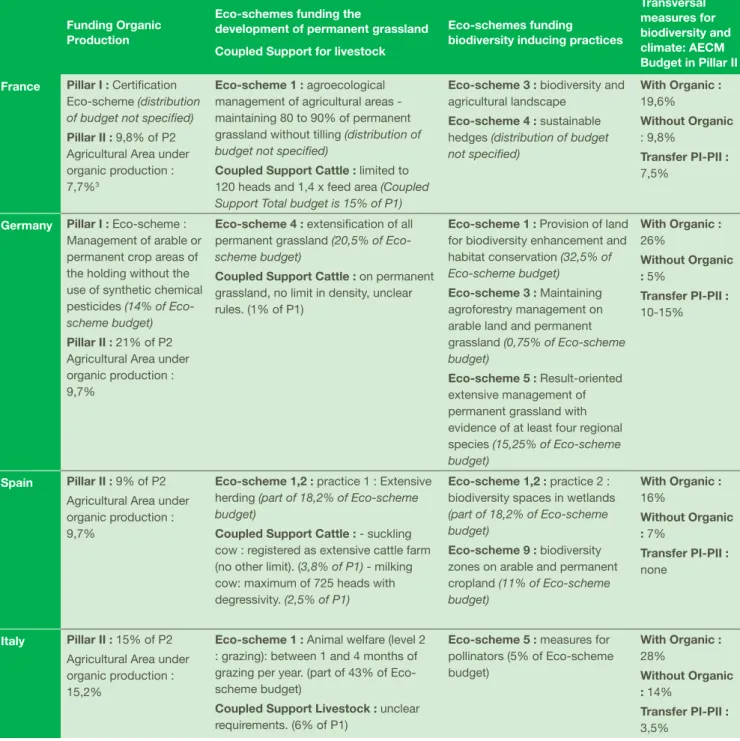
On organic production
On developing livestock breeding on permanent grassland and reaching feed
On measures for biodiversity and
In Pillar II, a larger part of the budget should be dedicated to AECMs. More Pillar II budget should be allocated directly to AECMs and Member States should transfer Pillar I budget to finance it.
CAP and Food Security: fallow lands, feeds, and transitioning the livestock industry
Fallow lands, the new El Dorado ?
CAP and food security: fallow land, feed and the transition from livestock farming. CAP and food security: fallow lands, feed and the transition from livestock farming. Even though it is true that, according to FAO statistics, fallow land represents 5 to 6% of the used agricultural land in Europe, the derogation will only directly affect the subsidized fallow land under the EFA greening payment, which amounts to 1 but %.
EU grain production and use
Some would argue that a certain amount of pasture in Europe could be converted to cropland. Assuming that cereals in the context of securing the food supply can be substituted for at least parts of food and feed use, a flexibility in the feed-food allocation of cereals in Europe could provide a great leverage.
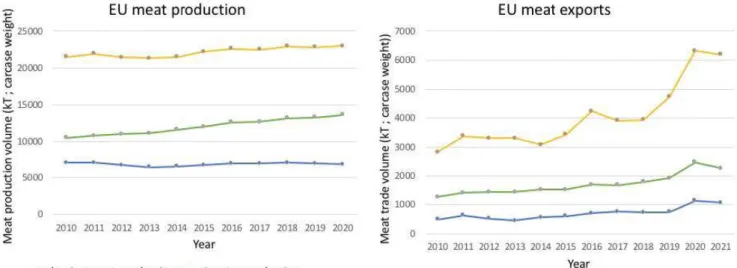
Livestock production and meat consumption
It is important that in the TYFA model all livestock are fed with low-opportunity feed, which means that they are solely dependent on grass, by-products and waste. This checks the needs of the TYFA hypothesis for an agroecological Europe and the recommendations of the EAT-Lancet team.
Is the CAP equipped for this change?
First Pillar
Second Pillar
Common Organisation of Markets (CMO)
Conspicuous by its absence…
Conclusion
With the number of farmers and holdings rapidly decreasing in Europe, it is clear that no one should be left behind. To pave the way for livestock systems to low options, the entire CAP architecture should be overhauled.
CAP implications beyond the EU: A just and green CAP and trade policy, Part 1
The CAP and Food Security: Fallow Land, Feed and the Transition of the Livestock Industry y Implications of the CAP Outside the EU: A Fair and Green CAP and Trade Policy, Part 1.
Historical analysis 1
1962–1992: Decades of market intervention
CAP implications outside the EU: A fair and green CAP and trade policy, Part 1 CAP implications outside the EU: A fair and green CAP and trade policy, Part 1. 4 https://www.boerengroep.nl/ wp-content/uploads/2016/06/Koning-2006.-Agricultural-development-and-international-al-trade.-CAP-and-EU.pdf.
From 1992 onwards, a WTO-ruled CAP
With the EU maintaining its export ambitions, these payments essentially replaced the former export subsidies. In the end, it mainly served the interests of (multinational) agricultural businesses that needed new markets to dispose of the EU overproduction at a cheap price.
Reforms in trade policy and CAP since 2001
Another important reason for this increase in dumping is the removal of the EU milk quota system in 2015. Even arable farmers lost part of their income since 2017 when the sugar quota system was removed in the EU led to a drop in prices9.
Current role of the Common Market Organisation (CMO)
Implications of the Common Agricultural Policy beyond the EU: A fair and green CAP and trade policy, Part 2 Implications of the CAP beyond the EU: A fair and green CAP and trade policy, Part 2.
CAP implications beyond the EU : A Just and Green CAP and Trade Policy, Part 2
Can the Farm to Fork Strategy be effective?
Ultimately, populations least responsible for the climate crisis will be most affected by it. Sharepics was developed in the context of the Good Food Good Farming campaign on the CAP in 2021.
New Regulations to handle the opposition
Proposal for a regulation on deforestation-free products
Products that come directly from deforested areas can be sold to China, while the EU imports so-called 'sustainable products'. By being part of the total demand, the EU's consumption is still responsible for – in of tropical deforestation2.
A Trojan Horse for the EU-Mercosur Free Trade Agreement ?
In a country like Brazil, that would mean relying on the Bolsonaro government to protect indigenous rights, something it has willingly avoided. However, as Obed Owusu-Addai, co-founder and campaign manager at EcoCare Ghana explains, “it is extremely important that smallholder farmers are supported to comply with the regulation, especially in sectors such as cocoa where smallholders are responding - possibly for a significant proportion of production ".
Additional EU propositions
Alternatives
This means that the EU will use much less land and water in the Global South for products such as feed and biofuels. Dutch economists such as Mathijs Bouman explain that effective environmental policies are only possible if the EU protects its markets3.
CAP implications beyond the EU: CAP and e-commerce, are quality schemes protected?
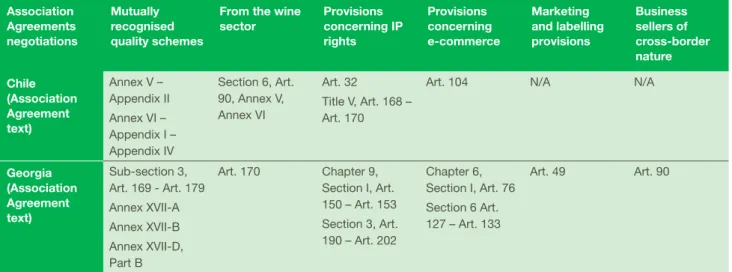
To what extent are the EU's association agreements with Chile and Georgia ready to regulate international e-commerce and protect IP rights for agri-food quality schemes. It focuses only on the control mechanisms for the enforcement of rules protecting the IP rights of agri-food quality schemes as goods are displayed and traded on such electronic platforms.
CAP post-2022 and protection of quality schemes’ IP rights
Box 2: Summary of the main changes to CAP Regulation 2021/2117 relevant to the protection of quality schemes in e-commerce. Source: own elaboration based on quality scheme assessments from the European Commission and EUIPO (See list in the reference section).

Can non-EU quality schemes be protected in EU e-commerce via association agreements? The case of Chilean and Georgian wine
Following this, we present our own observations after reviewing the legal provisions contained in the two association agreements and conducting interviews with the respective IP authorities.
The Chilean e-commerce legal dispositions
CAP implications outside the EU: CAP and e-commerce, are quality schemes protected? CAP implications outside the EU: CAP and e-commerce, are quality schemes protected? . Table 1: Compilation of the agreements of Association Agreements which include a) mutually recognized quality schemes; b) provisions for IP rights; and c) e-commerce clauses.
The Georgian e-commerce framework
Regarding trade relations between the EU and Georgia, according to SAKPATENTI, the Georgian government has been preparing a draft law on e-commerce since 2017-2018. Nevertheless, wines protected under the quality schemes from Chile and Georgia are sold on the EU market through different sales channels.
Can the EU Digital Services Act complement CAP reform and
Indeed, this directive has been the regulatory backbone for the control of e-commerce activities on the EU internal market and has also become relevant for the association agreements with Chile initiated in 2003 and with Georgia in 2016. Indeed, given the rapid evolution of digital markets, since 2020 the Commission has released a proposal for a Digital Services Act (DSA).
The next section briefly discusses how the new DSA initiative can further support the development of e-commerce in the context of the post-2022 CAP reform and association agreements with non-EU countries.
Conclusions & recommendations
Acknowledgements from the author
Retrieved from EUR-Lex: https://eur-lex.europa.eu/le- gal-content/EN/TXT/?uri=CELEX%3A52022PC0134 European Commission. Retrieved from The Business Research Company: https://www. thebusinessresearchcompany.com/report/food-and-be-verages-ecommerce-global-market-report.
CAP Strategic Plans: Observation Letters under scrutiny
Backpedalling on transparency
Fortunately, some member states seemed to disagree with the Commission's decision and already acted by announcing their dedicated Olympics. We could thank the snowball effect, but it also shows that at least some Member States agree that they can only win by opening debates through full transparency.
What’s in them?
Moreover, the OLs appear to be proposing changes that would be supported by many environmental stakeholders, who would support the Commission against pressure from the agricultural lobby. The uncommented OLs contain the original demands that would have been placed on Member States, but which may now be watered down due to various food security speculations, with limited time for any public debate to determine those choices.
Emphasis on the new context
CAP Strategic Plans: Observation Letters under scrutiny CAP Strategic Plans: Observation Letter s under scrutiny.
A fairer CAP
The Commission appears prepared to require that all Member States meet minimum criteria for redistributive payments, set clear criteria limiting access to schemes for young farmers so that they all benefit equally, and set clear targets for the inclusion of women and LGBTQ+ farmers to demand. . On ceilings and degressivity, the Commission can still use its leverage to influence Member States to achieve higher ambitions.
A greener CAP
In the leaked French OL, the Commission seeks to increase the ambitions of the HEV label access criteria, or to differentiate them in the eco-scheme payment scale. Too often, the Commission asks for clarifications and better justifications, when improving the content is what is really needed.
Changes “required” to Ireland’s CAP Strategic Plan – European Commission
CAP Strategic Plans: Notes under the microscope. Changes 'needed' to Ireland's CAP Strategic Plan - European Commission.
Change? Required
Environmental Ambition – there’s something about dairy
Changes 'required' to Ireland's CAP Strategic Plan - European Commission Changes 'required' to Ireland's CAP Strategic Plan - European Commission.
Eco-Schemes for all? Only with ambition – and money to match
They use a rating or scoring system or any other appropriate methodology to ensure the effectiveness and efficiency of eco-schemes in achieving their stated objectives. The comment letter itself (paragraph 111) states: “The likely large difference in cost/income loss of the eight covered practices could result in low compensation for some of them or possibly too high for others.
A litany of issues
This can discourage farmers from adopting the most demanding practices such as tree planting/hedges or maintaining landscape features/unproductive areas. The Commission is also requesting further information from Ireland on the compliance of the CAP Strategic Plan with the needs and objectives arising from the Water Framework Directive (Directive 2000/60/EC) – including how many of the country's water bodies Ireland wishes to exempt from the requirement to achieve ' of good status' under this Directive due to agricultural pressures'.
Fairness
An important concern is the reference to Ireland seeking exemptions for an unknown number of water bodies from achieving "good status" as required by EU law.
Next steps – what force does the Commission’s Observation Letter
The Observation Letter was submitted in the context of the war in Ukraine – and it is very aware of this. In the context of Russia's war on Ukraine, the Commission urges Ireland to consider interventions that will help reduce dependence on fossil fuels and other externally sourced inputs to maintain productive capacity and farm sustainability and strengthen food security". .
Wallonia’s Observation Letter: A plan that fails to address climate and biodiversity crises
Wallonia Observation Letter: A plan that fails to address climate and biodiversity crises Wallonia observation letter ter: A plan that fails to address climate and biodiversity crises.
Missed appointment with the Farm to Fork strategy
No tangible target or reduction expected in the use of synthetic
Extremely low” objectives, and means for biodiversity
The Walloon plan is thus incompatible with the Green Deal target of 10% of landscape elements to support biodiversity and contravenes European regulation by not taking sufficient account of the habitat needs identified in the "priority action" . Framework", a 7-year action plan for the implementation of Natura 2000. It also points out that the modest agri-environmental and climate measures (MAEC) area targets are not in line with the needs identified in the plan and alarming state of loss of biodiversity.
Red card for climate
Supporting sustainable forest management", and the extremely low values of the indicators "Conservation of habitats and species, investments related to biodiversity" (0.36%) and "Conservation of topographical features" (2.63%) do not address adequately the needs identified for the preservation and restoration of biodiversity. ". It therefore expressly calls for "new commitments" to increase the area of protected habitats and species habitats, and to increase the share of landscape features in the agricultural sector.
Hazardous measures for
This plan includes 46,000 grasslands of community interest linked to the agricultural sector, a jewel of Walloon heritage, most of which currently do not benefit from any protection or adequate management schemes. The Commission also calls for a strengthened cross-compliance (conditionality), which in principle should constitute protection for biodiversity, and for a larger budget for the ecological network eco-regime.
Walloon observation letter: A plan that does not address the climate and biodiversity crisis CAP plans in negotiations: what is the point. Walloon observation letter: A plan that does not address the climate and biodiversity crisis CAP plans in negotiations: what is the point.
CAP plans in negotiations: what is the substance?
From strategic to fickle approach
However, this small piece of progress, and the development of collaborative projects more generally, stand out as rare good examples of progressive social or environmental initiatives supported in Ireland's CAP Strategic Plan. German Minister Özdemir likewise welcomed the Commission's comments on a plan mostly worked out by the previous minister, stating that they would take the comments into account to reform the CAP plan.
Are Observation Letters fulfilling their purpose?
Observation letters and indicators: the shaky CAP foundations
Furthermore, Italy will only supply CRISS to the first 14 hectares of these eligible holdings (between 0.5 and 50 ha), and not the others (eg above or below). For example, it could shed more light on the 'French' or 'Irish' interpretation of CRISS, where money is redistributed to the first hectares of each farm.
Asking the right questions
The Commission can examine weak and strong approaches to shed light on their true meaning or encourage the most effective. In its review, the Commission must send clear political messages by distinguishing between the qualities of CAP intervention strategies.
What can the Commission do at this stage?
After submitting the revised CAP plans, the Commission will begin a three-month process of evaluating them before final approval.
Keeping the next steps in mind
Can the CAP Strategic Plans help in reaching our pesticide reduction goals?
A quick look at the new proposal
Member States on the offensive
A complex and multifactorial puzzle
CAP Strategic Plans at the rescue?
IPM and GAECs
It will come as no surprise that almost all Member States have decided to make use of the derogation for both GAECs next year. Here (pdf) you will find the list of Member States and the derogations they will implement.
Timing is everything
Many Member States will make use of the option not to apply a minimum width to small drainage ditches that do not meet the description of the watercourse, even though this could lead to pollution of watercourses. 17 out of 28 LSDs offer the opportunity to include productive elements that do not benefit biodiversity.
The right compass
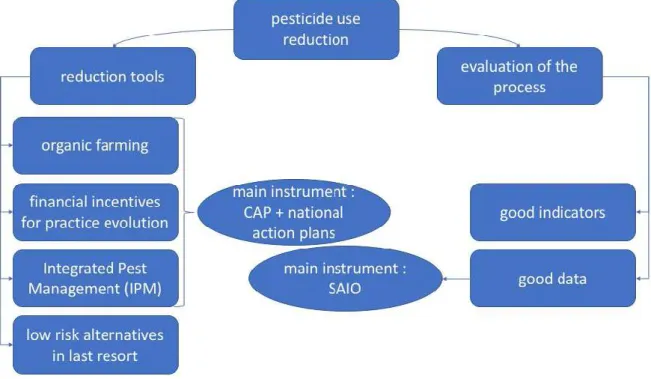
Another performance indicator, R-29, which gathers the share of agricultural land supported by the Common Agricultural Policy for organic farming, can indirectly provide information on pesticide reduction. In particular, this impact indicator uses the HRI-1 to evaluate the impact of the CAP measures on pesticide use.
The right tools
The first and main result indicator, R-24, is the compilation of the share of the agricultural area supported by specific commitments that lead to a sustainable use of pesticides. Furthermore, this indicator, even when raised ambitiously, does not necessarily ensure an effective reduction in pesticide use as the concrete reduction depends on the proposed commitments, through eco-schemes and agri-environmental and climate measures (AECM), for the design which may be of very poor quality.