Consumer
advocacy: what
we did in 2016/17
Citizens Advice annual report of consumer activities in 2016/17
Contents
Foreword 2
Introduction 4
Energy 6
Post 24
Cross-sector 37
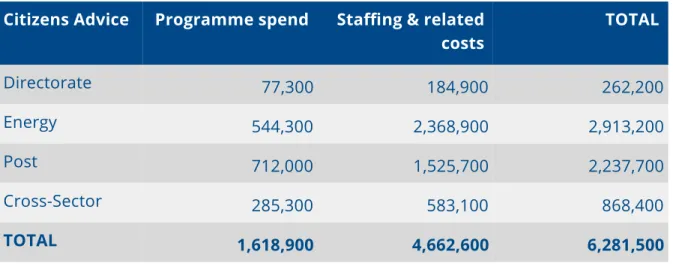
Expenditure in 2016/17 46
Foreword
When consumer markets falter, some of the costs are obvious. People pay too much for essential services, they su er poor customer service, and they waste precious time chasing down refunds. These frustrations are all too familiar.
But mis ring markets have hidden costs too. Rip-o s and scams don’t just hit consumers, they also undercut reputable businesses, hindering promising start-ups, stymying innovation and, ultimately, harming productivity growth.
These costs are less visible but their eventual impact is, if anything, bigger. They distort how our economy works, making us all poorer over time.
That’s why it’s good for everyone when consumers have someone to ght their corner: to balance well-funded pressure from industry with an expert consumer view, to call out and publicise poor customer service, and to highlight and share good practice on issues like the treatment of vulnerable customers.
This report describes Citizens Advice’s work to this end in 2016-17, covering the role we play in energy and postal markets in England and Wales. It shows the growing case for a more integrated approach to consumer advocacy, in the third year since the government began a push for a more joined up approach.
This was a year in which our cross-sector work, sharing lessons across markets and identifying thematic problems, came into its own. We published landmark reports to count the cost of consumer detriment—a staggering £23 billion a year—and to apply behavioural economics to regulatory policy. The latter triggered a growing debate about the loyalty penalty and the exploitation of consumer inertia. And we published agenda-setting work on alternative dispute resolution, price comparison websites, and unfair debt-collection practices.
Citizens Advice also played a wider role advocating on consumer issues, helping to secure a ban on letting agent fees and crackdowns on subscription traps and misleading terms and conditions. While this work was funded separately, it bene ted immensely from sitting alongside the expertise of our statutory role.
This year also saw real success in the way we leverage the Citizens Advice brand, increasing the pound for pound impact of our consumer work. When we spoke up for consumers, people listened. This helped us play a pivotal role in the national debate about energy prices, standing up for vulnerable people, and questioning certain claims from industry. The result was a price cap for people with prepayment meters and a promise of wider action to cut bills. This will save consumers at least £300 million a year and possibly far more.
It has also been pleasing to see how Citizens Advice’s presence in communities, and the data this generates, roots our advocacy in real world experience. During the year, for example, we worked in communities to assess over a thousand changes to Post O ces. Where a Post O ce moved, we secured changes to the plans in 88% of cases, improving access and services for disabled, elderly, and vulnerable people. This quiet work made a di erence to thousands of lives.
Alongside this work, I’m pleased that our technical expertise has not been
diluted; we are now even more e ective at representing consumers on complex questions of policy. Our work on consumer rights in the B2C parcels market, for example, revealed risks in a market growing at 19% a year. And our analysis of embedded bene ts in electricity markets shaped decisions that will ultimately save consumers £7.7bn, complementing our wider work on price settlements.
Together, this means one thing: three years on we are having more impact for consumers. Our work is more joined up and, by leveraging the strengths of Citizens Advice, each pound we spend goes further. The early steps toward a more integrated approach to consumer advocacy are working.
This all matters because the direct and indirect costs of broken markets
themselves matter more than ever. In uncertain times, it’s vital that consumers feel con dent and secure when they spend their money. And, with household incomes stretched so thin, it’s vital that this spending goes as far as possible. We look forward to working with consumers, government, regulators, and other organisations, to build on our important work in the coming year.
James Plunkett
Director of Policy & Advocacy Citizens Advice
Introduction
This report sets out the work Citizens Advice carried out in the energy and postal markets in England and Wales in 2016/17, as well as our work advocating for consumers on issues spanning more than one market. The report is divided into three chapters, covering our work on energy, post, and cross-sector issues. Each chapter reports against the priorities set out in the work plan published at the start of 2016/17. 1
The UK has a well-established landscape for independent consumer advocacy.
Most of the UK’s major regulated markets have a consumer advocate enshrined in statute, funded from a small levy on industry, with a remit to represent
consumer interests. This regime is important to well-functioning markets because it helps ensure the interests of consumers are balanced with the interests of producers. Consumer advocates complement other parts of the consumer policy landscape, such as enforcement bodies, ombudsmen, government policymakers and regulators. And they counterbalance pressure from industry, making sure the voice of consumers is heard.
To achieve this, we use a range of tactics:
● Public pressure to represent consumers’ interests: For example, the high costs of standard variable energy tari s was a major political issue in 2016/17, and our work helped to inform this debate, particularly on behalf of vulnerable consumers. In post, our research on consumer problems with parcel deliveries generated 65 news pieces, raising awareness of consumer rights and putting pressure on industry to take action.
● In-depth work behind the scenes to inform complex negotiations:
Our involvement in the debate between energy generators over
‘embedded bene ts’ resulted in a decision that Ofgem estimates could save consumers up to £7.7 billion over the next 18 years. In our work on post, we worked closely with the European Commission to inform the proposed cross-border parcels regulation. In addition, our complaint to
1Citizens Advice (2016) Citizens Advice Consumer Champion
the Advertising Standards Authority led to action against pay-per-bid companies.
● Soft pressure to drive up standards across the industry: Our energy league table ranks energy rms on their customer service performance, challenging those at the bottom to improve. Meanwhile, we use our cross-sector expertise to identify good practice in one market and apply it in others. Our work to improve debt collection practices across
government departments and the telecoms sector is one example.
To be successful, advocacy must be as e ective and e cient as possible. It must also keep up with a fast-changing world. As di erent products and services rise or fall in importance to consumers, it is important that consumer advocacy keeps up.
The regime as it stands today is the product of a welcome, yet incomplete agenda of consolidating consumer advocacy into a single, more powerful and e cient institution. This journey started with the 2007 Consumers, Estate Agents and Redress Act and was built on after the 2010 Spending Review, when
Consumer Future’s role in energy and postal markets was moved to Citizens Advice in April 2014. 2
This report represents the third year of a more integrated consumer landscape and re ects the growing bene ts of this partial integration. Much of our
advocacy is now rooted in data from local Citizens Advice and the Consumer Service, while our trusted brand boosts reach and impact. The government has a further opportunity in the forthcoming consumer green paper to build on this progress with a strong cross-sector consumer advocate.
2 Consumer Focus, the brand under which the NCC operated, had by now been renamed Consumer Futures.
Chapter 1: Energy
Our work
Citizens Advice helps hundreds of thousands of people each year with energy problems, giving us an unparalleled understanding of how the market can fail consumers. As the consumer advocate we use this insight, combined with deep technical understanding and externally commissioned research, to improve consumer outcomes in Britain’s complex energy market.
As the consumer voice in energy policy, regulation and implementation, we work closely with colleagues in Ofgem, the Competition and Markets Authority (CMA) and government to develop policy ideas that bring improvements right across the energy market, from infrastructure to retail. We scrutinise the energy industry to ensure every pound of consumer money is well spent and hold energy suppliers to account by publishing league tables which rank rms on their customer service performance.
The CMA investigation of the energy sector dominated the year in energy. The investigation led to the implementation of policies we supported, including a price cap for prepayment meter users and a whole of market price comparison website delivered by Citizens Advice. The investigation has also paved the way for the potential introduction of a wider cap on standard variable tari s. We have played a central role in shaping the form that this cap should take.
Against the backdrop of the CMA investigation, Citizens Advice has continued to promote reform of the energy sector, working with companies to improve their customer service, working with regulators to improve the value to consumers from network and policy charges, and working with the public to improve their understanding of the energy market.
At the start of the year, our work plan identi ed 5 priorities and 3 research themes. Our priorities were: improving customer service in the retail market, 3 representing consumers in regulatory negotiations, monitoring the smart meter rollout, helping consumers make informed choices, and reducing the number of cold homes. In some cases, Citizens Advice and Citizens Advice Scotland worked together to advocate for consumers across Great Britain. Citizens Advice
Scotland will publish a separate annual report describing their work.
3 Citizens Advice (2016) Citizens Advice Consumer Champion
The key priorities and their outcomes
Priority 1: Pushing for improved customer service in the energy retail market
Poor customer service and high prices continue to a ict the UK retail energy market. We made tackling these our top priority for the year. Our work on these topics shows the range of tactics we can use, pushing on at least 6 di erent fronts on behalf of consumers.
First, we used high-pro le research to challenge industry on exploiting loyal and vulnerable consumers. We focused on how much energy companies charge consumers on standard variable tari s. These tari s mean that the most loyal customers pay hundreds of pounds more than for the most competitive deals.
In June 2016, the CMA investigation into the energy market found that failures in the market cost consumers up to £1.4 billion a year. In the face of signi cant industry lobbying, we highlighted the impact on vulnerable, low income groups and set out our proposed solution to suppliers, politicians and the media. This 4 became a key election issue and all major parties committed to some form of price intervention. We will continue to provide an independent voice on behalf of consumers to shape the form and implementation of any cap.
Earlier work had already drawn attention to the high price, poor choice and poor service experienced by households using prepayment meters. This work led to 5 the introduction of the safeguard tari , expected to reduce prepayment meter customers' bills by £300 million per year. We worked with Energy UK on revised 6 prepayment meter principles, with 13 energy suppliers committing to a 10 point plan to improve the service and support for their prepayment customers. 7
4 Business Energy and Industrial Strategy Committee (2017) The CMA's investigation of the UK energy market - publications
5 Citizens Advice (2014) Fair Play for Prepay
6 Competition and Markets Authority (2016) The Energy Market Investigation (Prepayment Charge Restriction) Order 2016
7 Energy UK (2016) Energy UK PPM Principles
Second, we took on the issue of surprise back bills. Many consumers contact Citizens Advice after receiving a large catch up bill, caused by their supplier’s failure to bill them accurately. We provided Ofgem with evidence from the Consumer Service and Extra Help Unit showing that voluntary processes were not working, with some suppliers continuing to bill for more than a year’s arrears. This led to Ofgem launching a review into the regulatory framework around energy back billing. Ofgem is now minded to strengthen protections for consumers against back bills by bringing a voluntary industry code into the supply licence. This should ensure that all consumers receive the same
protection, whoever their supplier. In the coming year we will use our evidence to push for the new rules to re ect changes to billing arising from the smart meter rollout, and to protect micro businesses as well as domestic consumers.
Third, we worked directly with suppliers to x poor practices. There are now 58 domestic and 77 non-domestic energy suppliers in the GB market. With several new energy suppliers entering the market every month, the job of monitoring company performance has taken on greater signi cance. New entrants often need help understanding and meeting expected standards, while more
established suppliers can also experience di culties meeting their customers’
needs, particularly more vulnerable households.
Meanwhile, the gap between suppliers’ performance on complaints continues to grow. In the past year, we have seen both the worst and best performers on record. We therefore worked directly with suppliers to improve their
performance, avoiding the need for more formal or punitive measures. For example:
● We made one supplier aware that many of their prepayment customers had no gas or electricity because they lacked funds to top up their meters.
After pressure from our work and the Extra Help Unit, the supplier set up processes for issuing discretionary top ups and o ering support to these customers.
● Another supplier con rmed that they would stop disconnecting domestic customers following our pressure.
● We worked with a business supplier to understand why they received so many contacts regarding their use of brokers. This encouraged them to work with better brokers to reduce the level of misselling.
● We worked with several suppliers to ensure they met their commitment to limit back billing to 12 months, and to improve how they
communicated decisions to their customers.
Fourth, we raised customer service standards in key areas by sharing best practice with suppliers. We produced two good practice guides setting out how companies can identify and support vulnerable consumers. “Responding to prepayment customers who self-disconnect” led to a commitment from Energy UK members to improve their support for these customers. It has also been 8 used by individual suppliers to develop or update their policies on
self-disconnection. “How energy suppliers can signpost and refer vulnerable consumers to the right source of help” led to a number of smaller suppliers implementing new referral processes with third sector partners. Our 9 engagement with industry also led domestic suppliers to form a new vulnerability forum, for sharing further good practice.
Fifth, when suppliers didn’t listen, we secured enforcement action from Ofgem.
Cases involving Extra Energy, Economy Energy and Co-operative Energy, which indicated licence breaches, led us to refer the supplier to Ofgem’s enforcement team, or provide evidence to support existing investigations.
● Co-operative Energy paid £1.8 million to energy consumers in October 2016 after an investigation into its billing, call handling and complaints resolution performance, prompted by Consumer Service evidence. 10
● An investigation was opened into Extra Energy’s billing and customer service processes in July 2016 after submissions from Citizens Advice and the Extra Help Unit. At time of writing this investigation is still open. 11
● We submitted a signi cant amount of evidence at the opening of the investigation regarding Economy Energy’s sales practices in September 2016. This investigation is also still open. 12
8 Citizens Advice (2016) Responding to prepayment customers who self-disconnect . Energy UK (2016) PPM Principles
9 Citizens Advice (2017) How energy suppliers can signpost and refer vulnerable consumers to the right source of help
10 Ofgem (2016) Co-operative Energy to pay £1.8 million for customer service failings
11 Ofgem (2016) Ofgem opens investigation into Extra Energy's customer service and billing processes
12 Ofgem (2016) Ofgem launches investigation into Economy Energy Trading Limited sales practices
Sixth, we made better use of our data to achieve improvements in customer service across the industry. This has paid o in a number of ways:
● Data from the Consumer Service and external sources helped us to
illustrate the cost to consumers of being on a standard variable tari . This supported our case for stronger protection for these consumers after the CMA investigation. 13
● We began producing a league table of non-domestic supplier complaints handling. Poorer performers have already taken steps to improve their 14 complaints handling procedures. This supplements our longstanding domestic supplier league table, which has been upgraded and integrated into the Citizens Advice price comparison web service (see also Priority 4).
● “Living Without Mains Gas” reported on consumer detriment in
unregulated parts of the energy market, exploring the issues faced by consumers who use heating oil, LPG, district heating and solid fuel. We 15 followed this up by taking part in a steering group for a project led by the Joseph Rowntree Foundation and ChangeWorks on district heating. 16
● We published a new regular report analysing Consumer Service cases related to district heating, renewable heating, microgeneration, insulation and heating controls. We shared this information with stakeholders to help them develop and enforce regulation in these areas. We also worked with the Renewable Energy Consumer Code and Ofgem's Feed-in-Tari stakeholder panel to share information on our clients’ experiences. Our advocacy has informed the development of the new Renewable Heat Incentive and the provision of third party nance for low-income
consumers. Secondary legislation that needed to be passed to enact the new third-party nance rules was delayed due to parliament being suspended for the election. We will take this forward in the new parliament.
Due to external data publication delays, we will carry out our analysis of energy company performance information in relation to Quality of Service Guaranteed
13 Citizens Advice (2017) Energy rms ripping o loyal pensioners and families on low incomes by
£250m
14 Citizens Advice (2017) How does your non-domestic supplier stack up?
15 Citizens Advice (2017) Living without mains gas
16 ChangeWorks (2017) Regulation, nance and monitoring critical to success of district heating schemes
Standards of Service, and Supplier Guaranteed and Overall Standards of Performance requirements in 2017/18. The annual Advice in Detail: Energy report that analyses the energy issues Scottish consumers raise with the local Citizens Advice network, the Consumer Service and the Extra Help Unit will be published later in the summer.
Tripartite working
This year we began regular tripartite meetings with colleagues from Ofgem and Ombudsman Services: Energy to share data and insights on issues a ecting energy consumers. Together with Ofgem, we also hold regular meetings with suppliers to review and assess individual suppliers’ social obligations reporting gures, which monitor the treatment of customers in debt. These meetings are used for sharing best practice and helping raise the standards of service provided by suppliers to their most vulnerable customers.
In addition, evidence and insight from the Citizens Advice network was used in Ofgem’s social obligations report. 17
We participated in work led by Ofgem, following a strategic review of Ombudsman Services: Energy, to deliver improvements to their working practices and worked with both organisations to improve the experience of consumers seeking help and redress. 18
Priority 2: Representing consumers in negotiations over regulation, policy and investment
Decisions taken by the government and Ofgem about networks and generation determine how much consumers pay for energy. Our work in this area focuses on getting value for money from investments, as well as paving the way for new approaches as technology and markets develop. Through the year we worked with di erent policymakers to ensure consumers’ needs were fully taken into account.
17 Ofgem (2016) Domestic Suppliers' Social Obligations
18 Ofgem (2015) Lucerna Partners: Review of Ombudsman Services: Energy for Ofgem
The energy networks’ RIIO price controls approached their mid-point, triggering partial reviews for electricity and gas transmission. We supported Ofgem’s decision to return £185 million to energy consumers, but argued that more radical action on network costs was necessary. We undertook further analysis 19 of network costs to prepare the consumer case for a mid-period review of the electricity distribution price control. We also reviewed energy networks’ social 20 obligation incentives. This led to changes in Ofgem’s guidance and better 21 sharing of best practice across industry.
The CMA energy market investigation explored policy relating to energy
infrastructure, as well as the retail market. Their nal report endorsed Citizens Advice analysis of the value to consumers from allowing onshore wind and large scale solar power developments, and from subjecting all prospective generation projects to proper competition. We continue to evaluate the proposed 22
remedies and are working with Ofgem, BEIS and industry to ensure their e ective implementation.
The rules of the energy industry are decided in a number of code panels. We analyse the consumer impacts of proposed rule changes and make sure these are taken into account. We represent consumers on the Uniform Network Code Panel, the Balancing and Settlement Code Panel, the Smart Energy Code Panel and the Connection and Use of System Code Panel. This year we provided
impartial expertise on attempts to tackle embedded bene ts, a complex issue of considerable consumer detriment. Ofgem’s decision re ected the arguments we put forward at code panels and in consultation responses, and could reduce consumers’ bills by as much as £7.7 billion. Through our role on the Uniform 23 Network Code Panel in the gas sector, we have worked on developing rules that enable price comparison website to access the industry database, as demanded by the CMA. We are an e ective “critical friend” of these and other remedies. 24 We also work directly with energy networks to help improve their understanding
19 Citizens Advice (2016) Consultation on the mid-period review of RIIO-T1
20 Citizens Advice (2017) How to reduce energy bills by billions
21 Citizens Advice (2016) Networks’ good intentions
22 Competition and Markets Authority (2016) Final Report - Energy market investigation Chapter 6
23 Ofgem (2017) Impact Assessment and Decision on industry proposals (CMP264 and CMP265) to change electricity transmission charging arrangements for Embedded Generators p. 84
24 CMA (2016) The Energy Market Investigation (ECOES/DES) Order 2016
of customer needs. We participate in National Grid, Western Power Distribution and Northern Gas stakeholder groups.
We submitted evidence to the National Infrastructure Commission and the government to inform decisions over energy infrastructure, including
scrutinising the contracts for di erence and capacity market programmes. 25 Although there has been relatively little change in the contracts for di erence programme this year, we continued to provide feedback on the way that costs for supporting renewable generation are split between domestic and industrial consumers. We also provided evidence to the Hendry Review on the consumer 26 impacts of subsiding tidal lagoons, and to the Energy and Climate Change
Committee on renewable energy targets in heat and transport. 27 28
Between the twin challenges of developing interconnections to other European markets and beginning to work on Brexit, work with the EU has grown in
importance over the year. We have acted as the representative for all European consumer organisations at the ENTSO-E (European Network of Transmission System Operators for electricity) Advisory Council. This includes educating other European consumer bodies on energy codes, and representing consumer
interests to European energy network owners and regulators. We defended consumer interests at the European Commission as it began developing a new market design. We also provided written and oral evidence to BEIS select
committee investigations into the impact of Brexit on energy and climate change policy. 29
As government power over some energy-related matters has been devolved, we share our role in these matters with Citizens Advice Scotland. We scrutinise devolved energy policy in Wales, while Citizens Advice Scotland takes on the equivalent role for Scotland. This year, we contributed to the Welsh
Government’s consultation events on the committee’s recommendation to set up a nationally-owned energy supply company for Wales. We argued that there should be clear evidence of potential consumer bene t before the Welsh
25 Citizens Advice (2016) Response to National Infrastructure Commission
26 Citizens Advice (2016) Response to DECC consultation on exempting energy intensive industries from the costs of the Renewable Obligation and Feed-in Tari s
27 Citizens Advice (2017) Response to the Hendry Review of tidal lagoons
28 Energy and Climate Change Committee (2016) 2020 renewable heat and transport targets inquiry
29 Business Energy and Industrial Strategy Committee (2017) Leaving the EU: negotiation priorities for energy and climate change policy inquiry
Government entered the energy supply market, and that the proposal should be compared in value for money terms with other options for supporting
consumers. Original research and evidence from local Citizens Advice in Wales helped in uence the next stage of the Welsh Government’s fuel poverty scheme.
An initial proposal to substantially change the eligibility criteria for the scheme
30
was dropped after we argued that this change would exclude many households in the greatest need of support. We also monitored the implementation of the 31 Welsh government’s energy e ciency strategy.
As energy markets change, new risks emerge for consumers. One of our roles is to research these risks to make sure regulations keep up. The growth of
locally-generated solar power is one example. It raises big questions about how energy networks are paid for. Our report “Tackling Tari Design” considered how this could a ect rural and urban consumers and explored options for reform. 32 This shaped our response to Ofgem's Targeted Code Review on charging
arrangements and we will do further work as Ofgem considers its options. The 33 growth of electric vehicles (EVs) also poses challenges. To respond to these issues, we participate in an industry working group on smart EV charging. 34
The increasing volume of energy-related data has enabled structural changes to the market and many new business models. This year, we helped shape and support Ofgem’s future retail regulation workstream and its move to a less prescriptive approach to regulation, by participating in working groups and industry challenge panels. We worked closely with Ofgem and drafted policy papers on how to deliver the best outcomes for consumers in vulnerable
situations. This led to Ofgem drawing up principles that suppliers should enable consumers to make informed choices and have special regard for consumers in vulnerable situations. We contributed to Ofgem and BEIS’ call for evidence on 35 the future of the smart, exible energy system, particularly highlighting the need to limit consumer costs and provide adequate protection to early adopters of
30 Welsh Government (2017) Consultation on a future demand-led fuel poverty scheme to succeed Welsh Government Warm Homes - Nest. Responses to Consultation
31 Welsh Government (2017) Response to ‘A future demand-led fuel poverty scheme to succeed Welsh Government Warm Homes - Nest’ consultation
32 Citizens Advice (2016) Tackling Tari Design - managing the tari transition
33 Citizens Advice (2017) Response to Ofgem’s Targeted Charging Review: a consultation
34 EA Technology (2017) Smart EV
35 Ofgem (2017) Standards of conduct for suppliers in the retail energy market
smart tari s. We scrutinised the quality of the smart meter data and 36
communications company (DCC) price control, criticising its high margins on cost. Planned research into the impacts of half-hourly settlement of electricity 37 and one-day switching on consumer engagement and detriment was not
pursued this year following delays to the DCC.
To get a better sense of the issues energy consumers are likely to face in coming years, we published “The Disrupted Decade”. The report draws on lessons from 38 other parts of the economy where technology has progressed quickly and new business types have displaced incumbents, as well as other parts of the world where regulatory reform has outpaced the UK. The report has shaped our approaches to a number of key areas, including:
● the role of price comparison services and more sophisticated third party intermediaries in the energy market
● the potential advantages and risks of widespread time of use tari s
● the need for reform to distribution network charging.
Each of these areas has been taken on for further study. We presented the ndings of this report in response to the energy and climate change select committee inquiry on the “energy revolution”. 39
Priority 3: Supporting and scrutinising the smart meter rollout to maximise consumer bene ts
By the end of 2020, every household should have been o ered a smart meter as part of a nationwide modernisation of the energy system. Over the course of the year, the smart meter rollout programme has faced several challenges. Delays to critical infrastructure have resulted in an unexpectedly high number of early, lower-speci cation meters being installed, while problems over back billing remain. Citizens Advice continues to support progress on the rollout, and has
36 Citizens Advice (2016) Response to Ofgem/BEIS call for evidence on a smart, exible energy system
37 Citizens Advice (2016) Citizens Advice response to Ofgem’s consultation on Data Communications Company (DCC) price control
38 Citizens Advice (2016) The disrupted decade
39 Energy and Climate Change Committee (2016) Energy revolution inquiry
worked to ensure that consumers remain central to policy. We have achieved a number of changes to industry practice and regulation over the course of the year, each of which will ensure better customer service and a sharper focus on the needs of vulnerable consumers.
We undertook research to identify and share best practice in the smart meter rollout. Our report on the treatment of vulnerable consumers led three energy suppliers to o er additional support for vulnerable consumers post-installation.
We produced research on micro businesses’ aspirations for smart metering
40
and their experiences of smart meters. We hope that recommendations from 41 that report, including an advertising campaign targeted at micro business owners, and free access to data, will begin to be implemented this year. We shared all of our research consumer experiences of smart meters with energy
rms, national and devolved governments, Ofgem, Smart Energy GB and the EU, in order to inform delivery plans.
We regularly analyse and report on concerns that consumers have raised with us about the conduct of suppliers in relation to smart meters. We send our reports to key stakeholders to help them understand how suppliers are undertaking the smart meter rollout. This year, our Consumer Service smart meter reports integrated data from the Extra Help Unit and local Citizens Advice to give them greater depth. We also successfully argued for changes to the de nition of ‘vulnerability’ used by the Smart Meter Installation Code of Practice to avoid gaps in consumer protection. Working with Energy UK, we established principles to ensure consumers experience a smooth process when switching supplier.
Through our Consumer Service data, we identi ed signi cant problems with smart prepayment meter switching. Given the high impact of these issues on vulnerable consumers, we raised them with smart meter working groups within BEIS and industry. Our evidence and pressure led Energy UK to convene a special working group on the treatment of smart prepayment customers following a switch.
40 Citizens Advice (2017) Smart support: Support for vulnerable consumers in the smart meter roll-out
41 Citizens Advice (2017) Smart choices: Investigating micro businesses’ interest in, and understanding of, smart meters
Our evidence on consumer complaints also led the government to introduce principles for better communicating the limitations of early, low-speci cation smart meters so that consumers are not misled. We also successfully persuaded the government to work on minimum aftercare standards for consumers who have had a smart meter tted.
We continued to work with Smart Energy GB on their part in the rollout. Our director of energy serves as a non-executive director on their board. We
continued to engage with their representatives in Wales regarding Wales-speci c rollout issues, including the needs of Welsh speakers. We also continued
monitoring the roll-out to ensure that advice about how to use in-home displays is available in Welsh. In Europe, we participated in the EU Smart Grids Task Force, together with regulators and industry representatives, to defend consumer needs via the new EU General Data Protection Regulation and proposed broader legislative framework for energy.
As well as securing changes to other organisations’ policies, we also aim to work more closely with consumers on aspects of the rollout. We are developing a
‘data dashboard’ that allows consumers to see who has access to their smart meter data and to manage those permissions. This year we consulted with industry and the government, and subsequently built a proof-of-concept dashboard to demonstrate how it will work in practice.
Priority 4: Helping consumers make informed choices over how they buy and use energy
Consumers struggle to understand Britain’s complex energy market. We receive over 100 contacts every hour about energy issues. This year:
● 960,000 users visited the energy pages on our web site.
● The Consumer Service supported over 61,000 energy consumers.
● Local Citizens Advice o ces helped consumers with more than 160,000 energy issues.
● 9,289 consumers required specialist support from the Extra Help Unit.
The Extra Help Unit (EHU)
The EHU has a statutory duty to help vulnerable domestic and micro business consumers across GB with complaints made against regulated energy and postal service providers. The statutory responsibilities of the unit are set out in section 12 and 13 of the Consumer Estates and Redress (CEAR) Act 2007. The 42 EHU works closely with Citizens Advice, Ofgem and energy suppliers with the aim of improving practices and regulations that a ect consumers.
The majority of consumers (90%) referred to the EHU are referred by the Citizens Advice Consumer Service. Referrals can also be received from Ombudsman Services: Energy, Ofgem, other advice agencies and elected representatives.
In 2016/17, the Extra Help Unit received 2,040 priority complaints and 6,943 complaints overall. 76% of cases were closed within 35 working days and 91%
within 66 working days. In 87% of cases, a tangible outcome was achieved for the consumer. Total nancial redress obtained as a result of EHU intervention was £2,033,437. 92.5% of domestic consumers and 87% of micro businesses who contacted the EHU were either satis ed or very satis ed with the quality of their service.
89% of EHU complaints came from households and 11% from micro
businesses. Of domestic complaints, 25% related to debt and disconnection issues, 33% to billing errors, 18% to metering complaints, and 12% to
prepayment meters. Of micro business complaints, 37% related to debt and disconnection issues, 28% to billing errors, 14% to metering complaints, and 15% to transfers.
This year,the EHU devoted more time to engaging with new market entrants, helping them develop their customer support, and addressing problems with complaints handling.
Citizens Advice provides a range of services that directly support consumer engagement in the energy market, as well as helping other organisations improve their contact with consumers.
First, we provide a price comparison service that allows consumers to view deals available across the market. This is backed up by our energy supplier star rating,
42 HM Government (2007) Consumers, Estate Agents and Redress Act
which helps consumers choose on the basis of service as well as price when switching supplier. The rating currently covers the 18 largest energy suppliers. In the coming year we intend to expand the rating, providing consumers with a fuller view of customer service across the energy market. Citizens Advice will also become the designated provider of a whole-of-market price comparison service, as recommended by the CMA, further increasing the pro le of our price comparison service. 43
Second, our campaigns raise awareness of how to save money in the energy market and work directly with low income and vulnerable consumers to help them lower their bills. Our Energy Best Deal public awareness campaign helps low income consumers and people at risk of fuel poverty to understand how to switch energy suppliers, use less energy and get help if they are struggling to pay bills. In 2016/17 Energy Best Deal reached more than 10,000 low income
consumers at around 1,500 advice sessions. Energy Best Deal Extra provided a further 25,000 tailored one-to-one advice sessions to vulnerable consumers. We also recruited fty “energy champions” to deliver support and development programmes in their local areas. Following negotiations last year, we will also be taking over responsibility of the ‘Be an Energy Shopper’ campaign from Ofgem.
Combined with the Energy Best Deal and Energy Best Deal Extra programmes, we will provide a hub for advice on switching.
Third, Citizens Advice produces written guides for energy consumers. The Energy Consumer Checklist (also known as “Know your rights in the energy market”) gives 26 million households direct information about switching, how to complain and where to get energy advice and energy e ciency support. We also review 44 materials produced by suppliers and networks, providing guidance on how they could be made clearer, so that people know where to go and what to do when things go wrong. This year, we undertook a comprehensive audit of the way domestic and non-domestic energy suppliers signpost and refer customers when things go wrong. We also gave detailed instructions to individual suppliers to improve their signposting and simplify the customer redress journey. 45
Fourth, we have worked to improve the switching process for consumers by helping to promote the Energy Switch Guarantee. The Guarantee provides
43 Citizens Advice (2017) Compare gas and electricity prices
44 Citizens Advice (2016) Know your rights in the energy market
45 Citizens Advice (2017) Complaints signposting audit
consumers with assurance that they can switch quickly and reliably. We incorporated it into our price comparison website and energy supplier rating.
This has been credited with helping to drive supplier participation in the scheme, which this year grew to around 80% of the energy market.
Fifth, we want to make it easier for people to register for priority service
programmes across essential services. We consulted with the water and energy industries on a new service to help people sign up for both sectors’ priority service registers in one place, working with the industry-led ‘safeguarding customer’ working group. This registration form will be added to the Citizens Advice website in the coming year.
Finally, this year we increased our focus on helping publicise the rights of consumers using heating oil, LPG, solid fuel and district heating, who have di erent supplier relationships from gas and electricity consumers. Citizens Advice and Citizens Advice Scotland are seeking to work with o -gas suppliers to see how they can better help their customers and provide them with clearer information on customer charters and options for advice and redress.
Meanwhile, in Wales, we encouraged dissemination of the Federation of Petroleum Suppliers’ customer charter and called on other o -gas trade
associations to develop similar charters. In Wales and England, we supported 46 the development of the Cold Weather Priority Initiative. We commissioned
eldwork for a signi cant new report on the consumer impact of community energy schemes. The nal research and report will be published later in summer 2017. The role of devolved governments and local authorities will be considered in depth. We also tackled engagement on Welsh language standards relating to energy companies alongside issues with other utilities, postal and telecoms
rms (see also Chapter 3 Priority 1).
Priority 5: Pushing for steps to reduce the number of cold homes
Over 2 million families live in fuel poverty. One in ve households nd it di cult to meet their fuel costs, often as a result of energy ine cient housing. For
46 Federation of Petroleum Suppliers (2016) Customer charter
families living in energy ine cient, cold homes, the winter months can lead to problems with physical and mental health.
Key to making homes warmer is making sure that the right energy saving measures are installed to a good standard. Through our Consumer Service, we see the serious problems people face as a result of poor quality work on
measures like cavity wall insulation. This year, we played a central role in the Each Home Counts Review of consumer advice, protection, standards and enforcement for energy e ciency and renewable energy. The scope of the 47 review re ected ndings from our 2015 research into consumer protection for energy e ciency and renewables schemes. We were also asked to lead the 48 Review’s Consumer Protection workstream. The Review’s nal recommendations re ected many of our proposals are we are now working through the Each
Home Counts Implementation Board to make sure the recommendations are e ectively delivered in practice.
We have continued our work to support minimum energy e ciency standards to tackle cold homes. We published gures highlighting the energy e ciency gap faced by tenants in private rented homes and the need for tighter e ciency standards in this sector. We will published economic research later in the
summer to inform the development of standards. We also helped to shape BEIS’
new energy e ciency supplier obligation by showing how local involvement in delivery can be an e ective way of targeting fuel poor households. We have carried out research looking at what works and what doesn’t in projects
targeting health and fuel poverty alleviation. This has provided lessons for our advocacy on the energy e ciency obligation and will be published this summer.
A lack of heating controls, and ine ective use of existing controls, exacerbates the problem of cold homes. This year we carried out research on the installation of heating controls and advice given to consumers on use of controls. This
shaped our response to BEIS’s Boiler Plus consultation, where we argued for better regulation in this area and central provision of advice. We will be publishing our full research ndings over the summer.
47 Dr Peter Bon eld (2016) Each Home Counts An Independent Review of Consumer Advice, Protection, Standards and Enforcement for Energy E ciency and Renewable Energy
48 Pye Tait Research for Citizens Advice (2015) Research into quality assurance in energy e ciency and low carbon schemes in the domestic market
We had originally planned research into the consumer experience of heat networks in the private sector in England and Wales, seeking better statutory protections, improved customer service standards and easier advice and redress. This would have duplicated some work carried out by BEIS and therefore was not an e ective use of resources.
We continued to liaise with the UK Permanent Representation to the EU and with BEIS as the EU negotiated the nal details of the recalibration of the A-G energy label. We supported BEUC’s contributions to the European Commission during the nal drafting stages of the new EU legislative proposals on energy e ciency and on the energy e ciency of buildings.
In addition to our policy work, we continued developing our outreach
programmes to help consumers directly. Our energy champions piloted several new ways of supporting energy e ciency in England and Wales. This included an in-home advice service and a housing and health referral service, taking forward NICE guidelines on excess winter deaths.
Chapter 2: Post
Our work
Consumers and businesses still rely on letters and parcels. While letter volumes continue to fall, parcel deliveries are booming as people in the UK turn to online shopping with increasing regularity. Today, nearly two-thirds of online shoppers buy something online at least once a month. Overall satisfaction with postal 49 services is generally high, but there are areas that warrant attention, such as 50 quality of service in the highly competitive parcel delivery sector. Meanwhile the post o ce network, nearing the end of its biggest transformation ever, is still seen as an important service in local communities, but continues to rely on government subsidies to maintain its current footprint.
In the last year, two landmark reviews have determined the shape and direction of postal services for years to come. Ofcom concluded its review of the
regulation of Royal Mail, while the government consulted on the future of funding for the post o ce network.
Against this backdrop, we’ve been working hard to ensure that the needs of consumers are understood and their voices are heard. For example, our
research indicates 2 in 3 consumers have experienced at least 1 parcel delivery problem in the last year. As the postal market continues its rapid evolution, the 51 consumer advocate’s role is to ensure that consumers get a fair deal, products meet their needs, and all consumers can access the right services.
This year we undertook signi cant foundational research, which will inform policy and our understanding of consumers in the sector for subsequent years.
We carried out an in-depth investigation into the parcels market. We used geospatial analysis to assess how the 11,600 post o ce outlets perform against the government’s access criteria. We have ensured that communities are not disadvantaged by changes to their local post o ce, reviewing more than 1,000 cases and securing improvements to 88% of o -site conversions. We also delivered high-pro le consumer education campaigns on a range of topics, including scams and parcel delivery, empowering consumers to avoid common pitfalls and exercise their rights. As a result of this year’s investment in research, we are in a position to reduce future expenditure on commissioned studies.
49 Citizens Advice (2017) Parcel Delivery: Delivery services in the online shopping market
50 Ofcom (2017) Residential Postal Tracker 2016
51 Citizens Advice (2017) Parcel Delivery: Delivery services in the online shopping market
In our work plan for 2016/17 we set out 8 priorities for the year. Below we report on each of these priorities in turn. Where appropriate, we have reported on more than one priority in the same section in order to increase clarity.
The key priorities and their outcomes
Priority 1: Push for better customer service for people sending and receiving mail
Customer service standards and routes to redress are not consistent across postal services. Royal Mail is subject to more detailed regulation than other service providers operating in more competitive parts of the market. For example, Royal Mail is required to o er customers access to independent alternative dispute resolution services and publish complaints data, while other providers are not. This inconsistency can make it di cult for consumers to know and exercise their rights. Meanwhile, gaps in complaints data make it di cult for consumer representatives to assess and benchmark the performance of
operators across the market, and put pressure on poor performers. Our work in this area can be divided into 2 work streams.
First, in order to represent the interests of consumers in debates about the quality of customer service and the future of postal services, it is essential to have a strong understanding of what consumers need from postal services today, and how this might change in the future. In a major study we found that consumers still view postal services as an essential means of communication, particularly when it comes to receiving important information. We presented 52 this research to stakeholders, including industry, Ofcom, the Mail Users
Association and the Post O ce Advisory Group. This work also formed the foundation of more detailed research into the experience of consumers who administer their bene ts through the post and mobile-only consumers (see Priority 4). We will continue to draw on the insights from this research to inform our priorities and ensure that the needs of consumers are heard in debates about the future of postal services.
52 Breaking Blue (2016) The future of consumer needs for postal services
Second, we explored ways to combine our own data with external data to drive improvements in customer service across the industry. This work can be broken down into 3 areas:
● We tested the feasibility of combining data from the Consumer Service with external data to enable us to spot emerging areas of detriment quickly. Detailed scoping revealed signi cant gaps in complaints data across the industry, hindering progress. However, we have started testing Method 52, a natural language processing tool which allows us to analyse complaints made by consumers through social media. We will continue to re ne our use of this tool in the coming months, and present the ndings at the next Postal Operators Liaison Group meeting in October.
● This year we tested the viability of developing a league table which ranks the customer service of parcels companies, comparable to our energy supplier star rating. Further scoping revealed a lack of publicly available comparable data to allow us to do this robustly. In 2017/18 we will re ne our use of online data monitoring tools to enable us to gather and analyse complaints made on social media.
● We set up the Postal Operators Liaison Group, which is described in detail in Priority 2.
Priority 2: Representing consumers in negotiations over regulations and policy governing postal services
The postal services market is governed by a complex range of regulations at UK and European level which set universal service requirements, cap
prices on basic services and ensure that consumers can access redress. These rules are developed through a series of negotiations and consultations involving industry, the regulator and government. At times, the interests of industry and consumers can con ict. Ensuring the consumer voice is heard in these debates is an important part of our role.
Our work in this area over the