
In the case of a collective portfolio management investment firm, this section implements article 9 of AIFMD and (partially) article 7 of the UCITS Directive. This table belongs to GENPRU 2.1.40R. Firm category Capital requirement Bank, building society. or full scope BIPRU investment firm. the sum of the following:. For the purpose of the third paragraph of article 95(2) of the EU CRR, a BIPRU firm falls into the category in article 5(3) of the Capital Adequacy Directive.
Calculation of fixed overhead requirement (BIPRU investment firm only) 2.1.53 R In relation to an A BIPRU investment firm that is required to calculate.
GENPRU 2.2.49R
Third-country groups
Article 18(1) of the Financial Group Directive sets out the procedure for establishing equivalence in relation to third country financial conglomerates and Article 143(1) and (2) of the Banking Act. Consolidation Directive 127(1) and (2) CRD provides this in relation to third country banking and investment groups. Instead, they can only be used in relation to a specific group of third countries with the Part 4A permission of the company in that group of third countries.
2) (For the purposes of parts 1 and 2), where these rules require a group to be treated as if it were a single group. these rules apply to the banking sector and the investment services sector taken together. 6) (For the purposes of Part 3), when the financial conglomerate does not include a credit institution, the method in GENPRU 2 Appendix 4R must be used for the calculation of capital resources and BIPRU 8.6.8R does not apply. In addition to the above) EU CRR applies to the banking sector and the investment services sector.
Application of Annex I of the Financial Groups Directive) would otherwise apply in relation to a financial. Application of Methods 1, 2 or 3 Method 1 or 2 of Annex I of the Financial Groups Directive) applies in relation to a financial conglomerate which in (1); In relation to a BIPRU firm that is a member of a financial conglomerate where there are no credit institutions or investment firms, any CRR capital resource requirements calculated under a BIPRU TP for the purposes of the solo capital resource requirement in this rule is used in the same way as the CRR capital resource requirements under BIPRU 8 can be used.
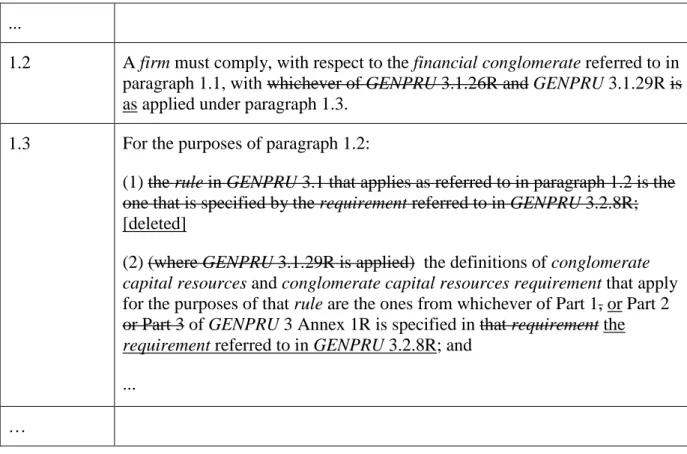
Investment services sector (in relation to a designated investment firm or IFPRU investment firm which is a member of a financial conglomerate for which the APR is the coordinator) Part One, Title II, Chapter 2 of the EU CRR and the PRA Regulation; . in relation to an IFPRU investment firm which is a member of a financial conglomerate for which the FCA is the coordinator) Part One, Title II, Chapter 2 of the EU CRR and IFPRU 8.1;. in relation to a BIPRU firm that is a member of a financial conglomerate where there are no credit institutions or investment firms for which the FCA is a coordinator) BIPRU 8 and BIPRU TP. 2) (where GENPRU 3.1.29R applies) the definitions of conglomerate capital resources and conglomerate capital resources requirements that apply for the purposes of that rule are those from whichever of Part 1, or Part 2 or Part 3 of GENPRU 3 Annex 1R is specified in that request the request mentioned in GENPRU 3.2.8R; and.
Miscellaneous capital resources definitions for BIPRU firms
Definition of the trading book
Applications for advanced approaches and waivers
Solo consolidation
Internal capital adequacy standards
Interest rate risk in the non-trading book
The central principles of the standardised approach to credit risk
The IRB approach: Application, purpose and overview Application
The IRB approach: High level material
The question of whether control is equivalent is decided in accordance with GENPRU 3.2 (Third Country Groups). 5) If the EEA banking and investment group for which the relevant regulator is the lead regulator is part of a wider third country banking and investment group that is not subject to equivalent supervision by a regulatory authority outside the EEA, then BIPRU 4.2.30R - BIPRU 4.2.32G will apply .
Application, purpose, general provisions and non-standard transactions
Interest rate PRR
Scope and basic consolidation requirements for non-EEA sub-groups Main consolidation rule for non-EEA sub-groups
This is illustrated in example three of BIPRU 8 Annex 3G (Examples of how to identify a non-EEA subgroup), where the subgroup of UK bank 1 and the subgroup of UK bank 2 are potential non-EEA subgroups - groups. This is illustrated in Example 1 of BIPRU 8 Annex 3G (Examples of how to identify a non-EEA subgroup). This is illustrated in example three in BIPRU 8 Annex 3G (Examples of how to identify a non-EEA subgroup).
In this example, there are four potential non-EEA subgroups and the elimination process results in only one remaining (the one headed by the UK parent financial holding company in a member state). The reason there are two non-EEA subgroups in these examples is that one of the third country banking or investment services firms is not a member of both potential non-EEA subgroups. In theory this means that there are two sets of consolidation requirements, one relating to the UK consolidation group and one relating to the non-EEA subgroup.
However, as the UK consolidation group and the non-EEA subgroup are the same, in practice this means that the additional consolidation of the non-EEA subgroup disappears. This is illustrated in example three in BIPRU 8 Annex 3G (Examples of how to identify a non-EEA subgroup). If a potential subset outside the EEA that would otherwise be regulated by the relevant regulator contains a.
The intention here is that the EEA competent authority closest to the third country banking or investment services undertaking should be responsible for the non-EEA sub-group sub-consolidation. Example 6 in BIPRU 8 Annex 3G (Examples of how to identify a non-EEA subgroup) illustrates this situation.
CAD Article 22 groups and investment firm consolidation waiver (BIPRU firm only)
Basis of consolidation
Consolidated capital resources
Consolidated capital resources requirements
One relates to credit risk in the non-trading portfolio (the credit risk capital component). The third is a capital requirement for exposures in the trading book that exceed the limits in BIPRU 10.5 (Limits for exposures). R An enterprise must not apply the second method in BIPRU 8.7.13R(3) (group-wide accounting consolidation) or apply accounting consolidation to parts of its UK consolidation group or non-EEA sub-group under method three as described in BIPRU 8.7 .13R(4 )(a) for the purposes of the calculation of the consolidated market risk requirement, unless the group or sub-group and the companies in this group or sub-group meet the conditions of this rule.
This rule applies where the rules applicable under BIPRU 8.7.12 R apply differently to different types of companies.
Advanced prudential calculation approaches
In the case of insurance through own and affiliated companies, the exposure must be ceded to an independent company that is not in the same group as the company or other members of the UK consolidation group or non-EEA subgroup, for example through eligible reinsurance. Where the parent company and its subsidiaries use credit rating systems on a unitary basis, the approval and reporting process described in BIPRU 4.3.12G (Approval and reporting arrangements for the IRB approach where credit rating systems are used on a unitary group basis) and BIPRU 6.5 .32G (Approval and reporting arrangements for AMAs where rating systems are applied on a single group basis) also apply for the purposes of this paragraph.
Application and purpose Application
Requirements for originators and sponsors
Technical criteria on disclosure: General requirements
Note: The relevant regulator has issued guidance with the aim of providing a framework for meeting the disclosure requirements of BIPRU 11.5.18R in accordance with the proportionality test set out in BIPRU 11.5.20R(2).
Qualifying requirements for the use of particular instruments or
The relevant regulator has provided guidance to provide a framework for compliance with the disclosure requirements of BIPRU 11.5.18R subject to the proportionality test set out in BIPRU 11.5.20R(2). This was published as final guidance FG12/19 'General guidance on proportionality'. http://www.bankofengland.co.uk/PRA/Pages/publications/default.aspx. Feedback on CP10/27 and the Final Rules” and is available at. http://www.bankofengland.co.uk/PRA/Pages/publications/default.aspx].
Liquidity risk management
Those plans must be regularly tested at least annually, updated based on the outcome of the alternative scenarios set out in BIPRU 12.4.-1R, and reported to and approved by the firm's governing body, so that. A firm must take the necessary operational steps in advance to ensure that liquidity recovery plans can be implemented immediately.
Liquidity assets buffer
Capital floors for a firm using the IRB or AMA approaches approach Application
BIPRU TP 1 (Applicable chapter of IPRU and other general provisions) is deleted in its entirety. G Article 152(5d) and (5e) of the Banking Consolidation Directive allows the relevant regulator to waive the capital floor calculation based on the IPRU capital resource requirement in BIPRU TP 2.8R(3) or BIPRU TP 2.8R(3) as used in BIPRU TP 2.9 R, only on a case-by-case basis if a company began using the IRB method or the advanced measurement method on or after January 1, 2010. R If a company has an exemption referred to in BIPRU TP 2.11 AG, it must make available capital resources equal to or exceeding 80% of the capital resource requirement that the company would be required to make available under the relevant sections of BIPRU applicable to it immediately before it began using the IRB method or the advanced measurement method as these paragraphs were in effect on December 31, 2010.
Let's say IPRU (BANK) requires the company's capital resources to be £8.00 million and partially meet that. This sets the capital resource requirement in this section at 95% times (£8.0m minus £0.5m) which equals £7.125m. If, for the purposes of the expected loss calculation, the result is negative (ie, impairments and provisions are less than the expected losses), this amount is deducted from the capital resources (equivalent to an increase in the capital resources requirement).
If the result is positive, it is added to capital resources (which is equivalent to a decrease in the capital resources requirement). As the sum of these two amounts (£6.65mn) is still less than the IPRU capital resource requirement of £7.125mn, the effect of this section is that the firm is subject to the (higher) IPRU requirement. If the sum of the BIPRU requirements was more than £7.125 million, the firm would not have been subject to the capital resource requirement in this section.
This will enable a company to decide which calculations to use in relation to BIPRU TP 2.22R and BIPRU TP 2.23R. The purpose of BIPRU TP 2.26R is to allow a firm to calculate the size of the excess exposures in the trading book for which it calculates the additional capital requirement using BIPRU 10 (requirement for large exposures) in order to avoid having to apply the IPRU -the requirements for large exposures only for this purpose.
Commodities firm transitionals: Exemption from capital requirements Application
Close substitutes for commodities
