Markets in Financial Instruments
Directive/
Regulation
Contents
Markets in Financial Instruments Directive/Regulation
Chapter 30 Commission Delegated Regulation (EU) 2017/590
001 Preamble
002 Article -3 Definitions 003 Article -2 Application 004 Article -1 Interpretation
005 Article 1 Data standards and formats for transaction reporting 006 Article 2 Meaning of transaction
007 Article 3 Meaning of execution of a transaction 008 Article 4 Transmission of an order
009 Article 5 Identification of the investment firm executing a transaction 010 Article 6 Designation to identify natural persons
011 Article 7 Details of the identity of the client and identifier and details for the decision maker
012 Article 8 Identification of person or computer algorithm responsible for the invest- ment decision
013 Article 9 Identification of person or computer algorithm responsible for execution of a transaction
014 Article 10 Designation to identify an applicable waiver 015 Article 11 Designation to identify a short sale
016 Article 12 Reporting of an execution for a combination of financial instruments 017 Article 13 Conditions upon which legal entity identifiers are to be developed, attrib-
uted and maintained
018 Article 14 Reporting transactions executed by branches
019 Article 15 Methods and arrangements for reporting financial transactions 021 Article 17 Entry into force and application
022 Signature
annex01 ANNEX I
annex02 ANNEX II National client identifiers for natural persons to be used in transaction reports
www.handbook.fca.org.uk
Markets in Financial Instruments Directive/Regulation
Chapter 30
Commission Delegated Regulation (EU)
2017/590
Commission Delegated Regulation (EU) 2017/590
Preamble
30
Preamble
THE EUROPEAN COMMISSION,
Having regard to the Treaty on the Functioning of the European Union,
Having regard to Regulation (EU) No 600/2014 of the European Parliament and of the Council of 15 May 2014 on markets in financial instruments and amending Regulation (EU) No 648/2012, and in particular the third subparagraph of Article 26(9) thereof,
01/01/2021
Whereas:
(1) For the purposes of effective data analysis by competent authorities, there should be consistency in the standards and formats used when reporting transactions.
(2) Given market practices, supervisory experience and market developments, the meaning of a transaction for reporting purposes should be broad. It should cover purchases and sales of reportable instruments as well as other cases of acquisition or disposal of reportable instruments, as these may also give rise to market abuse concerns.
Furthermore, changes to notional amount may give rise to concerns about possible market abuse as they are similar in nature to additional purchase or sale transactions. In order for competent authorities to distinguish those changes from other purchases or sales, inform- ation on those changes should be specifically reported in transaction reports.
(3) The concept of a transaction should not include acts or events which do not need to be reported to competent authorities for market surveillance purposes. In order to ensure that information on such acts and events is not included in transaction reports, they should be specifically excluded from the meaning of a transaction.
(4) In order to clarify which investment firms are required to report transactions, the activ- ities or services which lead to a transaction should be specified. Accordingly, an invest- ment firm should be considered to be executing a transaction where it performs a service or activity referred to in points 1, 2 and 3 of Section A of Annex I to Directive 2014/65/
EU of the European Parliament and of the Council, makes the investment decision in accordance with a discretionary mandate given by a client, or transfers financial instru- ments to or from accounts, provided that in each case such services or activities have resulted in a transaction. However, in accordance with Article 26(4) of Regulation (EU) No 600/2014, investment firms which are considered to have transmitted orders which result in transactions should not be considered as having executed those transactions.
Commission Delegated Regulation (EU) 2017/590
Preamble
(5) In order to avoid non-reporting or double reporting by investment firms that transmit orders to each other, the investment firm that intends to transmit the order should agree with the firm receiving the order whether the receiving firm will report all the details of the resulting transaction or transmit the order onwards to another investment firm. In the absence of an agreement, the order should be deemed not transmitted and each investment firm should submit its own transaction report containing [all] the details that pertain to the transaction that each investment firm is reporting. Moreover, the details relating to the order to be transmitted between firms should be specified in order to ensure that the competent authorities receive information that is relevant, accurate and complete.
(6) In order to ensure certain and efficient identification of investment firms respons- ible for execution of transactions, those firms should ensure that they are identified in the transaction report submitted pursuant to their transaction reporting obligation using validated, issued and duly renewed legal entity identifiers (LEIs).
(7) In order to ensure consistent and robust identification of natural persons referred to in transaction reports, they should be identified by a concatenation of the country of their nationality followed by identifiers assigned by the country of nationality of those persons.
Where those identifiers are not available, natural persons should be identified by identi- fiers created from a concatenation of their date of birth and name.
(8) In order to facilitate market surveillance, client identification should be consistent, unique and robust. Transaction reports should therefore include the full name and date of birth of clients that are natural persons and should identify clients that are legal entities by their LEIs.
(9) Persons or computer algorithms which make investment decisions may be respons- ible for market abuse. Therefore, in order to ensure effective market surveillance, where investment decisions are made by a person other than the client or by a computer algorithm, the person or algorithm should be identified in the transaction report using unique, robust and consistent identifiers. Where more than one person in an investment firm makes the investment decision, the person taking the primary responsibility for the decision should be identified in the report.
(10) The persons or computer algorithms responsible for determining the venue to access or an investment firm to which the orders are to be transmitted or any other conditions related to the execution of the order may thereby be responsible for market abuse. There- fore, in order to ensure effective market surveillance, a person or computer algorithm within the investment firm that is responsible for such activities should be identified in the transaction report. Where both a person and computer algorithm are involved, or more than one person or algorithm is involved, the investment firm should determine, on a consistent basis following predetermined criteria, which person or algorithm is primarily responsible for those activities.
(11) In order to enable effective market monitoring, transaction reports should include exact information on any change in the position of an investment firm or its client resulting from a reportable transaction at the time such transaction took place. Investment firms should therefore report related fields in an individual transaction report consistently and should report a transaction or different legs of a transaction in such manner that their reports, collectively, provide a clear overall picture which accurately reflects changes in
30
Commission Delegated Regulation (EU) 2017/590
Preamble
30
(12) Short Sale transactions should be specifically flagged as such regardless of whether these transactions constitute a full or partial short sale transaction.(13) Effective market surveillance in the case of a transaction in a combination of finan- cial instruments presents particular challenges for market surveillance. The competent authority needs to have the global view and needs to be able to see separately the transac- tion in respect of each financial instrument that is part of a transaction in which more than one financial instrument is involved. Therefore, investment firms which execute trans- actions in a combination of financial instruments should report the transaction for each financial instrument separately and link those reports by an identifier that is unique at the level of the firm to the group of transaction reports related to that execution.
(14) In order to safeguard the effectiveness of market abuse surveillance of legal persons, Member States should ensure that LEIs are developed, attributed and maintained in accordance with internationally established principles to ensure legal persons are consist- ently and uniquely identified. Investment firms should obtain LEIs from their clients before providing services which would trigger reporting obligations in respect of transac- tions carried out on behalf of those clients and use those LEIs in their transaction reports.
(15) In order to ensure efficient and effective market monitoring, transaction reports should be submitted only once and to a single competent authority that can route them to other relevant competent authorities. Therefore, where an investment firm executes a transaction, it should submit the report to the competent authority of the home Member State of the investment firm irrespective of whether or not a branch is involved, or whether the reporting firm executed the transaction through a branch in another Member State.
Moreover, where a transaction is executed wholly or partly through a branch of an invest- ment firm located in another Member State, the report should be submitted only once to the competent authority of the home Member State of the investment firm unless other- wise agreed by the competent authorities of the home and the host Member State. In order to ensure that competent authorities of host Member State can supervise the services provided by branches within their territory, they need to receive transaction reports on the activities of branches. For this reason, and to allow for the transaction reports to be routed to all the relevant competent authorities for the branches that take part in those transactions, it is necessary to include granular data on branch activity in the reports.
(16) Complete and accurate transaction reporting data is essential to market abuse surveil- lance. Trading venues and investment firms should therefore have methods and arrange- ments to ensure that complete and accurate transaction reports are submitted to competent authorities. ARMs should not be covered by this regulation since they are subject to own specific regime specified in the Commission Delegated Regulation (EU) 2017/571 and have analogous requirements to ensure the data completeness and accuracy.
(17) In order to be able to track the cancellations or corrections, the investment firm should retain the details of the corrections and cancellations provided to it by the ARM in the case where the ARM, in accordance with instructions from the investment firm, cancels or corrects a transaction report submitted on behalf of an investment firm.
(18) Determination of the most relevant market in terms of liquidity enables the routing of transaction reports to other competent authorities and enables investors to identify the competent authorities to whom they must report their short positions pursuant to Articles 5, 7 and 8 of Regulation (EU) No 236/2012 of the European Parliament and of the Council. The rules for determining the relevant competent authority under Directive
Commission Delegated Regulation (EU) 2017/590
Preamble
2004/39/EC of the European Parliament and of the Council have worked effectively for most financial instruments and should therefore remain unchanged. However, new rules should be introduced specifically for those instruments which are not covered by Directive 2004/39/EC, namely for debt instruments issued by a third-country entity, emis- sion allowances and for derivatives for which the immediate underlying has no global identifier, or is a basket or a non-EEA index.
(19) For reasons of consistency and in order to ensure the smooth functioning of the financial markets, it is necessary that the provisions laid down in this Regulation and the provisions laid down in Regulation (EU) No 600/2014 apply from the same date.
(20) This Regulation is based on the draft regulatory technical standards submitted by the European Securities and Markets Authority (ESMA) to the Commission.
(21) ESMA has conducted open public consultations on the draft regulatory technical standards on which this Regulation is based, analysed the potential related costs and bene- fits and requested the opinion of the Securities and Markets Stakeholder Group estab- lished by Article 37 of Regulation (EU) No 1095/2010 of the European Parliament and of the Council,
HAS ADOPTED THIS REGULATION:
30
Commission Delegated Regulation (EU) 2017/590
Article -3 Definitions
30
Article -3 Definitions
In this Regulation, ‘IP completion day’ has the meaning given in the European Union (With- drawal) Act 2020.
Commission Delegated Regulation (EU) 2017/590
Article -2 Application
Article -2 Application
This Regulation applies to:
a MiFID investment firm (other than a collective portfolio management investment firm) and a UK RIE.
30
Commission Delegated Regulation (EU) 2017/590
Article -1 Interpretation
30
Article -1 Interpretation
In this technical standard, unless the contrary intention appears:
(1) words and expressions used have the same meaning as in Regulation 600/2014/EU, (as amended by the Markets in Financial Instruments (Amendment) (EU Exit) Regulations 2018);
(2) in accordance with article 2(1)(62) of Regulation 600/2014/EU, all references in this technical standard to a ‘trading venue’ are to a ‘UK trading venue’;
(3) references to ‘UK or Union trading venues’ include ‘UK trading venues’ as defined in article 2(16A) of Regulation 600/2014/EU and ‘trading venues’ as defined by article 4(1)(24) of Directive 2014/65/EU and operated by a person authorised under Directive 2014/65/EU; and
(4) references to a ‘MiFID investment firm’ ‘collective portfolio management investment firm’ and ‘UK RIE’ are to the terms as defined in accordance with the Glossary to the Handbook of Rules and Guidance published by the Financial Conduct Authority, imme- diately after IP completion day.
Commission Delegated Regulation (EU) 2017/590
Article 1 Data standards and formats for transaction reporting
Article 1 Data standards and formats for transaction reporting
A transaction report shall include all details referred to in Table 2 of Annex I that pertain to the financial instruments concerned. All details to be included in transaction reports shall be submitted in accordance with the standards and formats specified in Table 2 of Annex I, in an electronic and machine-readable form and in a common XML template in accordance with the ISO 20022 methodology.
30
Commission Delegated Regulation (EU) 2017/590
Article 2 Meaning of transaction
30
Article 2 Meaning of transaction
(1) For the purposes of Article 26 of Regulation (EU) No 600/2014, the conclusion of an acquisition or disposal of a financial instrument referred to in Article 26(2) of Regulation (EU) No 600/2014 shall constitute a transaction.
(2) An acquisition referred to in paragraph 1 shall include the following:
(a) a purchase of a financial instrument;
(b) entering into a derivative contract;
(c) an increase in the notional amount of a derivative contract.
(3) A disposal referred to in paragraph 1 shall include the following:
(a) sale of a financial instrument;
(b) closing out of a derivative contract;
(c) a decrease in the notional amount of a derivative contract.
(4) For the purposes of Article 26 of Regulation (EU) No 600/2014, a transaction shall also include a simultaneous acquisition and disposal of a financial instrument where there is no change in the ownership of that financial instrument but post-trade publication is required under Articles 6, 10, 20 or 21 of Regulation (EU) No 600/2014.
(5) A transaction for the purposes of Article 26 of Regulation (EU) No 600/2014 shall not include the following:
(a) securities financing transactions as defined in Article 3(11) of Regulation (EU) 2015/2365 of the European Parliament and of the Council;
(b) a contract arising exclusively for clearing or settlement purposes;
Commission Delegated Regulation (EU) 2017/590
Article 2 Meaning of transaction
(c) a settlement of mutual obligations between parties where the net obligation is carried forward;
(d) an acquisition or disposal that is solely a result of custodial activity;
(e) a post-trade assignment or novation of a derivative contract where one of the parties to the derivative contract is replaced by a third party;
(f) a portfolio compression;
(g) the creation or redemption of units of a collective investment undertaking by the administrator of the collective investment undertaking;
(h) the exercise of a right embedded in a financial instrument, or the conversion of a convertible bond and the resultant transaction in the underlying financial instrument;
(i) the creation, expiration or redemption of a financial instrument as a result of pre- determined contractual terms, or as a result of mandatory events which are beyond the control of the investor where no investment decision by the investor takes place at the point in time of the creation, expiration or redemption of the financial instrument;
(j) a decrease or increase in the notional amount of a derivative contract as a result of pre-determined contractual terms or mandatory events where no investment decision by the investor takes place at the point in time of the change in the notional amount;
(k) a change in the composition of an index or a basket that occurs after the execution of a transaction;
(l) an acquisition under a dividend re-investment plan;
(m) an acquisition or disposal under an employee share incentive plan, or arising from the administration of an unclaimed asset trust, or of residual fractional share enti- tlements following corporate events or as part of shareholder reduction programmes where all the following criteria are met:
(i) the dates of acquisition or disposal are pre-determined and published in advance;
(ii) the investment decision concerning the acquisition or disposal that is taken by the investor amounts to a choice by the investor to enter into the transaction with no ability to unilaterally vary the terms of the transaction;
(iii) there is a delay of at least ten business days between the investment decision and the moment of execution;
30
Commission Delegated Regulation (EU) 2017/590
Article 2 Meaning of transaction
30
(iv) the value of the transaction is capped at the equivalent of EUR 1000 for a one- off transaction for the particular investor in the particular instrument or, where the arrangement results in transactions, the cumulative value of the transaction shall be capped at the equivalent of EUR 500 for the particular investor in the particular instrument per calendar month;
(n) an exchange and tender offer on a bond or other form of securitised debt where the terms and conditions of the offer are pre-determined and published in advance and the investment decision amounts to a choice by the investor to enter into the transaction with no ability to unilaterally vary its terms;
(o) an acquisition or disposal that is solely a result of a transfer of collateral.
The exclusion provided for in point (a) of the first subparagraph shall not apply to the securities financing transactions to which a member of the European System of Central Banks1 or Bank of England is a counterparty.
The exclusion provided for in point (i) of the first subparagraph shall not apply to initial public offerings or secondary public offerings or placings, or debt issuance.
[]
1 In accordance with paragraph 31bazg of Annex IX (Financial Services) to the EEA Agreement, this reference to a member of the European System of Central Banks shall be understood to include, in addition to its meaning in this Regulation, a national central bank of the EFTA States. Article 2(b) of the EEA Agreement defines ‘EFTA States’ to mean Iceland, the Principality of Liechtenstein and the Kingdom of Norway.
The European Union (Withdrawal) Act 2018 provides that the Annexes to the EEA Agreement, as they have effect in EU law immediately before IP completion day, form part of UK law on and after IP completion day – to the extent that they refer to or adapt any EU regulation, EU decision or EU tertiary legislation which is retained by section 3 of the Act. The 2018 Act also provides that Protocol 1 to the EEA Agreement, as it has effect in EU law immediately before IP completion day, forms part of UK law on and after IP completion day.
Commission Delegated Regulation (EU) 2017/590
Article 3 Meaning of execution of a transaction
Article 3 Meaning of execution of a transaction
(1) An investment firm shall be deemed to have executed a transaction within the meaning of Article 2, where it provides any of the following services or performs any of the following activities that result in a transaction:
(a) reception and transmission of orders in relation to one or more financial instruments;
(b) execution of orders on behalf of clients;
(c) dealing on own account;
(d) making an investment decision in accordance with a discretionary mandate given by a client;
(e) transfer of financial instruments to or from accounts.
(2) An investment firm shall not be deemed to have executed a transaction where it has transmitted an order in accordance with Article 4.
30
Commission Delegated Regulation (EU) 2017/590
Article 4 Transmission of an order
30
Article 4 Transmission of an order
(1) An investment firm transmitting an order pursuant to Article 26(4) of Regulation (EU) No 600/2014 (transmitting firm) shall be deemed to have transmitted that order only if the following conditions are met:
(a) the order was received from its client or results from its decision to acquire or dispose of a specific financial instrument in accordance with a discretionary mandate provided to it by one or more clients;
(b) the transmitting firm has transmitted the order details referred to in paragraph 2 to another investment firm (receiving firm);
(c) the receiving firm is a MiFID investment firm and is subject to Article 26(1) of Regulation (EU) No 600/2014 and agrees either to report the transaction resulting from the order concerned or to transmit the order details in accordance with this Article to another MiFID investment firm.
For the purposes of point (c) of the first subparagraph the agreement shall specify the time limit for the provision of the order details by the transmitting firm to the receiving firm and provide that the receiving firm shall verify whether the order details received contain obvious errors or omissions before submitting a transaction report or transmitting the order in accordance with this Article.
(2) The following order details shall be transmitted in accordance with paragraph 1, insofar as pertinent to a given order:
(a) the identification code of the financial instrument;
(b) whether the order is for the acquisition or disposal of the financial instrument;
(c) the price and quantity indicated in the order;
(d) the designation and details of the client of the transmitting firm for the purposes of the order;
Commission Delegated Regulation (EU) 2017/590
Article 4 Transmission of an order
(e) the designation and details of the decision maker for the client where the investment decision is made under a power of representation;
(f) a designation to identify a short sale;
(g) a designation to identify a person or algorithm responsible for the investment decision within the transmitting firm;
(h) country of the branch of the investment firm supervising the person responsible for the investment decision and country of the investment firm's branch that received the order from the client or made an investment decision for a client in accordance with a discretionary mandate given to it by the client;
(i) for an order in commodity derivatives, an indication whether the transaction is to reduce risk in an objectively measurable way in accordance with regulation 17 of the Financial Services and Markets Act 2000 (Markets in Financial Instruments) Regula- tions 2017;
(j) the code identifying the transmitting firm.
For the purposes of point (d) of the first subparagraph, where the client is a natural person, the client shall be designated in accordance with Article 6.
For the purposes of point (j) of the first subparagraph, where the order transmitted was received from a prior firm that did not transmit the order in accordance with the conditions set out in this Article, the code shall be the code identifying the transmitting firm. Where the order transmitted was received from a prior transmitting firm in accordance with the conditions set out in this Article, the code provided pursuant to point (j) referred to in the first subparagraph shall be the code identifying the prior transmitting firm.
(3) Where there is more than one transmitting firm in relation to a given order, the order details referred to in points (d) to (i) of the first subparagraph of paragraph 2 shall be transmitted in respect of the client of the first transmitting firm.
(4) Where the order is aggregated for several clients, information referred to in paragraph 2 shall be transmitted for each client.
30
Commission Delegated Regulation (EU) 2017/590
Article 5 Identification of the investment firm executing a transaction
30
Article 5 Identification of the investment firm executing a transaction
(1) An investment firm which executes a transaction shall ensure that it is identified with a validated, issued and duly renewed ISO 17442 legal entity identifier code in the trans- action report submitted pursuant to Article 26(1) of Regulation (EU) No 600/2014.
(2) An investment firm which executes a transaction shall ensure that the reference data related to its legal entity identifier is renewed in accordance with the terms of any of the accredited Local Operating Units of the Global Legal Entity Identifier System.
Commission Delegated Regulation (EU) 2017/590
Article 6 Designation to identify natural persons
Article 6 Designation to identify natural persons
(1) A natural person shall be identified in a transaction report using the designation resulting from the concatenation of the ISO 3166-1 alpha-2 (2 letter country code) of the nationality of the person, followed by the national client identifier listed in Annex II based on the nationality of the person.
(2) The national client identifier referred to in paragraph 1 shall be assigned in accordance with the priority levels provided in Annex II using the highest priority identifier that a person has regardless of whether that identifier is already known to the investment firm.
(3) Where a natural person is a national of more than one European Economic Area (EEA) country, the country code of the first nationality when sorted alphabetically by its ISO 3166-1 alpha-2 code and the identifier of that nationality assigned in accordance with paragraph 2 shall be used. Where a natural person has a non-EEA nationality, the highest priority identifier in accordance with the field referring to "all other countries" provided in Annex II shall be used. Where a natural person has EEA and non-EEA nationality, the country code of the EEA nationality and the highest priority identifier of that nationality assigned in accordance with paragraph 2 shall be used. For the purposes of this provision, a reference to ‘the EEA’ is to be interpreted as if the United Kingdom continues to be an EEA State.
(4) Where the identifier assigned in accordance with paragraph 2 refers to CONCAT, the natural person shall be identified by the investment firm using the concatenation of the following elements in the following order:
(a) the date of birth of the person in the format YYYYMMDD;
(b) the five first characters of the first name;
(c) the five first characters of the surname.
(5) For the purposes of paragraph 4, prefixes to names shall be excluded and first names and surnames shorter than five characters shall be appended by "#" so as to ensure that references to names and surnames in accordance with paragraph 4 contain five charac- ters. All characters shall be in upper case. No apostrophes, accents, hyphens, punctuation marks or spaces shall be used.
30
Commission Delegated Regulation (EU) 2017/590
Article 7 Details of the identity of the client and identifier and details for the decision maker
30
Article 7 Details of the identity of the client and identifier and details for the decision maker
(1) A transaction report relating to a transaction executed on behalf of a client who is a natural person shall include the full name and date of birth of the client as specified in Fields 9, 10, 11, 18, 19 and 20 of Table 2 of Annex I.
(2) Where the client is not the person taking the investment decision in relation to that transaction, the transaction report shall identify the person taking such decision on behalf of the client as specified in fields 12 to 15 for the buyer and in fields 21 to 24 for the seller in Table 2 of Annex I.
Commission Delegated Regulation (EU) 2017/590
Article 8 Identification of person or computer algorithm responsible for the investment decision
Article 8 Identification of person or computer algorithm responsible for the investment decision
(1) Where a person or computer algorithm within an investment firm makes the invest- ment decision to acquire or dispose of a specific financial instrument, that person or computer algorithm shall be identified as specified in field 57 of Table 2 of Annex I.
The investment firm shall only identify such a person or computer algorithm where that investment decision is made either on behalf of the investment firm itself, or on behalf of a client in accordance with a discretionary mandate given to it by the client.
(2) Where more than one person within the investment firm takes the investment decision, the investment firm shall determine the person taking the primary responsibility for that decision. The person taking primary responsibility for the investment decision shall be determined in accordance with pre-determined criteria established by the investment firm.
(3) Where a computer algorithm within the investment firm is responsible for the invest- ment decision in accordance with paragraph 1, the investment firm shall assign a desig- nation for identifying the computer algorithm in a transaction report. That designation shall comply with the following conditions:
(a) it is unique for each set of code or trading strategy that constitutes the algorithm, regardless of the financial instruments or markets that the algorithm applies to;
(b) it is used consistently when referring to the algorithm or version of the algorithm once assigned to it;
(c) it is unique over time.
30
Commission Delegated Regulation (EU) 2017/590
Article 9 Identification of person or computer algorithm responsible for execution of a transaction
30
Article 9 Identification of person or computer algorithm responsible for execution of a transaction
(1) Where a person or computer algorithm within the investment firm which executes a transaction determines which UK or Union trading venue, systematic internaliser or organised trading platform located outside the United Kingdom or the Union to access, which firms to transmit orders to or any conditions related to the execution of an order, that person or computer algorithm shall be identified in field 59 of Table 2 of Annex I.
(2) Where a person within the investment firm is responsible for the execution of the transaction, the investment firm shall assign a designation for identifying that person in a transaction report in accordance with Article 6.
(3) Where a computer algorithm within the investment firm is responsible for the execu- tion of the transaction, the investment firm shall assign a designation for identifying the computer algorithm in accordance with Article 8(3).
(4) Where a person and computer algorithm are both involved in execution of the trans- action, or more than one person or algorithm are involved, the investment firm shall determine which person or computer algorithm is primarily responsible for the execution of the transaction. The person or computer algorithm taking primary responsibility for the execution shall be determined in accordance with pre-determined criteria established by the investment firm.
Commission Delegated Regulation (EU) 2017/590
Article 10 Designation to identify an applicable waiver
Article 10 Designation to identify an applicable waiver
Transaction reports shall identify the applicable waiver pursuant to Article 4 or Article 9 of Regulation (EU) No 600/2014 under which the executed transaction has taken place in accordance with field 61 of Table 2 of Annex I to this Regulation.
30
Commission Delegated Regulation (EU) 2017/590
Article 11 Designation to identify a short sale
30
Article 11 Designation to identify a short sale
(1) Transaction reports shall identify transactions which, at the time of their execution, are short sale transactions, or are in part a short sale transaction, in accordance with field 62 of Table 2 of Annex I.
(2) An investment firm shall determine on a best effort basis the short sales transactions in which its client is the seller, including when an investment firm aggregates orders from several clients. The investment firm shall identify those short sale transactions in its transaction report in accordance with field 62 of Table 2 of Annex I.
(3) Where an investment firm executes a short sale transaction on its own behalf, it shall indicate in the transaction report whether the short sale transaction was undertaken in a market making or primary dealer capacity under an exemption provided by Article 17 of Regulation (EU) No 236/2012.
Commission Delegated Regulation (EU) 2017/590
Article 12 Reporting of an execution for a combination of financial instruments
Article 12 Reporting of an execution for a combination of financial instruments
Where an investment firm executes a transaction involving two or more financial instru- ments, the investment firm shall report the transaction for each financial instrument separ- ately and shall link those reports by an identifier that is unique at the level of the firm to the group of transaction reports related to that execution as specified in field 40 of Table 2 of Annex I.
30
Commission Delegated Regulation (EU) 2017/590
Article 13 Conditions upon which legal entity identifiers are to be developed, attributed and maintained
30
Article 13 Conditions upon which legal entity identifiers are to be developed, attributed and maintained
(1) The United Kingdom shall ensure that legal entity identifiers are developed, attributed and maintained in accordance with the following principles:
(a) uniqueness;
(b) accuracy;
(c) consistency;
(d) neutrality;
(e) reliability;
(f) open source;
(g) flexibility;
(h) scalability;
(i) accessibility.
The United Kingdom shall also ensure that legal entity identifiers are developed, attrib- uted and maintained using uniform global operational standards, are subject to the governance framework of the Legal Entity Identifier Regulatory Oversight Committee and are available at a reasonable cost.
(2) An investment firm shall not provide a service triggering the obligation to submit a transaction report for a transaction entered into on behalf of a client who is eligible for the legal entity identifier code, prior to obtaining the legal entity identifier code from that client.
Commission Delegated Regulation (EU) 2017/590
Article 13 Conditions upon which legal entity identifiers are to be developed, attributed and maintained (3) The investment firm shall ensure that the length and construction of the code are compliant with the ISO 17442 standard and that the code is included in the Global LEI database maintained by the Central Operating Unit appointed by the the Legal Entity
Identifier Regulatory Oversight Committee and pertains to the client concerned.
30
Commission Delegated Regulation (EU) 2017/590
Article 14 Reporting transactions executed by branches
30
Article 14 Reporting transactions executed by branches
(2) Where an investment firm executes a transaction wholly or partly through its branch, it shall report the transaction to the competent authority.
(3) Where country code details in respect of an investment firm's branch are required to be included in a transaction report in accordance with fields 8, 17, 37, 58 or 60 of Table 2 of Annex I due to the partial or full execution of a transaction through that branch, the investment firm shall provide in the transaction report the ISO 3166 country code for the relevant branch in all of the following cases:
(a) where the branch received the order from a client or made an investment decision for a client in accordance with a discretionary mandate given to it by the client;
(b) where the branch has supervisory responsibility for the person responsible for the investment decision concerned;
(c) where the branch has supervisory responsibility for the person responsible for execution of the transaction;
(d) where the transaction was executed on a UK or Union trading venue or an organised trading platform located outside the United Kingdom or the Union using the branch's membership of that trading venue or an organised trading platform.
(4) Where one or more of the cases provided in paragraph 3 do not apply to a branch of the investment firm, the relevant fields in Table 2 of Annex I shall be populated with the ISO country code of the country where the firm has established its head office or registered office.
Commission Delegated Regulation (EU) 2017/590
Article 15 Methods and arrangements for reporting financial transactions
Article 15 Methods and arrangements for reporting financial transactions
(1) The methods and arrangements by which transaction reports are generated and submitted by trading venues and investment firms shall include:
(a) systems to ensure the security and confidentiality of the data reported;
(b) mechanisms for authenticating the source of the transaction report;
(c) precautionary measures to enable the timely resumption of reporting in the case of a failure of the reporting system;
(d) mechanisms for identifying errors and omissions within transaction reports;
(e) mechanisms to avoid the reporting of duplicate transaction reports, including where an investment firm relies on a trading venue to report the details of transactions executed by the investment firm through the systems of the trading venue in accord- ance with Article 26(7) of Regulation (EU) No 600/2014;
(f) mechanisms to ensure that the trading venue only submits reports on behalf of those investment firms that have chosen to rely on the trading venue to send reports on their behalf for transactions completed through systems of the trading venue;
(g) mechanisms to avoid reporting of any transaction where there is no obligation to report under Article 26(1) of Regulation (EU) No 600/2014 either because there is no transaction within the meaning of Article 2 of this Regulation or because the instrument which is the subject of the transaction concerned does not fall within the scope of Article 26(2) of Regulation (EU) No 600/2014;
(h) mechanisms for identifying unreported transactions for which there is an oblig- ation to report under Article 26 of Regulation (EU) No 600/2014, including cases where transaction reports rejected by the competent authority concerned have not been successfully re-submitted.
(2) Where the trading venue or investment firm becomes aware of any error or omission within a transaction report submitted to the competent authority, any failure to submit
30
Commission Delegated Regulation (EU) 2017/590
Article 15 Methods and arrangements for reporting financial transactions
30
transactions that are reportable, or of the reporting of a transaction for which there is no obligation to report, it shall promptly notify the competent authority of this fact.
(3) Investment firms shall have arrangements in place to ensure that their transaction reports are complete and accurate. Those arrangements shall include testing of their reporting process and regular reconciliation of their front-office trading records against data samples provided to them by the competent authority to that effect.
(4) Where the competent authority does not provide data samples, investment firms shall reconcile their front-office trading records against the information contained in the trans- action reports that they have submitted to the competent authority, or in the transaction reports that ARMs or trading venues have submitted on their behalf. The reconciliation shall include checking the timeliness of the report, the accuracy and completeness of the individual data fields and their compliance with the standards and formats specified in Table 2 of Annex I.
(5) Investment firms shall have arrangements in place to ensure that their transaction reports, when viewed collectively, reflect all changes in their position and in the posi- tion of their clients in the financial instruments concerned at the time transactions in the financial instruments are executed.
(6) Where an ARM, in accordance with instructions from the investment firm, cancels or corrects a transaction report submitted on behalf of an investment firm, the investment firm shall retain the details of the corrections and cancellations provided to it by the ARM.
Commission Delegated Regulation (EU) 2017/590
Article 17 Entry into force and application
Article 17 Entry into force and application
This Regulation shall enter into force on the twentieth day following that of its publication in the Official Journal of the European Union.
It shall apply from 3 January 2018.
However, the second subparagraph of Article 2(5) shall apply 12 months after the date of entry into force of the delegated act adopted by the Commission pursuant to Article 4(9) of Regulation (EU) 2015/2365.
30
Commission Delegated Regulation (EU) 2017/590
Signature
30
Signature
01/01/2021
Done at Brussels, 28 July 2016.
01/01/2021
For the Commission 01/01/2021
The President 01/01/2021
Jean-Claude JUNCKER
Commission Delegated Regulation (EU) 2017/590
ANNEX I
ANNEX I
Table 1 Legend for Table 2
SYMBOL DATA TYPE DEFINITION
{ALPHANUM-n} Up to n alphanumerical characters Free text field.
{CFI_CODE} 6 characters ISO 10962 CFI code
{COUNTRYCODE_2} 2 alphanumerical characters 2 letter country code, as defined by ISO 3166-1 alpha-2 country code
{CURRENCYCODE_3} 3 alphanumerical characters 3 letter currency code, as defined by ISO 4217 currency codes
{DATE_TIME_FORMAT} ISO 8601 date and time format Date and time in the following format:
YYYY-MM-DDThh:mm:ss.ddddddZ.
- "YYYY" is the year;
- "MM" is the month;
- "DD" is the day;
- "T" - means that the letter "T" shall be used
- "hh" is the hour;
- "mm" is the minute;
- "ss.dddddd" is the second and its fraction of a second;
- Z is UTC time.
Dates and times shall be reported in UTC.
{DATEFORMAT} ISO 8601 date format Dates shall be formatted in the follow
ing format:
YYYY-MM-DD.
{DECIMAL-n/m} Decimal number of up to n digits in total of which up to m digits can be frac tion digits
Numerical field for both positive and negative values.
- decimal separator is "." (full stop);
- negative numbers are prefixed with
30
Commission Delegated Regulation (EU) 2017/590
ANNEX I
30
Values are rounded and not truncated.
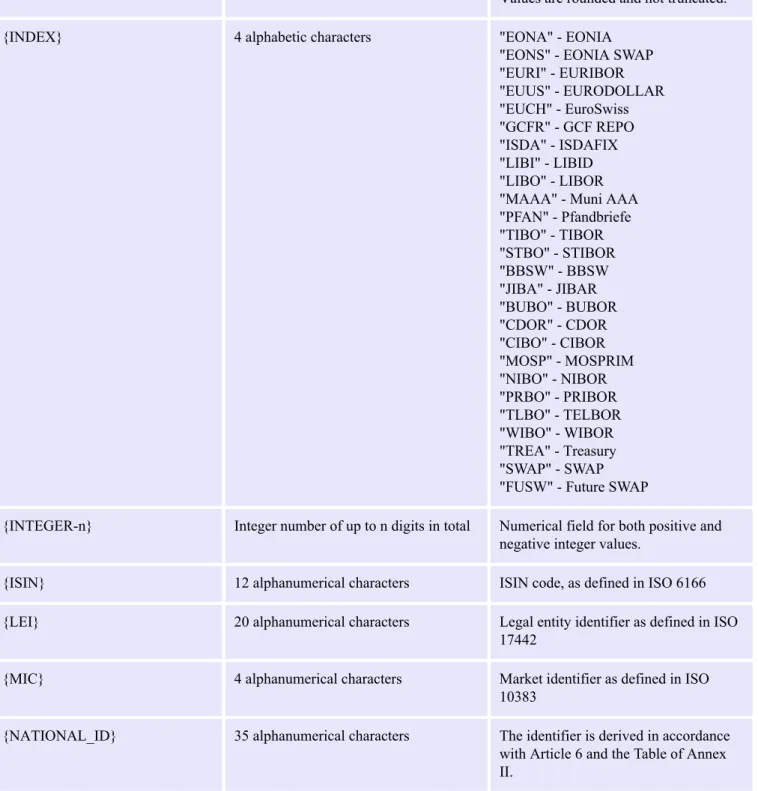
{INDEX} 4 alphabetic characters "EONA" - EONIA
"EONS" - EONIA SWAP
"EURI" - EURIBOR
"EUUS" - EURODOLLAR
"EUCH" - EuroSwiss
"GCFR" - GCF REPO
"ISDA" - ISDAFIX
"LIBI" - LIBID
"LIBO" - LIBOR
"MAAA" - Muni AAA
"PFAN" - Pfandbriefe
"TIBO" - TIBOR
"STBO" - STIBOR
"BBSW" - BBSW
"JIBA" - JIBAR
"BUBO" - BUBOR
"CDOR" - CDOR
"CIBO" - CIBOR
"MOSP" - MOSPRIM
"NIBO" - NIBOR
"PRBO" - PRIBOR
"TLBO" - TELBOR
"WIBO" - WIBOR
"TREA" - Treasury
"SWAP" - SWAP
"FUSW" - Future SWAP
{INTEGER-n} Integer number of up to n digits in total Numerical field for both positive and negative integer values.
{ISIN} 12 alphanumerical characters ISIN code, as defined in ISO 6166
{LEI} 20 alphanumerical characters Legal entity identifier as defined in ISO
17442
{MIC} 4 alphanumerical characters Market identifier as defined in ISO
10383
{NATIONAL_ID} 35 alphanumerical characters The identifier is derived in accordance with Article 6 and the Table of Annex II.
Table 2 Details to be reported in transaction reports
N FIELD CONTENT TO BE REPORTED FORMAT AND STANDARDS
TO BE USED FOR REPORTING
1 Report status Indication as to whether the transac
tion report is new or a cancellation. "NEWT" - New
"CANC" - Cancellation 2 Transaction Reference Number Identification number that is
unique to the executing firm for each transaction report.
{ALPHANUM-52}
Commission Delegated Regulation (EU) 2017/590
ANNEX I
Where, pursuant to Article 26(5) of Regulation (EU) No 600/2014, a trading venue submits a transac tion report on behalf of a firm that is not subject to Regulation (EU) No 600/2014, the trading venue shall populate this field with a num ber that has been internally gener ated by the trading venue and that is unique for each transaction re port submitted by the trading ven ue.
3 Trading venue transaction identific
ation code This is a number generated by UK
or Union trading venues and dis seminated to both the buying and the selling parties in accordance with Article 12 of Commission Del egated Regulation (EU) 2017/580.
This field is only required for the market side of a transaction ex ecuted on a UK or Union trading venue.
{ALPHANUM-52}
4 Executing entity identification
code Code used to identify the entity ex
ecuting the transaction. {LEI}
5 Investment Firm covered by Direct
ive 2014/65/EU Indicates whether the entity iden tified in field 4 is a MiFID invest ment firm.
"true"- yes
"false"- no
6 Submitting entity identification
code Code used to identify the entity sub
mitting the transaction report to the competent authority in accordance with Article 26(7) of Regulation (EU) No 600/2014.
Where the report is submitted by the executing firm directly to the competent authority, it shall be pop ulated with the LEI of the execut ing firm (where the executing firm is a legal entity).
Where the report is submitted by a trading venue, it shall be populated with the LEI of the operator of the trading venue.
Where the report is submitted by an ARM, it shall be populated with the LEI of the ARM.
{LEI}
Buyer details
- For joint accounts fields 7-11 shall be repeated for each buyer.
- Where the transaction is for a transmitted order that has met the conditions for transmission set out in Article 4, the information in fields 7-15 shall be populated by the receiving firm in the receiving firm's report with the information received from the transmitting firm.
30
Commission Delegated Regulation (EU) 2017/590
ANNEX I
30
- Where the transmission is for a transmitted order that has not met the conditions for transmission set out in Article 4 the receiving firm shall treat the transmitting firm as the buyer.
7 Buyer identification code Code used to identify the acquirer of the financial instrument.
Where the acquirer is a legal entity, the LEI code of the acquirer shall be used.
Where the acquirer is a non-legal entity, the identifier specified in Article 6 shall be used.
Where the transaction was ex ecuted on a UK or Union trading venue or on an organised trading platform outside of the United Kingdom or the Union that utilises a central counterparty (CCP) and where the identity of the acquirer is not disclosed, the LEI code of the CCP shall be used.
Where the transaction was ex ecuted on a UK or Union trading venue or on an organised trading platform outside of the United Kingdom or the Union that does not utilise a CCP and where the identity of the acquirer is not dis closed, the MIC code of the UK or Union trading venue or of the or ganised trading platform outside of the United Kingdom or the Union shall be used.
Where the acquirer is an invest ment firm acting as a systematic in ternaliser (SI), the LEI code of the SI shall be used.
"INTC" shall be used to designate an aggregate client account within the investment firm in order to re port a transfer into or out of that ac count with an associated allocation to the individual client(s) out of or into that account respectively.
In case of options and swaptions, the buyer shall be the counterparty that holds the right to exercise the option and the seller shall be the counterparty that sells the option and receives a premium.
In case of futures and forwards oth er than futures and forwards relat ing to currencies, the buyer shall be the counterparty buying the in strument and the seller the counter party selling the instrument.
In the case of swaps relating to securities, the buyer shall be the counterparty that gets the risk of price movement of the underly
{LEI}
{MIC}
{NATIONAL_ID}
"INTC"
Commission Delegated Regulation (EU) 2017/590
ANNEX I
ing security and receives the secur ity amount. The seller shall be the counterparty paying the security amount.
In the case of swaps related to in terest rates or inflation indices, the buyer shall be the counterparty pay ing the fixed rate. The seller shall be the counterparty receiving the fixed rate. In case of basis swaps (float-to-float interest rate swaps), the buyer shall be the counterparty that pays the spread and the seller the counterparty that receives the spread.
In the case of swaps and forwards related to currencies and of cross currency swaps, the buyer shall be the counterparty receiving the cur rency which is first when sorted al phabetically by ISO 4217 standard and the seller shall be the counter party delivering this currency.
In the case of swap related to di vidends, the buyer shall be the counterparty receiving the equi valent actual dividend payments.
The seller is the counterparty pay ing the dividend and receiving the fixed rate.
In the case of derivative instru ments for the transfer of credit risk except options and swaptions, the buyer shall be the counterparty buy ing the protection. The seller is the counterparty selling the protection.
In case of derivative contract re lated to commodities, the buyer shall be the counterparty that re ceives the commodity specified in the report and the seller the counter party delivering this commodity.
In case of forward rate agreements, the buyer shall be the counterparty paying the fixed rate and the seller the counterparty receiving the fixed rate.
For an increase in notional, the buy er shall be the same as the acquirer of the financial instrument in the original transaction and the seller shall be the same as the disposer of the financial instrument in the ori ginal transaction.
For a decrease in notional the buy er shall be the same as the disposer of the financial instrument in the original transaction and the seller
30
Commission Delegated Regulation (EU) 2017/590
ANNEX I
30
the financial instrument in the ori ginal transaction.
Additional details
- Field 8-15 are only applicable if the buyer is a client
- Fields 9-11 are only applicable if the buyer is a natural person
8 Country of the branch for the buyer Where the acquirer is a client, this field shall identify the country of the branch that received the order from the client or made an invest ment decision for a client in accord ance with a discretionary mandate given to it by the client as required by Article 14(3).
Where this activity was not conduc ted by a branch this shall be popu lated with the country code of the country where the investment firm has established its head office or re gistered office.
Where the transaction is for a trans mitted order that has met the condi tions for transmission set out in Art icle 4, this field shall be populated using the information received from the transmitting firm.
{COUNTRYCODE_2}
9 Buyer - first name(s) Full first name(s) of the buyer. In case of more than one first name, all names shall be included in this field separated by a comma.
{ALPHANUM-140}
10 Buyer - surname(s) Full surname(s) of the buyer. In case of more than one surname, all surnames shall be included in this field separated by a comma.
{ALPHANUM-140}
11 Buyer - date of birth Date of birth of the buyer {DATEFORMAT}
Buyer decision maker
- Fields 12-15 are only applicable if the decision maker acts under a power of representation 12 Buyer decision maker code Code used to identify the person
who makes the decision to acquire the financial instrument.
Where the decision is made by an investment firm, this field shall be populated with the identity of the investment firm rather than the in dividual making the investment de cision.
Where the decision maker is a legal entity, the LEI code of the decision maker shall be used.
{LEI}
{NATIONAL_ID}
Commission Delegated Regulation (EU) 2017/590
ANNEX I
Where the decision maker is a non- legal entity, the identifier specified in Article 6 shall be used.
Buyer decision maker details
- Fields 13-15 are only applicable if the decision maker is a natural person 13 Buy decision maker - First
Name(s) Full first name(s) of the decision
maker for the buyer. In case of more than one first name, all names shall be included in this field separated by a comma
{ALPHANUM-140}
14 Buy decision maker - Surname(s) Full surname(s) of the decision maker for the buyer. In case of more than one surname, all sur names shall be included in this field separated by a comma
{ALPHANUM-140}
15 Buy decision maker - Date of birth Date of birth of the decision maker
for the buyer {DATEFORMAT}
Seller details and decision maker
- For joint accounts fields 16-20 shall be repeated for each seller.
- Where the transaction for a seller is for a transmitted order that has met the conditions for transmission set out in Article 4, the information in fields 16-24 shall be populated by the receiving firm in the receiving firm's report from the information received from the transmitting firm.
- Where the transmission is for a transmitted order that has not met the conditions for transmission set out in Article 4, the receiving firm shall treat the transmitting firm as the seller.
16 Seller identification code Code used to identify the disposer of the financial instrument.
Where the disposer is a legal en tity, the LEI code of the disposer shall be used.
Where the disposer is a non-legal entity, the identifier specified in Article 6 shall be used.
Where the transaction was ex ecuted on a UK or Union trading venue or on an organised trading platform outside of the United Kingdom or the Union that utilises a central counterparty CCP and where the identity of the disposer is not disclosed, the LEI code of the CCP shall be used.
Where the transaction was ex ecuted on a UK or Union trading venue or on an organised trading platform outside of the United Kingdom or the Union that does not utilise a CCP and where the
{LEI}
{MIC}
{NATIONAL_ID}
"INTC"
30
Commission Delegated Regulation (EU) 2017/590
ANNEX I
30
ing venue or of the organised trad ing platform outside of the United Kingdom or the Union shall be used.
Where the disposer is an invest ment firm acting as a SI, the LEI code of the SI shall be used
"INTC" shall be used to designate an aggregate client account within the investment firm in order to re port a transfer into or out of that ac count with an associated allocation to the individual client(s) out of or into that account respectively.
In case of options and swaptions, the buyer shall be the counterparty that holds the right to exercise the option and the seller shall be the counterparty that sells the option and receives a premium.
In case of futures and forwards oth er than futures and forwards relat ing to currencies, the buyer shall be the counterparty buying the in strument and the seller the counter party selling the instrument.
In the case of swaps relating to securities, the buyer shall be the counterparty that gets the risk of price movement of the underly ing security and receives the secur ity amount. The seller shall be the counterparty paying the security amount.
In the case of swaps related to in terest rates or inflation indices, the buyer shall be the counterparty pay ing the fixed rate. The seller shall be the counterparty receiving the fixed rate. In case of basis swaps (float-to-float interest rate swaps), the buyer shall be the counterparty that pays the spread and the seller the counterparty that receives the spread.
In the case of swaps and forwards related to currencies and of cross currency swaps, the buyer shall be the counterparty receiving the cur rency which is first when sorted al phabetically by ISO 4217 standard and the seller shall be the counter party delivering this currency.
In the case of swap related to di vidends, the buyer shall be the counterparty receiving the equi valent actual dividend payments.
The seller is the counterparty pay ing the dividend and receiving the fixed rate.
Commission Delegated Regulation (EU) 2017/590
ANNEX I
In the case of derivative instru ments for the transfer of credit risk except options and swaptions, the buyer shall be the counterparty buy ing the protection. The seller is the counterparty selling the protection.
In case of derivative contracts re lated to commodities, the buyer shall be the counterparty that re ceives the commodity specified in the report and the seller the counter party delivering this commodity.
In case of forward rate agreements, the buyer shall be the counterparty paying the fixed rate and the seller the counterparty receiving the fixed rate.
For an increase in notional, the seller shall be the same as the dis poser in the original transaction.
For a decrease in notional the seller shall be the same as the acquirer of the financial instrument in the ori ginal transaction.
17-24 Fields 17-24 mirror all buyer related fields numbered 8-15 (buyer details and decision maker) for the seller.
Transmission details
- Fields 26 and 27 shall only be populated for transaction reports by a receiving firm where all the conditions for trans mission in Article 4 have been met.
- Where a firm acts both as a receiving firm and a transmitting firm it shall populate field 25 to indicate that it is a transmitting firm and shall populate fields 26 and 27 from its perspective as a receiving firm.
25 Transmission of order indicator "true" shall be populated by the transmitting firm within the trans mitting firm's report where the con ditions for transmission specified in Article 4 were not satisfied
"false" - in all other circumstances
"true"
"false"
26 Transmitting firm identification
code for the buyer Code used to identify the firm trans mitting the order
This shall be populated by the re ceiving firm within the receiving firm's report with the identification code provided by the transmitting firm.
{LEI}
27 Transmitting firm identification
code for the seller Code used to identify the firm trans mitting the order.
This shall be populated by the re ceiving firm within the receiving firm's report with the identification code provided by the transmitting
{LEI}
30
Commission Delegated Regulation (EU) 2017/590
ANNEX I
30
Transaction details28 Trading date time Date and time when the transaction was executed.
For transactions executed on a UK or Union trading venue, the level of granularity shall be in accord ance with the requirements set out in Article of Commission Deleg ated Regulation (EU) 2017/574.
For transactions not executed on a UK or Union trading venue, the date and time shall be when the parties agree the content of the fol lowing fields: quantity, price, cur rencies in fields 31, 34 and 44, in strument identification code, instru ment classification and underlying instrument code, where applicable.
For transactions not executed on a UK or Union trading venue the time reported shall be at least to the nearest second.
Where the transaction results from an order transmitted by the execut ing firm on behalf of a client to a third party where the conditions for transmission set out in Article 4 were not satisfied, this shall be the date and time of the transaction rather than the time of the order transmission.
{DATE_TIME_FORMAT}
29 Trading capacity Indication of whether the transac tion results from the executing firm carrying out matched principal trad ing under Article 4(1)(38) of Dir ective 2014/65/EU or dealing on own account under Article 4(1)(6) of Directive 2014/65/EU.
Where the transaction does not result from the executing firm car rying out matched principal trad ing or dealing on own account, the field shall indicate that the transac tion was carried out under any oth er capacity.
"DEAL" - Dealing on own account
"MTCH" - Matched principal
"AOTC" - Any other capacity
30 Quantity The number of units of the finan
cial instrument, or the number of derivative contracts in the transac tion.
The nominal or monetary value of the financial instrument.
For spread bets, the quantity shall be the monetary value wagered per point movement in the underlying financial instrument.
{DECIMAL-18/17} in case the quantity is expressed as number of units
{DECIMAL-18/5} in case the quantity is expressed as monetary or nominal value
Commission Delegated Regulation (EU) 2017/590
ANNEX I
For credit default swaps, the quant ity shall be the notional amount for which the protection is acquired or disposed of.
For increase or decrease in notion al amount derivative contracts, the number shall reflect the absolute value of the change and shall be ex pressed as a positive number.
The information reported in this field shall be consistent with the values provided in fields 33 and 46.
31 Quantity currency Currency in which the quantity is expressed.
Only applicable if quantity is ex pressed as nominal or monetary value.
{CURRENCYCODE_3}
32 Derivative notional increase/de
crease Indication as to whether the trans
action is an increase or decrease of notional of a derivative contract.
Field only applies when there is change in notional for a derivative contract.
"INCR" - Increase
"DECR" - Decrease
33 Price Traded price of the transaction ex
cluding, where applicable, commis sion and accrued interest.
In the case of option contracts, it shall be the premium of the deriv ative contract per underlying or in dex point.
In the case of spread bets it shall be the reference price of the underly ing instrument.
For credit default swaps (CDS) it shall be the coupon in basis points.
Where price is reported in monet ary terms, it shall be provided in the major currency unit.
Where price is currently not avail able but pending, the value shall be
"PNDG"
Where price is not applicable the value shall be "NOAP"
The information reported in this field shall be consistent with the values provided in fields 30 and 46.
{DECIMAL-18/13} in case the price is expressed as monetary value
{DECIMAL-11/10} in case the price is expressed as percentage or yield
{DECIMAL-18/17} in case the price is expressed as basis points
"PNDG" in case the price is not available
"NOAP" in case the price is not ap plicable
34 Price Currency Currency in which the price is ex
pressed (applicable if the price is expressed as monetary value).
{CURRENCYCODE_3}
35 Net amount The net amount of the transaction {DECIMAL-18/5}
30
Commission Delegated Regulation (EU) 2017/590
ANNEX I
30
strument upon the settlement of the transaction. This cash amount equals to: (clean price * nominal value)+any accrued coupons. As a result, the net amount of the trans action excludes any commission or other fees charged to the buyer of the debt instrument.
Field only applies when the finan cial instrument is debt.
36 Venue Identification of the venue where
the transaction was executed.
Use the ISO 10383 segment MIC for transactions executed on a UK or Union trading venue, a UK or Union Systematic Internaliser (SI) or organised trading platform out side of the United Kingdom or the Union. Where the segment MIC does not exist, use the operating MIC.Use MIC code 'XOFF' for financial instruments admitted to trading, or traded on a UK or Union trading venue or for which a request for ad mission was made to a UK or Uni on trading venue, where the trans action on that financial instrument is not executed on a UK or Union trading venue, UK or Union SI or organised trading platform outside of the United Kingdom or the Uni on, or where an investment firm does not know it is trading with an other investment firm acting as a UK or Union SI.
Use MIC code 'XXXX' for finan cial instruments that are not admit ted to trading or traded on a UK or Union trading venue or for which no request for admission has been made and that are not traded on an organised trading platform outside of the United Kingdom or the Uni on but where the underlying is ad mitted to trading or traded on a UK or Union trading venue.
{MIC}
37 Country of the branch membership Code used to identify the country of a branch of the investment firm whose market membership was used to execute the transaction.
Where a branch's market member ship was not used, this field shall be populated with the country code of the country where the firm has established its head office or re gistered office.
{COUNTRYCODE_2}
Commission Delegated Regulation (EU) 2017/590
ANNEX I
This field shall only be populated for the market side of a transaction executed on a UK or Union trad ing venue or on an organised trad ing platform outside of the United Kingdom or the Union.
38 Up-front payment Monetary value of any up-front
payment received or paid by the seller.
Where the seller receives the up- front payment, the value populated is positive. Where the seller pays the up-front payment, the value populated is negative.
{DECIMAL-18/5}
39 Up-front payment currency Currency of the up-front payment. {CURRENCYCODE_3}
40 Complex trade component id Identifier, internal to the report ing firm to identify all the reports related to the same execution of a combination of financial instru ments in accordance with Article 12. The code must be unique at the level of the firm for the group of re ports related to the execution.
Field only applies when the condi tions specified in Article 12 apply.
{ALPHANUM-35}
Instrument details
41 Instrument identification code Code used to identify the financial instrument
This field applies to financial instru ments for which a request for ad mission to trading has been made to a UK or Union trading venue, that are admitted to trading or traded on a UK or Union trading venue or on a UK or Union system atic internaliser. It also applies to financial instruments which have an ISIN and are traded on organ ised trading platform outside of the United Kingdom or the Union where the underlying is a financial instrument traded on a UK or Uni on trading venue.
{ISIN}
Fields 42-56 are not applicable where:
transactions are executed on a UK or Union trading venue or with an investment firm acting as a UK or Union SI;
orfield 41 is populated with an ISIN that exists on the reference data list 42 Instrument full name Full name of the financial instru
ment {ALPHANUM-350}
30
Commission Delegated Regulation (EU) 2017/590
ANNEX I
30
43 Instrument classification Taxonomy used to classify the fin ancial instrumentA complete and accurate CFI code shall be provided.
{CFI_CODE}
44 Notional currency 1 Currency in which the notional is denominated.