
A written report from the Chair of the Council containing the latest information on key issues will be circulated prior to the start of the meeting. This information has been in the hands of the world for quite some time.
Councillor Kyle Green
Councillor Debbie Davies
Councillor Alun Griffiths
Councillor Anna Watson
RECOMMENDATIONS FROM THE EXECUTIVE AND COMMITTEES (Standing Order 15)
Reviewing the size of the forest department to ensure it can effectively deliver trees and forest conservation across the district. To build the strongest possible lasting legacy of Bradford's year as a City of Culture for all communities across the District. We must ensure that our residents and
PAY POLICY STATEMENT UPDATE FOR 2022/23
Continue to work with the Mayor of West Yorkshire who is taking steps to tackle the cost of living crisis at a regional level, for example by capping bus fares. Invest in growth – we build the infrastructure for businesses to grow and invest in employment and skills to support people into work.
EXECUTIVE CONSIDERATION OF URGENT REPORT
The Household Support Fund, including support for: VCS provision, free school meals families in the summer holidays, food banks, carers, cheaper white goods and help with fuel costs. Calling on the Government to invest in a stronger, safer and growing economy for the long term – which means investing in Bradford to make leveling up a reality.
Report of the Director of Finance & IT to the
Subject
Summary statement
Overall Treasury Position as at 31st March 2022
Management of the Board's debt and investment position is organized by the Treasury Management Department to ensure adequate liquidity for income and capital activities, security for investments and to manage risk within all treasury management activities. The procedures and controls to achieve these objectives are well documented, both through member reporting as described in the summary, and through the activities of officers, as detailed in the Board's Treasury Management Practices.
Prudential Indicators
- The Council’s Capital Expenditure and Financing
- The Council’s Overall Borrowing Need
- Treasury Indicators
- Investment strategy and control of interest rate risk
- Investment Outturn 21-22
- Borrowing strategy and control of interest rate risk
- Borrowing Outturn 2021-22
- Rescheduling
The Council's underlying need to borrow for capital expenditure is called the Capital Funding Requirement (CFR). Part of the Council's treasury activities is to address the financing needs of this borrowing need. It includes PFI and leasing schemes on the balance sheet, increasing the Council's need to borrow.
The Council's MRP Policy for 2021-22 (as required by Department for Upgrading, Housing and Communities (DLUHC) guidance) was approved as part of the 2021-22 Budget Report on 18 February 2021. The table below shows that during 2021-22 The Council kept gross borrowing within the permitted limit. Operational limit - the operational limit is the expected state of the Council's indebtedness during the year.
The Council's investment policy is governed by the DLUHC's investment guidelines, which were included in the annual investment strategy approved by the Council on 17 May 2022. Investment activity during the year was in line with the adopted strategy, and the Council had no liquidity problems. The Council did not borrow more than or in advance of its needs simply to make a profit on the investment of the additional borrowed sums.
Other Considerations 1 None
Summary of Debt Transactions – The management of the debt portfolio has resulted in a decrease in the average interest rate of 0.07%, representing net savings to the General Fund. No rescheduling was done during the year as the average 1% difference between PWLB's new borrowing rates and prepayment rates made rescheduling impossible.
Other Issues 1 No issues
Financial and Resources Appraisal
Risk Management and Governance Issues
Risk: That the Council will commit too much of its investments in fixed-term investments and may have to call back investments prematurely, which will result in possible additional costs or new loans (Liquidity Risk). Risk: Increase in the net financing costs of the Council as a result of borrowing at high interest rates. Risk: The Council's Minimum Revenue Policy levies an insufficient amount on the Revenue Estimates to repay debt.
Mitigation: Adapt the minimum income policy to the service benefit derived from the Council's assets. Remedy: Council is required to produce a balanced budget for its revenue estimates; so broadly, the revenue received will match the expenditure in the 2022-23 financial year. To assist with management, the finance strategy identifies the element within the capital budget that is not immediately funded to anticipate Council's borrowing needs.
However, if the capital budget is undershot, the Board will have a lower financing requirement than expected. This risk is managed in practice because the Board only borrows if there is actually a shortage of cash flow. For example, it is less likely that the Council would benefit from a short-term fall in interest rates without more certainty about the timing of any borrowing needs.
Legal Appraisal
The 2022-23 revenue estimates only give rise to temporary cash flow differences, for example when revenue is received in a different month to when expenditure is incurred. However, the 2022-2023 capital budget will cause a cash flow shortfall in the long term, which generates a borrowing requirement. While part of the capital budget is financed immediately, mainly by government grants, other elements are not initially financed, leading to a cash flow deficit that requires borrowing.
Actions that have taken place to manage the risks associated with this uncertainty in the timing of capital expenditure are: Councilor and officer challenge meetings on the capital budget; increased scrutiny of the capital forecasts in the quarterly monitoring and collection of additional documentation about the critical paths of the individual schemes.
Recommendations
Appendices
Prudential and Treasury indicators
- PRUDENTIAL INDICATORS
- TREASURY MANAGEMENT INDICATORS
Borrowing and Investment Rates
The Economy and Interest Rates
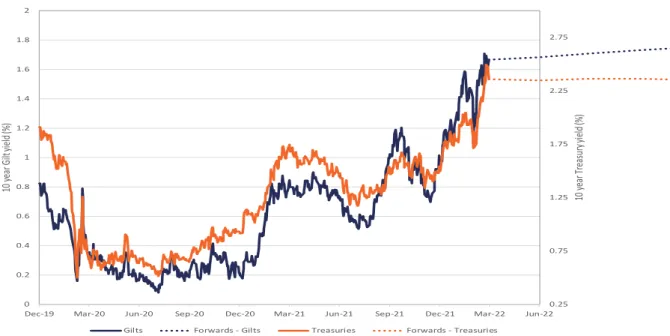
More recently, the reversal in 10-2-year Treasury yields in late March led to predictable speculation that the Fed's rate hikes would soon push the US economy into recession. With inflation in the eurozone rising to 7.5% in March, it seems increasingly likely that the ECB will accelerate its plans to tighten monetary policy. It is likely that net asset purchases will end in June – that is, earlier than the third-quarter date the ECB targeted in March.
After a concerted effort to contain the virus outbreak in the first quarter of 2020, the economic recovery was robust in the remainder of the year; In 2021, however, the economy was negatively impacted by political policies that focused on limiting digital services, limiting individual freedoms and restoring the power of the one-party state. With the recent outbreak of Covid-19 in major cities such as Shanghai, economic performance is likely to be subdued in the near term. With a succession of local lockdowns over the course of the year, GDP is expected to have increased by only 0.5% year-on-year, with a small contraction in the fourth quarter.
In addition, after the pandemic revealed how weak the extended supply lines around the world were, both factors are now likely to lead to a sharp contraction of the economies in the two blocs of Western democracies in. This gives governments a good reason to change their mandates. central banks to allow for higher average levels of inflation than we have generally seen over the past few decades. A higher average inflation rate would also contribute to a faster reduction in the real value of the public debt.
Report of the Director of Human Resources to the Council meeting of 12 July 2022.
Report of the Director of Human Resources to the meeting of the Council to be held on 12 July 2022
Equality & Diversity
- SUMMARY
- BACKGROUND
- FULL COUNCIL CONSIDERATION
- OTHER CONSIDERATIONS
- FINANCIAL & RESOURCE APPRAISAL
- RISK MANAGEMENT & GOVERNANCE ISSUES No significant implications have been identified
- LEGAL APPRAISAL
- OTHER IMPLICATIONS
- SUSTAINABILITY IMPLICATIONS Not applicable
- GREENHOUSE GAS EMISSIONS IMPACTS Not applicable
- COMMUNITY SAFETY IMPLICATIONS Not applicable
- HUMAN RIGHTS ACT
- TRADE UNION
- WARD IMPLICATIONS Not applicable
- IMPLICATIONS FOR CHILDREN AND YOUNG PEOPLE Not applicable
- ISSUES ARISING FROM PRIVACY IMPACT ASSESMENT None
- NOT FOR PUBLICATION DOCUMENTS
- OPTIONS
- RECOMMENDATIONS
- APPENDICES
- BACKGROUND DOCUMENTS
This post was approved by the Chief Executive according to the powers delegated in accordance with Article 14.20.3 of the Constitution of the Council. This salary policy statement recognizes that this situation may arise in exceptional circumstances and therefore a departure from this policy may be implemented without the need to seek full Council approval for a change to the salary policy statement. In accordance with the above paragraph, members are requested to note in relation to the proposed appointments of the Chief Executive and Finance Director of the Children's Trust, initial job evaluations have been carried out in relation to both these roles.
Approved posts within the Children's Trust will need to be funded by the Council as part of the overall budgetary provision allocated to the Fund. The Salary Policy Statement must be approved by a decision of the Authority before it becomes effective. The Authority should have regard to the Guidance referred to in this report in preparing and approving the Pay Policy Statement together with the provisions of the Local Government Transparency Code 2015, where applicable.
Under S39(4) of the Localism Act 2011, a council can change its payment policy statement even after the start of the financial year to which it relates. By resolution of the full council, the council may amend this payment policy statement during the 2022/23 financial year. Openness and accountability in local payment: guidance under section 40 of the Localism Act 2011 (additional guidance), February 2013.
PAY POLICY STATEMENT
- Introduction
- Definitions used in this Pay Policy Statement
- The Overall Approach to Pay and Remuneration
- Policy on Remunerating Chief Officers Policy on Remunerating the Chief Executive
- Policy on Remunerating the Lowest Paid Employees in the Workforce
- Policy on the Relationship between Chief Officer Remuneration and that of Other Staff
- Severance Payments for Chief Officers
- Flexibility to Address Recruitment Issues for Vacant Posts
- Amendments to the Policy
- Policy for Future Years
- Publication
When setting the remuneration for the Chief Executive, the Authority will compare the current salary of the post with comparable salaries for Chief Executives at councils of a similar size, type and location. The job evaluation scheme provides an analytical approach to evaluating the job value by assigning points to different factors (responsibilities and duties) of the job role, the total score of which is equivalent to a grade within the Authority's pay and grading structure. This is the definition of the "lowest paid employees" adopted by the Authority for the purposes of this Pay Policy Statement and is only increased in accordance with any nationally agreed wage awards as determined by the NJC for Local Government Services.
Guidance issued under the Localism Act 2011 recommends the inclusion of 'multiple payment' in an authority's payment policy statement. In the vast majority of circumstances, the provisions of this Pay Policy Statement will enable the Authority to ensure effective recruitment for any vacancy. This payment policy statement will be reviewed annually and presented annually to the full council for consideration to ensure that the policy is in place for the authority prior to the start of each financial year.
In such circumstances, a change to the remuneration package may be appropriate under the Authority's remuneration policy statement and any change will be approved through the appropriate decision-making process. The Authority provides access to the Local Government Pension Scheme for Chief Executives in accordance with the statutory provisions of the scheme. Amounts paid are published on the Authority's website in the Annual Statement of Accounts in accordance with the requirements of the Accounts and Audit Regulations 2015.
Report of the Leader to the meeting of Council on Tuesday 12 July 2022
Subject: Executive consideration of urgent report
Summary statement
RECOMMENDATIONS
