Smart choices
Investigating
microbusinesses’ interest in, and understanding of, smart meters
Contents
Contents
Executive summary Policy recommendations Key statistics
Introduction, background and methodology Findings and analysis
The background
Microbusinesses’ wider perspective on energy
Microbusinesses’ awareness and understanding of smart meters Current and potential smart interest of microbusinesses
Current smart meter usage by microbusinesses
Aspirations and potential and actual benefits and for microbusinesses Willingness to pay for a meter
Conclusions Appendix
Executive summary
By the end of 2020, 53 million smart meters will be fitted in more than 30 million households and businesses across England, Wales and Scotland. However, Citizens Advice considers that microbusinesses do not fully understand the 1 smart meter roll out and what that means for them as energy customers. As the statutory energy consumer champion, Citizens Advice advocates for these
consumers and is a ‘critical friend’ of the rollout programme.
Previous research suggested there are many issues specific to microbusinesses 2 which need to be resolved if they are to reduce their energy consumption and make the rollout a success. This research set out to;
● Understand what microbusinesses know, want and expect from smart meters;
● Evaluate to what extent these needs are being met by suppliers;
● Identify what steps (if any) are required to ensure microbusinesses understand and are in a position to make the most of the benefits smart meters bring.
Energy is a necessity for all microbusinesses . They consider their energy usage 3 as a critical cost of doing business. We would like to see microbusinesses
becoming more engaged and efficient energy consumers. They tend to be more concerned by other issues such as stock and staff. Many businesses have
engaged in energy saving measures where it has been made relatively easy for them, such as turning off lights when they are not needed.
However, smart meters are not associated with businesses, with
decision-makers in businesses tending to have heard about smart meters from
1 Hereafter, “businesses” and “consumers” and similar refers to microbusinesses
2
http://webarchive.nationalarchives.gov.uk/20131210190029/http:/www.consumerfutures.org.uk/
reports/a-smart-business-small-and-micro-businesses-experiences-of-smart-meters
3 As per Ofgem’s industry-standard definition, a non-domestic consumer is defined as a micro business if they meet one of the following criteria:
Employs fewer than 10 employees (or their full time equivalent) and has an annual turnover or balance sheet no greater than €2 million, or
Consumes not more than 100,000 kWh of electricity per year, or Consumer not more than 293,000 kWh of gas per year.
To put this in context, a business consuming these amounts of electricity and gas would pay about £10,000-£12,000 per year for each fuel, excluding VAT.
friends and family and mainly in a domestic context. Business owners generally fail to spontaneously think of ways in which a smart meter would benefit their business. They “don’t know what they don’t know”. They are aware that a smart meter would allow them to monitor their energy usage more closely, but they are unsure what benefit comes from this. When pushed, businesses without smart meters rate having real time cost information and visible data as the chief potential benefits. Initial cost and hassle are cited as potential negatives of getting a smart meter, as is the danger of cost savings not materialising.
Microbusinesses who have had a smart meter installed need more information about making efficiencies to feel the benefit. They are not experts, so struggle to turn awareness into savings. Often they fail to check their data at a useful
frequency - almost half never do so, and some have to pay their supplier to access data. This is despite finding the installation process disruption-free. These smart meter-using businesses primarily rate the benefits of accurate billing and avoiding meter readings; this distinguishes them from their counterparts
without smart meters who aspire to being able to monitor their consumption and thus (potentially) reduce demand. Some businesses say they do not have the time to get the most out of their meter.
Smart businesses need advice that goes beyond the provision of raw data.
Primarily this will be energy efficiency advice from a trusted source - possibly not their supplier. Most do not spontaneously associate awareness of their usage with switching energy suppliers, although some think they may become more likely to shop around over time. Many want their In Home Display (IHD) or app to do the ‘heavy lifting’ - turning their usage data into tips on energy efficiency and advice about the best tariffs available for their specific business.
Smart meters offer microbusinesses information they did not previously have access to but are yet to fully make the most of. Therefore, future information and additional services should focus on converting energy use monitoring into saving money. Some more tech savvy businesses assume that smart meters will be compatible with emergent Internet of Things (IoT) technology. Understanding and making the most of their usage information (at no cost) and getting tips on how to be more efficient are the main ways businesses will benefit from their smart meter in the future. Otherwise, there is a danger that smart meters will overwhelmingly benefit energy suppliers through avoided meter readings and accurate billing rather than ensuring consumers benefit from the lower bills that occur because of demand reduction.
Policy recommendations
● Small businesses need a comprehensive and very basic campaign to inform them of the smart rollout . Microbusinesses cannot formulate responses to what they do not know will be occurring. Stakeholders, led by Smart Energy GB, need lines as simple as “you can get a smart meter for your business” and advertising targeted at, and designed for, a
business audience. SMETS 2 meters for businesses will be likely rolled out from mid-2018 onwards - this messaging should be well underway by then.
● The more detailed information campaign that is already being undertaken by Smart Energy GB with bodies like the Federation of Small Businesses (FSB) needs to be accelerated . This would take passive interest in smart metering to an active interest. It could involve sector-specific case studies and placed discussion pieces explaining how businesses have employed smart technology so as to cut their energy bills. This will be crucial for encouraging complex changes such as Time of Use tariffs - businesses need reassurance and comparable examples of others who have done it successfully before they will do it themselves.
● Publicly concentrate communications eцorts on reducing businesses’
demand rather than settling for accurate bills. The benefits of accurate bills flow predominantly to energy suppliers; it is demand reduction that reduces businesses’ costs. Energy saving assistance
requires much more effort by both businesses and supplier and thus risks being sidelined. We expect Government and official bodies to be
especially clear on this given that the official Cost-Benefit Analysis 4 depends on it to justify the value of the smart meter programme.
● Suppliers need to undertake proactive installations that do not revolve around merely installing as quickly as possible and so miss the chance to promote demand reduction . The installation process (including aftercare) is not limited to the time spent physically installing;
suppliers should therefore be incentivised to monitor for benefits, including demand reductions, after installation. Suppliers should be encouraged to ‘translate’ interest across if, when installing domestic meters, they see non-domestic metering as well.
4
https://www.gov.uk/government/uploads/system/uploads/attachment_data/file/567167/OFFSEN _2016_smart_meters_cost-benefit-update_Part_I_FINAL_VERSION.PDF
● As in the domestic sector, smart meters and basic data should be provided at no upfront cost. There is no advantage to making the original technology seem solely like a cost burden and instantly
undermining interest. Making businesses pay to access their own basic data is unfair and undermines attempts to make those businesses look at their data as the first step to reducing consumption.
● Innovative technology should be encouraged and incentivised .
Businesses become interested in smart where it potentially interacts with pre-existing consumer technology and devices. Suppliers and others should develop protocols to prompt businesses in several ways to trim demand or switch supplier - automatically, if the business opts in to this.
Merely relaying data is insufficient. Suppliers should be encouraged to develop interfaces that fit into existing and popular apps and technologies for small businesses so as to make their usage less daunting.
Key statistics
Our research showed that:
● The vast majority of businesses (91%) expect and trust their supplier to ensure constant energy supply, but only half (54%) trust them for advice on how to use less energy;
● There is interest and demand in energy saving, with 71% of businesses both with and without smart meters already taking steps to reduce their usage, especially at the larger end of the microbusiness market. Where potential barriers to demand reduction do exist, businesses cite the difficulty of getting employees to engage (31%) and not having enough time to undertake such measures (21%);
● 90% of businesses have heard of smart meters but only 63% know that businesses will be getting one as well as domestic consumers. 44% of the latter also know “a fair amount” about them. Of those without a smart meter, 66% are interested in obtaining one, with interest highest where consumption is higher;
● Around half (53%) of existing smart meter users have an IHD and 12%
have an online app, and both these figures increase significantly for higher spending microbusinesses. 16% of users had to pay for their
meter, 23% for their display and 30% for an app so as to access their data.
Half (48%) had accessed their data whilst 47% had never done so; of the former 83% had done so at no extra cost;
● Smart users are divided on how often they check their data; 38% do so a
“few times a month” and 19% “a few times a week”. But a quarter checked
“hardly ever” and 8% have never done so;
● More businesses reported consumption falls (23%) than increases (14%) after a smart meter was installed but for the majority (58%) consumption stayed at the same discernible level;
● Consumers without smart meters rate as chief potential benefits the
“pounds and pence” real time information (15 v. 12 % between the two types of consumer) and visibility of data (16 v. 12%). Consumers who already have smart appear to more significantly rate the benefits of accurate billing (23 v. 14%) and avoided meter readings (16 v. 12%) however;
● When asked about potential negatives with a smart meter, the cost of obtaining one was cited by a quarter (26%) of non-smart businesses. 1 in 5 (21%) said that they were concerned it would be too much hassle and cost savings would not materialise respectively. However, 28% have no
concerns about smart meters at all and just 9% said they would not have time to use the meter, with 7% feeling unsure they would know how to use it properly. Of those consumers who already have a smart meter however over a quarter (26%) do not have the time to get the most from their meter and 14% say they simply don’t know how to use the meter;
● Half of non-smart meter using businesses (48%) rate advice on how the meter could help their business save money as the most useful type of advice. 44% cite a general list of benefits that smart could bring and 41%
advice on the features of the meter and how best to utilise them.
Introduction, background and methodology
For the initial qualitative stage of this project, Populus ran four 1.5 hour focus groups in London, Edinburgh, Manchester and Cardiff each with nine
microbusinesses, none of whom had smart meters. All were on on non-domestic supply contracts. Groups were mixed by size of business (between 1-9
employees) as well as energy spend. The sample consisted of the person in each microbusiness responsible for making decisions about energy use.
There was a separate process of eight 1 hour in-depth telephone interviews with microbusinesses who did have a smart meter in the same cities. These
interviews provided useful insight into the in-life aspect of microbusinesses’
smart meter journey.
Using the results from these stages, Populus developed and conducted a 15-minute long online quantitative survey with 1007 microbusinesses, a significant minority (171) of which had a smart meter. The participants were geographically balanced and reflected the wide breadth of microbusinesses, in turnover, size and industry.
Findings and analysis
The background
The focus groups suggested that microbusiness owners’ professional lives are intertwined with their personal lives – there is no ‘off switch’. In smaller
businesses, with zero or a few employees, the delineation between is often very blurred.
Perhaps unsurprisingly, owners are experts in their own fields, but much less confident outside their area of expertise - including utilities and especially energy. Anything that takes decision-makers away from their core business activities could cause loss of revenue. A constant energy supply, working in the background, is what businesses expect. They do not give it conscious thought except when bills arrive or when something goes wrong:
“How much time do you guys spend thinking about energy?”
“Not that much. I think you have your provider. Then whether that's an annual or other type contract . Then when it comes to renew, then you start to think about it again. In terms of a day-to-day thing, it's not something I think about. ” 5
The owners of the very smallest microbusinesses (up to three employees) have to deal with a range of varying day to day challenges. They feel time-poor and are often reluctant, and sometimes unable, to dedicate time to improve their knowledge on things they know little about. However, they are always on the lookout for ways they could save time and money, if this is relatively easy.
Microbusinesses’ wider perspective on energy
It repeatedly emerged in the focus groups that decision-makers’ opinions of energy companies are often formed by domestic experience. There is a general perception that tariffs are confusing. Some feel this is often intentional, to prevent people from finding the right deal for them. They cite the the use of technical language such as kilowatts and kilowatt hours or unclear breakdowns of costs on bills. While many are aware that they could save by switching
suppliers, this does not always mean they want to.
5 Edinburgh microbusiness - page 6 of transcript
As a result, most microbusiness decision-makers tend to have little trust in their energy company on many issues. Despite general distrust, microbusinesses see energy companies as experts, at least on the provision of gas and electricity, even if they are not necessarily expected to act in the consumer interest.
Disengagement with the industry means people struggle to think of other places they would go to find out more information on energy and how to engage with it. However, some sources were mentioned including Martin Lewis (of Money Saving Expert), who is seen as impartial, knowledgeable and on their side.
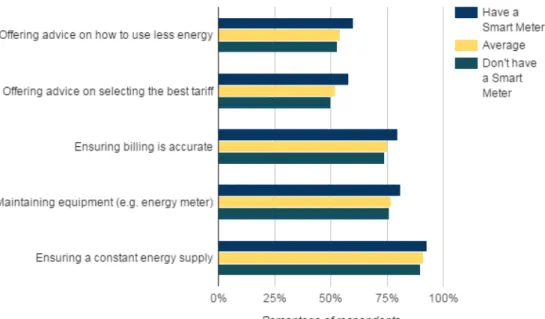
In the quantitative survey , the vast majority of businesses (91%) said they trust 6 their supplier to provide a constant supply of energy. Large numbers also trust their supplier to maintain their meter and ensure that their billing is accurate (77% and 75% respectively). In contrast, only around half (54%) trust their supplier when they offer advice generally on how to use less energy. This has very significant implications for the smart rollout, as suppliers are expected to give their customers energy efficiency advice . Only 52% trust their supplier to 7 offer advice on selecting the best tariff.
Figure 1: Level of trust in energy supplier functions
Source: Question 6 of the survey (base: All 1007 respondents)
8 9
6 Hereafter “the survey”
7 As per the Smart Metering Installation Code of Practice (SMICOP) which is backed by licence conditions
8 Question 6: How much trust do you have in your energy supplier to deliver in each of the following areas for your business?
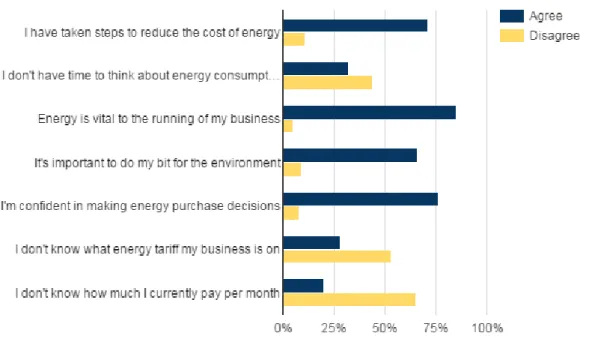
Looking at attitudes and behaviour on energy more generally, 71% of businesses say they have already undertaken some steps to reduce the cost of energy.
Figure 2: Attitudes to energy
Source: Question 8 of the survey (base: All 1007 respondents)
10
The rate was higher among businesses who reported a higher than average energy spend. 28% of those who spend less than £1000 a year on energy
“strongly agreed” they had taken steps to reduce energy cost, compared to 41%
of those spending more than £5000.
9 Questions 1-5 aimed to establish that the respondent was indeed an Ofgem-definition micro-business and that they had a non-domestic supply contract; also so that we could track differential answers in relation to the size of the respondent
10 Question 8: For each of the statements, when thinking about your business, please indicate the extent to which you agree or disagree?
Figure 3: Agreement on whether businesses had taken steps to reduce energy cost (by size)
Source: Question 8 of the survey (base: All 1007 respondents)
11
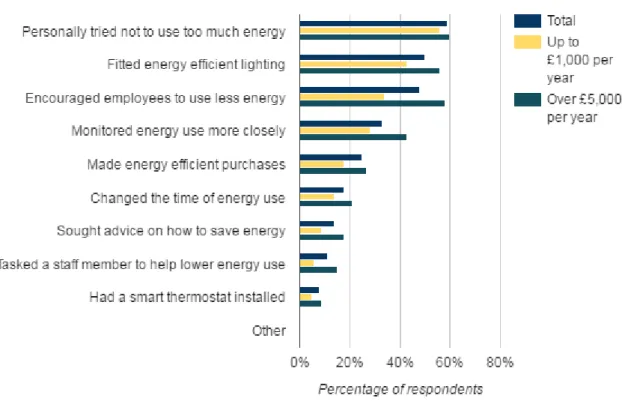
Looking into how businesses have already tried to reduce their energy costs, over half (59%) have personally tried not to use too much energy, for example by turning off lights or not overfilling the kettle. The focus groups often cited
behaviours businesses have been able to undertake in a domestic setting and have been “carried over” such as these. Just under half (48%) say they have encouraged employees to use less energy generally and a third (33%) have already monitored more closely how much energy their business uses.
“Making sure the switches are all switched off when we leave the building at the end of the night and the plugs are all pulled out for safety, but also for the electricity still being used, because energy is still going through there when it's switched on. So it's just wee changes like that, it can make a big difference. ” 12
11 Question 8: For each of the statements, when thinking about your business, please indicate the extent to which you agree or disagree?
12 Edinburgh microbusiness - page 13 of transcript
Just a quarter (25%) have purchased energy efficient equipment/appliances; 18%
have changed the time they use equipment . 14% have actively sought advice 13 from a third party on how to save energy. Perhaps unsurprisingly, businesses with a lower spend on energy are much less likely to purchase energy efficiency equipment than their higher-spending counterparts, although at all levels interest was low.
Figure 4: Actions taken to reduce energy use
Source: Question 9 of the survey (base: 897 respondents who have attempted to reduce energy
14
use)
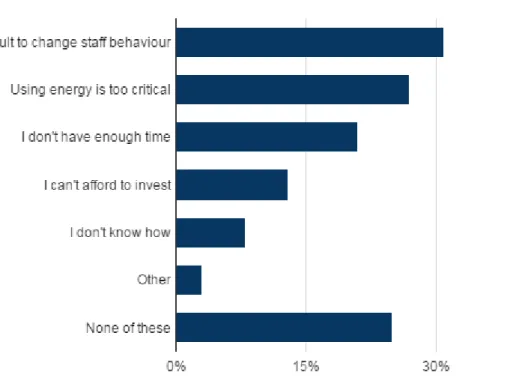
When businesses were asked about what barriers might stop them undertaking energy cost reduction, the responses were spread across several key perceived obstacles. Just under a third (31%) said that it was difficult to get staff to change the way they use energy (and was cited several times in the focus groups with larger businesses); 21% said that they did not have enough time to undertake measures and 13% said that they could not afford to invest in energy saving measures.
13 Though it is unclear whether these businesses were on TIme of Use tariffs and so whether this was a cost-reducing/rational decision
14 Question 9: For those who have taken steps to reduce energy (including those who said 'neither agree nor disagree'). I have done...
Figure 5: Barriers to reducing energy use
Source: Question 10 of the survey (Base: All 1007 respondents)
15
It is notable that there is not a particularly strong correlation in businesses reporting that they can't afford to invest in energy efficiency and those businesses’ energy spend.
However, the bigger the firm, the more difficult it is considered to engage staff in energy cost reduction. The sole trader has sole discretion as to energy control and costs but more employees means more people whose decisions might need to be taken into account. This has implications for how engagement with
different sizes of microbusiness is undertaken; we cannot assume that one size fits all.
“How interested are people then in actually reducing their energy costs?”
“I think people are.”
“So you guys, how interested are you really in doing that?”
“Depends how easy it is.”
15 Question 10: Below are a list of reasons which might prevent a business from being able to reduce their energy costs. Which, if any, apply to you and your business?
“Yes.”
“I think we are but we think it's futile as well.”
“That's what I'm trying to get at. Why is it futile to try and do that?”
“Because no matter what you seem to do…”
“It makes no difference. I answered that earlier. I go around turning everything off. 'Don't leave that on. Don't leave it on,' but the bill never comes down. ” 16
Decision makers tend to think of their energy usage as essential and, as a result, not a place where large savings can be made. Other business activities take up the majority of their time and are generally given greater priority over energy;
energy is in the background and not a day-to-day issue. The focus groups suggest that cost is the primary driver of any action by a microbusiness –
although some, usually larger microbusinesses, are part-driven by a wider social responsibility.
Most businesses think they are already energy efficient. Even with considerable prompting and discussion of the different elements of their business energy consumption, they struggle to think of what steps they could make beyond turning the lights off or reducing the time heating is on. It appears that a lack of awareness and information about energy efficiency results in latent
complacency.
Microbusinesses’ awareness and understanding of smart meters
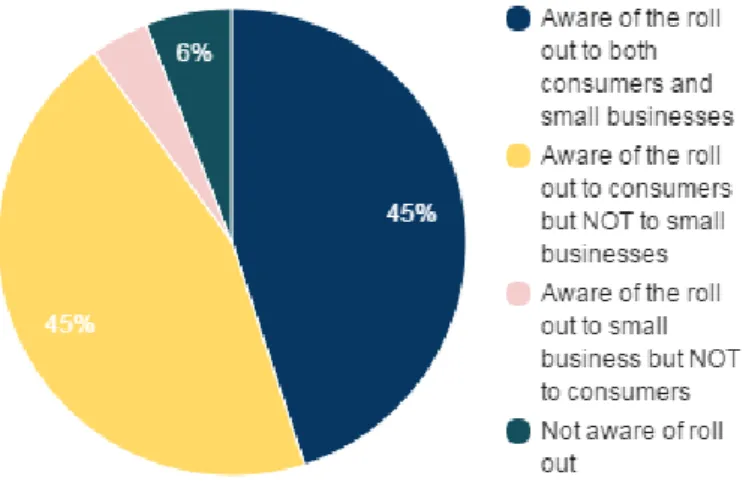
In the survey, 90% of businesses had heard of smart meters. However of those, only 63% knew they were being rolled out to businesses as well as domestic consumers. In total only just over half (55%) knew that smart meters were available in both markets.
16 Edinburgh microbusinesses - page 22 of transcript
Figure 7: Knowledge of smart meters generally
Source: Question 13 of the survey (Base: All 1007 respondents)
17
Figure 8: Awareness of smart meter roll out to businesses
Source: Question 14 of the survey (Base: All 1007 respondents)
18
17 Question 13: In this next series of questions we would like to understand what you know, if anything, about smart meters. Before today had you heard of smart meters?
18 Question 14: Did you know smart meters were being rolled out to small business consumers?
Figure 9: Awareness of businesses without smart meters to the smart meter rollout
Source: Question 14 of the survey (Base: 735 respondents who are aware of smart meters but
19
do not currently have one)
Of those businesses who had heard of smart meters being available for businesses, only 44% considered that they knew “a fair amount” about them.
More positively, only a very small number (7%), considered that they knew nothing about them.
19 Q14: Did you know smart meters were being rolled out to small business consumers?
Figure 10: Level of knowledge about smart meters
Question 15 of the survey (Base: 530 respondents who are aware of smart meters)
20
In the focus groups, the hassle of a smart meter installation and potential loss of revenue were sometimes considered to outweigh the (potential) savings they could lead to. For example, closing a shop for one day to install equipment may cost more than the savings made over a year. As for energy advice and
information generally, businesses would look to Martin Lewis and equivalents.
Otherwise information is found “On Google”. If looking for smart meters specifically, key search terms would focus on that or via the business’ current energy supplier. Where the decision-maker has knowledge of smart meters, it tends to come from their domestic consumer context. They often learnt about smart meters from friends and family - whether these experiences were positive or negative.
Some businesses have been contacted directly by their energy supplier. Most of those with smart meters received a letter from their energy supplier from which they believed they were obliged to have one installed . Although some focus 21 group participants mentioned consumer advertising (like Smart Energy GB’s Gaz + Leccy ) few spontaneously translated the message about meters in the home 22 to their business.
20 Question 15: Before today, how much, if anything, would you say you know about smart meters for business?
21 Businesses, like domestic consumers, are not obliged to take a smart meter but their supplier must offer them one. The businesses here were largely ambivalent about this (incorrect) view regardless.
22 https://www.smartenergygb.org/en/meet-gaz-and-leccy
Current and potential smart interest of microbusinesses
In the focus groups there was little sense of what the actual benefits of a smart meter for the business might be. Decision-makers failed, repeatedly, to
spontaneously think of ways in which a smart meter would benefit their business.
Although there is awareness that a smart meter would allow them to monitor their energy usage more closely, they are very unsure what the actual benefit of this could be. They claim that “we don’t know what we don’t know”. They do not consider that there is an easy transition between monitoring energy and actually using less and reducing costs.
“What kinds of information then do you think you might get from a smart meter?
Obviously you can see something. But what's that? What's the information you'd get?“
“Peak usage and also what you said, tumble dryers.”
“Yes, what's using…”
“ The things that cause the most amount of cost.“
“What you've spent to date. That's the most interesting thing. It's like looking at your phone bill if you're getting that daily, you know, seeing what you've
spent.”
“Yes, your usage.“
“You're still going to spend it.”
“Well… ” 23
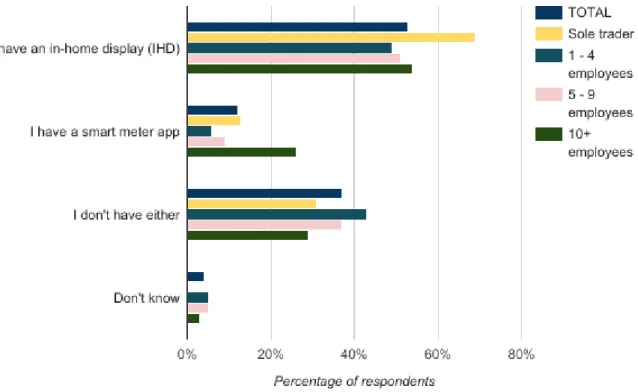
Of the current smart users sampled in the survey, around half (53%) had an IHD.
Interestingly, there was significant variance depending the size of the business:
23 Edinburgh microbusinesses - page 38 of transcript
69% of sole traders had one, while for businesses with employees it ranged from 49-54%. This could seem counter-intuitive but may reflect the propensity for sole traders to be more interested in consumption control given their ability to affect that consumption directly.
Only 12% of businesses use a mobile phone or tablet app to access their smart meter data. This rose to more than a quarter (26%) of businesses with more than 10 employees, perhaps because this method could allow different members of staff to access the data.
Just over a third (37%) had neither an IHD or an app. Those businesses are missing out on any easy to use method of data monitoring and so the potential for demand reduction is low. These figures were relatively consistent between large and small microbusinesses.
Figure 11: Methods of accessing data for businesses with smart meters
Question 17 of the survey (Base: 171 respondents with smart meters)
24
24 Question 17: For businesses with smart meters: Do you have an in-home display (IHD) or smart meter app for smart phone/tablet to go with your smart meter? NB the comparatively small base and thus relatively large margin of error (7.5% at 95% confidence assuming 50% sample)
Of the respondents who did not already have a smart meter (who were in the majority), two-thirds (66%) were either “very” or “fairly” interested in obtaining one. Just a small minority (15%) were “not very” or “not at all” interested.
Figure 12: Interest in obtaining a smart meter
Question 17 of the survey (Base: 836 respondents without smart meters)
25
Perhaps unsurprisingly, there is a positive correlation between energy spend and a business’ inclination to be interested in obtaining a smart meter. Just 55%
of businesses that spend up to £1000 a year on energy are interested in having a smart meter, however this steadily increases with spend to 77% among
businesses who spend over £5000. This is likely to be because of the greater savings they could make and the higher nominal amounts of demand reduction that are inherently possible when a business already spends a significant
amount on energy.
25 Q17: To what extent would you be interested, or not, in having a smart meter for your business?
Figure 13: Interest in obtaining a smart meter by energy spend
Question 17 of the survey (Base: 836 respondents without smart meters)
26
However, few of these business (22%) have tried to find out more information about smart meters.
Figure 14: Action taken to #nd out about smart meters
27
Source: Question 19 of the survey (Base: 836 respondents without smart meters)
26 Q17: To what extent would you be interested, or not, in having a smart meter for your business?
27 Question 19 Before today have you tried to find out more information about smart meters?
If looking to find out more about smart meters, just under a third (29%) of businesses said they would go to their current supplier to find out more about smart meters . No other prompted answer came close to this level. 10% said 28 they would go to the official rollout champion Smart Energy GB and 9%
Moneysavingexpert.com.
Figure 15: Sources of advice about smart meters businesses would use
29
Source: Question 20 of the survey (Base: All 1007 respondents)
Current smart meter usage by microbusinesses
In the survey, 16% of smart meter users reported paying for their meter, 23% for their display, and just under a third (30%) for the use of an app for seeing their data. There is not a clear trend of an increasing likelihood of paying for meter as a business’ spend rises. Suppliers have differing policies in this area, which may explain some of the variance - though these figures seem high given that we understand the vast majority of suppliers say they are not charging for these
28 Much less even than the percentage who said they would trust their supplier in this area in the previous section
29 Question 20: Which, if any, of the of the following information sources would you use/have you used to find out about smart meters for your business?
items. We have long advocated for meters to be free for microbusinesses at the point of offering to encourage uptake.
Figure 16: Businesses who paid for smart meter and associated equipment
Question 22 of survey (Base: 171 respondents with smart meters)
30
Respondents were fairly evenly split on their ability to get the most out of their smart meters: 48% had accessed their data and 47% had not.
Only those businesses spending more than £5000 a year on energy were much more likely than others to access their data, with 59% reporting they had done so. As with previous answers, it is logical to assume that they perceive greater potential savings. They may also have a member of staff who has the time, knowledge or inclination to look at and use such data.
30 Question 22 Did you have to pay for your...? NB the comparatively small base and thus relatively large margin of error (7.5% at 95% confidence assuming 50% sample)
Figure 17: Businesses who access smart meter data
Source: Question 23 of the survey (Base: 171 respondents with a smart meter)
31
Figure 18: Businesses who access smart meter data by energy spend
Source: Question 23 of the survey (Base: 171 respondents with a smart meter)
32
31 Q23. Have you accessed the data from your smart meter? NB the comparatively small base and thus relatively large margin of error (7.5% at 95% confidence assuming 50% sample) 32 Q23. Have you accessed the data from your smart meter? NB the comparatively small base and thus relatively large margin of error (7.5% at 95% confidence assuming 50% sample)
Very positively, those who did access their data largely did so at no extra cost (83%). It will be hard to encourage businesses to access their own basic data if they have to pay for it . We thus consider free data provision crucial to the 33 success of the roll out.
Figure 19: Businesses who had to pay to access their smart meter data
Source: Question 24 of the survey (Base: 82 respondents who had accessed their smart meter
34
data)
Smart meter enabled businesses varied considerably in terms of how often they check access the information from their meter. A plurality (38%) said they
checked “a few times a month” and 19% “a few times a week”. However one in four (24%) said “hardly ever” and 8% said they had “never” checked. The size of energy spend had no relationship with the business’ apparent propensity to check their smart-enabled information.
33 As per the Data Access and Privacy Framework
34 Question 24 Did you have to pay to access your data? NB the comparatively small base and thus relatively large margin of error (10.8% at 95% confidence assuming 50% sample)
From the focus groups it seems a lack of understanding can lead to
disengagement with the IHD, leading consumers to ‘put it in the cupboard and never look at it’. The overall message is that smart users, who have the potential to be engaged, needed advice and tips that go beyond raw data. Our recent research showed that less than half the domestic market were offered any proactive follow up support . 35
Many want the IHD or app, or indeed any consumer-facing interface, to do the
‘heavy-lifting’ for them. This would mean turning businesses’ usage data into tips on energy efficiency and advice about the best tariffs available for their specific needs and consumption profile. This could take the form of telling businesses which can shift demand, and thus save money, how to do so most effectively.
“So if there was a simple app then, what kinds of things might it tell you? What would you want to know I suppose?”
“Like where your energy is being used. It can pinpoint things every day.”
“So you're at work…”
“And then it's averaging, you know like weekly, you know like you say if you're at work and you know what's going on at home.”
“Yes, exactly. ” 36
35 Smart support 2017
36 Manchester microbusinesses - page 8 of transcript
Figure 20: Frequency of accessing smart meter data
Source: Question 25 of survey (Base: 101 respondents who have smart meter display or app)
37
In the survey, smart meter installations were satisfactory experiences for 65% of respondents , with only 1 in 10 (10%) dissatisfied to some degree. There was no clear relationship between energy spend and satisfaction.
Figure 21: Satisfaction with smart meter installations by spend
Source: Question 26 of survey (Base: 171 respondents with a smart meter)
38
37 Question 25 How often do you check the information provided to you by your smart meter for your business? NB the comparatively small base and thus relatively large margin of error (9.8%
at 95% confidence assuming 50% sample)
38 Question 26. To what extent were you satisfied or dissatisfied with the installation process by your energy supplier? NB the comparatively small base and thus relatively large margin of error (7.5% at 95% confidence assuming 50% sample)
BEIS predicts consumption falls of 4.5 and 2.8% for gas and electricity for
microbusinesses as a result of installing smart meters. In the survey, a majority 39 (58%) reported no change in consumption following installation. Some did report falls in consumption (23%) with a smaller number reporting increases (14%). It is unclear whether or not smart installation enabled or incentivised behaviours that caused these reported changes in consumption.
Figure 22: Energy consumption change since smart meter installation
Source: Question 27 of survey (Base: 171 respondents with a smart meter)
40
This may relate to the high reported satisfaction with installations, in that businesses had low expectations that were met (e.g. the exercise was not as disruptive as feared), rather than the installation had a detailed and satisfactory
39 Page 74 of
https://www.gov.uk/government/uploads/system/uploads/attachment_data/file/567168/OFFSEN _2016_smart_meters_cost-benefit-update_Part_II_FINAL_VERSION.PDF
40 Question 27 Since you have received your smart meter for your business, has your bill increased, decreased or remained the same? NB the comparatively small base and thus relatively large margin of error (7.5% at 95% confidence assuming 50% sample)
advice-giving section. There may be tension between ‘quick’ installations to minimise business disruption and a proper approach to energy efficiency advice and smart meter competence generally. The focus group discussions suggest that microbusinesses who have had a smart meter installed need more
information about making efficiencies. They are not experts, so struggle to turn awareness into savings.
Aspirations and potential and actual bene#ts and for microbusinesses
The main challenge for microbusinesses that the focus groups identified is bridging the gap in information between ‘seeing’ and ‘saving’. Microbusinesses understand that smart meters will allow them to monitor energy usage, but there are three primary barriers to installations being successful and having lasting effects:
● A lack of practical information about how to reduce energy - “what else can I do besides turn lights off and put eco-bulbs in?”;
● The thought that they will be inconvenienced and smart metering is not worth the hassle. Almost all energy use is perceived as business critical so businesses struggle to think of how they can reduce it;
● Fears regarding whether the savings will outweigh the inconvenience of the process of getting a smart meter i.e. calling up, the arranging of an appointment, the installation itself - especially if trading is disrupted or halted.
The survey showed that business owners without smart meters value the
‘pounds and pence’ real time information more highly those who have them (15 v. 12 % between the two types of consumer). They also see having visibility of data as being more important (16 v. 12%). Consumers who already have a smart meter appear to value the benefits of accurate billing (23 v. 14%) and avoided meter readings (16 v. 12%) more highly than those yet to have one fitted.
Consumers may become resigned solely to the advantages of smart metering that do not impact on their behaviour or require demand changes to enable full benefit. If this is the case it indicates a strong need for advice at installation to ensure that the apparent pre-existing interest in information and data is sustained.
Figure 23: Most appealing bene#ts of smart meters, pre- and post-installation
Question 29 of the survey (Base: All 1007 respondents)
41
In terms of potential downsides of getting a smart meter, the cost of obtaining one was cited by a quarter (26%) of non-smart businesses. 1 in 5 said that they were concerned it would be too much hassle and cost savings would not
materialise respectively.
However, more positively, over a quarter (28%) said they had no concerns about smart meters at all and respectively just 9% and 7% said they would not have time to use the meter or be unsure of how to use it.
41 Question 29 Listed below are a number of potential benefits that having a smart meter for your business might bring. Please indicate which is most appealing to you for your business?
Figure 24: Concerns about smart meter installation and operation
Source: Question 30 of the survey (Base: 836 respondents who do not have smart meters)
42
However, as with the benefits results, for those consumers who already have a smart meter the concerns were not the same. Worryingly, over a quarter (26%) said they did not have the time to get the most of their meter and 14% said they did not know how to use the meter. With the latter it is possible that consumers were overconfident in their prediction of how they could engage with their new technology, perhaps because of a lack of knowledge. Again this suggests the importance of support and advice once smart is installed so that this confidence is no longer misplaced. It is clear that this follow up support is essential to
ensure consumers benefit from smart meters. However, as mentioned above, our recent research showed this support being treated as an afterthought by many domestic suppliers.
42 Question 30 Listed below are a number of concerns related to smart meters for business.
Please indicate which, if any, you are concerned by.
Figure 25: Concerns over smart meter operation
Source: Question 31 of the survey (Base: 171 respondents who have a smart meter)
43
Again comparing smart meter owning with non-smart meter owning businesses, half of the latter (48%) rate advice on how the meter could help their business save money as the most useful advice. 44% cited a general list of benefits that smart could bring and 41% advice on the features of the meter and how best to utilise them. The sole category here that smart-enabled consumers rated more useful than their non-smart counterparts (albeit marginally) was advice on how to encourage staff to use less energy (25 v. 23%), presumably because they have already discovered that merely getting a meter will not lead to cost savings.
43 Question 31 Listed below are a number of concerns related to smart meters for business.
Please indicate which, if any, have you experienced. NB the comparatively small base and thus relatively large margin of error (7.5% at 95% confidence assuming 50% sample)
Figure 26: Useful advice about smart meters
Questions 28 and 32 of the survey (Base: All 1007 respondents)
44
Consumers without smart meters in general seem very confident that simply having a smart meter will reduce their costs effectively. Half (49%) said that they would expect “immediate” cost savings without “a lot” of effort - many of these consumers may therefore be disappointed. These consumers require advice and easy and free access to their data at the beginning of their smart journey.
60% of non-smart users agreed that tracking energy usage would facilitate long-term saving and 59% that smart meters would make them more confident in making informed decisions about energy; again these are encouraging
measures in a market where most do not yet have smart.
“What do we need to know in order to make the most out of a smart meter? What information? What do you need to know?”
44 Question 28 Thinking about using your smart meter for your business, which of the following types of advice would be useful to you?
Question 32 If you were offered a smart meter by your energy supplier, which of the following types of advice would be useful to you?
“What appliance uses the most electricity?”
“If you are going to be stuck to one provider. That's a big one for me because I move.”
“Anything else?”
“The cheaper tariffs, if they could tell you.”
“Yes, if they could advise there are cheaper deals. ” 45
However, in the interviews with consumers with smart meters and the focus groups it became apparent very quickly that future smart-enabled information and services are extremely hard for microbusiness to imagine. Whilst smart meters currently offer microbusinesses information they did not previously have access to, current users are yet to fully make the most of it. In the focus groups future services were only discussed after many rounds of narrative rather than spontaneously or with regard to pre-existing feelings and aspirations, even when monitoring was discussed in depth. In addition to the consumption savings 46 resulting from having smart meters, smart metering brings forward the potential for connected devices and other technologies to be used by businesses to cut demand, so this lack of awareness and interest may be concerning should it persist.
Therefore, future information and additional services should focus on converting monitoring into savings. Some more tech savvy businesses assume that smart meters will be compatible with the emergent IoT technologies e.g. Hive smart thermostats. This was also where the focus group participants became more engaged, suggesting a broader interest in technology may prove beneficial to the rollout. Smart metering should not be considered in isolation but in a world of apps and the IoT.
Understanding and making use of their consumption information and getting tips on how to be more efficient are the main ways businesses will benefit from their smart meter in the future - it is inherent to the primary goal of demand
45 Manchester microbusinesses - page 20 of transcript
46Though most consumers seem unenthusiastic about obtaining connected devices in the near future - see
http://utilityweek.co.uk/news/majority-of-consumers-%E2%80%98unlikely%E2%80%99-to-introdu ce-smart-home-tech-pwc/1248212#.WMvU2FWLRaQ for example
reduction on which the programme’s Cost-Benefit Analysis is based. All aspects of the installation and associated programmes must be focussed on this goal.
In terms of wider energy market effects, most businesses do not spontaneously associate awareness of their usage with switching energy suppliers, although some think they may become more likely to shop around over time. In terms of general engagement, in the survey just under half (48%) said that smart would make them more likely to switch tariff or supplier.
Figure 27: Attitudes to bene#ts of smart meters before installation
Question 33 of the survey (Base: 836 respondents without smart meters)
47
However, in the focus groups some larger microbusinesses have found their smart meter to be widely beneficial and indeed valuable. Where this has happened;
● They monitor usage actively – often with someone dedicated e.g. office manager – and they can work out where savings can be made;
47 Question 33 . To what extent do you agree or disagree with the following statements about smart meters?
● There is wider employee buy in and education has occurred in order to convert awareness into savings (this is easier for larger microbusinesses that have dedicated quasi-HR functions);
● They are incentivising or penalising employees for energy efficient behaviour;
● They map actual behaviour back to smart meter data.
Willingness to pay for a meter
Over half (55%) of non-smart using survey respondents would be unwilling to pay for a smart meter (at the point of entry) or a smart meter display (51%). 21%
would be willing to pay for the display versus 17% for the meter itself.
Figure 28: Willingness to pay for smart meter and display
Source: Question 34 of the survey (Base: 836 respondents who do not have smart meters)
48
When discussing the possible cost of meters and displays with the minority of consumers who were willing to pay for a meter, half (46%) stated only up to £50.
48 Question 34 To what extent would you be willing or unwilling to pay for each of the following?
There is some evidence of larger businesses being more willing than smaller ones to pay more for a smart meter, with 11% of businesses spending over
£5000 a year on energy willing to pay £201-250 for a smart meter compared to 0% spending up to £1000 a year and 1% spending £1001-3000.
For the smart meter display, a third (31%) would pay up to £10 and just 5% over
£50. As for the meter itself, there was a difference in the size of the business affecting the amount the business was willing to pay for a display, with 19% of the £5000 spend businesses being willing to pay £50 compared to 0% for the sub-£1000 spenders and 2% between £1001-3000.
It is essential that meters and associated elements like displays have no upfront cost. Businesses do not want to pay for them and therefore having them do so as part of the rollout is not an optimal way of ensuring engaged and positive demand reduction.
Conclusions
There is a distinct lack of confidence and knowledge from microbusinesses when it comes to smart meters. This is exacerbated as such businesses are unsure where they should go to in order to find out more and are reluctant to spend time and effort to find ways to reduce their demand. If this situation persists, there is a danger that benefits from the smart meter programme will flow
overwhelmingly to suppliers in the form of avoided meter readings and accurate billing, and not to consumers in the form of cost-saving behaviour change and demand reduction.
To avoid this happening, stakeholders must heed the results of this research.
The most useful information microbusinesses want to receive is how they can use their smart meter to save money on their energy bill - how this happens is open for discussion. Smart businesses need advice and tips that go beyond the provision of raw data or this information will not be made best use of. Energy efficiency advice may need to come from a trusted source, not their supplier, to be followed up. Many want their IHD or app to do the ‘heavy lifting’. This
requires using new technology and approaches to turn usage data into
pro-active guidance on energy efficiency. Businesses would also benefit from advice about the best tariffs and models available and how this would work for their type of business and consumption profile.
A key consideration will be to ensure that businesses’ interest in ‘pounds and pence’ real time information and data visibility overcomes fears they have. These potential negatives include initial cost and hassle, alongside a general skepticism that cost savings will not materialise. To assis