Promoting Climate-Resilient Livelihoods in Rice-Based Communities in the Tonle Sap Region
Part I: Project Information GEF ID
10177 Project Type FSP
Type of Trust Fund LDCF
CBIT/NGI CBIT No NGI No Project Title
Promoting Climate-Resilient Livelihoods in Rice-Based Communities in the Tonle Sap Region Countries
Cambodia Agency(ies) FAO
Other Executing Partner(s)
Ministry of Agriculture, Forestry and Fisheries (MAFF) and Ministry of Environment (MOE) Executing Partner Type
Government GEF Focal Area Climate Change Taxonomy
Focal Areas, Climate Change, Climate Change Adaptation, Community-based adaptation, Complementarity, Adaptation Tech Transfer, Least Developed Countries, Ecosystem-based Adaptation, Climate resilience, Climate information, Disaster risk management, Private sector, Livelihoods, Innovation, Climate finance, National Adaptation Programme of Action, National Adaptation Plan, Mainstreaming adaptation, Strengthen institutional capacity and decision-making, Influencing models, Demonstrate innovative approache, Deploy innovative financial instruments, Stakeholders, Type of Engagement, Participation, Information
Dissemination, Communications, Awareness Raising, Local Communities, Civil Society, Community Based Organization, Private Sector, Individuals/Entrepreneurs, SMEs, Beneficiaries, Gender Equality, Gender Mainstreaming, Women groups, Sex-disaggregated indicators, Gender-sensitive indicators, Gender results areas, Participation and leadership, Access to benefits and services, Access and control over natural resources, Knowledge Generation and Exchange, Capacity Development, Capacity, Knowledge and Research,
Knowledge Generation, Learning
Rio Markers
Climate Change Mitigation Climate Change Mitigation 0 Climate Change Adaptation Climate Change Adaptation 2
Submission Date 4/4/2019
Expected Implementation Start 7/1/2021
Expected Completion Date 6/30/2026
Duration 60In Months Agency Fee($) 848,580.00
A. FOCAL/NON-FOCAL AREA ELEMENTS Objectives/Programs Focal Area
Outcomes Trust
Fund GEF
Amount($) Co-Fin Amount($)
CCA-1 Outcome 1.1
Technologies and innovative solutions piloted or deployed to reduce climate-related risks and/or enhance resilience
LDC F
7,632,420.00 52,986,224.00
CCA-2 Outcome 2.1
Strengthened cross- sectoral mechanisms to mainstream climate adaptation and resilience Outcome 2.3
Institutional and human capacities strengthened to identify and
implement adaptation measures
LDC
F 1,300,000.00 13,409,056.00
Total Project Cost($) 8,932,420.00 66,395,280.00
B. Project description summary
Project Objective
Rice based communities in the Tonle Sap region of Cambodia reduce their climate vulnerability and increase their resilience to climate change through an ecosystem-based, market-driven approach.
Project Componen t
Financin
g Type Expected
Outcomes Expected
Outputs Trus
t Fun d
GEF Project Financing($
)
Confirmed Co- Financing($)
Project Componen t
Financin g Type
Expected Outcomes
Expected Outputs
Trus t Fun d
GEF Project Financing($
)
Confirmed Co- Financing($)
Component 1: Improving the enabling environment for climate change adaptation in the rice and related priority sectors through integrated policies and planning.
Technical
Assistance Outcome 1.1.:
Strengthened national and sub-national climate change adaptation policies, planning frameworks, and
governance.
Output.1.1.1.:
National and sub-national institutions have improved capacity for comprehensive planning and implementatio n.
Output 1.1.2.:
Cross-
ministerial and cross-sectoral coordination in climate change adaptation and agriculture improved, in collaboration with the Cambodia Climate Change Alliance.
Output 1.1.3.:
Integration of water-related information into agricultural CCA planning and decision processes at national and landscape levels strengthened.
Output 1.1.4.:
Financial and incentive mechanisms through MAFF for climate- resilient agriculture developed.
LDC F
1,299,550.0 0
8,056,800.00
Project Componen t
Financin g Type
Expected Outcomes
Expected Outputs
Trus t Fun d
GEF Project Financing($
)
Confirmed Co- Financing($)
Component 2:
Supporting resilient production systems in rice-based communities for improved livelihoods
Investment Outcome 2.1.:
Increased resilience and adaptive capacities of production systems and the natural resource base.
Output 2.1.1.:
On-farm diversification for improved resilience against climatic variations demonstrated and scaled out.
Output 2.1.2.:
Use of certified, premium, and stress-tolerant seeds
increased.
Output 2.1.3.:
Increased adoption of climate- resilient on- farm technologies and practices.
Output 2.1.4.:
Credit access for rice farmers improved.
LDC F
3,439,450.0 0
20,102,400.0 0
Project Componen t
Financin g Type
Expected Outcomes
Expected Outputs
Trus t Fun d
GEF Project Financing($
)
Confirmed Co- Financing($)
Component 3: Scaling up adaptation technologies and practices in selected value chains through partnerships, markets, and investments
Investment Outcome 3.1.: Scaling of adaptation innovations, technologies, and new markets, and scaling-up agribusinesse s,
employment, and
empowermen t at
community level.
Output 3.1.1.:
The
performance of agricultural cooperatives improved via human capacity building.
Output 3.1.2.:
Contract farming models negotiated between agricultural cooperatives and rice processors demonstrated and up-scaled, incorporating crop insurance.
Output 3.1.3.:
Pilot locally prioritized standards- based production Output 3.1.4.:
Post-harvest handling, collection, storage, and drying facilities at the processor level enhanced and climate- proofed.
Output 3.1.5.:
Credit
availability for rice processors improved.
LDC F
2,414,450.0 0
20,102,400.0 0
Project Componen t
Financin g Type
Expected Outcomes
Expected Outputs
Trus t Fun d
GEF Project Financing($
)
Confirmed Co- Financing($)
Component 4: Building effective knowledge management ,
innovations, and
monitoring
& evaluation systems
Technical
Assistance Outcome 4.1.: More effective knowledge management and
assessment of adaptation innovations
Output 4.1.1.:
Project management mechanisms established.
Output 4.1.2.:
Tools, methods, and approaches for monitoring and tracking project progress adopted.
Output 4.1.3.:
Information and M&E systems enhanced.
Output 4.1.4.:
Inter-regional knowledge- sharing fostered.
Output 4.1.5.:
Innovation and new market opportunities fostered.
LDC F
1,353,617.0 0
14,972,000.0 0
Sub Total ($) 8,507,067.0
0 63,233,600.0 0 Project Management Cost (PMC)
LDCF 425,353.00 3,161,680.00
Sub Total($) 425,353.00 3,161,680.00
Total Project Cost($) 8,932,420.00 66,395,280.00
C. Sources of Co-financing for the Project by name and by type Sources of
Co-financing Name of Co-financier Type of Co- financing
Investment
Mobilized Amount($)
Recipient Country Government
Ministry of Agriculture, Forestry, and Fisheries (MAFF)
In-kind Recurrent expenditures
330,000.00
Recipient Country Government
Ministry of Agriculture, Forestry, and Fisheries (MAFF)
Grant Investment
mobilized
3,200,000.00
Recipient Country Government
Ministry of Environment (MOE)
In-kind Recurrent expenditures
809,280.00
GEF Agency FAO Grant Investment
mobilized 6,300,000.00
Other GIZ Grant Investment
mobilized 6,500,000.00
Other IRRI Grant Investment
mobilized
5,800,000.00
Civil Society
Organization WCS Grant Investment
mobilized 4,000,000.00
Donor Agency ADB Loans Investment
mobilized
23,000,000.00
Donor Agency IFAD Loans Investment
mobilized 15,000,000.00
Donor Agency UNDP Grant Investment
mobilized 1,456,000.00 Total Co-Financing($) 66,395,280.00 Describe how any "Investment Mobilized" was identified
For descriptions of mobilized investments, please see descriptions in Section 1.a.4: Incremental/ Additional Cost Reasoning.???
D. Trust Fund Resources Requested by Agency(ies), Country(ies), Focal Area and the Programming of Funds Agenc
y Trust
Fund Country Focal
Area Programmin
g of Funds Amount($) Fee($)
FAO LDC
F
Cambodi a
Climat e Change
NA 8,932,420 848,580
Total Grant Resources($) 8,932,420.00 848,580.00
E. Non Grant Instrument
NON-GRANT INSTRUMENT at CEO Endorsement
Includes Non grant instruments? No Includes reflow to GEF? No
F. Project Preparation Grant (PPG) PPG Required false
PPG Amount ($) 200,000
PPG Agency Fee ($) 19,000
Agenc
y Trust
Fund Country Focal
Area Programmin
g of Funds Amount($) Fee($)
FAO LDC
F Cambodi
a Climat
e Change
NA 200,000 19,000
Total Project Costs($) 200,000.00 19,000.00
Part II. Project Justification
1a. Project Description
1.a.1. Adaptation problems, root causes, and barriers that need to be addressed (systems description).
Country Context
The Kingdom of Cambodia is situated on the southern part of the Indochina peninsula, spanning a total land area of 181,035 km2. The country is located within the tropical Indomalayan ecozone and the topography consists of a coastal area along the southwest of the country and low-lying central plains, including the Tonle Sap basin and the Mekong River flood-plains, which are surrounded by
mountainous and highland regions. Cambodia is bisected by the Mekong River Basin, which runs from north to south through the country. Cambodia?s hydrology is dominated by the Mekong River and its major tributaries, including the Tonle Sap River, which joins the Tonle Sap Lake. The Mekong?s water disperses into the wetlands of the central plains and heavily affects the seasonal nature of the Tonle Sap Lake, including both regular monsoon flooding in the basins and localized droughts in the plains.
Cambodia has a tropical monsoon climate, characterized by a rainy season and a dry season. The rainy season, which lasts from May to early October, accounts for 90% of annual precipitation. The dry season, from November to April, brings drier and cooler air from November to March, and then hotter air in April and early May. The geographical incidence of extreme weather events such as droughts and floods varies, and while floods affect lowlands areas, the geographical distribution of droughts is widespread. Storms occur more frequently between August and November, with the highest frequency in October. The country is rarely exposed to the full force of tropical cyclones and typhoons due to its surrounding mountain chains.[1]1
The population of Cambodia is estimated at 16.3 million (2019) and is growing at an average annual rate of 1.46%, among the highest in Southeast Asia.[2]2 Close to 80% of Cambodia?s population live in rural areas; more than half of the population lives in the central plains and about 30% around the Tonle Sap Lake.
Cambodia is a Least Developed Country (LDC) and poverty remains a serious constraint to the country?s economic development. Although poverty rates have declined significantly in recent years, the economy remains vulnerable to external shocks and natural disasters. Rural communities in particular are characterized by poverty, hunger, and malnutrition, with approximately 90% of the country?s poor living in the countryside.[3]3 Households engaged in agricultural activities have the highest incidence of poverty. Rural poverty and food insecurity are closely associated with limited access to land, forests, fisheries, and other natural resources, as well as limited opportunities in the industrial and service sectors. Poor health, combined with high healthcare costs, is the major cause of household poverty.[4]4
Cambodia?s economic development is heavily dependent on the country?s rich natural resource base.
Agriculture remains an important sector of the economy, representing roughly 23% of the gross domestic product (GDP) in 2017.[5]5 The agricultural sector is also the main source of livelihood for the majority of the rural population and is essential to poverty reduction and household food security.
Cambodia?s Agricultural Sector
Almost 70% of the Cambodian population is engaged in agriculture, about 60% of whom are women.
The majority of farmers are smallholders, with 21% of households being landless and a further 45%
owning less than one hectare.[6]6 Agricultural production is predominantly rain-fed and characterized by low input and low to moderate soil fertility, making the sector highly dependent on climatic conditions. Rice is Cambodia?s main staple and provides approximately 70% of nutritional needs. It is the principal crop of farmers, rice production accounts for 15% of agricultural value addition, and
paddy occupies 75% of cultivated land. Rice production, processing, and marketing employ about 3 million people, which is more than 20% of the country?s working-age population.[7]7
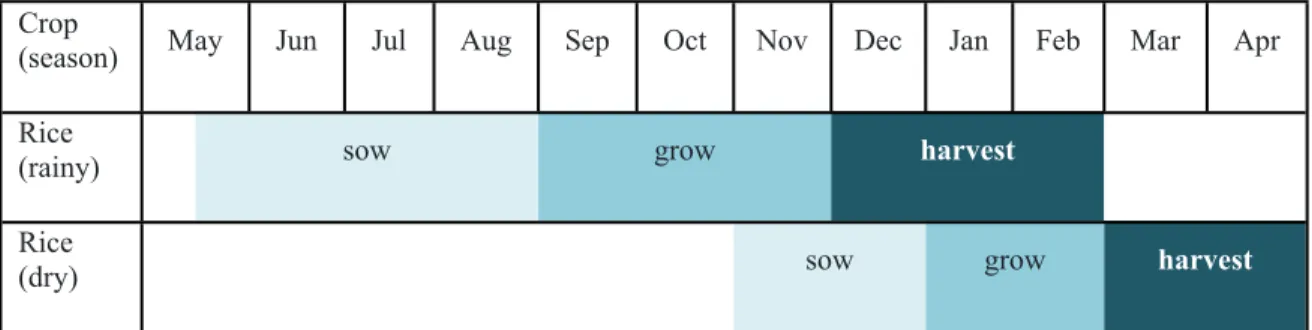
Around 80% of rice production originates from local varieties that are cultivated during the rainy season. High-yielding varieties are mainly planted during the dry season, and account for the remaining 20% of production. Figure 1 shows the cropping seasons for rice. Rice productivity is highly
dependent on weather conditions, and both flooding and droughts have resulted in significant decreases in production. Yields have gradually increased over the last decade, but remain among the lowest in Asia.
Figure 1: Rice Crop Calendar Crop
(season) May Jun Jul Aug Sep Oct Nov Dec Jan Feb Mar Apr
Rice
(rainy) sow grow harvest
Rice
(dry) sow grow harvest
Source: FAO GIEWS
Figure 2:: Map of Typical Precipitation and Dry-season Duration, 1981 ? 2004[8]8
Around 50% of paddy (harvested, unprocessed rice grain) produced in Cambodia is exported to neighboring countries (primarily Vietnam and Thailand) for milling and further distribution, which represents a huge lost opportunity for Cambodian rice millers and traders to add value, export directly, and create employment locally. Limited capacities to comply with premium quality and food-safety standards constrain Cambodian producers? access to international rice markets despite strong market demands.[9]9
Four other food crops?corn, cassava, soybean, and mung bean?occupy approximately 14% of Cambodia?s crop area. The remaining 3% is used for growing vegetables, sesame, peanut, sugarcane, sweet potato, potato, tobacco, and jute. Animal husbandry is traditionally practiced at the household level. Cattle and buffalo provide most agricultural draught and manure for fertilizing crops, and constitute essential household assets. Many rural families raise pigs and chickens at the household level.[10]10
Basic Typology of Rice-production Systems in
Cambodia
The following 3-part typology is a simplification of the various rice-farming systems used in
Cambodia, but is useful for understanding the broad categories of systems in terms of the stakeholders, climate-related risks, constraints, and opportunities. It is also worth noting that some farming systems do not fit neatly in a single category or are in the process of transitioning from one to another (e.g., in response to changing economic conditions, access to irrigation, etc.).
In general, rice-production systems in Cambodia fall into three categories: extensive agriculture, intensive agriculture, and agro-ecological production.
I. Extensive agriculture is characterized by low use of inputs, low risk, low resource efficiency, and low returns. This system is most often associated with subsistence farmers who cultivate relatively smaller holdings (usually less than 2 ha) that suffice for household consumption, plus some excess (perhaps 20%) to sell as a cash crop. These farmers typically prefer traditional practices and local varieties, which are often photo-periodic/ -sensitive (i.e., relatively longer growing seasons) and are preferred for flavor, suitability for traditional cooking, and suitability for historical climatic patterns and production techniques. These seeds are very rarely certified for quality and are often saved for replanting; there is a high tolerance among farmers for intermixed varieties. Seeds are typically dry broadcast, because although it generates lower yields, it requires less labor or mechanization (vs. direct-sowing, transplantation, etc.). For the same reason, little labor or capital is directed to land preparation (e.g., levelling), crop maintenance, soil management, pest management, etc. This form of production is nearly always rain-fed (little or no access to irrigation), such that dry-season cropping is rare, even for other crops and particularly for cash crops.
These farmers tend to migrate to access non-farm income and return at harvest time. They face labor shortages (and concomitantly high labor costs) and, when possible, hire mechanized services for land preparation, sowing, harvesting. Post-harvest, these farmers are typically price-takers, because they sell any excess quickly in order to repay their production loans as soon as possible. These farm-gate sales are usually of low-market-quality mixed wet paddy to convenient middle-men. Given that sellers have typically grown the same variety on the same schedule as most other farmers in the area, the market is flooded and prices are low. In these systems, rice production is more a matter of food security and culture than a business.
Incomes for families in these systems derive more from wage labor and remittances (both typically associated with migration) than from farming.
II. Intensive agriculture is characterized by high use of inputs, higher yields, higher efficiencies, greater market access, greater farmer interest in improving outcomes (e.g., increasing yields), use of non-traditional varieties, and more formal integration in value chains (e.g., via production contracts, established relationships with suppliers and processors, etc.).
These farmers have better access to inputs (e.g., fertilizer, quality seeds) and services (e.g., mechanization, agricultural cooperatives), often have benefitted from previous development- related opportunities (e.g., technical assistance via MAFF, private sector, NGOs, FOs), and have better water access (e.g., typically with at least some degree of irrigation). They use various forms of seeding?including broadcasting, direct-seeding, and sowing?depending on various factors. Their selection of varieties depends largely on the targeted buyer and markets. They often grow traditional varieties, but have also adopted improved modern varieties provided by MAFF, the private sector, and NGOs?e.g., fragrant rice, jasmine rice, IRRI?s high-yielding varieties such CAR 15, and high-value traditional varieties such as Phka Rumduol, Phka Malis, Sen Pido, and Somali. Such varieties typically require higher
investments in management and inputs (e.g., fertilizers, crop protection, weed control, irrigation), but can generate higher income if properly linked with markets. When improved varieties are used, they are often grown in locations with good soil conditions, good
accessibility for machinery, proximity to irrigation, etc. Farmers in this type of production system tend to invest more in rice production as a livelihood and typically do not rely heavily on migration-based income.
III. Agro-ecological production, the least prevalent system of rice production in Cambodia, is characterized by the generation of benefits for (or at least mitigated detriments to) people and the environment. These systems?also referred to as biologically or naturally enhanced niche systems?are characterized by their geographical contexts; they are often located near forested or preserved areas and are typically rain-fed or irrigated via nearby creeks, springs, etc. Such systems improve or maintain high soil fertility and have high indigenous yield carrying capacities (i.e., yields without adding mineral fertilizers), though agro-ecological production is not necessarily organic (nor is organic production necessarily agro-ecological). In agro- ecological production systems, rice fields often are smaller than in other systems due to the natural topography, such as in the form of small terraces along slopes, allowing better management (e.g., soil preparation, puddling, levelling, water management) and enable labor investments by farmers (e.g., transplanting, crop management, supplemental irrigation).
Such systems require greater farmer knowledge of production practices and ecological conditions, and typically require investments from farmers. Given that investments in such systems can take multiple seasons to yield benefits, transitions to such systems often require strong outside transitional support or market incentives (i.e., ?pulls?). Moreover, although such systems are more resilient to climatic shifts and shocks, they also typically have lower crop yields than do intensive systems. Therefore, these systems are often located in areas not well suited to mechanization, which means that they are also sensitive to labor costs, market
demand for premium pricing on production practices, and the credibility of associated prestige labelling.
Agro-ecological production systems are currently comparatively rare in Cambodia. Examples can be found in Preah Vihear province in conjunction with Ibis Rice, a brand of fragrant, organically grown Malis Rice. Wildlife Conservation Society[11]11 (WCS) and Sansom Mlup Prey (SMP) have been supporting around 1,000 smallholders? farmers to produce and market Wildlife Friendly Ibis Rice, which garners a 20% price premium. Ibis Rice has been certified organic to U.S and E.U. standards since 2016. Ibis Rice farmers produced more than 435 tons of organically grown, fragrant Malis during the 2013-2014 harvest season.
Project Site Context
The project?s sub-national activities will target five provinces surrounding Tonle Sap?Pursat, Battambang, Banteay Meanchey, Siem Reap, and Kampong Thom?because these provinces face high climate-related risks with similar threats and opportunities. Figure 3 depicts a map of the project?s targeted provinces.
Figure 3: Map of Project?s Targeted Provinces
The Tonle Sap plain is a complex hydrological system, composed of (i) the 2,600 km2 permanent shallow lake, Tonle Sap, (ii) the 120 km-long Tonle Sap River that connects the lake to the Mekong, and (iii) a 12,876 km2 floodplain covered with a mosaic of natural and agricultural habitats that the Mekong River replenishes with water and sediments annually. The extreme seasonal inter-phase between flood and drought in the floodplain determines major habitat types, geochemical processes, ecological interactions, and human activities interplaying in the Tonle Sap.[12]12
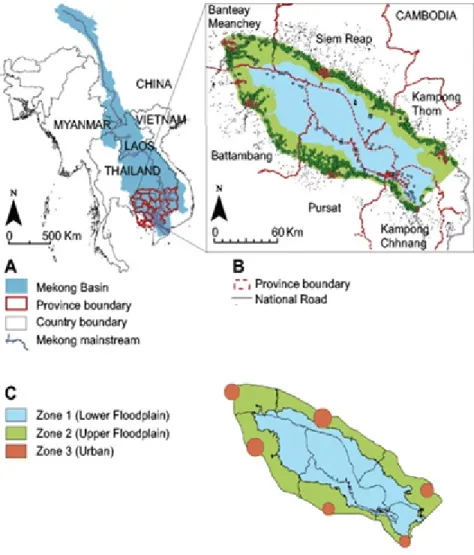
Thus, the Tonle Sap plain is divided into three zones (see Figure 4) that relate to the annual flood pulse. Zone 1 (Lower Floodplain) is closest to the lake and has an elevation of 0-6 meters above mean sea level (amsl), such that it experiences frequent, intense flooding, with maximum water depth typically ranging from 3 to 7.6 m.[13]13 Zone 2 (Upper Floodplain) extends from the Lower Floodplain to 3 km beyond the national roads (National Road 5 along the southern and western edge of the
floodplain and National Road 6 along the northern and eastern edge of the floodplain). This zone has an elevation of >6 m amsl and experiences less seasonal flooding than Zone 1 does, enabling regular rice cultivation and other agricultural activities.[14]14 Both Zones 1 and 2 contain village settlements. Zone 3 (Urban) includes urban settlements as defined in the Population Census,[15]15 including provincial capitals and towns located close to national roads. This zone has higher elevation and experiences little or no regular flooding. Overall, the three zones have very different interactions with the Tonle Sap and its annual flood pulse. The flood pulse has greatly impacted the floodplain?s functions and
vegetation,[16]16 and flood characteristics have shaped traditional livelihoods in the area, though recent changes along the Mekong are altering the timing, volume, and sediment loads of annual pulses.
Figure 4: Maps of Mekong Basin and Tonle Sap Floodplain
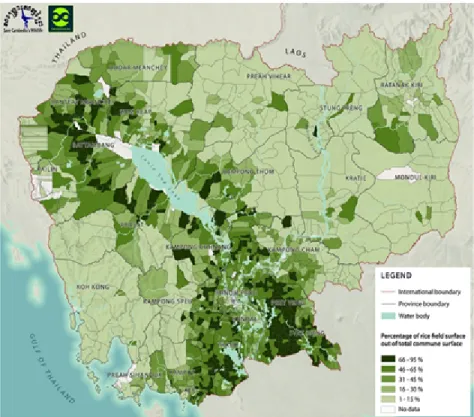
As depicted in Figure 5 and Figure 6, the project?s targeted provinces comprise one of Cambodia?s two major rice-growing regions. The other major rice-growing region is in southeastern Cambodia and benefits from much greater access to dry-season irrigation (a critical climate-adaptive technology), largely via the lower Mekong.
Figure 5: Map of Land Cover, 2016[17]17
Figure 6: Map of Rice Land Percentage by District[18]18
The five target provinces Tonle Sap region accounts for about 39% of total harvested rice area in the country; in 2019, this consisted of 1,106,413 ha of wet-season rice and 182,507 ha of dry season rice.
Table 1, Table 2, Table 3, Table 4, and Figure 7 present trend and recent rice-production figures by province.
Table 1: Trend in rice production by province, 1983-2019[19]19
Table 2: Rice production in wet season by province 2019[20]20
Table 3: Total rice production by season by province, 2019 ? 2020[21]21
Table 4: Rice cultivated areas affected by drought, flood, pest and disease by province, 2019 ? 2020[22]22
Figure 7: Milled rice export 2009 ? 2020 and export by month during 2020[23]23
The project?s targeted areas also contain numerous Community Protected Areas (CPAs), which are officially designated areas that allow local communities to conduct planned and approved activities, including some agricultural practices, within nationally designated protected areas. Figure 7 depicts a map of early CPAs, though the number and extent of CPAs has expanded in recent years. Protected Areas fall under the purview of the Ministry of Environment (MoE), which administers CPAs via the General Directorate of Local Community (GDLC). Thus, supporting agricultural practices within CPAs requires coordination between GDLC and the Ministry of Agriculture, Forestry, and Fisheries (MAFF), particularly via the General Directorate for Agriculture (GDA) and provincial and district counterparts (e.g., Provincial Departments of Agriculture, Forestry, and Fisheries?PDAFFs). CPAs provide an important means for landless and poor households to access land for agricultural production. CPAs are also often utilized by indigenous ethnic minority communities (see Annex J).
Figure 8: Community Protected Areas (CPAs, pins indicating locations of CPAs)[24]24
Climate-related Risks and Vulnerabilities
This section describes climate-related risks and vulnerabilities in the Tonle Sap region. As a preface to this section, it is important to note that climate-related adaptations can be categorized as (a) threat- specific or (b) general. That is, climate adaptability can be assessed and addressed in terms of threat- specific forecasts (e.g., rainy season shortened by 21 days by 2050; nightly low temperature during growing season increased by 1.5? C by 2080) or in terms of uncertainty (i.e., identifying ?no-regrets?
approaches that yield benefits no matter the trajectory or year-to-year variance). The following section primarily focuses on threat-specific exposure, sensitivity, and adaptive capacities. The project?s proposed approach (see Section 1.a.2) builds on these threat-specific considerations to prioritize initiatives that cover both (a) anticipated climatic trajectories and (b) unanticipated risks (i.e., ?no- regrets? approaches that are likely to yield benefits across a wide range of scenarios and high annual variance).
Climate-related vulnerabilities. Vulnerability to climate change is a function of exposure and
sensitivity. Exposure is the probability of experiencing a given climatic hazard (e.g., low rainfall, high
temperatures), whereas sensitivity is the degree to which such hazards result in harms (in terms of extent, severity, or duration).
Exposure. The first major on-going and forecast climatic trend for the Tonle Sap region (and Cambodia more broadly) is that the rainy season is predicted to have a later onset, shorter
duration, and more intense rainfall events.[25]25 This trend is already resulting in significant harms to farmers in the Tonle Tap basin. The later onset of the rainy season means that farmers following traditional cropping calendars often plant too soon, such that sown fields do not receive sufficient rainfall to survive. This trend is often accompanied by false starts to the rainy season, such that even if farmers wait for the first rain to sow, the actual rainy season does not begin for a few more weeks, such that the sown seeds fail to germinate or die shortly after sprouting. Farmers following traditional cropping calendars might sow prior to the first rain, but a false start to the rainy season is sufficient merely to germinate the seeds, and the sprouts then die from insufficient rainfall.
Ideally, the rainy season would have a predictable start date and duration, and rainfall events would have a frequency and volumes to ensure that fields rarely go more than a few days without standing water (which is important for weed suppression), the water table rarely drops below about 10 cm (ensuring sufficient water in the root zone for vigorous growth), and fields never receive enough water to breach paddy berms (resulting in erosion, crop damage from sheet flow or excessive inundation, etc.). However, the forecast trend will entail less predictability and more heavy-rainfall events, such that crops will go longer periods of time without rainfall, which result in crop stress and top-layer soil- crusting that reduces infiltration (increases run-off) when rain eventually falls. Heavy rainfall events then result in crop losses from excessive inundation, breached paddy berms, erosion, crop damage from sheet flow, etc.
Together, the later onset of the rainy season and increased proportion of precipitation via heavy rainfall events mean that the region will experience more drought conditions both between and within rainy seasons (projected increase of 0.5 months of drought per year by 2050). A 2016 household survey in four out of the five targeted provinces showed that all participating rice-farming households had experienced at least one drought and one flood event in the five years prior to the survey.[26]26 The increased incidence of droughts is already increasingly straining the conjunctive uses of limited water resources, including for basic residential consumption (drinking, hygiene, cooking, home gardens), agriculture (irrigation, livestock, fish ponds, market gardens), industry, ecological flows, etc. There is already very high and increasing demand for pumped wells, village/ household ponds and tanks, etc.
Less predictable rainfall?especially when combined with higher evaporative losses?leads to more social friction from competing uses of a scarce, critical resource. Moreover, even when total rainfall is sufficient, patterns matter: deluges have reduced infiltration rates (i.e., reduced groundwater recharge due to increased run-off because of soil crusts, saturation, etc.) and can exceed storage capacities.
Droughts also result in additional strains on groundwater resources, which are used for drinking water, for horticulture, and increasingly for supplemental irrigation. Although groundwater governance data are sparse for Cambodia, Figure 9 depicts trends in falling groundwater levels of 20 ? 35 cm per year.
Figure 9: Groundwater Levels in Typical Wells in Prey Veng and Svay Rieng, 1996 ? 2008[27]27
Cambodian farmers now face the seemingly paradoxical tragedy of repeatedly enduring floods and droughts. Cambodia experienced severe floods in 2011, 2013, and 2014, and severe droughts in 2004, 2012, 2014, 2015, 2016, and 2019.[28]28 The 2012 drought affected 11 out of the 24 provinces and negatively affected tens of thousands of hectares of rice-growing areas.[29]29 In October 2013, heavy rainfall resulted in flash floods, which seriously affected over half a million people living in rural communities. More than half of Cambodia's provinces were affected, particularly in the Mekong region. An assessment indicated that the damage and loss caused by the 2013 floods amounted to USD 356 million, including USD 153 million in damage to physical assets and USD 203 million in losses in production and economic flows. During the 2015-2016 dry season, there was a severe drought attributed to the El Ni?o phenomenon,[30]30 resulting in one of the worst droughts for Southeast Asia in decades. It affected 2.4 million people across 18 provinces in Cambodia. The 2019
drought[31]31 affected about 330,000 ha of rice-cultivated areas.
Additionally, heavy rainfall events are often a function of increased air temperatures, which allow greater atmospheric storage of water vapor, which has a very high specific heat (i.e., capacity to store energy). Consequently, heavy rainfall events are often accompanied by significant atmospheric energy gradients (weather fronts) that produce strong storms, which damage crops. Over the past decade, Cambodia has witnessed more frequent and severe floods, droughts, and windstorms, which have resulted in increasingly high physical and economic impacts, particularly in rural areas.[32]32 Figure 10: Provincial Proportions of Communes at High Risk of Climatic Hazards[33]33
Composite Risk Drought Risk
Flood Risk Storm Risk
The second major on-going and forecast climatic trend for the Tonle Sap region is higher temperatures, particularly for night-time lows in the rainy (growing) season and day-time highs in the dry season.
This on-going and predicted trend will likely have implications for agricultural yields (e.g., reduced soil moisture, reduced plant productivity) and labor (availability, cost, and productivity). For example, an increase of 1? C in night-time low temperatures during the rice-growing season results in a
decreased rice yield of approximately 10%.[34]34, [35]35
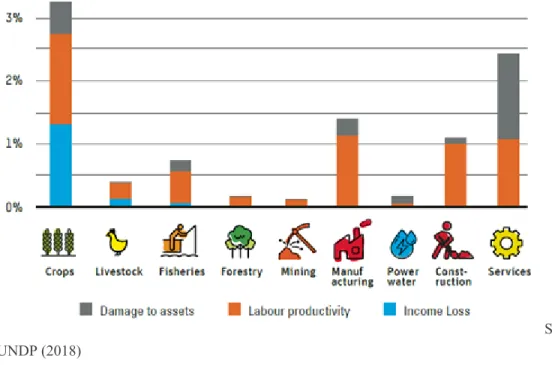
Additionally, increased day-time temperatures reduce labor productivity and availability (thereby significantly increasing labor costs and shortages). Climate forecasts suggest that agriculture will suffer the greatest economic impacts of climate change in Cambodia, particularly due to losses of
income and labor productivity associated with crop production (see Figure 11). Even under the relatively optimistic RCP 4.5 scenario, Cambodia is expected to experience an overall drop of 9.8% in GDP per capita between 2015 and 2050.[36]36
Figure 11: Expected Economic Impacts of Climate Change in Cambodia by Sector and Type of Impact (% decrement in GDP by 2050)
Source:
UNDP (2018)
Increased temperatures and shifting seasons also shift the ranges of pests and diseases. In Cambodia, rice losses due to infestations of stem-borers and leaf-folders have risen sharply over the past several years. In order to combat the increased ranges and prevalences of pests and diseases, farmers are likely to increase use of chemical inputs, thereby continuing a trend of increased costs of production and negative ecological consequences.
Finally, it should be noted that the constellation of climatic threats facing farmers in the Tonle Sap plain is not merely a matter of acute shocks, but also of trends that will increasingly threaten the agricultural productivity of the region, potentially requiring more profound social and economic
transitions. For example, Cambodia is expected to lose 20% of land suitable for rain-fed rice cultivation by 2050.[37]37
Sensitivity. Farming communities in the Tonle Sap basin are especially sensitive to these climatic trends for several reasons. First, these communities rely very heavily on agriculture for sustenance and livelihoods (yields and wage labor). Thus, climatic shocks typically directly result in harms to livelihoods and well-being (e.g., reduced production income, reduced wage income, food insecurity, reduced labor productivity). The agricultural sector?especially rice farming?is most impacted by climatic hazards; about 90% of economic losses from extreme weather events are due to crop- losses.[38]38 During the 2015-2016 El Ni?o, 37% of households reported water shortages, 62% of households reported lost income (average loss of 19%), and household production of paddy and cassava declined 22%.[39]39 These sensitivities are particularly acute for rain-fed production, which accounts for about 80% of rice production in the Tonle Sap region. Not only are rain-fed production systems especially sensitive to variability in precipitation and temperature (evaporative losses), but they are also susceptible to flooding, given that rain-fed fields lack the drainage and pumping systems of irrigated fields.
Second, agricultural systems in these communities and districts are very poorly suited to recent and forecast climatic trends. For example, nearly all districts have very low levels of economic diversification, including very little diversification of rice varieties (let alone diversity of crops or sectors). Therefore, climate-related shocks often have widespread effects. Moreover, the most commonly grown rice varieties are selected based either on local consumption preferences (traditional local varieties) or preferences of large-scale buyers, not based on tolerances to climate-related stresses.
For example, most common varieties are photo-sensitive (i.e., require a long growing period), meaning that they are susceptible to climate-related risks for longer periods of time. Commonly grown varieties are also not especially tolerant of droughts or floods. These variety-based sensitivities to climatic risks are greater for extensive producers (generally poorer smallholders), who are generally more reluctant to adopt new varieties and have less access to seeds (especially good quality seeds), technical assistance, infrastructure, and marketing[40]40 for adoption.
Additionally, these systems are highly sensitive to climate change because yields are comparatively low, particularly in rain-fed production, which is practiced by more than 80% of rice-growing
households. Low yields and small land holdings mean that even relatively small climatic shocks can have significant consequences.[41]41
Third, these communities have very limited resources with which to absorb shocks. They have weak economic shock absorbers due to high levels of poverty (see Figure 12), high household
indebtedness (along with high costs of credit), and limited household assets, including landlessness and limited land holdings (see Figure 13). Climatic shocks such as droughts and floods typically have a direct and significant impact on household incomes and food security, particularly for poor
households.[42]42
Figure 12: Map of Poor Populations by District, 2014 ? 2016[43]43
Figure 13: Percentage of Households with < 1 Hectare of Rice Land by District[44]44
Economic shock absorption is also weak due to limited and fragile infrastructure (physical capital). For example, in many areas, farm-to-market roads are easily washed out by deluges, thereby limiting or delaying accessibility for labor, machinery, technical assistance, transport of produce, etc. and adding to overall production costs. Limited private-sector investment continues to result in fragmented value chains, resulting in information asymmetries, inefficient matching of supplies and demands, local monopolies and monopsonies, etc. Likewise, limited physical capital in these value chains continues to result in limited facilities for local storage and processing (e.g., thereby increasing post-harvest losses and degrading paddy quality).[45]45 Without sufficient and appropriate technological improvements in these value chains, increased humidity levels and erratic rainfall patterns are likely to increase post- harvest losses due to spoilage while also increasing food-safety risks.
These communities have weak biophysical shock absorbers, because predominant land-use practices degrade soil and water quality (e.g., residue burning, bare soil, lack of crop diversification or rotation, lack of soil amendments, lack of riparian buffers, agricultural expansion, leaching from inappropriate use of chemical inputs, weak governance of ground and surface water, etc.). Such practices have driven declines in populations of globally important threatened species and of species that are beneficial to farmers and ecosystems. For example, associated loss of habitat (e.g., lack of perimeter plantings, habitat strips, etc.) exacerbates the plight of the critically endangered Bengal florican
(Houbaropsis bengalensis), which in Southeast Asia is restricted to the Tonle Sap region. In addition, stubble fields during the high water season make structurally poor habitat for the fish on which many communities depend.
In fact, given that these communities? economic and social shock absorbers are already strained, many shocks are transmitted to the environment, leading to degradation of biophysical capital. For example, increased climate-related threats have led many farmers to increase their reliance on inputs?e.g., synthetic chemical inputs?often in ways that produce limited benefits for yields. In the last decade, Cambodia?s importation of pesticides increased by a factor of 285, and the national use of pesticides rose from 200,000 liters in 2002 to 3.4 million liters in 2004.[46]46 This trend continues; Cambodia formally imported 13,800 tons more pesticides in 2016 than in 2015,[47]47 and in a 2016 survey, 100%
of farmers surveyed from five provinces in Cambodia applied some amount of pesticide in each season.[48]48 Cambodia is seen as a ?dumping ground for unwanted and dangerous pesticides.?[49]49 In 2016, there were 522 trade names (for 133 common names) of chemical pesticides available in local markets, most of them unregistered.[50]50 The pesticides are often used incorrectly due to lack of labelling in Khmer and insufficient extension services at the village level, thereby reducing the products? effectiveness and increasing negative environmental impacts (particularly water and soil contamination) from over-use and incorrect disposal.[51]51 Thus, current and forecast climatic changes pose risks not just to livelihoods, but also to local ecosystems, the degradation of which further
threatens these communities? livelihoods and well-being.
Although most communities have strong social capital, their social shock absorbers are weakened by the aforementioned lack of diversification, such that if one household is experiencing agricultural hardships, most other households in the community are likely experiencing the same hardships and are unable to offer much support. Similarly, institutional support (e.g., technical support from agricultural extension services, financial support from banks, etc.) is strained when such hardships are simultaneous and widespread.
Adaptive capacities. Whereas absorptive capacities (discussed above with respect to sensitivities) enable systems to incur and endure shocks without needing to alter the system, adaptive capacities are the abilities to reduce vulnerability (exposure and sensitivity). Simply put, whereas absorptive capacity is a function of the status of exposure and sensitivity, adaptive capacity is the ability of a system to manage risks. In extreme circumstances, adaptation requires a transition or transformation to a new normal (e.g., shifting to a different system of agriculture or away from agriculture completely) rather than mere resilience (recovering to a version of pre-shock conditions).
Adaptive capacities can be conceptualized in many ways and often include considerations of complex, context-specific factors. RGC has yet to adopt a formal framework of indicators for adaptive
capacities. However, from a decision-process perspective, adaptive capacities can be organized into strategic, technical, and operational functions, which can each be considered at multiple levels (e.g., national, communal, household, sectoral, etc.). As noted above, adaptive capacities can also be considered in terms of (a) preparedness to cope with forecast trends and (b) agility to cope with unforeseen hazards.
The strategic function corresponds to an awareness and prioritization of climate-related issues, and establishment of legal and institutional arrangements that facilitate good governance. The technical function corresponds to the decision-making frameworks (e.g., monitoring and data protocols), coordination, and planning. The operational function corresponds to the various resources to execute the strategic direction and technical plans (e.g., infrastructure, equipment, monitoring stations, broadcast networks, funding, personnel, etc.).
Cambodia?s strongest climate-related adaptive capacities are national, strategic, and threat-specific.
National agencies have been established with relevant mandates, national strategic plans and action plans have been established, and RGC has engaged with relevant multi-lateral partnerships. However, adaptive capacities significantly weaken the further one moves from (a) the national level to the household level, (b) strategic to operational functions, and (c) threat-specific coping to general agility.
That is, Cambodia has laid a strategic, national foundation for adaptive capacities, but those capacities need substantial strengthening at sub-national levels and for technical and operational functions.
Technically, several coordination mechanisms have been established with varying levels of effectiveness, though alignment with funding, mandates, and subnational institutional structures continues to be a challenge. Operationally, the mechanisms to translate strategic priorities into on-the- ground actions are tenuous. At the household level, adaptive capacities benefit from some awareness
of current and forecast climatic trends, but suffer from a lack of awareness of coping strategies, knowledge of relevant decision processes, access to fit-for-purpose information, and access to relevant resources, such as sufficient access to seeds for climate-resilient marketable rice varieties and
affordable credit. Communities also lack frameworks for effective local governance of natural resources (especially water), technical assistance, localized agro-meteorological forecasts, ready options for forecast-based crop-switching, localized plans and resources for unanticipated shocks, etc.
The increasing unreliability of seasonal weather patterns means farmers are less able to rely on traditional practices and need more accurate information, in terms of near-term weather forecasts, seasonal forecasts, and longer-term climatic trends.
Key Barriers
The key barriers to build climate resilience into the livelihoods of Cambodia?s rice-based communities in the target provinces include the following:
Barrier 1: Inadequate enabling environment for climate change adaptation in the agricultural sector, particularly for rice production.
Currently, MAFF lacks sufficient capacities to integrate climate change actions fully and effectively into annual budgets and workplans, as well as to integrate agricultural priorities into climate-related strategies, processes, and policies. Similarly, national and subnational institutions in the agricultural sector lack sufficient capacities for climate-related planning and implementation, such as provincial capacities for integrating CCA-relevant data into decision processes (e.g., agro-meteorological data).
Additionally, although cross-ministerial and inter-sectoral coordination mechanisms exist (e.g., the Cambodia Climate Change Alliance, CCCA; NCSD?s Technical Working Group on Climate Change, CCTWG; Technical Working Group on Agriculture and Water, TWG-AW), such mechanisms require on-going external support in order to maintain momentum and engagement as RGC transitions to long- term institutional and funding arrangements to support these mechanisms. One of the continuing challenges of effective inter-ministerial and inter-sectoral coordination on climate change adaptation is defining and ensuring alignment of locally and sectorally appropriate CCA operationalizations, metrics, collection protocols, data-sharing, etc. Whereas the more global nature of climate-change mitigation (CCM) challenges lend themselves to more internationally consistent transparency and accountability frameworks, CCA challenges and opportunities are far more locally and contextually specific. At present, RGC has yet to formalize CCA metrics for the agricultural sector or to link sectoral indicators to the production-oriented agricultural indicators in the National Strategic Development Plan (NSDP)
or Cambodia?s Sustainable Development Goals (CSDGs). Additionally, metrics in the agricultural sector do not adequately reflect national priorities related to gender and vulnerable groups. Moreover, the agricultural dimension is so far missing from CCCA?s recently initiated work on an online tracking system for RGC?s Nationally Determined Contribution (NDC), which is part of an effort to enable a coherent and coordinated view of RGC?s climate-related initiatives (both for mitigation and adaptation) as well as linkages between the NDC and the Sustainable Development Goals (SDGs).
MAFF also lacks sufficient data on climate vulnerabilities of rice-growing communities in the Tonle Sap region, particularly in a form that integrates with climate modelling of trends in the area?s agro- ecological zones. MAFF and MoE also currently lack the sub-national technical capacities to interpret and incorporate such information into provincial and district-level contexts and approaches (e.g., via PDAFFs, PDoEs), or to provide relevant bottom-up insights?e.g., from integration with Commune Investment/ Development Plans (CIPs/ CDPs).
There is also weak policy and regulatory alignment with respect to the mainstreaming of climate- adaptive approaches, such as natural resource governance. This is especially pronounced with respect to water-resource management. Particularly during the dry season, lack of water access significantly limits agricultural production. Farmers who can afford wells and pumps increasingly rely on them to enable dry-season production. The area irrigated by groundwater in Cambodia is increasing by more than 10% per year, such that by about 2030, if continued, the water table in much of the country will fall below the lift limit for suction pump wells, which are used for domestic water supply by more than 1.5 million people.[52]52 The falling water table also increases pumping costs, potential arsenic contamination, and land subsidence.[53]53
However, the risks and opportunities associated with groundwater extraction are not uniform across the country. The overall sustainability of groundwater extractions is largely a function of weather, land use, and geology. Broad-scale assessments of the lower Mekong Basin suggest that groundwater recharge rates around Tonle Sap are generally greater than 20% of annual precipitation.[54]54
Figure 14: Percentage of Households with Wells by Commune[55]55
Although groundwater information is limited, geological maps suggest that opportunities for
sustainable increases in groundwater use may be more likely in areas with older alluvial deposits (parts of Pursat, Siem Reap, and Kampong Thom) rather than in areas with newer alluvial deposits, which underlie most of the rest of the target area. The areas with older alluvial deposits?and correspondingly greater likelihood for sustainable expansion of groundwater use?are also areas with less commercially oriented rice production, smaller average land holdings, and greater poverty rates, which are also therefore more amenable to agricultural livelihood diversification via approaches that could take advantage of small-scale horticultural irrigation. (See discussion of this same issue under Output 2.1.1.)
Sufficient information for water-resource management is not only critical for climate resilience in agricultural communities, particularly for rice production, but is also a key prerequisite to engage with some sustainability-oriented value chains. For example, Mars Food?a major buyer of exported rice from Cambodia?has committed to reducing unsustainable water use by 50% by 2025 (equivalent to roughly 85 billion liters of water), primarily by purchasing agricultural products with high water-use efficiencies.
Finally, MAFF currently lacks a cohesive, effective, and sustainable approach to incentivizing adoption of climate-resilient agricultural practices, particularly via private-sector, market-driven mechanisms.
This leaves land users and value-chain actors to formulate and enact significant yet disconnected investments on their own. To date, RGC?s related interventions have required significant public resources that have rarely effectively induced and leveraged sustained private-sector investments.
Those shortcomings are due in part to insufficient technical assistance within Cambodia?s Agricultural
and Rural Development Bank (ARDB), MAFF, and MoE to accommodate the sector-specific challenges to financing such investments.
Currently, there is a limited volume and selection of financial products to support agricultural investments, due largely to a lack of knowledge in the financial sector about how to identify, assess, and price risk factors in the agricultural sector. Although different technologies and practices in agricultural value chains have very different risk-reward profiles?e.g., related to climate
resilience?lenders typically assume and price in uniformly high risk, differentiating instead on other factors (e.g., borrower characteristics, type of securitization). Therefore, lenders typically limit their exposure to the agricultural sector and charge high interest rates, both of which limit support especially to smallholders and small and medium enterprises (SMEs). This means that the financial sector currently poses an unrealized potential to support technologies and practices with desirable risk-reward profiles in the agricultural sector. Given that climatic factors pose the single greatest risk to
agricultural production, borrowers and lenders would benefit from financial products and terms that reflect the actual, stronger risk-reward profiles of technologies and practices that limit climatic risks (i.e., increase climate resilience and adaptation).
Similarly, relevant decision-makers in MAFF and MoE lack sufficient capacities to identify and support opportunities for blended financing of climate-resilient approaches in the agricultural sector.
Currently, such initiatives are primarily financed via grants, concessional lending, and public debt.
Private-sector financial support is under-utilized, largely because relevant private investment would typically require a blend of products and approaches to address different aspects of a proposal. For example, a coordinated initiative might pair public bonds for infrastructure, private debt for capital expenditures, subsidized debt for working capital, supply-chain credit for inputs, grants for technical assistance, philanthropy for transitional arrangements, and so forth. Given that climate-resilient approaches very often yield CCM benefits, investments in climate-resilience also pose a significant opportunity to support CCA efforts with CCM-related funding. The Climate Smart Agriculture (CSA)[56]56 framework is ideally suited to identify and strengthen those linkages. However, such multi-party, technically diverse arrangements require significant coordination. Currently, few organizations have the authority or capacities to do so. With strengthened capacities, RGC would be uniquely positioned to lead those efforts.
Barrier 2: Current agricultural networks are narrowly suited to conventional production practices that contribute to high vulnerability to climate change.
As described above, current agricultural practices in rice-growing communities of the Tonle Sap region are not resilient to climate change. They result in high sensitivities and afford low adaptive capacities.
Although these communities are conceptually aware of climatic trends and the harms those trends continue to produce, farmers have limited access to technical assistance, technologies, and institutional support that would enable them to transition to more climate-adaptive practices.
For example, in order for communities to transition to greater levels of local diversification, farmers would need, among other things, (i) business models indicating local costs, markets, price variability,
feasibility, etc., (ii) options for financing such transitions and guarding against downside risks, (iii) local suppliers, technical assistance, labor, relevant machinery, and buyers, (iv) in the case of land- users in CPAs, clarity regarding the legal implications of crop-switching for land-use rights, (v) local coordination to ensure adequate economies of scale while avoiding homogenization, and (vi) governance mechanisms for relevant natural resources.
Critically, current agricultural systems unduly burden and limit the options of women, women-led households, and the elderly. This unfortunate circumstance is primarily a function of the organic maladaptations to economic and climatic trends. Various complex factors (e.g., comparatively higher wage-labor opportunities in urban areas and neighboring countries, comparatively low agricultural yields in Cambodia, infrastructural changes) have led to increased out-migration from these
communities, particularly by working-age men. The roles of women have drastically expanded, often in ways that increase their personal and household vulnerabilities. These expanded responsibilities also limit their capacities and resources (especially in terms of time) to identify, create, and pursue new opportunities in the new socio-economic context. For example, reduced availability of time and labor may indicate opportunities for community-based market gardens for high-value crops, increased production of horticultural crops that require less labor and are more climate-resilient, increased conduct of home-based value-addition, increased pooling of resources for capital investments, etc.
Barrier 3: Agricultural value chains reinforce climate vulnerabilities.
Current agricultural value chains relevant to rice-growing communities in the Tonle Sap basin have evolved to suit conventional production practices and historical climatic patterns. These value chains do not account for climate change and are generally not robust to it. For example, agricultural value chains typically lack climate-adaptive technologies, such as adequate drying equipment and appropriate post-harvest storage facilities. Moreover, these networks are generally not conducive to switching to more climate-adaptive options. Although various value-chain actors are aware of climatic trends, they are generally unaware of specific actions, investments, or approaches that would efficiently contribute to improved resilience (e.g., lack of specific information on business modelling of opportunities, coordinating standards, etc.). Actors who consider moving into climate-adaptive niches face significant challenges in educating potential clients about climate-related value-addition.
Moreover, it is difficult for any given actor to initiate or sustain changes toward more climate-resilient options unilaterally. To varying degrees, value-chain actors also have a form of capital lock-in for current practices, which is reinforced by uncertainties about market demands, regulatory
considerations, etc. relative to more climate-adaptive options. (As an extreme example, rice processors have a very high capital disincentive regarding a shift away from rice production.) Overall, many value-chain actors are waiting for clear, reliable market demand to incentivize such shifts?including institutional, financial, and technical support?as well as clear, structured frameworks in which their businesses will operate (e.g., regulatory frameworks, standards, value chains). For example, such actors are concerned that banks might not be familiar with climate-adaptive approaches, so might resist providing appropriate credit terms.
These barriers are generally more appreciable in areas with greater production from intensive agriculture (more commercially oriented, greater access to irrigation, larger farms, greater mechanization), such as in Battambang and Banteay Meanchey.
Barrier 4: Insufficient knowledge management systems.
Knowledge management systems for climate risks in the agricultural sector do not efficiently facilitate knowledge-sharing, link directly with relevant decision processes, or ensure feedback for continuous improvement. Stakeholders lack sufficient information-management processes to enable a cohesive decision-making framework that integrates strategic priorities, conditions in the agricultural sector, climatic changes, and mechanisms of support. In short, many stakeholders are largely blind to others?
experiences regarding current conditions (e.g., harms, challenges, opportunities, suggestions), what is working, and what is not. Such formal and informal knowledge management systems are critical for effectiveness, efficiency, and continuous learning. This challenge extends from national to local stakeholders.
Additionally, project-based metrics are often insufficiently harmonized with governmental decision- processes. That is, project-based M&E systems are often constrained in scope and duration, and therefore provide limited utility for governmental decision-making processes and limited opportunities to concatenate metrics across projects and initiatives (particularly at different scales and in different sectors).
Similarly, a strategic approach has not been determined regarding the roles of the private sector in knowledge management systems. There are opportunities for an improved understanding of private- sector actors as (i) stakeholders/ users of information in such systems and (ii) potential contributors (e.g., linking relevant metrics and monitoring systems, service providers for various aspects of monitoring, interpretation, verification, communication, etc.).
1.a.2. The proposed alternative scenario with a brief description of expected outcomes and components of the project and the project?s Theory of Change.
The project contributes to the over-arching goal of building climate resilience into the livelihoods of vulnerable rice-based communities in the Tonle Sap region. The project?s objective is that rice-based communities in the Tonle Sap region of Cambodia reduce their climate vulnerability and increase their resilience to climate change through an ecosystem-based, market-driven approach.
Therefore, the project?s alternative scenario is to increase climate resilience of vulnerable smallholders in rice-based communities faced by increasing climate impacts in the targeted provinces. The project aims to improve livelihoods through income-generating and value-adding activities by improving the enabling environment, promoting climate-resilient on-farm practices, and improving the resilience, efficiency, and profitability of the rice value chain. The project will promote new technologies and innovations to strengthen the resilience in production systems and reduce vulnerability to climate risks
and hazards. The project will also promote a market-based approach to improve climate resilience through the engagement of local private sector and will enhance the adaptive capacities and livelihoods of the targeted communities through development of agribusiness skills and agricultural cooperatives (ACs), producer groups including within CPAs. In particular, the project will seek to impact 5% of the total rice harvested area in the five provinces (67,309 ha), equating to roughly 37,000 rice-based households or 170,200 direct beneficiaries.
Project components and related outputs address the above-mentioned barriers to climate-resilient rice- based livelihoods in the target provinces, and are described below.
Component 1: Improving the enabling environment for climate change adaptation in the rice and related priority sectors through integrated policies and planning.
This component will improve the policy environment for integration of climate resilience into targeted sectors. The project will strengthen the capacity of relevant national institutions (particularly MAFF) to integrate climate change actions into their programming using the national budget, as well as to integrate agricultural considerations into climate change policies, including CCA goal-setting and planning processes. Therefore, the implementation will be in close coordination and partnership among key partners under the leadership of GDA and GDLC.
Outcome 1.1.: Strengthened national and sub-national climate change adaptation policies, planning frameworks, and governance.
To achieve this outcome, the project will deliver outputs to strengthen the networks, capacities, and plans for CCA in the agricultural sector that will be delivered locally under Component 2 (technologies and practices for climate-resilient agricultural production) and Component 3 (technologies and
institutional support for climate-resilient agricultural value chains). In particular, outputs under this outcome will strengthen: capacities of national and sub-national institutions to establish and implement multi-level, data-informed CCA strategies and plans in the agricultural sector (Output 1.1.1.), inter- ministerial coordination for CCA-related decision-making (Output 1.1.2.), agro-meteorological advisory services (Output 1.1.3.), and related financial and incentive mechanisms (Output 1.1.4.).
This outcome contributes to the following prioritized adaptation actions in Cambodia?s NDC:
? Strengthening technical and institutional capacity to conduct climate change impact
assessments, climate change projections and mainstreaming of climate change into sector and sub-sector development plans
![Figure 5: Map of Land Cover, 2016[17] 17](https://thumb-eu.123doks.com/thumbv2/pubdocnet/19817679.0/22.918.150.639.145.892/figure-5-map-land-cover-2016-17-17.webp)
![Table 1: Trend in rice production by province, 1983-2019[19] 19](https://thumb-eu.123doks.com/thumbv2/pubdocnet/19817679.0/24.918.144.856.143.398/table-trend-rice-production-province-1983-2019-19.webp)
![Table 2: Rice production in wet season by province 2019[20] 20](https://thumb-eu.123doks.com/thumbv2/pubdocnet/19817679.0/24.918.147.852.456.805/table-rice-production-wet-season-province-2019-20.webp)
![Table 4: Rice cultivated areas affected by drought, flood, pest and disease by province, 2019 ? 2020[22] 22](https://thumb-eu.123doks.com/thumbv2/pubdocnet/19817679.0/25.918.150.855.123.554/table-rice-cultivated-areas-affected-drought-disease-province.webp)
![Figure 7: Milled rice export 2009 ? 2020 and export by month during 2020[23] 23](https://thumb-eu.123doks.com/thumbv2/pubdocnet/19817679.0/26.918.149.849.123.545/figure-milled-rice-export-2009-2020-export-month.webp)
![Figure 8: Community Protected Areas (CPAs, pins indicating locations of CPAs)[24] 24](https://thumb-eu.123doks.com/thumbv2/pubdocnet/19817679.0/27.918.147.756.109.637/figure-community-protected-areas-cpas-indicating-locations-cpas.webp)