Restoration Challenge Grant Platform for Smallholders and Communities, with Blockchain-Enabled Crowdfunding
Part I: Project Information GEF ID
10637 Project Type MSP
Type of Trust Fund GET
CBIT/NGI CBIT NGI Project Title
Restoration Challenge Grant Platform for Smallholders and Communities, with Blockchain-Enabled Crowdfunding
Countries
Regional, Cameroon, Kenya Agency(ies)
IUCN
Other Executing Partner(s) Executing Partner Type
Bioversity International CSO
GEF Focal Area Land Degradation Taxonomy
Focal Areas, Forest, Forest and Landscape Restoration, Land Degradation, Sustainable Land Management, Restoration and Rehabilitation of Degraded Lands, Influencing models, Deploy innovative financial
instruments, Demonstrate innovative approache, Stakeholders, Civil Society, Community Based Organization, Type of Engagement, Participation, Communications, Awareness Raising, Education, Gender Equality, Gender results areas, Participation and leadership, Access to benefits and services, Gender Mainstreaming,
Sex-disaggregated indicators, Capacity, Knowledge and Research, Knowledge Generation, Training, Innovation, Knowledge Exchange, South-South, Learning, Theory of change, Capacity Development
Rio Markers
Climate Change Mitigation Climate Change Mitigation 1 Climate Change Adaptation Climate Change Adaptation 1 Duration
36 In Months Agency Fee($) 180,000.00 Submission Date 7/8/2020
A. Indicative Focal/Non-Focal Area Elements
Programming Directions Trust Fund GEF Amount($) Co-Fin Amount($)
LD-1-3 GET 2,000,000.00 850,000.00
Total Project Cost ($) 2,000,000.00 850,000.00
B. Indicative Project description summary
Project Objective
To facilitate, support, and mobilize investment in, smallholder and community-led restoration of critical landscapes to provide global environmental benefits and enhanced resilient economic development and livelihoods, in support of the Bonn Challenge, AFR100, the Trillion Tree Campaign, and other global and national restoration efforts.
Project Compone nt
Financi ng Type
Project Outcomes
Project Outputs Tru st Fun d
GEF Amount($)
Co-Fin Amount(
$)
Project Compone nt
Financi ng Type
Project Outcomes
Project Outputs Tru st Fun d
GEF Amount($)
Co-Fin Amount(
$)
Component 1:
Smallholder - and Community -led Restoration
Investme
nt 1) Increased
implementati on of forest and landscape restoration by local community actors, with benefits for land, water, climate, biodiversity, and people
1.1) Platform mobile app supporting Platform through verification and payments transfer
? 180,000 verification and payment
transactions covering planting of 500,000 trees and 1.3M instances of tree care/maintenance work to Restoration
partners*
1.2) Network of Platform-provided phones hosting Platform mobile app supporting Restoration partners and Communit y entrepreneurs
? 300 mobile phones with mobile app provided to Community entrepreneurs and/or R estoration partners &
tech support provided 1.3) 400,000 trees planted and maintained as a result of Platform support and
cofinancing leveraged 1.4) At
least 4,000 direct beneficiaries of Platform restoration grants, male & female 1.5) At least 5,000 ha of land under restoration; At least 5,000 ha of land under improved practices
1.6) At least 3 TRI landscapes
in 2 different countries supported by Platform- supported restoration
GET 1,187,500.
00
250,000.
00
Project Compone nt
Financi ng Type
Project Outcomes
Project Outputs Tru st Fun d
GEF Amount($)
Co-Fin Amount(
$)
Component 2:
Awareness Raising and Capacity Building for Smallholder s,
Communitie s,
Community Entrepreneu rs, and Seedling Supply Chain Actors
Technical Assistanc e
2)
Strengthened awareness of restoration opportunities and best practices among smallholders and rural communities;
strengthened capacity for restoration among smallholders, communities and supply chain actors in target landscapes
2.1) At
least 1,000 Restoration partners and 25 Comm unity
entrepreneurs registere d with Platform following awareness- raising campaign in target landscapes 2.2) At
least 1,000 Restoration partners and 25 Comm unity
entrepreneurs trained on use of Platform mobile app, use of Platform-provided phones, and restoration practices
2.3) At least 1 tree nursery(s) in each target landscape established and/or strengthened and providing seedlings of suitable species and genetic stock to meet local demand, with point-of-transaction training on planting and care
GET 345,000.00 300,000.
00
Project Compone nt
Financi ng Type
Project Outcomes
Project Outputs Tru st Fun d
GEF Amount($)
Co-Fin Amount(
$)
Component 3:
Knowledge Capture and Disseminati on
Technical Assistanc e
3) Improved knowledge of best practices for engaging, supporting, and
incentivizing restoration by
smallholders and rural communities
3.1) 1 case study per targeted landscape on Platform-supported work and 1
Consolidated Report on Platform experiences with recommendations, including on Phase II scale up, developed and disseminated through relevant knowledge platforms
3.2) 1 presentation at GLF or similar global forum on Platform experiences &
recommendations; 1 high-level roundtable with government and private-sector partners in each country where Platform is engaged 3.3)
Collaboration/coordinat ion with other
platforms that promote the restoration agenda
GET 110,000.00 100,000.
00
Project Compone nt
Financi ng Type
Project Outcomes
Project Outputs Tru st Fun d
GEF Amount($)
Co-Fin Amount(
$)
Component 4: Phase II Scale Up and Financial Sustainabilit y
Technical Assistanc e
4)
Strengthened capacity and instruments for scaled-up investment in smallholder- and
community- led
restoration
4.1) 1 public web platform with blockchain-supported technology to attract, enable, and verify crowd-funding investment in Platform- supported smallholder- and community-led restoration
4.2) Awareness-raising campaign on crowd- funding opportunities for Platform-supported smallholder- and community-led restoration, and potential partnership with aligned platforms
4.3) $250,000 USD of crowd-sourced investment in Platform- supported restoration transacted
GET 175,682.00 100,000.
00
Sub Total ($) 1,818,182.
00 750,000.
00
Project Management Cost (PMC)
GET 181,818.00 100,000.00
Sub Total($) 181,818.00 100,000.00
Total Project Cost($) 2,000,000.00 850,000.00
C. Indicative sources of Co-financing for the Project by name and by type Sources of Co-
financing Name of Co-
financier Type of Co-
financing Investment
Mobilized Amount($)
GEF Agency IUCN Grant Recurrent
expenditures
100,000.00
GEF Agency IUCN In-kind Recurrent
expenditures 200,000.00
Others Bioversity
International Grant Recurrent
expenditures
150,000.00
Others Bioversity
International In-kind Recurrent
expenditures 150,000.00
Others Crowdsourced
investors Grant Investment
mobilized 250,000.00 Total Project Cost($) 850,000.00
Describe how any "Investment Mobilized" was identified
Under Output 4.1., in Year 2, a public web platform and underlying software system will be developed to facilitate secure and transparent crowd-funding of Platform-supported smallholder- and community-led restoration. Alongside information presented on the public web platform developed under Output 4.1, an awareness-raising campaign utilizing a variety of outreach and communication means, will be
implemented to build awareness of the Platform?s crowd-sourced restoration investment opportunities.
With work to develop the web-portal and awareness-raising campaign beginning in Year 2, it is anticipated that 20 months of operating the web-portal investment window, including through potential partnership with other aligned initiatives identified under Output 3.3, would yield $250,000 USD in crowd-sourced investment.
D. Indicative Trust Fund Resources Requested by Agency(ies), Country(ies), Focal Area and the Programming of Funds
Agenc
y Tru
st Fun d
Countr
y Focal
Area Programmin
g of Funds Amount($) Fee($) Total($)
IUCN GET Global Land
Degradati on
LD
Global/Region al Set-Aside
2,000,000 180,000 2,180,000.
00
Total GEF Resources($) 2,000,000.
00 180,000.
00 2,180,000.
00
E. Project Preparation Grant (PPG) PPG Required
PPG Amount ($) 50,000
PPG Agency Fee ($) 4,500
Agenc
y Trus
t Fun d
Countr
y Focal
Area Programmin
g of Funds Amount($
) Fee($) Total($)
IUCN GET Global Land
Degradatio n
LD
Global/Regiona l Set-Aside
50,000 4,500 54,500.0 0
Total Project Costs($) 50,000.00 4,500.0
0 54,500.0 0
Core Indicators
Indicator 3 Area of land restored
Ha (Expected at PIF)
Ha (Expected at CEO
Endorsement) Ha (Achieved at
MTR) Ha (Achieved at
TE)
5000.00 0.00 0.00 0.00
Indicator 3.1 Area of degraded agricultural land restored
Ha (Expected at PIF)
Ha (Expected at CEO
Endorsement) Ha (Achieved at
MTR) Ha (Achieved at
TE)
Indicator 3.2 Area of Forest and Forest Land restored
Ha (Expected at PIF)
Ha (Expected at CEO
Endorsement)
Ha (Achieved at MTR)
Ha (Achieved at TE)
5,000.00
Indicator 3.3 Area of natural grass and shrublands restored
Ha (Expected at PIF)
Ha (Expected at CEO
Endorsement) Ha (Achieved at
MTR) Ha (Achieved at
TE) Indicator 3.4 Area of wetlands (incl. estuaries, mangroves) restored
Ha (Expected at PIF)
Ha (Expected at CEO
Endorsement) Ha (Achieved at
MTR) Ha (Achieved at
TE)
Indicator 4 Area of landscapes under improved practices (hectares; excluding protected areas)
Ha (Expected at PIF)
Ha (Expected at CEO
Endorsement) Ha (Achieved at
MTR) Ha (Achieved at
TE)
5000.00 0.00 0.00 0.00
Indicator 4.1 Area of landscapes under improved management to benefit biodiversity (hectares, qualitative assessment, non-certified)
Ha (Expected at PIF)
Ha (Expected at CEO
Endorsement) Ha (Achieved at
MTR) Ha (Achieved at
TE) 5,000.00
Indicator 4.2 Area of landscapes that meets national or international third party certification that incorporates biodiversity considerations (hectares)
Ha (Expected at PIF)
Ha (Expected at CEO
Endorsement)
Ha (Achieved at MTR)
Ha (Achieved at TE)
Type/Name of Third Party Certification
Indicator 4.3 Area of landscapes under sustainable land management in production systems
Ha (Expected at PIF)
Ha (Expected at CEO
Endorsement) Ha (Achieved at
MTR) Ha (Achieved at
TE) Indicator 4.4 Area of High Conservation Value Forest (HCVF) loss avoided
Ha (Expected at PIF)
Ha (Expected at CEO
Endorsement) Ha (Achieved at
MTR) Ha (Achieved at
TE)
Documents (Please upload document(s) that justifies the HCVF)
Title Submitted
Indicator 6 Greenhouse Gas Emissions Mitigated Total Target Benefit (At
PIF) (At CEO
Endorsement) (Achieved
at MTR) (Achieved at TE) Expected metric tons of
CO?e (direct) 39574
9 0 0 0
Expected metric tons of
CO?e (indirect) 0 0 0 0
Indicator 6.1 Carbon Sequestered or Emissions Avoided in the AFOLU (Agriculture, Forestry and Other Land Use) sector
Total Target Benefit
(At PIF)
(At CEO Endorsement)
(Achieved at MTR)
(Achieved at TE) Expected metric tons of
CO?e (direct) 395,749
Expected metric tons of CO?e (indirect)
Total Target Benefit
(At PIF)
(At CEO Endorsement)
(Achieved at MTR)
(Achieved at TE) Anticipated start year of
accounting
2021 Duration of accounting 20
Indicator 6.2 Emissions Avoided Outside AFOLU (Agriculture, Forestry and Other Land Use) Sector Total Target Benefit
(At PIF)
(At CEO Endorsement)
(Achieved at MTR)
(Achieved at TE) Expected metric tons of
CO?e (direct)
Expected metric tons of CO?e (indirect)
Anticipated start year of accounting
Duration of accounting
Indicator 6.3 Energy Saved (Use this sub-indicator in addition to the sub-indicator 6.2 if applicable)
Total Target Benefit
Energy (MJ) (At PIF)
Energy (MJ) (At CEO
Endorsement)
Energy (MJ) (Achieved at MTR)
Energy (MJ) (Achieved at TE)
Target Energy Saved (MJ)
Indicator 6.4 Increase in Installed Renewable Energy Capacity per Technology (Use this sub-indicator in addition to the sub-indicator 6.2 if applicable)
Technolog y
Capacity (MW)
(Expected at PIF)
Capacity (MW) (Expected at CEO Endorsement)
Capacity (MW)
(Achieved at MTR)
Capacity (MW) (Achieved at TE)
Indicator 11 Number of direct beneficiaries disaggregated by gender as co-benefit of GEF investment Number
(Expected at
PIF) Number (Expected at CEO Endorsement)
Number (Achieved at MTR)
Number (Achieved at TE) Female 2,000
Male 2,000
Total 4000 0 0 0
Part II. Project Justification
1a. Project Description
Project Summary
The Restoration Challenge Grant Platform for Smallholders and Communities, with Blockchain- Enabled Crowdfunding (hereafter referred to as the Platform), will facilitate and support enhanced smallholder and rural community member engagement and investment in restoration. The Platform will utilize mobile cellular technology and payment transfer services to provide small grants/payments for smallholder-, community-, and school-led restoration work ? principally tree-planting ? matched by co- investment (in-kind and/or cash). Cellular technology will allow for efficient and effective verification of work and transfer of payments. Another key innovative focus of the Platform will be the integration of blockchain technology throughout the restoration value chain to provide transparency, build trust, facilitate real-time monitoring, evaluation and verification, and support mobilization of funding for restoration. From appropriate species selection, seed sourcing and seedling propagation, to tree planting and maintenance and transfer of payments, each transaction will be marked by a unique, traceable, unchangeable and verifiable blockchain. A second phase of the Platform will utilize a public-facing web platform and partnerships with other tree planting and restoration investment matching platforms to facilitate crowdfunding of Platform-supported restoration and financial sustainability, drawing upon the blockchain technology and ledger for security and transparency and trustworthyness of
crowdfunded transactions. A range of engagement approaches and selection of a diverse group of landscapes will allow for cross comparison and learning to inform restoration initiatives going forward.
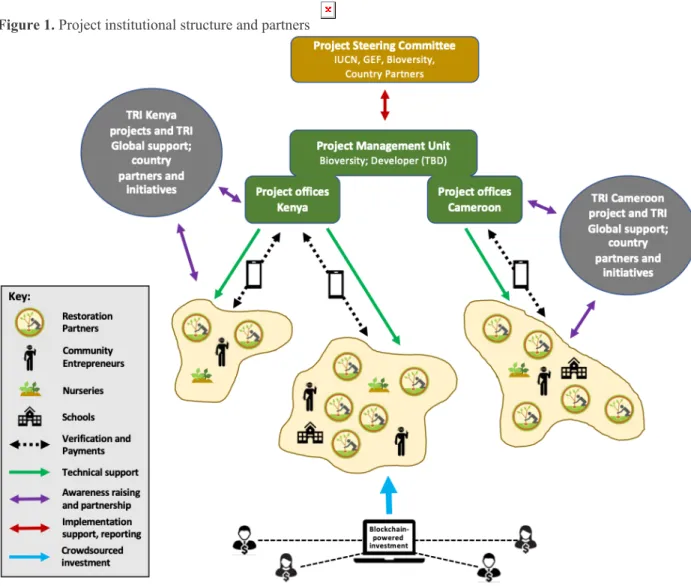
The Platform will initially be linked to The Restoration Initiative (TRI) GEF-6 programme to allow for use of TRI infrastructure and networks for communications and knowledge sharing, capacity building, and enhanced outcomes at reduced cost. Platform activities will be piloted in two partnering TRI countries, Cameroon and Kenya, whose selection was informed by a number of factors including: (1) Bonn Challenge commitments and strong alignment of national objectives on restoration, rural development and poverty alleviation, climate mitigation and adaptation, and other restoration co- benefits with Platform objectives; (2) diversity of landscapes and contexts afforded by East and West African experiences; (3) existing IUCN and Bioversity International programs of work, offices and infrastructure in both Cameroon and Kenya; (4) local Kenyan technology expertise to potentially support the mobile application, blockchain software and tech support components; (5) availability of Restoration Opportunity Assessment Methodology (ROAM)[1]1assessments at national and sub-national scales, identifying priority restoration opportunities and interventions; (6) availability of Species Threat Abatement and Recovery (STAR) assessments, including detailed, high-resolution geospatial analyses of landscapes and degradation and showing high priority areas and other information important for conservation of threatened species; and (7) size of the Project budget allowing for participation of 2
pilot countries. Additional countries and landscapes may be added at a subsequent date pending the success of the Platform, including work to mobilize crowdfunding of Platform-supported restoration.
Upon successful development and implementation of the Platform including blockchain-enabled crowdfunding, the Platform will function as a freestanding initiative ? one that can inform and link with other global and regional initiatives and platforms supporting the restoration agenda, including the Trillion Trees Initiative, UN Decade on Ecosystem Restoration, and others.
a) The global environmental and/or adaptation problems, root causes and barriers that need to be addressed
Some three quarters of all degraded land suitable for restoration ? one and a half billion hectares ? is found in areas under moderate human pressure, populated largely by a mix of smallholder farmers, herders, and rural communities, particularly in Africa and Asia[2]2. These land users are directly impacted by land degradation, and their contributions to restoring degraded lands are essential if we are to achieve restoration at the scale needed to address global challenges including food and water security, climate change, biodiversity conservation, jobs creation and more.
While the need to partner with, incentivize, and support smallholders and rural communities to restore degraded lands would appear self evident, given their direct dependence upon land resources and proximity to restoration opportunities, reaching and partnering with smallholders and rural community members is challenging. Many are situated far from major commercial and population centers where a lack of suitable infrastructure, both physical and technological, together with knowledge, market, finance, and other constraints, conspire to make the costs of transacting high. Due in part to these challenges, programs and initiatives directly targeting and incentivizing smallholder and community participation in restoration are to date limited in both number and scale.
Several multilateral institutions and social entrepreneurs have been engaging with smallholders and rural communities through various means, and their experiences can help inform similar efforts on restoration. The Global Environment Facility (GEF) initiated a Small Grants Programme in 1992 with the aim of financing community-led initiatives to address global environmental and sustainable development issues. The Forest and Farm Facility[3]3, a partnership of FAO, IIED, IUCN, and Agricord, works to provide direct financial support and technical assistance to strengthen forest and farm producer organizations representing smallholders and communities. IUCN, together with the GEF and World Bank, has since 2010 implemented the Save our Species Program, that channels grants to individuals, communities, and organizations for projects addressing species loss[4]4. And the for-profit organization Plastic Bank has, since 2013, operated a rapidly growing platform to incentivize
individuals living in poor and rural communities to collect and recycle plastic waste using mobile and
blockchain technologies[5]5. Among other positive outcomes, these initiatives demonstrate the importance of local ownership and involvement in the success and sustainability of initiatives that seek to improve the livelihoods of rural communities.
The need to extend and scale up this engagement and investment in smallholders and rural communities to the global project of restoring degraded and deforested lands is both pressing and largely untapped. If provided with access to finance, tools, and knowledge, the opportunities for smallholders and rural communities to invest in restoration are substantial: from investing in sustainable woodlots and on-farm trees, to agroforestry and enhanced soil and water management, to restoration-linked businesses such as tree and seed supply centers, fertilizer provision, value-added processing, and more. Moreover, new technology, including mobile phone applications, blockchain technology to facilitate secure transactions between parties that do not know or trust each other and/or are separated by great distances, and the emergence of low-cost money transfer providers, offer new means for addressing many of the challenges that have thus far limited scaled up engagement and investment in smallholder- and rural community-led restoration.
A number of recent studies illustrate the magnitude and extent of the challenge. One quarter of the world?s land area and some two-thirds of all lands in Africa are either highly degraded or undergoing high rates of degradation[6]6,[7]7. This degradation undermines the well being of 3.2 billion people, costing more than 10 percent of annual global gross product in lost species and ecosystem services[8]8. Looking forward, climate change is expected to intensify stresses on land resources, with a further 10 percent projected reductions in crop yields globally and up to 50 percent in certain regions by 2050[9]9. As widespread and significant is degradation, so too are opportunities for restoration. An assessment by the Global Partnership on Forest and Landscape Restoration (GPFLR) identifies 2 billion hectares of deforested and degraded landscapes worldwide ? an area larger than South America ? where
opportunities for forest landscape restoration may be found[10]10. Another study published in 2019 in the journal Science examining the global potential for reforestation alone finds the planet can support nearly 1 billion hectares of additional trees ? an area roughly the size of the US ? without encroaching upon cities or agricultural land, and that doing so would ultimately capture two thirds of all human- made carbon emissions since the Industrial Revolution.[11]11 Moreover, numerous studies show that wide-scale implementation of restoration would generate significant net benefits. For example, a study looking across Africa finds that the benefits of taking action against land degradation, including restoration, are nearly 7 times the cost of inaction.[12]12
Ongoing and planned restoration initiatives, including the GEF-6 Restoration Initiative (TRI), presently in Year 2 of a five-year programme of work in ten African and Asian countries, offer opportunities for partnership and piloting of initiatives aimed at incentivizing smallholder- and rural community-led restoration. In addition, the growing political will and demand for restoration, evidenced by, among other developments, the UN General Assembly declaration that 2021-2030 be the UN Decade on Ecosystem Restoration, commitments to the Bonn Challenge goal of bringing 350 million hectares of degraded lands into restoration by 2030[13]13, and the recently launched Trillion Tree Campaign[14]14, speak to the potential for scaled up investment in smallholder- and rural community-led restoration, if existing barriers can be overcome.
The Millenium Ecosystem Assessment identified four principle underlying factors affecting land degradation at the global level: land tenure security, rule of law, population density, and access to markets[15]15. In particular, improving access to markets has been found to lead to wider adoption of sustainable land management practices in many case studies[16]16. This project is focused on improving and expanding access to the restoration marketplace ? both for restoration investors and for the rural communities and smallholders living in areas where restoration needs and opportunities are great. If successful, the approach and underlying technology will help shift the incentives governing land use towards restoration, with potentially far reaching and positive impacts that can be replicated, scaled up, and incorporated into other restoration initiatives.
b) the baseline scenario and any associated baseline projects
Key baseline global and regional restoration initiatives and programs of relevance to the Platform include the following:
? The Bonn Challenge, launched in 2011 by the Government of Germany and IUCN as a global call for restoration of 150 million hectares of deforested and degraded lands by 2020 and 350 million hectares by 2030. To date, 62 commitments by governments and other partners totaling 172 million hectares have been made[17]17.
? The UN Decade on Ecosystem Restoration (2021-2030), launched by the UN General Assembly and led by UN Environment and FAO, seeks to accelerate progress on global restoration goals including the Bonn Challenge and regional initiatives, catalyzing political support for restoration and providing a coalition of partners offering scientific and financial support.
? The Trillion Tree Initiative, launched at the 2020 World Economic Forum in Davos as a platform for govenments, businesses and civil society to provide support to the UN Decade on Ecosystem Restoration. The US has commited to supporting the initiative, and the not-for-profit Plant-for-the- Planet foundation, based in Munich, Germany, is supporting the initiative including through a website
that proports to track trees planted by partners, allows users to register planted trees, and provides links to some 80+ tree planting organizations to which users can make donations.[18]18 The Platform will explore partnership with the Trillion Tree Initiative, that can include communications and awareness- raising, becoming listed as a partner tree planting organization, as well as sharing best practices, experiences, and technology.
? TerraMatch[19]19, recently launched (June 2020) by the World Resources Institute, is a digital platform that seeks to connect and match tree-growing project developers with suitable and interested funders. TerraMatch is presently available in beta form. The Platform will explore knowledge sharing, awareness raising, and crowdfunding opportunities with TerraMatch under Components 3 and 4 of the project.
? The Priceless Planet Coalition[20]20 is a recently launched initiative of Mastercard, that seeks to plant 100 million trees over five years through a number of card member-supported options, and with the help of Conservation International and the World Resources Institute. The Platform will explore knowledge sharing, awareness raising, and crowdfunding opportunities with TerraMatch under Components 3 and 4 of the project.
? Ecosia ? Ecosia is an internet search engine launched in 2009, with offices in Berlin, Germany.
The organization donates 80% or more of its profits to nonprofit organizations that focus on
reforestation. As of July 2020, the organization claims to have supported the planting of more than 100 million trees. Bioversity International is presently discussing potential partnership with Ecosia, including linking to this proposal?s work and investment opportunities.
? Crowdfunding platforms - A growing number of crowdfunding platforms are in operation, and they differ with respect to the type of projects they promote (e.g., education, personal crowdfunding, nonprofit ventures, creative projects, and more), the types of fees these platforms charge to facilitate transactions, the tools they offer to help promote projects, level of customer support, and more[21]21. Of these, Kickstarter is the largest in terms of funds mobilized, but other popular platforms include Indiegogo, Patreaon, GoFundMe, and many others[22]22.
? AFR100, The Africa Forest Landscape Restoration Initiative, is a country-led effort to bring 100 million hectares of land in Africa into restoration by 2030. AFR100 contributes to the Bonn Challenge, the Africa Resilient Landscapes Initiative, the African Union Agenda 2063, and other targets. Both Cameroon and Kenya have made AFR100 commitments, and the effort to date has surpassed its target for commitments by 125%.[23]23
? The Global Partnership on forest and Landscape Restoration (GPFLR) is a global network of governments, organizations, academic and research institutes, communities and individuals launched in 2003, and which works to catalyze voluntary action on restoration. It does this through awareness raising, knowledge sharing, capacity development, and other engagement.
? Collaborative Partnership on Forests (CPF) ? an inter agency partnership of 15 international organizations and secretariats with programmes on forests including IUCN, FAO, and UNEP. The CPF is presently implementing a joint programme of action on restoration, with support from the GEF[24]24. Relevant tools and platforms that will be drawn upon by the Platform include:
? SeedIT tool - SeedIT is a free mobile and deskop application developed by Bioversity
International to enable easy and verifiable recording and identification of data on tree seed sources and seedlings. SeedIT allows users to collect and map the information of individual trees used for seed collection or planting. Different user interfaces enable the platform to serve the needs of differing groups of users, from nurseries to national forestry department and local seed centers, to smallholders, to identify which tree sources are most suitable for a given site, and which nurseries have stocks of suitable seeds and seedlings. The application is presently being piloted to map seed collections of high value tree species seed sources in Laos.
? Diversity for Restoration (D4R) tool ? developed by Bioversity International, D4R helps in identifying appropriate species and seed sources for project sites to support achievement of desired restoration objectives. The tool includes consideration of anticipated climate change impacts and includes information on the propagation of more than 300 tree species.[25]25
? Species Threat Abatement and Recovery (STAR) metric[26]26 ? developed by IUCN with support from Newcastle University, Birdlife International, and others, provides a quantitative measure of benefits to biodiversity from alternative restoration and conservation actions. STAR assessments are being piloted in 4 TRI countries including in Cameroon and Kenya (both projects). Assessment work will be integrated into the selection of target landscapes and selection of appropriate tree species.
? Plastic Bank ? a for-profit organization established in 2013 that operate a rapidly growing platform to incentivize individuals living in poor and rural communities to collect and recycle plastic waste using mobile and blockchain technologies. Experiences from use of Plastic Bank?s mobile platform and approach have informed the development of the Platform (see Box 1 below), and the co- founder of Plastic Bank has offered to advise on the development of the Platform going forward.
? Sustainifi[27]27 ? this UK-based organization has developed a software platform to facilitate sustainable land management inlcuidng maping and verification of land-based management
applications using satellite-based imagery. Preliminary conversations with Sustainifi indicate that their proprietary platform can potentially be tailored to meet the needs of the Platform at reduced cost and risk (TBD in PPG stage).
? M-Pesa and other low-cost funds transfer providers ? M-Pesa is a mobile phone-based money transfer service launched in 2007 by Vodaphone Group plc and Safaricom, that provides a low cost means for transferring funds that does not require users to have a bank account. It is presently the most successful mobile-phone based financial service in the developing world, although it is by no means the only provider. According to M-Pesa, over 41.5 million people access the service regularly[28]28,
recording some 12 billion transactions in 2019 alone. Along with Kenya, the service is now available in Tanzania, Mozambique, DRC Lesotho, Ghana, Egypt, Afghanistan and South Africa. Other low-cost funds transfer service providers that are, or are becoming established across Africa and other parts of the developing world include Orange, MTN, and Camtel network providers in Cameroon. Globally, Sub-Saharan Africa is the fastest-growing mobile market in the world, and the market for mobile funds transfer providers is expected to continue to grow in number and size[29]29.
In Cameroon, relevant ongoing projects and initiatives include the following:
? In February 2017, the government of Cameroon pledged to restore 12.06 million ha of deforested and degraded lands as a contribution to the Bonn Challenge and AFR 100 restoration initiatives. Since then, the government has provided funding on an annual basis for local Councils to support tree planting and other restoration work[30]30, and a National Forest Land Restoration Strategy is anticipated for 2020[31]31.
? The Restoration Initiative (TRI) child project, Supporting Landscapes Restoration and Sustainable Use of Local Plant Species and Tree Products (Bambusa ssp, Irvingia spp, etc) for Biodiversity Conservation, Sustainable Livelihoods and Emissions Reduction in
Cameroon, implemented by IUCN and executed by the International Network for Bamboo and Rattan (INBAR). The project is working to support implementation and scaling up of FLR in Cameroon, with an innovative focus on piloting and assessing the role that bamboo can play in this effort. Project sites are located in the northern Waza district, and also at two southern sites: the Mbalmayo landscape near the capitol of Yaounde, and the Douala-Edea Landscape on the coast near Douala (see Annex A). The Platform will enhance and expand these efforts by engaging with smallholders and rural communities in target landscapes where appropriate, and by utilizing TRI Programme and TRI Cameroon
infrastructure for communications, engagement, capacity building, and enhanced outcomes at reduced cost. Landscapes and partnership arrangements will be further developed in the PPG stage.
? The GEF-6 project, Removing barriers to biodiversity conservation, land restoration and sustainable forest management through community-based landscape management, implemented by UNEP and executed by the Ministry of Environment, Nature Protection and Sustainable Development of Cameroon with support of Rainforest Alliance. The project is supporting participatory community- based natural resource management and local enterprise development in the Western Highlands and Southern regions of Cameroon, with some overlap with the GEF TRI Cameroon child project.
Opportunities for partnership and capture of synergies in the implementation of the Platform will be assessed during the PPG stage.
? The GEF-7 project, Integrated management of Cameroon?s forest landscapes in the Congo Basin, child project of the SFM Impact Programe on Dryland Sustainable Landscapes, implemented by WWF-US and executed by the Cameroon Ministry of Environment and Nature Protection. The project is presently under development but may offer opportunities for partnership and capture of synergies (TBD in PPG stage). The project targets the largely intact southern trans-frontier forest belt stretching from the Rio Campo seascape on the coast, across the Cameroon segments of the Tri-National Dja- Odzala-Minkebe and Sangha Tri-National landscapes towards the east, where forests are being
degraded by unsustainable logging and conversion of forest land for agricultural purposes, artisanal and industrial mining and new infrastructure development.
? Cameroon does not presently have a national network of tree seed centers, however the National Forestry Development Agency (ANAFOR) is supporting a national program to develop forest plantations, and through this work is supporting some 40 tree nurseries located across the country.
These nurseries predominantly propogate exotic species (e.g. Eucalyptus camadulensis, Casuarina equisetifolia, Pinus kesya, Cupresus lusitanica). A very limited number of native species are also produced in these nurseries to supply local needs, mostly for enrichment plantings in the degraded state forest reserves managed by the Agency.[32]32
In Kenya, relevant ongoing projects and initiatives include the following:
? In September 2016, the government of Kenya pledged to restore 5.1 million ha of deforested and degraded lands as a contribution to the Bonn Challenge and AFR 100 restoration initiatives. In addition, the country?s constitution mandates the maintenance of at least 10% tree cover across the country[33]33. A number of national initiatives and work programs are supporting these objectives.
? Kenya has a national tree seed center managed by the Kenyan Forestry Research Institute (KEFRI), that undertakes research in tree improvement, conservation of forest genetic resources, integration of high value trees on farms, and production of high-quality tree germoplasm. The Institute is operating in 6 ecoregions of Kenya and is providing training, advisory and consultancy services in tree seed, tree nursery management, and tree establishment, management and marketing. Information on tree species recommendations per ecozone is available for nearly 60 species (more than half native species) used in reforestation and restoration in the country. However, the production potential of KEFRI is low and presently unable to meet demand. Some private seed suppliers are also operating in the country for a small number of commercial species, as well as NGOs.[34]34
? Two child projects of The Restoration Initiative (TRI):
o Enhancing integrated natural resource management to arrest and reverse current trends in
biodiversity loss and land degradation for increased ecosystem services in the Tana Delta, Kenya (TRI Kenya Tana Delta), implemented by UNEP and executed by Nature Kenya. This project is working to restore degraded landscapes in the Tana Delta, with a target of 10,000 ha under restoration and 95,000 ha indigenous community conservation areas managed to benefit globally-important biodiversity. The Platform will enhance and expand these efforts by engaging with smallholders and rural communities in the targeted landscape as appropriate, and by utilizing TRI Programme and TRI Kenya Tana Delta infrastructure for communications, engagement, capacity building, and enhanced outcomes at reduced cost. Landscapes and partnership arrangements will be further developed in the PPG stage.
o Restoration of arid and semi-arid lands of Kenya through bio-enterprise development and other incentives under TRI (TRI Kenya ASAL), implemented by FAO and executed by KEFRI. This project is working to restore degraded lands in the north near Mt. Kulal and in the central part of Kenya near the Mukogodo forest, supporting the development of diversified livelihood options that include enhanced use of non-timber forest products (NTFPs). The Platform will enhance and expand these
efforts by engaging with smallholders and rural communities in the targeted landscapes as appropriate, and by utilizing TRI Programme and TRI Kenya ASAL infrastructure for communications,
engagement, capacity building, and enhanced outcomes at reduced cost. Landscapes and partnership arrangements will be further developed in the PPG stage.
? In the Lake Bogoria area to the northwest of Aberdare national park, RECONCILE, a national NGO with expertise in land-use rights and drylands management, is supporting participatory range land management by hosting a range of trainings on pasture management, range land re-seeding and rangeland management policy. The project is implemented within selected areas of the County, including the production landscape of Lake Baringo. The Platform will explore (in the PPG stage) whether a partnership in the degradation of these lands would be feasible and beneficial.
c) the proposed alternative scenario with a brief description of expected outcomes and components of the project
To address the above identified gaps for incentivizing, facilitating, mobilizing investment in, and supporting smallholder- and community-led restoration, a Restoration Challenge Grant Platform for Smallholders and Communities, with Blockchain-Enabled Crowdfunding will be established and operationalized. The Platform will utilize mobile cellular technology and payment transfer services to provide small grants/payments for smallholder-, community-, and school-led restoration work ? principally tree-planting ? matched by co-investment (in-kind and/or cash). Cellular technology will allow for efficient and effective verification of work and transfer of payments. Another key innovative focus of the Platform will be the integration of blockchain technology throughout the restoration value chain to provide transparency, build trust, facilitate real-time monitoring and evaluation and
verification, and support mobilization of funding for restoration. From appropriate species selection, seed sourcing and seedling propagation, to tree planting and maintenance and transfer of payments, each transaction will be marked by a unique, traceable, unchangeable and verifiable blockchain. A second phase of the Platform will utilize a public-facing web platform and partnerships with other tree planting and restoration investment matching platforms to facilitate crowdfunding of Platform- supported restoration and financial sustainability, drawing upon the blockchain technology and ledger for security and transparency and trustworthyness of crowdfunded transactions.
The Platform will initially be linked to The Restoration Initiative (TRI) GEF-6 programme to allow for use of TRI infrastructure for communications, engagement, capacity building, and enhanced outcomes at reduced cost. Upon successful development and implementation of the Platform including
blockchain-enabled crowdfunding, the Platform will function as a freestanding initiative.
A key objective for the Platform will be to pilot, enhance knowledge and best practices on, and subsequently scale up successful approaches and technology - including use of blockchain technology, crowdfunding, mobile payments, and mobile-based monitoring of restoration - for engaging,
incentivizing, mobilizing investment in, and supporting smallholders and rural community members in restoration. A range of engagement approaches and selection of a diverse group of landscapes will allow for cross comparison and learning to inform restoration initiatives going forward. Capture of lessons and sharing of best practices and approaches, and partnering with other global and regional initiatives and platforms supporting the restoration agenda including the Trillion Trees Initiative and
UN Decade on Ecosystem Restoration will be supported through a dedicated workstream and knowledge management and partnership strategy (Components 3 and 4).
The Platform will operate in part through the use of an Android[35]35 cellular phone application, developed with project support in Q1 of the project. The Platform mobile phone application will support two key processes:
o Verification of restoration work ? Utilizing the Platform mobile application, project participants will take geo-referenced photos for uploading. Uploaded photos can then be registered and reviewed by other project participants responsible for verifying restoration work and authorizing transfer of payments. The process of photographing and uploading geo-referenced photos can be repeated at determined intervals, facilitating monitoring and additional payments (for maintenance or other services) over the life of the project and beyond.
o Transfer of payments ? Authorized payments will be transfered to participants through utilization of M-Pesa[36]36, a low-cost mobile funds transfer service provider with extensive coverage throughout Kenya that does not require users to have a bank account to access its services. A similar funds transfer provider will be utilized in Cameroon, pending selection of identified landscapes in the PPG stage[37]37.
Low-cost phones with pre-paid cellular plans capable of running the Platform?s mobile application (see Box 1) will be provided to project participants, either to partnering Community Entrepreneurs charged with coordinating work and payments to
participating Restoration partners, or directly to individual Restoration partners, or some combination of the above (TBD in PPG phase).
Incentive payments will be provided for verified initial work (e.g., tree planting), as well as for subsequent verification of work to maintain and protect Platform-supported restoration work. In addition, the costs of procuring suitable, high-quality tree seedlings will be covered by the project and/or country partners (TBD in PPG phase), providing additional incentives for partnering smallholders and communities.
Pending the success of Phase I work to establish and operationalize the Platform, and positive results from initial engagement with project participants and restoration work, a second phase of the project will pursue more sustainable and scalable sources of funding for long-term sustainability. This will include crowdsource funding using blockchain technology to enable secure, traceable and trustworthy transactions, facilitated through a public web platform ? potentially linked to existing aggregating platforms like TerraMatch (see Baseline scenario) - and an awareness-raising campaign.
Project Components, expected Outcomes and Outputs
Component 1: Smallholder- and Community-led Restoration
Component 1 will establish the Platform mobile application and network of Platform-provided Android cellular phones needed to operationalize the Platform, and incentivize and facilitate Platform-supported restoration.
Outcome 1: Increased implementation of forest and landscape restoration by local community actors, with benefits for land, water, climate, biodiversity, and people.
Output 1.1: Platform mobile application supporting Platform through verification and payments transfer
In the first quarter (Q1) of the Project, a private firm with suitable experience and a successful track record in developing and deploying mobile applications for the Android mobile operating system will be contracted to develop and support the Platform mobile application. The mobile application will be small enough in size and phone operating requirements to enable easy, fast, and reliable operation on low-cost Android-based mobile phones.
The Platform mobile application and associated back-end capabilities will facilitate verification of restoration work and transfer of payments to Restoration partners through the following elements:
? All users of the Platform mobile application will need to sign up and create personal accounts, using a simple process accomplished directly through use of the mobile application[38]38. Information required will at a minimum include name, address, and sex.
? Utilizing the Platform mobile application and participants? built-in phone cameras, registered users will be able to take photos of restoration work that include date and time stamping as well as geo- spatial coordinates identifying the location of each photo within a 3 meter circular perimeter of accuracy (TBD in PPG phase)[39]39. Other information, including the type of tree species, restoration site, and restoration work (e.g., initial planting, 6-month maintenance, 12-month maintenance, etc.) will also be simultaneously requested from the user and stored as part of the associated photo?s information package. The mobile application will identify these restoration photos, store them on the phone?s internal memory, and facilitate their uploading and linked information to the Platform?s cloud-based server. Uploading of restoration photos to the Platform?s cloud-based server can be done over a cellular service network or via wi-fi (TBD in PPG phase).
? Upon successful uploading of photo(s), users will receive notification that the photo(s) have been uploaded and are pending review, and given an option to delete the successfully uploaded photos to free up space on the mobile phone?s internal memory.
? For the Platform Management Unit (PMU) and back end technical support, the mobile application will provide access to all stored information on registered users, photos and linked information. PMU and technical support will be alerted anytime new photos are uploaded to the cloud-based server.
? For the PMU and technical support, the mobile application will identify whether stored photos have been reviewed (see below), whether uploaded photos are duplicates (or potential duplicates due to proximity and other factors) of already uploaded photos, how long photos have been pending review, and for reviewed photos, the results from PMU review of photos.
? For the PMU, back-end review work will include examination of the uploaded photos and associated information. For each uploaded and reviewed photo, PMU member(s) will be able to enter a decision on the restoration work presented. Decision options will be: (a) verified; (b) not-verified; (c) impossible to determine.
? For each photo where supported restoration work has been verified by the PMU, the Platform mobile application will enable registered users to request payment via M-Pesa or other similar service provider in Cameroon. Requests for payment can be made for a single verified photo, or for a group of verified photos. [Note: whether M-Pesa will be embedded directly within the Platform mobile
application, or accessed separately by users through the M-Pesa system, and with transactions recorded on the Platform mobile application via other means (manual data entry by PMC or automatic via link with M-Pesa), will be determined during development of the mobile application].
? Metrics that will be tracked by the back-end capabilities of the Platform mobile application include verified photos (total; by user; by landscape; by species; by service); verified payments (total;
by user; by landscape; by species; by service).
? Restoration partners will have a dashboard on the mobile application that presents key
information including: number of restoration photos on phone; number of uploaded restoration photos;
number of verified, non-verified, and no decision photos; total pending payments; total payments received; as well as information on number of trees planted and maintenance and care reminders.
Output 1.2: Network of Platform-provided phones hosting Platform mobile app supporting Restoration partners and Community Entrepreneurs
To enable partnership with poorer communities for which access to mobile phones and a cellular network capable of hosting the Platform mobile application may be a barrier, the project will provide a number of low-cost but sufficient phones to either Community entrepreneurs, or directly to
registered Restoration partners. Provided phones will need to have: (a) a built-in camera capable of taking photos of sufficient resolution; (b) sufficient on-board memory to enable storage of a reasonable amount of restoration photos; (c) sufficient memory and hardware to host the Platform mobile
application; (d) compatibility with the M-Pesa system.
Phones will be provided with pre-paid cellular minutes sufficient to allow uploading of a reasonable amount of restoration photos over cell service, connection with the M-Pesa system (or that of another low-cost funds transfer service in Cameroon), and to enable direct communication between support staff and users in the event that technical or other support is needed. It is anticipated that some Project participants may utilize the provided phones? cellular time for non-Project uses. To address this, a simple Restoration Challenge Platform Rule Book will be developed for Project participants during the
PPG phase, outlining a transparent 3-strike policy to build trust (See Component 2, Output 2.2 below for more information on the Rule book).
Depending upon local needs and circumstance, and to facilitate piloting of different approaches for engaging, organizing, supporting and incentivizing smallholder- and community-led restoration, phones will be provided to either Community entrepreneurs, or directly to registered Restoration partners. Where phones are provided to Community entrepreneurs, these individuals will have responsibility for engaging with local Restoration partners, photographing and uploading restoration photos, and facilitating payment to Restoration partners, either by being responsible for distributing authorized M-Pesa (or other low-cost funds transfer service in Cameroon) payments directly, or by requesting and recording payments to Restoration partners for verified work that are then sent directly to Restoration partners personal M-Pesa or other accounts and phones.
As emphasized in the project identification phase (see Box 1), for some poorer community members, literacy and the ability to use a cellphone may be a barrier. This will be addressed through the use of Community entrepreneurs capable of using the phones and application and working with Restoration partners, and/or basic training in phone use and literacy as needed.
The ability for cellphone users to electrically charge provided phones will be one criteria determining the distribution of phones. In communities where access to reliable electricity is a barrier to
participation, the project may support provision of solar-powered charging stations for Community entrepreneurs, to be accessed by Restoration partners for charging of provided phones free of charge.
As with any technological application, it is anticipated that some users may experience occasional difficulties with both phones and the Platform application. To address this, the project will provide for sufficient technical support for provided phones, and any issues involving operation of the Platform mobile application. This service will be available during normal business hours.
Outputs 1.3, 1.4, 1.5: 400,000 trees planted and maintained as a result of Platform support and co- financing leveraged; At least 4,000direct beneficiaries of Platform restoration grants, male & female;
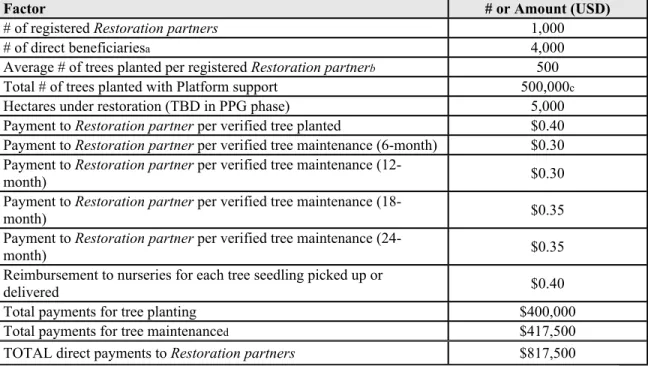
At least 5,000 ha of land under restoration; At least 5,000 ha of land under improved practices Table 1 below provides estimates for the number of trees planted, number of direct beneficiaries, and hectares under restoration, as well as the size of incentive payments provided to Restoration
partners per verified tree planted and for verified tree maintenance at 6 month intervals. Also shown in Table 1 is the payment amount per tree to nurseries for provision of high quality and appropriate tree seedlings. Note that incentive payments covering the costs of establishing tree stands are conservatively based on a recent ICRAF paper[40]40 that examined costs of tree stand establishment in the Gambia, which has a dryer climate than found in Cameroon and parts of Kenya (costs of establishing tree stands are typically higher in dryer climates). The size of incentive payments to Restoration partners may be further refined in the PPG stage pending consultation with partners and further assessment.
Table 1. Assumptions underlying estimation of Platform impacts
Factor # or Amount (USD)
# of registered Restoration partners 1,000
# of direct beneficiariesa 4,000
Average # of trees planted per registered Restoration partnerb 500
Total # of trees planted with Platform support 500,000c
Hectares under restoration (TBD in PPG phase) 5,000
Payment to Restoration partner per verified tree planted $0.40 Payment to Restoration partner per verified tree maintenance (6-month) $0.30 Payment to Restoration partner per verified tree maintenance (12-
month) $0.30
Payment to Restoration partner per verified tree maintenance (18-
month) $0.35
Payment to Restoration partner per verified tree maintenance (24-
month) $0.35
Reimbursement to nurseries for each tree seedling picked up or
delivered $0.40
Total payments for tree planting $400,000
Total payments for tree maintenanced $417,500
TOTAL direct payments to Restoration partners $817,500
aan average household size of 4 for each registered Restoration partner is assumed.
banticipates that registered Restoraton partners will have assistance in planting from household members and/or other community members.
cAn 80% survival rate is assumed for planted seedlings that survive initial maturity, yielding 400,000 trees planted and maintained.
dAssumes 400,000 verified 6-month payments; 350,000 verified 12-month payments; 300,000 verified 18-month payments; and 250,000 verified 24-month payments for tree maintenance given tree
mortality, timing of tree planting and project closure.
To ensure the accuracy of the mobile photo-verification system and to guard against possible misuse and/or fraudulent claims, field auditing/verification of a random sample of uploaded photos covering 5- 10% of transactions (TBD in PPG stage) will occur. This will be complimented by cross checking records of all seedlings provided to Restoration partners and/or Community entrepreneurs. The random field-verification approach will be described in the Restoration Challenge Platform Rule Book (See Component 2 below) and covered in the training provided to all Restoration partners and Community entrepreneurs. The Rule book and training will include clear rules defining any misuse of the the Platform application, incentive program, and Platform-provided phones, and consequences for misuse.
The project will support best-practice restoration, as defined through several foundational papers including Maginnis et al, 2005[41]41 and practiced by IUCN, Bioversity International, and other Global Partnership on Forest and Landscape Restoration (GPFLR) members. Three core elements of this approach are (1) adoption of landscape-level planning supporting rational land use planning, stakeholder support and buy in, capture of synergies, and long term sustainability; (2) use of appropriate, non-invasive species that can thrive under anticipated climate change impacts, and that
provide anticipated and desired benefits; and (3) ensuring clarity of land tenure and access rights at restoration sites. The project will adopt the following approaches to ensure these outcomes:
1. Landscape-level planning - PPG-stage identification of suitable landscapes and supported restoration interventions will be accomplished using outputs from landscape-level assessments and planning processes including prior assessments done in partnering countries with the Restoration Opportunities Assessment Methodology (ROAM)[42]42, Species Threat Abatement and Recovery (STAR)[43]43 assessments, and other similar approaches, and with full participation of stakeholders including those from partnering governments and targeted communities, complemented by relevant technical expertise and inputs from Bioversity International and IUCN.
2. Use of appropriate species ? A key focus of work detailed further under Outputs 2.2 and 2.3 will be ensuring the use of appropriate, high-quality, genetically diverse seedlings for project-supported restoration. An assessment[44]44 of livelihood and ecological benefits of restoration in Cameroon revealed that lack of attention to species selection is partly responsible for the failures observed in landscape restoration, including over-dependence on exotic species, poor species-site matching and no consideration of genetic diversity. Poor diversity was also confirmed as a major constraint to
successfulrestoration by a Bioversity global survey[45]45. The project will build capacity throughout the seed sourcing and seedling propagation value chain, and including among seed collectors, seed centers and nurseries. Bioversity International?s long-standing program of work in this area and substantial in- house expertise and related tools including the SeedIT application and Diversity for Restoration tools will be drawn upon. The project will only cover costs and provide incentive payments to Restoration partners that use appropriately sourced and appropriately suited seedlings ? as recorded and verified through the project mobile application, records of partnering tree nurseries, and random field verification. This includes avoidance of exotic, non-native species. Bioversity has already
identified 420 native tree species for use in restoration in Cameroon. Bioversity will compile a list of native tree species of interest for this project based their uses and services, habitat, conservation status, importance for women, and livelihood potential. A similar assessment of suitable species for
restoration in Kenya will be done in the PPG stage of this project. Restoration partnerswill be able to choose among a subset of appropriate tree species, depending upon their utility and preference, to support agroforestry, sustainable timber production, fruit production, and more.
3. Clarity of land tenure and access rights ? Community support, avoidance of any unintended conflicts over access to the benefits of tree planting/restoration, and the sustainability of Platform- supported restoration is threatened wherever and whenever there is uncertainty of ownership over land under restoration, uncertainty on access rights to the timber and non-timber forest products generated by restoration activities, and/or potential for restoration to exacerbate inequality. PPG-stage work to identify suitable landscapes and partner communities for Platform-supported restoration will, following IUCN ESMS procedures, carefully screen against the selection of landscapes and partner communities where land tenure of potential restoration sites is not clear, where access rights to the timber and non-
timber forest products generated by restoration activities is unclear, and/or where Platform-supported restoration has the potential to exacerbate inequality in partner communities.
Component 2: Awareness Raising and Capacity Building for Smallholders, Communities, and Community Entrepreneurs, and Seedling Supply Chain Actors
Component 2 will facilitate the engagement, on-boarding, training and support needed to bring the Platform?s tools, incentives and other resources directly to smallholders and rural communities, and ensure that these resources are utilized effectively to support restoration, generating anticipated positive impacts for food and water security, climate change, biodiversity conservation, jobs creation, and more.
In addition, Component 2 will address key gaps in the supply side of the restoration value chain, including establishment and/or strengthening of a sufficient network of tree nurseries in target landscapes able to meet local demand for tree seedlings of suitable species, quality, and genetic stock, as well as provide further support to Restoration partners in the form of point-of-pickup training on tree planting and care.
Outcome 2: Strengthened awareness of restoration opportunities and best practices among smallholders and rural communities; strengthened capacity for restoration among smallholders, communities, and seedling supply chain actors in target landscapes.
Output 2.1: At least 1,000 Restoration partners and 25 Community entrepreneurs registered with Platform following awareness-raising campaign in target landscapes
To project will utilize a number of means for building awareness and interest among smallholders and rural communities in targeted landscapes of the FLR Platform incentive program and its benefits and opportunities. This includes direct recruitment via door-to-door canvassing by trained Community Entrepreneurs, local events and workshops with food and potentially musical entertainment, and announcements and programming on local radio. It also includes meetings with community leaders, school officials, NGOs, and government agricultural, forestry, and natural resource field agents. In addition, the project will make use of TRI programme infrastructure and events including TRI- supported workshops and trainings in targeted landscapes, and the TRI internal and public web platforms.
By the end of Year 1 of the project, it is anticipated that 1,000 Restoration partners and 25 Community entrepreneurs in three partnering TRI countries and XX landscapes will have registered with the Platform and established accounts as a results of the awareness-raising and engagement activities under this output.
Note - PPG-stage work to identify partnering communities and suitable landscapes for restoration will provide a rough estimate for the potential size of the area that can be brought under restoration through project-supported tree planting, as well as the number of trees that can be planted using appropriate, best-practice tree spacing. In addition, as Restoration partners are engaged, registered and trained, project partners will keep track of the projected number of trees to be planted and maintained, based on consultation with Restoration partners and baseline analysis of restoration opportunities in partnering